"c68a05d5e51405b3"{"id":"1001879","slug":"female-mannequin-character","title":"Female Mannequin Character","category":"Humans","engine":"4.26+,5.0+","assetVersion":"","engineVersion":"Engine Version: 4.26+,5.0+","tag":"Humans","accent":"blue","visual":"character","summary":"Female Mannequin Character configured for Unreal Engine 5, Unity, and Blender. Features clean low-poly topology, UE5 skeleton rigging, and high-res textures.","platform":"Unreal Engine","publishedAt":"2026-10-22T11:20:09.015Z","updatedAt":"2026-10-22T11:20:09.015Z","sourceNotes":[],"fileContents":[],"compatibility":["Unreal Engine","Engine Version: 4.26+,5.0+"],"featuredImage":{"alt":"Female Mannequin Character","src":"/wp-content/uploads/published/2026/10/9d6bea3bafae-86b28624-5023-4a0c-9001-bf2925f10f6f-ffab78e28d.webp"},"hasDownloadLink":true,"downloads":0,"terms":[{"taxonomy":"category","slug":"humans","name":"Humans"}],"galleryImages":[{"src":"/wp-content/uploads/published/2026/10/57deace30ab6-53db4983-786c-4cfc-b365-563628ecbc9a-90d316d016.webp","alt":"Female Mannequin Character"},{"src":"/wp-content/uploads/published/2026/10/2cd8b6005a73-a3cde914-d8b8-4df3-b5f7-0749d3d56231-6a6be0bd11.webp","alt":"Female Mannequin Character"},{"src":"/wp-content/uploads/published/2026/10/e778783db354-17f1cfba-fdf3-41dc-9a49-f45f998ee56b-3e17ee6038.webp","alt":"Female Mannequin Character"},{"src":"/wp-content/uploads/published/2026/10/b43fc3c7a5f4-80c02cfc-cd5d-4efc-946b-6abe7bc209c3-9e93a33cc8.webp","alt":"Female Mannequin Character"},{"src":"/wp-content/uploads/published/2026/10/50d163317847-92fa928f-037c-423b-b994-3c4247f76836-aab2ef4665.webp","alt":"Female Mannequin Character"}],"accessPanel":{"kind":"resource","title":"Download this resource","eyebrow":"Free Download","message":"Log in or create a free account to start your download.","fileName":"Female Mannequin Character.7z","safetyNote":"Resources are manually reviewed before listing to improve quality and reduce obvious risks.","actionLabel":"Download Free","resourceType":"Resource archive"},"contentHtml":"\u003ch2\u003eImporting the Female Mannequin Character into Engine Pipelines\u003c/h2\u003e\n\u003cp\u003eDirect integration into an active project starts with choosing between the native Unreal Engine 5 asset files or the standalone FBX export. In Unreal Engine 5, introducing the mesh requires dropping the asset directly into the project hierarchy, where skeletal assignments and material references connect immediately without manual node reconstruction. The asset is built natively for real-time workflows, allowing immediate access to character blueprints, animation blueprints, and state machines.\u003c/p\u003e\n\u003cp\u003eFor developers working in non-Unreal environments or external digital content creation suites, the included FBX file serves as the core interchange bridge. Ingestion into external tools such as Blender or Unity preserves the joint hierarchy, vertex skin weights, and spatial coordinate alignments. Importing the FBX file into Unity preserves the bone orientations required for the Mecanim humanoid mapping utility, while Blender retains the complete bone roll data and unapplied transformations necessary for secondary animation passes.\u003c/p\u003e \u003ch2\u003eUnreal Engine 5 Skeleton Rigging and Animation Retargeting\u003c/h2\u003e\n\u003cp\u003eThe rig matches the structure of the official female skeleton within Unreal Engine 5. Because the joint chains, naming standards, and resting pose align with modern engine defaults, applying existing animation sequences avoids the corrective offset nodes typically required by legacy humanoid rigs. Animation assets can be targeted directly to the character through the engine's IK Rig and IK Retargeter frameworks, transferring walk cycles, sprints, jumps, and specialized combat locomotion without joint distortion.\u003c/p\u003e\n\u003cp\u003eAdvanced Unreal Engine developers can transition this skeletal hierarchy into alternative versions of the engine. While the character is built Unreal Engine 5 ready, the structural consistency of the bone transforms allows migration into earlier releases. Experienced technical animators can export the FBX joint hierarchy or retarget poses backward into Unreal Engine 4 projects, bridging the generational divide between older animation libraries and modern skeletal setups.\u003c/p\u003e \u003ch2\u003eClean Topology and Real-Time Low-Poly Optimization\u003c/h2\u003e\n\u003cp\u003eUnder the surface, the character features clean edge flow structured explicitly around mechanical deformation zones. Shoulders, elbows, hips, and knees rely on deliberate polygon density distributions that compress and expand cleanly during extreme combat motions, high-velocity movement, and acrobatic poses. This prevents undesirable surface pinching, volume loss, and mesh tearing when executing complex action sequences.\u003c/p\u003e\n\u003cp\u003eThe total geometric budget maintains a low-poly footprint suitable for demanding real-time rendering budgets. Prototyping phases often demand high actor counts on screen simultaneously, such as crowds, shooter enemy spawns, or systemic combat tests. Because the mesh does not carry excess or irregular tessellation, it maintains high frame-rate stability across complex testing environments without straining standard draw call budgets or compute overhead.\u003c/p\u003e \u003ch2\u003eHigh-Resolution Textures and Prototyping Utility\u003c/h2\u003e\n\u003cp\u003eThe model includes dedicated high-resolution textures that define its surface properties without obscuring the anatomical proportions required for animation review. Visual clarity is essential when evaluating whether combat swings, firearm aim offsets, or climbing mechanics match character boundaries. The clear surface definition provides instant spatial awareness during graybox level creation, gameplay testing, and initial scene staging.\u003c/p\u003e\n\u003cp\u003eThe visual execution of the mannequin allows it to function across multiple project themes, including modern shooters, realistic military exercises, anime combat tests, and stylized fantasy action frameworks. Its neutral yet precisely proportioned design ensures that animators, level designers, and gameplay programmers can assess character scale, hitboxes, and camera composition before final hero assets are completed.\u003c/p\u003e \u003ch2\u003eMulti-Software Workflows and Asset Compatibility\u003c/h2\u003e\n\u003cp\u003eThe asset functions across varied development suites, extending its operational role far beyond engine-specific staging. Within Blender, the model provides an accurate base for custom keyframe authoring, cloth simulation tests, or building custom accessories around standard proportions. In Unity, the clean topology and consistent hierarchy make it a dependable test dummy for physics-based character controllers, ragdoll generation, and procedural IK foot placement.\u003c/p\u003e\n\u003cp\u003eTechnical setups requiring inter-asset coordination also benefit from this standard skeletal structure. The character maintains compatibility with complementary technical setups, including the Spider Robot Pack, allowing developers to create multi-character test beds, combat interaction prototypes, and cooperative gameplay mechanics with zero adjustment to baseline scale or coordinate spaces.\u003c/p\u003e\n\n\u003ch2\u003eRelated Resources Worth Checking\u003c/h2\u003e\n\u003cul\u003e\n\u003cli\u003e\u003ca href=\"https://3dcghub.com/female-robot/\" title=\"Female Robot\"\u003eFemale Robot\u003c/a\u003e\u003c/li\u003e\n\u003cli\u003e\u003ca href=\"https://3dcghub.com/modular-elf-archer-girl/\" title=\"Modular Elf Archer Girl\"\u003eModular Elf Archer Girl\u003c/a\u003e\u003c/li\u003e\n\u003cli\u003e\u003ca href=\"https://3dcghub.com/survivor-girl-1-modular/\" title=\"Survivor Girl 1 (Modular)\"\u003eSurvivor Girl 1 (Modular)\u003c/a\u003e\u003c/li\u003e\n\u003cli\u003e\u003ca href=\"https://3dcghub.com/k-pop-series-sun/\" title=\"K-POP SERIES - Sun\"\u003eK-POP SERIES - Sun\u003c/a\u003e\u003c/li\u003e\n\u003cli\u003e\u003ca href=\"https://3dcghub.com/assassin-girl-modular/\" title=\"Assassin Girl Modular\"\u003eAssassin Girl Modular\u003c/a\u003e\u003c/li\u003e\n\u003c/ul\u003e","contentTextLength":5049,"navigation":{"current":46,"total":3860,"previous":{"id":"1001880","slug":"flying-drones-with-blueprints","title":"Flying Drones With Blueprints","category":"Military","platform":"Unreal Engine","updatedAt":"2026-10-22T11:20:40.615Z"},"next":{"id":"1001878","slug":"enveloping-ambient","title":"Enveloping Ambient","category":"Music","platform":"Unreal Engine","updatedAt":"2026-10-22T11:19:21.643Z"}},"relatedResources":[{"id":"2675","slug":"female-robot","title":"Female Robot","category":"Humans","engine":"4.26+,5.0+","assetVersion":"Engine version: 4.26+,5.0+","engineVersion":"4.24","tag":"Humans","accent":"blue","visual":"character","summary":"Enhance your sci-fi project with this game-ready female robot model. Featuring PBR materials, 4K textures, and 10 animations for seamless integration.","platform":"Unreal Engine","publishedAt":"2026-02-07T14:49:48.000Z","updatedAt":"2026-04-19T15:57:59.000Z","sourceNotes":[],"fileContents":[],"compatibility":["Unreal Engine","Engine version: 4.26+,5.0+"],"featuredImage":{"alt":"Female Robot","src":"https://3dcghub.com/wp-content/uploads/2026/02/609c644f-3f2c-47e7-bb95-472b0a1951f7.webp"},"hasDownloadLink":true,"downloads":0},{"id":"1000197","slug":"modular-elf-archer-girl","title":"Modular Elf Archer Girl","category":"Humans","engine":"4.26+,5.0+","assetVersion":"","engineVersion":"Engine Version: 4.26+,5.0+","tag":"Humans","accent":"blue","visual":"mech","summary":"A modular female elf archer character with Epic Skeleton rigging, facial blendshapes, 4K PBR textures, separated bow and arrow, and armor color variants.","platform":"Unreal Engine","publishedAt":"2026-06-23T11:13:13.917Z","updatedAt":"2026-06-23T11:13:13.917Z","sourceNotes":[],"fileContents":[],"compatibility":["Unreal Engine","Engine Version: 4.26+,5.0+"],"featuredImage":{"alt":"Modular Elf Archer Girl","src":"/wp-content/uploads/published/2026/06/be7f554506e0-1c33a7e5-3b94-42e5-b8f0-224995758e1d-f080b04b74.webp"},"hasDownloadLink":true,"downloads":1},{"id":"1000206","slug":"survivor-girl-1-modular","title":"Survivor Girl 1 (Modular)","category":"Humans","engine":"4.26+,5.0+","assetVersion":"","engineVersion":"Engine Version: 4.26+,5.0+","tag":"Humans","accent":"blue","visual":"mech","summary":"A fully rigged, modular female character model designed for apocalyptic survival games, featuring facial blendshapes, 4K PBR textures, and low-poly weapons.","platform":"Unreal Engine","publishedAt":"2026-06-23T19:35:44.835Z","updatedAt":"2026-06-23T19:35:44.835Z","sourceNotes":[],"fileContents":[],"compatibility":["Unreal Engine","Engine Version: 4.26+,5.0+"],"featuredImage":{"alt":"Survivor Girl 1 (Modular)","src":"/wp-content/uploads/published/2026/06/ea003c542fdd-d82dc264-87e2-40e6-a96c-2a4b916b4cb7-25e2910de6.webp"},"hasDownloadLink":true,"downloads":5}]}
Humans
Female Mannequin Character
Female Mannequin Character configured for Unreal Engine 5, Unity, and Blender. Features clean low-poly topology, UE5 skeleton rigging, and high-res textures.
Category:Unreal Engine,HumansPlatform: Unreal EngineEngine Version: 4.26+,5.0+Published: Oct 22, 2026
Humans
Resource overview
Importing the Female Mannequin Character into Engine Pipelines
Direct integration into an active project starts with choosing between the native Unreal Engine 5 asset files or the standalone FBX export. In Unreal Engine 5, introducing the mesh requires dropping the asset directly into the project hierarchy, where skeletal assignments and material references connect immediately without manual node reconstruction. The asset is built natively for real-time workflows, allowing immediate access to character blueprints, animation blueprints, and state machines.
For developers working in non-Unreal environments or external digital content creation suites, the included FBX file serves as the core interchange bridge. Ingestion into external tools such as Blender or Unity preserves the joint hierarchy, vertex skin weights, and spatial coordinate alignments. Importing the FBX file into Unity preserves the bone orientations required for the Mecanim humanoid mapping utility, while Blender retains the complete bone roll data and unapplied transformations necessary for secondary animation passes.
Unreal Engine 5 Skeleton Rigging and Animation Retargeting
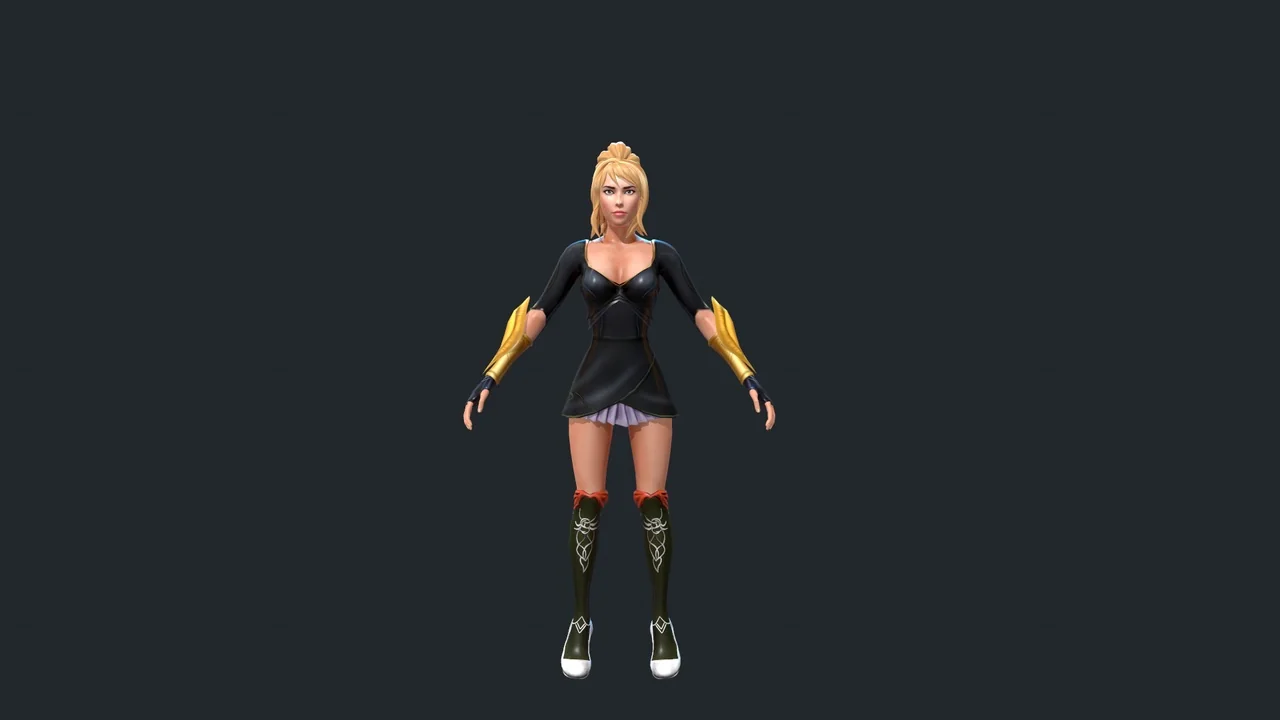
The rig matches the structure of the official female skeleton within Unreal Engine 5. Because the joint chains, naming standards, and resting pose align with modern engine defaults, applying existing animation sequences avoids the corrective offset nodes typically required by legacy humanoid rigs. Animation assets can be targeted directly to the character through the engine's IK Rig and IK Retargeter frameworks, transferring walk cycles, sprints, jumps, and specialized combat locomotion without joint distortion.
Advanced Unreal Engine developers can transition this skeletal hierarchy into alternative versions of the engine. While the character is built Unreal Engine 5 ready, the structural consistency of the bone transforms allows migration into earlier releases. Experienced technical animators can export the FBX joint hierarchy or retarget poses backward into Unreal Engine 4 projects, bridging the generational divide between older animation libraries and modern skeletal setups.
Clean Topology and Real-Time Low-Poly Optimization
Under the surface, the character features clean edge flow structured explicitly around mechanical deformation zones. Shoulders, elbows, hips, and knees rely on deliberate polygon density distributions that compress and expand cleanly during extreme combat motions, high-velocity movement, and acrobatic poses. This prevents undesirable surface pinching, volume loss, and mesh tearing when executing complex action sequences.
The total geometric budget maintains a low-poly footprint suitable for demanding real-time rendering budgets. Prototyping phases often demand high actor counts on screen simultaneously, such as crowds, shooter enemy spawns, or systemic combat tests. Because the mesh does not carry excess or irregular tessellation, it maintains high frame-rate stability across complex testing environments without straining standard draw call budgets or compute overhead.
High-Resolution Textures and Prototyping Utility
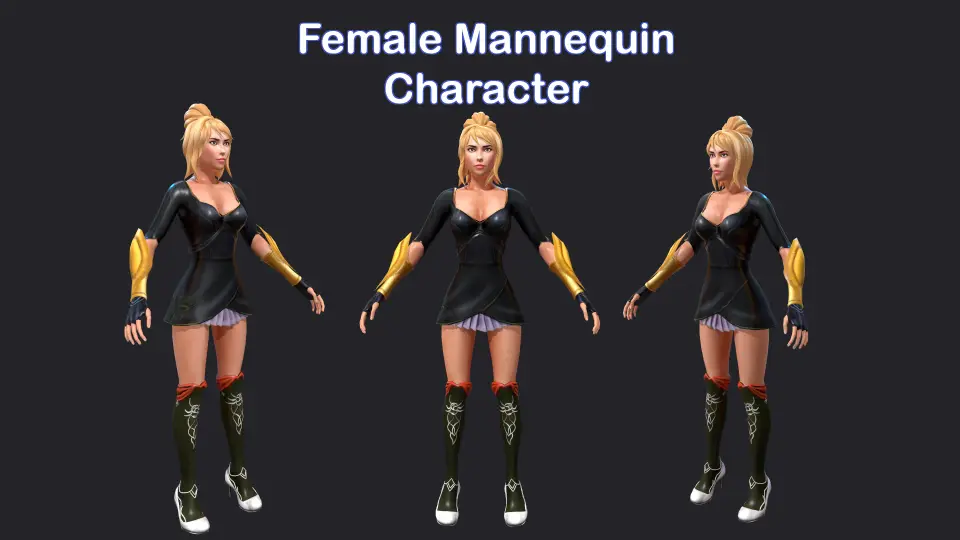
The model includes dedicated high-resolution textures that define its surface properties without obscuring the anatomical proportions required for animation review. Visual clarity is essential when evaluating whether combat swings, firearm aim offsets, or climbing mechanics match character boundaries. The clear surface definition provides instant spatial awareness during graybox level creation, gameplay testing, and initial scene staging.
The visual execution of the mannequin allows it to function across multiple project themes, including modern shooters, realistic military exercises, anime combat tests, and stylized fantasy action frameworks. Its neutral yet precisely proportioned design ensures that animators, level designers, and gameplay programmers can assess character scale, hitboxes, and camera composition before final hero assets are completed.
Multi-Software Workflows and Asset Compatibility
The asset functions across varied development suites, extending its operational role far beyond engine-specific staging. Within Blender, the model provides an accurate base for custom keyframe authoring, cloth simulation tests, or building custom accessories around standard proportions. In Unity, the clean topology and consistent hierarchy make it a dependable test dummy for physics-based character controllers, ragdoll generation, and procedural IK foot placement.
Technical setups requiring inter-asset coordination also benefit from this standard skeletal structure. The character maintains compatibility with complementary technical setups, including the Spider Robot Pack, allowing developers to create multi-character test beds, combat interaction prototypes, and cooperative gameplay mechanics with zero adjustment to baseline scale or coordinate spaces.
 Humans
 Humans
 Humans
 Humans