"9d170a19f86e0ace"{"id":"1001259","slug":"endless-random-worlds","title":"Endless Random Worlds","category":"Procedural Systems","engine":"5.0+","assetVersion":"","engineVersion":"Engine Version: 5.0+","tag":"Procedural Systems","accent":"blue","visual":"mech","summary":"Build dynamic procedural environments with Endless Random Worlds, using level streaming to assemble endless open maps and roguelike interior spaces.","platform":"Unreal Engine","publishedAt":"2026-09-27T05:27:08.445Z","updatedAt":"2026-09-27T05:27:08.445Z","sourceNotes":[],"fileContents":[],"compatibility":["Unreal Engine","Engine Version: 5.0+"],"featuredImage":{"alt":"Endless Random Worlds","src":"/wp-content/uploads/published/2026/09/4390d1da3360-6bd61fd8-acd3-4fa8-9527-f9f5ab33a842-cf89e64b75.webp"},"hasDownloadLink":true,"downloads":0,"terms":[{"taxonomy":"category","slug":"procedural-systems","name":"Procedural Systems"}],"galleryImages":[{"src":"/wp-content/uploads/published/2026/09/daaf86a498ca-107f1089-f321-4f18-9f84-f3115f25007a-b7b606a3fd.webp","alt":"Endless Random Worlds"},{"src":"/wp-content/uploads/published/2026/09/47fee9304de9-56a0e718-b28d-4eca-8ba3-17cf87e9fdf0-73f97ed144.webp","alt":"Endless Random Worlds"},{"src":"/wp-content/uploads/published/2026/09/ecd0e59d8d5f-945fe0a6-35bc-4427-9e73-41d6af2c08cb-adccda55d5.webp","alt":"Endless Random Worlds"},{"src":"/wp-content/uploads/published/2026/09/3d67aa29b346-a27e68a7-3b58-4dee-8d2c-0dad6f559400-4eb61768f9.webp","alt":"Endless Random Worlds"},{"src":"/wp-content/uploads/published/2026/09/70bd2ab7ad73-9cd429fc-8570-49f1-92c9-9ef9b3e1afc8-7c9542df0e.webp","alt":"Endless Random Worlds"},{"src":"/wp-content/uploads/published/2026/09/5eb571626fe6-454f1fd2-c073-4a90-85fe-e6d886b7e6fc-9e4df57265.webp","alt":"Endless Random Worlds"},{"src":"/wp-content/uploads/published/2026/09/fb81404ca913-260f6f9a-b053-4d39-8753-2c626034eedd-3765594282.webp","alt":"Endless Random Worlds"}],"accessPanel":{"kind":"resource","title":"Download this resource","eyebrow":"Free Download","message":"Log in or create a free account to start your download.","fileName":"Content.7z","safetyNote":"Resources are manually reviewed before listing to improve quality and reduce obvious risks.","actionLabel":"Download Free","resourceType":"Resource archive"},"contentHtml":"\u003ch2\u003eDynamic Level Streaming for Endless Random Worlds\u003c/h2\u003e\n\u003cp\u003eSprawling, unpredictable terrain and labyrinthine structures often present significant spatial management challenges during development. Endless Random Worlds approaches environment layout by generating endless procedural layouts through dynamic level streaming. Rather than loading an entire map into memory at once or forcing hard scene transitions, the system monitors player movement and streams levels in real time.\u003c/p\u003e\n\u003cp\u003eThis streaming logic functions similarly to chunk-based world generation found in titles like Minecraft. As the player navigates through the world, adjacent sections load automatically ahead of their path, while distant regions stream out behind them. Because the system continuously reacts to coordinates and traversal direction, environments can extend indefinitely without hitting conventional map boundaries. This procedural chunk handling allows creators to establish a continuous sense of exploration across both wide exterior environments and tight, modular corridors.\u003c/p\u003e \u003ch2\u003eHandcrafted Sub-Levels and Unreal Engine Chunk Assembly\u003c/h2\u003e\n\u003cp\u003eRather than relying strictly on purely algorithmic geometry generation, Endless Random Worlds is structured to utilize handcrafted sub-levels and custom chunks built with standard Unreal Engine assets. Developers and environment artists maintain direct aesthetic control over individual rooms, outdoor plots, architectural intersections, and terrain features. Once these discrete sub-levels are constructed, the procedural generation system handles their randomized selection and dynamic arrangement across the map grid.\u003c/p\u003e\n\u003cp\u003eWorking with distinct sub-levels enables teams to curate lighting conditions, prop dressing, collision profiles, and gameplay components within self-contained spaces before handing them over to the streaming framework. The generator then pulls from this modular library, streaming sub-levels in and out based on player proximity. By combining manual artistic design at the chunk level with automated random world assembly at runtime, projects retain visual fidelity and intentional level design while still delivering a different layout on every playthrough.\u003c/p\u003e \u003ch2\u003eGenerating Roguelike Dungeons and Backroom Interiors\u003c/h2\u003e\n\u003cp\u003eThe chunk-streaming approach translates directly to enclosed, maze-like structures. Endless Random Worlds is tailored for endless interior spaces, making it a functional foundation for roguelike dungeons and liminal spaces such as The Backrooms. In these interior contexts, handcrafted rooms can represent corridors, dead ends, multi-tier chambers, or specialized hazard zones that connect unpredictably as the character wanders deeper inside.\u003c/p\u003e\n\u003cp\u003eInterior generation relies on seamless level streaming to keep tension consistent. In roguelike layouts, the randomized selection of handcrafted sub-levels ensures that room sequences, branching paths, and navigation choke points change constantly, preventing players from memorizing a single route. In surreal or horror-themed settings like The Backrooms, dynamic loading allows hallways and repetitive modular rooms to stretch endlessly in all directions, reinforcing disorientation while the engine streams chunks in response to ongoing movement.\u003c/p\u003e \u003ch2\u003eEndless Open World Environments\u003c/h2\u003e\n\u003cp\u003eBeyond enclosed architecture, the same procedural generation logic applies to unbounded outdoor regions. Open landscapes can be partitioned into modular exterior sub-levels featuring varying terrain topography, scatter meshes, vegetation clusters, and points of interest. As the player travels across open plains, hills, or dense wilderness, the system continually streams relevant chunks along the travel perimeter.\u003c/p\u003e\n\u003cp\u003eBecause the generator organizes placement procedurally, outdoor exploration is not constrained by fixed terrain bounds. Creators can assemble massive outdoor spaces using modular nature assets and environmental kits without having to hand-sculpt square kilometers of static landmass. The chunk-streaming pipeline ensures that only the immediate playable area and its surrounding radius remain active in memory, allowing broad expanses to materialize smoothly as movement occurs.\u003c/p\u003e \u003ch2\u003eBlueprint Architecture and Rapid Setup\u003c/h2\u003e\n\u003cp\u003eImplemented through Unreal Engine Blueprints, Endless Random Worlds is made for straightforward integration into ongoing projects. The core logic can be configured and operational in minutes, avoiding elaborate pipeline overhauls or deep source-level restructuring. Developers assign their custom sub-levels to the generator, establish how chunks are tracked relative to the player, and allow the streaming management framework to handle loading triggers automatically.\u003c/p\u003e\n\u003cp\u003eThis rapid setup workflow lets teams test procedural flow early in production. Instead of writing custom streaming managers or chunk-caching logic from scratch, designers can focus directly on whiteboxing room layouts, tuning chunk dimensions, and refining environmental art. The Blueprint structure also maintains compatibility with complementary systems such as Endless Rooms, allowing creators working with modular room-building workflows to integrate procedural generation directly into their existing setups.\u003c/p\u003e \u003ch2\u003eDetermining Project Fit\u003c/h2\u003e\n\u003cp\u003eEndless Random Worlds is focused on single-player procedural generation driven by chunk-based level streaming. It is tailored specifically for projects that require either limitless open expanses or infinite interior networks built from handcrafted sub-levels. Developers whose designs rely on multi-biome world generation or dedicated multiplayer networking will need specialized toolsets intended for synchronized server-client streaming and biome blending. For standalone adventures, roguelike dungeon crawls, and single-player survival scenarios where infinite, modular spaces must be assembled quickly, this generator provides an accessible, asset-friendly streaming pipeline.\u003c/p\u003e\n\n\u003ch2\u003eExplore Similar Assets\u003c/h2\u003e\n\u003cul\u003e\n\u003cli\u003e\u003ca href=\"https://3dcghub.com/calysto-village-procedural-villages-farms-with-pcg/\" title=\"Calysto Village Procedural villages, farms with PCG\"\u003eCalysto Village Procedural villages, farms with PCG\u003c/a\u003e\u003c/li\u003e\n\u003cli\u003e\u003ca href=\"https://3dcghub.com/ultra-dynamic-sky/\" title=\"Ultra Dynamic Sky\"\u003eUltra Dynamic Sky\u003c/a\u003e\u003c/li\u003e\n\u003cli\u003e\u003ca href=\"https://3dcghub.com/worldscape-plugin-making-real-planets-and-endless-worlds/\" title=\"WorldScape Plugin - Making real planets and Endless worlds\"\u003eWorldScape Plugin - Making real planets and Endless worlds\u003c/a\u003e\u003c/li\u003e\n\u003cli\u003e\u003ca href=\"https://3dcghub.com/temperature-and-radiation-system-replicated-with-day-and-night/\" title=\"Temperature and Radiation System (Replicated - With day and night)\"\u003eTemperature and Radiation System (Replicated - With day and night)\u003c/a\u003e\u003c/li\u003e\n\u003cli\u003e\u003ca href=\"https://3dcghub.com/advanced-universal-spawner/\" title=\"Advanced Universal Spawner\"\u003eAdvanced Universal Spawner\u003c/a\u003e\u003c/li\u003e\n\u003c/ul\u003e","contentTextLength":6132,"navigation":{"current":1,"total":3202,"next":{"id":"1001258","slug":"advanced-photo-mode","title":"Advanced Photo Mode","category":"Gameplay Features","platform":"Unreal Engine","updatedAt":"2026-09-27T05:25:07.061Z"}},"relatedResources":[{"id":"11470","slug":"calysto-village-procedural-villages-farms-with-pcg","title":"Calysto Village Procedural villages, farms with PCG","category":"Procedural Systems","engine":"5.3+","assetVersion":"Engine version: 5.3+","engineVersion":"5.4","tag":"Procedural Systems","accent":"blue","visual":"animation","summary":"Streamline your level design with Calysto Village, a procedural tool for creating detailed villages and farms. Leverage the power of PCG and World Partition to build massive, high-performance environments with ease.","platform":"Unreal Engine","publishedAt":"2026-03-05T17:27:28.000Z","updatedAt":"2026-04-19T15:48:12.000Z","sourceNotes":[],"fileContents":[],"compatibility":["Unreal Engine","Engine version: 5.3+"],"featuredImage":{"alt":"Calysto Village Procedural villages, farms with PCG","src":"https://3dcghub.com/wp-content/uploads/2026/03/c9af98d7-f979-466d-a8d7-7720567e386e.webp"},"hasDownloadLink":true,"downloads":1},{"id":"11609","slug":"ultra-dynamic-sky","title":"Ultra Dynamic Sky","category":"Procedural Systems","engine":"Aseet Version:8.6b - 9.6","assetVersion":"Engine version: 5.1+","engineVersion":"Aseet Version:8.6b - 9.6","tag":"Procedural Systems","accent":"blue","visual":"character","summary":"Ultra Dynamic Sky offers a comprehensive and natural sky system designed for flexibility and speed. It features a full weather system, customizable volumetric clouds, and real-world celestial simulation.","platform":"Unreal Engine","publishedAt":"2026-03-05T18:00:27.000Z","updatedAt":"2026-07-08T21:45:49.541Z","sourceNotes":[],"fileContents":[],"compatibility":["Unreal Engine","Engine version: 5.1+","Aseet Version:8.6b - 9.6"],"featuredImage":{"alt":"Ultra Dynamic Sky","src":"https://3dcghub.com/wp-content/uploads/2026/03/cbacfeb0-4619-459c-8c69-eaffc8dda72c.webp"},"hasDownloadLink":true,"downloads":11},{"id":"14845","slug":"worldscape-plugin-making-real-planets-and-endless-worlds","title":"WorldScape Plugin - Making real planets and Endless worlds","category":"Engine Tools","engine":"5.0,5.2 - 5.3","assetVersion":"Engine version: 5.0,5.2 - 5.3","engineVersion":"4.26","tag":"Engine Tools","accent":"blue","visual":"animation","summary":"Build endless, optimized worlds with the WorldScape Plugin. Featuring 64-bit precision and procedural foliage, this tool enables seamless planetary exploration in Unreal Engine.","platform":"Unreal Engine","publishedAt":"2026-03-11T19:31:28.000Z","updatedAt":"2026-04-19T15:45:39.000Z","sourceNotes":[],"fileContents":[],"compatibility":["Unreal Engine","Engine version: 5.0,5.2 - 5.3"],"featuredImage":{"alt":"WorldScape Plugin - Making real planets and Endless worlds","src":"https://3dcghub.com/wp-content/uploads/2026/03/61a35f8d-6545-4175-8834-ff592783a1c4.webp"},"hasDownloadLink":true,"downloads":1}]}
Procedural Systems
Endless Random Worlds
Build dynamic procedural environments with Endless Random Worlds, using level streaming to assemble endless open maps and roguelike interior spaces.
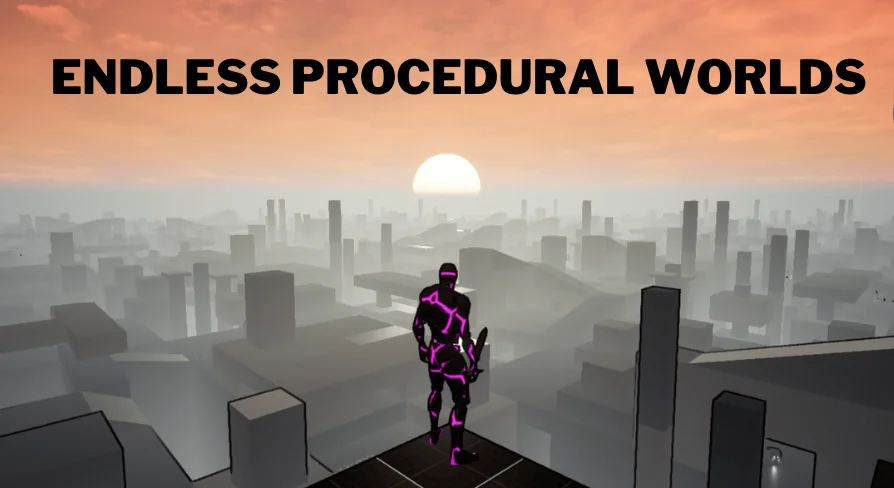
Sprawling, unpredictable terrain and labyrinthine structures often present significant spatial management challenges during development. Endless Random Worlds approaches environment layout by generating endless procedural layouts through dynamic level streaming. Rather than loading an entire map into memory at once or forcing hard scene transitions, the system monitors player movement and streams levels in real time.
This streaming logic functions similarly to chunk-based world generation found in titles like Minecraft. As the player navigates through the world, adjacent sections load automatically ahead of their path, while distant regions stream out behind them. Because the system continuously reacts to coordinates and traversal direction, environments can extend indefinitely without hitting conventional map boundaries. This procedural chunk handling allows creators to establish a continuous sense of exploration across both wide exterior environments and tight, modular corridors.
Handcrafted Sub-Levels and Unreal Engine Chunk Assembly
Rather than relying strictly on purely algorithmic geometry generation, Endless Random Worlds is structured to utilize handcrafted sub-levels and custom chunks built with standard Unreal Engine assets. Developers and environment artists maintain direct aesthetic control over individual rooms, outdoor plots, architectural intersections, and terrain features. Once these discrete sub-levels are constructed, the procedural generation system handles their randomized selection and dynamic arrangement across the map grid.
Working with distinct sub-levels enables teams to curate lighting conditions, prop dressing, collision profiles, and gameplay components within self-contained spaces before handing them over to the streaming framework. The generator then pulls from this modular library, streaming sub-levels in and out based on player proximity. By combining manual artistic design at the chunk level with automated random world assembly at runtime, projects retain visual fidelity and intentional level design while still delivering a different layout on every playthrough.
Generating Roguelike Dungeons and Backroom Interiors
The chunk-streaming approach translates directly to enclosed, maze-like structures. Endless Random Worlds is tailored for endless interior spaces, making it a functional foundation for roguelike dungeons and liminal spaces such as The Backrooms. In these interior contexts, handcrafted rooms can represent corridors, dead ends, multi-tier chambers, or specialized hazard zones that connect unpredictably as the character wanders deeper inside.
Interior generation relies on seamless level streaming to keep tension consistent. In roguelike layouts, the randomized selection of handcrafted sub-levels ensures that room sequences, branching paths, and navigation choke points change constantly, preventing players from memorizing a single route. In surreal or horror-themed settings like The Backrooms, dynamic loading allows hallways and repetitive modular rooms to stretch endlessly in all directions, reinforcing disorientation while the engine streams chunks in response to ongoing movement.
Endless Open World Environments
Beyond enclosed architecture, the same procedural generation logic applies to unbounded outdoor regions. Open landscapes can be partitioned into modular exterior sub-levels featuring varying terrain topography, scatter meshes, vegetation clusters, and points of interest. As the player travels across open plains, hills, or dense wilderness, the system continually streams relevant chunks along the travel perimeter.
Because the generator organizes placement procedurally, outdoor exploration is not constrained by fixed terrain bounds. Creators can assemble massive outdoor spaces using modular nature assets and environmental kits without having to hand-sculpt square kilometers of static landmass. The chunk-streaming pipeline ensures that only the immediate playable area and its surrounding radius remain active in memory, allowing broad expanses to materialize smoothly as movement occurs.
Blueprint Architecture and Rapid Setup
Implemented through Unreal Engine Blueprints, Endless Random Worlds is made for straightforward integration into ongoing projects. The core logic can be configured and operational in minutes, avoiding elaborate pipeline overhauls or deep source-level restructuring. Developers assign their custom sub-levels to the generator, establish how chunks are tracked relative to the player, and allow the streaming management framework to handle loading triggers automatically.
This rapid setup workflow lets teams test procedural flow early in production. Instead of writing custom streaming managers or chunk-caching logic from scratch, designers can focus directly on whiteboxing room layouts, tuning chunk dimensions, and refining environmental art. The Blueprint structure also maintains compatibility with complementary systems such as Endless Rooms, allowing creators working with modular room-building workflows to integrate procedural generation directly into their existing setups.
Determining Project Fit
Endless Random Worlds is focused on single-player procedural generation driven by chunk-based level streaming. It is tailored specifically for projects that require either limitless open expanses or infinite interior networks built from handcrafted sub-levels. Developers whose designs rely on multi-biome world generation or dedicated multiplayer networking will need specialized toolsets intended for synchronized server-client streaming and biome blending. For standalone adventures, roguelike dungeon crawls, and single-player survival scenarios where infinite, modular spaces must be assembled quickly, this generator provides an accessible, asset-friendly streaming pipeline.
 Procedural Systems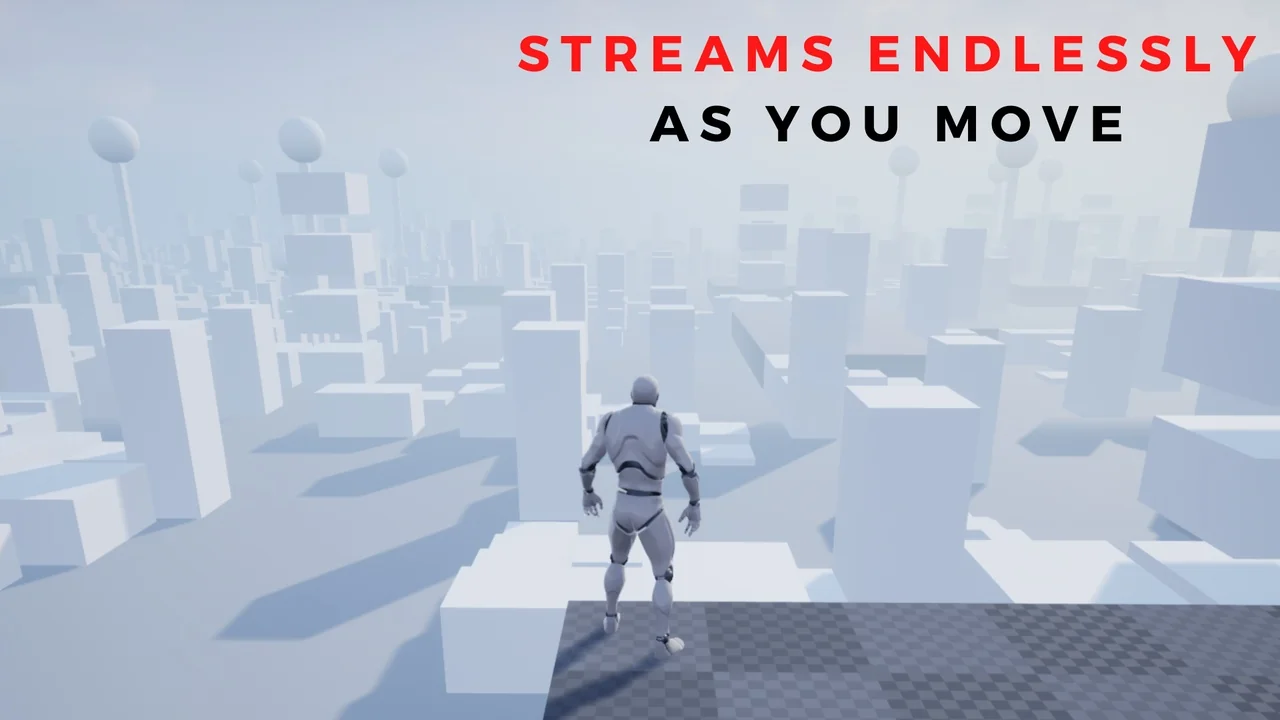
 Procedural Systems
 Procedural Systems
 Engine Tools