"a19e0535960bd083"{"id":"1002007","slug":"eighteen-fantasy-chests-pack","title":"Eighteen Fantasy Chests Pack","category":"Fantasy","engine":"4.26+,5.0+","assetVersion":"","engineVersion":"Engine Version: 4.26+,5.0+","tag":"Fantasy","accent":"blue","visual":"mech","summary":"Eighteen Fantasy Chests Pack features 18 game-ready medieval chests with two-mesh construction, openable lids, and an example interactive blueprint actor.","platform":"Unreal Engine","publishedAt":"2026-10-26T12:29:08.417Z","updatedAt":"2026-10-26T12:29:08.417Z","sourceNotes":[],"fileContents":[],"compatibility":["Unreal Engine","Engine Version: 4.26+,5.0+"],"featuredImage":{"alt":"Eighteen Fantasy Chests Pack","src":"/wp-content/uploads/published/2026/10/401c1980b36b-140d70b5-4b16-442e-9543-73e8cecb045b-b12288729f.webp"},"hasDownloadLink":true,"downloads":0,"terms":[{"taxonomy":"category","slug":"fantasy","name":"Fantasy"}],"galleryImages":[{"src":"/wp-content/uploads/published/2026/10/58b29f14a23d-993bed2f-76e6-4082-b110-6428c6554d6a-f4679fd751.webp","alt":"Eighteen Fantasy Chests Pack"},{"src":"/wp-content/uploads/published/2026/10/8d47054cc824-b70d64b8-9e5a-4e85-80cb-63ab0dbd9c57-0fdf9fdbfe.webp","alt":"Eighteen Fantasy Chests Pack"},{"src":"/wp-content/uploads/published/2026/10/f2d62da9f4cd-19cad28e-a6b3-444a-84b0-af4c760ad0b4-3a6a51a422.webp","alt":"Eighteen Fantasy Chests Pack"},{"src":"/wp-content/uploads/published/2026/10/347add3d2531-f4ae0364-8325-4811-b56b-2b20ab8857ff-ea71bb5838.webp","alt":"Eighteen Fantasy Chests Pack"},{"src":"/wp-content/uploads/published/2026/10/d8bc35ab4253-5b0589d4-d40b-4cfa-8318-2f6c0e68bba1-b5f7e2fe3f.webp","alt":"Eighteen Fantasy Chests Pack"},{"src":"/wp-content/uploads/published/2026/10/d0262dfb783f-ae77dbea-3937-42b0-be06-7bcd1e130cf4-ff0d09383f.webp","alt":"Eighteen Fantasy Chests Pack"},{"src":"/wp-content/uploads/published/2026/10/57fa0a52f75d-844400bf-a775-4c5f-9ed1-4d2947538967-991667e0f2.webp","alt":"Eighteen Fantasy Chests Pack"},{"src":"/wp-content/uploads/published/2026/10/5e2298191ede-0f2956af-b173-454b-9365-041b722a7c61-ae36d34079.webp","alt":"Eighteen Fantasy Chests Pack"}],"accessPanel":{"kind":"resource","title":"Download this resource","eyebrow":"Free Download","message":"Log in or create a free account to start your download.","fileName":"Content.7z","safetyNote":"Resources are manually reviewed before listing to improve quality and reduce obvious risks.","actionLabel":"Download Free","resourceType":"Resource archive"},"contentHtml":"\u003ch2\u003eFantasy and Medieval Environment Dressing\u003c/h2\u003e\n\u003cp\u003eDungeon corridors, guild halls, treasure vaults, and roadside encampments rely heavily on convincing container props to ground their spaces. In medieval and fantasy game worlds, chests serve as both visual anchors and primary points of player interest. When dressing complex levels, populating multiple rooms with identical containers quickly shatters immersion. Having eighteen distinct chests allows environment artists to distribute visual variety across an entire campaign without breaking stylistic coherence.\u003c/p\u003e\n\u003cp\u003eThe collection spans fantasy, medieval, and realistic aesthetics. This range makes the models suitable for grit-focused historical settings just as easily as high-fantasy ruins filled with arcane relics. Because these assets are game-ready, they can be dragged directly into active levels to flesh out corners, fill out shopfronts, or sit under banquet tables as static set dressing. Their primary value in decorative layouts lies in their diversity: minor storage rooms can feature plainer wooden variants, while high-value throne rooms or guarded crypts can showcase ornate, reinforced containers.\u003c/p\u003e\n\u003cp\u003eLevel composition often demands a balance between background clutter and focal items. These eighteen variants furnish level designers with the tools to establish visual hierarchies. Players intuitively recognize that different chest designs can indicate distinct tiers of treasure or varying levels of factional ownership, reinforcing non-verbal storytelling throughout an environment.\u003c/p\u003e \u003ch2\u003eTwo-Mesh Construction for Openable Lids\u003c/h2\u003e\n\u003cp\u003eA static prop limits gameplay possibilities to passive observation. To transition from a simple decorative container to a functional object, a container requires physical articulation. Every model in this collection consists of two separate meshes: the container base and the lid. By dividing each chest into two discrete geometric components, the collection bypasses the rigid limitations of single-piece static props.\u003c/p\u003e\n\u003cp\u003eSplitting the geometry in this manner provides immediate mechanical utility. A single mesh forces developers to either keep the container permanently shut, permanently open, or swap the entire asset out when an interaction occurs. With two meshes, the lid retains its own independent transform. This allows developers to set an exact pivot line along the back hinges, enabling smooth rotational movement along an arc without requiring skeletal rigs or skinning weights.\u003c/p\u003e\n\u003cp\u003eThis physical split directly supports the needs of real-time interaction. Players expect treasure chests to react when searched, unlocked, or looted. Because the lids are detached from the main body, they can swing backward, stay partially propped open, or even be knocked free by external forces depending on how the game logic handles the secondary mesh.\u003c/p\u003e \u003ch2\u003eInteractive Logic and the Example Blueprint Actor\u003c/h2\u003e\n\u003cp\u003eBridging the gap between raw 3D meshes and functional gameplay mechanics often requires technical setup that slows down level prototyping. To solve this, the package includes one actor accompanied by simple example blueprints that demonstrate how to make the openable lid function work in practice.\u003c/p\u003e\n\u003cp\u003eRather than leaving developers to configure base-to-lid parent hierarchies and rotation scripts from scratch, the included actor presents a clear, functional implementation. The blueprint logic outlines the core steps necessary to manipulate the separate lid mesh relative to the static base. Developers can examine how the example script drives the rotation, whether through input triggers, procedural timelines, or state toggles that swing the lid open upon interaction.\u003c/p\u003e\n\u003cp\u003eThis implementation serves as a functional foundation. Programmers can take the simple example blueprints and expand them into advanced gameplay systems, incorporating audio cues, particle bursts, locked states, key checks, or inventory pop-ups. For teams running rapid prototyping phases, having an actor already configured with openable functionality means playable interactive loot nodes can be tested inside test levels immediately.\u003c/p\u003e \u003ch2\u003eEighteen Fantasy Chests Pack in Exploration and Loot Systems\u003c/h2\u003e\n\u003cp\u003eLoot collection represents one of the most persistent loops in role-playing, adventure, and dungeon-crawling genres. In these systems, chests act as tangible reward milestones at the end of combat encounters, hidden secrets behind puzzle walls, or optional incentives off the critical path. The Eighteen Fantasy Chests Pack fits directly into these reward structures.\u003c/p\u003e\n\u003cp\u003eBecause the pack supplies eighteen different variations, developers can build tiered reward architectures. Early-game zones can feature modest, simpler chests, while late-game dungeons introduce elaborate and sturdy designs. The two-mesh construction ensures that every reward moment delivers the physical feedback of a lid opening, satisfying the player's expectation of discovery. The visual distinction between the models prevents loot fatigue, ensuring that opening an eighteenth chest still feels unique compared to the first.\u003c/p\u003e\n\u003cp\u003eThe dual role of decoration and interaction gives designers structural freedom. A level can feature dozens of these chests scattered throughout as ambient props, with a curated selection converted into interactable objective containers via the actor logic. This visual consistency unifies the art direction across both static background clutter and active gameplay elements.\u003c/p\u003e \u003ch2\u003ePractical Implementation for Developers and Level Designers\u003c/h2\u003e\n\u003cp\u003eSolo creators, indie teams, and technical designers handling fantasy or medieval projects benefit the most from this resource. Solo developers frequently face bottlenecks when splitting static assets, adjusting pivot alignments, and scripting basic object interactions. By supplying game-ready chests that already feature split meshes alongside working blueprint logic, the pack eliminates redundant asset preparation.\u003c/p\u003e\n\u003cp\u003eEnvironment artists gain an immediate palette of eighteen containers capable of grounding interior and exterior scenes without visual repetition. At the same time, gameplay scripters receive a clean, uncomplicated actor that clearly demonstrates how to manipulate container lids through blueprints. Whether used purely to dress atmospheric medieval halls or wired into comprehensive loot-drop mechanics, the collection delivers ready-to-use functional versatility.\u003c/p\u003e\n\n\u003ch2\u003eContinue Browsing Similar Packs\u003c/h2\u003e\n\u003cul\u003e\n\u003cli\u003e\u003ca href=\"https://3dcghub.com/rome-fantasy-pack-i/\" title=\"Rome Fantasy Pack I\"\u003eRome Fantasy Pack I\u003c/a\u003e\u003c/li\u003e\n\u003cli\u003e\u003ca href=\"https://3dcghub.com/dwarf-fantasy-environment-set-1-1/\" title=\"Dwarf Fantasy Environment Set 1.1\"\u003eDwarf Fantasy Environment Set 1.1\u003c/a\u003e\u003c/li\u003e\n\u003cli\u003e\u003ca href=\"https://3dcghub.com/rome-fantasy-pack-ii-2/\" title=\"Rome Fantasy Pack II\"\u003eRome Fantasy Pack II\u003c/a\u003e\u003c/li\u003e\n\u003cli\u003e\u003ca href=\"https://3dcghub.com/roman-palace-arena-and-dungeon-rome-fantasy-modular-kit/\" title=\"Roman Palace, Arena \u0026amp; Dungeon - Rome Fantasy Modular Kit\"\u003eRoman Palace, Arena \u0026amp; Dungeon - Rome Fantasy Modular Kit\u003c/a\u003e\u003c/li\u003e\n\u003cli\u003e\u003ca href=\"https://3dcghub.com/dreamscape-stylized-environment-tower-stylized-nature-open-world-fantasy/\" title=\"Dreamscape: Stylized Environment Tower - Stylized Nature Open World Fantasy\"\u003eDreamscape: Stylized Environment Tower - Stylized Nature Open World Fantasy\u003c/a\u003e\u003c/li\u003e\n\u003c/ul\u003e","contentTextLength":6612,"navigation":{"current":84,"total":4026,"previous":{"id":"1002008","slug":"elf-female-voice-pack","title":"Elf Female Voice Pack","category":"Sound Effects","platform":"Unreal Engine","updatedAt":"2026-10-26T12:29:47.587Z"},"next":{"id":"1002006","slug":"easy-soft-outlines","title":"Easy Soft Outlines","category":"Variety","platform":"Unreal Engine","updatedAt":"2026-10-26T12:23:49.117Z"}},"relatedResources":[{"id":"1000964","slug":"rome-fantasy-pack-i","title":"Rome Fantasy Pack I","category":"Fantasy","engine":"4.26+,5.0+","assetVersion":"","engineVersion":"Engine Version: 4.26+,5.0+","tag":"Fantasy","accent":"blue","visual":"mech","summary":"Modular ancient Roman streets with the blueprints, Substance-built textures, and props for middle- and lower-class life in Rome Fantasy Pack I.","platform":"Unreal Engine","publishedAt":"2026-08-15T11:18:20.925Z","updatedAt":"2026-10-04T08:42:17.590Z","sourceNotes":[],"fileContents":[],"compatibility":["Unreal Engine","Engine Version: 4.26+,5.0+"],"featuredImage":{"alt":"Rome Fantasy Pack I","src":"/wp-content/uploads/published/2026/08/47b205682961-e6db0a2f-5ed6-4af2-8e0c-68a8b8365c69-02fea6cfcf.webp"},"hasDownloadLink":true,"downloads":2},{"id":"1002021","slug":"fantasy-mining-dungeon","title":"Fantasy Mining Dungeon","category":"Fantasy","engine":"4.26+,5.0+","assetVersion":"","engineVersion":"Engine Version: 4.26+,5.0+","tag":"Fantasy","accent":"blue","visual":"mech","summary":"Explore Fantasy Mining Dungeon, featuring 36 stylized models with full LODs, PBR materials, and combined texture atlases for fantasy RPG projects.","platform":"Unreal Engine","publishedAt":"2026-10-26T12:59:17.114Z","updatedAt":"2026-10-26T12:59:17.114Z","sourceNotes":[],"fileContents":[],"compatibility":["Unreal Engine","Engine Version: 4.26+,5.0+"],"featuredImage":{"alt":"Fantasy Mining Dungeon","src":"/wp-content/uploads/published/2026/10/ad73e695a616-1fdffeab-369b-4d8c-8253-3193593e938c-009511d8db.webp"},"hasDownloadLink":true,"downloads":0},{"id":"1002020","slug":"fantasy-meadow-foliage-pack","title":"Fantasy Meadow Foliage Pack","category":"Fantasy","engine":"4.26+,5.0+","assetVersion":"","engineVersion":"Engine Version: 4.26+,5.0+","tag":"Fantasy","accent":"blue","visual":"mech","summary":"Explore the Fantasy Meadow Foliage Pack, featuring six foliage meshes with wind controls, six high-resolution ground textures, and terrain painting setups.","platform":"Unreal Engine","publishedAt":"2026-10-26T12:58:24.913Z","updatedAt":"2026-10-26T12:58:24.913Z","sourceNotes":[],"fileContents":[],"compatibility":["Unreal Engine","Engine Version: 4.26+,5.0+"],"featuredImage":{"alt":"Fantasy Meadow Foliage Pack","src":"/wp-content/uploads/published/2026/10/f108a5ee79ae-9a912b37-11d5-4f45-a6ac-e1be101b0685-d646353fd8.webp"},"hasDownloadLink":true,"downloads":0}]}
Fantasy
Eighteen Fantasy Chests Pack
Eighteen Fantasy Chests Pack features 18 game-ready medieval chests with two-mesh construction, openable lids, and an example interactive blueprint actor.
Category:Unreal Engine,FantasyPlatform: Unreal EngineEngine Version: 4.26+,5.0+Published: Oct 26, 2026
Fantasy
Resource overview
Fantasy and Medieval Environment Dressing
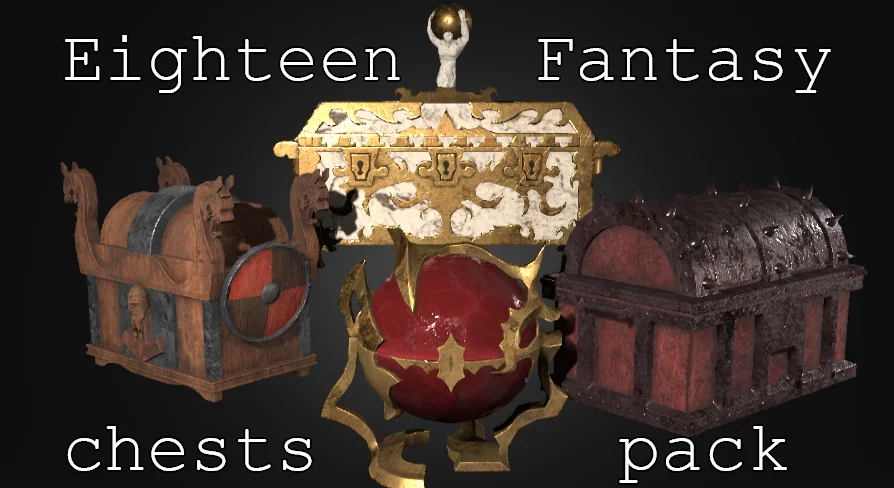
Dungeon corridors, guild halls, treasure vaults, and roadside encampments rely heavily on convincing container props to ground their spaces. In medieval and fantasy game worlds, chests serve as both visual anchors and primary points of player interest. When dressing complex levels, populating multiple rooms with identical containers quickly shatters immersion. Having eighteen distinct chests allows environment artists to distribute visual variety across an entire campaign without breaking stylistic coherence.
The collection spans fantasy, medieval, and realistic aesthetics. This range makes the models suitable for grit-focused historical settings just as easily as high-fantasy ruins filled with arcane relics. Because these assets are game-ready, they can be dragged directly into active levels to flesh out corners, fill out shopfronts, or sit under banquet tables as static set dressing. Their primary value in decorative layouts lies in their diversity: minor storage rooms can feature plainer wooden variants, while high-value throne rooms or guarded crypts can showcase ornate, reinforced containers.
Level composition often demands a balance between background clutter and focal items. These eighteen variants furnish level designers with the tools to establish visual hierarchies. Players intuitively recognize that different chest designs can indicate distinct tiers of treasure or varying levels of factional ownership, reinforcing non-verbal storytelling throughout an environment.
Two-Mesh Construction for Openable Lids
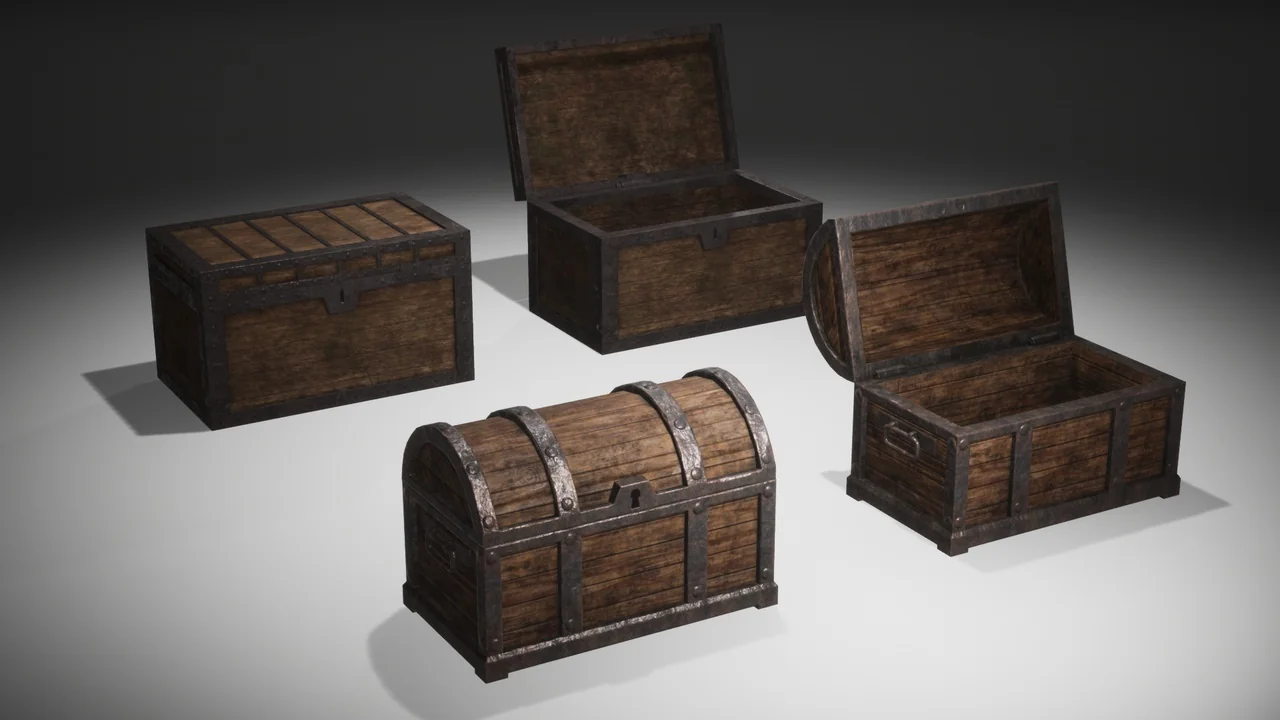
A static prop limits gameplay possibilities to passive observation. To transition from a simple decorative container to a functional object, a container requires physical articulation. Every model in this collection consists of two separate meshes: the container base and the lid. By dividing each chest into two discrete geometric components, the collection bypasses the rigid limitations of single-piece static props.
Splitting the geometry in this manner provides immediate mechanical utility. A single mesh forces developers to either keep the container permanently shut, permanently open, or swap the entire asset out when an interaction occurs. With two meshes, the lid retains its own independent transform. This allows developers to set an exact pivot line along the back hinges, enabling smooth rotational movement along an arc without requiring skeletal rigs or skinning weights.
This physical split directly supports the needs of real-time interaction. Players expect treasure chests to react when searched, unlocked, or looted. Because the lids are detached from the main body, they can swing backward, stay partially propped open, or even be knocked free by external forces depending on how the game logic handles the secondary mesh.
Interactive Logic and the Example Blueprint Actor
Bridging the gap between raw 3D meshes and functional gameplay mechanics often requires technical setup that slows down level prototyping. To solve this, the package includes one actor accompanied by simple example blueprints that demonstrate how to make the openable lid function work in practice.
Rather than leaving developers to configure base-to-lid parent hierarchies and rotation scripts from scratch, the included actor presents a clear, functional implementation. The blueprint logic outlines the core steps necessary to manipulate the separate lid mesh relative to the static base. Developers can examine how the example script drives the rotation, whether through input triggers, procedural timelines, or state toggles that swing the lid open upon interaction.
This implementation serves as a functional foundation. Programmers can take the simple example blueprints and expand them into advanced gameplay systems, incorporating audio cues, particle bursts, locked states, key checks, or inventory pop-ups. For teams running rapid prototyping phases, having an actor already configured with openable functionality means playable interactive loot nodes can be tested inside test levels immediately.
Eighteen Fantasy Chests Pack in Exploration and Loot Systems
Loot collection represents one of the most persistent loops in role-playing, adventure, and dungeon-crawling genres. In these systems, chests act as tangible reward milestones at the end of combat encounters, hidden secrets behind puzzle walls, or optional incentives off the critical path. The Eighteen Fantasy Chests Pack fits directly into these reward structures.
Because the pack supplies eighteen different variations, developers can build tiered reward architectures. Early-game zones can feature modest, simpler chests, while late-game dungeons introduce elaborate and sturdy designs. The two-mesh construction ensures that every reward moment delivers the physical feedback of a lid opening, satisfying the player's expectation of discovery. The visual distinction between the models prevents loot fatigue, ensuring that opening an eighteenth chest still feels unique compared to the first.
The dual role of decoration and interaction gives designers structural freedom. A level can feature dozens of these chests scattered throughout as ambient props, with a curated selection converted into interactable objective containers via the actor logic. This visual consistency unifies the art direction across both static background clutter and active gameplay elements.
Practical Implementation for Developers and Level Designers
Solo creators, indie teams, and technical designers handling fantasy or medieval projects benefit the most from this resource. Solo developers frequently face bottlenecks when splitting static assets, adjusting pivot alignments, and scripting basic object interactions. By supplying game-ready chests that already feature split meshes alongside working blueprint logic, the pack eliminates redundant asset preparation.
Environment artists gain an immediate palette of eighteen containers capable of grounding interior and exterior scenes without visual repetition. At the same time, gameplay scripters receive a clean, uncomplicated actor that clearly demonstrates how to manipulate container lids through blueprints. Whether used purely to dress atmospheric medieval halls or wired into comprehensive loot-drop mechanics, the collection delivers ready-to-use functional versatility.
 Fantasy
 Fantasy
 Fantasy
 Fantasy