"b00678cacce53329"{"id":"1002782","slug":"dynamic-scifi-trail-pack","title":"Dynamic SciFi Trail Pack","category":"Fire \u0026 Explosions","engine":"4.25+,5.0+","assetVersion":"","engineVersion":"Engine Version: 4.25+,5.0+","tag":"Fire \u0026 Explosions","accent":"blue","visual":"mech","summary":"Create customizable visual trails using Niagara, Blueprints, and spline-driven paths with flame, fire, and organic movement styles.","platform":"Unreal Engine","indexPolicy":"index","publishedAt":"2026-11-20T07:05:09.140Z","updatedAt":"2026-11-20T07:05:09.140Z","sourceNotes":[],"fileContents":[],"compatibility":["Unreal Engine","Engine Version: 4.25+,5.0+"],"featuredImage":{"alt":"Dynamic SciFi Trail Pack","src":"/wp-content/uploads/published/2026/11/7ef1531afbc8-0cd0991f-9973-40f7-863e-0f79f7e47722-8fb2a26598.webp"},"fileSizeBytes":21621225,"hasDownloadLink":true,"downloads":0,"terms":[{"taxonomy":"category","slug":"fire-and-explosions","name":"Fire \u0026 Explosions"}],"galleryImages":[{"src":"/wp-content/uploads/published/2026/11/48ff2d54116d-5ab1dcd9-4870-42a7-9cb1-b30f974334df-a6df71e117.webp","alt":"Dynamic SciFi Trail Pack"},{"src":"/wp-content/uploads/published/2026/11/3160210428d5-e7ce01a7-ef6f-4105-8ca6-910d43badedb-36bca217c7.webp","alt":"Dynamic SciFi Trail Pack"},{"src":"/wp-content/uploads/published/2026/11/4e7527b607f1-f898a154-3777-4812-83e5-d2970e4e6cb1-2f395d7364.webp","alt":"Dynamic SciFi Trail Pack"},{"src":"/wp-content/uploads/published/2026/11/46b89594df7b-159c02f9-6a9a-4d9f-a088-f3bad8bf678f-06315d14ad.webp","alt":"Dynamic SciFi Trail Pack"},{"src":"/wp-content/uploads/published/2026/11/6e7431a61235-33260019-d67c-4c8f-a41b-501ef6893394-4f0743a803.webp","alt":"Dynamic SciFi Trail Pack"},{"src":"/wp-content/uploads/published/2026/11/67314e5406db-34af5177-90a1-43d6-9ea6-d39530755402-6c6599b1a4.webp","alt":"Dynamic SciFi Trail Pack"},{"src":"/wp-content/uploads/published/2026/11/65d3a0dfacdd-c77cfd48-4b13-49fc-9a83-52aaf96ca099-2457ed8155.webp","alt":"Dynamic SciFi Trail Pack"},{"src":"/wp-content/uploads/published/2026/11/12f2a502e5b3-99f41160-2cf6-4de4-a321-bb028a2e4732-63a521954c.webp","alt":"Dynamic SciFi Trail Pack"},{"src":"/wp-content/uploads/published/2026/11/a75c926bee64-14d7c251-b6c9-4304-8ebc-845b9282de16-84a0797673.webp","alt":"Dynamic SciFi Trail Pack"}],"accessPanel":{"kind":"resource","title":"Get this resource","safetyNote":"Resources are manually reviewed before listing to improve quality and reduce obvious risks.","fileName":"Content.7z","resourceType":"Resource archive","versions":[]},"contentHtml":"\u003cp\u003eFuturistic installations, high-speed vehicle chases, space combat encounters, and abstract digital landscapes frequently rely on directional energy streams to establish velocity and space. When scenes require precise motion guides, glowing conduits, or dynamic atmospheric wakes, trail effects provide the visual language that anchors movement in three dimensions. The Dynamic SciFi Trail Pack targets these precise staging requirements by combining real-time simulation with accessible curve editing, giving creators direct control over how light and energy navigate virtual worlds.\u003c/p\u003e \u003ch2\u003eSci-Fi Environments and Dynamic Motion Routing\u003c/h2\u003e \u003cp\u003eHigh-tech spaces demand visual cues that communicate motion instantly. Whether marking the exhaust vector of a craft weaving between industrial structures or tracing telemetry arcs across a holographic terminal, trails give players and viewers immediate kinetic context. The Dynamic SciFi Trail Pack addresses these scene types through an architecture driven by editable splines, allowing artists to draw complex trajectories through levels without wrestling with rigid, pre-baked animation clips.\u003c/p\u003e \u003cp\u003ePath layout functions smoothly within the scene viewport. Because the system emphasizes quick spline routing, placing a path requires only dragging spline points, adjusting tangents, and letting the particle logic follow the resulting curve. This flexibility proves essential when dressing levels with curving plasma pipes, navigating laser fire through winding trenches, or staging ambient light ribbons that follow architectural curves through complex multi-level environments.\u003c/p\u003e \u003cp\u003eBecause spline editing remains interactive, designers can adjust routes on the fly to match geometry changes. If a doorway shifts or an obstacle is introduced to alter player navigation, the trail path adapts by moving individual spline control vertices. The particle system conforms to the updated curvature, maintaining its flow without requiring asset re-exporting or timing recalculations.\u003c/p\u003e \u003ch2\u003eParametric Generation Across Varied Trail Styles\u003c/h2\u003e \u003cp\u003eRather than locking creators into a single rigid look, the pack emphasizes parameter-driven variation. Users can explore countless visual outcomes by adjusting core variables directly inside the asset setup. This parametric approach transforms a single toolset into a multi-purpose generator capable of serving multiple artistic directions across a production.\u003c/p\u003e \u003cp\u003eTuning parameters alters the character of the emitted effect. A trail can transition from a tight, razor-sharp energy line to a broad, billowing ribbon simply by modifying values governing width, dissipation, color intensity, and particle life. This adjustability allows teams to maintain stylistic consistency while differentiating distinct factions, power levels, or environmental hazards throughout a project.\u003c/p\u003e \u003cp\u003eIterative look development benefits significantly from this parametric workflow. Instead of assembling separate particle systems for weak, medium, and heavy energy emissions, an artist can duplicate a preset and tweak input fields. Adjusting velocity, scale factors, and visual density yields variations suitable for quick background accents or bold hero sequences where the trail must seize viewer attention immediately.\u003c/p\u003e \u003ch2\u003eSpline Pathing with Blueprint Controls\u003c/h2\u003e \u003cp\u003eUnderpinning the visual systems is a Blueprint implementation designed to manage the underlying spline components cleanly. Blueprints act as the structural bridge, exposing the necessary spline coordinates to the rendering engine and coordinating the behavior of the attached visual components. This architecture keeps technical friction low for artists who want to drop an effect into a map and begin manipulating handles immediately.\u003c/p\u003e \u003cp\u003eThe spline functionality simplifies the construction of non-linear movement. Trails do not need to follow straight coordinates or rely on complex physical collisions to produce intricate loops, corkscrews, or serpentine sweeps. By laying down spline points directly inside the level editor, developers can thread an effect through open doorways, wrap it around structural pillars, or curl it into tight spirals that simulate high-energy anomalies.\u003c/p\u003e \u003cp\u003eBlueprint integration also provides clear avenues for gameplay hookups. Because the path logic lives within Blueprint actors, triggering trail events, modulating travel speeds along the curve, or activating and deactivating paths based on player proximity or mission milestones fits neatly into standard development pipelines.\u003c/p\u003e \u003ch2\u003eNiagara Simulation of Fire, Flame, and Organic Fish Forms\u003c/h2\u003e \u003cp\u003eVisual output is driven by the Niagara VFX framework, harnessing modern GPU particle computation to render rich motion with high fidelity. The system incorporates distinctly different aesthetic themes, spanning from aggressive combustion styles to smooth, undulating organic behaviors.\u003c/p\u003e \u003cp\u003eFor high-heat scenarios, the pack features flame and fire aesthetics. These variations evoke burning booster plumes, atmospheric re-entry friction, incendiary ordnance trails, or catastrophic engine failures. Fire and flame trails utilize chaotic turbulence, heat dispersal curves, and high-luminance cores to create the illusion of raw thermal energy tearing through space along the designated spline path.\u003c/p\u003e \u003cp\u003eContrasting the violent nature of flame effects, the pack also incorporates fish-like movement profiles. This aesthetic direction introduces rhythmic, undulating pathing reminiscent of aquatic locomotion. In a science fiction context, these organic curves translate into bioluminescent energy streams, fluid cybernetic ribbons, or strange alien fauna swimming through low-gravity anomalies. The sinusoidal, fluid cadence possible with these profiles expands the pack beyond conventional mechanical propulsion effects.\u003c/p\u003e \u003cp\u003eNiagara handles the particle spawning, ribbon interpolation, and lifetime behavior necessary to make these contrasting themes read clearly at speed. Whether rendering blistering flame arcs or rhythmic, swimming streams of light, the particle engine evaluates movement data along the spline smoothly, minimizing stepping artifacts even along tightly wound curves.\u003c/p\u003e \u003ch2\u003eProject Roles Suited for Dynamic SciFi Trails\u003c/h2\u003e \u003cp\u003eReal-time visual effects artists looking to accelerate path-based particle creation will find immediate utility in the system's parametric flexibility. Bypassing the need to construct spline-following emitters from the ground up frees VFX specialists to focus purely on visual refinement, material tuning, and timing polish.\u003c/p\u003e \u003cp\u003eLevel designers and environmental artists also gain a practical toolkit for directing player focus. By routing dynamic light ribbons through dimly lit sci-fi installations, designers can naturally guide the player eye toward objectives, exits, or key interactable stations. The ease with which paths can be modified ensures that visual guidance stays aligned with level revisions throughout production.\u003c/p\u003e \u003cp\u003eWhether utilized for searing fire propulsion wakes, delicate cybernetic data streams, or undulating organic phenomena, the combination of Niagara simulation, Blueprint coordination, and parametric spline editing equips developers with an adaptable asset tailored for creative experimentation.\u003c/p\u003e\n\n\u003ch2\u003eContinue Browsing Similar Packs\u003c/h2\u003e\n\u003cul\u003e\n\u003cli\u003e\u003ca href=\"https://3dcghub.com/advanced-fireworks-system-vfx/\" rel=\"noopener noreferrer\"\u003eAdvanced Fireworks System VFX\u003c/a\u003e\u003c/li\u003e\n\u003cli\u003e\u003ca href=\"https://3dcghub.com/scifi-environment-offworld/\" rel=\"noopener noreferrer\"\u003eSciFi Environment — \u0026#039;Offworld\u0026#039;\u003c/a\u003e\u003c/li\u003e\n\u003cli\u003e\u003ca href=\"https://3dcghub.com/stylized-vfx-pack/\" rel=\"noopener noreferrer\"\u003eStylized VFX Pack\u003c/a\u003e\u003c/li\u003e\n\u003cli\u003e\u003ca href=\"https://3dcghub.com/stylized-vfx-fire/\" rel=\"noopener noreferrer\"\u003eStylized VFX - Fire\u003c/a\u003e\u003c/li\u003e\n\u003cli\u003e\u003ca href=\"https://3dcghub.com/art-of-explosions-with-sounds/\" rel=\"noopener noreferrer\"\u003eArt of Explosions with Sounds\u003c/a\u003e\u003c/li\u003e\n\u003c/ul\u003e","contentTextLength":7368,"navigation":{"current":98,"total":4797,"previous":{"id":"1002783","slug":"easy-dissolve-material","title":"Easy Dissolve Material","category":"Shaders","platform":"Unreal Engine","updatedAt":"2026-11-20T07:05:58.737Z"},"next":{"id":"1002781","slug":"dragon-abilities","title":"Dragon Abilities","category":"Spells \u0026 Combat","platform":"Unreal Engine","updatedAt":"2026-11-20T07:04:13.195Z"}},"relatedResources":[{"id":"1002842","slug":"stylized-shooting-vfx-niagara-muzzle-bullet-trail-impact","title":"Stylized Shooting VFX Niagara (Muzzle - Bullet Trail - Impact)","category":"Fire \u0026 Explosions","engine":"4.26+,5.0+","assetVersion":"","engineVersion":"Engine Version: 4.26+,5.0+","tag":"Fire \u0026 Explosions","accent":"blue","visual":"mech","summary":"A technical breakdown of the 17 Niagara FX included in Stylized Shooting VFX Niagara, spanning muzzle flashes, bullet trails, ribbons, and impacts.","platform":"Unreal Engine","indexPolicy":"index","publishedAt":"2026-11-20T12:23:46.116Z","updatedAt":"2026-11-20T12:23:46.116Z","sourceNotes":[],"fileContents":[],"compatibility":["Unreal Engine","Engine Version: 4.26+,5.0+"],"featuredImage":{"alt":"Stylized Shooting VFX Niagara (Muzzle - Bullet Trail - Impact)","src":"/wp-content/uploads/published/2026/11/2982b94a8a48-32843b42-3712-436e-9699-f1872f57f17e-55d053e3b3.webp"},"fileSizeBytes":21027598,"hasDownloadLink":true,"downloads":0},{"id":"1002805","slug":"m5-vfx-vol1-smoke-and-big-explosion-niagara","title":"M5 VFX Vol1. Smoke and Big Explosion(Niagara)","category":"Fire \u0026 Explosions","engine":"4.15+,5.0+","assetVersion":"","engineVersion":"Engine Version: 4.15+,5.0+","tag":"Fire \u0026 Explosions","accent":"blue","visual":"mech","summary":"Explore M5 VFX Vol1. Smoke and Big Explosion (Niagara) for Unreal Engine, featuring realistic multi-emitter blast dynamics and high-resolution textures.","platform":"Unreal Engine","indexPolicy":"index","publishedAt":"2026-11-20T07:34:39.854Z","updatedAt":"2026-11-20T07:34:39.854Z","sourceNotes":[],"fileContents":[],"compatibility":["Unreal Engine","Engine Version: 4.15+,5.0+"],"featuredImage":{"alt":"M5 VFX Vol1. Smoke and Big Explosion(Niagara)","src":"/wp-content/uploads/published/2026/11/7fe314fc6a85-598fdcb3-735f-46fa-9664-cc3f2345d7f3-c63af4fb70.webp"},"fileSizeBytes":479234755,"hasDownloadLink":true,"downloads":0},{"id":"1001499","slug":"advanced-fireworks-system-vfx","title":"Advanced Fireworks System VFX","category":"Fire \u0026 Explosions","engine":"5.0+","assetVersion":"","engineVersion":"Engine Version: 5.0+","tag":"Fire \u0026 Explosions","accent":"blue","visual":"mech","summary":"Explore the Advanced Fireworks System VFX, featuring GPU Niagara performance, 9 explosion effects, customizable launch Blueprints, and rocket trails.","platform":"Unreal Engine","indexPolicy":"index","publishedAt":"2026-10-09T07:26:39.722Z","updatedAt":"2026-10-09T07:26:39.722Z","sourceNotes":[],"fileContents":[],"compatibility":["Unreal Engine","Engine Version: 5.0+"],"featuredImage":{"alt":"Advanced Fireworks System VFX","src":"/wp-content/uploads/published/2026/10/5ba884d58060-be9ccfa2-c57b-48df-af4c-5e14015fb623-27b522d621.webp"},"fileSizeBytes":6498863,"hasDownloadLink":true,"downloads":0}]}
Resource screenshots
1 / 9
Join our channel
Follow 3DCGHUB on Telegram for new resource drops, migration updates, and community notices.
Futuristic installations, high-speed vehicle chases, space combat encounters, and abstract digital landscapes frequently rely on directional energy streams to establish velocity and space. When scenes require precise motion guides, glowing conduits, or dynamic atmospheric wakes, trail effects provide the visual language that anchors movement in three dimensions. The Dynamic SciFi Trail Pack targets these precise staging requirements by combining real-time simulation with accessible curve editing, giving creators direct control over how light and energy navigate virtual worlds.
Sci-Fi Environments and Dynamic Motion Routing
High-tech spaces demand visual cues that communicate motion instantly. Whether marking the exhaust vector of a craft weaving between industrial structures or tracing telemetry arcs across a holographic terminal, trails give players and viewers immediate kinetic context. The Dynamic SciFi Trail Pack addresses these scene types through an architecture driven by editable splines, allowing artists to draw complex trajectories through levels without wrestling with rigid, pre-baked animation clips.
Path layout functions smoothly within the scene viewport. Because the system emphasizes quick spline routing, placing a path requires only dragging spline points, adjusting tangents, and letting the particle logic follow the resulting curve. This flexibility proves essential when dressing levels with curving plasma pipes, navigating laser fire through winding trenches, or staging ambient light ribbons that follow architectural curves through complex multi-level environments.
Because spline editing remains interactive, designers can adjust routes on the fly to match geometry changes. If a doorway shifts or an obstacle is introduced to alter player navigation, the trail path adapts by moving individual spline control vertices. The particle system conforms to the updated curvature, maintaining its flow without requiring asset re-exporting or timing recalculations.
Parametric Generation Across Varied Trail Styles
Rather than locking creators into a single rigid look, the pack emphasizes parameter-driven variation. Users can explore countless visual outcomes by adjusting core variables directly inside the asset setup. This parametric approach transforms a single toolset into a multi-purpose generator capable of serving multiple artistic directions across a production.
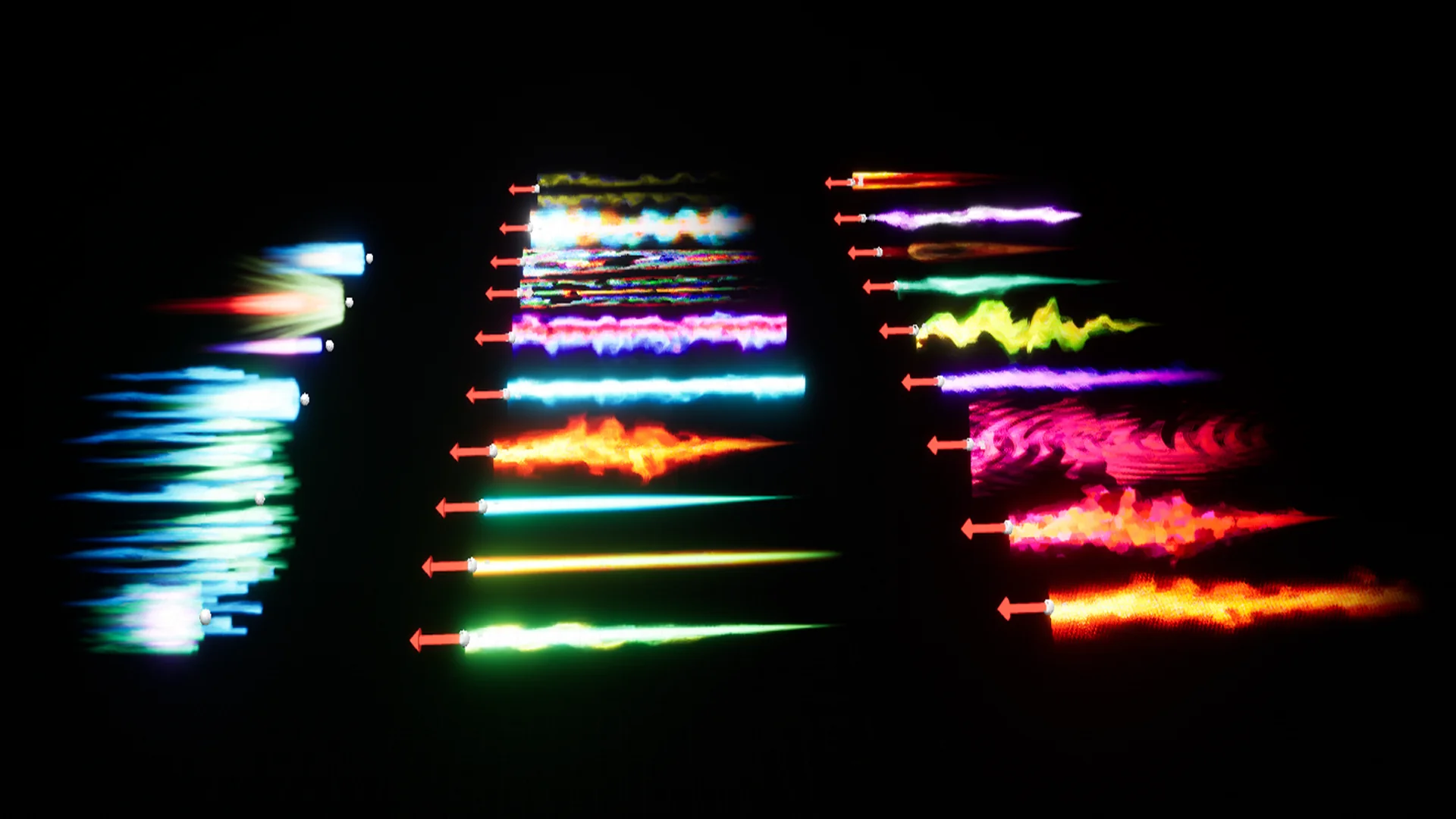
Tuning parameters alters the character of the emitted effect. A trail can transition from a tight, razor-sharp energy line to a broad, billowing ribbon simply by modifying values governing width, dissipation, color intensity, and particle life. This adjustability allows teams to maintain stylistic consistency while differentiating distinct factions, power levels, or environmental hazards throughout a project.
Iterative look development benefits significantly from this parametric workflow. Instead of assembling separate particle systems for weak, medium, and heavy energy emissions, an artist can duplicate a preset and tweak input fields. Adjusting velocity, scale factors, and visual density yields variations suitable for quick background accents or bold hero sequences where the trail must seize viewer attention immediately.
Spline Pathing with Blueprint Controls
Underpinning the visual systems is a Blueprint implementation designed to manage the underlying spline components cleanly. Blueprints act as the structural bridge, exposing the necessary spline coordinates to the rendering engine and coordinating the behavior of the attached visual components. This architecture keeps technical friction low for artists who want to drop an effect into a map and begin manipulating handles immediately.
The spline functionality simplifies the construction of non-linear movement. Trails do not need to follow straight coordinates or rely on complex physical collisions to produce intricate loops, corkscrews, or serpentine sweeps. By laying down spline points directly inside the level editor, developers can thread an effect through open doorways, wrap it around structural pillars, or curl it into tight spirals that simulate high-energy anomalies.
Blueprint integration also provides clear avenues for gameplay hookups. Because the path logic lives within Blueprint actors, triggering trail events, modulating travel speeds along the curve, or activating and deactivating paths based on player proximity or mission milestones fits neatly into standard development pipelines.
Niagara Simulation of Fire, Flame, and Organic Fish Forms
Visual output is driven by the Niagara VFX framework, harnessing modern GPU particle computation to render rich motion with high fidelity. The system incorporates distinctly different aesthetic themes, spanning from aggressive combustion styles to smooth, undulating organic behaviors.
For high-heat scenarios, the pack features flame and fire aesthetics. These variations evoke burning booster plumes, atmospheric re-entry friction, incendiary ordnance trails, or catastrophic engine failures. Fire and flame trails utilize chaotic turbulence, heat dispersal curves, and high-luminance cores to create the illusion of raw thermal energy tearing through space along the designated spline path.
Contrasting the violent nature of flame effects, the pack also incorporates fish-like movement profiles. This aesthetic direction introduces rhythmic, undulating pathing reminiscent of aquatic locomotion. In a science fiction context, these organic curves translate into bioluminescent energy streams, fluid cybernetic ribbons, or strange alien fauna swimming through low-gravity anomalies. The sinusoidal, fluid cadence possible with these profiles expands the pack beyond conventional mechanical propulsion effects.
Niagara handles the particle spawning, ribbon interpolation, and lifetime behavior necessary to make these contrasting themes read clearly at speed. Whether rendering blistering flame arcs or rhythmic, swimming streams of light, the particle engine evaluates movement data along the spline smoothly, minimizing stepping artifacts even along tightly wound curves.
Project Roles Suited for Dynamic SciFi Trails
Real-time visual effects artists looking to accelerate path-based particle creation will find immediate utility in the system's parametric flexibility. Bypassing the need to construct spline-following emitters from the ground up frees VFX specialists to focus purely on visual refinement, material tuning, and timing polish.
Level designers and environmental artists also gain a practical toolkit for directing player focus. By routing dynamic light ribbons through dimly lit sci-fi installations, designers can naturally guide the player eye toward objectives, exits, or key interactable stations. The ease with which paths can be modified ensures that visual guidance stays aligned with level revisions throughout production.
Whether utilized for searing fire propulsion wakes, delicate cybernetic data streams, or undulating organic phenomena, the combination of Niagara simulation, Blueprint coordination, and parametric spline editing equips developers with an adaptable asset tailored for creative experimentation.
 Fire & Explosions
 Fire & Explosions
 Fire & Explosions