"b00678cacce53329"{"id":"1002781","slug":"dragon-abilities","title":"Dragon Abilities","category":"Spells \u0026 Combat","engine":"4.25+,5.0+","assetVersion":"","engineVersion":"Engine Version: 4.25+,5.0+","tag":"Spells \u0026 Combat","accent":"blue","visual":"mech","summary":"Explore Dragon Abilities, featuring high-quality Niagara and Cascade visual effects synchronized with dragon animation through an Unreal Engine Blueprint.","platform":"Unreal Engine","indexPolicy":"index","publishedAt":"2026-11-20T07:04:13.195Z","updatedAt":"2026-11-20T07:04:13.195Z","sourceNotes":[],"fileContents":[],"compatibility":["Unreal Engine","Engine Version: 4.25+,5.0+"],"featuredImage":{"alt":"Dragon Abilities","src":"/wp-content/uploads/published/2026/11/147bd555fbce-0e8ac6bc-0e0d-4e61-bbb9-11ddb1dd7b78-c86e6d6ffd.webp"},"fileSizeBytes":361174743,"hasDownloadLink":true,"downloads":0,"terms":[{"taxonomy":"category","slug":"spells-and-combat","name":"Spells \u0026 Combat"}],"galleryImages":[{"src":"/wp-content/uploads/published/2026/11/0758ebd4ff5c-8b797116-e852-4a74-a120-08f5d14add66-3dd48ed7da.webp","alt":"Dragon Abilities"},{"src":"/wp-content/uploads/published/2026/11/a473914b5a5e-6195f416-8db1-4a05-90bc-f63d55a9c291-03a1d27e62.webp","alt":"Dragon Abilities"},{"src":"/wp-content/uploads/published/2026/11/e46fbbd87c37-d38b22e5-561d-411a-b9a2-276ef8b2b6c5-18d8628eb1.webp","alt":"Dragon Abilities"},{"src":"/wp-content/uploads/published/2026/11/f6c3acb5a642-7a6529b8-5752-40ad-9ede-ea7de816ae71-65d82f8273.webp","alt":"Dragon Abilities"},{"src":"/wp-content/uploads/published/2026/11/405a3b4bfb75-56a4831c-dcbf-4879-8a01-0861b77ef383-4e72553a74.webp","alt":"Dragon Abilities"},{"src":"/wp-content/uploads/published/2026/11/b765a4c27935-79115edf-58ee-408a-96f8-8fbac30b7cf2-7c7bc28683.webp","alt":"Dragon Abilities"},{"src":"/wp-content/uploads/published/2026/11/16c51d0963da-3ee7d8e1-b914-4ecb-b9de-37fa8cd6dd7b-aacdc581c2.webp","alt":"Dragon Abilities"},{"src":"/wp-content/uploads/published/2026/11/f3f479d01277-6ee82bc5-9222-4ece-8941-5b7fca8a87e4-98209457a7.webp","alt":"Dragon Abilities"},{"src":"/wp-content/uploads/published/2026/11/ed9a12728beb-34ebb49e-412c-4f13-842e-993a49f4ee61-30134789f0.webp","alt":"Dragon Abilities"},{"src":"/wp-content/uploads/published/2026/11/451f0a865bd3-a6c37a98-a531-4510-bd6e-18ac0403f69d-c5aab8ce08.webp","alt":"Dragon Abilities"}],"accessPanel":{"kind":"resource","title":"Get this resource","safetyNote":"Resources are manually reviewed before listing to improve quality and reduce obvious risks.","fileName":"Content.7z","resourceType":"Resource archive","versions":[]},"contentHtml":"\u003cp\u003eA dragon striking during combat requires tight alignment between massive physical movement and raw particle luminescence. When a monstrous creature unleashes an offensive burst, the magical or elemental energy cannot look like an afterthought attached arbitrarily to world coordinates. Dragon Abilities resolves this spatial connection by binding dragon animation directly to both Niagara and Cascade visual effects using an integrated Blueprint framework.\u003c/p\u003e \u003ch2\u003eSynchronizing Dragon Animation with Visual Effect Timing\u003c/h2\u003e\n\u003cp\u003eAction-oriented fantasy encounters rely heavily on anticipation, execution, and recovery windows. When animating large beasts, the weight of the mesh must dictate when and where an ability discharges. Because Dragon Abilities includes dedicated dragon animation paired with the visual effects, the motion of the creature's limbs, head, and torso functions in harmony with the emitted energy. Instead of manually adjusting emitter delays to match an arbitrary skeletal sequence, the asset uses coordinated staging where particle bursts match the physical momentum of the creature.\u003c/p\u003e\n\u003cp\u003eThis animation-driven design directly benefits designers building cinematic moments or boss phases. In an arena encounter, players read telegraphs from the creature's posture. When the animation shifts into an ability wind-up, the corresponding visual elements begin their generation cycle, tracking along the body before emitting into the world space. The visual effect responds to the monster's performance, giving physical weight to what would otherwise be a detached particle system floating near a skeletal mesh.\u003c/p\u003e \u003ch2\u003eBlueprint Construction of the Dragon Effect\u003c/h2\u003e\n\u003cp\u003eAt the center of this package is its scripting architecture. The dragon effect is assembled within a Blueprint, serving as the bridge that orchestrates visual effects and animation simultaneously. Rather than leaving the user to manually script event tracks, notify triggers, and particle spawn logic from scratch, the Blueprint encapsulates the core components needed to execute the dragon's combat actions.\u003c/p\u003e\n\u003cp\u003eBy housing the dragon animation, mesh references, and particle emitters under a single Blueprint umbrella, the setup simplifies how gameplay systems call the ability. When a character controller, behavior tree, or sequencer tells the monster to execute an action, the Blueprint handles the trigger sequences internally. It can fire the animation playback, activate the relevant particle components, govern their duration, and terminate lingering elements once the sequence ends. This cohesive encapsulation keeps character master classes uncluttered and ensures that visual effect assets remain modular and portable across different levels or game modes.\u003c/p\u003e \u003ch2\u003eIntegrating Niagara and Cascade Particle Systems\u003c/h2\u003e\n\u003cp\u003eUnreal Engine projects often span different stages of technical transition, with some pipelines relying strictly on legacy particle tools while others take full advantage of modern simulation graphs. Dragon Abilities accommodates both paradigms by incorporating both Niagara and Cascade particle assets. The high-quality effects take advantage of each system's particular strengths to deliver impactful fantasy combat visuals.\u003c/p\u003e\n\u003cp\u003eThe presence of Cascade particles ensures compatibility for projects maintaining long-standing emitter libraries or workflows based on classic particle modules. These emitters handle direct, deterministic particle behaviors that interface reliably with the dragon's physical body. Alongside these classic systems, Niagara system particles provide complex, highly dynamic simulations. Niagara allows for advanced mathematical control over particle lifetimes, spatial distribution, velocity scaling, and responsive environmental interactions. Developers can inspect how the dragon abilities are implemented across both frameworks, adapting elements to their studio's specific technical guidelines or rendering budgets.\u003c/p\u003e \u003ch2\u003eStaging Fantasy Monster Abilities for Impact\u003c/h2\u003e\n\u003cp\u003eFantasy monster abilities demand a distinct visual language. Whether suited to an ancient boss guarding a dungeon or an environmental hazard sweeping across an open expanse, an effective creature skill must communicate danger instantly. Dragon Abilities fulfills the visual expectations of the fantasy genre by pairing intense magical shapes, ambient glow, and kinetic propulsion with the presence of a legendary beast.\u003c/p\u003e\n\u003cp\u003eBecause visual effects are paired directly with the monster's body geometry, the emissions frame the creature rather than obscuring it completely. In combat design, particle saturation often poses a gameplay risk: if an effect is too dense, players cannot read incoming attacks or track the dragon's position. Dragon Abilities balances emitter intensity against the monster's silhouette. The ability radiates outward, underscoring the dragon's anatomy and maintaining clear line-of-sight during active combat phases.\u003c/p\u003e \u003ch2\u003eConfiguring the Niagara Plugin for Dragon Abilities\u003c/h2\u003e\n\u003cp\u003eTo access the modern visual elements included in the asset, the Niagara Plugin must be active in the host Unreal Engine project. Because the package relies on native Niagara system particles alongside its Cascade and Blueprint components, the engine must compile and initialize the corresponding Niagara modules upon startup.\u003c/p\u003e\n\u003cp\u003eActivating the plugin ensures that the Niagara systems compile correctly, load all parameter maps, and execute their custom logic without throwing missing-system warnings. Once the plugin is confirmed as active, developers can place the Blueprint into their scenes or hook the dragon's ability actions directly into existing AI controllers. This gives a self-contained combat asset that unites monster animation, classic Cascade particle support, and modern Niagara simulation inside a functional Blueprint workflow.\u003c/p\u003e\n\n\u003ch2\u003eContinue Browsing Similar Packs\u003c/h2\u003e\n\u003cul\u003e\n\u003cli\u003e\u003ca href=\"https://3dcghub.com/niagara-ki-auras/\" rel=\"noopener noreferrer\"\u003eNiagara KI auras\u003c/a\u003e\u003c/li\u003e\n\u003cli\u003e\u003ca href=\"https://3dcghub.com/magic-kit-01/\" rel=\"noopener noreferrer\"\u003eMagic Kit 01\u003c/a\u003e\u003c/li\u003e\n\u003cli\u003e\u003ca href=\"https://3dcghub.com/rpg-fx-starter-pack/\" rel=\"noopener noreferrer\"\u003eRPG FX Starter Pack\u003c/a\u003e\u003c/li\u003e\n\u003cli\u003e\u003ca href=\"https://3dcghub.com/ultra-fx-warrior/\" rel=\"noopener noreferrer\"\u003eUltra FX : Warrior\u003c/a\u003e\u003c/li\u003e\n\u003cli\u003e\u003ca href=\"https://3dcghub.com/summon-creatures-vol-1-niagara/\" rel=\"noopener noreferrer\"\u003eSummon Creatures Vol.1 - Niagara\u003c/a\u003e\u003c/li\u003e\n\u003c/ul\u003e","contentTextLength":5923,"navigation":{"current":99,"total":4797,"previous":{"id":"1002782","slug":"dynamic-scifi-trail-pack","title":"Dynamic SciFi Trail Pack","category":"Fire \u0026 Explosions","platform":"Unreal Engine","updatedAt":"2026-11-20T07:05:09.140Z"},"next":{"id":"1002780","slug":"dash-vfx","title":"Dash VFX","category":"Spells \u0026 Combat","platform":"Unreal Engine","updatedAt":"2026-11-20T07:02:17.168Z"}},"relatedResources":[{"id":"16517","slug":"niagara-ki-auras","title":"Niagara KI auras","category":"Spells \u0026 Combat","engine":"4.27,5.0+","assetVersion":"Engine version: 4.27,5.0+","engineVersion":"4.24","tag":"Spells \u0026 Combat","accent":"blue","visual":"animation","summary":"Enhance your project with the Niagara KI auras pack, featuring 10 unique visual effects. This collection includes a dragon character model and various material instances designed for energy and magic themes.","platform":"Unreal Engine","indexPolicy":"noindex","publishedAt":"2026-03-12T17:17:53.000Z","updatedAt":"2026-04-19T15:44:32.000Z","sourceNotes":[],"fileContents":[],"compatibility":["Unreal Engine","Engine version: 4.27,5.0+"],"featuredImage":{"alt":"Niagara KI auras","src":"https://3dcghub.com/wp-content/uploads/2026/03/3fc0f25a-fc50-4235-8729-b13f490a5eff.webp"},"fileSizeBytes":46869852,"hasDownloadLink":true,"downloads":5},{"id":"16432","slug":"magic-kit-01","title":"Magic Kit 01","category":"Spells \u0026 Combat","engine":"4.26+,5.0+","assetVersion":"Engine version: 4.26+,5.0+","engineVersion":"4.26","tag":"Spells \u0026 Combat","accent":"blue","visual":"character","summary":"Magic Kit 01 is a specialized VFX pack featuring four elements with unique attack and defense abilities. Built with the Niagara System, it includes example Blueprints for easy integration.","platform":"Unreal Engine","indexPolicy":"noindex","publishedAt":"2026-03-12T17:08:09.000Z","updatedAt":"2026-04-19T15:44:33.000Z","sourceNotes":[],"fileContents":[],"compatibility":["Unreal Engine","Engine version: 4.26+,5.0+"],"featuredImage":{"alt":"Magic Kit 01","src":"https://3dcghub.com/wp-content/uploads/2026/03/c38d577f-f411-4f15-a921-9ddd9f27c2a1.webp"},"fileSizeBytes":200969489,"hasDownloadLink":true,"downloads":3},{"id":"1001190","slug":"rpg-fx-starter-pack","title":"RPG FX Starter Pack","category":"Spells \u0026 Combat","engine":"5.0+","assetVersion":"","engineVersion":"Engine Version: 5.0+","tag":"Spells \u0026 Combat","accent":"blue","visual":"mech","summary":"Stylized combat visual effects built with Niagara for Unreal Engine 4.26, featuring hero abilities, status indicators, and customizable targeting shapes.","platform":"Unreal Engine","indexPolicy":"index","publishedAt":"2026-09-17T07:30:24.618Z","updatedAt":"2026-09-17T07:30:24.618Z","sourceNotes":[],"fileContents":[],"compatibility":["Unreal Engine","Engine Version: 5.0+"],"featuredImage":{"alt":"RPG FX Starter Pack","src":"/wp-content/uploads/published/2026/09/ef0cc4ec29c7-ac91b658-aed8-4821-892c-456eb8b55795-78b1056208.webp"},"fileSizeBytes":41722656,"hasDownloadLink":true,"downloads":3}]}
Resource screenshots
1 / 10
Join our channel
Follow 3DCGHUB on Telegram for new resource drops, migration updates, and community notices.
Resources are manually reviewed before listing to improve quality and reduce obvious risks.
No account required
Spells & Combat
Dragon Abilities
Explore Dragon Abilities, featuring high-quality Niagara and Cascade visual effects synchronized with dragon animation through an Unreal Engine Blueprint.
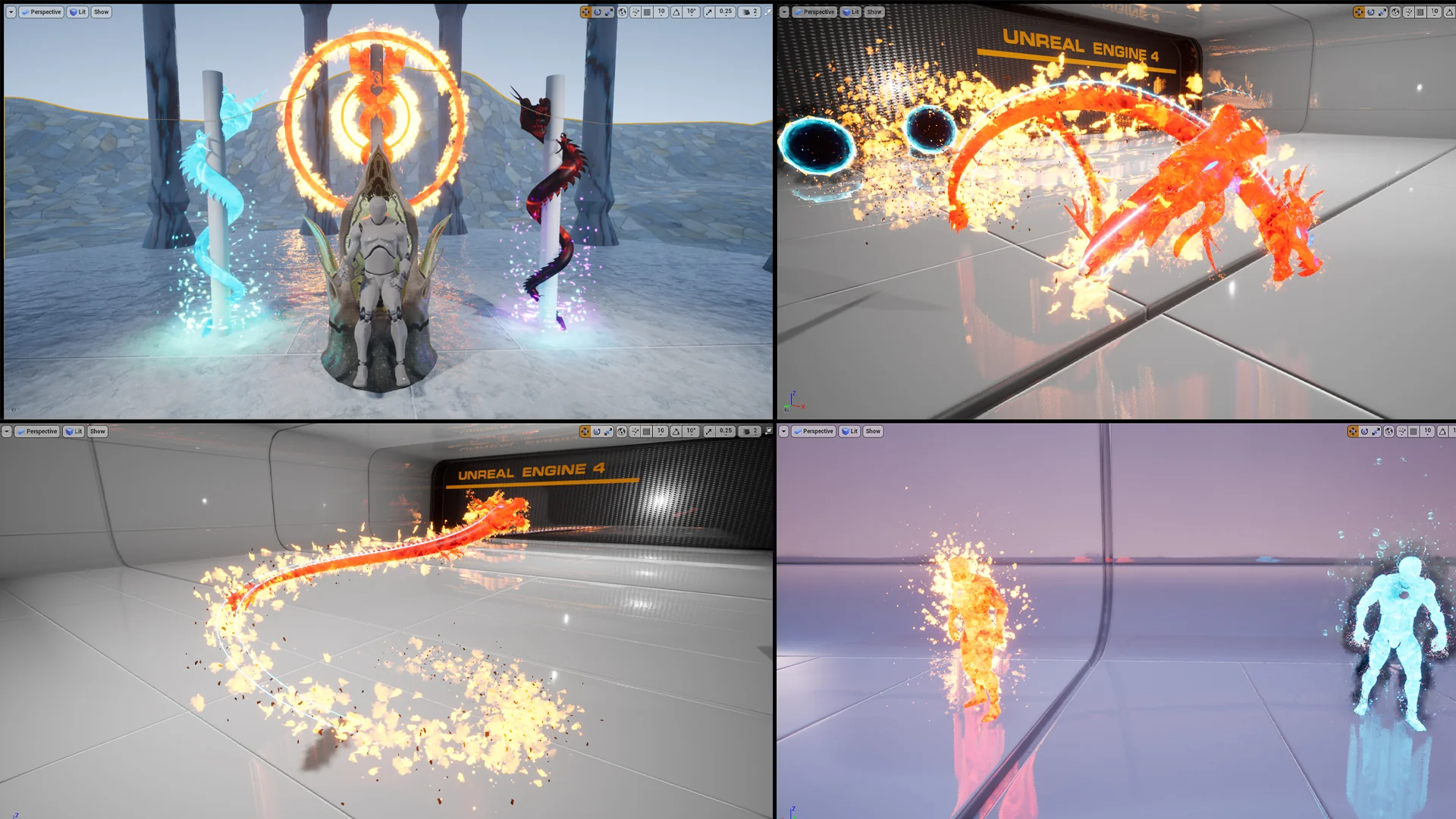
A dragon striking during combat requires tight alignment between massive physical movement and raw particle luminescence. When a monstrous creature unleashes an offensive burst, the magical or elemental energy cannot look like an afterthought attached arbitrarily to world coordinates. Dragon Abilities resolves this spatial connection by binding dragon animation directly to both Niagara and Cascade visual effects using an integrated Blueprint framework.
Synchronizing Dragon Animation with Visual Effect Timing
Action-oriented fantasy encounters rely heavily on anticipation, execution, and recovery windows. When animating large beasts, the weight of the mesh must dictate when and where an ability discharges. Because Dragon Abilities includes dedicated dragon animation paired with the visual effects, the motion of the creature's limbs, head, and torso functions in harmony with the emitted energy. Instead of manually adjusting emitter delays to match an arbitrary skeletal sequence, the asset uses coordinated staging where particle bursts match the physical momentum of the creature.
This animation-driven design directly benefits designers building cinematic moments or boss phases. In an arena encounter, players read telegraphs from the creature's posture. When the animation shifts into an ability wind-up, the corresponding visual elements begin their generation cycle, tracking along the body before emitting into the world space. The visual effect responds to the monster's performance, giving physical weight to what would otherwise be a detached particle system floating near a skeletal mesh.
Blueprint Construction of the Dragon Effect
At the center of this package is its scripting architecture. The dragon effect is assembled within a Blueprint, serving as the bridge that orchestrates visual effects and animation simultaneously. Rather than leaving the user to manually script event tracks, notify triggers, and particle spawn logic from scratch, the Blueprint encapsulates the core components needed to execute the dragon's combat actions.
By housing the dragon animation, mesh references, and particle emitters under a single Blueprint umbrella, the setup simplifies how gameplay systems call the ability. When a character controller, behavior tree, or sequencer tells the monster to execute an action, the Blueprint handles the trigger sequences internally. It can fire the animation playback, activate the relevant particle components, govern their duration, and terminate lingering elements once the sequence ends. This cohesive encapsulation keeps character master classes uncluttered and ensures that visual effect assets remain modular and portable across different levels or game modes.
Integrating Niagara and Cascade Particle Systems
Unreal Engine projects often span different stages of technical transition, with some pipelines relying strictly on legacy particle tools while others take full advantage of modern simulation graphs. Dragon Abilities accommodates both paradigms by incorporating both Niagara and Cascade particle assets. The high-quality effects take advantage of each system's particular strengths to deliver impactful fantasy combat visuals.
The presence of Cascade particles ensures compatibility for projects maintaining long-standing emitter libraries or workflows based on classic particle modules. These emitters handle direct, deterministic particle behaviors that interface reliably with the dragon's physical body. Alongside these classic systems, Niagara system particles provide complex, highly dynamic simulations. Niagara allows for advanced mathematical control over particle lifetimes, spatial distribution, velocity scaling, and responsive environmental interactions. Developers can inspect how the dragon abilities are implemented across both frameworks, adapting elements to their studio's specific technical guidelines or rendering budgets.
Staging Fantasy Monster Abilities for Impact
Fantasy monster abilities demand a distinct visual language. Whether suited to an ancient boss guarding a dungeon or an environmental hazard sweeping across an open expanse, an effective creature skill must communicate danger instantly. Dragon Abilities fulfills the visual expectations of the fantasy genre by pairing intense magical shapes, ambient glow, and kinetic propulsion with the presence of a legendary beast.
Because visual effects are paired directly with the monster's body geometry, the emissions frame the creature rather than obscuring it completely. In combat design, particle saturation often poses a gameplay risk: if an effect is too dense, players cannot read incoming attacks or track the dragon's position. Dragon Abilities balances emitter intensity against the monster's silhouette. The ability radiates outward, underscoring the dragon's anatomy and maintaining clear line-of-sight during active combat phases.
Configuring the Niagara Plugin for Dragon Abilities
To access the modern visual elements included in the asset, the Niagara Plugin must be active in the host Unreal Engine project. Because the package relies on native Niagara system particles alongside its Cascade and Blueprint components, the engine must compile and initialize the corresponding Niagara modules upon startup.
Activating the plugin ensures that the Niagara systems compile correctly, load all parameter maps, and execute their custom logic without throwing missing-system warnings. Once the plugin is confirmed as active, developers can place the Blueprint into their scenes or hook the dragon's ability actions directly into existing AI controllers. This gives a self-contained combat asset that unites monster animation, classic Cascade particle support, and modern Niagara simulation inside a functional Blueprint workflow.
 Spells & Combat
 Spells & Combat
 Spells & Combat