"6c6413bef81af556"{"id":"1001190","slug":"rpg-fx-starter-pack","title":"RPG FX Starter Pack","category":"Spells \u0026 Combat","engine":"5.0+","assetVersion":"","engineVersion":"Engine Version: 5.0+","tag":"Spells \u0026 Combat","accent":"blue","visual":"mech","summary":"Stylized combat visual effects built with Niagara for Unreal Engine 4.26, featuring hero abilities, status indicators, and customizable targeting shapes.","platform":"Unreal Engine","publishedAt":"2026-09-17T07:30:24.618Z","updatedAt":"2026-09-17T07:30:24.618Z","sourceNotes":[],"fileContents":[],"compatibility":["Unreal Engine","Engine Version: 5.0+"],"featuredImage":{"alt":"RPG FX Starter Pack","src":"/wp-content/uploads/published/2026/09/ef0cc4ec29c7-ac91b658-aed8-4821-892c-456eb8b55795-78b1056208.webp"},"hasDownloadLink":true,"downloads":0,"terms":[{"taxonomy":"category","slug":"spells-and-combat","name":"Spells \u0026 Combat"}],"galleryImages":[{"src":"/wp-content/uploads/published/2026/09/b8cecd84f734-84c5c68f-5f31-4b6e-a382-f9ff41ec5b02-d251f9a5a7.webp","alt":"RPG FX Starter Pack"},{"src":"/wp-content/uploads/published/2026/09/66980d491f9b-f4bc1bd8-d590-41b9-8ca2-147bb05b5a6a-7d515f4deb.webp","alt":"RPG FX Starter Pack"},{"src":"/wp-content/uploads/published/2026/09/f57ee2b97a51-5cd68d1d-a266-487c-81e1-d4b0e3b70d5b-b09f42d398.webp","alt":"RPG FX Starter Pack"},{"src":"/wp-content/uploads/published/2026/09/db2d66bc07aa-92e996c4-b715-4729-913e-4eb63ee12c40-29c96a04f6.webp","alt":"RPG FX Starter Pack"},{"src":"/wp-content/uploads/published/2026/09/37ee212034a8-77e0beec-366d-436b-a72a-64e3a7e65be5-e62153bf77.webp","alt":"RPG FX Starter Pack"}],"accessPanel":{"kind":"resource","title":"Download this resource","eyebrow":"Free Download","message":"Log in or create a free account to start your download.","fileName":"Content.7z","safetyNote":"Resources are manually reviewed before listing to improve quality and reduce obvious risks.","actionLabel":"Download Free","resourceType":"Resource archive"},"contentHtml":"\u003cp\u003eFast-paced combat in Action RPG and MOBA projects depends heavily on visual clarity. When a skirmish breaks out, players must immediately differentiate between distinct combat disciplines, recognize hostile crowd control, and identify the boundaries of incoming area-of-effect spells. The RPG FX Starter Pack addresses this layer of production by supplying stylized particle effects authored in the Niagara VFX system for Unreal Engine 4.26. By supplying tailored ability kits for specific character archetypes alongside essential status indicators and targeting decals, the collection provides a structured visual language ready for rapid combat implementation.\u003c/p\u003e \u003ch2\u003eHero Visuals Across Archer, Mage, Warrior, and Priest Archetypes\u003c/h2\u003e\n\u003cp\u003eCombat systems in role-playing games typically hinge on distinct character roles, each demanding a coherent visual profile. The collection divides its primary spell and ability assets into four distinct classes: Archer, Mage, Warrior, and Priest. Each class includes nine individual particle effects, yielding a total of thirty-six hero-specific visual elements.\u003c/p\u003e\n\u003cp\u003eDistributing nine effects per hero allows teams to build complete ability profiles for individual character kits without mixing mismatched art styles. An Archer kit typically requires high-velocity trajectory trails, impact bursts, and piercing shot flourishes. In contrast, Warrior visuals generally emphasize physical momentum, ground-cracking impacts, cleave trails, and blunt force energy. The Mage set accommodates elemental conjuring, burst detonations, and sustained magical casting, while the Priest effects focus on supportive emanations, restoration indicators, and protective auras. Because all thirty-six hero effects share a unified stylized aesthetic, teams can construct encounter gameplay where abilities from competing or allied classes remain visually distinct yet stylistically harmonious.\u003c/p\u003e \u003ch2\u003eTuning Colour, Alpha, and Lifetime in Niagara FX\u003c/h2\u003e\n\u003cp\u003eDeploying combat effects across varying environments requires granular control over emitter parameters. The particles in the package are updated for Unreal Engine 4.26's Niagara architecture, exposing key properties directly through user-facing particle parameters. Instead of forcing artists to rebuild emitter networks from scratch, the system enables rapid aesthetic shifts through exposed variables such as Colour, Alpha, Lifetime, and Size.\u003c/p\u003e\n\u003cp\u003eModifying the Colour parameter allows a developer to repurpose a single ability effect across elemental variations or faction alignments. A Warrior's cleave or burst effect can shift from aggressive crimson to icy blue or necrotic green to reflect enchanted weaponry or enemy variants. Adjusting Alpha parameters gives control over transparency, enabling artists to dial down visual clutter during high-density multiplayer fights or elevate opacity for critical cinematic attacks. Lifetime controls directly govern how long particle bursts linger in the game world, allowing technical designers to align emitter dissipation with hit-frame data, animation cancels, and weapon recovery frames. Size adjustments ensure that an effect scaled for a standard humanoid character can expand smoothly to fit giant boss encounters or scale down for agile minions.\u003c/p\u003e \u003ch2\u003eCustomizable Targeting Effects and Combat Statuses\u003c/h2\u003e\n\u003cp\u003eBeyond active class abilities, tactical gameplay relies heavily on telegraphing incoming threats and communicating character states. The collection contains five dedicated targeting effects designed to indicate spell placement, skill shots, and area boundaries before an ability activates. These targeting effects feature full customization across size and shape, allowing teams to map them precisely to specific game logic—whether an ability covers a narrow directional cone, a broad circular perimeter, or a focused impact node. Aligning targeting shape scales with actual damage collision volumes ensures accurate gameplay feedback for players dodging or aiming attacks.\u003c/p\u003e\n\u003cp\u003eStatus communication is handled by eight distinct status effects created to represent active combat conditions. Among these are dedicated indicators for Stun, Confusion, and a Teleport effect. A Stun effect visually grounds an immobilized character, giving immediate tactical feedback that inputs are disabled. The Confusion effect provides a readable visual disruption above or around the affected target, signaling disoriented movement or reversed controls. The Teleport effect supplies the necessary entry and exit visual cues for blinks, spatial leaps, or recall mechanics, hiding the instant translation of a character mesh across the game world with an energetic burst.\u003c/p\u003e \u003ch2\u003eMaterial Functions, Instances, and Mesh Integration\u003c/h2\u003e\n\u003cp\u003eUnderpinning the visual effects is a modular rendering setup consisting of 42 Materials, 1 Material Function, 6 Material Instances, 25 Meshes, and 40 Textures. This technical balance ensures that the stylized aesthetic remains lightweight while maintaining high expressive flexibility across Niagara emitters.\u003c/p\u003e\n\u003cp\u003eThe single material function serves as a centralized logic hub, standardizing core shading behaviors, UV distortion math, or blending routines across the material library. By driving six material instances from the parent materials, the pack establishes a workflow where global adjustments to shader behavior propagate cleanly throughout the particle systems without recompiling every individual asset. The 40 included textures supply stylized noise patterns, energy ramps, alpha masks, and elemental shapes that feed into the Niagara systems. Meanwhile, the 25 custom meshes provide stylized geometry for three-dimensional energy rings, directional slashes, weapon trails, and physical debris spikes, grounding the particles in solid three-dimensional forms rather than relying solely on flat camera-facing billboards.\u003c/p\u003e \u003ch2\u003ePipeline Fit for Stylized Combat Systems\u003c/h2\u003e\n\u003cp\u003eDevelopers constructing top-down MOBAs or third-person Action RPGs often face the bottleneck of generating dozens of bespoke visual cues before gameplay mechanics can be adequately tested. The combination of structured hero kits, customizable targeting projections, and unambiguous status ailments provides a direct pipeline solution. Designers can prototype new character classes and balance combat timing using fully functional Niagara emitters that already account for visual telegraphing and recovery windows. For teams working within Unreal Engine 4.26, the pack establishes an adaptable foundation of stylized combat visual effects ready to be tuned to specific combat balances.\u003c/p\u003e\n\n\u003ch2\u003eMore From The Same Workflow\u003c/h2\u003e\n\u003cul\u003e\n\u003cli\u003e\u003ca href=\"https://3dcghub.com/blink-and-dash-vfx/\" title=\"Blink and Dash VFX\"\u003eBlink and Dash VFX\u003c/a\u003e\u003c/li\u003e\n\u003cli\u003e\u003ca href=\"https://3dcghub.com/ethereal-tentacle-fx/\" title=\"Ethereal Tentacle FX\"\u003eEthereal Tentacle FX\u003c/a\u003e\u003c/li\u003e\n\u003cli\u003e\u003ca href=\"https://3dcghub.com/realistic-gun-vfx-muzzle-flash-bullet-impact-ejections-gun-vfx-vfx/\" title=\"Realistic Gun VFX (Muzzle Flash, Bullet Impact, Ejections, Gun VFX, VFX)\"\u003eRealistic Gun VFX (Muzzle Flash, Bullet Impact, Ejections, Gun VFX, VFX)\u003c/a\u003e\u003c/li\u003e\n\u003cli\u003e\u003ca href=\"https://3dcghub.com/dash-fx/\" title=\"Dash FX\"\u003eDash FX\u003c/a\u003e\u003c/li\u003e\n\u003cli\u003e\u003ca href=\"https://3dcghub.com/m5-vfx-rpg2-projectileniagara/\" title=\"M5 VFX RPG2. Projectile(Niagara)\"\u003eM5 VFX RPG2. Projectile(Niagara)\u003c/a\u003e\u003c/li\u003e\n\u003c/ul\u003e","contentTextLength":6739,"navigation":{"current":8,"total":3140,"previous":{"id":"1001191","slug":"basic-pickups-vfx-set-niagara","title":"Basic Pickups VFX Set (Niagara)","category":"Variety","platform":"Unreal Engine","updatedAt":"2026-09-17T07:33:56.417Z"},"next":{"id":"1001189","slug":"mega-magic-vfx-bundle","title":"Mega Magic VFX Bundle","category":"Spells \u0026 Combat","platform":"Unreal Engine","updatedAt":"2026-09-17T06:44:28.385Z"}},"relatedResources":[{"id":"1001188","slug":"blink-and-dash-vfx","title":"Blink and Dash VFX","category":"Spells \u0026 Combat","engine":"5.0+","assetVersion":"","engineVersion":"Engine Version: 5.0+","tag":"Spells \u0026 Combat","accent":"blue","visual":"mech","summary":"Explore mesh-based Niagara teleportation and movement effects in Blink and Dash VFX, featuring camera FOV Blueprint macros and Hack And Slash FX compatibility.","platform":"Unreal Engine","publishedAt":"2026-09-17T06:42:29.643Z","updatedAt":"2026-09-17T06:42:29.643Z","sourceNotes":[],"fileContents":[],"compatibility":["Unreal Engine","Engine Version: 5.0+"],"featuredImage":{"alt":"Blink and Dash VFX","src":"/wp-content/uploads/published/2026/09/dffb4ab1bf8c-00274fcc-2e4a-42d2-b0ec-de2d7c3ed9a2-f0fc96a53b.webp"},"hasDownloadLink":true,"downloads":0},{"id":"1000819","slug":"ethereal-tentacle-fx","title":"Ethereal Tentacle FX","category":"Spells \u0026 Combat","engine":"5.0+","assetVersion":"","engineVersion":"Engine Version: 5.0+","tag":"Spells \u0026 Combat","accent":"blue","visual":"mech","summary":"Ethereal Tentacle FX delivers Unreal Engine Niagara particle systems with caustic light functions, attachable to characters for trailing visual effects in fanta","platform":"Unreal Engine","publishedAt":"2026-07-31T11:34:05.168Z","updatedAt":"2026-07-31T11:39:17.799Z","sourceNotes":[],"fileContents":[],"compatibility":["Unreal Engine","Engine Version: 5.0+"],"featuredImage":{"alt":"Ethereal Tentacle FX","src":"/wp-content/uploads/published/2026/07/45d414d7d2d2-5f5b070f-ac3d-4cc0-b7d4-ee031e37c0c7-3335b3d28d.webp"},"hasDownloadLink":true,"downloads":3},{"id":"1000326","slug":"realistic-gun-vfx-muzzle-flash-bullet-impact-ejections-gun-vfx-vfx","title":"Realistic Gun VFX (Muzzle Flash, Bullet Impact, Ejections, Gun VFX, VFX)","category":"Spells \u0026 Combat","engine":"5.4+","assetVersion":"","engineVersion":"Engine Version: 5.4+","tag":"Spells \u0026 Combat","accent":"blue","visual":"mech","summary":"A high-fidelity gun weapon FX pack featuring plug-and-play Niagara systems for muzzle flashes, 31 surface impacts, and bullet ejections for PC and console.","platform":"Unreal Engine","publishedAt":"2026-07-05T06:37:35.328Z","updatedAt":"2026-07-05T06:37:35.328Z","sourceNotes":[],"fileContents":[],"compatibility":["Unreal Engine","Engine Version: 5.4+"],"featuredImage":{"alt":"Realistic Gun VFX (Muzzle Flash, Bullet Impact, Ejections, Gun VFX, VFX)","src":"/wp-content/uploads/published/2026/07/688ec596cc82-d9998270-7a81-402d-869b-83469c0a764b-984b07c132.webp"},"hasDownloadLink":true,"downloads":7}]}
Spells & Combat
RPG FX Starter Pack
Stylized combat visual effects built with Niagara for Unreal Engine 4.26, featuring hero abilities, status indicators, and customizable targeting shapes.
Fast-paced combat in Action RPG and MOBA projects depends heavily on visual clarity. When a skirmish breaks out, players must immediately differentiate between distinct combat disciplines, recognize hostile crowd control, and identify the boundaries of incoming area-of-effect spells. The RPG FX Starter Pack addresses this layer of production by supplying stylized particle effects authored in the Niagara VFX system for Unreal Engine 4.26. By supplying tailored ability kits for specific character archetypes alongside essential status indicators and targeting decals, the collection provides a structured visual language ready for rapid combat implementation.
Hero Visuals Across Archer, Mage, Warrior, and Priest Archetypes
Combat systems in role-playing games typically hinge on distinct character roles, each demanding a coherent visual profile. The collection divides its primary spell and ability assets into four distinct classes: Archer, Mage, Warrior, and Priest. Each class includes nine individual particle effects, yielding a total of thirty-six hero-specific visual elements.
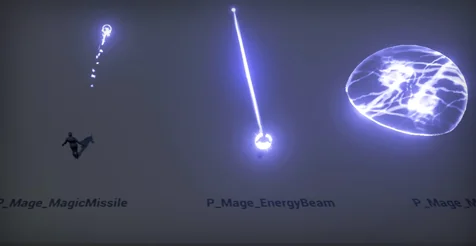
Distributing nine effects per hero allows teams to build complete ability profiles for individual character kits without mixing mismatched art styles. An Archer kit typically requires high-velocity trajectory trails, impact bursts, and piercing shot flourishes. In contrast, Warrior visuals generally emphasize physical momentum, ground-cracking impacts, cleave trails, and blunt force energy. The Mage set accommodates elemental conjuring, burst detonations, and sustained magical casting, while the Priest effects focus on supportive emanations, restoration indicators, and protective auras. Because all thirty-six hero effects share a unified stylized aesthetic, teams can construct encounter gameplay where abilities from competing or allied classes remain visually distinct yet stylistically harmonious.
Tuning Colour, Alpha, and Lifetime in Niagara FX
Deploying combat effects across varying environments requires granular control over emitter parameters. The particles in the package are updated for Unreal Engine 4.26's Niagara architecture, exposing key properties directly through user-facing particle parameters. Instead of forcing artists to rebuild emitter networks from scratch, the system enables rapid aesthetic shifts through exposed variables such as Colour, Alpha, Lifetime, and Size.
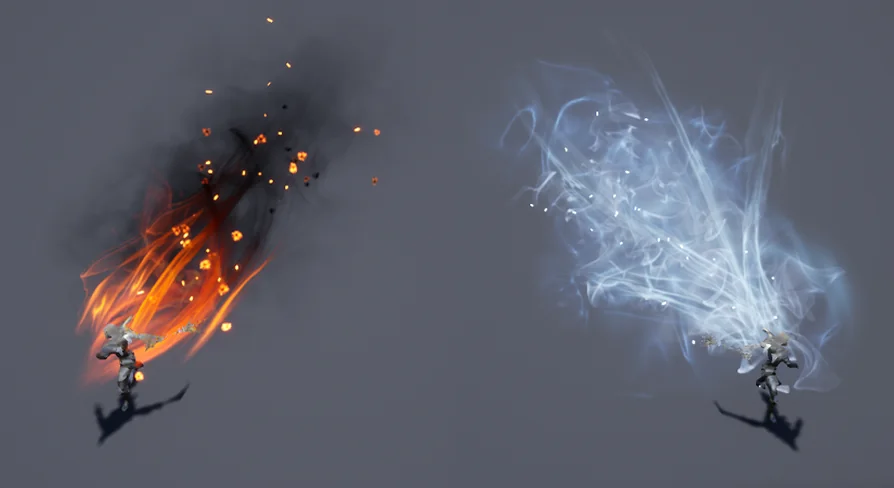
Modifying the Colour parameter allows a developer to repurpose a single ability effect across elemental variations or faction alignments. A Warrior's cleave or burst effect can shift from aggressive crimson to icy blue or necrotic green to reflect enchanted weaponry or enemy variants. Adjusting Alpha parameters gives control over transparency, enabling artists to dial down visual clutter during high-density multiplayer fights or elevate opacity for critical cinematic attacks. Lifetime controls directly govern how long particle bursts linger in the game world, allowing technical designers to align emitter dissipation with hit-frame data, animation cancels, and weapon recovery frames. Size adjustments ensure that an effect scaled for a standard humanoid character can expand smoothly to fit giant boss encounters or scale down for agile minions.
Customizable Targeting Effects and Combat Statuses
Beyond active class abilities, tactical gameplay relies heavily on telegraphing incoming threats and communicating character states. The collection contains five dedicated targeting effects designed to indicate spell placement, skill shots, and area boundaries before an ability activates. These targeting effects feature full customization across size and shape, allowing teams to map them precisely to specific game logic—whether an ability covers a narrow directional cone, a broad circular perimeter, or a focused impact node. Aligning targeting shape scales with actual damage collision volumes ensures accurate gameplay feedback for players dodging or aiming attacks.
Status communication is handled by eight distinct status effects created to represent active combat conditions. Among these are dedicated indicators for Stun, Confusion, and a Teleport effect. A Stun effect visually grounds an immobilized character, giving immediate tactical feedback that inputs are disabled. The Confusion effect provides a readable visual disruption above or around the affected target, signaling disoriented movement or reversed controls. The Teleport effect supplies the necessary entry and exit visual cues for blinks, spatial leaps, or recall mechanics, hiding the instant translation of a character mesh across the game world with an energetic burst.
Material Functions, Instances, and Mesh Integration
Underpinning the visual effects is a modular rendering setup consisting of 42 Materials, 1 Material Function, 6 Material Instances, 25 Meshes, and 40 Textures. This technical balance ensures that the stylized aesthetic remains lightweight while maintaining high expressive flexibility across Niagara emitters.
The single material function serves as a centralized logic hub, standardizing core shading behaviors, UV distortion math, or blending routines across the material library. By driving six material instances from the parent materials, the pack establishes a workflow where global adjustments to shader behavior propagate cleanly throughout the particle systems without recompiling every individual asset. The 40 included textures supply stylized noise patterns, energy ramps, alpha masks, and elemental shapes that feed into the Niagara systems. Meanwhile, the 25 custom meshes provide stylized geometry for three-dimensional energy rings, directional slashes, weapon trails, and physical debris spikes, grounding the particles in solid three-dimensional forms rather than relying solely on flat camera-facing billboards.
Pipeline Fit for Stylized Combat Systems
Developers constructing top-down MOBAs or third-person Action RPGs often face the bottleneck of generating dozens of bespoke visual cues before gameplay mechanics can be adequately tested. The combination of structured hero kits, customizable targeting projections, and unambiguous status ailments provides a direct pipeline solution. Designers can prototype new character classes and balance combat timing using fully functional Niagara emitters that already account for visual telegraphing and recovery windows. For teams working within Unreal Engine 4.26, the pack establishes an adaptable foundation of stylized combat visual effects ready to be tuned to specific combat balances.
 Spells & Combat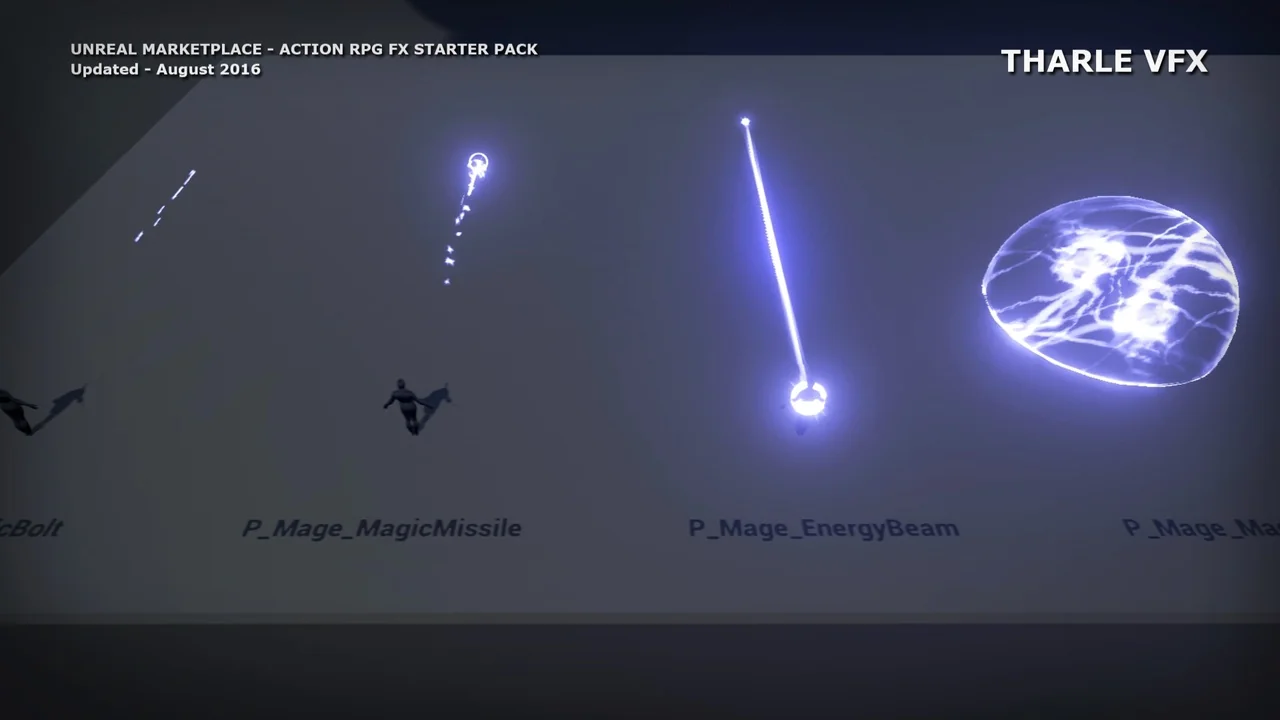
 Spells & Combat
 Spells & Combat
 Spells & Combat