"fa182e0cd0a6ea73"{"id":"1000575","slug":"dgruwier-flashlight-textures","title":"DGruwier Flashlight Textures","category":"Consumer","engine":"5.1+","assetVersion":"","engineVersion":"Engine Version: 5.1+","tag":"Consumer","accent":"blue","visual":"luts","summary":"52 high-resolution 16-bit 2K flashlight light cookie textures for games, VFX, and animation, compatible with Unity, Unreal Engine, Octane, Vray, Redshift, and C","platform":"Unreal Engine","publishedAt":"2026-07-16T22:59:56.333Z","updatedAt":"2026-07-16T22:59:56.333Z","sourceNotes":[],"fileContents":[],"compatibility":["Unreal Engine","Engine Version: 5.1+"],"featuredImage":{"alt":"DGruwier Flashlight Textures","src":"/wp-content/uploads/published/2026/07/3af00a78af66-rqahmzlsmvvzy5oge0unw0rzctms-0bbfcfcb44.webp"},"hasDownloadLink":true,"downloads":2,"terms":[{"taxonomy":"category","slug":"consumer","name":"Consumer"}],"galleryImages":[],"accessPanel":{"kind":"resource","title":"Download this resource","eyebrow":"Free Download","message":"Log in or create a free account to start your download.","fileName":"DGruwierFlashlightTextures.7z","safetyNote":"Resources are manually reviewed before listing to improve quality and reduce obvious risks.","actionLabel":"Download Free","resourceType":"Resource archive"},"contentHtml":"\u003cp\u003eImplementing realistic flashlight beams in a digital scene usually requires more than simply attaching a light source to a virtual object. To get realistic falloff, lens artifacts, and dispersion patterns, engines rely on light cookies, which are grayscale projection textures placed in front of a light to mask its shape and output. The DGruwier Flashlight Textures library provides 52 high-resolution 2K textures designed to serve this specific role. The images are 16-bit, meaning they offer more steps between pure black and pure white than standard 8-bit files. This translates into smoother gradients when a flashlight beam needs to show soft edges or subtle internal hotspots.\u003c/p\u003e\u003cp\u003eThe pack is built to be engine-agnostic. Any render engine or game engine that supports light textures or light cookies can ingest the files. The creator specifically lists compatibility with Octane, Vray, Redshift, Unity, Unreal Engine, and Cycles. Readying the textures inside Unreal Engine 5.1.1 or Blender 3.5 can be guided by the included example scenes, which are included in the package.\u003c/p\u003e\u003ch2\u003eEngine Compatibility and Integration\u003c/h2\u003e\u003cp\u003eThe library requires no proprietary pipeline. The files function as standard projection textures, so they slot into existing lighting rigs wherever a light cookie node or light function slot is available.\u003c/p\u003e\u003cp\u003eIn Unity and Unreal Engine, the 2K 16-bit files can be imported as textures and assigned to a spotlight's cookie or light function parameter. In offline renderers such as Vray, Redshift, and Octane, the same files can be connected to a light's projection or cookie image input. Because the files are 16-bit, they hold up well under operations that pull contrast into the extremes, such as tightening the intensity of a flashlight to create a harsher hotspot while maintaining a smooth gradient toward the beam spill. The included example files for Blender 3.5 and Unreal Engine 5.1.1 demonstrate how the creator intended the cookies to be applied inside those two environments.\u003c/p\u003e\u003ch2\u003eAnatomy of the 52 Flashlight Textures\u003c/h2\u003e\u003cp\u003eThe core of the pack is 52 individual flashlight textures. Each file is rendered at a 2K resolution with a 16-bit color depth. The variety covers different flashlight profiles, shapes, and beam patterns. Using static textures for flashlight beams works well for scenes with fixed lighting requirements, but some situations call for motion. To address this, the pack includes an animated flashlight focus pull. This file simulates the effect of a flashlight lens being adjusted in real time, changing the beam from a wide flood to a tighter spot or vice versa.\u003c/p\u003e\u003ch3\u003eHow the 16-Bit 2K Flashlight Textures Were Built\u003c/h2\u003e\u003cp\u003eThe textures were not captured with simple photography. The creator used a constructive approach to generate the files. They began by 3D modeling flashlight lenses. The modeling process was based on patent drawings, CAD models, and photo reference. Building the lenses from these sources gave the digital geometry a strong physical basis, rather than relying on purely artistic interpretation, ensuring the lens profiles and internal structures matched existing hardware.\u003c/p\u003e\u003cp\u003eOnce the digital lenses were constructed, the creator rendered the resulting beams with dispersion and caustics. Dispersion accounts for how light separates into different wavelengths as it passes through optical glass, while caustics handle the concentrated patterns created when light bends through and around the physical structures inside a lens. Rendering with these properties allowed the creator to bring out subtle details and imperfections that real flashlights and spotlights exhibit. This includes the minor flaws, internal reflections, and uneven beam distributions that make a projected light look like it is coming from a physical object rather than a clean synthetic source.\u003c/p\u003e\u003ch2\u003eApplying Light Cookies in Games, VFX, and Animation\u003c/h2\u003e\u003cp\u003eThe library is designed to serve three domains. In games, projecting a light cookie from a flashlight mesh gives the beam a physical identity. The dispersion and caustic details baked into the textures help sell the illusion that the light is passing through a polished glass lens. In VFX work, the 16-bit depth of the files allows for compositing flexibility, holding up under exposure adjustments and color grading without banding. For animation, the animated flashlight focus pull adds the ability to show a beam tightening or loosening during a shot, a behavior that real flashlights exhibit when their heads are twisted or adjusted.\u003c/p\u003e\u003ch3\u003eExample Files for Blender 3.5 and Unreal Engine 5.1.1\u003c/h2\u003e\u003cp\u003eThe creator provides example files for two specific environments. The Blender 3.5 example demonstrates how a flashlight cookie can be integrated using Cycles, which is a path-tracing renderer. The Unreal Engine 5.1.1 example shows how the same textures can be applied within a real-time pipeline, where light function materials direct the projection texture. These files function as references for seeing the textures in a working scene. Developers can inspect the example setups to see how the creator applied the cookies to lights, and then replicate that approach for their own scenes.\u003c/p\u003e\u003ch2\u003eWho Benefits From a Focused Flashlight Textures Library\u003c/h2\u003e\u003cp\u003eCreators who need to simulate flashlight beams in dark environments such as horror games, technical visualization, or cinematic animation will find this pack useful. The library provides a technically grounded alternative to generic circular gradients or procedurally generated light functions. Because the textures were generated from physically modeled lenses and rendered with optical phenomena like dispersion and caustics, they are suited for productions where matching the behavior of real flashlights is a priority. The inclusion of an animated focus pull file adds value for anyone who needs dynamic beam adjustments without building a custom simulation. The pack comes with a commercial license.\u003c/p\u003e\n\n\u003ch2\u003eExplore Similar Assets\u003c/h2\u003e\n\u003cul\u003e\n\u003cli\u003e\u003ca href=\"https://3dcghub.com/the-flashlight-toolkit/\" title=\"The Flashlight Toolkit\"\u003eThe Flashlight Toolkit\u003c/a\u003e\u003c/li\u003e\n\u003cli\u003e\u003ca href=\"https://3dcghub.com/radio-system-and-interaction/\" title=\"Radio System and Interaction\"\u003eRadio System and Interaction\u003c/a\u003e\u003c/li\u003e\n\u003cli\u003e\u003ca href=\"https://3dcghub.com/multiplayer-horror-bodycam/\" title=\"Multiplayer Horror Bodycam\"\u003eMultiplayer Horror Bodycam\u003c/a\u003e\u003c/li\u003e\n\u003cli\u003e\u003ca href=\"https://3dcghub.com/hdri-into-the-clouds-panoramas/\" title=\"HDRI Into The Clouds Panoramas\"\u003eHDRI Into The Clouds Panoramas\u003c/a\u003e\u003c/li\u003e\n\u003cli\u003e\u003ca href=\"https://3dcghub.com/hdri-into-the-clouds-panoramas-2/\" title=\"HDRI Into The Clouds Panoramas\"\u003eHDRI Into The Clouds Panoramas\u003c/a\u003e\u003c/li\u003e\n\u003c/ul\u003e","contentTextLength":6065,"navigation":{"current":1360,"total":3789,"previous":{"id":"1000576","slug":"comic-sound-effect-fx","title":"Comic Sound Effect FX","category":"Variety","platform":"Unreal Engine","updatedAt":"2026-07-16T23:07:30.522Z"},"next":{"id":"25066","slug":"directexcel","title":"DirectExcel","category":"Engine Tools","platform":"Unreal Engine","updatedAt":"2026-07-16T22:54:41.230Z"}},"relatedResources":[{"id":"11537","slug":"radio-system-and-interaction","title":"Radio System and Interaction","category":"Procedural Systems","engine":"5.4+","assetVersion":"Engine version: 5.4+","engineVersion":"4.16","tag":"Procedural Systems","accent":"blue","visual":"mech","summary":"This Radio System and Interaction package provides a highly detailed 3D model equipped with 4K PBR textures. It includes interactive features such as frequency searching, volume control, and an integrated flashlight for immersive gameplay.","platform":"Unreal Engine","publishedAt":"2026-03-05T17:42:18.000Z","updatedAt":"2026-04-19T15:48:10.000Z","sourceNotes":[],"fileContents":[],"compatibility":["Unreal Engine","Engine version: 5.4+"],"featuredImage":{"alt":"Radio System and Interaction","src":"https://3dcghub.com/wp-content/uploads/2026/03/05db4a02-e2ac-434b-8f79-203c3e425a71.webp"},"hasDownloadLink":true,"downloads":0},{"id":"11162","slug":"the-flashlight-toolkit","title":"The Flashlight Toolkit","category":"Gameplay Features","engine":"5.2+","assetVersion":"Engine version: 5.2+","engineVersion":"4.27","tag":"Gameplay Features","accent":"blue","visual":"mech","summary":"Add professional lighting mechanics to your project in minutes with this beginner-friendly system. It features net replication, an inventory manager, and full blueprint support.","platform":"Unreal Engine","publishedAt":"2026-03-03T17:02:40.000Z","updatedAt":"2026-04-19T15:48:15.000Z","sourceNotes":[],"fileContents":[],"compatibility":["Unreal Engine","Engine version: 5.2+"],"featuredImage":{"alt":"The Flashlight Toolkit","src":"https://3dcghub.com/wp-content/uploads/2026/03/2118b25e-a01e-49b5-b831-66eb5803d44a.webp"},"hasDownloadLink":true,"downloads":0},{"id":"12770","slug":"ground-material-texture-pack-advanced-materials-5-variations","title":"Ground Material Texture Pack (Advanced Materials / 5 Variations)","category":"Nature \u0026 Terrain","engine":"5.1+","assetVersion":"Engine version: 5.1+","engineVersion":"5.1","tag":"Nature \u0026 Terrain","accent":"blue","visual":"luts","summary":"Build believable natural landscapes with this versatile ground material pack. It includes five unique tiling textures, master materials, and material instances for easy customization.","platform":"Unreal Engine","publishedAt":"2026-03-09T16:36:13.000Z","updatedAt":"2026-04-19T15:46:36.000Z","sourceNotes":[],"fileContents":[],"compatibility":["Unreal Engine","Engine version: 5.1+"],"featuredImage":{"alt":"Ground Material Texture Pack (Advanced Materials / 5 Variations)","src":"https://3dcghub.com/wp-content/uploads/2026/03/3f181444-e9ff-4f49-91c9-f3cec31921a1.webp"},"hasDownloadLink":true,"downloads":2}]}
Consumer
DGruwier Flashlight Textures
52 high-resolution 16-bit 2K flashlight light cookie textures for games, VFX, and animation, compatible with Unity, Unreal Engine, Octane, Vray, Redshift, and C
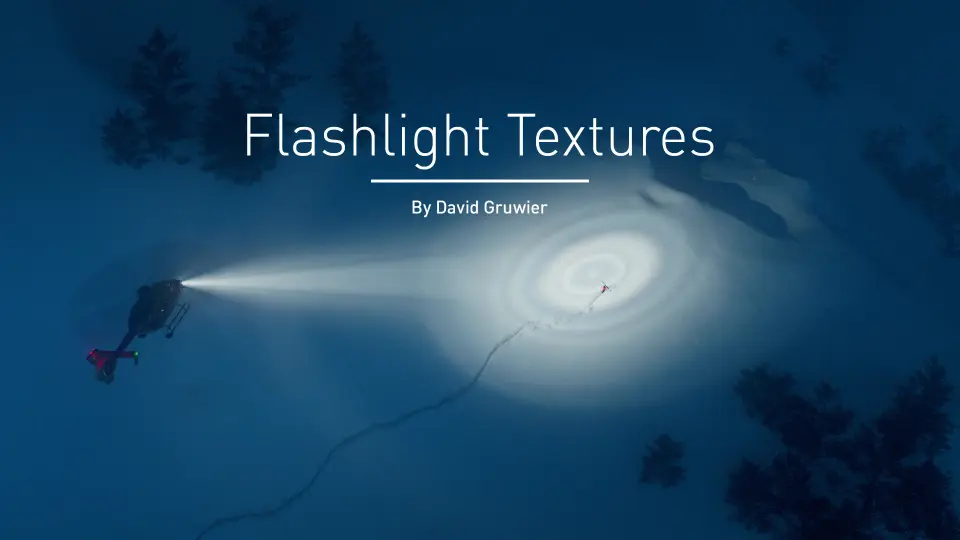
Implementing realistic flashlight beams in a digital scene usually requires more than simply attaching a light source to a virtual object. To get realistic falloff, lens artifacts, and dispersion patterns, engines rely on light cookies, which are grayscale projection textures placed in front of a light to mask its shape and output. The DGruwier Flashlight Textures library provides 52 high-resolution 2K textures designed to serve this specific role. The images are 16-bit, meaning they offer more steps between pure black and pure white than standard 8-bit files. This translates into smoother gradients when a flashlight beam needs to show soft edges or subtle internal hotspots.
The pack is built to be engine-agnostic. Any render engine or game engine that supports light textures or light cookies can ingest the files. The creator specifically lists compatibility with Octane, Vray, Redshift, Unity, Unreal Engine, and Cycles. Readying the textures inside Unreal Engine 5.1.1 or Blender 3.5 can be guided by the included example scenes, which are included in the package.
Engine Compatibility and Integration
The library requires no proprietary pipeline. The files function as standard projection textures, so they slot into existing lighting rigs wherever a light cookie node or light function slot is available.
In Unity and Unreal Engine, the 2K 16-bit files can be imported as textures and assigned to a spotlight's cookie or light function parameter. In offline renderers such as Vray, Redshift, and Octane, the same files can be connected to a light's projection or cookie image input. Because the files are 16-bit, they hold up well under operations that pull contrast into the extremes, such as tightening the intensity of a flashlight to create a harsher hotspot while maintaining a smooth gradient toward the beam spill. The included example files for Blender 3.5 and Unreal Engine 5.1.1 demonstrate how the creator intended the cookies to be applied inside those two environments.
Anatomy of the 52 Flashlight Textures
The core of the pack is 52 individual flashlight textures. Each file is rendered at a 2K resolution with a 16-bit color depth. The variety covers different flashlight profiles, shapes, and beam patterns. Using static textures for flashlight beams works well for scenes with fixed lighting requirements, but some situations call for motion. To address this, the pack includes an animated flashlight focus pull. This file simulates the effect of a flashlight lens being adjusted in real time, changing the beam from a wide flood to a tighter spot or vice versa.
How the 16-Bit 2K Flashlight Textures Were Built
The textures were not captured with simple photography. The creator used a constructive approach to generate the files. They began by 3D modeling flashlight lenses. The modeling process was based on patent drawings, CAD models, and photo reference. Building the lenses from these sources gave the digital geometry a strong physical basis, rather than relying on purely artistic interpretation, ensuring the lens profiles and internal structures matched existing hardware.
Once the digital lenses were constructed, the creator rendered the resulting beams with dispersion and caustics. Dispersion accounts for how light separates into different wavelengths as it passes through optical glass, while caustics handle the concentrated patterns created when light bends through and around the physical structures inside a lens. Rendering with these properties allowed the creator to bring out subtle details and imperfections that real flashlights and spotlights exhibit. This includes the minor flaws, internal reflections, and uneven beam distributions that make a projected light look like it is coming from a physical object rather than a clean synthetic source.
Applying Light Cookies in Games, VFX, and Animation
The library is designed to serve three domains. In games, projecting a light cookie from a flashlight mesh gives the beam a physical identity. The dispersion and caustic details baked into the textures help sell the illusion that the light is passing through a polished glass lens. In VFX work, the 16-bit depth of the files allows for compositing flexibility, holding up under exposure adjustments and color grading without banding. For animation, the animated flashlight focus pull adds the ability to show a beam tightening or loosening during a shot, a behavior that real flashlights exhibit when their heads are twisted or adjusted.
Example Files for Blender 3.5 and Unreal Engine 5.1.1
The creator provides example files for two specific environments. The Blender 3.5 example demonstrates how a flashlight cookie can be integrated using Cycles, which is a path-tracing renderer. The Unreal Engine 5.1.1 example shows how the same textures can be applied within a real-time pipeline, where light function materials direct the projection texture. These files function as references for seeing the textures in a working scene. Developers can inspect the example setups to see how the creator applied the cookies to lights, and then replicate that approach for their own scenes.
Who Benefits From a Focused Flashlight Textures Library
Creators who need to simulate flashlight beams in dark environments such as horror games, technical visualization, or cinematic animation will find this pack useful. The library provides a technically grounded alternative to generic circular gradients or procedurally generated light functions. Because the textures were generated from physically modeled lenses and rendered with optical phenomena like dispersion and caustics, they are suited for productions where matching the behavior of real flashlights is a priority. The inclusion of an animated focus pull file adds value for anyone who needs dynamic beam adjustments without building a custom simulation. The pack comes with a commercial license.
 Consumer
 Procedural Systems
 Gameplay Features
 Nature & Terrain