"7e6fc58c410f2894"{"id":"1001644","slug":"cyberpunk-fx-pack-2-neon-panels-and-screens","title":"Cyberpunk FX Pack 2 - Neon Panels and Screens","category":"Shaders","engine":"4.20+,5.0+","assetVersion":"","engineVersion":"Engine Version: 4.20+,5.0+","tag":"Shaders","accent":"blue","visual":"mech","summary":"Implement deformable neon signs, parallax 3D effect textures, hologram screens, and hologram globes from Cyberpunk FX Pack 2 into custom environments.","platform":"Unreal Engine","publishedAt":"2026-10-13T02:28:20.229Z","updatedAt":"2026-10-13T02:28:20.229Z","sourceNotes":[],"fileContents":[],"compatibility":["Unreal Engine","Engine Version: 4.20+,5.0+"],"featuredImage":{"alt":"Cyberpunk FX Pack 2 - Neon Panels and Screens","src":"/wp-content/uploads/published/2026/10/420306a50bfd-06b12c54-c578-4a0e-9f69-4f4069add9a2-0df00049ea.webp"},"hasDownloadLink":true,"downloads":0,"terms":[{"taxonomy":"category","slug":"shaders","name":"Shaders"}],"galleryImages":[{"src":"/wp-content/uploads/published/2026/10/eaf38f790776-b31d17c0-e8ed-440f-9403-57b5e2184f5c-0f6724ddf8.webp","alt":"Cyberpunk FX Pack 2 - Neon Panels and Screens"},{"src":"/wp-content/uploads/published/2026/10/f037da1d0304-d2db418a-b5c8-47b9-b3f0-a099e0cbdd04-36e599c80e.webp","alt":"Cyberpunk FX Pack 2 - Neon Panels and Screens"},{"src":"/wp-content/uploads/published/2026/10/5c68c718d7a0-db010f44-5b81-455c-b032-67df2bd9f629-d85e69617c.webp","alt":"Cyberpunk FX Pack 2 - Neon Panels and Screens"},{"src":"/wp-content/uploads/published/2026/10/50d63e7875fd-89937b84-eb16-48b7-b352-de4b8427c0a0-547e812f58.webp","alt":"Cyberpunk FX Pack 2 - Neon Panels and Screens"},{"src":"/wp-content/uploads/published/2026/10/a037bd123ee4-b2b515f4-7fef-4e9e-96cc-9201591b2834-fdd86e49a9.webp","alt":"Cyberpunk FX Pack 2 - Neon Panels and Screens"},{"src":"/wp-content/uploads/published/2026/10/e04da141d5fd-e8b72e56-513b-4338-a0f7-f361a6ff4255-4d1bfb4156.webp","alt":"Cyberpunk FX Pack 2 - Neon Panels and Screens"},{"src":"/wp-content/uploads/published/2026/10/b631ebe074fb-567b1b39-15ae-4d23-8454-9a94f8da97b0-4eb7f0558f.webp","alt":"Cyberpunk FX Pack 2 - Neon Panels and Screens"},{"src":"/wp-content/uploads/published/2026/10/ff36ef1eb276-1f22ae18-a87d-414f-8e74-7bee01d5e40c-d3af341c5c.webp","alt":"Cyberpunk FX Pack 2 - Neon Panels and Screens"},{"src":"/wp-content/uploads/published/2026/10/46ad5f0f808d-04a2725e-a2bc-45a8-a897-95fcea93c41d-4f6cf04a1d.webp","alt":"Cyberpunk FX Pack 2 - Neon Panels and Screens"},{"src":"/wp-content/uploads/published/2026/10/85badbcf5370-894a51b9-1208-454c-887c-56b57b239def-d7e9a81a35.webp","alt":"Cyberpunk FX Pack 2 - Neon Panels and Screens"}],"accessPanel":{"kind":"resource","title":"Download this resource","eyebrow":"Free Download","message":"Log in or create a free account to start your download.","fileName":"Content.7z","safetyNote":"Resources are manually reviewed before listing to improve quality and reduce obvious risks.","actionLabel":"Download Free","resourceType":"Resource archive"},"contentHtml":"\u003ch2\u003eConfiguring Deformable Neon Signs Across Custom Surfaces\u003c/h2\u003e\n\u003cp\u003eIntegrating environmental visual effects into dense futuristic scenes often requires signage to wrap around architectural corners, sit flush against curved walls, or bend across irregular structures. The neon sign assets in this collection provide two distinct approaches to mesh adaptation: procedural deformation and manual deformation. When working with complex structural layouts, procedural controls allow the geometry of the neon tubes and backplates to automatically calculate adjustments along defined vectors, speeding up placement across repeated structural pillars and curved storefront facades.\u003c/p\u003e\n\u003cp\u003eFor custom placements where an exact artistic silhouette is needed, manual deformation gives direct control over the physical contouring of the neon signs. This dual workflow ensures that signage is not restricted to flat rectangular planes. It should be noted during initial level dressing that broad city geometry displayed in promotional demonstrations serves purely as background staging and is not packaged with the assets. Creators must supply their own building shells, alleys, and roadway layouts, applying the deformable neon signs directly onto their project's custom environment meshes.\u003c/p\u003e \u003ch2\u003eSimulating Depth with Parallax 3D Effect Textures\u003c/h2\u003e\n\u003cp\u003eFlat displays frequently break scene immersion when viewed from acute camera angles. To resolve this without increasing geometric overhead, the pack includes parallax 3D effect textures that create an illusion of internal volumetric space behind glass panels and screens. These material setups simulate multi-layered depth inside terminal windows, recessed neon housings, and interior display frames, shifting the perceived perspective as the player or camera moves past the surface.\u003c/p\u003e\n\u003cp\u003eBy relying on parallax mapping calculations within the texture shaders rather than modeled interior geometry, artists can populate long corridors, storefronts, and massive digital billboards with detailed visual depth. This approach maintains high rendering efficiency while delivering the complex, recessed layering typical of high-density cyberpunk streetscapes.\u003c/p\u003e \u003ch2\u003eDeploying Hologram Screens and Hologram Globes\u003c/h2\u003e\n\u003cp\u003eThe collection extends beyond standard solid-state lighting by supplying floating holographic elements, notably flat hologram screens and spherical hologram globes. Hologram screens are structured to handle interface visuals, data displays, and floating UI panels that can hover independently within architectural voids, above reception counters, or alongside building entryways. Their translucent and emissive material characteristics allow them to integrate cleanly into high-contrast night scenes without relying on physical mounting brackets.\u003c/p\u003e\n\u003cp\u003eHologram globes offer a fully volumetric aesthetic for spatial interfaces, navigation hubs, planetary projections, and tactical displays. Positioning these spherical projections requires careful coordination with surrounding ambient light sources, as their translucent spherical materials cast distinct luminous profiles that can serve as focal points for sci-fi interiors, command rooms, or open-air street markets.\u003c/p\u003e \u003ch2\u003eTypography, Vector Assets, and Epic Demo Room Integration\u003c/h2\u003e\n\u003cp\u003eVisual credibility in sci-fi signage relies heavily on graphic identity and typographic style. The pack incorporates 2D neon sign vector artwork created by Freepik, supplying foundational vector profiles designed specifically to translate into high-intensity luminous strokes. These vector silhouettes give the glowing tubing clean, readable edges even when emissive bloom and post-processing passes are heavily applied to the scene.\u003c/p\u003e\n\u003cp\u003eTypography across the signage utilizes the Gang of Three font crafted by Vic Fieger. This typeface provides angular, stylized letterforms that match East Asian and industrial cyberpunk design conventions, ensuring text-based signs remain legible while reinforcing the visual themes of futuristic city centers. Additionally, the asset package integrates functional content derived from the Epic Demo Room, giving users a standardized testing baseline to inspect material instances, luminous outputs, and mesh deformations within a calibrated staging environment before migrating assets into full production levels.\u003c/p\u003e \u003ch2\u003ePairing Neon Panels with the Broader Cyberpunk Collection\u003c/h2\u003e\n\u003cp\u003eCyberpunk FX Pack 2 represents an ongoing progression within the creator's broader Cyberpunk collection, serving as a dedicated follow-up to the original Cyberpunk FX Pack. While the earlier release established general visual effects and atmospheric treatments for sci-fi settings, this second release focuses its toolset on environmental display hardware, luminous advertising, and interactive projections.\u003c/p\u003e\n\u003cp\u003eBecause the pack is developed as a modular companion to the first Cyberpunk FX Pack, the shaders, holographic projection parameters, and neon light profiles are built to operate harmoniously alongside the foundational visual effects from the original library. Combining the atmospheric effects from the initial release with the deformable panels, parallax textures, and hologram screens from Pack 2 enables the creation of cohesive, multi-layered urban environments with continuous art direction across all emissive and holographic surfaces.\u003c/p\u003e\n\n\u003ch2\u003eExplore Similar Assets\u003c/h2\u003e\n\u003cul\u003e\n\u003cli\u003e\u003ca href=\"https://3dcghub.com/cyberpunk-fx-pack/\" title=\"Cyberpunk FX Pack\"\u003eCyberpunk FX Pack\u003c/a\u003e\u003c/li\u003e\n\u003cli\u003e\u003ca href=\"https://3dcghub.com/wall-fx-pack/\" title=\"Wall FX pack\"\u003eWall FX pack\u003c/a\u003e\u003c/li\u003e\n\u003cli\u003e\u003ca href=\"https://3dcghub.com/good-fx-ui-icon-trail/\" title=\"Good FX : UI Icon Trail\"\u003eGood FX : UI Icon Trail\u003c/a\u003e\u003c/li\u003e\n\u003cli\u003e\u003ca href=\"https://3dcghub.com/cyberpunk-holograms-neon-set-set-of-33-holograms/\" title=\"Cyberpunk Holograms / Neon Set ( Set of 33 Holograms )\"\u003eCyberpunk Holograms / Neon Set ( Set of 33 Holograms )\u003c/a\u003e\u003c/li\u003e\n\u003cli\u003e\u003ca href=\"https://3dcghub.com/lasers-with-shadows/\" title=\"Lasers with shadows\"\u003eLasers with shadows\u003c/a\u003e\u003c/li\u003e\n\u003c/ul\u003e","contentTextLength":5438,"navigation":{"current":39,"total":3618,"previous":{"id":"1001645","slug":"cyberpunk-street","title":"CYBERPUNK STREET","category":"Cyberpunk","platform":"Unreal Engine","updatedAt":"2026-10-13T02:29:04.369Z"},"next":{"id":"1001643","slug":"lighting-vol-2-interior-nanite-and-low-poly","title":"Lighting VOL.2 - Interior (Nanite and Low Poly)","category":"Lighting","platform":"Unreal Engine","updatedAt":"2026-10-13T02:27:28.794Z"}},"relatedResources":[{"id":"15803","slug":"cyberpunk-fx-pack","title":"Cyberpunk FX Pack","category":"Shaders","engine":"4.26+,5.0+","assetVersion":"Engine version: 4.26+,5.0+","engineVersion":"4.16","tag":"Shaders","accent":"blue","visual":"city","summary":"Enhance your game environments with the Cyberpunk FX Pack, featuring over 70 shaders and 15 mesh effects. This collection is optimized for high performance using vertex animations, making it ideal for futuristic bars and digital presentations.","platform":"Unreal Engine","publishedAt":"2026-03-12T13:10:40.000Z","updatedAt":"2026-04-19T15:44:40.000Z","sourceNotes":[],"fileContents":[],"compatibility":["Unreal Engine","Engine version: 4.26+,5.0+"],"featuredImage":{"alt":"Cyberpunk FX Pack","src":"https://3dcghub.com/wp-content/uploads/2026/03/108e257d-721c-4afc-be8e-0016bd1a1d59.webp"},"hasDownloadLink":true,"downloads":1},{"id":"15973","slug":"wall-fx-pack","title":"Wall FX pack","category":"Shaders","engine":"4.26+,5.0+","assetVersion":"Engine version: 4.26+,5.0+","engineVersion":"4.24","tag":"Shaders","accent":"blue","visual":"audio","summary":"The Wall FX pack is a versatile collection of visual effects designed for futuristic and cyberpunk environments. It features stylized assets like holograms, electric shields, and glitch effects.","platform":"Unreal Engine","publishedAt":"2026-03-12T13:38:58.000Z","updatedAt":"2026-04-19T15:44:38.000Z","sourceNotes":[],"fileContents":[],"compatibility":["Unreal Engine","Engine version: 4.26+,5.0+"],"featuredImage":{"alt":"Wall FX pack","src":"https://3dcghub.com/wp-content/uploads/2026/03/ed2e601e-04c7-4770-8d41-c42abec5f623.webp"},"hasDownloadLink":true,"downloads":0},{"id":"1000834","slug":"good-fx-ui-icon-trail","title":"Good FX : UI Icon Trail","category":"Shaders","engine":"4.26+,5.0+","assetVersion":"","engineVersion":"Engine Version: 4.26+,5.0+","tag":"Shaders","accent":"blue","visual":"mech","summary":"A material-driven UI effect pack with over 20 icon animation presets, customizable parameters, and support for desktop, mobile, and VR platforms.","platform":"Unreal Engine","publishedAt":"2026-08-03T13:13:06.882Z","updatedAt":"2026-08-03T13:13:06.882Z","sourceNotes":[],"fileContents":[],"compatibility":["Unreal Engine","Engine Version: 4.26+,5.0+"],"featuredImage":{"alt":"Good FX : UI Icon Trail","src":"/wp-content/uploads/published/2026/08/500483cbcab3-0644eb9a-2271-4184-a014-a7e6abb267e1-c0b2531ae5.webp"},"hasDownloadLink":true,"downloads":0}]}
Shaders
Cyberpunk FX Pack 2 - Neon Panels and Screens
Implement deformable neon signs, parallax 3D effect textures, hologram screens, and hologram globes from Cyberpunk FX Pack 2 into custom environments.
Category:Unreal Engine,ShadersPlatform: Unreal EngineEngine Version: 4.20+,5.0+Published: Oct 13, 2026
Shaders
Resource overview
Configuring Deformable Neon Signs Across Custom Surfaces
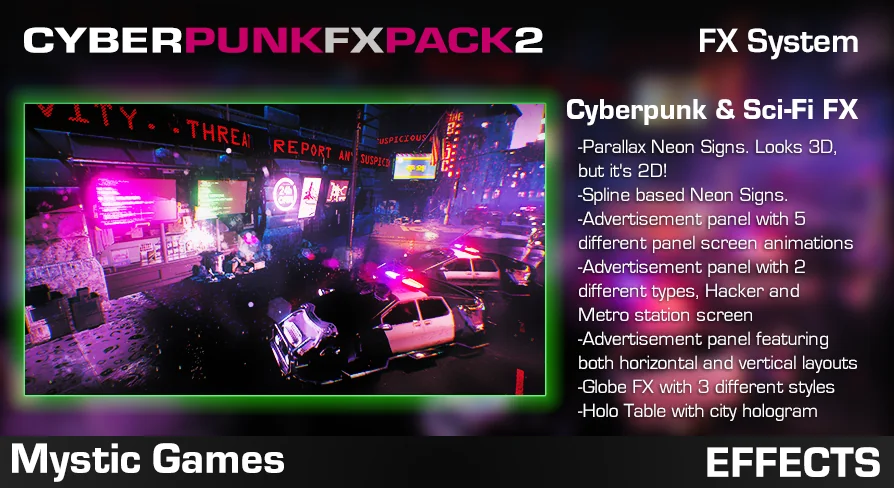
Integrating environmental visual effects into dense futuristic scenes often requires signage to wrap around architectural corners, sit flush against curved walls, or bend across irregular structures. The neon sign assets in this collection provide two distinct approaches to mesh adaptation: procedural deformation and manual deformation. When working with complex structural layouts, procedural controls allow the geometry of the neon tubes and backplates to automatically calculate adjustments along defined vectors, speeding up placement across repeated structural pillars and curved storefront facades.
For custom placements where an exact artistic silhouette is needed, manual deformation gives direct control over the physical contouring of the neon signs. This dual workflow ensures that signage is not restricted to flat rectangular planes. It should be noted during initial level dressing that broad city geometry displayed in promotional demonstrations serves purely as background staging and is not packaged with the assets. Creators must supply their own building shells, alleys, and roadway layouts, applying the deformable neon signs directly onto their project's custom environment meshes.
Simulating Depth with Parallax 3D Effect Textures
Flat displays frequently break scene immersion when viewed from acute camera angles. To resolve this without increasing geometric overhead, the pack includes parallax 3D effect textures that create an illusion of internal volumetric space behind glass panels and screens. These material setups simulate multi-layered depth inside terminal windows, recessed neon housings, and interior display frames, shifting the perceived perspective as the player or camera moves past the surface.
By relying on parallax mapping calculations within the texture shaders rather than modeled interior geometry, artists can populate long corridors, storefronts, and massive digital billboards with detailed visual depth. This approach maintains high rendering efficiency while delivering the complex, recessed layering typical of high-density cyberpunk streetscapes.
Deploying Hologram Screens and Hologram Globes
The collection extends beyond standard solid-state lighting by supplying floating holographic elements, notably flat hologram screens and spherical hologram globes. Hologram screens are structured to handle interface visuals, data displays, and floating UI panels that can hover independently within architectural voids, above reception counters, or alongside building entryways. Their translucent and emissive material characteristics allow them to integrate cleanly into high-contrast night scenes without relying on physical mounting brackets.
Hologram globes offer a fully volumetric aesthetic for spatial interfaces, navigation hubs, planetary projections, and tactical displays. Positioning these spherical projections requires careful coordination with surrounding ambient light sources, as their translucent spherical materials cast distinct luminous profiles that can serve as focal points for sci-fi interiors, command rooms, or open-air street markets.
Typography, Vector Assets, and Epic Demo Room Integration
Visual credibility in sci-fi signage relies heavily on graphic identity and typographic style. The pack incorporates 2D neon sign vector artwork created by Freepik, supplying foundational vector profiles designed specifically to translate into high-intensity luminous strokes. These vector silhouettes give the glowing tubing clean, readable edges even when emissive bloom and post-processing passes are heavily applied to the scene.
Typography across the signage utilizes the Gang of Three font crafted by Vic Fieger. This typeface provides angular, stylized letterforms that match East Asian and industrial cyberpunk design conventions, ensuring text-based signs remain legible while reinforcing the visual themes of futuristic city centers. Additionally, the asset package integrates functional content derived from the Epic Demo Room, giving users a standardized testing baseline to inspect material instances, luminous outputs, and mesh deformations within a calibrated staging environment before migrating assets into full production levels.
Pairing Neon Panels with the Broader Cyberpunk Collection
Cyberpunk FX Pack 2 represents an ongoing progression within the creator's broader Cyberpunk collection, serving as a dedicated follow-up to the original Cyberpunk FX Pack. While the earlier release established general visual effects and atmospheric treatments for sci-fi settings, this second release focuses its toolset on environmental display hardware, luminous advertising, and interactive projections.
Because the pack is developed as a modular companion to the first Cyberpunk FX Pack, the shaders, holographic projection parameters, and neon light profiles are built to operate harmoniously alongside the foundational visual effects from the original library. Combining the atmospheric effects from the initial release with the deformable panels, parallax textures, and hologram screens from Pack 2 enables the creation of cohesive, multi-layered urban environments with continuous art direction across all emissive and holographic surfaces.
 Shaders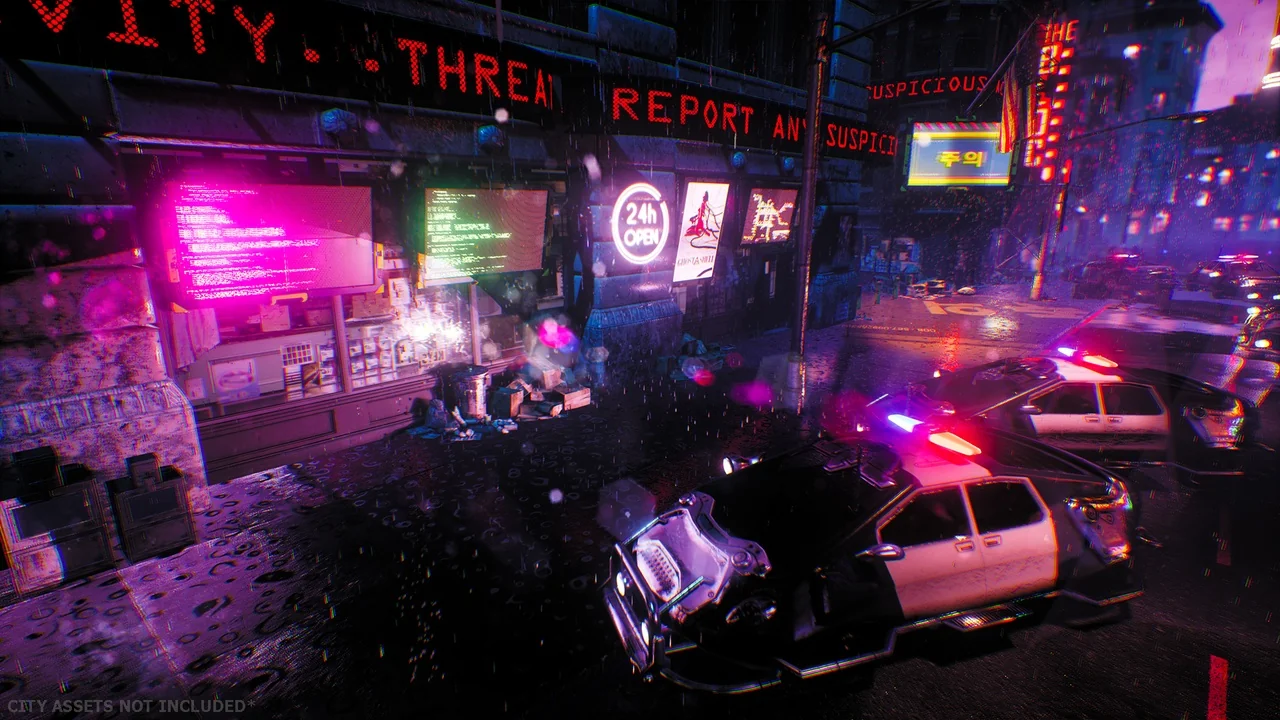
 Shaders
 Shaders
 Shaders