"07a32e720bd988c8"{"id":"1002471","slug":"chibi-characters","title":"Chibi Characters","category":"Characters \u0026 Creatures","engine":"4.19+,5.0+","assetVersion":"","engineVersion":"Engine Version: 4.19+,5.0+","tag":"Characters","accent":"blue","visual":"character","summary":"Stylized Chibi Characters featuring Boy, Girl, and Skullboy models rigged to the Epic Male skeleton with modular assembly and color variants.","platform":"Unreal Engine","indexPolicy":"index","publishedAt":"2026-11-12T03:18:15.757Z","updatedAt":"2026-11-12T03:18:15.757Z","sourceNotes":[],"fileContents":[],"compatibility":["Unreal Engine","Engine Version: 4.19+,5.0+"],"featuredImage":{"alt":"Chibi Characters","src":"/wp-content/uploads/published/2026/11/5ccc9034e1f6-1b37333e-cd6b-46bc-862e-2d6ff92f7315-a1fe98d637.webp"},"hasDownloadLink":true,"downloads":0,"terms":[{"taxonomy":"category","slug":"characters-and-creatures","name":"Characters \u0026 Creatures"}],"galleryImages":[{"src":"/wp-content/uploads/published/2026/11/7e46f4215b10-5cef7620-eaf0-470a-a6ae-312234fc4efa-462642bad6.webp","alt":"Chibi Characters"},{"src":"/wp-content/uploads/published/2026/11/d95e5c2a69fb-e0596a0b-9288-4f10-9d7c-b2344481a861-91d91077b1.webp","alt":"Chibi Characters"},{"src":"/wp-content/uploads/published/2026/11/4972eb0282b2-5b620012-8add-407c-a7d4-5712e2d82cd6-c1a12be477.webp","alt":"Chibi Characters"},{"src":"/wp-content/uploads/published/2026/11/2f87a79a92e9-bb1140f0-2bc7-4120-84f6-84972d02660d-fc45506700.webp","alt":"Chibi Characters"},{"src":"/wp-content/uploads/published/2026/11/5ca5eed03227-88783fc3-7ba7-4a3d-8b3b-35a535966a6e-09c88834ee.webp","alt":"Chibi Characters"},{"src":"/wp-content/uploads/published/2026/11/15cc0d4410cf-70a7f884-a0ee-4f64-a715-d64659456732-789b124250.webp","alt":"Chibi Characters"},{"src":"/wp-content/uploads/published/2026/11/4106535b08a5-fd5ab577-0bdb-47bd-9896-d2e1cb31cfaf-f946bd57a8.webp","alt":"Chibi Characters"},{"src":"/wp-content/uploads/published/2026/11/f6a5a7c23a96-36991e90-821c-4991-889c-e6914b82b9f3-42eb39af64.webp","alt":"Chibi Characters"},{"src":"/wp-content/uploads/published/2026/11/3d9c19679e3c-c478e85e-eebb-4878-9256-2f14ac45081b-0861adfe5c.webp","alt":"Chibi Characters"},{"src":"/wp-content/uploads/published/2026/11/ba6b0efde071-f75c42d5-d3d8-4ae6-92c4-d5657f270276-10838ff6e6.webp","alt":"Chibi Characters"}],"accessPanel":{"kind":"resource","title":"Get this resource","eyebrow":"Free resource","message":"Download this resource in your browser.","fileName":"Content.7z","safetyNote":"Resources are manually reviewed before listing to improve quality and reduce obvious risks.","actionLabel":"Get this resource","resourceType":"Resource archive","versions":[]},"contentHtml":"\u003ch2\u003eIntegrating Chibi Characters into the SideScroller Template\u003c/h2\u003e\u003cp\u003eDropping stylized models into an active project often demands immediate verification against default game templates. Because these chibi assets match standard animation conventions, initial setup inside a standard project environment like the SideScroller template requires little more than redirecting the character blueprint to point to the imported skeletal mesh. When opening the default character blueprint within the template, assigning the mesh asset directly to the existing character mesh component preserves the default input mappings, jump curves, and camera lag settings already tuned for side-scrolling navigation.\u003c/p\u003e\u003cp\u003eThe cute, exaggerated proportions typical of stylized kid characters interact cleanly with the template camera framing. Because side-scrolling layouts place the camera at an orthographic or fixed perspective distance, the silhouette readability of the character becomes paramount. The compact proportions read clearly against background geometry. Adjusting the spring arm length or camera offset inside the template blueprint accommodates the shorter stature of the mesh, ensuring that ground contact, shadow projection, and jump apexes match the collision capsule without requiring deep mechanical alterations to standard movement logic.\u003c/p\u003e\u003ch2\u003eSkeletal Compatibility and Epic Male Animation Sharing\u003c/h2\u003e\u003cp\u003eA primary mechanical advantage of these assets is direct compatibility with the Epic Male skeleton. Stylized and kid-proportioned meshes often suffer from bespoke bone structures that force developers into extensive retargeting pipelines. Because these chibi characters share the Epic Male skeletal structure, standard animation sequences, blend spaces, and aim offsets authored for the base mannequin can be targeted straight to the meshes without rebuilding a rig hierarchy from scratch.\u003c/p\u003e\u003cp\u003eThis shared hierarchy simplifies locomotion trees. Standard walking loops, running transitions, crouching states, and aerial jumps drive the character using identical bone names and default coordinate orientations. When working with state machines, developers can reuse existing locomotion assets directly, mapping the stylized character to pre-authored movement databases. While the physical proportions differ from a realistic adult mannequin, the underlying joint connectivity maps cleanly across the spine, neck, limbs, and extremities, allowing motion libraries to transfer smoothly while retaining the expressive aesthetic of the stylized form.\u003c/p\u003e\u003ch2\u003eChibi Characters Roster and Color Variants\u003c/h2\u003e\u003cp\u003eThe collection supplies three distinct character models: Boy, Girl, and Skullboy. Each archetype delivers a recognizable kid-style aesthetic suitable for projects leaning into stylized, lighthearted, or whimsical art directions. The inclusion of Boy and Girl base meshes covers fundamental character needs for protagonist options, companion characters, or ambient background figures, while the Skullboy model introduces an edgy, playful variation suitable for distinct gameplay roles, specialty costumes, or opposing factions within the same artistic universe.\u003c/p\u003e\u003cp\u003eVisual customization is supported across the lineup through multiple color variants. Having alternative color schemes for each model allows teams to diversify scenes without multiplying asset memory requirements or re-authoring base geometry. These color choices serve practical gameplay roles, such as establishing cooperative player identification, delineating team affiliations in multiplayer matches, or signaling distinct character classes. By swapping the assigned color materials on the mesh sections, the same underlying geometry communicates varied character identities while keeping visual coherence across the world.\u003c/p\u003e\u003ch2\u003eMulti-Part Assembly and Custom Character Controllers\u003c/h2\u003e\u003cp\u003eBeyond single-mesh assignments, the asset framework accounts for assembling multiple component parts onto a unified character controller. Incorporating multi-part meshes demands a structured approach inside the character blueprint to prevent animation desynchronization and clipping between disparate components. The assembly workflow links modular pieces together under the master skeletal hierarchy, ensuring that peripheral clothing, accessories, or structural variations follow the primary movement system in lockstep.\u003c/p\u003e\u003cp\u003eConfiguring a custom character controller with these multi-part assemblies involves parenting secondary skeletal or static mesh components directly to the primary mesh or utilizing master pose setups. When the main character controller processes input vectors—whether adjusting velocity through ground movement, handling collision queries against slopes, or executing mid-air abilities—the attached components maintain absolute alignment with the animated bones. This structured assembly method allows developers to mix and match modular elements across the Boy, Girl, and Skullboy foundations, expanding the pool of unique on-screen configurations while maintaining clean controller logic.\u003c/p\u003e\u003ch2\u003eProduction Workflow with Documented Chibi Setups\u003c/h2\u003e\u003cp\u003eImplementing stylized assets into existing production pipelines is supported by reference documentation and dedicated video walk-through material. These instructional guides outline the step-by-step procedures required to map the meshes to custom controller blueprints, assemble separate component pieces, and verify that material assignments are functioning correctly. Reviewing the provided workflow materials minimizes setup friction, guiding technical artists and programmers through the binding process and showing exactly how parts relate to the core rig.\u003c/p\u003e\u003cp\u003eThe video presentation demonstrates the active motion performance of the characters, showcasing how the stylized silhouettes deform under standard animation sets. By observing the models in motion prior to integration, technical teams can evaluate how the joints behave during extreme poses, verifying limb deformation and silhouette integrity across various movement states. Between the structured documentation, the tutorial guidance on assembling parts, and the native compatibility with the Epic Male skeleton, the package provides an efficient path for embedding functional stylized kid models into game prototypes and full productions alike.\u003c/p\u003e\n\n\u003ch2\u003eMore From The Same Workflow\u003c/h2\u003e\n\u003cul\u003e\n\u003cli\u003e\u003ca href=\"https://3dcghub.com/feline-swordsman-character/\" rel=\"noopener noreferrer\"\u003eFeline Swordsman Character\u003c/a\u003e\u003c/li\u003e\n\u003cli\u003e\u003ca href=\"https://3dcghub.com/styled-characters-pack-military-male-female/\" rel=\"noopener noreferrer\"\u003eStyled Characters Pack: Military Male/Female\u003c/a\u003e\u003c/li\u003e\n\u003cli\u003e\u003ca href=\"https://3dcghub.com/novice-girl/\" rel=\"noopener noreferrer\"\u003eNovice Girl\u003c/a\u003e\u003c/li\u003e\n\u003cli\u003e\u003ca href=\"https://3dcghub.com/character-factory-vol-2-heavy-police/\" rel=\"noopener noreferrer\"\u003eCharacter Factory Vol 2 Heavy Police\u003c/a\u003e\u003c/li\u003e\n\u003cli\u003e\u003ca href=\"https://3dcghub.com/character-factory-vol-3-ruspecial/\" rel=\"noopener noreferrer\"\u003eCharacter Factory Vol 3 RuSpecial\u003c/a\u003e\u003c/li\u003e\n\u003c/ul\u003e","contentTextLength":6463,"navigation":{"current":28,"total":4421,"previous":{"id":"1002472","slug":"cyberpunk-female-characters","title":"Cyberpunk female characters","category":"Characters \u0026 Creatures","platform":"Unreal Engine","updatedAt":"2026-11-12T03:19:32.975Z"},"next":{"id":"1002470","slug":"character-factory-vol-3-ruspecial","title":"Character Factory Vol 3 RuSpecial","category":"Characters \u0026 Creatures","platform":"Unreal Engine","updatedAt":"2026-11-12T03:15:36.738Z"}},"relatedResources":[{"id":"1002371","slug":"feline-swordsman-character","title":"Feline Swordsman Character","category":"Characters \u0026 Creatures","engine":"4.19+,5.0+","assetVersion":"","engineVersion":"Engine Version: 4.19+,5.0+","tag":"Characters","accent":"blue","visual":"character","summary":"Feline Swordsman Character: fantasy Unreal model with custom animations, Epic Male skeleton support, color variants, facial blendshapes, and a socketed weapon.","platform":"Unreal Engine","indexPolicy":"index","publishedAt":"2026-11-09T18:40:38.381Z","updatedAt":"2026-11-09T18:40:38.381Z","sourceNotes":[],"fileContents":[],"compatibility":["Unreal Engine","Engine Version: 4.19+,5.0+"],"featuredImage":{"alt":"Feline Swordsman Character","src":"/wp-content/uploads/published/2026/11/360c28fcb27b-b74d5755-1d86-4aa9-b42f-fae85ed3f191-25ce01c489.webp"},"hasDownloadLink":true,"downloads":0},{"id":"1001842","slug":"styled-characters-pack-military-male-female","title":"Styled Characters Pack: Military Male/Female","category":"Characters \u0026 Creatures","engine":"4.19+,5.0+","assetVersion":"","engineVersion":"Engine Version: 4.19+,5.0+","tag":"Characters","accent":"blue","visual":"character","summary":"Stylized modular military male and female characters for third person shooters, rigged to the Epic Skeleton with extra bones, morph targets, and blueprints.","platform":"Unreal Engine","indexPolicy":"index","publishedAt":"2026-10-21T08:33:25.353Z","updatedAt":"2026-10-21T08:33:25.353Z","sourceNotes":[],"fileContents":[],"compatibility":["Unreal Engine","Engine Version: 4.19+,5.0+"],"featuredImage":{"alt":"Styled Characters Pack: Military Male/Female","src":"/wp-content/uploads/published/2026/10/98e5fee8073c-dc48ba2c-9c83-4906-825f-7249c0032428-07b9eb71e5.webp"},"hasDownloadLink":true,"downloads":0},{"id":"1002393","slug":"novice-girl","title":"Novice Girl","category":"Characters \u0026 Creatures","engine":"4.19+,5.0+","assetVersion":"","engineVersion":"Engine Version: 4.19+,5.0+","tag":"Characters","accent":"blue","visual":"character","summary":"Explore the Novice Girl modular 3D character featuring Epic Skeleton retargeting, 4K PBR textures, custom secondary bones, and facial blendshapes.","platform":"Unreal Engine","indexPolicy":"index","publishedAt":"2026-11-10T04:18:53.597Z","updatedAt":"2026-11-10T04:18:53.597Z","sourceNotes":[],"fileContents":[],"compatibility":["Unreal Engine","Engine Version: 4.19+,5.0+"],"featuredImage":{"alt":"Novice Girl","src":"/wp-content/uploads/published/2026/11/e8273e779ef8-dcc4dcfd-4b9c-4e05-8d40-f18cadfc206b-6adc7cfe28.webp"},"hasDownloadLink":true,"downloads":0}]}
Characters
Chibi Characters
Stylized Chibi Characters featuring Boy, Girl, and Skullboy models rigged to the Epic Male skeleton with modular assembly and color variants.
Integrating Chibi Characters into the SideScroller Template
Dropping stylized models into an active project often demands immediate verification against default game templates. Because these chibi assets match standard animation conventions, initial setup inside a standard project environment like the SideScroller template requires little more than redirecting the character blueprint to point to the imported skeletal mesh. When opening the default character blueprint within the template, assigning the mesh asset directly to the existing character mesh component preserves the default input mappings, jump curves, and camera lag settings already tuned for side-scrolling navigation.
The cute, exaggerated proportions typical of stylized kid characters interact cleanly with the template camera framing. Because side-scrolling layouts place the camera at an orthographic or fixed perspective distance, the silhouette readability of the character becomes paramount. The compact proportions read clearly against background geometry. Adjusting the spring arm length or camera offset inside the template blueprint accommodates the shorter stature of the mesh, ensuring that ground contact, shadow projection, and jump apexes match the collision capsule without requiring deep mechanical alterations to standard movement logic.
Skeletal Compatibility and Epic Male Animation Sharing
A primary mechanical advantage of these assets is direct compatibility with the Epic Male skeleton. Stylized and kid-proportioned meshes often suffer from bespoke bone structures that force developers into extensive retargeting pipelines. Because these chibi characters share the Epic Male skeletal structure, standard animation sequences, blend spaces, and aim offsets authored for the base mannequin can be targeted straight to the meshes without rebuilding a rig hierarchy from scratch.
This shared hierarchy simplifies locomotion trees. Standard walking loops, running transitions, crouching states, and aerial jumps drive the character using identical bone names and default coordinate orientations. When working with state machines, developers can reuse existing locomotion assets directly, mapping the stylized character to pre-authored movement databases. While the physical proportions differ from a realistic adult mannequin, the underlying joint connectivity maps cleanly across the spine, neck, limbs, and extremities, allowing motion libraries to transfer smoothly while retaining the expressive aesthetic of the stylized form.
Chibi Characters Roster and Color Variants
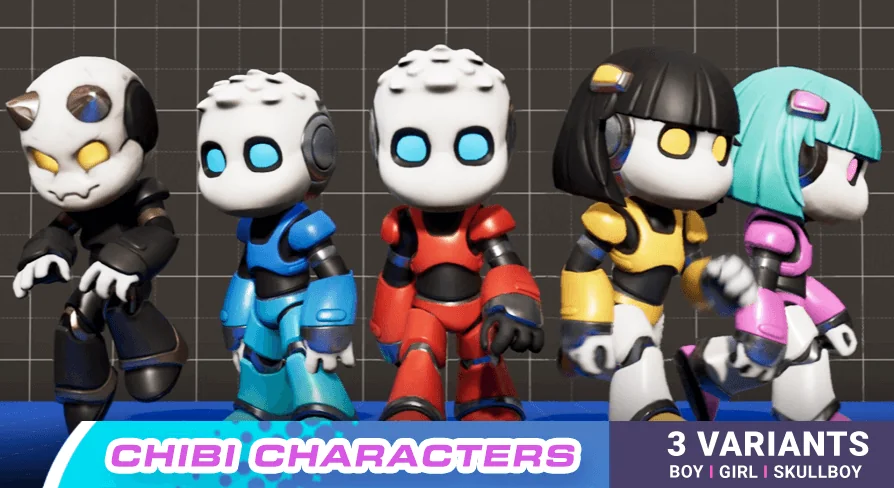
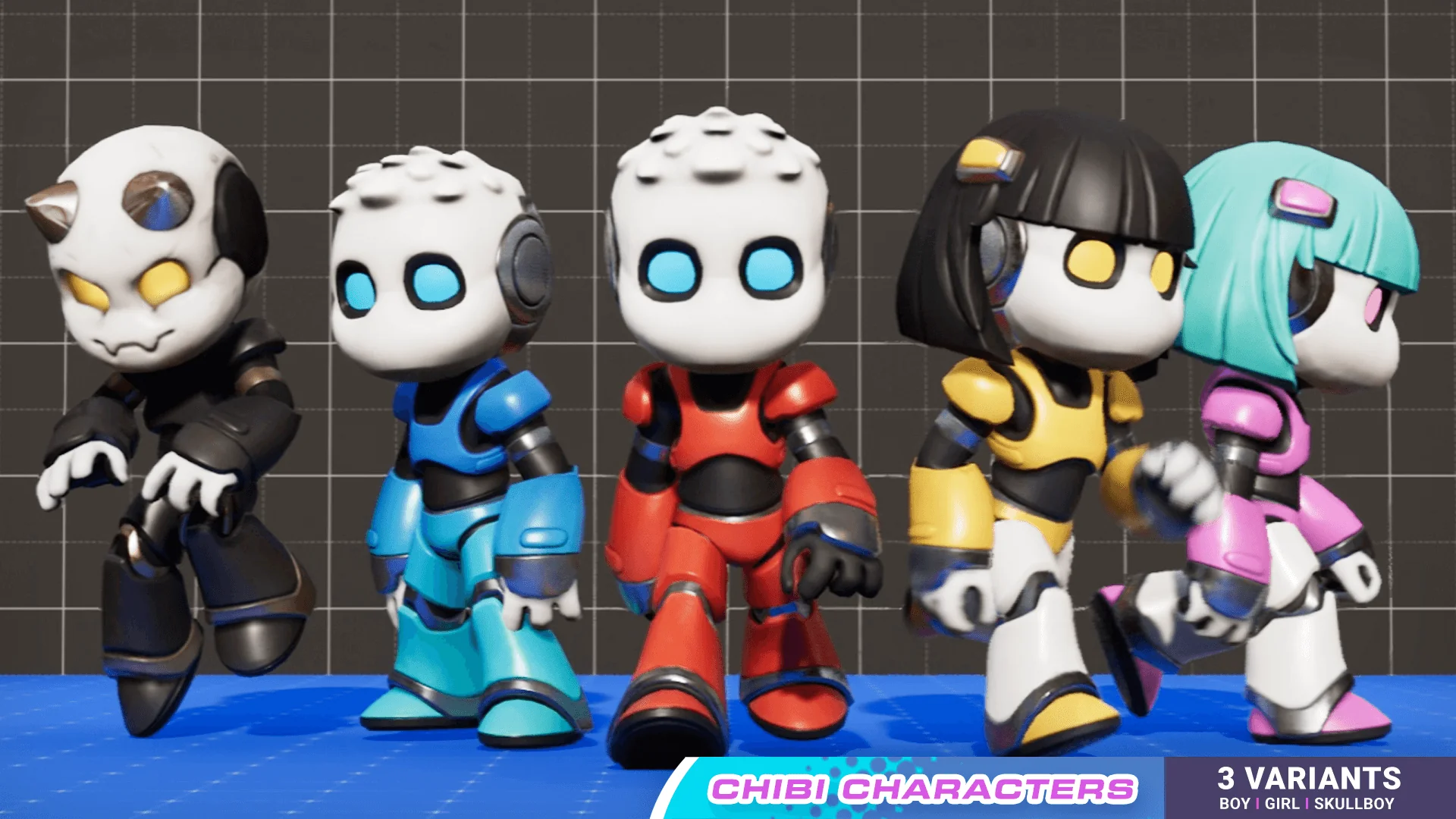
The collection supplies three distinct character models: Boy, Girl, and Skullboy. Each archetype delivers a recognizable kid-style aesthetic suitable for projects leaning into stylized, lighthearted, or whimsical art directions. The inclusion of Boy and Girl base meshes covers fundamental character needs for protagonist options, companion characters, or ambient background figures, while the Skullboy model introduces an edgy, playful variation suitable for distinct gameplay roles, specialty costumes, or opposing factions within the same artistic universe.
Visual customization is supported across the lineup through multiple color variants. Having alternative color schemes for each model allows teams to diversify scenes without multiplying asset memory requirements or re-authoring base geometry. These color choices serve practical gameplay roles, such as establishing cooperative player identification, delineating team affiliations in multiplayer matches, or signaling distinct character classes. By swapping the assigned color materials on the mesh sections, the same underlying geometry communicates varied character identities while keeping visual coherence across the world.
Multi-Part Assembly and Custom Character Controllers
Beyond single-mesh assignments, the asset framework accounts for assembling multiple component parts onto a unified character controller. Incorporating multi-part meshes demands a structured approach inside the character blueprint to prevent animation desynchronization and clipping between disparate components. The assembly workflow links modular pieces together under the master skeletal hierarchy, ensuring that peripheral clothing, accessories, or structural variations follow the primary movement system in lockstep.
Configuring a custom character controller with these multi-part assemblies involves parenting secondary skeletal or static mesh components directly to the primary mesh or utilizing master pose setups. When the main character controller processes input vectors—whether adjusting velocity through ground movement, handling collision queries against slopes, or executing mid-air abilities—the attached components maintain absolute alignment with the animated bones. This structured assembly method allows developers to mix and match modular elements across the Boy, Girl, and Skullboy foundations, expanding the pool of unique on-screen configurations while maintaining clean controller logic.
Production Workflow with Documented Chibi Setups
Implementing stylized assets into existing production pipelines is supported by reference documentation and dedicated video walk-through material. These instructional guides outline the step-by-step procedures required to map the meshes to custom controller blueprints, assemble separate component pieces, and verify that material assignments are functioning correctly. Reviewing the provided workflow materials minimizes setup friction, guiding technical artists and programmers through the binding process and showing exactly how parts relate to the core rig.
The video presentation demonstrates the active motion performance of the characters, showcasing how the stylized silhouettes deform under standard animation sets. By observing the models in motion prior to integration, technical teams can evaluate how the joints behave during extreme poses, verifying limb deformation and silhouette integrity across various movement states. Between the structured documentation, the tutorial guidance on assembling parts, and the native compatibility with the Epic Male skeleton, the package provides an efficient path for embedding functional stylized kid models into game prototypes and full productions alike.
 Characters
 Characters
 Characters
 Characters