"07a32e720bd988c8"{"id":"1002469","slug":"character-factory-vol-2-heavy-police","title":"Character Factory Vol 2 Heavy Police","category":"Characters \u0026 Creatures","engine":"4.19+,5.0+","assetVersion":"","engineVersion":"Engine Version: 4.19+,5.0+","tag":"Characters","accent":"blue","visual":"character","summary":"Explore Character Factory Vol 2 Heavy Police for UE4, featuring full mannequin compatibility, ALS v3 support, modular swaps, and custom decals.","platform":"Unreal Engine","indexPolicy":"index","publishedAt":"2026-11-12T03:09:23.837Z","updatedAt":"2026-11-12T03:09:23.837Z","sourceNotes":[],"fileContents":[],"compatibility":["Unreal Engine","Engine Version: 4.19+,5.0+"],"featuredImage":{"alt":"Character Factory Vol 2 Heavy Police","src":"/wp-content/uploads/published/2026/11/6c8b23e73d0f-50e30f97-7c98-4130-8cbe-6f91d448960e-73963f28b8.webp"},"hasDownloadLink":true,"downloads":0,"terms":[{"taxonomy":"category","slug":"characters-and-creatures","name":"Characters \u0026 Creatures"}],"galleryImages":[{"src":"/wp-content/uploads/published/2026/11/99f5f3877e3c-c57fc74b-3d2c-447b-9a62-c7799137127b-7f34b90e86.webp","alt":"Character Factory Vol 2 Heavy Police"},{"src":"/wp-content/uploads/published/2026/11/f93a7448d792-7ab73e25-9135-4a48-948f-4329499ca67a-6ae2617525.webp","alt":"Character Factory Vol 2 Heavy Police"},{"src":"/wp-content/uploads/published/2026/11/58e7fc7ee7eb-593a635f-02d7-43d6-b2f6-657e98899cd8-8b132424a9.webp","alt":"Character Factory Vol 2 Heavy Police"},{"src":"/wp-content/uploads/published/2026/11/c989308067eb-46ee29bb-1aad-430a-9d0a-c182b162d5d2-c03032aec1.webp","alt":"Character Factory Vol 2 Heavy Police"},{"src":"/wp-content/uploads/published/2026/11/0e2f242a64de-6ca919f1-9847-4066-95d5-fa3bc47740e4-dfde06b661.webp","alt":"Character Factory Vol 2 Heavy Police"},{"src":"/wp-content/uploads/published/2026/11/42d42d489947-abe57e53-1134-4350-b3b4-985b40d54b34-59926c525e.webp","alt":"Character Factory Vol 2 Heavy Police"},{"src":"/wp-content/uploads/published/2026/11/0a3adf559b8a-1587f02e-7200-46d8-90b5-a7e37b2b8152-6d9f642c1c.webp","alt":"Character Factory Vol 2 Heavy Police"},{"src":"/wp-content/uploads/published/2026/11/664c88944bd3-87a58863-05f4-4481-9ce1-525e97c0ec77-b831425492.webp","alt":"Character Factory Vol 2 Heavy Police"},{"src":"/wp-content/uploads/published/2026/11/e626ec5d1531-e28b9a19-95b2-4e5c-ac56-989a3d0ab31e-6494b9c204.webp","alt":"Character Factory Vol 2 Heavy Police"}],"accessPanel":{"kind":"resource","title":"Get this resource","eyebrow":"Free resource","message":"Download this resource in your browser.","fileName":"Content.7z","safetyNote":"Resources are manually reviewed before listing to improve quality and reduce obvious risks.","actionLabel":"Get this resource","resourceType":"Resource archive","versions":[]},"contentHtml":"\u003ch2\u003eIntegrating Character Factory Vol 2 into Unreal Engine Projects\u003c/h2\u003e\n\u003cp\u003ePlacing new skeletal meshes into an established production pipeline often introduces retargeting hurdles and rigging mismatches. Character Factory Vol 2 Heavy Police bypasses these typical technical bottlenecks by establishing native, full compatibility with the standard Unreal Engine 4 mannequin skeleton. Because the bone hierarchy, naming conventions, and joint orientations follow the reference standard, bringing the mesh into a project requires only standard asset migration. Existing animation trees, state machines, and montages apply directly to the character mesh without requiring tedious retargeting setups or skeletal remapping passes.\u003c/p\u003e\n\u003cp\u003eThe mesh structure natively accommodates external locomotion toolsets, specifically supporting smooth integration with Advanced Locomotion System v3 (ALS v3). Developers utilizing ALS v3 can swap the base mannequin for the Heavy Police model to immediately leverage complex locomotion mechanics, including dynamic foot IK, procedural lean, sprint-to-stop transitions, and stance changes. The standard skeletal alignment preserves root-motion data integrity, preventing visual foot sliding or hip drift during directional shifts.\u003c/p\u003e\n\u003cp\u003eInteraction-heavy systems benefit from verified workflow compatibility with the Character Interaction pack. Because the operative's rigging matches default proportions, two-handed object manipulation, tactical door breaches, ladder climbing, and equipment handling function reliably. Hand sockets and attachment transforms align with expected mannequin locations, eliminating the need to offset weapon grips or reposition interactive scenario props manually.\u003c/p\u003e \u003ch2\u003eHeavy Police Surface Customization and Decal Configuration\u003c/h2\u003e\n\u003cp\u003eTactical realism relies heavily on visual variation across squad members, preventing fireteams from appearing as identical clones. Character Factory Vol 2 Heavy Police provides an in-depth material and surface customization system designed to build distinct unit loadouts from a unified base. The texturing framework includes camouflage pattern blending and direct color control across distinct material sectors. Artists can shift base uniform fabrics from high-contrast urban black or navy blue SWAT configurations to subdued grey tones, desert schemes, or industrial tactical patterns depending on the scene environment.\u003c/p\u003e\n\u003cp\u003eBeyond color and camouflage manipulation, the character setup supports custom decal projection and placement. Tactical law enforcement operatives require distinct visual identification markers, such as departmental patches, squad numbering, precinct insignias, and rank tabs. The decal pipeline allows artists to project custom emblems, lettering, and unit identifiers directly onto uniform surfaces, vest plates, or tactical armor panels without editing source textures externally.\u003c/p\u003e\n\u003cp\u003eThis decal and tint system preserves material memory efficiency. Instead of generating hundreds of individual unique textures for every team member, a single primary master material set drives diverse appearances through lightweight parameter shifts. Roughness, color masks, and camouflage repeats can be adjusted in material instances to balance pristine dress gear against weathered, field-deployed operational wear.\u003c/p\u003e \u003ch2\u003eCross-Asset Modularity Across Character Factory Releases\u003c/h2\u003e\n\u003cp\u003eModularity stands as the structural foundation of the Character Factory line. Assets in this collection are deliberately engineered with cross-compatibility in mind, meaning meshes are divided into logical, swappable segments rather than fused into an immutable single-piece model. Heavy Police follows these exact segmentation standards, allowing individual gear pieces, protective layers, utility components, and uniform parts to detach and interface with other compatible releases.\u003c/p\u003e\n\u003cp\u003eThis design philosophy extends compatibility across disparate genres within the same ecosystem, including assets like Gothic Knight. Because the developer enforces identical modular seam alignments and attachment protocols throughout the Character Factory series, assets can share component pieces without mesh clipping along necklines, waists, or limb seams. A developer can harvest tactical utility belts, protective armor plates, or tactical undergarments and pair them with parts from adjacent series entries to produce specialized mercenary archetypes, post-apocalyptic scavengers, or heavily armored security personnel.\u003c/p\u003e\n\u003cp\u003eThe shared modular logic keeps draw calls and mesh complexity manageable. Individual skeletal segments can be toggled via master character blueprints, enabling procedural loadout generation at runtime. Squads can spawn with randomized protective equipment, pouches, and tactical accessories while referencing a shared, unified modular catalog.\u003c/p\u003e \u003ch2\u003eAnimationblueprint Mechanics and Tactical Simulation Setups\u003c/h2\u003e\n\u003cp\u003eOperating effectively in a tactical environment requires rock-solid animation blueprint execution. The mesh accommodates precise physics asset setups and complex Animationblueprints, allowing modern tactical routines to drive the character cleanly. The weight painting across the shoulders, elbows, and knees prevents unnatural volume collapse when the character enters compressed tactical stances, such as low crouching, high-ready weapon holds, or prone crawling.\u003c/p\u003e\n\u003cp\u003eIn simulation-focused projects, characters must handle high-stress physical interactions. When switching from kinematic movement states to simulated ragdoll physics, the rigid components—such as tactical plate carriers, communication gear, and protective gear—maintain their visual structural integrity while softer uniform materials flex naturally with underlying limb motion. The physics asset minimizes self-collision jitter, providing stable transitions when an operative is incapacitated or drops to the ground during a dynamic breach.\u003c/p\u003e\n\u003cp\u003eScripting capabilities extend to procedural equipment attachment. Tactical accessories can be linked dynamically via sockets or merged directly into the master pose component. Because the rig matches the standard mannequin so closely, third-party procedural aim offsets and look-at constraints operate without causing secondary twisting across the spine or collarbones, maintaining strict visual accuracy during aiming passes.\u003c/p\u003e \u003ch2\u003eDeploying Tactical Units in Specialized Environments\u003c/h2\u003e\n\u003cp\u003eCharacter Factory Vol 2 Heavy Police addresses visual requirements across several distinct interactive scenarios:\u003c/p\u003e\n\u003cul\u003e\n\u003cli\u003e\u003cstrong\u003eUrban Tactical Interventions:\u003c/strong\u003e Configured with dark tactical colorways, low-profile camouflage, and law enforcement decals, the model represents municipal SWAT units handling hostage rescues, barricaded suspects, or active response operations.\u003c/li\u003e\n\u003cli\u003e\u003cstrong\u003eIndustrial Defense and Security:\u003c/strong\u003e Neutral color variations and subdued utility patterns transform the operative into a high-threat facility guard, protecting sensitive infrastructure, research complexes, or industrial plants.\u003c/li\u003e\n\u003cli\u003e\u003cstrong\u003eSpecial Forces Infiltration:\u003c/strong\u003e Utilizing field camouflage schemes and stripped-down modular equipment, the model adapts to unconventional military operations, reconnaissance, and military simulation environments.\u003c/li\u003e\n\u003c/ul\u003e\n\u003cp\u003eThe balance of strict skeletal standard compliance, deep color and decal control, and expansive cross-asset modularity gives the package immediate utility for production teams building modern combat, law enforcement, or industrial simulation titles.\u003c/p\u003e\n\n\u003ch2\u003eMore From The Same Workflow\u003c/h2\u003e\n\u003cul\u003e\n\u003cli\u003e\u003ca href=\"https://3dcghub.com/sci-fi-heavy-bot/\" rel=\"noopener noreferrer\"\u003eSci Fi Heavy Bot\u003c/a\u003e\u003c/li\u003e\n\u003cli\u003e\u003ca href=\"https://3dcghub.com/heroic-fantasy-villains-vol-1/\" rel=\"noopener noreferrer\"\u003eHeroic Fantasy Villains Vol 1\u003c/a\u003e\u003c/li\u003e\n\u003cli\u003e\u003ca href=\"https://3dcghub.com/g-swat/\" rel=\"noopener noreferrer\"\u003eG SWAT\u003c/a\u003e\u003c/li\u003e\n\u003cli\u003e\u003ca href=\"https://3dcghub.com/first-person-base-arms-vol-1-skinny-male/\" rel=\"noopener noreferrer\"\u003eFirst Person Base Arms Vol. 1 - Skinny Male\u003c/a\u003e\u003c/li\u003e\n\u003cli\u003e\u003ca href=\"https://3dcghub.com/sci-fi-characters-pack-vol-2/\" rel=\"noopener noreferrer\"\u003eSci-Fi Characters (Pack) Vol.2\u003c/a\u003e\u003c/li\u003e\n\u003c/ul\u003e","contentTextLength":7544,"navigation":{"current":30,"total":4421,"previous":{"id":"1002470","slug":"character-factory-vol-3-ruspecial","title":"Character Factory Vol 3 RuSpecial","category":"Characters \u0026 Creatures","platform":"Unreal Engine","updatedAt":"2026-11-12T03:15:36.738Z"},"next":{"id":"1002468","slug":"carmel","title":"Carmel","category":"Humans","platform":"Unreal Engine","updatedAt":"2026-11-12T03:08:36.535Z"}},"relatedResources":[{"id":"1002470","slug":"character-factory-vol-3-ruspecial","title":"Character Factory Vol 3 RuSpecial","category":"Characters \u0026 Creatures","engine":"4.19+,5.0+","assetVersion":"","engineVersion":"Engine Version: 4.19+,5.0+","tag":"Characters","accent":"blue","visual":"character","summary":"Examine Character Factory Vol 3 RuSpecial, focusing on modular modern special forces assets, camouflage, decal systems, and UE4 mannequin integration.","platform":"Unreal Engine","indexPolicy":"index","publishedAt":"2026-11-12T03:15:36.738Z","updatedAt":"2026-11-12T03:15:36.738Z","sourceNotes":[],"fileContents":[],"compatibility":["Unreal Engine","Engine Version: 4.19+,5.0+"],"featuredImage":{"alt":"Character Factory Vol 3 RuSpecial","src":"/wp-content/uploads/published/2026/11/2197d19094c1-321ba11b-86ab-4788-b713-d5ca044dea50-c5116f9030.webp"},"hasDownloadLink":true,"downloads":0},{"id":"1002494","slug":"sci-fi-robots-pack-vol-1","title":"SCI FI ROBOTS PACK VOL 1","category":"Characters \u0026 Creatures","engine":"4.4+,5.0+","assetVersion":"","engineVersion":"Engine Version: 4.4+,5.0+","tag":"Characters","accent":"blue","visual":"character","summary":"Explore the 9 animated lowpoly mecha models in SCI FI ROBOTS PACK VOL 1, featuring realistic droids, pods, and animation blueprint integration.","platform":"Unreal Engine","indexPolicy":"index","publishedAt":"2026-11-12T04:01:24.809Z","updatedAt":"2026-11-12T04:01:24.809Z","sourceNotes":[],"fileContents":[],"compatibility":["Unreal Engine","Engine Version: 4.4+,5.0+"],"featuredImage":{"alt":"SCI FI ROBOTS PACK VOL 1","src":"/wp-content/uploads/published/2026/11/2fe86326e4a9-c63b5c71-fbd8c48ff6.webp"},"hasDownloadLink":true,"downloads":0},{"id":"1002481","slug":"heavy-g-soldier","title":"Heavy G Soldier","category":"Characters \u0026 Creatures","engine":"4.18+,5.0+","assetVersion":"","engineVersion":"Engine Version: 4.18+,5.0+","tag":"Characters","accent":"blue","visual":"character","summary":"Explore the Heavy G Soldier asset, featuring modular tactical armor, PBR texture maps, custom camouflage materials, and standard UE mannequin rigging.","platform":"Unreal Engine","indexPolicy":"index","publishedAt":"2026-11-12T03:42:25.782Z","updatedAt":"2026-11-12T03:42:25.782Z","sourceNotes":[],"fileContents":[],"compatibility":["Unreal Engine","Engine Version: 4.18+,5.0+"],"featuredImage":{"alt":"Heavy G Soldier","src":"/wp-content/uploads/published/2026/11/d96c9d3cedf9-2576b439-12f6-4d63-a576-0e862b7dd59f-2140e6b36f.webp"},"hasDownloadLink":true,"downloads":0}]}
Characters
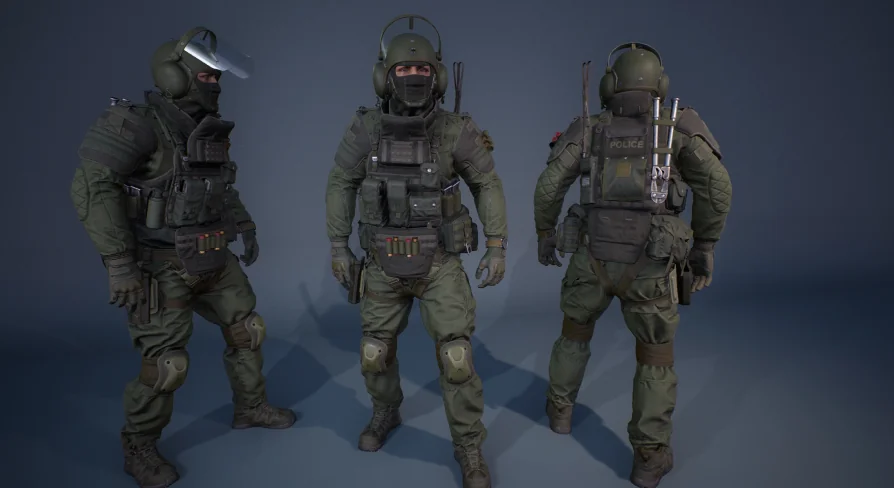
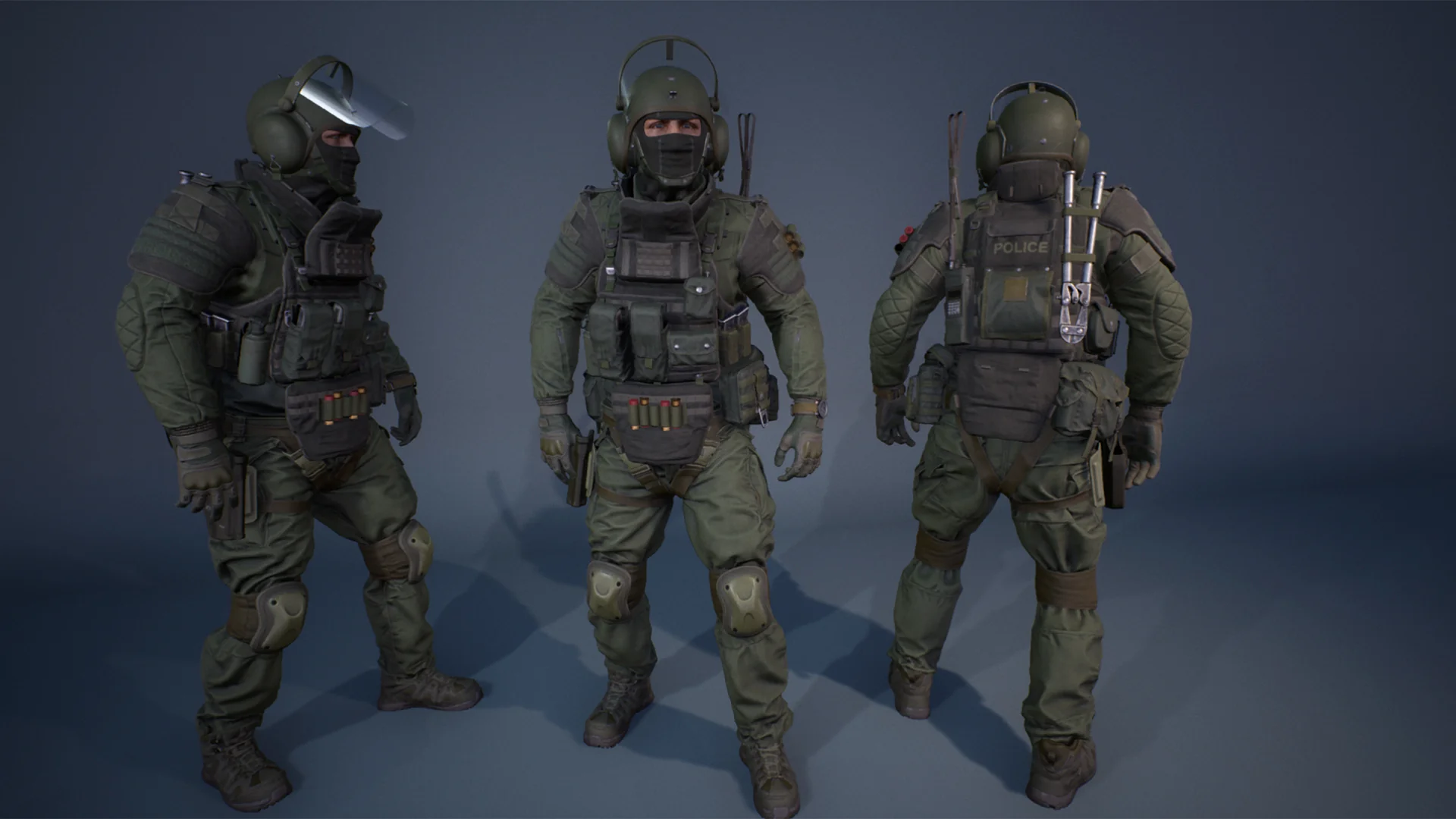
Character Factory Vol 2 Heavy Police
Explore Character Factory Vol 2 Heavy Police for UE4, featuring full mannequin compatibility, ALS v3 support, modular swaps, and custom decals.
Integrating Character Factory Vol 2 into Unreal Engine Projects
Placing new skeletal meshes into an established production pipeline often introduces retargeting hurdles and rigging mismatches. Character Factory Vol 2 Heavy Police bypasses these typical technical bottlenecks by establishing native, full compatibility with the standard Unreal Engine 4 mannequin skeleton. Because the bone hierarchy, naming conventions, and joint orientations follow the reference standard, bringing the mesh into a project requires only standard asset migration. Existing animation trees, state machines, and montages apply directly to the character mesh without requiring tedious retargeting setups or skeletal remapping passes.
The mesh structure natively accommodates external locomotion toolsets, specifically supporting smooth integration with Advanced Locomotion System v3 (ALS v3). Developers utilizing ALS v3 can swap the base mannequin for the Heavy Police model to immediately leverage complex locomotion mechanics, including dynamic foot IK, procedural lean, sprint-to-stop transitions, and stance changes. The standard skeletal alignment preserves root-motion data integrity, preventing visual foot sliding or hip drift during directional shifts.
Interaction-heavy systems benefit from verified workflow compatibility with the Character Interaction pack. Because the operative's rigging matches default proportions, two-handed object manipulation, tactical door breaches, ladder climbing, and equipment handling function reliably. Hand sockets and attachment transforms align with expected mannequin locations, eliminating the need to offset weapon grips or reposition interactive scenario props manually.
Heavy Police Surface Customization and Decal Configuration
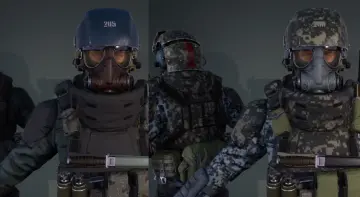
Tactical realism relies heavily on visual variation across squad members, preventing fireteams from appearing as identical clones. Character Factory Vol 2 Heavy Police provides an in-depth material and surface customization system designed to build distinct unit loadouts from a unified base. The texturing framework includes camouflage pattern blending and direct color control across distinct material sectors. Artists can shift base uniform fabrics from high-contrast urban black or navy blue SWAT configurations to subdued grey tones, desert schemes, or industrial tactical patterns depending on the scene environment.
Beyond color and camouflage manipulation, the character setup supports custom decal projection and placement. Tactical law enforcement operatives require distinct visual identification markers, such as departmental patches, squad numbering, precinct insignias, and rank tabs. The decal pipeline allows artists to project custom emblems, lettering, and unit identifiers directly onto uniform surfaces, vest plates, or tactical armor panels without editing source textures externally.
This decal and tint system preserves material memory efficiency. Instead of generating hundreds of individual unique textures for every team member, a single primary master material set drives diverse appearances through lightweight parameter shifts. Roughness, color masks, and camouflage repeats can be adjusted in material instances to balance pristine dress gear against weathered, field-deployed operational wear.
Cross-Asset Modularity Across Character Factory Releases
Modularity stands as the structural foundation of the Character Factory line. Assets in this collection are deliberately engineered with cross-compatibility in mind, meaning meshes are divided into logical, swappable segments rather than fused into an immutable single-piece model. Heavy Police follows these exact segmentation standards, allowing individual gear pieces, protective layers, utility components, and uniform parts to detach and interface with other compatible releases.
This design philosophy extends compatibility across disparate genres within the same ecosystem, including assets like Gothic Knight. Because the developer enforces identical modular seam alignments and attachment protocols throughout the Character Factory series, assets can share component pieces without mesh clipping along necklines, waists, or limb seams. A developer can harvest tactical utility belts, protective armor plates, or tactical undergarments and pair them with parts from adjacent series entries to produce specialized mercenary archetypes, post-apocalyptic scavengers, or heavily armored security personnel.
The shared modular logic keeps draw calls and mesh complexity manageable. Individual skeletal segments can be toggled via master character blueprints, enabling procedural loadout generation at runtime. Squads can spawn with randomized protective equipment, pouches, and tactical accessories while referencing a shared, unified modular catalog.
Animationblueprint Mechanics and Tactical Simulation Setups
Operating effectively in a tactical environment requires rock-solid animation blueprint execution. The mesh accommodates precise physics asset setups and complex Animationblueprints, allowing modern tactical routines to drive the character cleanly. The weight painting across the shoulders, elbows, and knees prevents unnatural volume collapse when the character enters compressed tactical stances, such as low crouching, high-ready weapon holds, or prone crawling.
In simulation-focused projects, characters must handle high-stress physical interactions. When switching from kinematic movement states to simulated ragdoll physics, the rigid components—such as tactical plate carriers, communication gear, and protective gear—maintain their visual structural integrity while softer uniform materials flex naturally with underlying limb motion. The physics asset minimizes self-collision jitter, providing stable transitions when an operative is incapacitated or drops to the ground during a dynamic breach.
Scripting capabilities extend to procedural equipment attachment. Tactical accessories can be linked dynamically via sockets or merged directly into the master pose component. Because the rig matches the standard mannequin so closely, third-party procedural aim offsets and look-at constraints operate without causing secondary twisting across the spine or collarbones, maintaining strict visual accuracy during aiming passes.
Deploying Tactical Units in Specialized Environments
Character Factory Vol 2 Heavy Police addresses visual requirements across several distinct interactive scenarios:
Urban Tactical Interventions: Configured with dark tactical colorways, low-profile camouflage, and law enforcement decals, the model represents municipal SWAT units handling hostage rescues, barricaded suspects, or active response operations.
Industrial Defense and Security: Neutral color variations and subdued utility patterns transform the operative into a high-threat facility guard, protecting sensitive infrastructure, research complexes, or industrial plants.
Special Forces Infiltration: Utilizing field camouflage schemes and stripped-down modular equipment, the model adapts to unconventional military operations, reconnaissance, and military simulation environments.
The balance of strict skeletal standard compliance, deep color and decal control, and expansive cross-asset modularity gives the package immediate utility for production teams building modern combat, law enforcement, or industrial simulation titles.
 Characters
 Characters
 Characters
 Characters