"7b46a695175d8694"{"id":"1000039","slug":"cgr-armod-pack","title":"CGr ARMod Pack","category":"Guns","engine":"5.0+","assetVersion":"","engineVersion":"5.0+","tag":"Guns","accent":"blue","visual":"mech","summary":"A customizable assault rifle pack for UE5 with attachments, firing modes, procedural aiming and recoil, body-part damage, grenades, and True FPS updates.","platform":"Unreal Engine","publishedAt":"2026-05-22T07:18:43.799Z","updatedAt":"2026-05-22T07:18:43.799Z","sourceNotes":[],"fileContents":[],"compatibility":["Unreal Engine","Engine version: 5.0+"],"featuredImage":{"alt":"CGr ARMod Pack","src":"/wp-content/uploads/published/2026/05/ff5c526bd35e-8fdcf341-9ce6-4ba7-a55f-2db28777c818-d26139c75b.webp"},"hasDownloadLink":true,"downloads":7,"terms":[{"taxonomy":"category","slug":"guns","name":"Guns"}],"galleryImages":[{"src":"/wp-content/uploads/published/2026/05/eff76e94f4d9-7c97c4e6-f1ac-4c12-8092-668b3c7680db-bffdfdb270.webp","alt":"CGr ARMod Pack"},{"src":"/wp-content/uploads/published/2026/05/2c5a2234e596-4cadd669-ae85-4e54-bf13-0a3100074ad0-8fed5a6677.webp","alt":"CGr ARMod Pack"},{"src":"/wp-content/uploads/published/2026/05/cce26ece4097-69a94d28-1954-4a92-83cc-5ffcfb2a035b-5966963693.webp","alt":"CGr ARMod Pack"},{"src":"/wp-content/uploads/published/2026/05/d93a775d4c54-4fb4113e-96d9-4bb5-9d22-f8cf18e2db27-0cbcbcd0db.webp","alt":"CGr ARMod Pack"},{"src":"/wp-content/uploads/published/2026/05/134ae3ed4fcf-22831e68-5c2c-4c40-b28f-1a0a3bc34dd8-1cfa395b67.webp","alt":"CGr ARMod Pack"},{"src":"/wp-content/uploads/published/2026/05/16d9b90c2baf-a3ae2431-6080-437f-b2a4-2fac5e62e479-8de741e2a8.webp","alt":"CGr ARMod Pack"},{"src":"/wp-content/uploads/published/2026/05/418242680bf0-40940a84-b59b-4c40-ad51-e3b909c0bb7e-6651d9ad1f.webp","alt":"CGr ARMod Pack"},{"src":"/wp-content/uploads/published/2026/05/8db721441f79-25397c24-9b45-4bd4-af2a-73dbab90476a-0830edd03c.webp","alt":"CGr ARMod Pack"},{"src":"/wp-content/uploads/published/2026/05/bf0c4cbf5ccd-5399d32d-b189-43b2-9840-ec6b8f8602a2-2972f3ee8e.webp","alt":"CGr ARMod Pack"},{"src":"/wp-content/uploads/published/2026/05/a5b799506dfc-528962cf-c5f0-44c6-baa2-10fa95a4a174-c20a749d38.webp","alt":"CGr ARMod Pack"}],"accessPanel":{"kind":"resource","title":"Access this resource","eyebrow":"Free Download","message":"Log in or create a free account to start your download.","fileName":"CG_ARMod_Pack5.7z","safetyNote":"Resources are manually reviewed before listing to improve quality and reduce obvious risks.","actionLabel":"Download Free","resourceType":"Resource archive"},"contentHtml":"\u003cp\u003eIn motion, this pack is less about placing a static rifle in a scene and more about shaping how a weapon behaves once a player starts moving, aiming, firing, crouching, or sliding. CGr ARMod Pack combines one customizable assault rifle with the animation and logic needed to build playable weapon behavior, giving developers a base that already reaches into handling, effects, and combat response rather than stopping at presentation alone.\u003c/p\u003e \u003cp\u003eThe rifle can shift its identity through three mesh options: classic, modern, and custom. That core setup is expanded through multiple holo sights and a set of attachments that includes a laser or flashlight, compensator, suppressor, bipods, and a grenade launcher. Because the weapon is meant to be assembled from a main skeletal mesh plus attachments, it can be pushed into noticeably different silhouettes. The pack describes this variability as a kind of constructor, making it possible to assemble classic or modern variants, along with short, regular, or long versions of the same weapon type.\u003c/p\u003e \u003ch2\u003eDifferent views of the rifle change the feel of a scene\u003c/h2\u003e\n\u003cp\u003eThat flexibility matters visually as much as mechanically. A rifle fitted with a suppressor and holo sight suggests one tone, while a longer setup with bipods and launcher leans toward a heavier battlefield presence. The pack supports different views of the weapon through its customization, so artists and developers are not locked into one fixed profile. For anyone building first-person sequences, close-up promotional renders, or a prototype with several loadout identities, that range gives the same base rifle room to read differently from one scenario to the next.\u003c/p\u003e \u003cp\u003eThe material system adds another layer to that variation. Material layering is used so the weapon can take on different patterns, and it is also possible to change only a tint. This is a practical detail for teams that want to separate structural changes from surface treatment. One version of the rifle can keep the same attachments while shifting its finish, or hold the same pattern while using a different color tint to better fit a faction, map palette, or character setup.\u003c/p\u003e \u003cp\u003eRaindrops appearing on weapons reinforce that sense of environmental presence. Instead of treating the gun as an isolated prop, the pack includes a visual response that helps it sit inside weather-driven scenes. For developers trying to make first-person presentation feel more immediate, that kind of detail can help the rifle feel part of the world rather than overlaid on top of it.\u003c/p\u003e \u003ch2\u003eProcedural aiming, recoil, and weapon deflection in CGr ARMod Pack\u003c/h2\u003e\n\u003cp\u003eFunctionally, the pack reaches into the parts of weapon handling that shape moment-to-moment play. It uses procedural aiming and procedural recoil, which gives the rifle a more system-driven feel than a purely static animation set. That is paired with procedural walking, along with character crouching and sliding. Together, these elements point toward a weapon setup that reacts to character movement rather than existing as a disconnected object.\u003c/p\u003e \u003cp\u003eWeapon deflection is also included when the character approaches an object. That detail can make close-quarters movement feel more grounded, especially in interiors or dense combat spaces where walls and obstacles matter. Instead of a weapon passing cleanly through everything, the pack accounts for proximity and changes the gun’s behavior near surfaces.\u003c/p\u003e \u003cp\u003eFiring is not limited to a single pattern. Different firing modes are present, and weapon accuracy can also be customized. That gives developers another practical control point when shaping the rifle’s role. The same customizable platform can be tuned toward different handling profiles without abandoning the broader modular setup. Bullet projectiles are subject to gravity and do not fly off into infinity, which helps define the weapon as a projectile-based system with travel behavior rather than a purely abstract hitscan stand-in.\u003c/p\u003e \u003ch2\u003eBody-part damage and grenade effects push it beyond a model pack\u003c/h2\u003e\n\u003cp\u003eCombat response is one of the clearest signs that this is intended as more than a weapon mesh collection. The enemy damage system depends on which body part is hit. A headshot leads to death with fewer hits than a strike to an arm or leg. That makes the rifle part of a more structured damage model, where hit location has gameplay consequences and not all impacts are treated equally.\u003c/p\u003e \u003cp\u003eThe pack also includes grenades in three types: fragmentation, flashbang, and smoke. Those are accompanied by explosions, blinding, and concussion effects. In use, that broadens the resource from a rifle-focused package into something that can help stage a larger combat loop. A developer can move from direct rifle fire to area disruption and visual impairment without stepping outside the set of features described here.\u003c/p\u003e \u003cp\u003eThere are bonus animations for a frag grenade throw and a stun grenade throw, plus an animation of weapon jamming. In the BONUS directory, there are also animations that are not implemented in the project, including Weapon Block Idle Animations and Movements. For teams exploring extensions or alternate handling states, those extra pieces may be useful as a starting point, even if they are not wired into the project as delivered.\u003c/p\u003e \u003ch2\u003eUE5 Manny, True FPS, and changed animation handling\u003c/h2\u003e\n\u003cp\u003eThe pack has been updated on the UE5 side, and all animations have been retargeted for UE5 Manny and adjusted for that mannequin. It is now True FPS, which means the character Blueprint includes the entire mannequin rather than only the arms. That change affects how the weapon presentation fits into a first-person setup and signals a broader full-body approach.\u003c/p\u003e \u003cp\u003eAnimation handling has shifted with that update. Because Manny’s animation blueprint is split into upper and lower body parts, the \u003cem\u003eIk_hand_gun\u003c/em\u003e Bone is no longer used in animations, though it is still needed for procedural aiming. Older animation equivalents where that bone is animated remain available in the Legacy folder. Newer animation versions use \u003cem\u003eGunMainBoneMove\u003c/em\u003e, where the Main bone of the weapon is animated while the weapon itself stays attached to the socket of the right hand.\u003c/p\u003e \u003cp\u003eThere are exceptions in some projects, including SAShotgun and BASnpR, where certain animations dynamically attach the weapon to the socket on the left hand. That left-hand socket is necessary in those cases. The Data Table was changed along with these updates, which is important for anyone planning to work directly with the project’s underlying setup instead of treating it as a closed presentation piece.\u003c/p\u003e \u003ch2\u003eWhere the blueprints help and where teams will need to take over\u003c/h2\u003e\n\u003cp\u003eCGr ARMod Pack is framed as an asset pack rather than a complete project. The blueprints are configured for presentation only, and advanced developers can improve them further. That makes its best use fairly clear: it is a foundation for teams who want access to weapon models, animation work, and some gameplay logic, then plan to adapt those parts inside a more advanced project of their own.\u003c/p\u003e \u003cp\u003eAt the same time, the pack is not positioned as beginner-friendly. It may seem complicated for new users, and there are a few specific areas that require attention. Custom collision presets in the project settings matter, as do notifications in animation montages. Weapon-specific changes are handled through \u003cem\u003eDT_Weapon_DataTable\u003c/em\u003e. Some variables have also been moved from the Data Table into the weapon blueprints so they can be changed and viewed in real time through the construction script. For developers who like to iterate while seeing immediate results, that is a practical workflow detail.\u003c/p\u003e \u003cp\u003eThe pack also notes that if it is combined with shotgun projects, the reloading logic for SAShotgun and PAShotgun is not included directly here. Separate shotgun components are used for that logic. Another project-level note concerns versions UE5.5 and possibly higher, where freezes and disappearing materials may occur. The stated fix is to reduce the resolution of all textures, with lower-resolution textures uploaded and high-resolution textures placed in the appropriate folder. There are also notes covering issues such as image shift to the right and ragdoll sliding on the floor.\u003c/p\u003e \u003ch2\u003eX-axis weapon orientation and a direct fit-for-purpose read\u003c/h2\u003e\n\u003cp\u003eThe weapon is set up on the X-axis. If a Y-axis orientation is needed, the workflow is straightforward: export the weapon model, import it again with a rotation of -90 degrees on the Z-axis, and apply the same change to the weapon animation, or rotate the weapon manually by -90 degrees in each animation and set the key. That is a small but concrete pipeline note, and exactly the sort of detail that can save time when integrating the pack into a different production standard.\u003c/p\u003e \u003cp\u003eFor teams evaluating what this resource actually offers, the strongest takeaway is that it covers a wider slice of playable weapon behavior than a rifle model alone. CGr ARMod Pack combines a modular assault rifle, layered material variation, procedural aiming and recoil, movement-aware handling, projectile gravity, body-part damage, grenade effects, and UE5 Manny retargeting in a package that is meant to be adapted by developers who want a substantial base rather than a finished game system.\u003c/p\u003e\n\n\u003ch2\u003eRelated Resources Worth Checking\u003c/h2\u003e\n\u003cul\u003e\n\u003cli\u003e\u003ca href=\"https://3dcghub.com/cgr-handgun/\" title=\"CGr Handgun\"\u003eCGr Handgun\u003c/a\u003e\u003c/li\u003e\n\u003cli\u003e\u003ca href=\"https://3dcghub.com/custom-ar-15-style-rifle/\" title=\"Custom AR-15 Style Rifle\"\u003eCustom AR-15 Style Rifle\u003c/a\u003e\u003c/li\u003e\n\u003cli\u003e\u003ca href=\"https://3dcghub.com/animated-fps-loaded-3-pistol-guns-pack/\" title=\"Animated FPS Loaded 3-Pistol Guns Pack\"\u003eAnimated FPS Loaded 3-Pistol Guns Pack\u003c/a\u003e\u003c/li\u003e\n\u003cli\u003e\u003ca href=\"https://3dcghub.com/gun-weapon-grenade/\" title=\"Gun Weapon Grenade\"\u003eGun Weapon Grenade\u003c/a\u003e\u003c/li\u003e\n\u003cli\u003e\u003ca href=\"https://3dcghub.com/cyberpunk-handguns-cyberpunk-handguns-handgun-cyberpunks-weapon-guns/\" title=\"Cyberpunk Handguns ( Cyberpunk Handguns Handgun Cyberpunks Weapon Guns )\"\u003eCyberpunk Handguns ( Cyberpunk Handguns Handgun Cyberpunks Weapon Guns )\u003c/a\u003e\u003c/li\u003e\n\u003c/ul\u003e","contentTextLength":9451,"navigation":{"current":1586,"total":3481,"previous":{"id":"1000040","slug":"cgr-shotguns-pack","title":"CGr Shotguns Pack","category":"Guns","platform":"Unreal Engine","updatedAt":"2026-05-22T07:23:04.999Z"},"next":{"id":"1000037","slug":"cathedrals-churches","title":"Cathedrals churches","category":"Fantasy","platform":"Unreal Engine","updatedAt":"2026-05-22T07:11:39.968Z"}},"relatedResources":[{"id":"1000801","slug":"cgr-pcc-pack","title":"CGr PCC Pack","category":"Guns","engine":"5.5+","assetVersion":"","engineVersion":"Engine Version: 5.5+","tag":"Guns","accent":"blue","visual":"mech","summary":"Unreal Engine 5 asset pack featuring a customizable Pistol Caliber Carbine with procedural aiming/recoil, material layering, grenades, and True FPS Manny integr","platform":"Unreal Engine","publishedAt":"2026-07-30T23:06:31.513Z","updatedAt":"2026-07-30T23:06:31.513Z","sourceNotes":[],"fileContents":[],"compatibility":["Unreal Engine","Engine Version: 5.5+"],"featuredImage":{"alt":"CGr PCC Pack","src":"/wp-content/uploads/published/2026/07/c44af81a37d3-e7cb14e3-eb6e-45a7-ad82-30dd3618792e-170b9a7e23.webp"},"hasDownloadLink":true,"downloads":4},{"id":"1000800","slug":"cgr-basnpr","title":"CGr BASnpR","category":"Guns","engine":"5.1+","assetVersion":"","engineVersion":"Engine Version: 5.1+","tag":"Guns","accent":"blue","visual":"mech","summary":"Customizable sniper rifle asset pack for Unreal Engine 5 with procedural aiming, recoil, body-part damage, grenades, and Manny retargeted animations.","platform":"Unreal Engine","publishedAt":"2026-07-30T22:59:50.063Z","updatedAt":"2026-07-30T22:59:50.063Z","sourceNotes":[],"fileContents":[],"compatibility":["Unreal Engine","Engine Version: 5.1+"],"featuredImage":{"alt":"CGr BASnpR","src":"/wp-content/uploads/published/2026/07/1592ab78ebb1-e181ced0-2b2e-4e7f-b917-4f903811c272-5238ede6c2.webp"},"hasDownloadLink":true,"downloads":2},{"id":"1000040","slug":"cgr-shotguns-pack","title":"CGr Shotguns Pack","category":"Guns","engine":"5.0+","assetVersion":"","engineVersion":"5.0+","tag":"Guns","accent":"blue","visual":"mech","summary":"A UE5 shotgun asset pack with three shotgun types, attachments, animations, assembly blueprints, projectile logic, and presentation-ready FPS systems.","platform":"Unreal Engine","publishedAt":"2026-05-22T07:23:04.999Z","updatedAt":"2026-05-22T07:23:04.999Z","sourceNotes":[],"fileContents":[],"compatibility":["Unreal Engine","Engine version: 5.0+"],"featuredImage":{"alt":"CGr Shotguns Pack","src":"/wp-content/uploads/published/2026/05/e6eaeb9374b9-7540bf76-ac2f-4dbb-bf8b-3fee8c709309-5aca621bb2.webp"},"hasDownloadLink":true,"downloads":1}]}
Guns
CGr ARMod Pack
A customizable assault rifle pack for UE5 with attachments, firing modes, procedural aiming and recoil, body-part damage, grenades, and True FPS updates.
Category:Unreal Engine,GunsPlatform: Unreal EngineEngine version: 5.0+Published: May 22, 2026
Guns
Resource overview
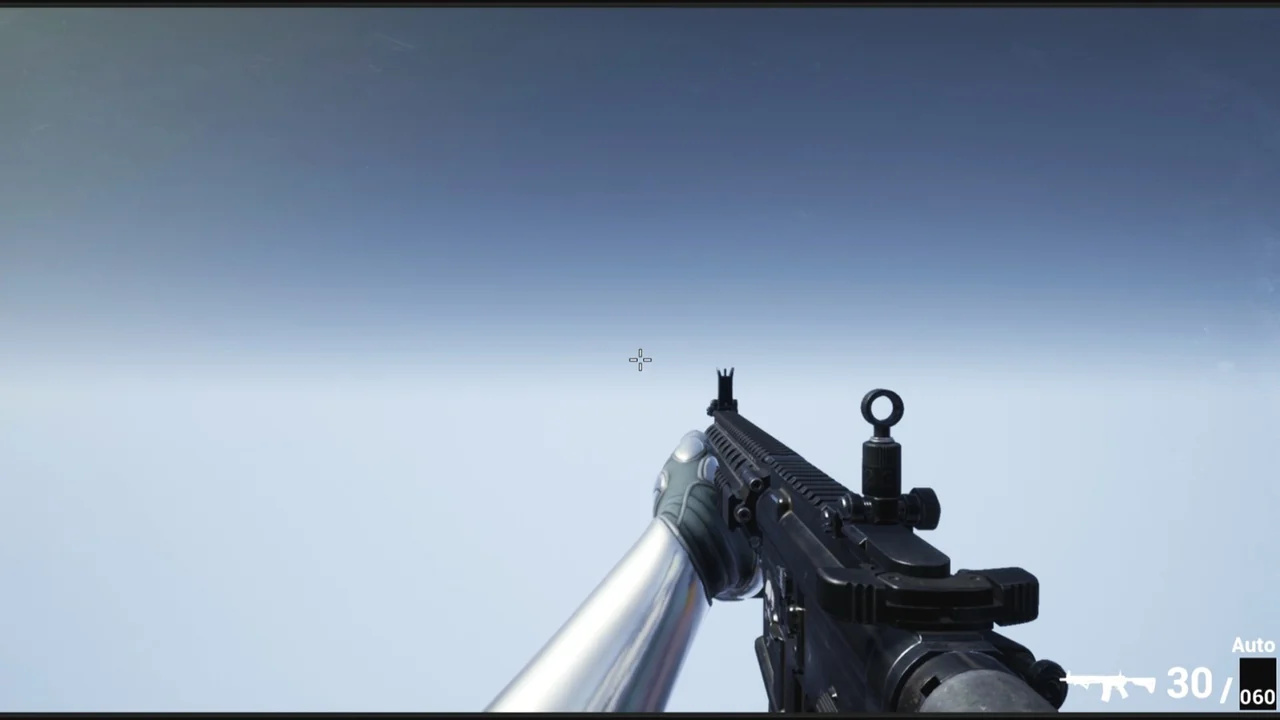
In motion, this pack is less about placing a static rifle in a scene and more about shaping how a weapon behaves once a player starts moving, aiming, firing, crouching, or sliding. CGr ARMod Pack combines one customizable assault rifle with the animation and logic needed to build playable weapon behavior, giving developers a base that already reaches into handling, effects, and combat response rather than stopping at presentation alone.
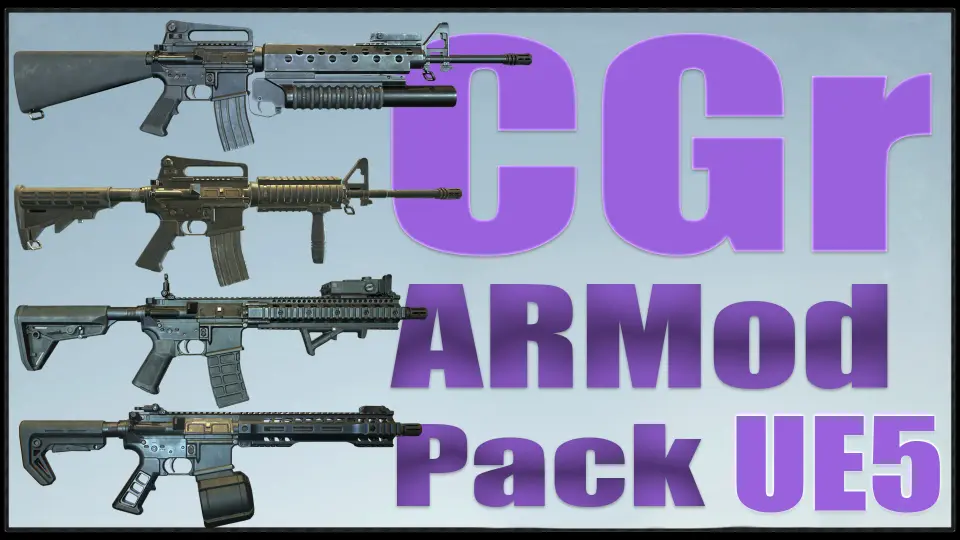
The rifle can shift its identity through three mesh options: classic, modern, and custom. That core setup is expanded through multiple holo sights and a set of attachments that includes a laser or flashlight, compensator, suppressor, bipods, and a grenade launcher. Because the weapon is meant to be assembled from a main skeletal mesh plus attachments, it can be pushed into noticeably different silhouettes. The pack describes this variability as a kind of constructor, making it possible to assemble classic or modern variants, along with short, regular, or long versions of the same weapon type.
Different views of the rifle change the feel of a scene
That flexibility matters visually as much as mechanically. A rifle fitted with a suppressor and holo sight suggests one tone, while a longer setup with bipods and launcher leans toward a heavier battlefield presence. The pack supports different views of the weapon through its customization, so artists and developers are not locked into one fixed profile. For anyone building first-person sequences, close-up promotional renders, or a prototype with several loadout identities, that range gives the same base rifle room to read differently from one scenario to the next.
The material system adds another layer to that variation. Material layering is used so the weapon can take on different patterns, and it is also possible to change only a tint. This is a practical detail for teams that want to separate structural changes from surface treatment. One version of the rifle can keep the same attachments while shifting its finish, or hold the same pattern while using a different color tint to better fit a faction, map palette, or character setup.
Raindrops appearing on weapons reinforce that sense of environmental presence. Instead of treating the gun as an isolated prop, the pack includes a visual response that helps it sit inside weather-driven scenes. For developers trying to make first-person presentation feel more immediate, that kind of detail can help the rifle feel part of the world rather than overlaid on top of it.
Procedural aiming, recoil, and weapon deflection in CGr ARMod Pack
Functionally, the pack reaches into the parts of weapon handling that shape moment-to-moment play. It uses procedural aiming and procedural recoil, which gives the rifle a more system-driven feel than a purely static animation set. That is paired with procedural walking, along with character crouching and sliding. Together, these elements point toward a weapon setup that reacts to character movement rather than existing as a disconnected object.
Weapon deflection is also included when the character approaches an object. That detail can make close-quarters movement feel more grounded, especially in interiors or dense combat spaces where walls and obstacles matter. Instead of a weapon passing cleanly through everything, the pack accounts for proximity and changes the gun’s behavior near surfaces.
Firing is not limited to a single pattern. Different firing modes are present, and weapon accuracy can also be customized. That gives developers another practical control point when shaping the rifle’s role. The same customizable platform can be tuned toward different handling profiles without abandoning the broader modular setup. Bullet projectiles are subject to gravity and do not fly off into infinity, which helps define the weapon as a projectile-based system with travel behavior rather than a purely abstract hitscan stand-in.
Body-part damage and grenade effects push it beyond a model pack
Combat response is one of the clearest signs that this is intended as more than a weapon mesh collection. The enemy damage system depends on which body part is hit. A headshot leads to death with fewer hits than a strike to an arm or leg. That makes the rifle part of a more structured damage model, where hit location has gameplay consequences and not all impacts are treated equally.
The pack also includes grenades in three types: fragmentation, flashbang, and smoke. Those are accompanied by explosions, blinding, and concussion effects. In use, that broadens the resource from a rifle-focused package into something that can help stage a larger combat loop. A developer can move from direct rifle fire to area disruption and visual impairment without stepping outside the set of features described here.
There are bonus animations for a frag grenade throw and a stun grenade throw, plus an animation of weapon jamming. In the BONUS directory, there are also animations that are not implemented in the project, including Weapon Block Idle Animations and Movements. For teams exploring extensions or alternate handling states, those extra pieces may be useful as a starting point, even if they are not wired into the project as delivered.
UE5 Manny, True FPS, and changed animation handling
The pack has been updated on the UE5 side, and all animations have been retargeted for UE5 Manny and adjusted for that mannequin. It is now True FPS, which means the character Blueprint includes the entire mannequin rather than only the arms. That change affects how the weapon presentation fits into a first-person setup and signals a broader full-body approach.
Animation handling has shifted with that update. Because Manny’s animation blueprint is split into upper and lower body parts, the Ik_hand_gun Bone is no longer used in animations, though it is still needed for procedural aiming. Older animation equivalents where that bone is animated remain available in the Legacy folder. Newer animation versions use GunMainBoneMove, where the Main bone of the weapon is animated while the weapon itself stays attached to the socket of the right hand.
There are exceptions in some projects, including SAShotgun and BASnpR, where certain animations dynamically attach the weapon to the socket on the left hand. That left-hand socket is necessary in those cases. The Data Table was changed along with these updates, which is important for anyone planning to work directly with the project’s underlying setup instead of treating it as a closed presentation piece.
Where the blueprints help and where teams will need to take over
CGr ARMod Pack is framed as an asset pack rather than a complete project. The blueprints are configured for presentation only, and advanced developers can improve them further. That makes its best use fairly clear: it is a foundation for teams who want access to weapon models, animation work, and some gameplay logic, then plan to adapt those parts inside a more advanced project of their own.
At the same time, the pack is not positioned as beginner-friendly. It may seem complicated for new users, and there are a few specific areas that require attention. Custom collision presets in the project settings matter, as do notifications in animation montages. Weapon-specific changes are handled through DT_Weapon_DataTable. Some variables have also been moved from the Data Table into the weapon blueprints so they can be changed and viewed in real time through the construction script. For developers who like to iterate while seeing immediate results, that is a practical workflow detail.
The pack also notes that if it is combined with shotgun projects, the reloading logic for SAShotgun and PAShotgun is not included directly here. Separate shotgun components are used for that logic. Another project-level note concerns versions UE5.5 and possibly higher, where freezes and disappearing materials may occur. The stated fix is to reduce the resolution of all textures, with lower-resolution textures uploaded and high-resolution textures placed in the appropriate folder. There are also notes covering issues such as image shift to the right and ragdoll sliding on the floor.
X-axis weapon orientation and a direct fit-for-purpose read
The weapon is set up on the X-axis. If a Y-axis orientation is needed, the workflow is straightforward: export the weapon model, import it again with a rotation of -90 degrees on the Z-axis, and apply the same change to the weapon animation, or rotate the weapon manually by -90 degrees in each animation and set the key. That is a small but concrete pipeline note, and exactly the sort of detail that can save time when integrating the pack into a different production standard.
For teams evaluating what this resource actually offers, the strongest takeaway is that it covers a wider slice of playable weapon behavior than a rifle model alone. CGr ARMod Pack combines a modular assault rifle, layered material variation, procedural aiming and recoil, movement-aware handling, projectile gravity, body-part damage, grenade effects, and UE5 Manny retargeting in a package that is meant to be adapted by developers who want a substantial base rather than a finished game system.
 Guns
Guns