"7aa4acc705f0d80b"{"id":"1001965","slug":"blood-circulation","title":"Blood Circulation","category":"Interior","engine":"5.0+","assetVersion":"","engineVersion":"Engine Version: 5.0+","tag":"Interior","accent":"blue","visual":"mech","summary":"Simulate the human heart and vascular system with Blood Circulation, featuring healthy and unhealthy organ states, valves, vessels, and cellular models.","platform":"Unreal Engine","publishedAt":"2026-10-24T13:30:58.851Z","updatedAt":"2026-10-24T13:30:58.851Z","sourceNotes":[],"fileContents":[],"compatibility":["Unreal Engine","Engine Version: 5.0+"],"featuredImage":{"alt":"Blood Circulation","src":"/wp-content/uploads/published/2026/10/7c20e605e2eb-508abaee-0887-4435-a095-b9cfb16f3969-f172217522.webp"},"hasDownloadLink":true,"downloads":0,"terms":[{"taxonomy":"category","slug":"interior","name":"Interior"}],"galleryImages":[{"src":"/wp-content/uploads/published/2026/10/3617e76ca8f0-6eb16295-a628-42fb-82c7-b5ecdbcf8af4-53ea08e91e.webp","alt":"Blood Circulation"},{"src":"/wp-content/uploads/published/2026/10/aa7ed0df5d69-31758efb-a3bb-41e0-859e-8bf305829397-729c3c7352.webp","alt":"Blood Circulation"},{"src":"/wp-content/uploads/published/2026/10/014bfedcd8b9-7d1905ff-5a50-40c3-9aea-0d44c49f4274-0760d5452e.webp","alt":"Blood Circulation"},{"src":"/wp-content/uploads/published/2026/10/1a706da47971-1dca2d3a-d4d8-4346-9d59-69eb2d38a404-28b3760052.webp","alt":"Blood Circulation"},{"src":"/wp-content/uploads/published/2026/10/646dc7c1e51b-53da9a92-f2af-4db8-a224-8cf1d4c2b5e2-fb3fc0f015.webp","alt":"Blood Circulation"},{"src":"/wp-content/uploads/published/2026/10/49046fce4b57-a6f9b284-4a93-4ba8-a499-1b3ad8cc01f2-79b6d7dcc2.webp","alt":"Blood Circulation"},{"src":"/wp-content/uploads/published/2026/10/2e9f85377117-682a72e5-bf91-4f12-82e9-5b86aa751d14-82b07b055b.webp","alt":"Blood Circulation"},{"src":"/wp-content/uploads/published/2026/10/f9619a70588e-0c7cecd8-1ace-4b31-884b-c6f1b1083786-eca17f3fef.webp","alt":"Blood Circulation"},{"src":"/wp-content/uploads/published/2026/10/ad22f4e597b7-aba60091-dff5-4683-8d4a-99c2f1dace1b-65c1f777b2.webp","alt":"Blood Circulation"},{"src":"/wp-content/uploads/published/2026/10/d4d29614443e-0e7b5031-ec71-49d1-9f1c-e4053e320562-0491556158.webp","alt":"Blood Circulation"}],"accessPanel":{"kind":"resource","title":"Download this resource","eyebrow":"Free Download","message":"Log in or create a free account to start your download.","fileName":"Content.7z","safetyNote":"Resources are manually reviewed before listing to improve quality and reduce obvious risks.","actionLabel":"Download Free","resourceType":"Resource archive"},"contentHtml":"\u003ch2\u003eMapping Internal Vessels and Heart Cavities in Blood Circulation\u003c/h2\u003e\u003cp\u003eRendering the internal biological space of human cardiovascular pathways presents unique setup challenges. Constructing convincing vascular interiors requires assets that accurately depict the enclosed topology of veins, arteries, and cardiac chambers.\u003c/p\u003e\u003cp\u003eBlood Circulation addresses this production hurdle by providing dedicated 3D structures and shader setups built to represent the interior environment of the heart and surrounding vessels. Rather than relying on exterior organ meshes, the package concentrates on the internal spaces through which biological fluids move. Developers and visualizers can arrange these meshes to depict continuous circulatory routes, establishing internal anatomical chambers that capture the fluid, organic qualities of veins, pulmonary structures, and inner cardiac tissue.\u003c/p\u003e\u003ch2\u003eRouting Anatomical Pathways from the Superior Vena Cava to Capillaries\u003c/h2\u003e\u003cp\u003eSetting up a full circulatory circuit requires precise structural staging across distinct cardiac zones. The asset kit covers the major anatomical waypoints necessary to demonstrate functional blood routing.\u003c/p\u003e\u003cp\u003eThe geometric collection includes foundational pathways spanning the systemic and pulmonary systems. Included meshes represent the superior vena cava, which directs venous flow, along with internal atria configurations and vital junction valves including both the mitral valve and the aortic valve. From these central heart components, the network continues outward into the aorta, branching further along the pulmonary artery, pulmonary capillaries, pulmonary veins, and peripheral capillary beds. Each mesh represents a defined segment of the human circulatory loop, allowing creators to assemble connected anatomical routes or focus specifically on localized operations within the pulmonary or aortic systems.\u003c/p\u003e\u003ch2\u003ePopulating Flow with Red Blood Cells, White Blood Cells, and Platelets\u003c/h2\u003e\u003cp\u003eAn empty vascular lumen lacks the kinetic identity of human physiology. Populating these routes with the accurate cellular constituents transforms static interior tunnels into believable biological streams.\u003c/p\u003e\u003cp\u003eWithin the package, microscopic circulatory entities are provided to accompany the larger structural organs. Individual models depict red blood cells, white blood cells, and platelets, enabling artists to populate blood vessels with their authentic components. These microscopic models can be arranged across capillary beds, arterial trunks, or internal heart chambers. By incorporating distinct cell varieties alongside the vessel walls, scenes can represent respiratory oxygen exchange, immune presence, or clotting factors, grounding interior bodily sequences in recognizable cellular elements.\u003c/p\u003e\u003ch2\u003eSwitching Organ States Between Healthy and Unhealthy Materials\u003c/h2\u003e\u003cp\u003ePhysiological simulation frequently demands visual shifts from pristine biological function to compromised tissue. Organ models in the package accommodate this requirement through dedicated pathological states.\u003c/p\u003e\u003cp\u003eEvery included organ is prepared with both healthy and unhealthy visual states, configured directly through material instances. The creator equipped these material instances with adjustable parameters that govern surface appearance, enabling users to transition tissues from normal condition to diseased or degraded representations. By fine-tuning values within the material properties, developers can shift surface color, texture dynamics, and internal wall characteristics. This parameter-driven approach allows a single cardiac or vascular asset to fulfill multiple diagnostic or dramatic requirements without requiring separate replacement meshes.\u003c/p\u003e\u003ch2\u003eImplementing Biological Assets in Medical Projects and Game Levels\u003c/h2\u003e\u003cp\u003eThe balance between anatomical accuracy and adjustable visual parameters accommodates varied production environments. Both interactive games and scientific presentations can draw upon the same underlying cardiovascular framework.\u003c/p\u003e\u003cp\u003eIn medical projects, the asset collection provides an intuitive foundation for illustrating cardiac mechanics, pulmonary exchange, and circulatory transit across specific heart valves and vessel branches. The ability to modify healthy and unhealthy material states supports clear diagnostic demonstrations and physiological walkthroughs. For game development, the extensive interior pathways, cellular meshes, and organic shaders translate naturally into unique biological levels, micro-scale underwater-like environments, or visceral human body stages where players navigate directly through veins, arteries, and pulsing cardiac chambers.\u003c/p\u003e\n\n\u003ch2\u003eContinue Browsing Similar Packs\u003c/h2\u003e\n\u003cul\u003e\n\u003cli\u003e\u003ca href=\"https://3dcghub.com/semi-permanent-blood-droplets/\" title=\"Semi-Permanent Blood Droplets\"\u003eSemi-Permanent Blood Droplets\u003c/a\u003e\u003c/li\u003e\n\u003cli\u003e\u003ca href=\"https://3dcghub.com/realistic-blood-vfx-niagara-blood-effects-blood-vfx-blood-blood-vfx/\" title=\"Realistic Blood VFX (Niagara Blood Effects, Blood VFX, Blood, Blood VFX)\"\u003eRealistic Blood VFX (Niagara Blood Effects, Blood VFX, Blood, Blood VFX)\u003c/a\u003e\u003c/li\u003e\n\u003cli\u003e\u003ca href=\"https://3dcghub.com/blood/\" title=\"Blood\"\u003eBlood\u003c/a\u003e\u003c/li\u003e\n\u003cli\u003e\u003ca href=\"https://3dcghub.com/horror-collection-blood-1000-textures/\" title=\"Horror Collection: Blood [1000+ textures]\"\u003eHorror Collection: Blood [1000+ textures]\u003c/a\u003e\u003c/li\u003e\n\u003cli\u003e\u003ca href=\"https://3dcghub.com/blood-additional-splashes-and-washed/\" title=\"Blood: Additional Splashes And Washed\"\u003eBlood: Additional Splashes And Washed\u003c/a\u003e\u003c/li\u003e\n\u003c/ul\u003e","contentTextLength":4824,"navigation":{"current":25,"total":3925,"previous":{"id":"1001966","slug":"blood-splatter-blueprint-system","title":"Blood Splatter Blueprint System","category":"Weapons \u0026 Combat","platform":"Unreal Engine","updatedAt":"2026-10-24T13:31:45.156Z"},"next":{"id":"1001964","slug":"black-hole","title":"Black Hole","category":"Sky","platform":"Unreal Engine","updatedAt":"2026-10-24T11:40:28.947Z"}},"relatedResources":[{"id":"1001184","slug":"semi-permanent-blood-droplets","title":"Semi-Permanent Blood Droplets","category":"Liquid","engine":"5.0+","assetVersion":"","engineVersion":"Engine Version: 5.0+","tag":"Liquid","accent":"blue","visual":"mech","summary":"Configure Semi-Permanent Blood Droplets in Unreal Engine using Niagara instanced mesh decals, CPU surface normals, and GPU distance field collisions.","platform":"Unreal Engine","publishedAt":"2026-09-17T06:32:56.595Z","updatedAt":"2026-09-17T06:32:56.595Z","sourceNotes":[],"fileContents":[],"compatibility":["Unreal Engine","Engine Version: 5.0+"],"featuredImage":{"alt":"Semi-Permanent Blood Droplets","src":"/wp-content/uploads/published/2026/09/40fc17e94d63-03acfe1a-80b2-4b10-8472-9a8b35314535-454bf86bde.webp"},"hasDownloadLink":true,"downloads":2},{"id":"16636","slug":"realistic-blood-vfx-niagara-blood-effects-blood-vfx-blood-blood-vfx","title":"Realistic Blood VFX (Niagara Blood Effects, Blood VFX, Blood, Blood VFX)","category":"Spells \u0026 Combat","engine":"5.2+","assetVersion":"Engine version: 5.2+","engineVersion":"5.0","tag":"Spells \u0026 Combat","accent":"blue","visual":"luts","summary":"Enhance your project with Realistic Blood VFX, a comprehensive Niagara-based system featuring dynamic splatters, arterial bleeding, and PBR-compatible decals for high-fidelity results.","platform":"Unreal Engine","publishedAt":"2026-03-12T17:37:05.000Z","updatedAt":"2026-04-19T15:43:44.000Z","sourceNotes":[],"fileContents":[],"compatibility":["Unreal Engine","Engine version: 5.2+"],"featuredImage":{"alt":"Realistic Blood VFX (Niagara Blood Effects, Blood VFX, Blood, Blood VFX)","src":"https://3dcghub.com/wp-content/uploads/2026/03/436dc969-0b81-4830-9180-0a4919a2a247.webp"},"hasDownloadLink":true,"downloads":14},{"id":"1001722","slug":"blood","title":"Blood","category":"Damage \u0026 Grunge","engine":"4.26+,5.0+","assetVersion":"","engineVersion":"Engine Version: 4.26+,5.0+","tag":"Damage \u0026 Grunge","accent":"blue","visual":"mech","summary":"Over 120 horror decals deliver 4K and 2K blood smears, demonic symbols, and text with a performance-first single-texture setup and Decal Blueprint control.","platform":"Unreal Engine","publishedAt":"2026-10-19T16:20:31.409Z","updatedAt":"2026-10-19T16:20:31.409Z","sourceNotes":[],"fileContents":[],"compatibility":["Unreal Engine","Engine Version: 4.26+,5.0+"],"featuredImage":{"alt":"Blood","src":"/wp-content/uploads/published/2026/10/c8e02bd2344b-ac47f0d8-8e82-4163-b6b7-d83fe1867fbb-065bd8a46c.webp"},"hasDownloadLink":true,"downloads":1}]}
Interior
Blood Circulation
Simulate the human heart and vascular system with Blood Circulation, featuring healthy and unhealthy organ states, valves, vessels, and cellular models.
Category:Unreal Engine,InteriorPlatform: Unreal EngineEngine Version: 5.0+Published: Oct 24, 2026
Interior
Resource overview
Mapping Internal Vessels and Heart Cavities in Blood Circulation
Rendering the internal biological space of human cardiovascular pathways presents unique setup challenges. Constructing convincing vascular interiors requires assets that accurately depict the enclosed topology of veins, arteries, and cardiac chambers.
Blood Circulation addresses this production hurdle by providing dedicated 3D structures and shader setups built to represent the interior environment of the heart and surrounding vessels. Rather than relying on exterior organ meshes, the package concentrates on the internal spaces through which biological fluids move. Developers and visualizers can arrange these meshes to depict continuous circulatory routes, establishing internal anatomical chambers that capture the fluid, organic qualities of veins, pulmonary structures, and inner cardiac tissue.
Routing Anatomical Pathways from the Superior Vena Cava to Capillaries
Setting up a full circulatory circuit requires precise structural staging across distinct cardiac zones. The asset kit covers the major anatomical waypoints necessary to demonstrate functional blood routing.
The geometric collection includes foundational pathways spanning the systemic and pulmonary systems. Included meshes represent the superior vena cava, which directs venous flow, along with internal atria configurations and vital junction valves including both the mitral valve and the aortic valve. From these central heart components, the network continues outward into the aorta, branching further along the pulmonary artery, pulmonary capillaries, pulmonary veins, and peripheral capillary beds. Each mesh represents a defined segment of the human circulatory loop, allowing creators to assemble connected anatomical routes or focus specifically on localized operations within the pulmonary or aortic systems.
Populating Flow with Red Blood Cells, White Blood Cells, and Platelets
An empty vascular lumen lacks the kinetic identity of human physiology. Populating these routes with the accurate cellular constituents transforms static interior tunnels into believable biological streams.
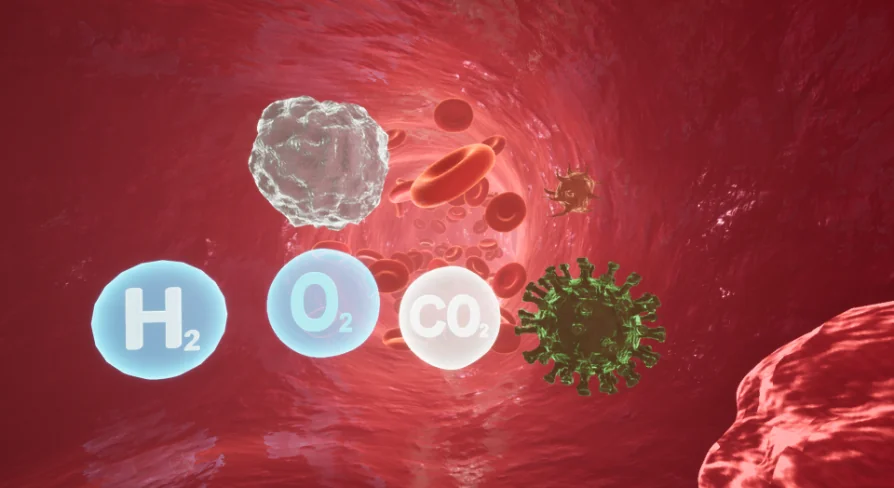
Within the package, microscopic circulatory entities are provided to accompany the larger structural organs. Individual models depict red blood cells, white blood cells, and platelets, enabling artists to populate blood vessels with their authentic components. These microscopic models can be arranged across capillary beds, arterial trunks, or internal heart chambers. By incorporating distinct cell varieties alongside the vessel walls, scenes can represent respiratory oxygen exchange, immune presence, or clotting factors, grounding interior bodily sequences in recognizable cellular elements.
Switching Organ States Between Healthy and Unhealthy Materials
Physiological simulation frequently demands visual shifts from pristine biological function to compromised tissue. Organ models in the package accommodate this requirement through dedicated pathological states.
Every included organ is prepared with both healthy and unhealthy visual states, configured directly through material instances. The creator equipped these material instances with adjustable parameters that govern surface appearance, enabling users to transition tissues from normal condition to diseased or degraded representations. By fine-tuning values within the material properties, developers can shift surface color, texture dynamics, and internal wall characteristics. This parameter-driven approach allows a single cardiac or vascular asset to fulfill multiple diagnostic or dramatic requirements without requiring separate replacement meshes.
Implementing Biological Assets in Medical Projects and Game Levels
The balance between anatomical accuracy and adjustable visual parameters accommodates varied production environments. Both interactive games and scientific presentations can draw upon the same underlying cardiovascular framework.
In medical projects, the asset collection provides an intuitive foundation for illustrating cardiac mechanics, pulmonary exchange, and circulatory transit across specific heart valves and vessel branches. The ability to modify healthy and unhealthy material states supports clear diagnostic demonstrations and physiological walkthroughs. For game development, the extensive interior pathways, cellular meshes, and organic shaders translate naturally into unique biological levels, micro-scale underwater-like environments, or visceral human body stages where players navigate directly through veins, arteries, and pulsing cardiac chambers.
 Interior
 Liquid
 Spells & Combat
 Damage & Grunge