"4481da9c895ef786"{"id":"1000279","slug":"baby-vampire","title":"Baby Vampire","category":"Creatures \u0026 Monsters","engine":"4.26+,5.0+","assetVersion":"","engineVersion":"Engine Version: 4.26+,5.0+","tag":"Creatures","accent":"blue","visual":"character","summary":"A technical breakdown of the Baby Vampire creature asset, detailing its 31,320-triangle base mesh, optimized LODs, and robust 72-animation movement library.","platform":"Unreal Engine","publishedAt":"2026-07-02T18:23:20.451Z","updatedAt":"2026-07-02T18:23:20.451Z","sourceNotes":[],"fileContents":[],"compatibility":["Unreal Engine","Engine Version: 4.26+,5.0+"],"featuredImage":{"alt":"Baby Vampire","src":"/wp-content/uploads/published/2026/07/d41d761c622d-c5d334f4-4961-4049-b04c-bc8ad1658722-28872bbf41.webp"},"hasDownloadLink":true,"downloads":0,"terms":[{"taxonomy":"category","slug":"creatures-and-monsters","name":"Creatures \u0026 Monsters"}],"galleryImages":[{"src":"/wp-content/uploads/published/2026/07/1cbb7d7a5cc2-e9b1735a-2ddd-4e5c-8e64-d9d6cad974d0-5a5415b3f6.webp","alt":"Baby Vampire"},{"src":"/wp-content/uploads/published/2026/07/75f49cf60d1e-3920c8a5-2c47-4f63-96b8-94bf4295dfda-feed1454ed.webp","alt":"Baby Vampire"},{"src":"/wp-content/uploads/published/2026/07/9a348a366d8e-076f8ff8-b060-45df-bf84-0b01dd8b7eef-97d0b68cc4.webp","alt":"Baby Vampire"},{"src":"/wp-content/uploads/published/2026/07/27ea4d247ffb-5ff0e0e6-8e5d-4d71-be2c-d6d741fb7a2e-aa657e214d.webp","alt":"Baby Vampire"},{"src":"/wp-content/uploads/published/2026/07/a768004be576-2b7e48be-a511-4b59-8ed0-f55f37009dc7-7090c60886.webp","alt":"Baby Vampire"},{"src":"/wp-content/uploads/published/2026/07/1f5d52818b79-9bc05204-56e5-46d1-94ca-acb73333b200-35ee617e80.webp","alt":"Baby Vampire"},{"src":"/wp-content/uploads/published/2026/07/19b3c0eaa6b7-cece11ac-94f8-4cab-8481-f16d0b866745-80700be7ff.webp","alt":"Baby Vampire"}],"accessPanel":{"kind":"resource","title":"Download this resource","eyebrow":"Free Download","message":"Log in or create a free account to start your download.","fileName":"Content.7z","safetyNote":"Resources are manually reviewed before listing to improve quality and reduce obvious risks.","actionLabel":"Download Free","resourceType":"Resource archive"},"contentHtml":"\u003ch2\u003eAtmospheric Contexts for an Undead Child Creature\u003c/h2\u003e\n\u003cp\u003eDark fantasy and horror projects often rely on unsettling enemy types to build tension and subvert player expectations. The concept of an undead child or a smaller, aggressive creature introduces a highly specific type of gameplay dynamic. These encounters usually involve low-to-the-ground hitboxes, erratic movements, and a stark contrast to towering, hulking brutes. The Baby Vampire package provides a foundational asset for these exact scenarios, combining a thematic monster design with a comprehensive suite of movement data. By integrating this fully rigged child Dracula creature, developers can populate their haunted environments, crypts, or gothic castles with an unconventional undead threat. The thematic tags associated with the asset—Dead, Vampire, Undead, Baby, Child, Dracula, Creature, and Monster—highlight its primary role as a hostile or atmospheric entity within a dark narrative setting.\u003c/p\u003e \u003ch2\u003eBase Geometry of the Baby Vampire\u003c/h2\u003e\n\u003cp\u003eEstablishing the visual fidelity of a creature requires an understanding of its underlying geometry. The base character model in this package is constructed to support detailed close-up encounters while maintaining general engine performance. The primary mesh consists of 15,688 polygons, which translates directly to 31,320 triangles and 15,874 vertexes. This specific triangle count places the creature in a comfortable mid-resolution tier. It carries enough geometric density to support smooth deformations during complex skeletal movements, ensuring that the joints articulate naturally without harsh, angular breaks. For a primary enemy, an important NPC, or a creature that the camera will track closely, this 31,320-triangle baseline provides the necessary structural detail to hold up under dynamic lighting and tight focal lengths.\u003c/p\u003e \u003ch2\u003eImplementing the Low Polygonal LOD\u003c/h2\u003e\n\u003cp\u003eWhen rendering multiple enemies on screen simultaneously, vertex processing can quickly become a bottleneck for the GPU. The inclusion of a low polygonal character version acts as a direct countermeasure to this performance hurdle. By stepping down from the primary model to the included Level of Detail (LOD) mesh, the geometry is drastically simplified for distant rendering. The LOD version contains 4,497 polygons, which equates to 8,942 triangles and 4,659 vertexes. This aggressive reduction cuts the triangle count to nearly a quarter of the original base mesh. As the in-game camera moves further away from the undead entity, the rendering pipeline can swap to this low polygonal iteration. This allows developers to spawn groups of these monsters in a single area without overwhelming the hardware, preserving both performance and the overarching silhouette of the creature.\u003c/p\u003e \u003ch2\u003eStructuring the Animationblueprint and Script Logic\u003c/h2\u003e\n\u003cp\u003eThe core utility of this asset lies in its extensive movement data. A creature's believability relies heavily on how it traverses the environment and reacts to player input. The package delivers a robust library of 72 distinct animations. This volume suggests a wide range of states necessary for a functional enemy AI, providing enough variety to prevent the creature's behavior from feeling repetitive. To manage this library, the asset includes an Animationblueprint alongside associated script elements. The presence of an Animationblueprint means the logic for blending these 72 animations is already scaffolded. Technical animators and programmers can utilize this blueprint to manage state transitions, blending rules, and event triggers, significantly reducing the initial setup time required to get the monster moving within the game engine.\u003c/p\u003e \u003ch2\u003eCapsule-Driven Movement with 48 In-Place Animations\u003c/h2\u003e\n\u003cp\u003eWithin the total animation pool, there is a strict categorization that dictates how the creature's movement is handled by the underlying code. The package includes 48 \"on place\" or in-place animations. For these sequences, the character's root bone remains entirely stationary at the origin point. This setup is suited to capsule-driven movement, where the game engine's code dictates the speed, direction, and velocity of the character's collision cylinder, while the animation simply plays on top of it to provide the visual representation of movement. These 48 in-place animations are highly effective for standard locomotion states like basic walking, running, or idle loops, where the programmer needs absolute control over the entity's speed variables without interference from the animation data.\u003c/p\u003e \u003ch2\u003eDriving Displacement with 24 RM (Root Motion) Sequences\u003c/h2\u003e\n\u003cp\u003eContrasting the in-place data, a specific subset of the library is dedicated to complex spatial displacement. There are 24 animations that contain root motion data. To ensure a smooth workflow, these specific files are clearly labeled with an \"RM\" prefix for immediate identification within the content browser. Root motion is critical for a creature asset when standard capsule-driven movement falls short. Instead of relying on rigid code to push the character forward, root motion allows the animation itself to drive the character's physical location in the world space. This technique prevents immersion-breaking issues like foot sliding during sudden lunges, heavy impacts, or complex attacks where the monster's momentum must perfectly match its skeletal movement. The \"RM\" prefix ensures developers can quickly filter these sequences and assign them to the correct nodes within their montages.\u003c/p\u003e \u003ch2\u003eIdeal Adopters of this Dracula Monster\u003c/h2\u003e\n\u003cp\u003eDevelopers building horror, dark fantasy, or gothic action titles stand to gain the most from this package. Rigging and animating a non-standard humanoid, particularly one with the proportions of a child monster, often requires specialized animation workflows. By providing a pre-configured Animationblueprint, an optimized 8,942-triangle LOD for crowd rendering, and a clear division between 48 in-place and 24 root motion animations, the asset removes much of the foundational technical friction. It serves as a ready-to-deploy undead adversary, allowing small teams or solo developers to focus on AI programming and encounter design rather than building a creature's movement systems from scratch.\u003c/p\u003e\n\n\u003ch2\u003eContinue Browsing Similar Packs\u003c/h2\u003e\n\u003cul\u003e\n\u003cli\u003e\u003ca href=\"https://3dcghub.com/monsters-wraith/\" title=\"Monsters - Wraith\"\u003eMonsters - Wraith\u003c/a\u003e\u003c/li\u003e\n\u003cli\u003e\u003ca href=\"https://3dcghub.com/ork-rogue/\" title=\"Ork Rogue\"\u003eOrk Rogue\u003c/a\u003e\u003c/li\u003e\n\u003cli\u003e\u003ca href=\"https://3dcghub.com/ocean-monster-fish-pack-part-2-underwater-creatures-fish-low-poly-11/\" title=\"Ocean Monster Fish Pack - Part 2 - Underwater Creatures - Fish low poly - #11\"\u003eOcean Monster Fish Pack - Part 2 - Underwater Creatures - Fish low poly - #11\u003c/a\u003e\u003c/li\u003e\n\u003cli\u003e\u003ca href=\"https://3dcghub.com/demon-7/\" title=\"Demon 7\"\u003eDemon 7\u003c/a\u003e\u003c/li\u003e\n\u003cli\u003e\u003ca href=\"https://3dcghub.com/goblin-shaman/\" title=\"Goblin Shaman\"\u003eGoblin Shaman\u003c/a\u003e\u003c/li\u003e\n\u003c/ul\u003e","contentTextLength":6372,"navigation":{"current":1125,"total":3269,"previous":{"id":"1000280","slug":"battle-tank-military-pack","title":"Battle Tank Military Pack","category":"Military","platform":"Unreal Engine","updatedAt":"2026-07-03T05:22:07.290Z"},"next":{"id":"1000278","slug":"baby-in-capsule","title":"Baby In Capsule","category":"Characters \u0026 Creatures","platform":"Unreal Engine","updatedAt":"2026-07-02T18:20:15.884Z"}},"relatedResources":[{"id":"1001005","slug":"orc-warrior","title":"Orc Warrior","category":"Creatures \u0026 Monsters","engine":"4.26+,5.0+","assetVersion":"","engineVersion":"Engine Version: 4.26+,5.0+","tag":"Creatures","accent":"blue","visual":"character","summary":"A rigged low-poly orc with a weapon, 11 animations, a control rig, plus 4096x4096 Color, Normal, and AORM textures for real-time fantasy work.","platform":"Unreal Engine","publishedAt":"2026-08-22T10:59:41.214Z","updatedAt":"2026-08-22T10:59:41.214Z","sourceNotes":[],"fileContents":[],"compatibility":["Unreal Engine","Engine Version: 4.26+,5.0+"],"featuredImage":{"alt":"Orc Warrior","src":"/wp-content/uploads/published/2026/08/07a81bcdb165-a721db55-38ea-4d04-a1d7-b62b48c726b0-dc71636e7b.webp"},"hasDownloadLink":true,"downloads":1},{"id":"1000937","slug":"allosaurus-dinosaur-character-rig-and-animations","title":"Allosaurus Dinosaur Character Rig and Animations","category":"Creatures \u0026 Monsters","engine":"4.26+,5.0+","assetVersion":"","engineVersion":"Engine Version: 4.26+,5.0+","tag":"Creatures","accent":"blue","visual":"animation","summary":"Allosaurus rig with 15 animations: idles, root-motion 360-degree turns, 200cm/sec walks, 500cm/sec run, roar, attack, hits, death. Built for VR.","platform":"Unreal Engine","publishedAt":"2026-08-10T02:52:27.202Z","updatedAt":"2026-08-10T02:52:27.202Z","sourceNotes":[],"fileContents":[],"compatibility":["Unreal Engine","Engine Version: 4.26+,5.0+"],"featuredImage":{"alt":"Allosaurus Dinosaur Character Rig and Animations","src":"/wp-content/uploads/published/2026/08/4a17638d37c8-d30086b0-95fc-484e-bb27-6f8c77633eb3-20dee40414.webp"},"hasDownloadLink":true,"downloads":2},{"id":"1001006","slug":"ork-rogue-2","title":"Ork Rogue","category":"Creatures \u0026 Monsters","engine":"4.26+,5.0+","assetVersion":"","engineVersion":"Engine Version: 4.26+,5.0+","tag":"Creatures","accent":"blue","visual":"character","summary":"Ork Rogue is a ready-made lowpoly orc with a blueprint-connected weapon, 4096 to 512 UV sets, and poly counts suited for game projects.","platform":"Unreal Engine","publishedAt":"2026-08-22T11:04:26.209Z","updatedAt":"2026-08-22T11:04:26.209Z","sourceNotes":[],"fileContents":[],"compatibility":["Unreal Engine","Engine Version: 4.26+,5.0+"],"featuredImage":{"alt":"Ork Rogue","src":"/wp-content/uploads/published/2026/08/e1b3f07042d3-d3ef89db-f3ec-4c73-bddf-edba852e9eb8-e4e0eed622.webp"},"hasDownloadLink":true,"downloads":0}]}
Creatures
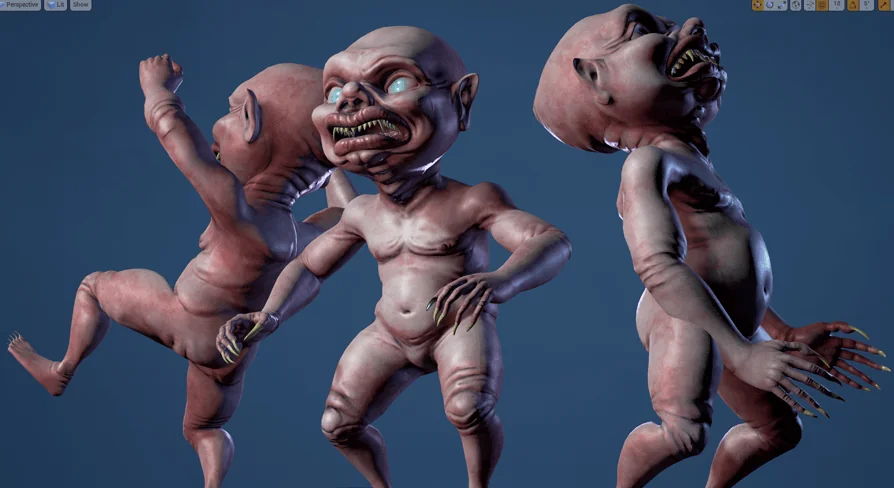
Baby Vampire
A technical breakdown of the Baby Vampire creature asset, detailing its 31,320-triangle base mesh, optimized LODs, and robust 72-animation movement library.
Dark fantasy and horror projects often rely on unsettling enemy types to build tension and subvert player expectations. The concept of an undead child or a smaller, aggressive creature introduces a highly specific type of gameplay dynamic. These encounters usually involve low-to-the-ground hitboxes, erratic movements, and a stark contrast to towering, hulking brutes. The Baby Vampire package provides a foundational asset for these exact scenarios, combining a thematic monster design with a comprehensive suite of movement data. By integrating this fully rigged child Dracula creature, developers can populate their haunted environments, crypts, or gothic castles with an unconventional undead threat. The thematic tags associated with the asset—Dead, Vampire, Undead, Baby, Child, Dracula, Creature, and Monster—highlight its primary role as a hostile or atmospheric entity within a dark narrative setting.
Base Geometry of the Baby Vampire
Establishing the visual fidelity of a creature requires an understanding of its underlying geometry. The base character model in this package is constructed to support detailed close-up encounters while maintaining general engine performance. The primary mesh consists of 15,688 polygons, which translates directly to 31,320 triangles and 15,874 vertexes. This specific triangle count places the creature in a comfortable mid-resolution tier. It carries enough geometric density to support smooth deformations during complex skeletal movements, ensuring that the joints articulate naturally without harsh, angular breaks. For a primary enemy, an important NPC, or a creature that the camera will track closely, this 31,320-triangle baseline provides the necessary structural detail to hold up under dynamic lighting and tight focal lengths.
Implementing the Low Polygonal LOD
When rendering multiple enemies on screen simultaneously, vertex processing can quickly become a bottleneck for the GPU. The inclusion of a low polygonal character version acts as a direct countermeasure to this performance hurdle. By stepping down from the primary model to the included Level of Detail (LOD) mesh, the geometry is drastically simplified for distant rendering. The LOD version contains 4,497 polygons, which equates to 8,942 triangles and 4,659 vertexes. This aggressive reduction cuts the triangle count to nearly a quarter of the original base mesh. As the in-game camera moves further away from the undead entity, the rendering pipeline can swap to this low polygonal iteration. This allows developers to spawn groups of these monsters in a single area without overwhelming the hardware, preserving both performance and the overarching silhouette of the creature.
Structuring the Animationblueprint and Script Logic
The core utility of this asset lies in its extensive movement data. A creature's believability relies heavily on how it traverses the environment and reacts to player input. The package delivers a robust library of 72 distinct animations. This volume suggests a wide range of states necessary for a functional enemy AI, providing enough variety to prevent the creature's behavior from feeling repetitive. To manage this library, the asset includes an Animationblueprint alongside associated script elements. The presence of an Animationblueprint means the logic for blending these 72 animations is already scaffolded. Technical animators and programmers can utilize this blueprint to manage state transitions, blending rules, and event triggers, significantly reducing the initial setup time required to get the monster moving within the game engine.
Capsule-Driven Movement with 48 In-Place Animations
Within the total animation pool, there is a strict categorization that dictates how the creature's movement is handled by the underlying code. The package includes 48 "on place" or in-place animations. For these sequences, the character's root bone remains entirely stationary at the origin point. This setup is suited to capsule-driven movement, where the game engine's code dictates the speed, direction, and velocity of the character's collision cylinder, while the animation simply plays on top of it to provide the visual representation of movement. These 48 in-place animations are highly effective for standard locomotion states like basic walking, running, or idle loops, where the programmer needs absolute control over the entity's speed variables without interference from the animation data.
Driving Displacement with 24 RM (Root Motion) Sequences
Contrasting the in-place data, a specific subset of the library is dedicated to complex spatial displacement. There are 24 animations that contain root motion data. To ensure a smooth workflow, these specific files are clearly labeled with an "RM" prefix for immediate identification within the content browser. Root motion is critical for a creature asset when standard capsule-driven movement falls short. Instead of relying on rigid code to push the character forward, root motion allows the animation itself to drive the character's physical location in the world space. This technique prevents immersion-breaking issues like foot sliding during sudden lunges, heavy impacts, or complex attacks where the monster's momentum must perfectly match its skeletal movement. The "RM" prefix ensures developers can quickly filter these sequences and assign them to the correct nodes within their montages.
Ideal Adopters of this Dracula Monster
Developers building horror, dark fantasy, or gothic action titles stand to gain the most from this package. Rigging and animating a non-standard humanoid, particularly one with the proportions of a child monster, often requires specialized animation workflows. By providing a pre-configured Animationblueprint, an optimized 8,942-triangle LOD for crowd rendering, and a clear division between 48 in-place and 24 root motion animations, the asset removes much of the foundational technical friction. It serves as a ready-to-deploy undead adversary, allowing small teams or solo developers to focus on AI programming and encounter design rather than building a creature's movement systems from scratch.
 Creatures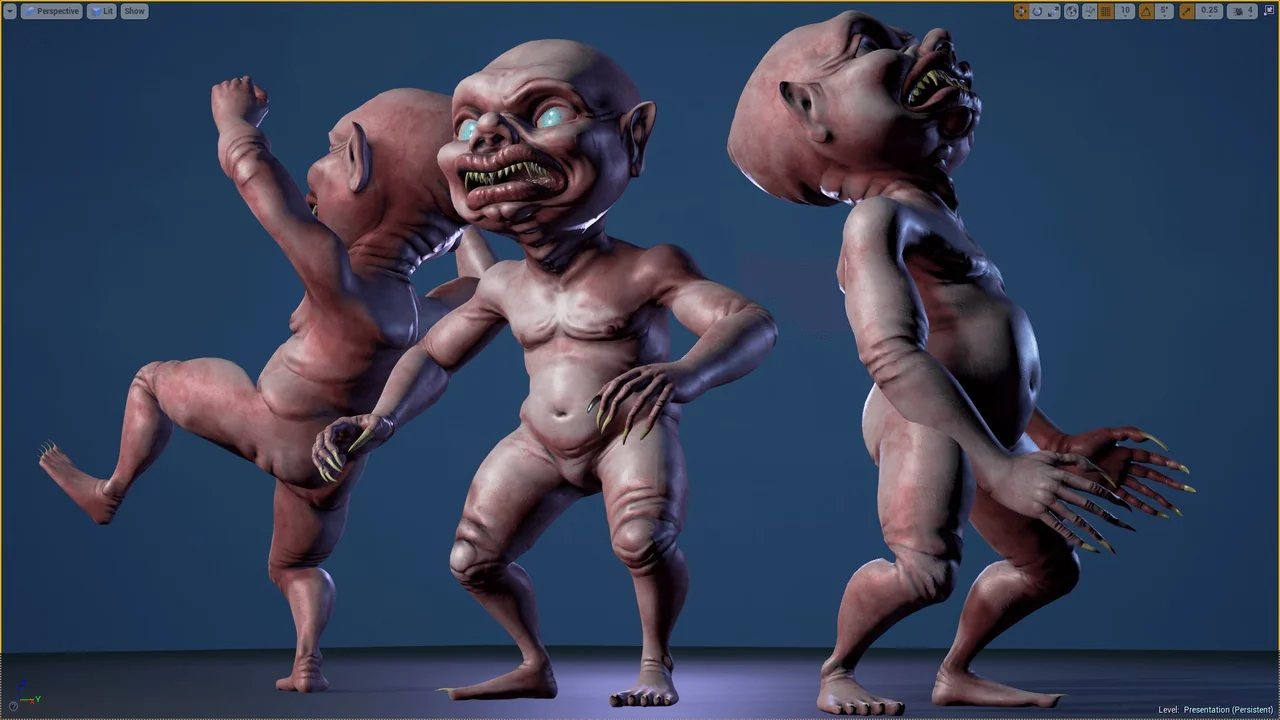
 Creatures
 Creatures
 Creatures