"72681c893cb4e083"{"id":"1002694","slug":"archviz-interior-vol-3","title":"Archviz Interior vol.3","category":"Interior","engine":"5.0+","assetVersion":"","engineVersion":"Engine Version: 5.0+","tag":"Interior","accent":"blue","visual":"mech","summary":"Explore an industrial apartment environment for Unreal Engine 4.27 to 5.2, featuring 80 distinct objects, GPU Lightmass baked GI, and Lumen dynamic lighting.","platform":"Unreal Engine","indexPolicy":"index","publishedAt":"2026-11-17T18:19:31.117Z","updatedAt":"2026-11-17T18:19:31.117Z","sourceNotes":[],"fileContents":[],"compatibility":["Unreal Engine","Engine Version: 5.0+"],"featuredImage":{"alt":"Archviz Interior vol.3","src":"/wp-content/uploads/published/2026/11/285b70cb7fad-73c2ac06-50c9-40e3-a5be-b304ec507881-5d0d4095f2.webp"},"hasDownloadLink":true,"downloads":0,"terms":[{"taxonomy":"category","slug":"interior","name":"Interior"}],"galleryImages":[{"src":"/wp-content/uploads/published/2026/11/3564c9159c5c-acc63deb-ae9a-4635-8959-181e69968b36-256ee1e2ed.webp","alt":"Archviz Interior vol.3"},{"src":"/wp-content/uploads/published/2026/11/f6e120253191-f32a9dd7-104c-4672-98de-fc82da622dc1-bef02efc9c.webp","alt":"Archviz Interior vol.3"},{"src":"/wp-content/uploads/published/2026/11/13c936449161-fe54e312-1c30-4925-8a59-405259786a67-336e6aa321.webp","alt":"Archviz Interior vol.3"},{"src":"/wp-content/uploads/published/2026/11/5815b1bc2be1-f265d706-050a-4007-8eae-20fb192c50d6-cc7ae3d17a.webp","alt":"Archviz Interior vol.3"},{"src":"/wp-content/uploads/published/2026/11/481f20d3f022-02df4a52-77d8-42ca-ba96-901a327bd855-83925efe4c.webp","alt":"Archviz Interior vol.3"},{"src":"/wp-content/uploads/published/2026/11/54b001749a5f-faffa5f6-9896-4607-b573-e8ab99b083c2-6d8167016e.webp","alt":"Archviz Interior vol.3"},{"src":"/wp-content/uploads/published/2026/11/dfd1a53719fc-683589fd-e040-482c-b1ca-33196841a462-8c728700aa.webp","alt":"Archviz Interior vol.3"},{"src":"/wp-content/uploads/published/2026/11/7f38f2587dcc-e8249390-877b-4785-b535-a99a8abe7b65-ad4adef518.webp","alt":"Archviz Interior vol.3"},{"src":"/wp-content/uploads/published/2026/11/c3a6ddc38e5e-2685ab73-d137-4085-8362-fa9b259faebf-adf9063de5.webp","alt":"Archviz Interior vol.3"},{"src":"/wp-content/uploads/published/2026/11/2c9e22565c80-48ce7605-7d18-4e05-b7db-257acb9c27b2-7d66a0bbea.webp","alt":"Archviz Interior vol.3"}],"accessPanel":{"kind":"resource","title":"Get this resource","safetyNote":"Resources are manually reviewed before listing to improve quality and reduce obvious risks.","fileName":"Content.7z","resourceType":"Resource archive","versions":[]},"contentHtml":"\u003cp\u003eReal-time architectural visualization requires balancing environmental detail, geometry density, and precise global illumination. Archviz Interior vol.3 presents a complete interior level structured as a modern apartment, containing a conjoined living room and kitchen zone paired with a dedicated bedroom space. Rather than presenting isolated prop vignettes, the package delivers an integrated residential floor plan arranged with an industrial aesthetic, providing artists with a full architectural space ready for inspection, lighting study, or project integration across multiple iterations of Unreal Engine.\u003c/p\u003e \u003ch2\u003eConfiguring the Archviz Apartment Layout\u003c/h2\u003e \u003cp\u003eThe layout in Archviz Interior vol.3 focuses on two primary living sectors: an expansive open-plan space containing both the living room and kitchen, alongside a private bedroom. In architectural visualization, open layouts present distinct challenges compared to compartmentalized rooms. Balancing illumination across a combined kitchen and sitting space demands consistent light propagation, as light entering through exterior apertures must naturally reach the functional areas of the kitchen cabinetry and counters deeper in the floor plan.\u003c/p\u003e \u003cp\u003eBy pairing the communal area with an adjoining bedroom, the level offers two distinct spatial typologies within a single scene. The living room and kitchen introduce longer sightlines, multi-surface interaction, and varied material requirements spanning soft seating, reflective kitchen finishes, and industrial architectural details. The bedroom provides a more intimate enclosure where close-up furniture arrangements, personal effects, and tighter indirect lighting bounces take center stage. Because the entire apartment is supplied as a complete level rather than a loose collection of parts, spatial relationships between doorways, window placements, and structural boundaries remain coherent throughout.\u003c/p\u003e \u003ch2\u003eDeploying the 80 Objects Across Living and Sleeping Zones\u003c/h2\u003e \u003cp\u003ePopulating a believable apartment requires substantial asset variation to prevent visible repetition. Archviz Interior vol.3 supplies 80 distinct objects designed to furnish both the social and private sectors of the residence. These individual components encompass core furniture, kitchen appointments, bedroom essentials, and supporting architectural elements that define the industrial theme.\u003c/p\u003e \u003cp\u003eDistributing 80 pieces across an apartment footprint creates dense, lived-in vignettes without overflowing into visual clutter. In the living room and kitchen sectors, the prop collection furnishes functional seating, tables, cabinetry, and kitchen-specific fittings that establish an authentic residential flow. Moving into the bedroom, the asset assortment transitions to bed framing, accent furniture, and spatial accessories appropriate for a private quarters setup. Because the assets are distinct entities within the level, technical artists and level designers can isolate individual props for redistribution, adjust placements to test alternative interior designs, or evaluate how specific surface textures react under changing illumination conditions.\u003c/p\u003e \u003ch2\u003eDual Lighting Setups Across Interior Environments\u003c/h2\u003e \u003cp\u003eLighting defines how an interior space is perceived, and Archviz Interior vol.3 approaches this requirement by packaging two separate illumination pipelines: a traditional Baked Global Illumination configuration and a modern Lumen dynamic lighting setup. This dual-pipeline implementation accommodates divergent production needs, engine versions, and platform constraints without forcing artists to reconstruct light sources from scratch.\u003c/p\u003e \u003cp\u003eThe baked lighting implementation spans Unreal Engine 4.27 through Unreal Engine 5.2. This setup relies specifically on the built-in GPU Lightmass plugin. GPU Lightmass accelerates the calculation of high-resolution lightmaps directly on modern graphics hardware, delivering smooth, noise-free indirect light bounces, soft contact shadows, and stable ambient occlusion across static interior surfaces. For architectural workflows prioritizing rock-solid runtime performance, static lightmaps remain an industry standard. Bakes generated via GPU Lightmass lock complex bounced light directly into texture channels, freeing up frame budgets for complex geometry, higher screen resolutions, or high-framerate interactive walkthroughs.\u003c/p\u003e \u003cp\u003eFor artists operating strictly within Unreal Engine 5.2, Archviz Interior vol.3 also incorporates a dedicated Lumen configuration. Lumen recalculates diffuse interreflections and specular reflections dynamically, allowing light to propagate through the apartment in real time. In an industrial apartment scene with deep rooms and mixed illumination zones, Lumen captures color bleeding from furniture surfaces and recalculates daylight shifts without requiring recalculation bakes. The availability of both setups within the same architectural asset offers a direct technical reference point for contrasting the visual nuances, bounce fidelity, and performance footprints of GPU Lightmass lightmaps against real-time software or hardware ray-traced dynamic bounce.\u003c/p\u003e \u003ch2\u003eGPU Lightmass Baking Compared to Lumen in Archviz Projects\u003c/h2\u003e \u003cp\u003eUnderstanding when to utilize GPU Lightmass versus Lumen is central to modern Unreal Engine development, and having both configured inside the same asset package clarifies the strengths of each method. The GPU Lightmass setup included for versions 4.27 through 5.2 is calibrated to handle the enclosed geometry of the apartment. Traditional CPU baking often suffered from lengthy calculation times on complex interior geometry; the built-in GPU Lightmass plugin eliminates these bottlenecks by tracing progressive path-traced samples on the local graphics processor. This allows tight control over lightmap density across the 80 individual props, ensuring that subtle industrial finishes, kitchen surfaces, and fabric folds retain clean contact shadows without light leakage at wall seams.\u003c/p\u003e \u003cp\u003eConversely, the Unreal Engine 5.2 Lumen project bypasses the lightmap baking phase entirely. When testing camera paths, moving furniture items, or modifying window apertures, the dynamic solver updates light bounces instantaneously. While dynamic solvers inherently incur a higher runtime computational load than static baked maps, the Lumen integration in Archviz Interior vol.3 shows how to configure post-process volumes, exposure parameters, and interior light sources to maintain clean fidelity inside multi-room apartment environments.\u003c/p\u003e \u003ch2\u003eProduction Pipeline Fit for Unreal Engine Artists\u003c/h2\u003e \u003cp\u003eArchviz Interior vol.3 serves multiple production profiles within real-time visualization and level creation. Architectural visualizers seeking a ready-to-render residential apartment can leverage the pre-composed industrial layout immediately, avoiding the multi-day task of building room shells, sourcing matching furniture, and balancing global illumination bounces. The environment functions as a testing ground for camera cinematics, material evaluation, and post-processing calibration across both contemporary living room and bedroom settings.\u003c/p\u003e \u003cp\u003eBeyond visualization specialists, level designers and environment artists working on narrative projects can utilize the full apartment level as an authentic urban interior. Because the scene includes 80 separate objects matching an industrial architectural theme, the assets can easily be repurposed across broader level designs or studied to observe optimal object placement, lightmap resolution balance, and engine-native lighting techniques. The explicit support bridging Unreal Engine 4.27 through 5.2 ensures broad pipeline compatibility, whether an existing project relies on legacy baked lightmap stability or requires modern Lumen real-time illumination in newer engine versions.\u003c/p\u003e\n\n\u003ch2\u003eMore From The Same Workflow\u003c/h2\u003e\n\u003cul\u003e\n\u003cli\u003e\u003ca href=\"https://3dcghub.com/modern-apartment-archinteriors-vol-9-scene-5/\" rel=\"noopener noreferrer\"\u003eModern Apartment - Archinteriors Vol 9 Scene 5\u003c/a\u003e\u003c/li\u003e\n\u003cli\u003e\u003ca href=\"https://3dcghub.com/modern-home-house-interior-with-22-original-modern-paintings-painting/\" rel=\"noopener noreferrer\"\u003eModern Home / House Interior with 22 Original Modern Paintings ( Painting )\u003c/a\u003e\u003c/li\u003e\n\u003cli\u003e\u003ca href=\"https://3dcghub.com/modern-home-archinteriors-vol-1-scene-4/\" rel=\"noopener noreferrer\"\u003eModern Home - Archinteriors Vol 1 Scene 4\u003c/a\u003e\u003c/li\u003e\n\u003cli\u003e\u003ca href=\"https://3dcghub.com/rt-archviz-furniture-chairs/\" rel=\"noopener noreferrer\"\u003eRT ArchViz Furniture - Chairs\u003c/a\u003e\u003c/li\u003e\n\u003cli\u003e\u003ca href=\"https://3dcghub.com/modern-bedroom/\" rel=\"noopener noreferrer\"\u003eModern Bedroom\u003c/a\u003e\u003c/li\u003e\n\u003c/ul\u003e","contentTextLength":8029,"navigation":{"current":35,"total":4651,"previous":{"id":"1002695","slug":"bank-building-interior-bank-building-interior-bank-building-atm-cash-money","title":"Bank Building / Interior ( Bank Building Interior Bank Building Atm Cash Money )","category":"Interior","platform":"Unreal Engine","updatedAt":"2026-11-17T18:20:29.197Z"},"next":{"id":"1002693","slug":"ancient-temple-ruins-modular-environment","title":"Ancient Temple Ruins - Modular Environment","category":"Temple","platform":"Unreal Engine","updatedAt":"2026-11-17T18:18:22.918Z"}},"relatedResources":[{"id":"4402","slug":"modern-apartment-archinteriors-vol-9-scene-5","title":"Modern Apartment - Archinteriors Vol 9 Scene 5","category":"Interior","engine":"5.2+","assetVersion":"Engine version: 5.2+","engineVersion":"5.2","tag":"Interior","accent":"blue","visual":"animation","summary":"Create stunning architectural visualizations with this modern apartment scene for Unreal Engine 5. Features Lumen, Nanite, and high-quality 3D assets.","platform":"Unreal Engine","indexPolicy":"noindex","publishedAt":"2026-02-13T07:47:55.000Z","updatedAt":"2026-04-19T15:57:09.000Z","sourceNotes":[],"fileContents":[],"compatibility":["Unreal Engine","Engine version: 5.2+"],"featuredImage":{"alt":"Modern Apartment - Archinteriors Vol 9 Scene 5","src":"https://3dcghub.com/wp-content/uploads/2026/02/3c6238b5-90d7-451c-8093-23a672cfc9e0.webp"},"fileSizeBytes":1651179032,"hasDownloadLink":true,"downloads":3},{"id":"1000194","slug":"modern-home-house-interior-with-22-original-modern-paintings-painting","title":"Modern Home / House Interior with 22 Original Modern Paintings ( Painting )","category":"Interior","engine":"Version details listed","assetVersion":"","engineVersion":"","tag":"Interior","accent":"blue","visual":"mech","summary":"A modern house interior pack with 22 original paintings, low-poly game-ready models, an example map, and an overview map for archviz, VR, and games.","platform":"Unreal Engine","indexPolicy":"index","publishedAt":"2026-06-22T17:35:56.558Z","updatedAt":"2026-06-22T17:35:56.558Z","sourceNotes":[],"fileContents":[],"compatibility":["Unreal Engine"],"featuredImage":{"alt":"Modern Home / House Interior with 22 Original Modern Paintings ( Painting )","src":"/wp-content/uploads/published/2026/06/298175f8ccd5-143cdfa7-b983-4853-8076-8a1cb29f0977-420f5b2da1.webp"},"fileSizeBytes":2332190327,"hasDownloadLink":true,"downloads":0},{"id":"1000528","slug":"modern-home-archinteriors-vol-1-scene-4","title":"Modern Home - Archinteriors Vol 1 Scene 4","category":"Interior","engine":"4.26+,5.0+","assetVersion":"","engineVersion":"Engine Version: 4.26+,5.0+","tag":"Interior","accent":"blue","visual":"mech","summary":"A modern apartment interior scene for Unreal Engine featuring raytraced reflections, GPU-baked lightmaps, animated cinema cameras, and optimized Archviz props.","platform":"Unreal Engine","indexPolicy":"index","publishedAt":"2026-07-14T16:48:36.604Z","updatedAt":"2026-07-14T16:48:36.604Z","sourceNotes":[],"fileContents":[],"compatibility":["Unreal Engine","Engine Version: 4.26+,5.0+"],"featuredImage":{"alt":"Modern Home - Archinteriors Vol 1 Scene 4","src":"/wp-content/uploads/published/2026/07/6ab63f9b14b7-36f3458f-b8d5-4bd5-aa54-b2099f142bb0-f6acf12ad6.webp"},"fileSizeBytes":845264520,"hasDownloadLink":true,"downloads":0}]}
Resource screenshots
1 / 10
Join our channel
Follow 3DCGHUB on Telegram for new resource drops, migration updates, and community notices.
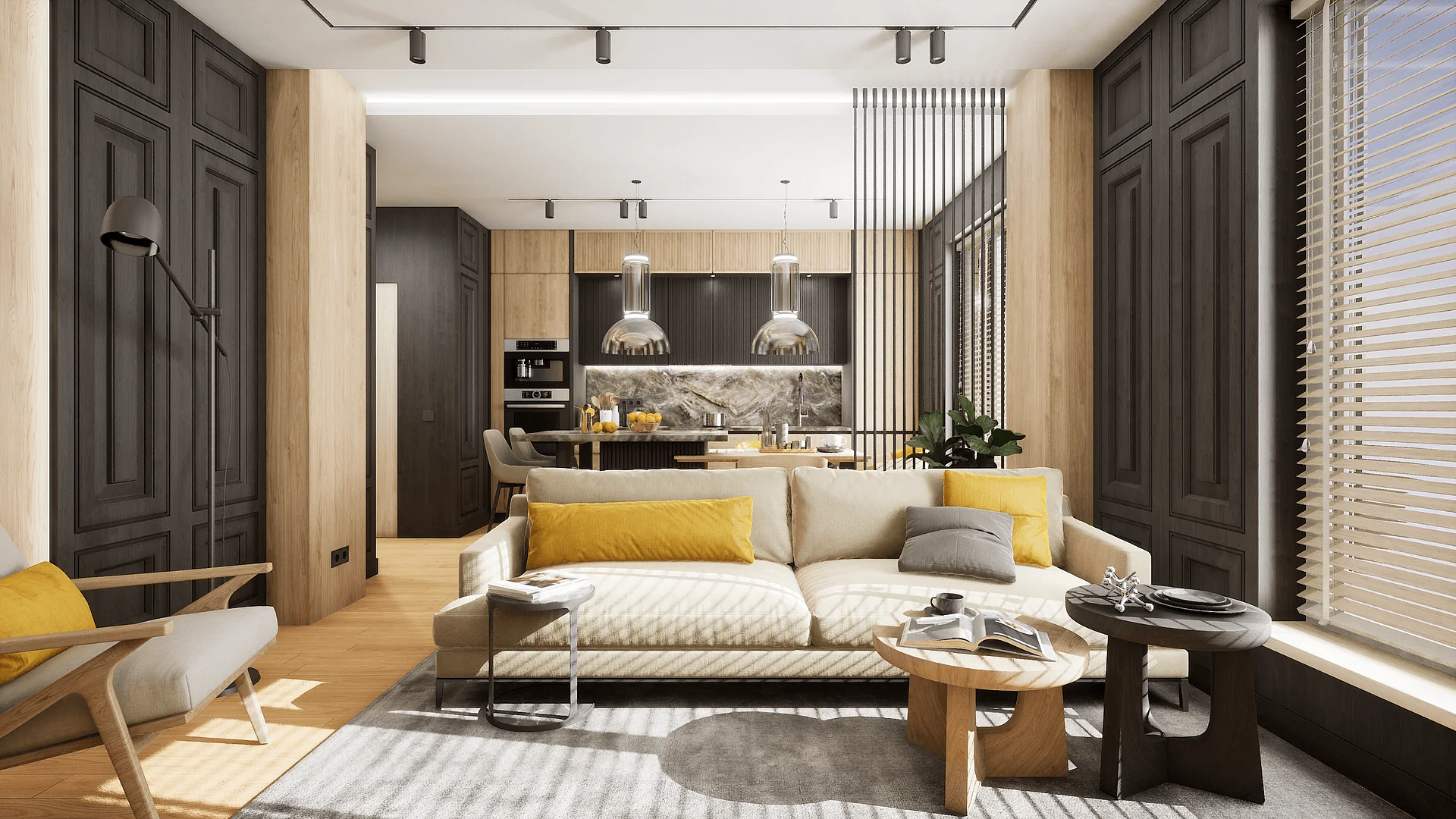
Real-time architectural visualization requires balancing environmental detail, geometry density, and precise global illumination. Archviz Interior vol.3 presents a complete interior level structured as a modern apartment, containing a conjoined living room and kitchen zone paired with a dedicated bedroom space. Rather than presenting isolated prop vignettes, the package delivers an integrated residential floor plan arranged with an industrial aesthetic, providing artists with a full architectural space ready for inspection, lighting study, or project integration across multiple iterations of Unreal Engine.
Configuring the Archviz Apartment Layout
The layout in Archviz Interior vol.3 focuses on two primary living sectors: an expansive open-plan space containing both the living room and kitchen, alongside a private bedroom. In architectural visualization, open layouts present distinct challenges compared to compartmentalized rooms. Balancing illumination across a combined kitchen and sitting space demands consistent light propagation, as light entering through exterior apertures must naturally reach the functional areas of the kitchen cabinetry and counters deeper in the floor plan.
By pairing the communal area with an adjoining bedroom, the level offers two distinct spatial typologies within a single scene. The living room and kitchen introduce longer sightlines, multi-surface interaction, and varied material requirements spanning soft seating, reflective kitchen finishes, and industrial architectural details. The bedroom provides a more intimate enclosure where close-up furniture arrangements, personal effects, and tighter indirect lighting bounces take center stage. Because the entire apartment is supplied as a complete level rather than a loose collection of parts, spatial relationships between doorways, window placements, and structural boundaries remain coherent throughout.
Deploying the 80 Objects Across Living and Sleeping Zones
Populating a believable apartment requires substantial asset variation to prevent visible repetition. Archviz Interior vol.3 supplies 80 distinct objects designed to furnish both the social and private sectors of the residence. These individual components encompass core furniture, kitchen appointments, bedroom essentials, and supporting architectural elements that define the industrial theme.
Distributing 80 pieces across an apartment footprint creates dense, lived-in vignettes without overflowing into visual clutter. In the living room and kitchen sectors, the prop collection furnishes functional seating, tables, cabinetry, and kitchen-specific fittings that establish an authentic residential flow. Moving into the bedroom, the asset assortment transitions to bed framing, accent furniture, and spatial accessories appropriate for a private quarters setup. Because the assets are distinct entities within the level, technical artists and level designers can isolate individual props for redistribution, adjust placements to test alternative interior designs, or evaluate how specific surface textures react under changing illumination conditions.
Dual Lighting Setups Across Interior Environments
Lighting defines how an interior space is perceived, and Archviz Interior vol.3 approaches this requirement by packaging two separate illumination pipelines: a traditional Baked Global Illumination configuration and a modern Lumen dynamic lighting setup. This dual-pipeline implementation accommodates divergent production needs, engine versions, and platform constraints without forcing artists to reconstruct light sources from scratch.
The baked lighting implementation spans Unreal Engine 4.27 through Unreal Engine 5.2. This setup relies specifically on the built-in GPU Lightmass plugin. GPU Lightmass accelerates the calculation of high-resolution lightmaps directly on modern graphics hardware, delivering smooth, noise-free indirect light bounces, soft contact shadows, and stable ambient occlusion across static interior surfaces. For architectural workflows prioritizing rock-solid runtime performance, static lightmaps remain an industry standard. Bakes generated via GPU Lightmass lock complex bounced light directly into texture channels, freeing up frame budgets for complex geometry, higher screen resolutions, or high-framerate interactive walkthroughs.
For artists operating strictly within Unreal Engine 5.2, Archviz Interior vol.3 also incorporates a dedicated Lumen configuration. Lumen recalculates diffuse interreflections and specular reflections dynamically, allowing light to propagate through the apartment in real time. In an industrial apartment scene with deep rooms and mixed illumination zones, Lumen captures color bleeding from furniture surfaces and recalculates daylight shifts without requiring recalculation bakes. The availability of both setups within the same architectural asset offers a direct technical reference point for contrasting the visual nuances, bounce fidelity, and performance footprints of GPU Lightmass lightmaps against real-time software or hardware ray-traced dynamic bounce.
GPU Lightmass Baking Compared to Lumen in Archviz Projects
Understanding when to utilize GPU Lightmass versus Lumen is central to modern Unreal Engine development, and having both configured inside the same asset package clarifies the strengths of each method. The GPU Lightmass setup included for versions 4.27 through 5.2 is calibrated to handle the enclosed geometry of the apartment. Traditional CPU baking often suffered from lengthy calculation times on complex interior geometry; the built-in GPU Lightmass plugin eliminates these bottlenecks by tracing progressive path-traced samples on the local graphics processor. This allows tight control over lightmap density across the 80 individual props, ensuring that subtle industrial finishes, kitchen surfaces, and fabric folds retain clean contact shadows without light leakage at wall seams.
Conversely, the Unreal Engine 5.2 Lumen project bypasses the lightmap baking phase entirely. When testing camera paths, moving furniture items, or modifying window apertures, the dynamic solver updates light bounces instantaneously. While dynamic solvers inherently incur a higher runtime computational load than static baked maps, the Lumen integration in Archviz Interior vol.3 shows how to configure post-process volumes, exposure parameters, and interior light sources to maintain clean fidelity inside multi-room apartment environments.
Production Pipeline Fit for Unreal Engine Artists
Archviz Interior vol.3 serves multiple production profiles within real-time visualization and level creation. Architectural visualizers seeking a ready-to-render residential apartment can leverage the pre-composed industrial layout immediately, avoiding the multi-day task of building room shells, sourcing matching furniture, and balancing global illumination bounces. The environment functions as a testing ground for camera cinematics, material evaluation, and post-processing calibration across both contemporary living room and bedroom settings.
Beyond visualization specialists, level designers and environment artists working on narrative projects can utilize the full apartment level as an authentic urban interior. Because the scene includes 80 separate objects matching an industrial architectural theme, the assets can easily be repurposed across broader level designs or studied to observe optimal object placement, lightmap resolution balance, and engine-native lighting techniques. The explicit support bridging Unreal Engine 4.27 through 5.2 ensures broad pipeline compatibility, whether an existing project relies on legacy baked lightmap stability or requires modern Lumen real-time illumination in newer engine versions.
 Interior
 Interior
 Interior