"331efa9a712e5ce0"{"id":"1002693","slug":"ancient-temple-ruins-modular-environment","title":"Ancient Temple Ruins - Modular Environment","category":"Temple","engine":"5.2+","assetVersion":"","engineVersion":"Engine Version: 5.2+","tag":"Temple","accent":"blue","visual":"city","summary":"Examine the technical profile of Ancient Temple Ruins - Modular Environment, featuring Nanite geometry, Lumen lighting, and dense Mayan architecture.","platform":"Unreal Engine","indexPolicy":"index","publishedAt":"2026-11-17T18:18:22.918Z","updatedAt":"2026-11-17T18:18:22.918Z","sourceNotes":[],"fileContents":[],"compatibility":["Unreal Engine","Engine Version: 5.2+"],"featuredImage":{"alt":"Ancient Temple Ruins - Modular Environment","src":"/wp-content/uploads/published/2026/11/b18e1a43f98a-d0476cef-82e7-438f-8c70-8810292ea5ef-3cd7133d30.webp"},"hasDownloadLink":true,"downloads":0,"terms":[{"taxonomy":"category","slug":"temple","name":"Temple"}],"galleryImages":[{"src":"/wp-content/uploads/published/2026/11/eb94d3677f01-3cdddef5-8fc9-4d55-9018-dab3bb09c8c3-b530d65584.webp","alt":"Ancient Temple Ruins - Modular Environment"},{"src":"/wp-content/uploads/published/2026/11/46080ef09f35-647e1088-abfd-4901-9d30-45c5db982554-723bbbd9f1.webp","alt":"Ancient Temple Ruins - Modular Environment"},{"src":"/wp-content/uploads/published/2026/11/02cec893b645-b06f3f7d-0285-4fcb-99df-dd480490d699-41bf59610f.webp","alt":"Ancient Temple Ruins - Modular Environment"},{"src":"/wp-content/uploads/published/2026/11/3cb91748193b-59374e20-98f6-4a99-acd6-f97abaa06720-c187732a3b.webp","alt":"Ancient Temple Ruins - Modular Environment"},{"src":"/wp-content/uploads/published/2026/11/bd31916e84da-dfc69f6c-9358-4fa2-a691-a0a5e0d29b9c-0ac64adc16.webp","alt":"Ancient Temple Ruins - Modular Environment"},{"src":"/wp-content/uploads/published/2026/11/1d04652dc30e-5dfe34a6-bc57-4209-8017-014c2c27ffcd-2b1c160538.webp","alt":"Ancient Temple Ruins - Modular Environment"},{"src":"/wp-content/uploads/published/2026/11/ed690a7dc3f1-8afdd406-18a2-4196-9d2f-e63090659604-2b9a7a6a19.webp","alt":"Ancient Temple Ruins - Modular Environment"},{"src":"/wp-content/uploads/published/2026/11/225577117e31-f708ad33-b82c-4d06-b83c-16cb224d7a90-9399dee3dc.webp","alt":"Ancient Temple Ruins - Modular Environment"},{"src":"/wp-content/uploads/published/2026/11/31cc2f260ee0-ed570843-9868-4d14-9055-cbd077de1adc-4c1a2d36df.webp","alt":"Ancient Temple Ruins - Modular Environment"},{"src":"/wp-content/uploads/published/2026/11/8fa0ed6ffec2-7ffe3310-484a-4f3c-9832-772d01d4c22c-84cd675fa0.webp","alt":"Ancient Temple Ruins - Modular Environment"}],"accessPanel":{"kind":"resource","title":"Get this resource","safetyNote":"Resources are manually reviewed before listing to improve quality and reduce obvious risks.","fileName":"Content.7z","resourceType":"Resource archive","versions":[]},"contentHtml":"\u003cp\u003eConstructing ancient historical settings often demands a careful balance between monumental architectural silhouettes and intricate surface breakdown. Ancient Temple Ruins - Modular Environment addresses this challenge by providing structural and natural elements tailored to Mayan ruins, realistic fantasy spaces, and adventure level design. Rather than relying on traditional low-poly workflows or precalculated lighting techniques, the asset package adopts an uncompromising high-fidelity approach driven by Unreal Engine's modern rendering toolset.\u003c/p\u003e\u003ch2\u003eArchitecture and World-Building in Ancient Temple Ruins\u003c/h2\u003e\u003cp\u003eThe visual framework of the collection is rooted in Mayan architectural themes, giving level designers the building blocks needed to assemble sprawling ruins, ceremonial plazas, and overgrown sanctuaries. Modular structural pieces allow for diverse level layouts, ranging from narrow, subterranean corridors to grand open-air temples embedded deep within nature. Because the aesthetic sits at the intersection of realistic historical research and fantastic adventure design, the components adapt smoothly to cinematic sequences, narrative discovery segments, or action-oriented third-person exploration.\u003c/p\u003e\u003cp\u003eA critical characteristic of the architectural kit is its reliance on raw geometric detail. Ancient stone blocks, carved steps, and weathered surfaces do not depend on aggressive normal map baking to suggest depth. Instead, the geometry carries the physical weight of aged masonry directly within the vertices, creating tangible silhouettes across crumbling edges, scattered rubble, and stepped platforms. This structural authenticity anchors the environment in a grounded physical space, making historical or fantasy expeditions feel visually credible under varied camera angles.\u003c/p\u003e\u003ch2\u003eModular Environment Geometry and Mesh Density\u003c/h2\u003e\u003cp\u003eWorking within the package requires an understanding of how mesh data is structured. The assets are extremely polycount dense, abandoning the conventional optimization practices of previous console generations. Notably, there are no lightmaps or manual Level of Detail (LOD) steps included on the meshes. Traditional optimization ladders are bypassed entirely in favor of native virtualized geometry.\u003c/p\u003e\u003cp\u003eBecause the meshes dispense with pre-generated LOD chains, the project requires Nanite to function. Supported in Unreal Engine 5.2 and above, Nanite streams micropolygon geometry dynamically, scaling polygon budgets on the fly without popping artifacts or visible step-downs. Bypassing lightmaps similarly means that the static geometry is not prepared for baked static lighting passes. The meshes are authored purely for real-time evaluation, leaving all shadowing, ambient occlusion, and surface bounces to modern dynamic rendering pipelines.\u003c/p\u003e\u003ch2\u003eHardware Demands and Benchmark Setup for Temple Scenes\u003c/h2\u003e\u003cp\u003eThe extreme density of the meshes translates directly into rigorous hardware requirements. Running and editing the package requires a high-end PC configuration, as opening the levels or manipulating scene content can overwhelm machines that lack adequate compute or system memory. Real-world performance figures reveal the exact resource budget necessary to navigate the environment smoothly.\u003c/p\u003e\u003cp\u003eTesting with a standard third-person character controller yields performance levels between 30 and 40 frames per second when utilizing the Epic scalability preset. This framerate benchmark was captured on a system equipped with an NVIDIA GeForce RTX 2080 graphics card, an AMD Ryzen Threadripper 1950X processor, and 64 GB of DDR4 system memory running from a solid-state drive at 1440p resolution. To achieve that frame window, the project employs a 70 percent render scale alongside Temporal Super Resolution (TSR). Creators planning to incorporate these spaces into active games must account for this baseline performance ceiling, recognizing that real-time exploration under Epic settings requires modern scaling technologies to remain performant.\u003c/p\u003e\u003ch2\u003eHero Tree Variants and Foliage Implementation\u003c/h2\u003e\u003cp\u003eNatural vegetation plays a central role in breaking up the stark stonework of ancient ceremonial grounds. To capture the feeling of an environment reclaimed by nature, the environment incorporates foliage elements, including bush leaves sourced from Poly Haven. These organic assets interact directly with stone thresholds and dilapidated walls to convey decades or centuries of exposure to wilderness growth.\u003c/p\u003e\u003cp\u003eThe centerpiece of the natural assets is a large Hero tree, which presents unique production considerations due to its immense geometric density. To prevent memory spikes and stability issues, the Hero tree is divided into three distinct mesh versions:\u003c/p\u003e\u003cul\u003e\u003cli\u003e\u003cstrong\u003eLow Version:\u003c/strong\u003e Configured as the default mesh in the overview and showcase levels to prevent PCs from crashing when loading high-density scenes.\u003c/li\u003e\u003cli\u003e\u003cstrong\u003eMedium Version:\u003c/strong\u003e Offers an intermediate geometric step between baseline stability and full sculptural detail for scenes with moderate overhead.\u003c/li\u003e\u003cli\u003e\u003cstrong\u003eHigh Version:\u003c/strong\u003e Delivers uncompromised geometric fidelity across the trunk and branches, tailored for extreme close-ups or heavy cinematic renders.\u003c/li\u003e\u003c/ul\u003e\u003cp\u003eEmploying the low-density variant by default in the included demonstration maps ensures that creators can safely open and inspect the layout without encountering sudden application crashes caused by out-of-memory states on system start.\u003c/p\u003e\u003ch2\u003eProject Compatibility and Real-Time Illumination Workflows\u003c/h2\u003e\u003cp\u003eAchieving realistic depth throughout deep jungle foliage and dense temple stonework depends entirely on dynamic global illumination. The package supports Lumen in Unreal Engine 5.2 and higher, pairing seamlessly with its Nanite infrastructure. Lumen calculates multi-bounce indirect lighting, diffuse interreflections, and detailed specular highlights in real time, eliminating the long baking times and memory overhead traditionally associated with dense lightmap atlases.\u003c/p\u003e\u003cp\u003eAs light filters through foliage canopies or bounces off weathered Mayan masonry, the dynamic lighting system updates surface luminance instantly. This setup proves particularly beneficial for developers building atmospheric adventure games, fantasy set pieces, or virtual production backgrounds where lighting conditions must adapt dynamically to weather changes, day-night cycles, or moving torchlight. Because both Lumen and Nanite are strict dependencies, projects standardized on older engine versions or lower-tier rendering profiles will not be able to deploy the kit without significant architectural rework.\u003c/p\u003e\u003ch2\u003eIdeal Production Fit\u003c/h2\u003e\u003cp\u003eAncient Temple Ruins - Modular Environment serves teams developing visually driven adventure titles, cinematic cinematics, and historical or fantasy level showcases. It is not intended for low-spec deployment, mobile targets, or older engine releases that lack virtualized geometry pipelines. Studios equipped with high-end workstations and targeting contemporary hardware platforms can leverage the modular layout, dense sculptural stone assets, and flexible Hero tree configurations to construct intricate jungle ruins that showcase the upper limits of real-time geometric fidelity.\u003c/p\u003e\n\n\u003ch2\u003eMore From The Same Workflow\u003c/h2\u003e\n\u003cul\u003e\n\u003cli\u003e\u003ca href=\"https://3dcghub.com/ancient-temple-environment-temple-ancient-tropical-temple-ancient-temple/\" rel=\"noopener noreferrer\"\u003eAncient Temple Environment ( Temple, Ancient Tropical Temple, Ancient , Temple )\u003c/a\u003e\u003c/li\u003e\n\u003cli\u003e\u003ca href=\"https://3dcghub.com/mountain-temple-japanese-temple-ancient-temple-temple-shrine-feudal-japan/\" rel=\"noopener noreferrer\"\u003eMountain Temple (Japanese Temple, Ancient Temple, Temple Shrine, Feudal Japan)\u003c/a\u003e\u003c/li\u003e\n\u003cli\u003e\u003ca href=\"https://3dcghub.com/ancient-cathedral-environment-ancient-cathedral-ancient-dungeon-cathedral-3d/\" rel=\"noopener noreferrer\"\u003eAncient Cathedral Environment ( Ancient Cathedral Ancient Dungeon Cathedral 3D )\u003c/a\u003e\u003c/li\u003e\n\u003cli\u003e\u003ca href=\"https://3dcghub.com/temple-of-the-gods-ancient-temple-modular-temple-cathedral-temple-hall/\" rel=\"noopener noreferrer\"\u003eTemple Of The Gods (Ancient Temple, Modular Temple, Cathedral, Temple, Hall)\u003c/a\u003e\u003c/li\u003e\n\u003cli\u003e\u003ca href=\"https://3dcghub.com/wind-temple/\" rel=\"noopener noreferrer\"\u003eWind Temple\u003c/a\u003e\u003c/li\u003e\n\u003c/ul\u003e","contentTextLength":7477,"navigation":{"current":33,"total":4648,"previous":{"id":"1002694","slug":"archviz-interior-vol-3","title":"Archviz Interior vol.3","category":"Interior","platform":"Unreal Engine","updatedAt":"2026-11-17T18:19:31.117Z"},"next":{"id":"1002692","slug":"abandoned-lighthouse-island-modular-environment-pack","title":"Abandoned Lighthouse Island – Modular Environment Pack","category":"Island","platform":"Unreal Engine","updatedAt":"2026-11-17T18:16:43.073Z"}},"relatedResources":[{"id":"1000913","slug":"ancient-temple-environment-temple-ancient-tropical-temple-ancient-temple","title":"Ancient Temple Environment ( Temple, Ancient Tropical Temple, Ancient , Temple )","category":"Temple","engine":"5.1+","assetVersion":"","engineVersion":"Engine Version: 5.1+","tag":"Temple","accent":"blue","visual":"city","summary":"Explore a modular Ancient Temple Environment with 34 ready-to-use prefabs, ancient Indian architectural references, and a valley demo map for UE5 games and cine","platform":"Unreal Engine","indexPolicy":"index","publishedAt":"2026-08-08T03:11:58.956Z","updatedAt":"2026-08-08T03:11:58.956Z","sourceNotes":[],"fileContents":[],"compatibility":["Unreal Engine","Engine Version: 5.1+"],"featuredImage":{"alt":"Ancient Temple Environment ( Temple, Ancient Tropical Temple, Ancient , Temple )","src":"/wp-content/uploads/published/2026/08/841ea3296a93-0c853b90-8415-4696-8bdc-5d82ff9e05a3-b564c94d66.webp"},"fileSizeBytes":7320495732,"hasDownloadLink":true,"downloads":1},{"id":"1000652","slug":"mountain-temple-japanese-temple-ancient-temple-temple-shrine-feudal-japan","title":"Mountain Temple (Japanese Temple, Ancient Temple, Temple Shrine, Feudal Japan)","category":"Temple","engine":"5.5+","assetVersion":"","engineVersion":"Engine Version: 5.5+","tag":"Temple","accent":"blue","visual":"mech","summary":"A modular Japanese shrine temple environment for Unreal Engine with material layering, vertex painting, Nanite foliage, and prop kits for building feudal Japan","platform":"Unreal Engine","indexPolicy":"index","publishedAt":"2026-07-21T19:17:13.891Z","updatedAt":"2026-07-21T19:17:13.891Z","sourceNotes":[],"fileContents":[],"compatibility":["Unreal Engine","Engine Version: 5.5+"],"featuredImage":{"alt":"Mountain Temple (Japanese Temple, Ancient Temple, Temple Shrine, Feudal Japan)","src":"/wp-content/uploads/published/2026/07/c65473b30385-e14168cc-6d72-423a-a7bf-177d39c6402a-3db1da1c73.webp"},"fileSizeBytes":1533075456,"hasDownloadLink":true,"downloads":0},{"id":"28474","slug":"ancient-cathedral-environment-ancient-cathedral-ancient-dungeon-cathedral-3d","title":"Ancient Cathedral Environment ( Ancient Cathedral Ancient Dungeon Cathedral 3D )","category":"Temple","engine":"5.1+","assetVersion":"Engine version: 5.1+","engineVersion":"","tag":"Temple","accent":"blue","visual":"city","summary":"Ancient Cathedral Environment centers on a large interior scene language of stone architecture, vaulted spaces, stained glass, and shadow-heavy religious halls. With 141 unique meshes, a showcased preassembled scene, and support for Nanite, Lumen, and ULAT,...","platform":"Unreal Engine","indexPolicy":"index","publishedAt":"2026-05-15T17:03:38.000Z","updatedAt":"2026-05-15T17:03:39.000Z","sourceNotes":[],"fileContents":[],"compatibility":["Unreal Engine","Engine version: 5.1+"],"featuredImage":{"alt":"Ancient Cathedral Environment ( Ancient Cathedral Ancient Dungeon Cathedral 3D )","src":"https://3dcghub.com/wp-content/uploads/2026/05/2248341ed05d_eb3bf56c-be29-448f-9c74-ae6b825e4648.webp"},"fileSizeBytes":1868130720,"hasDownloadLink":true,"downloads":3}]}
Resource screenshots
1 / 10
Join our channel
Follow 3DCGHUB on Telegram for new resource drops, migration updates, and community notices.
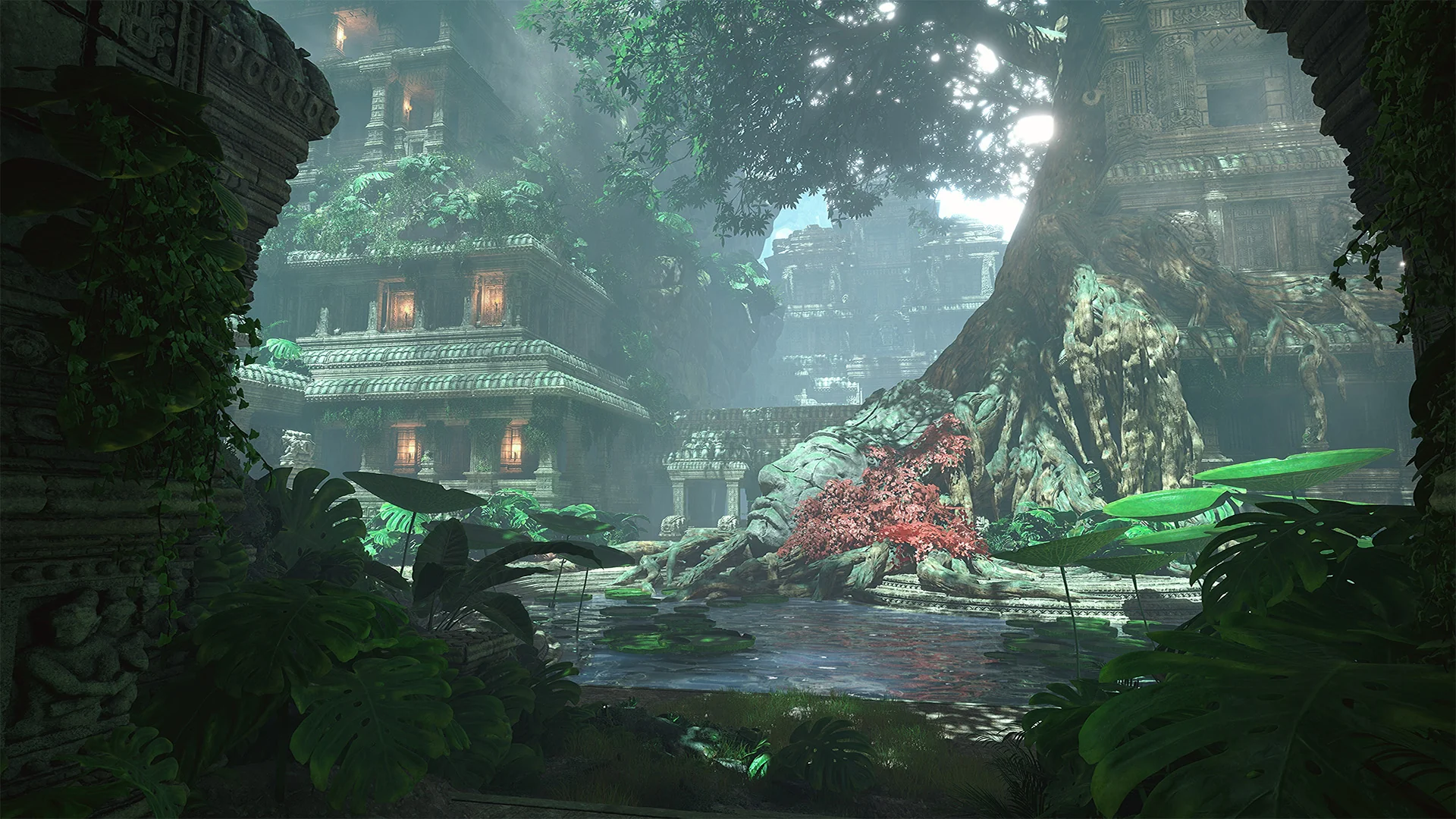
Constructing ancient historical settings often demands a careful balance between monumental architectural silhouettes and intricate surface breakdown. Ancient Temple Ruins - Modular Environment addresses this challenge by providing structural and natural elements tailored to Mayan ruins, realistic fantasy spaces, and adventure level design. Rather than relying on traditional low-poly workflows or precalculated lighting techniques, the asset package adopts an uncompromising high-fidelity approach driven by Unreal Engine's modern rendering toolset.
Architecture and World-Building in Ancient Temple Ruins
The visual framework of the collection is rooted in Mayan architectural themes, giving level designers the building blocks needed to assemble sprawling ruins, ceremonial plazas, and overgrown sanctuaries. Modular structural pieces allow for diverse level layouts, ranging from narrow, subterranean corridors to grand open-air temples embedded deep within nature. Because the aesthetic sits at the intersection of realistic historical research and fantastic adventure design, the components adapt smoothly to cinematic sequences, narrative discovery segments, or action-oriented third-person exploration.
A critical characteristic of the architectural kit is its reliance on raw geometric detail. Ancient stone blocks, carved steps, and weathered surfaces do not depend on aggressive normal map baking to suggest depth. Instead, the geometry carries the physical weight of aged masonry directly within the vertices, creating tangible silhouettes across crumbling edges, scattered rubble, and stepped platforms. This structural authenticity anchors the environment in a grounded physical space, making historical or fantasy expeditions feel visually credible under varied camera angles.
Modular Environment Geometry and Mesh Density
Working within the package requires an understanding of how mesh data is structured. The assets are extremely polycount dense, abandoning the conventional optimization practices of previous console generations. Notably, there are no lightmaps or manual Level of Detail (LOD) steps included on the meshes. Traditional optimization ladders are bypassed entirely in favor of native virtualized geometry.
Because the meshes dispense with pre-generated LOD chains, the project requires Nanite to function. Supported in Unreal Engine 5.2 and above, Nanite streams micropolygon geometry dynamically, scaling polygon budgets on the fly without popping artifacts or visible step-downs. Bypassing lightmaps similarly means that the static geometry is not prepared for baked static lighting passes. The meshes are authored purely for real-time evaluation, leaving all shadowing, ambient occlusion, and surface bounces to modern dynamic rendering pipelines.
Hardware Demands and Benchmark Setup for Temple Scenes
The extreme density of the meshes translates directly into rigorous hardware requirements. Running and editing the package requires a high-end PC configuration, as opening the levels or manipulating scene content can overwhelm machines that lack adequate compute or system memory. Real-world performance figures reveal the exact resource budget necessary to navigate the environment smoothly.
Testing with a standard third-person character controller yields performance levels between 30 and 40 frames per second when utilizing the Epic scalability preset. This framerate benchmark was captured on a system equipped with an NVIDIA GeForce RTX 2080 graphics card, an AMD Ryzen Threadripper 1950X processor, and 64 GB of DDR4 system memory running from a solid-state drive at 1440p resolution. To achieve that frame window, the project employs a 70 percent render scale alongside Temporal Super Resolution (TSR). Creators planning to incorporate these spaces into active games must account for this baseline performance ceiling, recognizing that real-time exploration under Epic settings requires modern scaling technologies to remain performant.
Hero Tree Variants and Foliage Implementation
Natural vegetation plays a central role in breaking up the stark stonework of ancient ceremonial grounds. To capture the feeling of an environment reclaimed by nature, the environment incorporates foliage elements, including bush leaves sourced from Poly Haven. These organic assets interact directly with stone thresholds and dilapidated walls to convey decades or centuries of exposure to wilderness growth.
The centerpiece of the natural assets is a large Hero tree, which presents unique production considerations due to its immense geometric density. To prevent memory spikes and stability issues, the Hero tree is divided into three distinct mesh versions:
Low Version: Configured as the default mesh in the overview and showcase levels to prevent PCs from crashing when loading high-density scenes.
Medium Version: Offers an intermediate geometric step between baseline stability and full sculptural detail for scenes with moderate overhead.
High Version: Delivers uncompromised geometric fidelity across the trunk and branches, tailored for extreme close-ups or heavy cinematic renders.
Employing the low-density variant by default in the included demonstration maps ensures that creators can safely open and inspect the layout without encountering sudden application crashes caused by out-of-memory states on system start.
Project Compatibility and Real-Time Illumination Workflows
Achieving realistic depth throughout deep jungle foliage and dense temple stonework depends entirely on dynamic global illumination. The package supports Lumen in Unreal Engine 5.2 and higher, pairing seamlessly with its Nanite infrastructure. Lumen calculates multi-bounce indirect lighting, diffuse interreflections, and detailed specular highlights in real time, eliminating the long baking times and memory overhead traditionally associated with dense lightmap atlases.
As light filters through foliage canopies or bounces off weathered Mayan masonry, the dynamic lighting system updates surface luminance instantly. This setup proves particularly beneficial for developers building atmospheric adventure games, fantasy set pieces, or virtual production backgrounds where lighting conditions must adapt dynamically to weather changes, day-night cycles, or moving torchlight. Because both Lumen and Nanite are strict dependencies, projects standardized on older engine versions or lower-tier rendering profiles will not be able to deploy the kit without significant architectural rework.
Ideal Production Fit
Ancient Temple Ruins - Modular Environment serves teams developing visually driven adventure titles, cinematic cinematics, and historical or fantasy level showcases. It is not intended for low-spec deployment, mobile targets, or older engine releases that lack virtualized geometry pipelines. Studios equipped with high-end workstations and targeting contemporary hardware platforms can leverage the modular layout, dense sculptural stone assets, and flexible Hero tree configurations to construct intricate jungle ruins that showcase the upper limits of real-time geometric fidelity.
 Temple
 Temple
 Temple