"7aa4acc705f0d80b"{"id":"1001942","slug":"aes-encrypt-decrypt-dtaes","title":"AES Encrypt Decrypt - DTAes","category":"Engine Tools","engine":"5.3","assetVersion":"Asset Version: 1.0","engineVersion":"Engine Version: 5.3","tag":"Engine Tools","accent":"blue","visual":"mech","summary":"Implement symmetric AES encryption and decryption for strings and data arrays in Blueprints with dedicated Mqtt Client compatibility.","platform":"Unreal Engine","publishedAt":"2026-10-24T11:17:29.802Z","updatedAt":"2026-10-24T11:17:29.802Z","sourceNotes":[],"fileContents":[],"compatibility":["Unreal Engine","Asset Version: 1.0","Engine Version: 5.3"],"featuredImage":{"alt":"AES Encrypt Decrypt - DTAes","src":"/wp-content/uploads/published/2026/10/0c98437d5447-1372925b-f909-48ca-90f7-e244475eceeb-37a9eb6988.webp"},"hasDownloadLink":true,"downloads":0,"terms":[{"taxonomy":"category","slug":"engine-tools-tools-and-plugins","name":"Engine Tools"}],"galleryImages":[{"src":"/wp-content/uploads/published/2026/10/f246f0807a2c-5dd40938-204e-493c-b3e3-4ad030cd755f-299437a927.webp","alt":"AES Encrypt Decrypt - DTAes"},{"src":"/wp-content/uploads/published/2026/10/d84c6692f69c-e7e6d52c-5b72-4ffb-ac9c-f0599b564180-1bdfbc499c.webp","alt":"AES Encrypt Decrypt - DTAes"},{"src":"/wp-content/uploads/published/2026/10/c9778e1eefc5-543b0da1-01ba-4f91-9b45-d3f0ef7e9abd-108b4b512b.webp","alt":"AES Encrypt Decrypt - DTAes"}],"accessPanel":{"kind":"resource","title":"Download this resource","eyebrow":"Free Download","message":"Log in or create a free account to start your download.","fileName":"AES Encrypt Decrypt - DTAes.7z","safetyNote":"Resources are manually reviewed before listing to improve quality and reduce obvious risks.","actionLabel":"Download Free","resourceType":"Resource archive"},"contentHtml":"\u003ch2\u003eSecuring Data Payloads Across Connected Interactive Systems\u003c/h2\u003e\u003cp\u003eModern connected interactive projects often require moving sensitive data between local endpoints, game logic, and outside services. Data transmission across live networks or local storage demands encryption routines that shield raw plain text and structured information from exposure. AES Encrypt Decrypt - DTAes provides symmetric cryptographic capabilities to address these data protection needs directly inside visual scripting graphs.\u003c/p\u003e\u003cp\u003eBy utilizing the Advanced Encryption Standard (AES), the tool allows projects to convert vulnerable runtime information into encrypted states and subsequently restore that data back into legible formats when required. This process prevents plain-text visibility while preserving data integrity across diverse communication channels. Whether handling serialized configurations, gameplay save states, or remote telemetries, establishing an encryption baseline ensures that information remains uncompromised between sender and recipient.\u003c/p\u003e\u003ch2\u003eProcessing Strings and Data Arrays with DTAes\u003c/h2\u003e\u003cp\u003eData formats in interactive systems usually fall into distinct categories depending on whether they represent human-readable messaging or structured binary packets. DTAes handles both strings and data arrays, accommodating the dual nature of engine communication.\u003c/p\u003e\u003cp\u003eText-based strings frequently contain user authentication credentials, session tokens, configuration states, chat messages, or serialized text structures. Encrypting strings ensures that text content cannot be intercepted as readable characters in transit or in memory. The corresponding decryption pass restores the encrypted string back into its original textual form, ready to be parsed by user interface widgets, database handlers, or game state managers.\u003c/p\u003e\u003cp\u003eData arrays represent sequences of raw elements, binary buffers, or structured byte collections. Arrays are common when dealing with network payloads, state captures, file reads, or custom packed data structures. Having distinct AES encryption and decryption operations for data arrays enables developers to secure non-text payloads without forcing them through error-prone string encoding conversions. The symmetry between array encryption and array decryption ensures that array lengths and element sequences stay coherent throughout the transformation.\u003c/p\u003e\u003ch2\u003eBlueprint Graph Execution for AES Encrypt Decrypt Tasks\u003c/h2\u003e\u003cp\u003eBuilding cryptographic routines within visual scripting environments keeps functionality accessible without demanding custom engine compilation or external code bridges. The presence of Blueprint support allows technical designers and gameplay programmers to execute cryptographic functions directly within standard graph pipelines.\u003c/p\u003e\u003cp\u003eIn a Blueprint workflow, an AES Encrypt Decrypt node structure handles the handoff of inputs—whether feeding a source string or routing an array variable—directly into the transformation logic. The graph receives the transformed ciphertext as an output, which can be passed immediately into save variables, network dispatchers, or temporary memory buffers.\u003c/p\u003e\u003cp\u003eDecryption nodes mirror this flow in reverse within the graph. An incoming encrypted string or data array connects to the decryption logic, outputting the decrypted string or recovered array. By working natively inside Blueprint graphs, developers can place security checks inside event ticks, asynchronous callbacks, UI button triggers, or network response events without breaking the visual logic flow of their actors or game instances.\u003c/p\u003e\u003ch2\u003ePipeline Integration with Mqtt Client Systems\u003c/h2\u003e\u003cp\u003eHandling networked telemetries, Internet of Things (IoT) feeds, or real-time simulation updates often involves lightweight publish-subscribe protocols. The compatibility with Mqtt Client situates DTAes as a complementary security layer for projects running MQTT communications.\u003c/p\u003e\u003cp\u003eMQTT messaging pipelines transmit payloads across brokers to distributed subscribers. In default setups, MQTT topics might carry unencrypted payloads across open or semi-private networks. Combining AES encryption with an Mqtt Client pipeline guarantees that published messages—whether formatted as strings containing state notifications or data arrays carrying packed telemetry—arrive at the broker fully encrypted.\u003c/p\u003e\u003cp\u003eSubscribers receiving payloads via the Mqtt Client can feed those inbound messages directly into DTAes decryption nodes inside Blueprint. Only nodes possessing the appropriate decryption logic can resolve the encrypted string or data array back into usable game events. This integration eliminates exposed plain text inside MQTT topics, bridging real-time messaging with practical symmetric data protection.\u003c/p\u003e\u003ch2\u003eEvaluating Project Fit for Data Security Workflows\u003c/h2\u003e\u003cp\u003eDeploying AES Encrypt Decrypt - DTAes depends on the specific security demands and networking architecture of an interactive build. When an application communicates strictly offline with basic local assets, deep encryption tools might exceed standard production requirements.\u003c/p\u003e\u003cp\u003eFor projects requiring secure outbound messaging through an Mqtt Client, protected runtime configuration parsing, or encrypted storage of sensitive strings and data arrays in Blueprints, this tool establishes a direct and standardized path. It removes the necessity of building custom cryptographic wrappers from scratch, giving teams a focused utility for keeping data streams private and intact across engine graphs.\u003c/p\u003e\n\n\u003ch2\u003eRelated Resources Worth Checking\u003c/h2\u003e\n\u003cul\u003e\n\u003cli\u003e\u003ca href=\"https://3dcghub.com/le-encryption/\" title=\"LE Encryption\"\u003eLE Encryption\u003c/a\u003e\u003c/li\u003e\n\u003cli\u003e\u003ca href=\"https://3dcghub.com/voxel-plugin/\" title=\"Voxel Plugin\"\u003eVoxel Plugin\u003c/a\u003e\u003c/li\u003e\n\u003cli\u003e\u003ca href=\"https://3dcghub.com/ase-importer/\" title=\"Ase Importer\"\u003eAse Importer\u003c/a\u003e\u003c/li\u003e\n\u003cli\u003e\u003ca href=\"https://3dcghub.com/clarus-viewer-base/\" title=\"Clarus Viewer Base\"\u003eClarus Viewer Base\u003c/a\u003e\u003c/li\u003e\n\u003cli\u003e\u003ca href=\"https://3dcghub.com/clarus-viewer-asset-support/\" title=\"Clarus Viewer Asset Support\"\u003eClarus Viewer Asset Support\u003c/a\u003e\u003c/li\u003e\n\u003c/ul\u003e","contentTextLength":5559,"navigation":{"current":48,"total":3925,"previous":{"id":"1001943","slug":"african-weapon-pack","title":"African Weapon Pack","category":"Weapons \u0026 Combat","platform":"Unreal Engine","updatedAt":"2026-10-24T11:18:02.991Z"},"next":{"id":"1001941","slug":"adventure-music-vol-i","title":"Adventure Music Vol. I","category":"Music","platform":"Unreal Engine","updatedAt":"2026-10-24T11:16:53.425Z"}},"relatedResources":[{"id":"14092","slug":"le-encryption","title":"LE Encryption","category":"Engine Tools","engine":"4.26 - 5.3","assetVersion":"Engine version: 4.26 - 5.3","engineVersion":"4.11","tag":"Engine Tools","accent":"blue","visual":"character","summary":"LE Encryption is a specialized plugin that allows developers to encrypt bytes via Blueprints. It is specifically designed to bridge the gap between game clients and Java-based backend servers.","platform":"Unreal Engine","publishedAt":"2026-03-11T15:47:47.000Z","updatedAt":"2026-04-19T15:45:53.000Z","sourceNotes":[],"fileContents":[],"compatibility":["Unreal Engine","Engine version: 4.26 - 5.3"],"featuredImage":{"alt":"LE Encryption","src":"https://3dcghub.com/wp-content/uploads/2026/03/592df0d2-2231-4892-b688-69d9fb08f700.webp"},"hasDownloadLink":true,"downloads":0},{"id":"1001780","slug":"voxel-plugin","title":"Voxel Plugin","category":"Engine Tools","engine":"5.3","assetVersion":"Asset Version: 1.0","engineVersion":"Engine Version: 5.3","tag":"Engine Tools","accent":"blue","visual":"mech","summary":"Generate smoothed voxel terrain in Unreal Engine with in-editor terraforming, real-time destruction, dynamic NavMesh, replication, and infinite generation.","platform":"Unreal Engine","publishedAt":"2026-10-20T03:27:28.201Z","updatedAt":"2026-10-20T03:27:28.201Z","sourceNotes":[],"fileContents":[],"compatibility":["Unreal Engine","Asset Version: 1.0","Engine Version: 5.3"],"featuredImage":{"alt":"Voxel Plugin","src":"/wp-content/uploads/published/2026/10/8b4d1df60f53-5a2ff731-ea13-4a01-aa5b-d547af54be89-29d6658113.webp"},"hasDownloadLink":true,"downloads":1},{"id":"13682","slug":"ase-importer","title":"Ase Importer","category":"Engine Tools","engine":"5.1,5.3 - 5.5","assetVersion":"Asset Version: 1.0","engineVersion":"Engine version: 5.1,5.3 - 5.5","tag":"Engine Tools","accent":"blue","visual":"character","summary":"The Ase Importer plugin streamlines the process of bringing pixel art into your project. It automatically converts .aseprite files into texture atlases and PaperFlipbooks with a simple drag-and-drop action.","platform":"Unreal Engine","publishedAt":"2026-03-11T09:35:57.000Z","updatedAt":"2026-09-30T05:37:33.311Z","sourceNotes":[],"fileContents":[],"compatibility":["Unreal Engine","Asset Version: 1.0","Engine version: 5.1,5.3 - 5.5"],"featuredImage":{"alt":"Ase Importer","src":"https://3dcghub.com/wp-content/uploads/2026/03/c4b21ae8-3546-46af-9639-02081461927a.webp"},"hasDownloadLink":true,"downloads":1}]}
Engine Tools
AES Encrypt Decrypt - DTAes
Implement symmetric AES encryption and decryption for strings and data arrays in Blueprints with dedicated Mqtt Client compatibility.
Securing Data Payloads Across Connected Interactive Systems
Modern connected interactive projects often require moving sensitive data between local endpoints, game logic, and outside services. Data transmission across live networks or local storage demands encryption routines that shield raw plain text and structured information from exposure. AES Encrypt Decrypt - DTAes provides symmetric cryptographic capabilities to address these data protection needs directly inside visual scripting graphs.
By utilizing the Advanced Encryption Standard (AES), the tool allows projects to convert vulnerable runtime information into encrypted states and subsequently restore that data back into legible formats when required. This process prevents plain-text visibility while preserving data integrity across diverse communication channels. Whether handling serialized configurations, gameplay save states, or remote telemetries, establishing an encryption baseline ensures that information remains uncompromised between sender and recipient.
Processing Strings and Data Arrays with DTAes
Data formats in interactive systems usually fall into distinct categories depending on whether they represent human-readable messaging or structured binary packets. DTAes handles both strings and data arrays, accommodating the dual nature of engine communication.
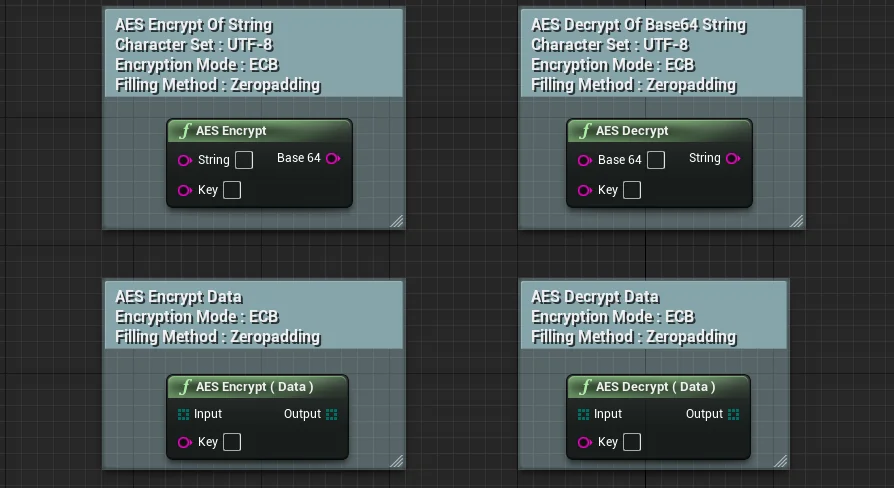
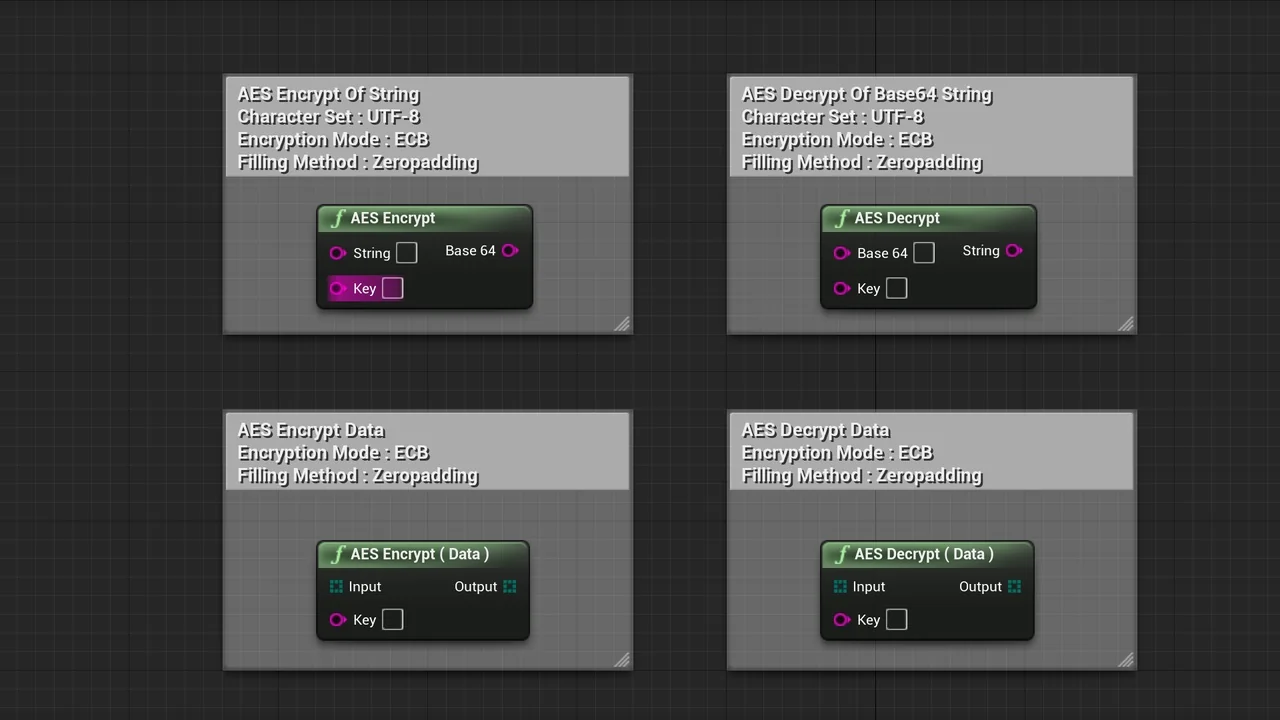
Text-based strings frequently contain user authentication credentials, session tokens, configuration states, chat messages, or serialized text structures. Encrypting strings ensures that text content cannot be intercepted as readable characters in transit or in memory. The corresponding decryption pass restores the encrypted string back into its original textual form, ready to be parsed by user interface widgets, database handlers, or game state managers.
Data arrays represent sequences of raw elements, binary buffers, or structured byte collections. Arrays are common when dealing with network payloads, state captures, file reads, or custom packed data structures. Having distinct AES encryption and decryption operations for data arrays enables developers to secure non-text payloads without forcing them through error-prone string encoding conversions. The symmetry between array encryption and array decryption ensures that array lengths and element sequences stay coherent throughout the transformation.
Blueprint Graph Execution for AES Encrypt Decrypt Tasks
Building cryptographic routines within visual scripting environments keeps functionality accessible without demanding custom engine compilation or external code bridges. The presence of Blueprint support allows technical designers and gameplay programmers to execute cryptographic functions directly within standard graph pipelines.
In a Blueprint workflow, an AES Encrypt Decrypt node structure handles the handoff of inputs—whether feeding a source string or routing an array variable—directly into the transformation logic. The graph receives the transformed ciphertext as an output, which can be passed immediately into save variables, network dispatchers, or temporary memory buffers.
Decryption nodes mirror this flow in reverse within the graph. An incoming encrypted string or data array connects to the decryption logic, outputting the decrypted string or recovered array. By working natively inside Blueprint graphs, developers can place security checks inside event ticks, asynchronous callbacks, UI button triggers, or network response events without breaking the visual logic flow of their actors or game instances.
Pipeline Integration with Mqtt Client Systems
Handling networked telemetries, Internet of Things (IoT) feeds, or real-time simulation updates often involves lightweight publish-subscribe protocols. The compatibility with Mqtt Client situates DTAes as a complementary security layer for projects running MQTT communications.
MQTT messaging pipelines transmit payloads across brokers to distributed subscribers. In default setups, MQTT topics might carry unencrypted payloads across open or semi-private networks. Combining AES encryption with an Mqtt Client pipeline guarantees that published messages—whether formatted as strings containing state notifications or data arrays carrying packed telemetry—arrive at the broker fully encrypted.
Subscribers receiving payloads via the Mqtt Client can feed those inbound messages directly into DTAes decryption nodes inside Blueprint. Only nodes possessing the appropriate decryption logic can resolve the encrypted string or data array back into usable game events. This integration eliminates exposed plain text inside MQTT topics, bridging real-time messaging with practical symmetric data protection.
Evaluating Project Fit for Data Security Workflows
Deploying AES Encrypt Decrypt - DTAes depends on the specific security demands and networking architecture of an interactive build. When an application communicates strictly offline with basic local assets, deep encryption tools might exceed standard production requirements.
For projects requiring secure outbound messaging through an Mqtt Client, protected runtime configuration parsing, or encrypted storage of sensitive strings and data arrays in Blueprints, this tool establishes a direct and standardized path. It removes the necessity of building custom cryptographic wrappers from scratch, giving teams a focused utility for keeping data streams private and intact across engine graphs.
 Engine Tools
 Engine Tools
 Engine Tools
 Engine Tools