"7aa4acc705f0d80b"{"id":"1001930","slug":"400-noise-texture-mega-pack","title":"400 Noise Texture Mega Pack","category":"Building \u0026 Human-made","engine":"4.26+,5.0+","assetVersion":"","engineVersion":"Engine Version: 4.26+,5.0+","tag":"Building","accent":"blue","visual":"luts","summary":"Organize and deploy the 400 Noise Texture Mega Pack with TGA source files, natural and alien variations, and shader-driven VFX workflows.","platform":"Unreal Engine","publishedAt":"2026-10-24T11:09:34.236Z","updatedAt":"2026-10-24T11:09:34.236Z","sourceNotes":[],"fileContents":[],"compatibility":["Unreal Engine","Engine Version: 4.26+,5.0+"],"featuredImage":{"alt":"400 Noise Texture Mega Pack","src":"/wp-content/uploads/published/2026/10/457770538be1-91f87d19-64dc-47a4-ae07-d016c1b455e5-206f76e36e.webp"},"hasDownloadLink":true,"downloads":0,"terms":[{"taxonomy":"category","slug":"building-and-human-made","name":"Building \u0026 Human-made"}],"galleryImages":[{"src":"/wp-content/uploads/published/2026/10/433f34760fab-01dad8fe-1675-4df4-9963-02db8cc2c284-f9250eaf26.webp","alt":"400 Noise Texture Mega Pack"},{"src":"/wp-content/uploads/published/2026/10/0e4f114ae620-0939cce5-1151-4007-a8e7-757d84167fe5-3009283cf4.webp","alt":"400 Noise Texture Mega Pack"},{"src":"/wp-content/uploads/published/2026/10/e9be9d092932-b25f0a24-3041-4825-a454-46c55c5a2b45-3aad2f014c.webp","alt":"400 Noise Texture Mega Pack"},{"src":"/wp-content/uploads/published/2026/10/fdab0d4fe88d-eaec3e77-c5fb-4654-8cfe-54ccffd0adda-8063811018.webp","alt":"400 Noise Texture Mega Pack"},{"src":"/wp-content/uploads/published/2026/10/383ab9bd01eb-ac5eff3d-2422-4641-92a3-4cdc2038eff4-bcfdf6fa83.webp","alt":"400 Noise Texture Mega Pack"}],"accessPanel":{"kind":"resource","title":"Download this resource","eyebrow":"Free Download","message":"Log in or create a free account to start your download.","fileName":"Content.7z","safetyNote":"Resources are manually reviewed before listing to improve quality and reduce obvious risks.","actionLabel":"Download Free","resourceType":"Resource archive"},"contentHtml":"\u003ch2\u003eDeploying TGA Source Files Alongside the Content Folder\u003c/h2\u003e\n\u003cp\u003eWorking with procedural noise in real-time pipelines requires ready access to clean source data. The 400 Noise Texture Mega Pack organizes its core assets to facilitate direct engine integration alongside external image manipulation workflows. Rather than burying raw image files inside proprietary asset containers, the original textures are supplied in TGA format located directly next to the primary project Content folder.\u003c/p\u003e\n\u003cp\u003eThis organizational layout enables immediate drag-and-drop ingestion into Unreal Engine projects while preserving an uncompressed, platform-agnostic file structure on disk. Technical artists and graphic designers can tap directly into the standalone TGA directory to pull source noise into external graphics suites, digital content creation tools, or custom shader development environments without needing to extract textures from pre-compiled engine packages. Keeping the source TGA files accessible eliminates conversion steps when synchronizing materials across various stages of 2D concept generation and 3D rendering.\u003c/p\u003e \u003ch2\u003eCategorizing Natural and Alien Noise Profiles\u003c/h2\u003e\n\u003cp\u003eThe library features over 400 high-resolution, unique noise textures divided broadly into natural and alien profiles. This conceptual division provides distinct visual frequencies and mathematical signatures suitable for wildly different artistic targets.\u003c/p\u003e\n\u003cp\u003eNatural noise profiles replicate organic structures, atmospheric phenomena, and terrestrial turbulence. Within material graphs, these textures generate predictable chaotic gradients that mimic organic distribution: cloud density, moisture buildup, dirt accumulation, stone grain, and eroded earth. The distribution curves in these natural maps feature softer transitions and familiar fractal clusters, helping artists avoid visual repetition when layering ground surfaces or atmospheric particles.\u003c/p\u003e\n\u003cp\u003eAlien noise textures, by contrast, focus on non-standard mathematical distributions, harsh frequency transitions, crystalline arrays, and unusual chaotic patterns. These profiles are tailored for science fiction mechanics, extraterrestrial surfaces, anomalous magical energies, and synthetic tech surfaces. Their contrasting values and sharp cellular transitions create distinct interference patterns, enabling artists to forge unnatural distortions and high-contrast masks that break away from everyday biological or terrestrial patterns.\u003c/p\u003e \u003ch2\u003eIntegrating Functional Masks into Shaders and Post Effects\u003c/h2\u003e\n\u003cp\u003eHigh-resolution noise functions fundamentally as data rather than standalone diffuse art. Across complex material systems, these 400 textures act as functional inputs to control math nodes, dynamic thresholds, and UV offsets. In visual effects creation, feeding these noise patterns into particle life stages yields evolving turbulence, dissolving smoke volumes, energy fields, and dynamic flame fronts.\u003c/p\u003e\n\u003cp\u003eIn post-processing passes, the distinct noise maps drive screen-space distortion, camera lens contamination, optical interference, and stylized render filters. By shifting UV coordinates through a low-contrast alien noise texture, a post-process material can generate optical ripples, heat shimmers, or digital artifacting. Because the textures feature varied frequency spreads, shader authors can combine high-frequency natural grain with low-frequency alien warps to create complex, multi-layered visual interactions in a single material instance.\u003c/p\u003e \u003ch2\u003eBuilding Landscapes and Layering Complex Textures\u003c/h2\u003e\n\u003cp\u003eTerrain building introduces unique texturing hurdles, particularly the prevention of visible tiling across large square-kilometer landscapes. Within landscape material setups, the 400 Noise Texture Mega Pack serves as a utility library for procedural height blending, slope masking, and macro variation. Layering noise maps into landscape blend nodes breaks the harsh seams between rock cliffs, mud, grass, and gravel.\u003c/p\u003e\n\u003cp\u003eThe pack functions in direct compatibility with specialized texture collections such as the Stylized Textures Mega Pack. When combining stylized diffuse surfaces with broad landscape geometry, procedural noise masks control where stylized grass gives way to exposed dirt or bedrock. Modulating primary terrain textures with complementary noise prevents repetitive tiling patterns on sprawling landmasses, maintaining visual coherence across diverse viewing distances without blowing out texture memory budgets.\u003c/p\u003e \u003ch2\u003eGraphic Design and Multi-Discipline Production Readiness\u003c/h2\u003e\n\u003cp\u003eBeyond material graphs and environmental terrain, the high-resolution nature of the library makes it directly useful in static graphic design, user interface development, and illustration pipelines. Graphic designers can utilize the TGA files for print elements, distressed overlay maps, typographical treatments, and abstract motion graphics assets.\u003c/p\u003e\n\u003cp\u003eBecause the pack functions wherever image data is accepted—inside Unreal Engine or across external editing applications—it establishes a continuous visual bridge between UI elements, 2D concept art, and in-engine 3D assets. Having 400 distinct natural and alien options ready on disk allows teams to rapidly iterate on texture variation, post effects, and shader functionality without building noise profiles from scratch for every new production asset.\u003c/p\u003e\n\n\u003ch2\u003eRelated Resources Worth Checking\u003c/h2\u003e\n\u003cul\u003e\n\u003cli\u003e\u003ca href=\"https://3dcghub.com/1000-mega-decal-package-ai-sources/\" title=\"1000+ Mega Decal Package / AI SOURCES\"\u003e1000+ Mega Decal Package / AI SOURCES\u003c/a\u003e\u003c/li\u003e\n\u003cli\u003e\u003ca href=\"https://3dcghub.com/mega-sci-fi-city-package/\" title=\"Mega Sci-Fi City Package\"\u003eMega Sci-Fi City Package\u003c/a\u003e\u003c/li\u003e\n\u003cli\u003e\u003ca href=\"https://3dcghub.com/roof-vol-51-hand-painted-textures/\" title=\"Roof Vol.51 - Hand Painted Textures\"\u003eRoof Vol.51 - Hand Painted Textures\u003c/a\u003e\u003c/li\u003e\n\u003cli\u003e\u003ca href=\"https://3dcghub.com/building-interior-cubemap-material-function/\" title=\"Building Interior Cubemap Material Function\"\u003eBuilding Interior Cubemap Material Function\u003c/a\u003e\u003c/li\u003e\n\u003cli\u003e\u003ca href=\"https://3dcghub.com/cellar-materials/\" title=\"Cellar Materials\"\u003eCellar Materials\u003c/a\u003e\u003c/li\u003e\n\u003c/ul\u003e","contentTextLength":5493,"navigation":{"current":60,"total":3925,"previous":{"id":"1001931","slug":"4k-full-fantasy-gui-ui-524-png-186-widget-blueprints","title":"4k Full Fantasy GUI / UI + 524 png + 186 widget blueprints","category":"UI Kits / HUDs","platform":"Unreal Engine","updatedAt":"2026-10-24T11:10:16.342Z"},"next":{"id":"1001929","slug":"3d-tilemap-simple-helper","title":"3D Tilemap - Simple Helper","category":"Gameplay Features","platform":"Unreal Engine","updatedAt":"2026-10-24T11:06:32.986Z"}},"relatedResources":[{"id":"1000144","slug":"1000-mega-decal-package-ai-sources","title":"1000+ Mega Decal Package / AI SOURCES","category":"Variety","engine":"4.26+,5.0+","assetVersion":"","engineVersion":"Engine Version: 4.26+,5.0+","tag":"Variety","accent":"blue","visual":"mech","summary":"A high-quality customizable decal pack with texture-driven flexibility, combined or separate use, and access to main vector drawing files.","platform":"Unreal Engine","publishedAt":"2026-06-12T18:37:30.067Z","updatedAt":"2026-10-03T14:08:24.863Z","sourceNotes":[],"fileContents":[],"compatibility":["Unreal Engine","Engine Version: 4.26+,5.0+"],"featuredImage":{"alt":"1000+ Mega Decal Package / AI SOURCES","src":"/wp-content/uploads/published/2026/06/c65003b15164-8cfb9e15-1251-4bec-a5db-4031508b2f53-10a82d485f.webp"},"hasDownloadLink":true,"downloads":1},{"id":"1001647","slug":"mega-sci-fi-city-package","title":"Mega Sci-Fi City Package","category":"Sci-Fi","engine":"4.25+,5.0+","assetVersion":"","engineVersion":"Engine Version: 4.25+,5.0+","tag":"Sci-Fi","accent":"blue","visual":"city","summary":"Explore the Mega Sci-Fi City Package featuring 20 low-poly building meshes, 5 road tiles, 160 PBR textures, and customizable emissive color options.","platform":"Unreal Engine","publishedAt":"2026-10-13T08:23:28.893Z","updatedAt":"2026-10-13T08:23:28.893Z","sourceNotes":[],"fileContents":[],"compatibility":["Unreal Engine","Engine Version: 4.25+,5.0+"],"featuredImage":{"alt":"Mega Sci-Fi City Package","src":"/wp-content/uploads/published/2026/10/7c9f281ecb5a-5f26f034-9063-4f1f-88ef-0dffb8ec0a44-cef414291d.webp"},"hasDownloadLink":true,"downloads":0},{"id":"12364","slug":"roof-vol-51-hand-painted-textures","title":"Roof Vol.51 - Hand Painted Textures","category":"Building \u0026 Human-made","engine":"4.26+,5.0+","assetVersion":"Engine version: 4.26+,5.0+","engineVersion":"4.24","tag":"Building","accent":"blue","visual":"luts","summary":"Roof Vol.51 - Hand Painted Textures is a high-quality set of five unique, tileable textures. Designed for stylized and fantasy projects, these assets are mobile-ready and support PBR workflows.","platform":"Unreal Engine","publishedAt":"2026-03-07T12:20:05.000Z","updatedAt":"2026-04-19T15:47:58.000Z","sourceNotes":[],"fileContents":[],"compatibility":["Unreal Engine","Engine version: 4.26+,5.0+"],"featuredImage":{"alt":"Roof Vol.51 - Hand Painted Textures","src":"https://3dcghub.com/wp-content/uploads/2026/03/bcba476a-5b7d-4ba0-9b26-c5b561b3ed3f.webp"},"hasDownloadLink":true,"downloads":2}]}
Building
400 Noise Texture Mega Pack
Organize and deploy the 400 Noise Texture Mega Pack with TGA source files, natural and alien variations, and shader-driven VFX workflows.
Deploying TGA Source Files Alongside the Content Folder
Working with procedural noise in real-time pipelines requires ready access to clean source data. The 400 Noise Texture Mega Pack organizes its core assets to facilitate direct engine integration alongside external image manipulation workflows. Rather than burying raw image files inside proprietary asset containers, the original textures are supplied in TGA format located directly next to the primary project Content folder.
This organizational layout enables immediate drag-and-drop ingestion into Unreal Engine projects while preserving an uncompressed, platform-agnostic file structure on disk. Technical artists and graphic designers can tap directly into the standalone TGA directory to pull source noise into external graphics suites, digital content creation tools, or custom shader development environments without needing to extract textures from pre-compiled engine packages. Keeping the source TGA files accessible eliminates conversion steps when synchronizing materials across various stages of 2D concept generation and 3D rendering.
Categorizing Natural and Alien Noise Profiles
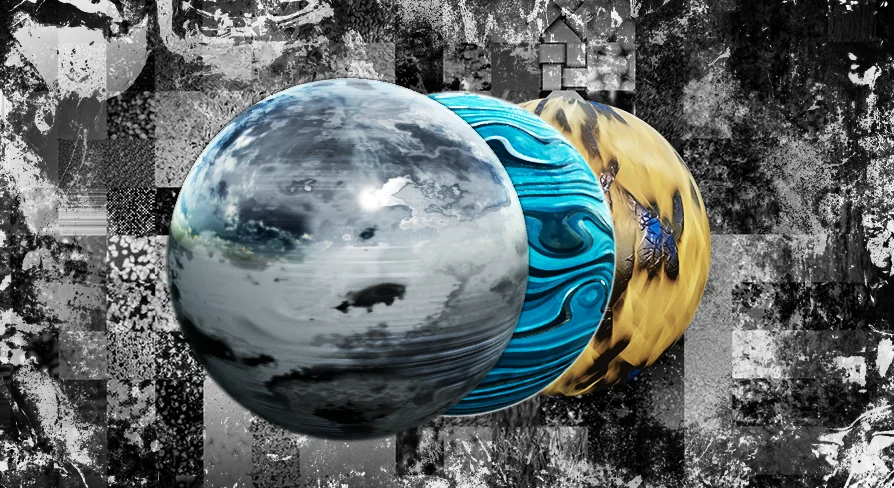
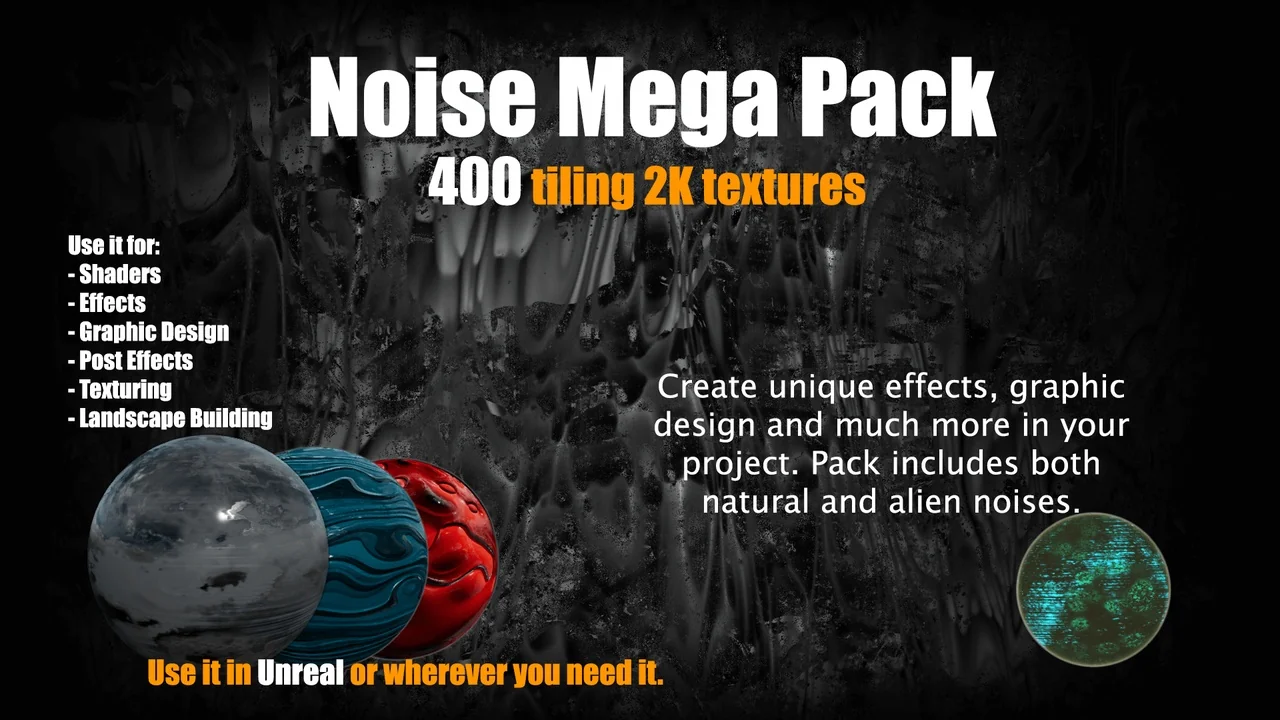
The library features over 400 high-resolution, unique noise textures divided broadly into natural and alien profiles. This conceptual division provides distinct visual frequencies and mathematical signatures suitable for wildly different artistic targets.
Natural noise profiles replicate organic structures, atmospheric phenomena, and terrestrial turbulence. Within material graphs, these textures generate predictable chaotic gradients that mimic organic distribution: cloud density, moisture buildup, dirt accumulation, stone grain, and eroded earth. The distribution curves in these natural maps feature softer transitions and familiar fractal clusters, helping artists avoid visual repetition when layering ground surfaces or atmospheric particles.
Alien noise textures, by contrast, focus on non-standard mathematical distributions, harsh frequency transitions, crystalline arrays, and unusual chaotic patterns. These profiles are tailored for science fiction mechanics, extraterrestrial surfaces, anomalous magical energies, and synthetic tech surfaces. Their contrasting values and sharp cellular transitions create distinct interference patterns, enabling artists to forge unnatural distortions and high-contrast masks that break away from everyday biological or terrestrial patterns.
Integrating Functional Masks into Shaders and Post Effects
High-resolution noise functions fundamentally as data rather than standalone diffuse art. Across complex material systems, these 400 textures act as functional inputs to control math nodes, dynamic thresholds, and UV offsets. In visual effects creation, feeding these noise patterns into particle life stages yields evolving turbulence, dissolving smoke volumes, energy fields, and dynamic flame fronts.
In post-processing passes, the distinct noise maps drive screen-space distortion, camera lens contamination, optical interference, and stylized render filters. By shifting UV coordinates through a low-contrast alien noise texture, a post-process material can generate optical ripples, heat shimmers, or digital artifacting. Because the textures feature varied frequency spreads, shader authors can combine high-frequency natural grain with low-frequency alien warps to create complex, multi-layered visual interactions in a single material instance.
Building Landscapes and Layering Complex Textures
Terrain building introduces unique texturing hurdles, particularly the prevention of visible tiling across large square-kilometer landscapes. Within landscape material setups, the 400 Noise Texture Mega Pack serves as a utility library for procedural height blending, slope masking, and macro variation. Layering noise maps into landscape blend nodes breaks the harsh seams between rock cliffs, mud, grass, and gravel.
The pack functions in direct compatibility with specialized texture collections such as the Stylized Textures Mega Pack. When combining stylized diffuse surfaces with broad landscape geometry, procedural noise masks control where stylized grass gives way to exposed dirt or bedrock. Modulating primary terrain textures with complementary noise prevents repetitive tiling patterns on sprawling landmasses, maintaining visual coherence across diverse viewing distances without blowing out texture memory budgets.
Graphic Design and Multi-Discipline Production Readiness
Beyond material graphs and environmental terrain, the high-resolution nature of the library makes it directly useful in static graphic design, user interface development, and illustration pipelines. Graphic designers can utilize the TGA files for print elements, distressed overlay maps, typographical treatments, and abstract motion graphics assets.
Because the pack functions wherever image data is accepted—inside Unreal Engine or across external editing applications—it establishes a continuous visual bridge between UI elements, 2D concept art, and in-engine 3D assets. Having 400 distinct natural and alien options ready on disk allows teams to rapidly iterate on texture variation, post effects, and shader functionality without building noise profiles from scratch for every new production asset.
 Building
 Variety
 Sci-Fi
 Building