"b00678cacce53329"{"id":"1002850","slug":"the-explosions-mega-pack","title":"The Explosions Mega Pack","category":"Game Development Resource","engine":"4.15+,5.0+","assetVersion":"","engineVersion":"Engine Version: 4.15+,5.0+","tag":"Game Development R","accent":"blue","visual":"mech","summary":"Explore The Explosions Mega Pack for Unreal Engine 4, featuring 48 particle systems, 354 emitters, and simulations built with SideFX Houdini 3D.","platform":"Unreal Engine","indexPolicy":"index","publishedAt":"2026-11-20T12:32:31.940Z","updatedAt":"2026-11-20T12:32:31.940Z","sourceNotes":[],"fileContents":[],"compatibility":["Unreal Engine","Engine Version: 4.15+,5.0+"],"featuredImage":{"alt":"The Explosions Mega Pack","src":"/wp-content/uploads/published/2026/11/516b34416f6d-777a811f-2605-40a3-ad42-60c61c40cb74-b28a39a96e.webp"},"fileSizeBytes":167122171,"hasDownloadLink":true,"downloads":0,"terms":[],"galleryImages":[{"src":"/wp-content/uploads/published/2026/11/f9426da48c5f-4bedc54c-b98e-4ec0-9ea8-9cffb72a3bb5-19b07a3cbf.webp","alt":"The Explosions Mega Pack"},{"src":"/wp-content/uploads/published/2026/11/d186ae1b969e-f18743fe-88ce-4cd8-9a24-c005dc3d5d98-ad9140b2de.webp","alt":"The Explosions Mega Pack"},{"src":"/wp-content/uploads/published/2026/11/63d0778d4f5c-4dbd7b62-a1a5-414c-a0ee-40d25aec4036-d703ea1d66.webp","alt":"The Explosions Mega Pack"},{"src":"/wp-content/uploads/published/2026/11/f825ca630a6d-77ca328c-6bb0-4d59-b955-b5f31598dc0c-6ac3e1bcd4.webp","alt":"The Explosions Mega Pack"},{"src":"/wp-content/uploads/published/2026/11/a0cc20137f6e-1c1b6147-eee8-46ac-9221-00d45ad5d53e-01e7217121.webp","alt":"The Explosions Mega Pack"},{"src":"/wp-content/uploads/published/2026/11/447ea9edcb04-869bdc4b-a07d-442f-8cc2-4547d23cf917-59ababd4ee.webp","alt":"The Explosions Mega Pack"},{"src":"/wp-content/uploads/published/2026/11/e6caa194b657-f03fdc81-71f8-4b85-b20f-e55143ce0b4f-76ca9c9957.webp","alt":"The Explosions Mega Pack"}],"accessPanel":{"kind":"resource","title":"Get this resource","safetyNote":"Resources are manually reviewed before listing to improve quality and reduce obvious risks.","fileName":"Content.7z","resourceType":"Resource archive","versions":[]},"contentHtml":"\u003ch2\u003eOvercoming Pyrotechnic Workflow Hurdles in Real-Time Production\u003c/h2\u003e\u003cp\u003eCrafting believable pyrotechnic events under real-time constraints is one of the most demanding disciplines in video game visual effects. Artists must continually balance high fluid fidelity against frame budgets, which often leaves in-game combustion looking thin, repetitive, or poorly integrated with the surrounding scene.\u003c/p\u003e\u003cp\u003eTraditional particle authoring frequently suffers from flat sprite motion and artificial expansion rates that fail to evoke the violent energy of a physical blast. Replicating the volumetric billow of fire, the clinging density of smoke, and the sudden flash of a grenade burst requires sophisticated fluid solvers that standard game engines do not run natively at runtime. The Explosions Mega Pack targets this specific production bottleneck by supplying pre-calculated, simulation-driven particle assets developed specifically for Unreal Engine 4. Instead of forcing developers to construct complex fluid motion by hand or settle for basic spherical bursts, the collection delivers ready-to-use pyrotechnic assets capable of drop-in implementation directly into interactive scenes.\u003c/p\u003e\u003ch2\u003eThe Explosions Mega Pack Simulation Pipeline\u003c/h2\u003e\u003cp\u003eProducing organic smoke billows and incandescent fire requires calculating fluid dynamics at a resolution far beyond the computational capacity of standard real-time game loops.\u003c/p\u003e\u003cp\u003eSideFX Houdini 3D, recognized as an industry standard for high-end visual effects simulation, served as the computational backbone for this library. Generating the assets involved months of continuous production work and hundreds of hours dedicated to running physical fluid and combustion simulations. Throughout this intensive phase, terabits of raw simulation data were generated, refined, and converted into formats optimized for real-time playback. By solving complex aerodynamic turbulence, thermal expansion, and combustion pressures inside Houdini before bringing the data into Unreal Engine 4, the pack preserves the nuanced physics of real pyrotechnic events without asking the game engine to compute heavy fluid math on the fly.\u003c/p\u003e\u003ch2\u003eTesting Explosions in Variable Lighting and Slow Motion\u003c/h2\u003e\u003cp\u003eA primary obstacle when designing visual effects is guaranteeing that particle shaders hold up equally well whether a map is bathed in harsh sunlight or shrouded in darkness.\u003c/p\u003e\u003cp\u003ePyrotechnic effects often reveal visual flaws when the surrounding environment changes, as semi-transparent smoke and self-illuminated fire can appear washed out at noon or unnaturally flat under moonlight. To address this exact challenge, the included Showcase Map provides an integrated control system that allows artists to shift the environmental time of day freely from broad daylight to deep night, including intermediate twilight stages. Alongside lighting controls, the map features a real-time playback slowdown function. By dialing back the simulation speed, developers can inspect the growth of an explosion frame by frame, monitoring how the initial fireball expands, how the shockwave disperses, and how the resulting smoke plume settles against different lighting backdrops.\u003c/p\u003e\u003ch2\u003eModular Architecture Across 354 Particle Emitters\u003c/h2\u003e\u003cp\u003eFlexibility in VFX workflows depends on whether an artist can dissect a complex visual event into its constituent components or must accept an unalterable monolithic asset.\u003c/p\u003e\u003cp\u003eThe package organizes its pyrotechnics into 48 complex Particle Systems backed by 354 individual Particle Emitters that serve as modular building blocks. This layered setup means creators are never locked into a single fixed sequence. An artist looking to assemble an unusual detonation can isolate a specific flame core, borrow a swirling cloud of dark soot, or extract individual debris trails from the broader library. Because each emitter functions as an autonomous modular layer, combining and reconfiguring elements allows for endless variation across an entire game project. Teams can build custom explosions tailored to specific gameplay events while maintaining visual consistency across every blast.\u003c/p\u003e\u003ch2\u003ePractical Deployment for Grenades, Fireballs, and Environmental Hazards\u003c/h2\u003e\u003cp\u003eGame levels require distinct visual languages for different explosive events, ranging from compact tactical weapon impacts to sprawling cinematic disasters.\u003c/p\u003e\u003cp\u003eThe included effects span several specific categories of combustion, including rapid grenade detonations, sweeping fireballs, and sustained smoke and fire sequences. Tactical weapons like grenades require sharp, punchy bursts that communicate lethal force in a split second without obscuring combat sightlines for extended periods. In contrast, environmental hazards and heavy artillery impacts demand lingering smoke columns and violent fireballs that billow outward with realistic turbulence. With ready access to both instantaneous shock bursts and voluminous slow-burning elements, level designers can clearly signal the scale, threat level, and type of ordnance being deployed throughout a level.\u003c/p\u003e\u003ch2\u003eImplementation Strategy for Unreal Engine 4 Projects\u003c/h2\u003e\u003cp\u003eEfficient adoption of third-party visual effects packages relies on immediate compatibility with standard engine structures and straightforward customization paths.\u003c/p\u003e\u003cp\u003eBecause every effect in the collection was built exclusively for Unreal Engine 4, artists and gameplay programmers can trigger these systems directly through blueprints, animation notifies, or cinematic sequencer tracks without specialized conversion steps. The ready-to-use nature of the particle systems minimizes initial setup time, while the modular emitter structure supports quick parameter adjustments to scale, timing, and density. Whether dropped directly into early level blockouts to establish visual impact or refined into bespoke detonation sequences for final release, the pack provides a complete pyrotechnic toolkit that accelerates visual effects authoring across entire game development cycles.\u003c/p\u003e\n\n\u003ch2\u003eMore From The Same Workflow\u003c/h2\u003e\n\u003cul\u003e\n\u003cli\u003e\u003ca href=\"https://3dcghub.com/space-explosion-pack/\" rel=\"noopener noreferrer\"\u003eSpace Explosion Pack\u003c/a\u003e\u003c/li\u003e\n\u003cli\u003e\u003ca href=\"https://3dcghub.com/mega-sci-fi-particle-fx-bundle-3in1/\" rel=\"noopener noreferrer\"\u003eMega Sci-Fi Particle FX Bundle 3in1\u003c/a\u003e\u003c/li\u003e\n\u003cli\u003e\u003ca href=\"https://3dcghub.com/m5-vfx-vol1-smoke-and-big-explosion-niagara/\" rel=\"noopener noreferrer\"\u003eM5 VFX Vol1. Smoke and Big Explosion(Niagara)\u003c/a\u003e\u003c/li\u003e\n\u003cli\u003e\u003ca href=\"https://3dcghub.com/explosion-blueprints/\" rel=\"noopener noreferrer\"\u003eExplosion Blueprints\u003c/a\u003e\u003c/li\u003e\n\u003cli\u003e\u003ca href=\"https://3dcghub.com/creatures-mega-pack/\" rel=\"noopener noreferrer\"\u003eCreatures Mega Pack\u003c/a\u003e\u003c/li\u003e\n\u003c/ul\u003e","contentTextLength":6124,"navigation":{"current":30,"total":4797,"previous":{"id":"1002851","slug":"toon-projectiles-vol-1","title":"Toon Projectiles Vol. 1","category":"Spells \u0026 Combat","platform":"Unreal Engine","updatedAt":"2026-11-20T12:33:25.424Z"},"next":{"id":"1002849","slug":"text-popup-effects-and-magic-spells","title":"Text Popup effects and Magic Spells","category":"Spells \u0026 Combat","platform":"Unreal Engine","updatedAt":"2026-11-20T12:31:09.942Z"}},"relatedResources":[{"id":"1002206","slug":"space-explosion-pack","title":"Space Explosion Pack","category":"Game Development Resource","engine":"4.26+,5.0+","assetVersion":"","engineVersion":"Engine Version: 4.26+,5.0+","tag":"Game Development R","accent":"blue","visual":"mech","summary":"Space Explosion Pack delivers 15 realistic space explosion effects for Unreal Engine 4.26+, featuring color, speed, and emissive controls.","platform":"Unreal Engine","indexPolicy":"index","publishedAt":"2026-10-29T14:49:52.434Z","updatedAt":"2026-10-29T14:49:52.434Z","sourceNotes":[],"fileContents":[],"compatibility":["Unreal Engine","Engine Version: 4.26+,5.0+"],"featuredImage":{"alt":"Space Explosion Pack","src":"/wp-content/uploads/published/2026/10/01f9c8ba2e63-dede173b-25ba-4b43-8767-999a52d8cfda-e347dda192.webp"},"fileSizeBytes":464334261,"hasDownloadLink":true,"downloads":0},{"id":"1002811","slug":"mega-sci-fi-particle-fx-bundle-3in1","title":"Mega Sci-Fi Particle FX Bundle 3in1","category":"Variety","engine":"4.15+,5.0+","assetVersion":"","engineVersion":"Engine Version: 4.15+,5.0+","tag":"Variety","accent":"blue","visual":"mech","summary":"Examine the technical layout, realistic visual effects, and scene staging options inside the 34-system Mega Sci-Fi Particle FX Bundle 3in1.","platform":"Unreal Engine","indexPolicy":"index","publishedAt":"2026-11-20T07:41:29.840Z","updatedAt":"2026-11-20T07:41:29.840Z","sourceNotes":[],"fileContents":[],"compatibility":["Unreal Engine","Engine Version: 4.15+,5.0+"],"featuredImage":{"alt":"Mega Sci-Fi Particle FX Bundle 3in1","src":"/wp-content/uploads/published/2026/11/59f5c8a20250-86697ede-966e-446b-a607-1082e95befc9-0498b26cb7.webp"},"fileSizeBytes":78539712,"hasDownloadLink":true,"downloads":0},{"id":"1002805","slug":"m5-vfx-vol1-smoke-and-big-explosion-niagara","title":"M5 VFX Vol1. Smoke and Big Explosion(Niagara)","category":"Fire \u0026 Explosions","engine":"4.15+,5.0+","assetVersion":"","engineVersion":"Engine Version: 4.15+,5.0+","tag":"Fire \u0026 Explosions","accent":"blue","visual":"mech","summary":"Explore M5 VFX Vol1. Smoke and Big Explosion (Niagara) for Unreal Engine, featuring realistic multi-emitter blast dynamics and high-resolution textures.","platform":"Unreal Engine","indexPolicy":"index","publishedAt":"2026-11-20T07:34:39.854Z","updatedAt":"2026-11-20T07:34:39.854Z","sourceNotes":[],"fileContents":[],"compatibility":["Unreal Engine","Engine Version: 4.15+,5.0+"],"featuredImage":{"alt":"M5 VFX Vol1. Smoke and Big Explosion(Niagara)","src":"/wp-content/uploads/published/2026/11/7fe314fc6a85-598fdcb3-735f-46fa-9664-cc3f2345d7f3-c63af4fb70.webp"},"fileSizeBytes":479234755,"hasDownloadLink":true,"downloads":0}]}
Resource screenshots
1 / 7
Join our channel
Follow 3DCGHUB on Telegram for new resource drops, migration updates, and community notices.
Overcoming Pyrotechnic Workflow Hurdles in Real-Time Production
Crafting believable pyrotechnic events under real-time constraints is one of the most demanding disciplines in video game visual effects. Artists must continually balance high fluid fidelity against frame budgets, which often leaves in-game combustion looking thin, repetitive, or poorly integrated with the surrounding scene.
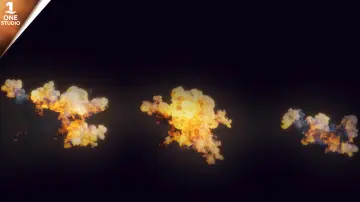
Traditional particle authoring frequently suffers from flat sprite motion and artificial expansion rates that fail to evoke the violent energy of a physical blast. Replicating the volumetric billow of fire, the clinging density of smoke, and the sudden flash of a grenade burst requires sophisticated fluid solvers that standard game engines do not run natively at runtime. The Explosions Mega Pack targets this specific production bottleneck by supplying pre-calculated, simulation-driven particle assets developed specifically for Unreal Engine 4. Instead of forcing developers to construct complex fluid motion by hand or settle for basic spherical bursts, the collection delivers ready-to-use pyrotechnic assets capable of drop-in implementation directly into interactive scenes.
The Explosions Mega Pack Simulation Pipeline
Producing organic smoke billows and incandescent fire requires calculating fluid dynamics at a resolution far beyond the computational capacity of standard real-time game loops.
SideFX Houdini 3D, recognized as an industry standard for high-end visual effects simulation, served as the computational backbone for this library. Generating the assets involved months of continuous production work and hundreds of hours dedicated to running physical fluid and combustion simulations. Throughout this intensive phase, terabits of raw simulation data were generated, refined, and converted into formats optimized for real-time playback. By solving complex aerodynamic turbulence, thermal expansion, and combustion pressures inside Houdini before bringing the data into Unreal Engine 4, the pack preserves the nuanced physics of real pyrotechnic events without asking the game engine to compute heavy fluid math on the fly.
Testing Explosions in Variable Lighting and Slow Motion
A primary obstacle when designing visual effects is guaranteeing that particle shaders hold up equally well whether a map is bathed in harsh sunlight or shrouded in darkness.
Pyrotechnic effects often reveal visual flaws when the surrounding environment changes, as semi-transparent smoke and self-illuminated fire can appear washed out at noon or unnaturally flat under moonlight. To address this exact challenge, the included Showcase Map provides an integrated control system that allows artists to shift the environmental time of day freely from broad daylight to deep night, including intermediate twilight stages. Alongside lighting controls, the map features a real-time playback slowdown function. By dialing back the simulation speed, developers can inspect the growth of an explosion frame by frame, monitoring how the initial fireball expands, how the shockwave disperses, and how the resulting smoke plume settles against different lighting backdrops.
Modular Architecture Across 354 Particle Emitters
Flexibility in VFX workflows depends on whether an artist can dissect a complex visual event into its constituent components or must accept an unalterable monolithic asset.
The package organizes its pyrotechnics into 48 complex Particle Systems backed by 354 individual Particle Emitters that serve as modular building blocks. This layered setup means creators are never locked into a single fixed sequence. An artist looking to assemble an unusual detonation can isolate a specific flame core, borrow a swirling cloud of dark soot, or extract individual debris trails from the broader library. Because each emitter functions as an autonomous modular layer, combining and reconfiguring elements allows for endless variation across an entire game project. Teams can build custom explosions tailored to specific gameplay events while maintaining visual consistency across every blast.
Practical Deployment for Grenades, Fireballs, and Environmental Hazards
Game levels require distinct visual languages for different explosive events, ranging from compact tactical weapon impacts to sprawling cinematic disasters.
The included effects span several specific categories of combustion, including rapid grenade detonations, sweeping fireballs, and sustained smoke and fire sequences. Tactical weapons like grenades require sharp, punchy bursts that communicate lethal force in a split second without obscuring combat sightlines for extended periods. In contrast, environmental hazards and heavy artillery impacts demand lingering smoke columns and violent fireballs that billow outward with realistic turbulence. With ready access to both instantaneous shock bursts and voluminous slow-burning elements, level designers can clearly signal the scale, threat level, and type of ordnance being deployed throughout a level.
Implementation Strategy for Unreal Engine 4 Projects
Efficient adoption of third-party visual effects packages relies on immediate compatibility with standard engine structures and straightforward customization paths.
Because every effect in the collection was built exclusively for Unreal Engine 4, artists and gameplay programmers can trigger these systems directly through blueprints, animation notifies, or cinematic sequencer tracks without specialized conversion steps. The ready-to-use nature of the particle systems minimizes initial setup time, while the modular emitter structure supports quick parameter adjustments to scale, timing, and density. Whether dropped directly into early level blockouts to establish visual impact or refined into bespoke detonation sequences for final release, the pack provides a complete pyrotechnic toolkit that accelerates visual effects authoring across entire game development cycles.

 Game Development R
 Variety
 Fire & Explosions