"efaa631e936fd3ee"{"id":"1002219","slug":"stylized-handpainted-wildflowers-pack-low-poly-3d-model","title":"Stylized Handpainted Wildflowers Pack: Low-poly 3D Model","category":"Plants","engine":"4.27,5.0+","assetVersion":"","engineVersion":"Engine Version: 4.27,5.0+","tag":"Plants","accent":"blue","visual":"mech","summary":"Explore the Stylized Handpainted Wildflowers Pack featuring 6 low-poly flower sets, dedicated 2k.tga textures, and assets modeled across Maya and 3DCoat.","platform":"Unreal Engine","publishedAt":"2026-10-29T15:18:47.312Z","updatedAt":"2026-10-29T15:18:47.312Z","sourceNotes":[],"fileContents":[],"compatibility":["Unreal Engine","Engine Version: 4.27,5.0+"],"featuredImage":{"alt":"Stylized Handpainted Wildflowers Pack: Low-poly 3D Model","src":"/wp-content/uploads/published/2026/10/7749aa4933e6-af02da52-61bc-4e9c-ad0a-d650952da927-9c2a1fbd49.webp"},"hasDownloadLink":true,"downloads":0,"terms":[{"taxonomy":"category","slug":"plants","name":"Plants"}],"galleryImages":[{"src":"/wp-content/uploads/published/2026/10/561fae984f3c-c2b04776-7f66-4d9c-842d-9c319aea00a2-c9338701d7.webp","alt":"Stylized Handpainted Wildflowers Pack: Low-poly 3D Model"},{"src":"/wp-content/uploads/published/2026/10/ec3dbbdc1fd4-22ad1b31-7330-44d1-96f0-117fe80043de-058d6929ae.webp","alt":"Stylized Handpainted Wildflowers Pack: Low-poly 3D Model"},{"src":"/wp-content/uploads/published/2026/10/b543c49d83ad-9aef5c5a-2881-474a-b18e-5c29ab8baa42-259c426bcc.webp","alt":"Stylized Handpainted Wildflowers Pack: Low-poly 3D Model"},{"src":"/wp-content/uploads/published/2026/10/862dbbd0c2ed-5c3e947c-6f97-40d2-a230-749d4e489c6f-958efaee4b.webp","alt":"Stylized Handpainted Wildflowers Pack: Low-poly 3D Model"},{"src":"/wp-content/uploads/published/2026/10/a47802d1cfc8-1faddb00-d420-4d28-9c91-22336d0630a7-64ea3aa591.webp","alt":"Stylized Handpainted Wildflowers Pack: Low-poly 3D Model"},{"src":"/wp-content/uploads/published/2026/10/2b4a326cd708-ad634bff-72dd-4b0a-affd-1af1bae1d0ab-9cb6e4863e.webp","alt":"Stylized Handpainted Wildflowers Pack: Low-poly 3D Model"},{"src":"/wp-content/uploads/published/2026/10/241987218e44-03594fb0-6276-410d-8ef5-061143dbd7e1-24b992d3d6.webp","alt":"Stylized Handpainted Wildflowers Pack: Low-poly 3D Model"},{"src":"/wp-content/uploads/published/2026/10/5260b7a2b117-56057781-997f-429a-ac46-2065beff3126-7c946e6a43.webp","alt":"Stylized Handpainted Wildflowers Pack: Low-poly 3D Model"},{"src":"/wp-content/uploads/published/2026/10/3f209fb32e89-51e5bae0-8160-49ec-85c0-d43ae20e9412-a43c7b70f6.webp","alt":"Stylized Handpainted Wildflowers Pack: Low-poly 3D Model"}],"accessPanel":{"kind":"resource","title":"Download this resource","eyebrow":"Free Download","message":"Log in or create a free account to start your download.","fileName":"Content.7z","safetyNote":"Resources are manually reviewed before listing to improve quality and reduce obvious risks.","actionLabel":"Download Free","resourceType":"Resource archive"},"contentHtml":"\u003ch2\u003ePopulating Environments with Stylized Handpainted Foliage\u003c/h2\u003e\u003cp\u003eWild vegetation creates immediate context in natural environments, grounding outdoor scenes through organic scatter and handpainted detail. The Stylized Handpainted Wildflowers Pack provides an assortment of low-poly 3D models configured to dress open fields, garden plots, and path borders. Built to convey vibrant nature themes, the collection contains six sets of flowers representing species such as daisies, poppies, sunflowers, cornflowers, wheat, and guelder rose plants. Because foliage in stylized scenes often requires visible, painterly surface work rather than photorealistic scanning, hand-crafted textures define the visual identity of each stem, petal, and leaf.\u003c/p\u003e\u003cp\u003eIntegrating these plants into an exterior environment relies on understanding their structure. The collection includes both standalone field sprigs and contained domestic arrangements. Broad flower heads and slim stalks allow artists to establish contrasting heights across terrain surfaces, forming dense clusters or sparse patches depending on scene requirements. By pairing individual wildflower varieties or mixing composite groups of cornflower and wheat, level designers can establish natural transitions across spring meadows, rustic farmsteads, and forest clearings.\u003c/p\u003e\u003ch2\u003ePolygon Budgets Across the Guelder Rose, Sunflower, and Field Sets\u003c/h2\u003e\u003cp\u003eThe six sets feature varying geometric allocations tailored to their branching complexity and floral structure. Low-poly meshes must balance clean edge flow with enough surface area to showcase stylized painterly textures without excessive deformation.\u003c/p\u003e\u003cul\u003e\u003cli\u003e\u003cstrong\u003eCornflower and Wheat:\u003c/strong\u003e At 10,600 polygons, this composite set carries the highest density in the collection. The combined geometry accommodates multiple slender wheat stalks, awns, and delicate cornflower petals organized into a ready-to-place field patch.\u003c/li\u003e\u003cli\u003e\u003cstrong\u003eGuelder Rose:\u003c/strong\u003e Measuring 10,200 polygons, this asset captures the complex branching, broad leaves, and clustered berry heads characteristic of the shrub. The polygon budget supports the spherical groupings of berries and layered sprigs necessary for convincing volume.\u003c/li\u003e\u003cli\u003e\u003cstrong\u003eSunflower Set and Pot:\u003c/strong\u003e The sunflower grouping is divided into two distinct components. The flower set itself uses 9,300 polygons to support wide petal rings, substantial leaves, and thick stalks. Accompanying the plant is an optional planter pot constructed with 204 polygons, allowing the asset to transition between outdoor soil and domestic or village environments.\u003c/li\u003e\u003cli\u003e\u003cstrong\u003ePoppy:\u003c/strong\u003e Standing at 4,580 polygons, the poppy set focuses its geometry on characteristic cup-shaped blossoms, delicate stems, and seed pods, making it suitable for mid-density meadow scatter.\u003c/li\u003e\u003cli\u003e\u003cstrong\u003eDaisy:\u003c/strong\u003e With a lightweight budget of 3,700 polygons, the daisy collection offers an efficient scatter asset. Its simpler radiating petal geometry allows wide distribution across grassy clearings without inflating scene complexity.\u003c/li\u003e\u003c/ul\u003e\u003cp\u003eThese polygon allocations reflect the physical traits of each plant. Multi-stem arrangements and berry clusters demand greater geometric support to prevent planes from clipping unnaturally, whereas single-bloom species like daisies and poppies keep vertex counts restrained.\u003c/p\u003e\u003ch2\u003eProduction Pipeline: Maya, RizomUV, 3DCoat, and Photoshop\u003c/h2\u003e\u003cp\u003eThe construction of the low-poly models follows a specialized digital content creation pipeline spanning four dedicated tools. Maya provided the core environment for base mesh modeling, silhouette design, and structural assembly. Working in Maya allowed clean management of leaf cards, stem topology, and proportion calibration among the different plant species.\u003c/p\u003e\u003cp\u003eUV unwrapping was executed in RizomUV. Foliage meshes present distinct challenges for UV mapping, as thin stems, petal rings, and overlapping leaf clusters require minimal distortion and efficient packing. RizomUV ensured clean unwrapping and seam distribution, maximizing usable texture space for every individual sprig and petal.\u003c/p\u003e\u003cp\u003eSurfacing and color application were carried out through 3DCoat and Photoshop. 3DCoat served as the primary viewport painting environment, allowing direct brushstrokes across the 3D surfaces to ensure continuity over seams and petal folds. Photoshop was utilized to finalize texture maps, refine color balances, adjust values, and manage layer blending for the painterly aesthetic. This combination of 3D projection painting and 2D image editing produces clean highlights, shadows, and stylized brush patterns directly on the plant surfaces.\u003c/p\u003e\u003ch2\u003eIndividual 2k.tga Texture Implementation\u003c/h2\u003e\u003cp\u003eEach of the six flower sets is accompanied by its own dedicated 2k texture mapped in.tga format. A 2048x2048 resolution per set ensures that fine painterly strokes, color gradients, and petal details remain crisp even when the camera approaches ground level.\u003c/p\u003e\u003cp\u003eThe choice of uncompressed or lossless.tga files provides consistent color preservation without compression artifacts that can soften sharp handpainted contours. Because each plant variety maintains its own dedicated texture map, scene dressers can isolate specific assets without being forced to load a shared texture atlas that contains unused varieties. A standalone daisy patch, for instance, references only its dedicated 2k map, keeping memory utilization modular when dressing diverse scenes.\u003c/p\u003e\u003cp\u003eThis individual mapping structure also simplifies material assignment inside modern game engines and rendering packages. Artists can create standalone master or instance materials for each plant variety, applying custom wind displacement or ambient shading parameters to specific sets without affecting other foliage in the environment.\u003c/p\u003e\u003ch2\u003eScene Layout Strategies for Potted and Wild Plant Arrangements\u003c/h2\u003e\u003cp\u003eThe inclusion of wild field species alongside a potted sunflower provides flexibility in how these 3D models can be deployed across game scenes. While the cornflower, wheat, daisy, and poppy sets naturally belong on open terrain, the sunflower's separate 204-polygon pot transforms the asset from an uncultivated field plant into a decorative feature for porches, courtyards, interior windowsills, or village pathways.\u003c/p\u003e\u003cp\u003eFor open meadow environments, combining the lighter 3,700-polygon daisy meshes with the 4,580-polygon poppy models provides a color-rich undergrowth layer that keeps performance budgets predictable. The denser 10,600-polygon cornflower and wheat clusters work well as visual anchors or transition zones between low grass and taller shrubs. The guelder rose, with its berry clusters and substantial 10,200-polygon footprint, acts effectively as edge foliage along rock faces, fences, or tree lines where visual weight is needed.\u003c/p\u003e\u003cp\u003eEvaluating the technical distribution of the Stylized Handpainted Wildflowers Pack reveals a modular, production-ready asset kit. With six independent sets, dedicated 2k.tga textures, and polygon densities scaled to the structural requirements of each botanical form, the collection equips technical artists and environment modelers with dependable tools for building vibrant, painterly outdoor worlds.\u003c/p\u003e\n\n\u003ch2\u003eRelated Resources Worth Checking\u003c/h2\u003e\n\u003cul\u003e\n\u003cli\u003e\u003ca href=\"https://3dcghub.com/ontario-pbr-plant-pack/\" title=\"Ontario PBR Plant Pack\"\u003eOntario PBR Plant Pack\u003c/a\u003e\u003c/li\u003e\n\u003cli\u003e\u003ca href=\"https://3dcghub.com/foliage-vol-23-ivy-low-poly/\" title=\"Foliage VOL.23 - Ivy (Low Poly)\"\u003eFoliage VOL.23 - Ivy (Low Poly)\u003c/a\u003e\u003c/li\u003e\n\u003cli\u003e\u003ca href=\"https://3dcghub.com/suburbs-vol-12-interior-decor-nanite-and-low-poly/\" title=\"Suburbs VOL.12 - Interior Decor (Nanite and Low Poly)\"\u003eSuburbs VOL.12 - Interior Decor (Nanite and Low Poly)\u003c/a\u003e\u003c/li\u003e\n\u003cli\u003e\u003ca href=\"https://3dcghub.com/suburbs-vol-23-garden-boxes-nanite-and-low-poly/\" title=\"Suburbs VOL.23 - Garden Boxes (Nanite and Low Poly)\"\u003eSuburbs VOL.23 - Garden Boxes (Nanite and Low Poly)\u003c/a\u003e\u003c/li\u003e\n\u003cli\u003e\u003ca href=\"https://3dcghub.com/foliage-vol-27-beach-grass-low-poly/\" title=\"Foliage VOL.27 - Beach Grass (Low Poly)\"\u003eFoliage VOL.27 - Beach Grass (Low Poly)\u003c/a\u003e\u003c/li\u003e\n\u003c/ul\u003e","contentTextLength":7298,"navigation":{"current":66,"total":4209,"previous":{"id":"1002220","slug":"stylized-newbie-weapons-pack","title":"Stylized Newbie Weapons Pack","category":"Weapons \u0026 Combat","platform":"Unreal Engine","updatedAt":"2026-10-29T15:19:27.771Z"},"next":{"id":"1002218","slug":"stylized-forest-vol-3","title":"Stylized Forest VOL 3","category":"Forest \u0026 Jungle","platform":"Unreal Engine","updatedAt":"2026-10-29T15:17:11.563Z"}},"relatedResources":[{"id":"1001904","slug":"ontario-pbr-plant-pack","title":"Ontario PBR Plant Pack","category":"Plants","engine":"4.27+,5.0+","assetVersion":"","engineVersion":"Engine Version: 4.27+,5.0+","tag":"Plants","accent":"blue","visual":"mech","summary":"PBR foliage library featuring 16 scanned Ontario plant species, 100 low-poly meshes, dual leaf textures, and customizable material instances.","platform":"Unreal Engine","publishedAt":"2026-10-22T11:42:29.891Z","updatedAt":"2026-10-22T11:42:29.891Z","sourceNotes":[],"fileContents":[],"compatibility":["Unreal Engine","Engine Version: 4.27+,5.0+"],"featuredImage":{"alt":"Ontario PBR Plant Pack","src":"/wp-content/uploads/published/2026/10/3e87bdb86f4b-8968e0cb-16c2-4f29-91f2-67af341e3b59-9bed0b5fca.webp"},"hasDownloadLink":true,"downloads":0},{"id":"1001441","slug":"foliage-vol-23-ivy-low-poly","title":"Foliage VOL.23 - Ivy (Low Poly)","category":"Plants","engine":"5.1+","assetVersion":"","engineVersion":"Engine Version: 5.1+","tag":"Plants","accent":"blue","visual":"mech","summary":"Deploy and optimize Foliage VOL.23 - Ivy (Low Poly) in Unreal Engine with 49 meshes, Lumen support, modular branching, and vertex paint wall textures.","platform":"Unreal Engine","publishedAt":"2026-10-07T08:34:14.081Z","updatedAt":"2026-10-07T08:34:14.081Z","sourceNotes":[],"fileContents":[],"compatibility":["Unreal Engine","Engine Version: 5.1+"],"featuredImage":{"alt":"Foliage VOL.23 - Ivy (Low Poly)","src":"/wp-content/uploads/published/2026/10/ab74fe532ca8-53fce03b-c635-4bb2-ba66-1d26d6d4c521-0b026bd542.webp"},"hasDownloadLink":true,"downloads":2},{"id":"1001460","slug":"suburbs-vol-12-interior-decor-nanite-and-low-poly","title":"Suburbs VOL.12 - Interior Decor (Nanite and Low Poly)","category":"Plants","engine":"5.1+","assetVersion":"","engineVersion":"Engine Version: 5.1+","tag":"Plants","accent":"blue","visual":"mech","summary":"Examine Suburbs VOL.12 - Interior Decor, featuring 200 Nanite and low-poly meshes, 4K channel-packed textures, and Unreal Engine 5 Lumen support.","platform":"Unreal Engine","publishedAt":"2026-10-08T01:05:12.025Z","updatedAt":"2026-10-08T01:05:12.025Z","sourceNotes":[],"fileContents":[],"compatibility":["Unreal Engine","Engine Version: 5.1+"],"featuredImage":{"alt":"Suburbs VOL.12 - Interior Decor (Nanite and Low Poly)","src":"/wp-content/uploads/published/2026/10/498abc41b643-26d01b59-9156-4273-90eb-446ee8171d9c-366d9cfbce.webp"},"hasDownloadLink":true,"downloads":1}]}
Plants
Stylized Handpainted Wildflowers Pack: Low-poly 3D Model
Explore the Stylized Handpainted Wildflowers Pack featuring 6 low-poly flower sets, dedicated 2k.tga textures, and assets modeled across Maya and 3DCoat.
Category:Unreal Engine,PlantsPlatform: Unreal EngineEngine Version: 4.27,5.0+Published: Oct 29, 2026
Plants
Resource overview
Populating Environments with Stylized Handpainted Foliage
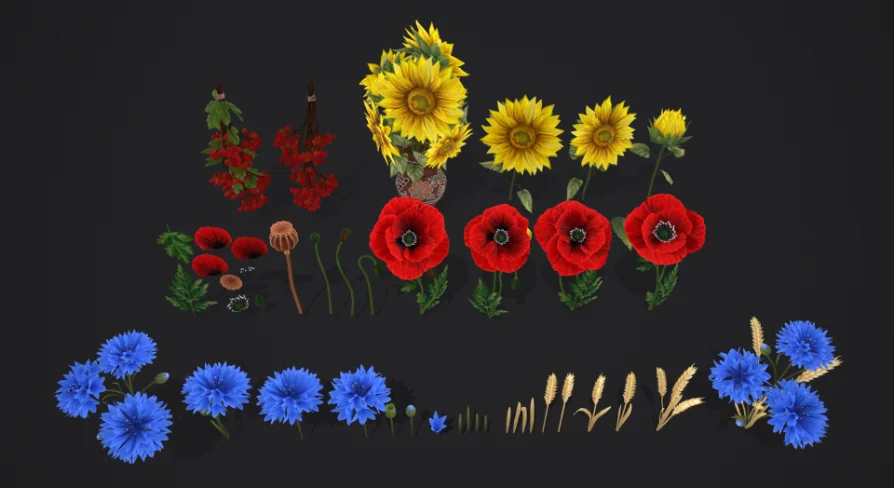
Wild vegetation creates immediate context in natural environments, grounding outdoor scenes through organic scatter and handpainted detail. The Stylized Handpainted Wildflowers Pack provides an assortment of low-poly 3D models configured to dress open fields, garden plots, and path borders. Built to convey vibrant nature themes, the collection contains six sets of flowers representing species such as daisies, poppies, sunflowers, cornflowers, wheat, and guelder rose plants. Because foliage in stylized scenes often requires visible, painterly surface work rather than photorealistic scanning, hand-crafted textures define the visual identity of each stem, petal, and leaf.
Integrating these plants into an exterior environment relies on understanding their structure. The collection includes both standalone field sprigs and contained domestic arrangements. Broad flower heads and slim stalks allow artists to establish contrasting heights across terrain surfaces, forming dense clusters or sparse patches depending on scene requirements. By pairing individual wildflower varieties or mixing composite groups of cornflower and wheat, level designers can establish natural transitions across spring meadows, rustic farmsteads, and forest clearings.
Polygon Budgets Across the Guelder Rose, Sunflower, and Field Sets
The six sets feature varying geometric allocations tailored to their branching complexity and floral structure. Low-poly meshes must balance clean edge flow with enough surface area to showcase stylized painterly textures without excessive deformation.
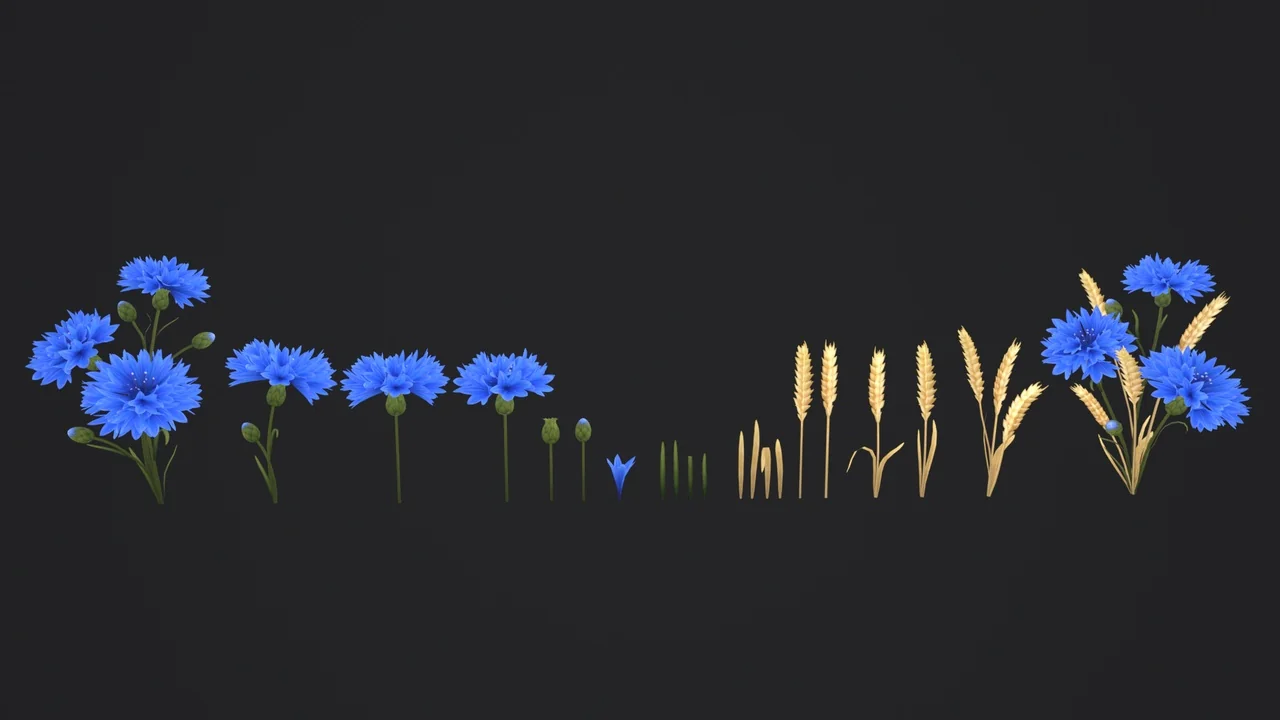
Cornflower and Wheat: At 10,600 polygons, this composite set carries the highest density in the collection. The combined geometry accommodates multiple slender wheat stalks, awns, and delicate cornflower petals organized into a ready-to-place field patch.
Guelder Rose: Measuring 10,200 polygons, this asset captures the complex branching, broad leaves, and clustered berry heads characteristic of the shrub. The polygon budget supports the spherical groupings of berries and layered sprigs necessary for convincing volume.
Sunflower Set and Pot: The sunflower grouping is divided into two distinct components. The flower set itself uses 9,300 polygons to support wide petal rings, substantial leaves, and thick stalks. Accompanying the plant is an optional planter pot constructed with 204 polygons, allowing the asset to transition between outdoor soil and domestic or village environments.
Poppy: Standing at 4,580 polygons, the poppy set focuses its geometry on characteristic cup-shaped blossoms, delicate stems, and seed pods, making it suitable for mid-density meadow scatter.
Daisy: With a lightweight budget of 3,700 polygons, the daisy collection offers an efficient scatter asset. Its simpler radiating petal geometry allows wide distribution across grassy clearings without inflating scene complexity.
These polygon allocations reflect the physical traits of each plant. Multi-stem arrangements and berry clusters demand greater geometric support to prevent planes from clipping unnaturally, whereas single-bloom species like daisies and poppies keep vertex counts restrained.
Production Pipeline: Maya, RizomUV, 3DCoat, and Photoshop
The construction of the low-poly models follows a specialized digital content creation pipeline spanning four dedicated tools. Maya provided the core environment for base mesh modeling, silhouette design, and structural assembly. Working in Maya allowed clean management of leaf cards, stem topology, and proportion calibration among the different plant species.
UV unwrapping was executed in RizomUV. Foliage meshes present distinct challenges for UV mapping, as thin stems, petal rings, and overlapping leaf clusters require minimal distortion and efficient packing. RizomUV ensured clean unwrapping and seam distribution, maximizing usable texture space for every individual sprig and petal.
Surfacing and color application were carried out through 3DCoat and Photoshop. 3DCoat served as the primary viewport painting environment, allowing direct brushstrokes across the 3D surfaces to ensure continuity over seams and petal folds. Photoshop was utilized to finalize texture maps, refine color balances, adjust values, and manage layer blending for the painterly aesthetic. This combination of 3D projection painting and 2D image editing produces clean highlights, shadows, and stylized brush patterns directly on the plant surfaces.
Individual 2k.tga Texture Implementation
Each of the six flower sets is accompanied by its own dedicated 2k texture mapped in.tga format. A 2048x2048 resolution per set ensures that fine painterly strokes, color gradients, and petal details remain crisp even when the camera approaches ground level.
The choice of uncompressed or lossless.tga files provides consistent color preservation without compression artifacts that can soften sharp handpainted contours. Because each plant variety maintains its own dedicated texture map, scene dressers can isolate specific assets without being forced to load a shared texture atlas that contains unused varieties. A standalone daisy patch, for instance, references only its dedicated 2k map, keeping memory utilization modular when dressing diverse scenes.
This individual mapping structure also simplifies material assignment inside modern game engines and rendering packages. Artists can create standalone master or instance materials for each plant variety, applying custom wind displacement or ambient shading parameters to specific sets without affecting other foliage in the environment.
Scene Layout Strategies for Potted and Wild Plant Arrangements
The inclusion of wild field species alongside a potted sunflower provides flexibility in how these 3D models can be deployed across game scenes. While the cornflower, wheat, daisy, and poppy sets naturally belong on open terrain, the sunflower's separate 204-polygon pot transforms the asset from an uncultivated field plant into a decorative feature for porches, courtyards, interior windowsills, or village pathways.
For open meadow environments, combining the lighter 3,700-polygon daisy meshes with the 4,580-polygon poppy models provides a color-rich undergrowth layer that keeps performance budgets predictable. The denser 10,600-polygon cornflower and wheat clusters work well as visual anchors or transition zones between low grass and taller shrubs. The guelder rose, with its berry clusters and substantial 10,200-polygon footprint, acts effectively as edge foliage along rock faces, fences, or tree lines where visual weight is needed.
Evaluating the technical distribution of the Stylized Handpainted Wildflowers Pack reveals a modular, production-ready asset kit. With six independent sets, dedicated 2k.tga textures, and polygon densities scaled to the structural requirements of each botanical form, the collection equips technical artists and environment modelers with dependable tools for building vibrant, painterly outdoor worlds.
 Plants
 Plants
 Plants
 Plants