"a7cfa646d0d8ae55"{"id":"1000887","slug":"special-forces-ski-fi-soldier","title":"Special forces ski-fi soldier","category":"Characters \u0026 Creatures","engine":"4.26+,5.0+","assetVersion":"","engineVersion":"Engine Version: 4.26+,5.0+","tag":"Characters","accent":"blue","visual":"character","summary":"Low-poly sci-fi special forces soldier with respirator, rigged and skinned for Mannequin, includes auto rifle and baton, scalable 4K–1K textures.","platform":"Unreal Engine","publishedAt":"2026-08-05T18:03:28.977Z","updatedAt":"2026-08-05T18:03:28.977Z","sourceNotes":[],"fileContents":[],"compatibility":["Unreal Engine","Engine Version: 4.26+,5.0+"],"featuredImage":{"alt":"Special forces ski-fi soldier","src":"/wp-content/uploads/published/2026/08/8c9441f8d0d4-6bc53af4-1679-467b-8856-52c5905a0e67-9459541a09.webp"},"hasDownloadLink":true,"downloads":5,"terms":[{"taxonomy":"category","slug":"characters-and-creatures","name":"Characters \u0026 Creatures"}],"galleryImages":[{"src":"/wp-content/uploads/published/2026/08/55fbcadc0ce6-ec219aa8-4794-428e-be7b-72030e5adfa1-dec089dee1.webp","alt":"Special forces ski-fi soldier"},{"src":"/wp-content/uploads/published/2026/08/97082eb6f713-3b5e1934-878c-4ef6-b3e4-5e79256cb2b1-74727300b8.webp","alt":"Special forces ski-fi soldier"},{"src":"/wp-content/uploads/published/2026/08/b23f625b0a0e-fe880d58-3233-4ddc-8246-ce96887057eb-2dbcd3b160.webp","alt":"Special forces ski-fi soldier"},{"src":"/wp-content/uploads/published/2026/08/80f68b87d1e5-9d58b401-b867-4e31-819f-670aa2f5925a-40f6a03b13.webp","alt":"Special forces ski-fi soldier"},{"src":"/wp-content/uploads/published/2026/08/793cfdc85617-91139f14-f431-40a1-b086-73f48a339280-d84f28c5e6.webp","alt":"Special forces ski-fi soldier"},{"src":"/wp-content/uploads/published/2026/08/32c85a0217be-2814f505-9954-4116-ba7c-0d73b3336f36-4a8d5f560f.webp","alt":"Special forces ski-fi soldier"},{"src":"/wp-content/uploads/published/2026/08/1069dfc1a278-1960d7be-f298-4c45-a875-4a8be82183c2-3fd51b15b7.webp","alt":"Special forces ski-fi soldier"}],"accessPanel":{"kind":"resource","title":"Download this resource","eyebrow":"Free Download","message":"Log in or create a free account to start your download.","fileName":"Content.7z","safetyNote":"Resources are manually reviewed before listing to improve quality and reduce obvious risks.","actionLabel":"Download Free","resourceType":"Resource archive"},"contentHtml":"\u003cp\u003eDropping the \u003cem\u003eSpecial Forces Sci-Fi Soldier\u003c/em\u003e into a game scene is mostly a matter of assigning the existing Texture and letting the \u003ccode\u003eMannequin\u003c/code\u003e Animation Set drive the Skeleton. The character arrives rigged and skinned, so there is no extra binding step between the Mesh and the Bone Hierarchy. For teams working with the standard Unreal Engine \u003ccode\u003eMannequin\u003c/code\u003e Skeleton, the included animation set is meant to match that setup, which shortens the gap from import to playable preview.\u003c/p\u003e\n\n\u003ch2\u003eRigging, Skinning, and the \u003ccode\u003eMannequin\u003c/code\u003e Animation Set\u003c/h2\u003e\n\n\u003cp\u003eThe character is built as a Low-Poly game asset, but the technical preparation is where it saves time. Being rigged means the model already has a bone structure; being skinned means the vertices follow those bones correctly when the Skeleton moves. That matters when you swap in Locomotion, aiming, or combat stances. The asset includes standard animations for the \u003ccode\u003eMannequin\u003c/code\u003e, which is the reference Skeleton used across many Unreal Engine projects. This compatibility lets developers reuse existing Animation Blueprints or Retarget other motion sets that target the same Skeleton.\u003c/p\u003e\n\n\u003cp\u003eBecause the animation set is included, the soldier is not just a static prop. The character is ready to move, run, strafe, and interact with gameplay systems that rely on a common Character Rig. That is a practical starting point for an indie project where a custom animation set may be more work than the model itself.\u003c/p\u003e\n\n\u003ch2\u003ePolygon Count Breakdown: Soldier and Weapons\u003c/h2\u003e\n\n\u003cp\u003eThe asset’s face count is split between the character Mesh and its weapon set. The Mesh itself sits at 33,945 faces, while the auto rifle and baton account for 5,310 faces. Combined, the full set is 39,255 faces. That total stays within a reasonable range for a Low-Poly character used in a game scene, and it leaves headroom for the rest of the environment.\u003c/p\u003e\n\n\u003cp\u003eThe 2 weapons serve distinct roles. An auto rifle covers ranged combat, while a baton gives a close-combat option. Having both on the same character means you can change equipment without pulling in a separate asset pack. The weapon faces are separated from the main body, so they can be optimized or replaced independently when needed.\u003c/p\u003e\n\n\u003ch2\u003eTexture Sizes: From 4K Down to 1024 or Less\u003c/h2\u003e\n\n\u003cp\u003eTextures are provided in either 4096x4096 or 2048x2048 resolution. The developer notes that the Texture can be compressed down to 1024x1024 or even smaller without much visible quality loss. That makes the asset adjustable for different target platforms. A 2K Texture is enough for hero shots on a mid-range PC, while a 1K or 512 version could be used on mobile or on distant characters where detail matters less.\u003c/p\u003e\n\n\u003cp\u003eThe flexibility is useful when packing multiple characters into a Level. A scene with many soldiers can use the compressed Texture, while a Cutscene-specific model can load the full 4K map. Because the compression loss is described as minimal, the same character can be tuned for performance without requiring a different Material setup.\u003c/p\u003e\n\n\u003ch2\u003eDesign Identity: Special Forces with a Sci-Fi Edge\u003c/h2\u003e\n\n\u003cp\u003eTags for the asset include \u003cem\u003eSpecial\u003c/em\u003e, \u003cem\u003eForce\u003c/em\u003e, \u003cem\u003eSoldier\u003c/em\u003e, \u003cem\u003eRespirator\u003c/em\u003e, \u003cem\u003eMilitary\u003c/em\u003e, and \u003cem\u003eScience Fiction\u003c/em\u003e. That combination points to a design that reads as a futuristic or alternate-universe special forces trooper. The respirator is a key visual cue, giving the face a covered, tactical look and removing the need for a detailed facial expression. The style is described as Low-Poly but also realistic, which suggests the proportions and Materials aim for believability without high vertex density.\u003c/p\u003e\n\n\u003cp\u003eFor a game, this kind of character fits a strike-team soldier, a security guard in a sci-fi facility, or an enemy grunt in a shooting Level. The Low-Poly approach keeps the asset fast to render, while the realistic Material and rigging help it blend into a serious tone.\u003c/p\u003e\n\n\u003ch2\u003eAnimation and Locomotion Demo Video\u003c/h2\u003e\n\n\u003cp\u003eThe product page for this soldier includes a video demo showing the animation and Locomotion. That video is the quickest way to see how the \u003ccode\u003eMannequin\u003c/code\u003e animations behave on the custom Mesh before importing it. Since the game-ready asset already has a Skeleton, the demo likely shows walk, run, and other movement cycles without additional setup. For a developer deciding whether the animation set matches their needs, that video is a useful reference that bypasses the import-test loop.\u003c/p\u003e\n\n\u003ch2\u003eFuture Updates Based on Community Interest\u003c/h2\u003e\n\n\u003cp\u003eThe developer states that updates for the product will be released if there is interest in it. That means reviews and community feedback directly shape whether the asset gets expanded upon. A character pack that gains attention may receive new animations, Texture variations, or other additions down the line. Keeping an eye on the asset’s update path is worth doing if you plan to build a long-term project around this soldier.\u003c/p\u003e\n\n\u003cp\u003eUntil then, the current package already provides a complete core: a rigged, skinned Low-Poly character, \u003ccode\u003eMannequin\u003c/code\u003e animations, 2 weapons, and scalable Texture options. That is enough to put a specialized sci-fi soldier into action quickly.\u003c/p\u003e\n\n\u003ch2\u003eMore From The Same Workflow\u003c/h2\u003e\n\u003cul\u003e\n\u003cli\u003e\u003ca href=\"https://3dcghub.com/sci-fi-assault-trooper/\" title=\"Sci-Fi Assault Trooper\"\u003eSci-Fi Assault Trooper\u003c/a\u003e\u003c/li\u003e\n\u003cli\u003e\u003ca href=\"https://3dcghub.com/astronaut-soldier/\" title=\"Astronaut Soldier\"\u003eAstronaut Soldier\u003c/a\u003e\u003c/li\u003e\n\u003cli\u003e\u003ca href=\"https://3dcghub.com/futuristic-soldier/\" title=\"Futuristic Soldier\"\u003eFuturistic Soldier\u003c/a\u003e\u003c/li\u003e\n\u003cli\u003e\u003ca href=\"https://3dcghub.com/sci-fi-elite-trooper/\" title=\"SCI FI: ELITE TROOPER\"\u003eSCI FI: ELITE TROOPER\u003c/a\u003e\u003c/li\u003e\n\u003cli\u003e\u003ca href=\"https://3dcghub.com/a-c-s-u-mantis/\" title=\"A.C.S.U. \u0026quot;MANTIS\u0026quot;\"\u003eA.C.S.U. \u0026quot;MANTIS\u0026quot;\u003c/a\u003e\u003c/li\u003e\n\u003c/ul\u003e","contentTextLength":5149,"navigation":{"current":361,"total":3167,"previous":{"id":"1000888","slug":"sport-female","title":"Sport_female","category":"Characters \u0026 Creatures","platform":"Unreal Engine","updatedAt":"2026-08-05T18:09:26.478Z"},"next":{"id":"1000886","slug":"smart-traffic-light","title":"Smart Traffic Light","category":"Gameplay Features","platform":"Unreal Engine","updatedAt":"2026-08-05T18:00:25.092Z"}},"relatedResources":[{"id":"3398","slug":"sci-fi-assault-trooper","title":"Sci-Fi Assault Trooper","category":"Characters \u0026 Creatures","engine":"4.26,5.0+","assetVersion":"Engine version: 4.26,5.0+","engineVersion":"4.22","tag":"Characters","accent":"blue","visual":"character","summary":"Enhance your futuristic project with the Sci-Fi Assault Trooper pack. Features 10 modular meshes, male and female soldiers, and customizable materials.","platform":"Unreal Engine","publishedAt":"2026-02-09T07:00:56.000Z","updatedAt":"2026-04-19T15:57:39.000Z","sourceNotes":[],"fileContents":[],"compatibility":["Unreal Engine","Engine version: 4.26,5.0+"],"featuredImage":{"alt":"Sci-Fi Assault Trooper","src":"https://3dcghub.com/wp-content/uploads/2026/02/578e5358-c676-457f-b5e4-9b852865255f.webp"},"hasDownloadLink":true,"downloads":1},{"id":"1666","slug":"astronaut-soldier","title":"Astronaut Soldier","category":"Characters \u0026 Creatures","engine":"4.26+,5.0+","assetVersion":"Engine version: 4.26+,5.0+","engineVersion":"4.18","tag":"Characters","accent":"blue","visual":"character","summary":"Enhance your sci-fi game with the Astronaut Soldier 3D character. Features 5 unique faces, PBR textures, and a custom weapon for immersive space adventures.","platform":"Unreal Engine","publishedAt":"2026-02-06T20:24:02.000Z","updatedAt":"2026-04-19T15:58:07.000Z","sourceNotes":[],"fileContents":[],"compatibility":["Unreal Engine","Engine version: 4.26+,5.0+"],"featuredImage":{"alt":"Astronaut Soldier","src":"https://3dcghub.com/wp-content/uploads/2026/02/ad597eb7-f602-463e-b433-682b3f761e65.webp"},"hasDownloadLink":true,"downloads":0},{"id":"2461","slug":"futuristic-soldier","title":"Futuristic Soldier","category":"Characters \u0026 Creatures","engine":"4.26+,5.0+","assetVersion":"Engine version: 4.26+,5.0+","engineVersion":"4.16","tag":"Characters","accent":"blue","visual":"character","summary":"Enhance your sci-fi project with this high-quality Futuristic Soldier character. Featuring PBR textures and Epic Skeleton compatibility for easy integration.","platform":"Unreal Engine","publishedAt":"2026-02-07T10:01:24.000Z","updatedAt":"2026-04-19T15:58:02.000Z","sourceNotes":[],"fileContents":[],"compatibility":["Unreal Engine","Engine version: 4.26+,5.0+"],"featuredImage":{"alt":"Futuristic Soldier","src":"https://3dcghub.com/wp-content/uploads/2026/02/852260c2-6ff5-4a5f-b6a3-00e21d6f00c9.webp"},"hasDownloadLink":true,"downloads":0}]}
Characters
Special forces ski-fi soldier
Low-poly sci-fi special forces soldier with respirator, rigged and skinned for Mannequin, includes auto rifle and baton, scalable 4K–1K textures.
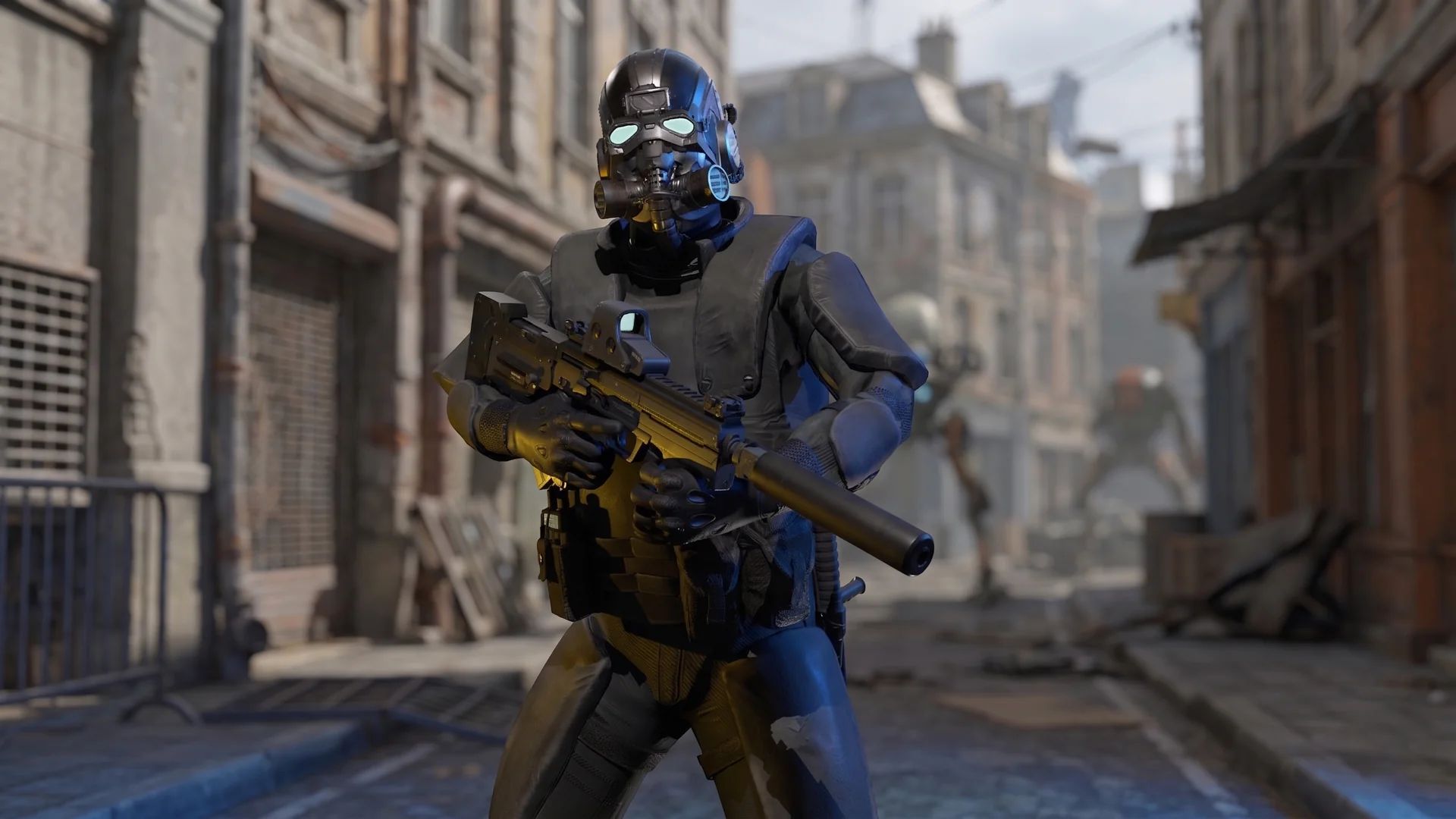
Dropping the Special Forces Sci-Fi Soldier into a game scene is mostly a matter of assigning the existing Texture and letting the Mannequin Animation Set drive the Skeleton. The character arrives rigged and skinned, so there is no extra binding step between the Mesh and the Bone Hierarchy. For teams working with the standard Unreal Engine Mannequin Skeleton, the included animation set is meant to match that setup, which shortens the gap from import to playable preview.
Rigging, Skinning, and the Mannequin Animation Set
The character is built as a Low-Poly game asset, but the technical preparation is where it saves time. Being rigged means the model already has a bone structure; being skinned means the vertices follow those bones correctly when the Skeleton moves. That matters when you swap in Locomotion, aiming, or combat stances. The asset includes standard animations for the Mannequin, which is the reference Skeleton used across many Unreal Engine projects. This compatibility lets developers reuse existing Animation Blueprints or Retarget other motion sets that target the same Skeleton.
Because the animation set is included, the soldier is not just a static prop. The character is ready to move, run, strafe, and interact with gameplay systems that rely on a common Character Rig. That is a practical starting point for an indie project where a custom animation set may be more work than the model itself.
Polygon Count Breakdown: Soldier and Weapons
The asset’s face count is split between the character Mesh and its weapon set. The Mesh itself sits at 33,945 faces, while the auto rifle and baton account for 5,310 faces. Combined, the full set is 39,255 faces. That total stays within a reasonable range for a Low-Poly character used in a game scene, and it leaves headroom for the rest of the environment.
The 2 weapons serve distinct roles. An auto rifle covers ranged combat, while a baton gives a close-combat option. Having both on the same character means you can change equipment without pulling in a separate asset pack. The weapon faces are separated from the main body, so they can be optimized or replaced independently when needed.
Texture Sizes: From 4K Down to 1024 or Less
Textures are provided in either 4096x4096 or 2048x2048 resolution. The developer notes that the Texture can be compressed down to 1024x1024 or even smaller without much visible quality loss. That makes the asset adjustable for different target platforms. A 2K Texture is enough for hero shots on a mid-range PC, while a 1K or 512 version could be used on mobile or on distant characters where detail matters less.
The flexibility is useful when packing multiple characters into a Level. A scene with many soldiers can use the compressed Texture, while a Cutscene-specific model can load the full 4K map. Because the compression loss is described as minimal, the same character can be tuned for performance without requiring a different Material setup.
Design Identity: Special Forces with a Sci-Fi Edge
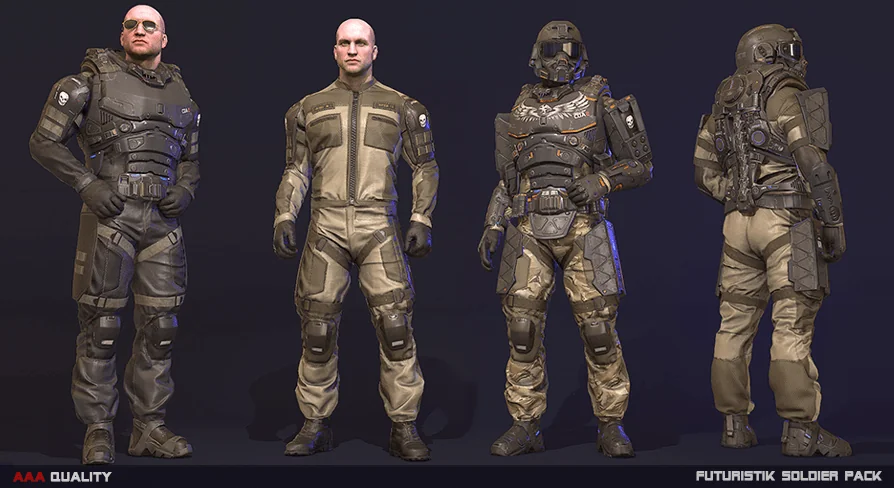
Tags for the asset include Special, Force, Soldier, Respirator, Military, and Science Fiction. That combination points to a design that reads as a futuristic or alternate-universe special forces trooper. The respirator is a key visual cue, giving the face a covered, tactical look and removing the need for a detailed facial expression. The style is described as Low-Poly but also realistic, which suggests the proportions and Materials aim for believability without high vertex density.
For a game, this kind of character fits a strike-team soldier, a security guard in a sci-fi facility, or an enemy grunt in a shooting Level. The Low-Poly approach keeps the asset fast to render, while the realistic Material and rigging help it blend into a serious tone.
Animation and Locomotion Demo Video
The product page for this soldier includes a video demo showing the animation and Locomotion. That video is the quickest way to see how the Mannequin animations behave on the custom Mesh before importing it. Since the game-ready asset already has a Skeleton, the demo likely shows walk, run, and other movement cycles without additional setup. For a developer deciding whether the animation set matches their needs, that video is a useful reference that bypasses the import-test loop.
Future Updates Based on Community Interest
The developer states that updates for the product will be released if there is interest in it. That means reviews and community feedback directly shape whether the asset gets expanded upon. A character pack that gains attention may receive new animations, Texture variations, or other additions down the line. Keeping an eye on the asset’s update path is worth doing if you plan to build a long-term project around this soldier.
Until then, the current package already provides a complete core: a rigged, skinned Low-Poly character, Mannequin animations, 2 weapons, and scalable Texture options. That is enough to put a specialized sci-fi soldier into action quickly.
 Characters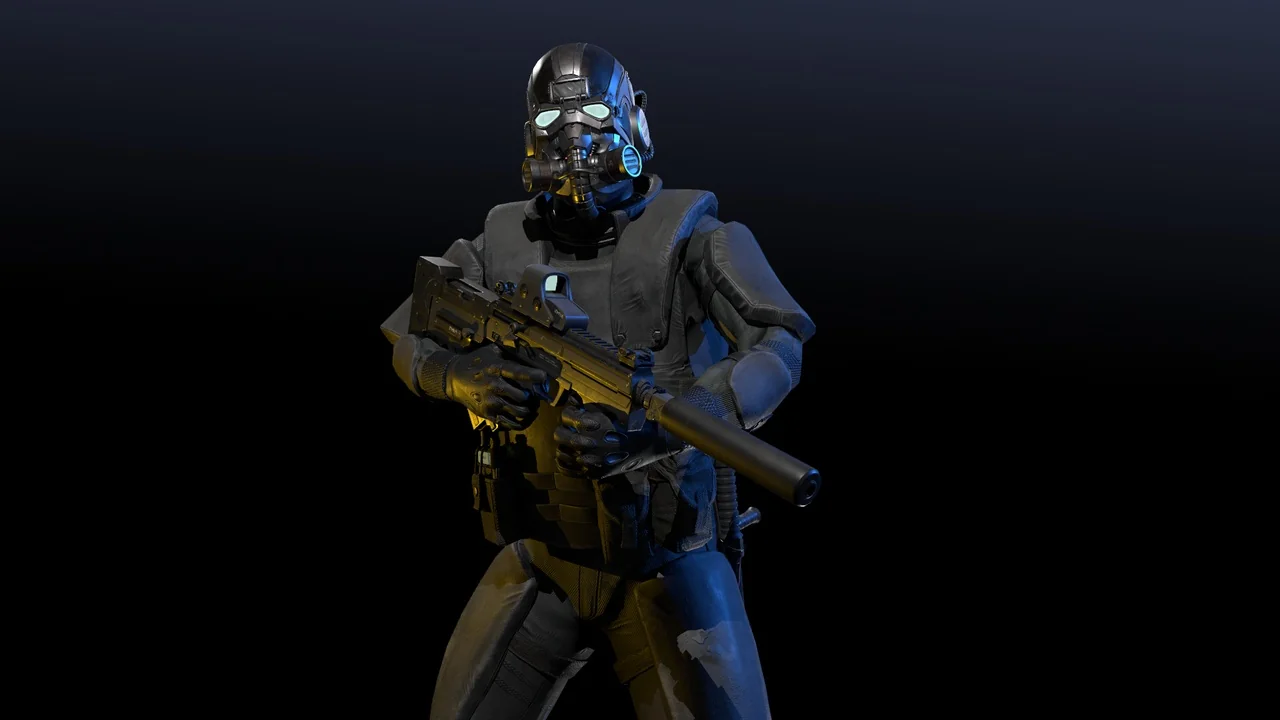
 Characters
 Characters
 Characters