"c68a05d5e51405b3"{"id":"1000682","slug":"soviet-electric-locomotive","title":"Soviet Electric Locomotive","category":"Trains","engine":"4.27,5.0+","assetVersion":"","engineVersion":"Engine Version: 4.27,5.0+","tag":"Trains","accent":"blue","visual":"mech","summary":"Game-ready Soviet Electric Locomotive 3D model with railway tracks and trolley props. PBR materials, ORM texture sets, Unreal Engine blueprint, Unity and Blende","platform":"Unreal Engine","publishedAt":"2026-07-22T15:43:21.918Z","updatedAt":"2026-07-22T15:43:21.918Z","sourceNotes":[],"fileContents":[],"compatibility":["Unreal Engine","Engine Version: 4.27,5.0+"],"featuredImage":{"alt":"Soviet Electric Locomotive","src":"/wp-content/uploads/published/2026/07/f58379deba0c-d1b2c520-c892-448f-b4c4-37d7372ac634-504cfdce01.webp"},"hasDownloadLink":true,"downloads":0,"terms":[{"taxonomy":"category","slug":"trains","name":"Trains"}],"galleryImages":[{"src":"/wp-content/uploads/published/2026/07/4347728d2dcb-c28c6bed-618e-4858-a808-b166097032f9-f59deaa1b0.webp","alt":"Soviet Electric Locomotive"},{"src":"/wp-content/uploads/published/2026/07/17d6139c0f39-ffa47b1a-d9d7-4689-9059-c5f33303f2f1-fda3a11e69.webp","alt":"Soviet Electric Locomotive"},{"src":"/wp-content/uploads/published/2026/07/02da98d9ae5a-95dfd7b4-5f4f-4a7e-bb98-acf9122525cf-4c683dd66a.webp","alt":"Soviet Electric Locomotive"},{"src":"/wp-content/uploads/published/2026/07/ee8ec0617ac1-179d16a7-a33e-4c1c-a734-0474a5145fda-c58443b7c0.webp","alt":"Soviet Electric Locomotive"},{"src":"/wp-content/uploads/published/2026/07/3bf195810d93-a8956ded-1628-4c4b-b19f-393476246081-d03e0c110d.webp","alt":"Soviet Electric Locomotive"},{"src":"/wp-content/uploads/published/2026/07/77fe1850409c-80fedf96-f87c-424a-a62d-dbf1baf824d0-f4f20b2e0d.webp","alt":"Soviet Electric Locomotive"},{"src":"/wp-content/uploads/published/2026/07/17cb487472d9-09321257-e00f-4ce5-bed4-787eedaf8560-74e346a45c.webp","alt":"Soviet Electric Locomotive"},{"src":"/wp-content/uploads/published/2026/07/599e2e804daa-287cb97d-b123-480d-b5e2-934f3eb83fb8-5324cf039b.webp","alt":"Soviet Electric Locomotive"},{"src":"/wp-content/uploads/published/2026/07/a15d17b72e96-6830e7d2-da70-4ff5-aba9-dc1d3b7d45f4-64977f6f01.webp","alt":"Soviet Electric Locomotive"},{"src":"/wp-content/uploads/published/2026/07/e59e86cd27a9-afbcc419-17d5-4f04-8f5e-e4d0bf695a2e-4e06ba32fb.webp","alt":"Soviet Electric Locomotive"}],"accessPanel":{"kind":"resource","title":"Download this resource","eyebrow":"Free Download","message":"Log in or create a free account to start your download.","fileName":"Content.7z","safetyNote":"Resources are manually reviewed before listing to improve quality and reduce obvious risks.","actionLabel":"Download Free","resourceType":"Resource archive"},"contentHtml":"\u003cp\u003eAn electric locomotive sits on modular rail segments, flanked by a separate trolley and scattered component parts. The package is modeled after a specific class of Soviet rail vehicle that saw active service on the railways of the USSR and the Russian Federation, and the surrounding props are oriented toward dressing post-Soviet railway environments. The locomotive model is also part of a broader Modular Abandoned Depot set, meaning it can anchor a larger industrial scene rather than existing only as an isolated vehicle.\u003c/p\u003e \n\n\u003ch2\u003eThe Locomotive and Its Railway Environment\u003c/h2\u003e\n\u003cp\u003eThe core of the release is the train itself, modeled as a low-poly, game-ready asset. Alongside the locomotive, the set includes several variants of railway track, giving level designers flexibility to lay out straight sections, junctions, or sidings without reaching for external packages. A separate train trolley and its component parts are provided as props, which broadens the dressing options beyond the rolling stock alone. A depot platform, rusted track segments, and movable trolley wheels can be combined to dress a staging yard or a derelict industrial siding.\u003c/p\u003e \n\u003cp\u003eThe historical framing matters for art direction. Electric locomotives of this type were workhorses on Soviet and Russian rail networks, so the silhouette, surface detailing, and weathering logic align with that lineage. For projects set in post-Soviet countries, the asset provides period-appropriate rolling stock without requiring custom reference modeling.\u003c/p\u003e \n\n\u003ch2\u003ePBR Materials and Texture Pipeline\u003c/h2\u003e\n\u003cp\u003eSurface quality is handled through PBR materials, with the train using a few distinct texture sets instead of one shared map. This allows different parts of the locomotive to carry varied wear, paint, and metal conditions. Texture density has been optimized so resolutions stay practical without unnecessarily bloating video memory.\u003c/p\u003e \n\u003cp\u003eA notable pipeline choice is the ORM channel packing convention. PBR textures are collected into ORM packages, meaning ambient occlusion, roughness, and metallic data are consolidated into a single channel-packed texture rather than distributed across separate files. This is a workflow-friendly decision for teams importing into engines that expect packed ORM inputs, and it reduces material sampler count.\u003c/p\u003e \n\u003cul\u003e\n\u003cli\u003eMultiple texture sets assigned to the train for visual variation\u003c/li\u003e\n\u003cli\u003eOptimized texture density across the model\u003c/li\u003e\n\u003cli\u003eORM-packed PBR textures for streamlined material setup\u003c/li\u003e\n\u003c/ul\u003e \n\n\u003ch2\u003eUnreal Engine Blueprint and Poly Count\u003c/h2\u003e\n\u003cp\u003eFor Unreal Engine users, the locomotive ships with a customizable Blueprint. This gives designers exposed parameters or modular options directly inside the engine rather than requiring every configuration change to be made in a separate DCC application. The Blueprint can drive variations in appearance or setup without needing to re-import geometry.\u003c/p\u003e \n\u003cp\u003eThe model maintains a reasonable poly count, keeping it suitable for real-time rendering in games. The low-poly designation confirms that the geometry is meant for engine use, not offline cinematic baking at high subdivision levels. Combined with the optimized texture density, the locomotive is positioned as a real-time-ready asset rather than a hero prop intended only for pre-rendered shots.\u003c/p\u003e \n\n\u003ch2\u003eCross-Engine and DCC Compatibility\u003c/h2\u003e\n\u003cp\u003eThe package is not locked to a single platform. It provides versions for Unreal Engine 4, Unity, and Blender, and the available file formats extend further:\u003c/p\u003e \n\u003cul\u003e\n\u003cli\u003eUnreal Engine 4.27\u003c/li\u003e\n\u003cli\u003eUnity 2022 — Built-in, URP, and HDRP render pipelines\u003c/li\u003e\n\u003cli\u003eBlender Scene 3.6\u003c/li\u003e\n\u003cli\u003e3DS Max 2021\u003c/li\u003e\n\u003cli\u003eFBX\u003c/li\u003e\n\u003cli\u003eOBJ\u003c/li\u003e\n\u003cli\u003ePNG for textures\u003c/li\u003e\n\u003c/ul\u003e \n\u003cp\u003eThe Unity package covering Built-in, URP, and HDRP means the asset can drop into projects regardless of which render pipeline the target production has committed to. The Blender scene file provides a native working environment for artists who need to modify or repose elements before export. FBX and OBJ cover interchange with other DCC tools, and PNG textures ensure the image data is accessible outside any engine-specific packaging.\u003c/p\u003e \n\n\u003ch2\u003eWhere This Asset Fits\u003c/h2\u003e\n\u003cp\u003eThe clearest use case is railway environment design for post-Soviet settings. A project set in a Russian or post-Soviet industrial zone can use the locomotive as a centerpiece, with the track variants to lay the surrounding infrastructure and the trolley components as scattered set dressing. The Modular Abandoned Depot connection suggests the locomotive is intended to integrate into a larger degraded industrial facility rather than sitting on pristine track in a modern yard.\u003c/p\u003e \n\u003cp\u003eThe asset is tagged across a range of descriptors including Retro, Railroad, Industrial, Painted, Realistic, Old, Metal, Metallic, Transport, Railcar, and Trolley. These point toward scenes where aging and industrial character are desired. The Soviet and Russian tags confirm the geographic and historical framing, while Blueprint and Script indicate the engine-side customization layer included for Unreal users.\u003c/p\u003e \n\u003cp\u003eTeams building abandoned or semi-abandoned railway scenes with a realistic, slightly weathered aesthetic will get the most from this package. The included Blueprint, ORM texture workflow, and multi-platform exports make it practical for small studios that need to move assets between DCC work and engine assembly without rebuilding materials at every step.\u003c/p\u003e\n\n\u003ch2\u003eExplore Similar Assets\u003c/h2\u003e\n\u003cul\u003e\n\u003cli\u003e\u003ca href=\"https://3dcghub.com/lightning-electric-effect-alembics-pack/\" title=\"Lightning \u0026amp; Electric Effect Alembics Pack\"\u003eLightning \u0026amp; Electric Effect Alembics Pack\u003c/a\u003e\u003c/li\u003e\n\u003cli\u003e\u003ca href=\"https://3dcghub.com/railway-system-with-ic-train/\" title=\"Railway System with IC Train\"\u003eRailway System with IC Train\u003c/a\u003e\u003c/li\u003e\n\u003cli\u003e\u003ca href=\"https://3dcghub.com/soviet-post-soviet-abandoned-world/\" title=\"Soviet/Post Soviet Abandoned World.\"\u003eSoviet/Post Soviet Abandoned World.\u003c/a\u003e\u003c/li\u003e\n\u003cli\u003e\u003ca href=\"https://3dcghub.com/post-soviet-flat/\" title=\"Post Soviet Flat\"\u003ePost Soviet Flat\u003c/a\u003e\u003c/li\u003e\n\u003cli\u003e\u003ca href=\"https://3dcghub.com/modular-post-soviet-building/\" title=\"Modular Post Soviet Building\"\u003eModular Post Soviet Building\u003c/a\u003e\u003c/li\u003e\n\u003c/ul\u003e","contentTextLength":5437,"navigation":{"current":1323,"total":3860,"previous":{"id":"1000683","slug":"space-colony-and-sci-fi-city","title":"Space Colony \u0026 Sci-Fi City","category":"Sci-Fi","platform":"Unreal Engine","updatedAt":"2026-07-22T16:41:05.632Z"},"next":{"id":"1000681","slug":"song-of-alcazar-signature-collection","title":"Song of Alcazar - Signature Collection","category":"Fantasy","platform":"Unreal Engine","updatedAt":"2026-07-22T15:33:23.616Z"}},"relatedResources":[{"id":"1000703","slug":"ultimate-train-system-train-locomotive-steam-engine-wild-west-train","title":"Ultimate Train System (Train, Locomotive, Steam Engine, Wild West Train)","category":"Trains","engine":"5.1+","assetVersion":"","engineVersion":"Engine Version: 5.1+","tag":"Trains","accent":"blue","visual":"mech","summary":"A comprehensive train and locomotive blueprint system featuring a wild west Canyon demo map, modular smart carts, spline snapping rails, and full VFX.","platform":"Unreal Engine","publishedAt":"2026-07-24T00:46:43.909Z","updatedAt":"2026-07-24T00:46:43.909Z","sourceNotes":[],"fileContents":[],"compatibility":["Unreal Engine","Engine Version: 5.1+"],"featuredImage":{"alt":"Ultimate Train System (Train, Locomotive, Steam Engine, Wild West Train)","src":"/wp-content/uploads/published/2026/07/d5fce1e52a39-4446054c-f677-4496-98b4-a722dabf852f-01ccf08ec5.webp"},"hasDownloadLink":true,"downloads":0},{"id":"1001372","slug":"vintage-train","title":"Vintage train","category":"Trains","engine":"4.25+,5.0+","assetVersion":"","engineVersion":"Engine Version: 4.25+,5.0+","tag":"Trains","accent":"blue","visual":"mech","summary":"Examine the animated Vintage train asset pack, featuring a 128,800-triangle vintage locomotive alongside tender, hopper, freight, and coach wagons.","platform":"Unreal Engine","publishedAt":"2026-10-04T10:39:53.047Z","updatedAt":"2026-10-04T10:39:53.047Z","sourceNotes":[],"fileContents":[],"compatibility":["Unreal Engine","Engine Version: 4.25+,5.0+"],"featuredImage":{"alt":"Vintage train","src":"/wp-content/uploads/published/2026/10/0e167efa526f-ef01bd2e-91e1-42e3-872f-27a70dde532e-0489bdb2df.webp"},"hasDownloadLink":true,"downloads":0},{"id":"1001448","slug":"retro-80-s-vol-3-toys-nanite-and-low-poly","title":"Retro 80's VOL.3 - Toys (Nanite and Low Poly)","category":"Trains","engine":"5.1+","assetVersion":"","engineVersion":"Engine Version: 5.1+","tag":"Trains","accent":"blue","visual":"mech","summary":"Retro 80's VOL.3 - Toys delivers 80 Nanite and low-poly meshes, 4K RMAO textures, a working lava lamp, and Lumen support for Unreal Engine 5.","platform":"Unreal Engine","publishedAt":"2026-10-08T00:52:05.381Z","updatedAt":"2026-10-08T00:52:05.381Z","sourceNotes":[],"fileContents":[],"compatibility":["Unreal Engine","Engine Version: 5.1+"],"featuredImage":{"alt":"Retro 80's VOL.3 - Toys (Nanite and Low Poly)","src":"/wp-content/uploads/published/2026/10/c0de1495fa4e-0f96335e-e94b-43d3-82aa-b4becb6fea41-ab53d1598f.webp"},"hasDownloadLink":true,"downloads":0}]}
Trains
Soviet Electric Locomotive
Game-ready Soviet Electric Locomotive 3D model with railway tracks and trolley props. PBR materials, ORM texture sets, Unreal Engine blueprint, Unity and Blende
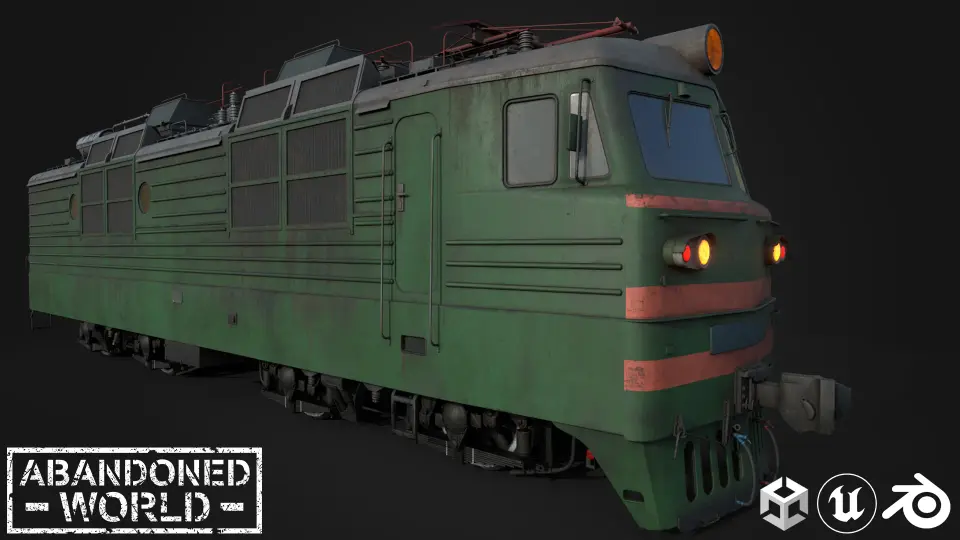
An electric locomotive sits on modular rail segments, flanked by a separate trolley and scattered component parts. The package is modeled after a specific class of Soviet rail vehicle that saw active service on the railways of the USSR and the Russian Federation, and the surrounding props are oriented toward dressing post-Soviet railway environments. The locomotive model is also part of a broader Modular Abandoned Depot set, meaning it can anchor a larger industrial scene rather than existing only as an isolated vehicle.
The Locomotive and Its Railway Environment
The core of the release is the train itself, modeled as a low-poly, game-ready asset. Alongside the locomotive, the set includes several variants of railway track, giving level designers flexibility to lay out straight sections, junctions, or sidings without reaching for external packages. A separate train trolley and its component parts are provided as props, which broadens the dressing options beyond the rolling stock alone. A depot platform, rusted track segments, and movable trolley wheels can be combined to dress a staging yard or a derelict industrial siding.
The historical framing matters for art direction. Electric locomotives of this type were workhorses on Soviet and Russian rail networks, so the silhouette, surface detailing, and weathering logic align with that lineage. For projects set in post-Soviet countries, the asset provides period-appropriate rolling stock without requiring custom reference modeling.
PBR Materials and Texture Pipeline
Surface quality is handled through PBR materials, with the train using a few distinct texture sets instead of one shared map. This allows different parts of the locomotive to carry varied wear, paint, and metal conditions. Texture density has been optimized so resolutions stay practical without unnecessarily bloating video memory.
A notable pipeline choice is the ORM channel packing convention. PBR textures are collected into ORM packages, meaning ambient occlusion, roughness, and metallic data are consolidated into a single channel-packed texture rather than distributed across separate files. This is a workflow-friendly decision for teams importing into engines that expect packed ORM inputs, and it reduces material sampler count.
Multiple texture sets assigned to the train for visual variation
Optimized texture density across the model
ORM-packed PBR textures for streamlined material setup
Unreal Engine Blueprint and Poly Count
For Unreal Engine users, the locomotive ships with a customizable Blueprint. This gives designers exposed parameters or modular options directly inside the engine rather than requiring every configuration change to be made in a separate DCC application. The Blueprint can drive variations in appearance or setup without needing to re-import geometry.
The model maintains a reasonable poly count, keeping it suitable for real-time rendering in games. The low-poly designation confirms that the geometry is meant for engine use, not offline cinematic baking at high subdivision levels. Combined with the optimized texture density, the locomotive is positioned as a real-time-ready asset rather than a hero prop intended only for pre-rendered shots.
Cross-Engine and DCC Compatibility
The package is not locked to a single platform. It provides versions for Unreal Engine 4, Unity, and Blender, and the available file formats extend further:
Unreal Engine 4.27
Unity 2022 — Built-in, URP, and HDRP render pipelines
Blender Scene 3.6
3DS Max 2021
FBX
OBJ
PNG for textures
The Unity package covering Built-in, URP, and HDRP means the asset can drop into projects regardless of which render pipeline the target production has committed to. The Blender scene file provides a native working environment for artists who need to modify or repose elements before export. FBX and OBJ cover interchange with other DCC tools, and PNG textures ensure the image data is accessible outside any engine-specific packaging.
Where This Asset Fits
The clearest use case is railway environment design for post-Soviet settings. A project set in a Russian or post-Soviet industrial zone can use the locomotive as a centerpiece, with the track variants to lay the surrounding infrastructure and the trolley components as scattered set dressing. The Modular Abandoned Depot connection suggests the locomotive is intended to integrate into a larger degraded industrial facility rather than sitting on pristine track in a modern yard.
The asset is tagged across a range of descriptors including Retro, Railroad, Industrial, Painted, Realistic, Old, Metal, Metallic, Transport, Railcar, and Trolley. These point toward scenes where aging and industrial character are desired. The Soviet and Russian tags confirm the geographic and historical framing, while Blueprint and Script indicate the engine-side customization layer included for Unreal users.
Teams building abandoned or semi-abandoned railway scenes with a realistic, slightly weathered aesthetic will get the most from this package. The included Blueprint, ORM texture workflow, and multi-platform exports make it practical for small studios that need to move assets between DCC work and engine assembly without rebuilding materials at every step.
 Trains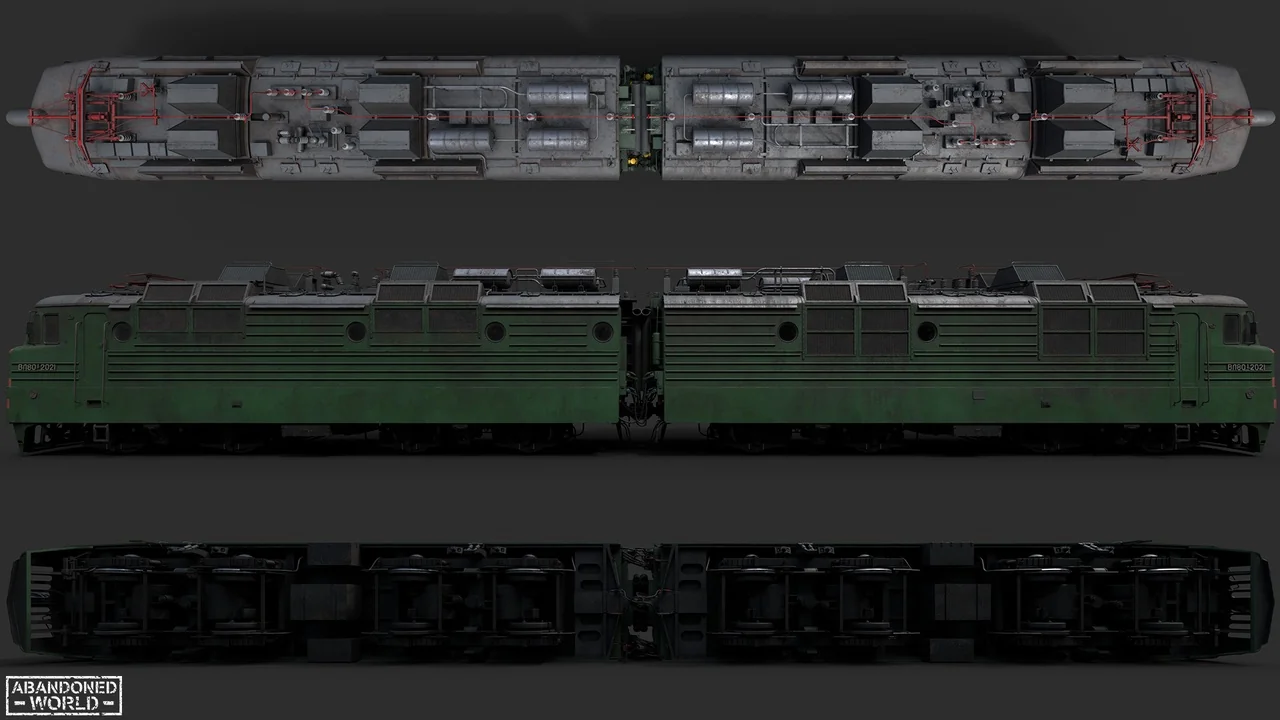
 Trains
 Trains
 Trains