"0148f1904a9b0d16"{"id":"1002599","slug":"sci-fi-modular-hover-vehicles","title":"Sci-Fi Modular Hover Vehicles","category":"Vehicles \u0026 Transportation","engine":"5.0+","assetVersion":"","engineVersion":"Engine Version: 5.0+","tag":"Vehicles","accent":"blue","visual":"mech","summary":"Explore the Sci-Fi Modular Hover Vehicles asset, featuring PBR static meshes, pilotable hovercraft, automated Blueprints, and weapons for Unreal projects.","platform":"Unreal Engine","indexPolicy":"index","publishedAt":"2026-11-14T05:49:30.538Z","updatedAt":"2026-11-14T05:49:30.538Z","sourceNotes":[],"fileContents":[],"compatibility":["Unreal Engine","Engine Version: 5.0+"],"featuredImage":{"alt":"Sci-Fi Modular Hover Vehicles","src":"/wp-content/uploads/published/2026/11/160a20102aaf-fcfdf9cd-6b2f-4b8b-b420-94da4d75420d-6cbd007a59.webp"},"hasDownloadLink":true,"downloads":0,"terms":[{"taxonomy":"category","slug":"vehicles-and-transportation","name":"Vehicles \u0026 Transportation"}],"galleryImages":[{"src":"/wp-content/uploads/published/2026/11/ae89900aa078-fdefbd2e-808b-419b-ac22-b0ea42d8988c-c19c1aeed6.webp","alt":"Sci-Fi Modular Hover Vehicles"},{"src":"/wp-content/uploads/published/2026/11/71314f7930cc-b5f5ad75-de09-43e2-87db-e08c86ef9d6a-8f3c93fd18.webp","alt":"Sci-Fi Modular Hover Vehicles"},{"src":"/wp-content/uploads/published/2026/11/7fd79e1e8b2b-0a718013-506e-4417-9f18-2b34a0ebcc41-518841ee76.webp","alt":"Sci-Fi Modular Hover Vehicles"},{"src":"/wp-content/uploads/published/2026/11/0f709c189643-f39984b3-5a36-4d38-b1e5-4319ba68cb5d-bb8cb1342b.webp","alt":"Sci-Fi Modular Hover Vehicles"},{"src":"/wp-content/uploads/published/2026/11/417c7cea6ded-a8366b31-44d6-4b05-aada-f20697b813ba-ebec87c4bc.webp","alt":"Sci-Fi Modular Hover Vehicles"},{"src":"/wp-content/uploads/published/2026/11/a3f3cc6c3a06-ba66ac78-2c59-4d6e-9449-fb1d3cdfd821-e17c6fd0c1.webp","alt":"Sci-Fi Modular Hover Vehicles"},{"src":"/wp-content/uploads/published/2026/11/47b43d126414-9c45d6f8-2e5a-4a96-b040-4e79acda1d84-288b87664a.webp","alt":"Sci-Fi Modular Hover Vehicles"},{"src":"/wp-content/uploads/published/2026/11/f38cdebf02f6-53e56883-5faf-469f-84bb-a9227a692d0b-b15d183e0b.webp","alt":"Sci-Fi Modular Hover Vehicles"},{"src":"/wp-content/uploads/published/2026/11/d5f3a39559ba-9385f8ac-fed2-4804-9179-10ed34bfbd4f-e725f30bd9.webp","alt":"Sci-Fi Modular Hover Vehicles"},{"src":"/wp-content/uploads/published/2026/11/28d799917846-e9492f63-d665-41ee-849a-353ce8cc7d53-7d30d6093d.webp","alt":"Sci-Fi Modular Hover Vehicles"}],"accessPanel":{"kind":"resource","title":"Get this resource","eyebrow":"Free resource","message":"Download this resource in your browser.","fileName":"HoverVehicles_TH.7z","safetyNote":"Resources are manually reviewed before listing to improve quality and reduce obvious risks.","actionLabel":"Get this resource","resourceType":"Resource archive","versions":[]},"contentHtml":"\u003cp\u003eFuturistic military environments often demand distinct vehicle designs that can hover over uneven terrain without requiring complex skeletal mesh setups. Sci-Fi Modular Hover Vehicles addresses this mechanical balance by providing a static-mesh-driven construction kit paired with functional Blueprints. Instead of relying on traditional skeletal rigging, the kit uses modular static components to assemble hover tanks, mobile hover guns, radar surveillance units, missile launchers, and heavy cargo crafts. Because the framework avoids skeletal hierarchies, developers can detach, rearrange, or expand pieces without retargeting bones or re-weighting vertices.\u003c/p\u003e \u003ch2\u003eStatic Mesh Assembly of Sci-Fi Modular Units\u003c/h2\u003e\n\u003cp\u003eRelying completely on static meshes shifts vehicle construction into a direct, socket- or attachment-driven workflow. Each hull, stabilizer, engine pod, and weapon mount functions as an independent component. This structural decision eliminates the overhead typically tied to vehicle animation Blueprints and physics asset collision physics suited to jointed tracks or wheeled chassis. Instead, components align cleanly in standard coordinate space, giving artists full control over the footprint and operational silhouette of each craft.\u003c/p\u003e\n\u003cp\u003eThe system welcomes both in-house and third-party static meshes alongside the core asset parts. Integrating a proprietary scanner dome, an aftermarket energy turret, or supplemental armor plating requires no custom skinning. You place the additional geometry directly into the vehicle hierarchy, aligning it with the established hardpoints. This openness accommodates multiple military branches or factions within a single project, allowing visual differentiation simply by swapping weapons, radar dishes, or cargo containers across the shared hover chassis.\u003c/p\u003e \u003ch2\u003eBlueprint Logic and Hover Component Mechanics\u003c/h2\u003e\n\u003cp\u003eAlthough filed under the props category, the package contains behavioral Blueprints that bridge the gap between static level decoration and dynamic gameplay elements. At the core is a customizable hovering component that suspends the craft above surfaces, providing the visual sensation of anti-gravity repulsion without needing complex physical constraints. This hovering behavior is paired with basic particle systems specifically authored to generate hover thrust and thruster wash effects underneath the hulls.\u003c/p\u003e\n\u003cp\u003eAmbient scene life is supported through pre-configured movement scripts. Certain Blueprints feature automated circular pathing, allowing ambient or patrol vehicles to navigate circular patrol routes with exposed controls for travel speed and turning radius. Hardpoint mechanics match this automated movement: mounted weapons and turrets can auto-rotate to track surroundings or simulate active scanning sweeps. Supplementing these kinematics are configurable light systems that can be tuned for exterior running indicators, weapon charge lights, or spotlight illumination.\u003c/p\u003e \u003ch2\u003ePiloting Vehicles Across the Demo Playground\u003c/h2\u003e\n\u003cp\u003eTo verify flight characteristics and interaction systems directly in the viewport, the asset provides ready-to-use testing spaces, led by the map named MAP_Demo_Playground. Rather than leaving developers to construct control logic from scratch, the asset supplies two fully pilotable hovercraft setups ready for testing input response. These test vehicles feature dedicated directional translation, turning rotation, and chassis tilting to convey the weight and maneuverability expected of futuristic repulsorcraft.\u003c/p\u003e\n\u003cp\u003eCombat interactions accompany the vehicle controls. The pilotable setups include responsive turret aiming tied directly to camera rotation, paired with active weapon discharge systems. Players can switch between two distinct camera perspectives to test pilot visibility, ranging from close tactical orientations to broader chase angles. A mouse Y-invert toggle is also implemented directly in the control options, letting testers adjust pitch input behavior without diving into editor project settings or rewriting control mapping nodes.\u003c/p\u003e \u003ch2\u003ePBR Surface Pipeline and Fleet Roles\u003c/h2\u003e\n\u003cp\u003eVisual fidelity across the vehicle fleet relies on dedicated PBR materials tuned for low-poly geometry. This surface workflow ensures panel lines, metallic plates, composite hull plating, and heat-treated exhaust ports react accurately to dynamic environmental lighting, baked skyboxes, and harsh directional sun sources. The low-poly budget makes the assets practical for filling large hangars, industrial starports, or tactical bases without incurring excessive render thread penalties.\u003c/p\u003e\n\u003cp\u003eThe mesh combinations naturally fit distinct battlefield roles:\u003c/p\u003e\n\u003cul\u003e \u003cli\u003e\u003cstrong\u003eFrontline Combat:\u003c/strong\u003e Armored hover tanks equipped with heavy direct-fire cannons.\u003c/li\u003e \u003cli\u003e\u003cstrong\u003eFire Support:\u003c/strong\u003e Mobile hover guns and artillery platforms engineered for perimeter defense.\u003c/li\u003e \u003cli\u003e\u003cstrong\u003eTactical Reconnaissance:\u003c/strong\u003e Rotating radar and electronic warfare arrays suited to sensor pickets.\u003c/li\u003e \u003cli\u003e\u003cstrong\u003eStrategic Bombardment:\u003c/strong\u003e Stand-off missile launchers positioned on medium hover hulls.\u003c/li\u003e \u003cli\u003e\u003cstrong\u003eBattlefield Logistics:\u003c/strong\u003e Flatbed and enclosed cargo crafts for hauling munitions or freight.\u003c/li\u003e\n\u003c/ul\u003e \u003ch2\u003eExpansion Trajectory for Sci-Fi Modular Fleets\u003c/h2\u003e\n\u003cp\u003eThe vehicle framework continues past its base functional hulls. Planned roadmap developments slated for the beginning of 2024 include alternate vehicle body versions to broaden the visual diversity of the fleet. These additional hulls will allow for varied structural silhouettes while maintaining compatibility with existing modular attachments, turrets, and thruster units.\u003c/p\u003e\n\u003cp\u003eAccompanying the new body frames are destroyed vehicle versions. Incorporating ruined, broken-down, and charred wreckage variations addresses combat feedback loops, giving artists dedicated assets for battlefield set dressing, mission objectives, and post-destruction actor swapping when a player or AI unit is neutralized in combat. For productions requiring futuristic ground-effect armor with low mechanical overhead, these static-mesh hovercraft provide immediate operational value right from the demo maps.\u003c/p\u003e\n\n\u003ch2\u003eMore From The Same Workflow\u003c/h2\u003e\n\u003cul\u003e\n\u003cli\u003e\u003ca href=\"https://3dcghub.com/scifi-playable-flying-drones/\" rel=\"noopener noreferrer\"\u003eSciFi Playable Flying Drones\u003c/a\u003e\u003c/li\u003e\n\u003cli\u003e\u003ca href=\"https://3dcghub.com/scifi-cyber-car-2/\" rel=\"noopener noreferrer\"\u003eSciFi Cyber Car 2\u003c/a\u003e\u003c/li\u003e\n\u003cli\u003e\u003ca href=\"https://3dcghub.com/stellar-phoenix-shuttle-spaceship-with-controller/\" rel=\"noopener noreferrer\"\u003eStellar Phoenix Shuttle - Spaceship With Controller\u003c/a\u003e\u003c/li\u003e\n\u003cli\u003e\u003ca href=\"https://3dcghub.com/hover-controller/\" rel=\"noopener noreferrer\"\u003eHover Controller\u003c/a\u003e\u003c/li\u003e\n\u003cli\u003e\u003ca href=\"https://3dcghub.com/hover-car-system/\" rel=\"noopener noreferrer\"\u003eHover Car System\u003c/a\u003e\u003c/li\u003e\n\u003c/ul\u003e","contentTextLength":6164,"navigation":{"current":50,"total":4543,"previous":{"id":"1002600","slug":"sci-fi-troopers-collection","title":"Sci-FI Troopers Collection","category":"Characters \u0026 Creatures","platform":"Unreal Engine","updatedAt":"2026-11-14T05:50:39.758Z"},"next":{"id":"1002598","slug":"sci-fi-mech","title":"Sci-fi Mech","category":"Characters \u0026 Creatures","platform":"Unreal Engine","updatedAt":"2026-11-14T05:48:29.213Z"}},"relatedResources":[{"id":"1001014","slug":"scifi-playable-flying-drones","title":"SciFi Playable Flying Drones","category":"Vehicles \u0026 Transportation","engine":"5.3+","assetVersion":"","engineVersion":"Engine Version: 5.3+","tag":"Vehicles","accent":"blue","visual":"mech","summary":"A playable sci-fi drone set with three pawns, five skins, 4K PBR textures, acceleration sound, and controls configured for immediate flight.","platform":"Unreal Engine","indexPolicy":"index","publishedAt":"2026-08-22T13:29:03.565Z","updatedAt":"2026-08-22T13:29:03.565Z","sourceNotes":[],"fileContents":[],"compatibility":["Unreal Engine","Engine Version: 5.3+"],"featuredImage":{"alt":"SciFi Playable Flying Drones","src":"/wp-content/uploads/published/2026/08/77b4dcd43224-75c0061e-e73b-4577-8f9f-fda418fe1f68-c298071771.webp"},"hasDownloadLink":true,"downloads":0},{"id":"5206","slug":"scifi-cyber-car-2","title":"SciFi Cyber Car 2","category":"Vehicles \u0026 Transportation","engine":"5.3+","assetVersion":"Engine version: 5.3+","engineVersion":"4.20","tag":"Vehicles","accent":"blue","visual":"luts","summary":"Enhance your cyberpunk world with SciFi Cyber Car 2. This drivable Unreal Engine 5 vehicle features 4K PBR textures, complex suspension, and full customization.","platform":"Unreal Engine","indexPolicy":"noindex","publishedAt":"2026-02-14T18:13:17.000Z","updatedAt":"2026-04-19T15:57:00.000Z","sourceNotes":[],"fileContents":[],"compatibility":["Unreal Engine","Engine version: 5.3+"],"featuredImage":{"alt":"SciFi Cyber Car 2","src":"https://3dcghub.com/wp-content/uploads/2026/02/619e2cb8-67d3-4783-b648-f090ced80b72.webp"},"hasDownloadLink":true,"downloads":0},{"id":"5282","slug":"stellar-phoenix-shuttle-spaceship-with-controller","title":"Stellar Phoenix Shuttle - Spaceship With Controller","category":"Vehicles \u0026 Transportation","engine":"5.1+","assetVersion":"Engine version: 5.1+","engineVersion":"5.1","tag":"Vehicles","accent":"blue","visual":"animation","summary":"Discover the Stellar Phoenix Shuttle for Unreal Engine. A complete spaceship asset with a flight controller, PBR textures, and animated parts for game developer","platform":"Unreal Engine","indexPolicy":"noindex","publishedAt":"2026-02-15T14:03:31.000Z","updatedAt":"2026-04-19T15:56:59.000Z","sourceNotes":[],"fileContents":[],"compatibility":["Unreal Engine","Engine version: 5.1+"],"featuredImage":{"alt":"Stellar Phoenix Shuttle - Spaceship With Controller","src":"https://3dcghub.com/wp-content/uploads/2026/02/03140a6b-8a6a-472f-a68f-9db9fd7b3131.webp"},"hasDownloadLink":true,"downloads":0}]}
Vehicles
Sci-Fi Modular Hover Vehicles
Explore the Sci-Fi Modular Hover Vehicles asset, featuring PBR static meshes, pilotable hovercraft, automated Blueprints, and weapons for Unreal projects.
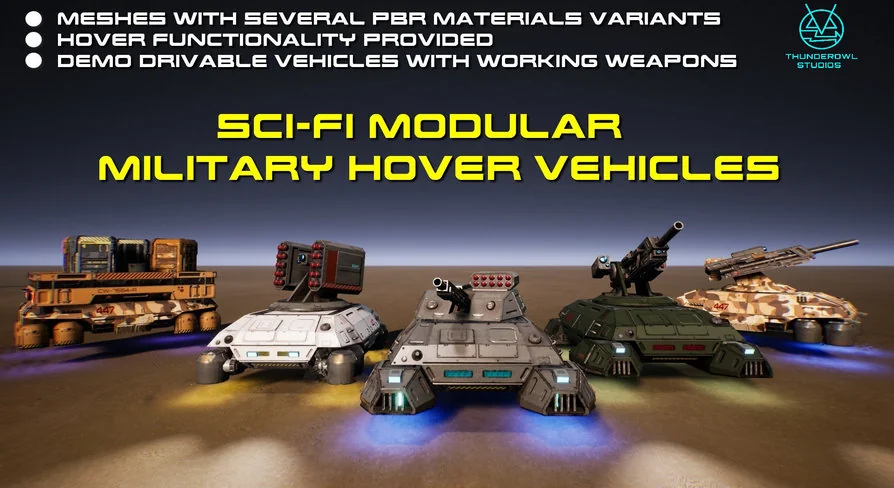
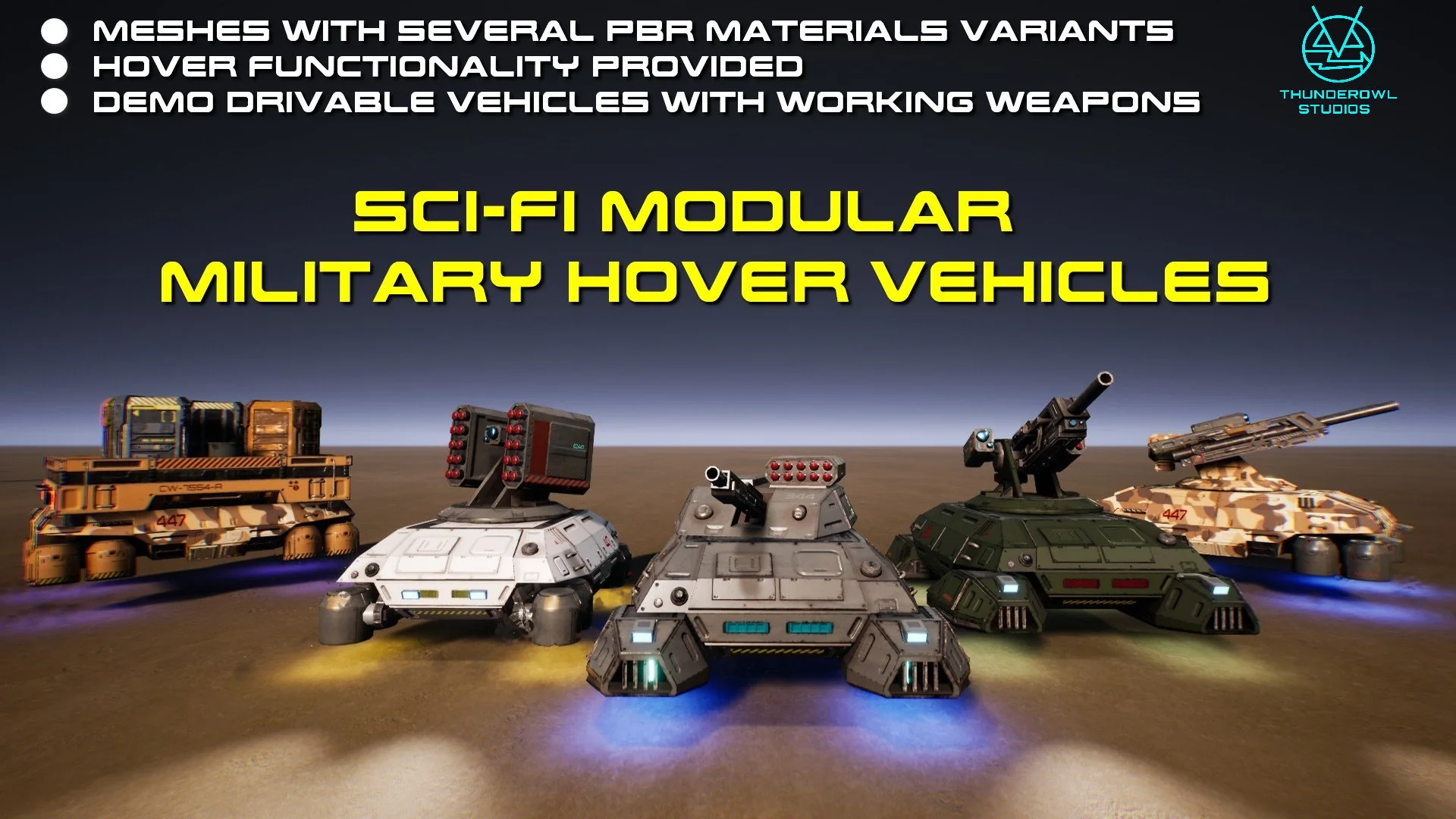
Futuristic military environments often demand distinct vehicle designs that can hover over uneven terrain without requiring complex skeletal mesh setups. Sci-Fi Modular Hover Vehicles addresses this mechanical balance by providing a static-mesh-driven construction kit paired with functional Blueprints. Instead of relying on traditional skeletal rigging, the kit uses modular static components to assemble hover tanks, mobile hover guns, radar surveillance units, missile launchers, and heavy cargo crafts. Because the framework avoids skeletal hierarchies, developers can detach, rearrange, or expand pieces without retargeting bones or re-weighting vertices.
Static Mesh Assembly of Sci-Fi Modular Units
Relying completely on static meshes shifts vehicle construction into a direct, socket- or attachment-driven workflow. Each hull, stabilizer, engine pod, and weapon mount functions as an independent component. This structural decision eliminates the overhead typically tied to vehicle animation Blueprints and physics asset collision physics suited to jointed tracks or wheeled chassis. Instead, components align cleanly in standard coordinate space, giving artists full control over the footprint and operational silhouette of each craft.
The system welcomes both in-house and third-party static meshes alongside the core asset parts. Integrating a proprietary scanner dome, an aftermarket energy turret, or supplemental armor plating requires no custom skinning. You place the additional geometry directly into the vehicle hierarchy, aligning it with the established hardpoints. This openness accommodates multiple military branches or factions within a single project, allowing visual differentiation simply by swapping weapons, radar dishes, or cargo containers across the shared hover chassis.
Blueprint Logic and Hover Component Mechanics
Although filed under the props category, the package contains behavioral Blueprints that bridge the gap between static level decoration and dynamic gameplay elements. At the core is a customizable hovering component that suspends the craft above surfaces, providing the visual sensation of anti-gravity repulsion without needing complex physical constraints. This hovering behavior is paired with basic particle systems specifically authored to generate hover thrust and thruster wash effects underneath the hulls.
Ambient scene life is supported through pre-configured movement scripts. Certain Blueprints feature automated circular pathing, allowing ambient or patrol vehicles to navigate circular patrol routes with exposed controls for travel speed and turning radius. Hardpoint mechanics match this automated movement: mounted weapons and turrets can auto-rotate to track surroundings or simulate active scanning sweeps. Supplementing these kinematics are configurable light systems that can be tuned for exterior running indicators, weapon charge lights, or spotlight illumination.
Piloting Vehicles Across the Demo Playground
To verify flight characteristics and interaction systems directly in the viewport, the asset provides ready-to-use testing spaces, led by the map named MAP_Demo_Playground. Rather than leaving developers to construct control logic from scratch, the asset supplies two fully pilotable hovercraft setups ready for testing input response. These test vehicles feature dedicated directional translation, turning rotation, and chassis tilting to convey the weight and maneuverability expected of futuristic repulsorcraft.
Combat interactions accompany the vehicle controls. The pilotable setups include responsive turret aiming tied directly to camera rotation, paired with active weapon discharge systems. Players can switch between two distinct camera perspectives to test pilot visibility, ranging from close tactical orientations to broader chase angles. A mouse Y-invert toggle is also implemented directly in the control options, letting testers adjust pitch input behavior without diving into editor project settings or rewriting control mapping nodes.
PBR Surface Pipeline and Fleet Roles
Visual fidelity across the vehicle fleet relies on dedicated PBR materials tuned for low-poly geometry. This surface workflow ensures panel lines, metallic plates, composite hull plating, and heat-treated exhaust ports react accurately to dynamic environmental lighting, baked skyboxes, and harsh directional sun sources. The low-poly budget makes the assets practical for filling large hangars, industrial starports, or tactical bases without incurring excessive render thread penalties.
The mesh combinations naturally fit distinct battlefield roles:
Frontline Combat: Armored hover tanks equipped with heavy direct-fire cannons.
Fire Support: Mobile hover guns and artillery platforms engineered for perimeter defense.
Tactical Reconnaissance: Rotating radar and electronic warfare arrays suited to sensor pickets.
Strategic Bombardment: Stand-off missile launchers positioned on medium hover hulls.
Battlefield Logistics: Flatbed and enclosed cargo crafts for hauling munitions or freight.
Expansion Trajectory for Sci-Fi Modular Fleets
The vehicle framework continues past its base functional hulls. Planned roadmap developments slated for the beginning of 2024 include alternate vehicle body versions to broaden the visual diversity of the fleet. These additional hulls will allow for varied structural silhouettes while maintaining compatibility with existing modular attachments, turrets, and thruster units.
Accompanying the new body frames are destroyed vehicle versions. Incorporating ruined, broken-down, and charred wreckage variations addresses combat feedback loops, giving artists dedicated assets for battlefield set dressing, mission objectives, and post-destruction actor swapping when a player or AI unit is neutralized in combat. For productions requiring futuristic ground-effect armor with low mechanical overhead, these static-mesh hovercraft provide immediate operational value right from the demo maps.
 Vehicles
 Vehicles
 Vehicles
 Vehicles