"a19e0535960bd083"{"id":"1002055","slug":"hover-car-system","title":"Hover Car System","category":"Vehicles \u0026 Transportation","engine":"4.26+,5.0+","assetVersion":"","engineVersion":"Engine Version: 4.26+,5.0+","tag":"Vehicles","accent":"blue","visual":"mech","summary":"Explore the Hover Car System for Unreal Engine, featuring physically based hover mechanics, custom mesh integration, spline navigation, and AI control.","platform":"Unreal Engine","publishedAt":"2026-10-26T15:12:29.161Z","updatedAt":"2026-10-26T15:12:29.161Z","sourceNotes":[],"fileContents":[],"compatibility":["Unreal Engine","Engine Version: 4.26+,5.0+"],"featuredImage":{"alt":"Hover Car System","src":"/wp-content/uploads/published/2026/10/c480e8076fba-a61929d4-3dbc-46da-8590-475583a1f0c8-1ccfca2074.webp"},"hasDownloadLink":true,"downloads":0,"terms":[{"taxonomy":"category","slug":"vehicles-and-transportation","name":"Vehicles \u0026 Transportation"}],"galleryImages":[{"src":"/wp-content/uploads/published/2026/10/5fc0d788a2f5-d107539c-006c-408b-8d8b-b1fea322cd47-bf2bee2926.webp","alt":"Hover Car System"},{"src":"/wp-content/uploads/published/2026/10/204991b5df06-9d2a05d8-45e0-445d-b7b7-ae2b982607b2-4af3853ca7.webp","alt":"Hover Car System"},{"src":"/wp-content/uploads/published/2026/10/9136dab87477-575efef9-6fe0-48c8-9d3d-1c2a1939a3a0-09fc8deb8e.webp","alt":"Hover Car System"}],"accessPanel":{"kind":"resource","title":"Download this resource","eyebrow":"Free Download","message":"Log in or create a free account to start your download.","fileName":"Hover Car System.7z","safetyNote":"Resources are manually reviewed before listing to improve quality and reduce obvious risks.","actionLabel":"Download Free","resourceType":"Resource archive"},"contentHtml":"\u003cp\u003eThe Hover Car System provides a dedicated Blueprint framework designed to handle physically based hovering vehicles, complete with an AI-Controller, a spline based navigation-system, and integrated mechanics for both solo and multiplayer gameplay. Instead of relying on traditional wheeled vehicle movement, the setup establishes a floating vehicle foundation that can be adapted to hovercars, flying craft, and hoverbikes while maintaining a clear balance between usability and runtime performance.\u003c/p\u003e \u003ch2\u003ePhysically Based Hovering Vehicle Architecture\u003c/h2\u003e\n\u003cp\u003eHover vehicles operate under fundamentally different physical constraints than standard wheeled or tracked actors. The Hover Car System uses a physically based approach to resolve vehicle balance, suspension, and aerial stabilization. By calculating movement and hovering forces dynamically, vehicles react naturally to uneven surfaces, elevation changes, and mid-air orientation shifts. This physical grounding prevents hovering movement from appearing rigid or purely translational, giving craft a convincing sense of momentum, weight, and inertia.\u003c/p\u003e\n\u003cp\u003eWhile dynamic physics systems can quickly become complex, this package prioritizes performance and straightforward implementation. The underlying Blueprint framework calculates hover behavior cleanly, ensuring the physical simulations can run across multiple active vehicle actors simultaneously. Whether driving a light hoverbike that hugs terrain tightly or maneuvering a heavier hovercar that drifts through wide turns, the physics framework supplies the foundational calculations required to keep the craft stable and responsive across different gameplay situations.\u003c/p\u003e \u003ch2\u003eCustom Mesh Integration for Cars and Hoverbikes\u003c/h2\u003e\n\u003cp\u003eA primary feature of the Hover Car System is the ability to easily incorporate custom 3D models into the vehicle pipeline. Creators are not restricted to placeholder geometry or predefined craft shapes. The system is designed to allow developers to replace default vehicle components with custom meshes, fitting their own creative aesthetic or project art style.\u003c/p\u003e\n\u003cp\u003eBecause the logic separates visual representation from the underlying hover physics calculations, adapting a new mesh requires minimal structural changes. Developers can import vehicles spanning a broad variety of silhouettes, such as:\u003c/p\u003e\n\u003cul\u003e \u003cli\u003eSleek, aerodynamic futuristic hovercars made for high-speed street courses.\u003c/li\u003e \u003cli\u003eAgile, lightweight hoverbikes intended for tight navigation and fast cornering.\u003c/li\u003e \u003cli\u003eHeavier, industrial flying transports or defensive patrol units.\u003c/li\u003e\n\u003c/ul\u003e\n\u003cp\u003eThis mesh flexibility makes the toolset practical across distinct artistic directions, providing a direct route from completed 3D concept asset to drivable physics actor without requiring manual recreation of vehicle suspension points or handling scripts.\u003c/p\u003e \u003ch2\u003eSpline Based Navigation System Workflows\u003c/h2\u003e\n\u003cp\u003eGuidance and pathway control represent a critical component of any vehicle setup, particularly when craft operate off the ground. The Hover Car System includes a dedicated spline based navigation-system tailored specifically to hovering movement. Splines provide an intuitive, visual way to define track boundaries, highway conduits, and automated flight paths throughout level geometry.\u003c/p\u003e\n\u003cp\u003eBecause hovering craft move smoothly through three-dimensional space, spline paths serve as reliable guides for elevation shifts, banked turns, and directional tracking. Designers can plot routes through urban corridors, across open landscape terrains, or along elevated race circuits. The spline framework handles spatial coordinate referencing, giving vehicles a continuous trajectory to follow or check against during movement routines. This makes the system equally useful for pre-planned visual sequences, automated circuit traffic, and structured competitive track boundaries.\u003c/p\u003e \u003ch2\u003eAutonomous Driving with the Included AI-Controller\u003c/h2\u003e\n\u003cp\u003eBeyond manual player input, vehicle projects frequently require non-player entities to navigate courses, participate in competitive events, or populate ambient scenes. The Hover Car System addresses this requirement by including a specialized AI-Controller built to interface directly with the vehicle physics and the spline based navigation-system.\u003c/p\u003e\n\u003cp\u003eSteering hovering vehicles via artificial intelligence requires handling momentum and drift, factors that do not apply to conventional grid-based ground navigation. The included AI-Controller interprets spline paths to govern steering angles, acceleration, and braking inputs automatically. This allows AI-driven hovercars and hoverbikes to traverse complex layouts without human intervention. Creators can deploy autonomous craft to act as rival racers on dedicated circuits, automated transit units moving along predefined routes, or moving patrol vehicles inside larger gameplay zones.\u003c/p\u003e \u003ch2\u003eMultiplayer Racing and Gameplay Scripting\u003c/h2\u003e\n\u003cp\u003eThe system is tagged and structured for multiplayer racing and general gameplay deployment, built as an accessible Blueprint script framework. In racing contexts, predictable yet responsive physics are essential for fair competition. The Hover Car System provides the core movement logic required to stage competitive flying and hover events, giving players granular control over high-speed maneuvers, corner drifting, and course navigation.\u003c/p\u003e\n\u003cp\u003eFor multiplayer applications, having clean script execution is essential. The focus on performance within the Blueprint logic ensures that position updates, vehicle interactions, and movement inputs function predictably within networked environments. Developers constructing competitive hovercraft titles or shared game worlds can build atop this baseline framework, adding custom scoring, lap tracking, or combat mechanics without having to author hover mechanics from scratch.\u003c/p\u003e \u003ch2\u003eUnreal Engine 5 Integration and System Performance\u003c/h2\u003e\n\u003cp\u003eThe Hover Car System is built to serve long-term production pipelines, supporting Unreal Engine 5.0 and subsequent engine versions. As projects transition to modern rendering engines and updated physics pipelines, having a vehicle framework tuned for current engine architecture prevents common performance bottlenecks associated with physics evaluation.\u003c/p\u003e\n\u003cp\u003eBy unifying physically based movement, custom mesh adaptability, AI spline routing, and multiplayer framework tags into a cohesive Blueprint package, the Hover Car System offers a practical toolkit for any scene requiring hovering or flying surface transport. It eliminates the overhead of engineering custom hover suspension scripts, allowing developers and technical artists to focus directly on visual vehicle design, track layouts, and gameplay iteration.\u003c/p\u003e\n\n\u003ch2\u003eRelated Resources Worth Checking\u003c/h2\u003e\n\u003cul\u003e\n\u003cli\u003e\u003ca href=\"https://3dcghub.com/military-truck-rigged-bp-controllable-military-truck-army-drivable-car-3d/\" title=\"Military Truck - Rigged/BP Controllable ( Military Truck Army Drivable Car 3D )\"\u003eMilitary Truck - Rigged/BP Controllable ( Military Truck Army Drivable Car 3D )\u003c/a\u003e\u003c/li\u003e\n\u003cli\u003e\u003ca href=\"https://3dcghub.com/vehicles-vol-2-retro-cars-low-poly/\" title=\"Vehicles VOL.2 - Retro Cars (Low Poly)\"\u003eVehicles VOL.2 - Retro Cars (Low Poly)\u003c/a\u003e\u003c/li\u003e\n\u003cli\u003e\u003ca href=\"https://3dcghub.com/drivable-retro-car-farton/\" title=\"Drivable retro car \u0026quot;Farton\u0026quot;\"\u003eDrivable retro car \u0026quot;Farton\u0026quot;\u003c/a\u003e\u003c/li\u003e\n\u003cli\u003e\u003ca href=\"https://3dcghub.com/driveable-steampunk-car-vehicle-steampunk-car-retro-futuristic-victorian/\" title=\"Driveable SteamPunk Car / Vehicle ( SteamPunk Car Retro Futuristic Victorian)\"\u003eDriveable SteamPunk Car / Vehicle ( SteamPunk Car Retro Futuristic Victorian)\u003c/a\u003e\u003c/li\u003e\n\u003cli\u003e\u003ca href=\"https://3dcghub.com/hoverbike-system/\" title=\"Hoverbike System\"\u003eHoverbike System\u003c/a\u003e\u003c/li\u003e\n\u003c/ul\u003e","contentTextLength":6908,"navigation":{"current":36,"total":4026,"previous":{"id":"1002056","slug":"hover-controller","title":"Hover Controller","category":"Vehicles \u0026 Transportation","platform":"Unreal Engine","updatedAt":"2026-10-26T15:13:04.821Z"},"next":{"id":"1002054","slug":"house-on-a-hill-house-houses-fantasy-house-stylized-house","title":"House On A Hill (House, Houses, Fantasy House, Stylized House)","category":"Towns \u0026 Villages","platform":"Unreal Engine","updatedAt":"2026-10-26T15:11:51.550Z"}},"relatedResources":[{"id":"1002056","slug":"hover-controller","title":"Hover Controller","category":"Vehicles \u0026 Transportation","engine":"4.26+,5.0+","assetVersion":"","engineVersion":"Engine Version: 4.26+,5.0+","tag":"Vehicles","accent":"blue","visual":"mech","summary":"A Blueprint actor component delivering drivable, replicated hovercraft mechanics, surface alignment, and Sticky Hover Mode for Unreal Engine projects.","platform":"Unreal Engine","publishedAt":"2026-10-26T15:13:04.821Z","updatedAt":"2026-10-26T15:13:04.821Z","sourceNotes":[],"fileContents":[],"compatibility":["Unreal Engine","Engine Version: 4.26+,5.0+"],"featuredImage":{"alt":"Hover Controller","src":"/wp-content/uploads/published/2026/10/511c31781f5f-cd2abea4-7cee-4888-b6f2-c764e1bb0d97-50be6d2a5b.webp"},"hasDownloadLink":true,"downloads":0},{"id":"5159","slug":"military-truck-rigged-bp-controllable-military-truck-army-drivable-car-3d","title":"Military Truck - Rigged/BP Controllable ( Military Truck Army Drivable Car 3D )","category":"Vehicles \u0026 Transportation","engine":"4.26+,5.0+","assetVersion":"Engine version: 4.26+,5.0+","engineVersion":"4.18","tag":"Vehicles","accent":"blue","visual":"mech","summary":"Enhance your project with a high-quality, drivable military truck for Unreal Engine. Featuring AAA visuals and a full Blueprint setup for easy integration.","platform":"Unreal Engine","publishedAt":"2026-02-14T17:58:00.000Z","updatedAt":"2026-04-19T15:57:00.000Z","sourceNotes":[],"fileContents":[],"compatibility":["Unreal Engine","Engine version: 4.26+,5.0+"],"featuredImage":{"alt":"Military Truck - Rigged/BP Controllable ( Military Truck Army Drivable Car 3D )","src":"https://3dcghub.com/wp-content/uploads/2026/02/2a08f5a0-548d-4b3c-80b8-341938a33ab3.webp"},"hasDownloadLink":true,"downloads":0},{"id":"1002081","slug":"replicated-drivable-rc-car-blueprint","title":"Replicated Drivable RC Car (Blueprint)","category":"Vehicles \u0026 Transportation","engine":"5.0+","assetVersion":"","engineVersion":"Engine Version: 5.0+","tag":"Vehicles","accent":"blue","visual":"mech","summary":"Explore the Replicated Drivable RC Car Blueprint, featuring fully rigged skeletal meshes, bone scale integrity, color material parameters, and VoIP support.","platform":"Unreal Engine","publishedAt":"2026-10-26T15:50:47.654Z","updatedAt":"2026-10-26T15:50:47.654Z","sourceNotes":[],"fileContents":[],"compatibility":["Unreal Engine","Engine Version: 5.0+"],"featuredImage":{"alt":"Replicated Drivable RC Car (Blueprint)","src":"/wp-content/uploads/published/2026/10/9812b44c9454-0b4bfd06-0230-4573-8df6-b954f12d503d-86b6a7726b.webp"},"hasDownloadLink":true,"downloads":0}]}
Vehicles
Hover Car System
Explore the Hover Car System for Unreal Engine, featuring physically based hover mechanics, custom mesh integration, spline navigation, and AI control.
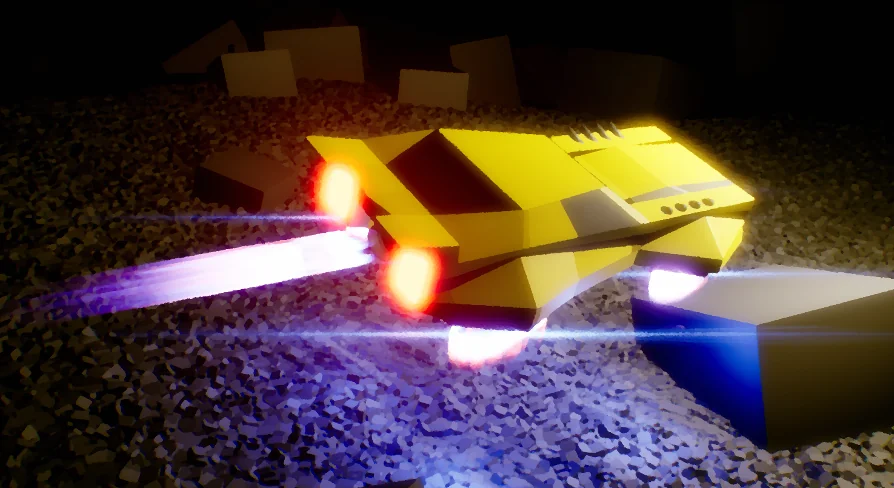
The Hover Car System provides a dedicated Blueprint framework designed to handle physically based hovering vehicles, complete with an AI-Controller, a spline based navigation-system, and integrated mechanics for both solo and multiplayer gameplay. Instead of relying on traditional wheeled vehicle movement, the setup establishes a floating vehicle foundation that can be adapted to hovercars, flying craft, and hoverbikes while maintaining a clear balance between usability and runtime performance.
Physically Based Hovering Vehicle Architecture
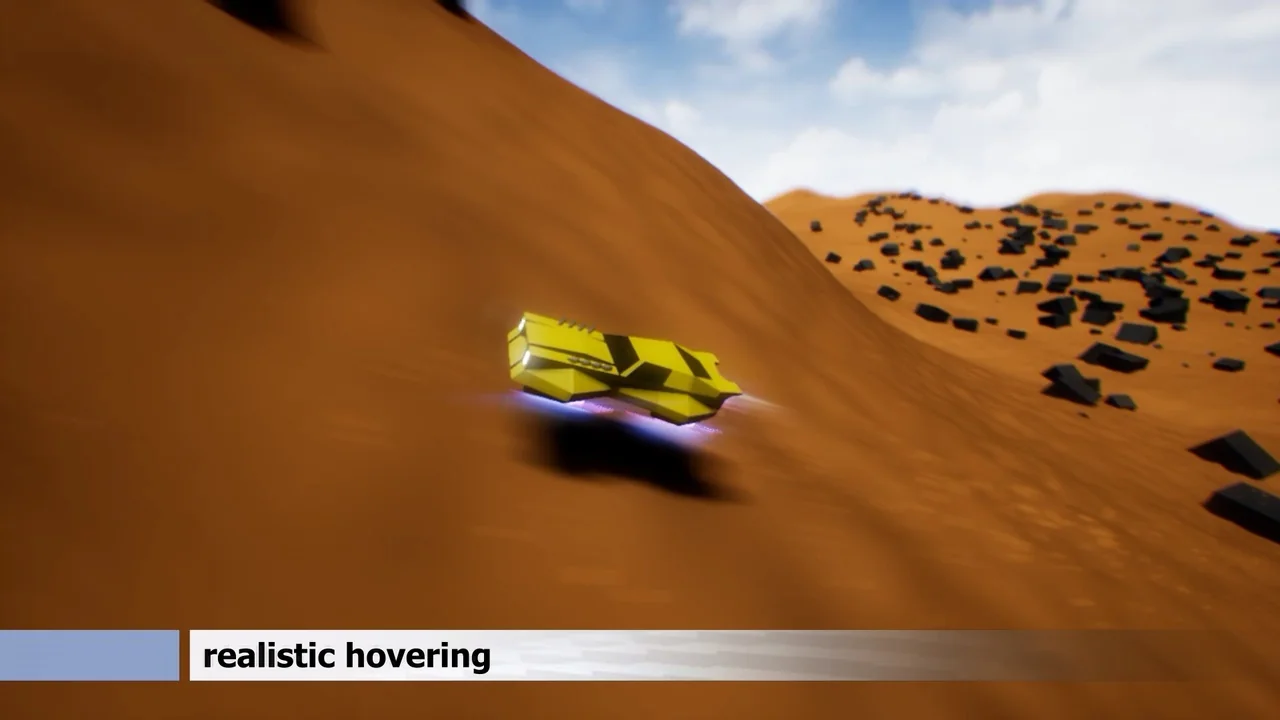
Hover vehicles operate under fundamentally different physical constraints than standard wheeled or tracked actors. The Hover Car System uses a physically based approach to resolve vehicle balance, suspension, and aerial stabilization. By calculating movement and hovering forces dynamically, vehicles react naturally to uneven surfaces, elevation changes, and mid-air orientation shifts. This physical grounding prevents hovering movement from appearing rigid or purely translational, giving craft a convincing sense of momentum, weight, and inertia.
While dynamic physics systems can quickly become complex, this package prioritizes performance and straightforward implementation. The underlying Blueprint framework calculates hover behavior cleanly, ensuring the physical simulations can run across multiple active vehicle actors simultaneously. Whether driving a light hoverbike that hugs terrain tightly or maneuvering a heavier hovercar that drifts through wide turns, the physics framework supplies the foundational calculations required to keep the craft stable and responsive across different gameplay situations.
Custom Mesh Integration for Cars and Hoverbikes
A primary feature of the Hover Car System is the ability to easily incorporate custom 3D models into the vehicle pipeline. Creators are not restricted to placeholder geometry or predefined craft shapes. The system is designed to allow developers to replace default vehicle components with custom meshes, fitting their own creative aesthetic or project art style.
Because the logic separates visual representation from the underlying hover physics calculations, adapting a new mesh requires minimal structural changes. Developers can import vehicles spanning a broad variety of silhouettes, such as:
Sleek, aerodynamic futuristic hovercars made for high-speed street courses.
Agile, lightweight hoverbikes intended for tight navigation and fast cornering.
Heavier, industrial flying transports or defensive patrol units.
This mesh flexibility makes the toolset practical across distinct artistic directions, providing a direct route from completed 3D concept asset to drivable physics actor without requiring manual recreation of vehicle suspension points or handling scripts.
Spline Based Navigation System Workflows
Guidance and pathway control represent a critical component of any vehicle setup, particularly when craft operate off the ground. The Hover Car System includes a dedicated spline based navigation-system tailored specifically to hovering movement. Splines provide an intuitive, visual way to define track boundaries, highway conduits, and automated flight paths throughout level geometry.
Because hovering craft move smoothly through three-dimensional space, spline paths serve as reliable guides for elevation shifts, banked turns, and directional tracking. Designers can plot routes through urban corridors, across open landscape terrains, or along elevated race circuits. The spline framework handles spatial coordinate referencing, giving vehicles a continuous trajectory to follow or check against during movement routines. This makes the system equally useful for pre-planned visual sequences, automated circuit traffic, and structured competitive track boundaries.
Autonomous Driving with the Included AI-Controller
Beyond manual player input, vehicle projects frequently require non-player entities to navigate courses, participate in competitive events, or populate ambient scenes. The Hover Car System addresses this requirement by including a specialized AI-Controller built to interface directly with the vehicle physics and the spline based navigation-system.
Steering hovering vehicles via artificial intelligence requires handling momentum and drift, factors that do not apply to conventional grid-based ground navigation. The included AI-Controller interprets spline paths to govern steering angles, acceleration, and braking inputs automatically. This allows AI-driven hovercars and hoverbikes to traverse complex layouts without human intervention. Creators can deploy autonomous craft to act as rival racers on dedicated circuits, automated transit units moving along predefined routes, or moving patrol vehicles inside larger gameplay zones.
Multiplayer Racing and Gameplay Scripting
The system is tagged and structured for multiplayer racing and general gameplay deployment, built as an accessible Blueprint script framework. In racing contexts, predictable yet responsive physics are essential for fair competition. The Hover Car System provides the core movement logic required to stage competitive flying and hover events, giving players granular control over high-speed maneuvers, corner drifting, and course navigation.
For multiplayer applications, having clean script execution is essential. The focus on performance within the Blueprint logic ensures that position updates, vehicle interactions, and movement inputs function predictably within networked environments. Developers constructing competitive hovercraft titles or shared game worlds can build atop this baseline framework, adding custom scoring, lap tracking, or combat mechanics without having to author hover mechanics from scratch.
Unreal Engine 5 Integration and System Performance
The Hover Car System is built to serve long-term production pipelines, supporting Unreal Engine 5.0 and subsequent engine versions. As projects transition to modern rendering engines and updated physics pipelines, having a vehicle framework tuned for current engine architecture prevents common performance bottlenecks associated with physics evaluation.
By unifying physically based movement, custom mesh adaptability, AI spline routing, and multiplayer framework tags into a cohesive Blueprint package, the Hover Car System offers a practical toolkit for any scene requiring hovering or flying surface transport. It eliminates the overhead of engineering custom hover suspension scripts, allowing developers and technical artists to focus directly on visual vehicle design, track layouts, and gameplay iteration.
 Vehicles
 Vehicles
 Vehicles
 Vehicles