"c14ff6bd758dadb1"{"id":"1001757","slug":"sci-fi-character-06-necromancer","title":"Sci-Fi Character 06 (Necromancer)","category":"Characters \u0026 Creatures","engine":"4.26+,5.0+","assetVersion":"","engineVersion":"Engine Version: 4.26+,5.0+","tag":"Characters","accent":"blue","visual":"character","summary":"Explore the mesh structure, APEX fabric simulation, Blueprint setup, and 56 creature animations included with Sci-Fi Character 06 (Necromancer).","platform":"Unreal Engine","publishedAt":"2026-10-20T03:02:03.751Z","updatedAt":"2026-10-20T03:02:03.751Z","sourceNotes":[],"fileContents":[],"compatibility":["Unreal Engine","Engine Version: 4.26+,5.0+"],"featuredImage":{"alt":"Sci-Fi Character 06 (Necromancer)","src":"/wp-content/uploads/published/2026/10/959abf120e1c-92ece96d-eb41-4d3a-9fea-c8c8f377b119-36343f6451.webp"},"hasDownloadLink":true,"downloads":0,"terms":[{"taxonomy":"category","slug":"characters-and-creatures","name":"Characters \u0026 Creatures"}],"galleryImages":[{"src":"/wp-content/uploads/published/2026/10/8ac63386f35f-0d0f70c1-1353-4244-9975-9b2eb2b6a3ad-bdf66e1315.webp","alt":"Sci-Fi Character 06 (Necromancer)"},{"src":"/wp-content/uploads/published/2026/10/46fb762e76cf-3d1c5bbf-e120-49dc-a664-c6707b2f0536-352fcec7e3.webp","alt":"Sci-Fi Character 06 (Necromancer)"},{"src":"/wp-content/uploads/published/2026/10/89aea8d0e21f-d0701094-7672-4c05-9f8b-8697510344dd-d60af53659.webp","alt":"Sci-Fi Character 06 (Necromancer)"},{"src":"/wp-content/uploads/published/2026/10/636ae64f6b84-57d9f521-12a2-4c40-b40e-15aafc3f05a4-c4461ac55a.webp","alt":"Sci-Fi Character 06 (Necromancer)"},{"src":"/wp-content/uploads/published/2026/10/d733761cd0b3-625a5413-54ef-4455-8e88-1292e063b1d9-cfa6e5215e.webp","alt":"Sci-Fi Character 06 (Necromancer)"},{"src":"/wp-content/uploads/published/2026/10/374d4efc0ad3-d8016e79-1ef4-47c6-ad7b-70bf5c13accb-0ef3287a30.webp","alt":"Sci-Fi Character 06 (Necromancer)"},{"src":"/wp-content/uploads/published/2026/10/9bc0f716ee10-8a57d872-296c-4e84-83ca-adf136920469-2ea53c8dae.webp","alt":"Sci-Fi Character 06 (Necromancer)"},{"src":"/wp-content/uploads/published/2026/10/a02372e42273-c535f0ad-37eb-40b2-a211-f14f0996631f-c38bb07288.webp","alt":"Sci-Fi Character 06 (Necromancer)"},{"src":"/wp-content/uploads/published/2026/10/49827c42e123-6a54c47f-53f2-4690-9ec4-6ab70fbca87d-ce7f841947.webp","alt":"Sci-Fi Character 06 (Necromancer)"}],"accessPanel":{"kind":"resource","title":"Download this resource","eyebrow":"Free Download","message":"Log in or create a free account to start your download.","fileName":"Content.7z","safetyNote":"Resources are manually reviewed before listing to improve quality and reduce obvious risks.","actionLabel":"Download Free","resourceType":"Resource archive"},"contentHtml":"\u003ch2\u003eFull Mesh and Split Body Parts Configuration\u003c/h2\u003e\n\u003cp\u003eSci-Fi Character 06 (Necromancer) supplies two distinct geometric workflows inside a real-time production pipeline: a single unified full mesh and an assembly of split body parts. In standard character rendering, a complete single-piece skeletal mesh minimizes draw calls and eliminates seam management issues along internal polygon borders. This full mesh acts as a drop-in asset when the character functions as an uncustomized enemy, an ambient encounter, or an isolated non-player entity.\u003c/p\u003e\n\u003cp\u003eOffering the model through separated body parts provides immediate utility for modular character systems. Segmented meshes allow developers to swap out limbs, replace specific armor pieces, or isolate components for gore, damage, and dismemberment systems common in horror and action RPG development. Separating the parts also allows dynamic occlusion culling of hidden geometry beneath armor plates or outer garments, reducing unnecessary rasterization overhead on low-poly meshes. Because both continuous and broken-down variants are provided, technical artists can deploy whichever structure suits the memory, customization, or rendering requirements of their scenes.\u003c/p\u003e \u003ch2\u003eAPEX Fabric Simulation and Dynamic Cloth Behavior\u003c/h2\u003e\n\u003cp\u003eIntegrated APEX fabric simulation governs the movement of flexible surfaces on the model. Rather than relying entirely on manual bone skinning or bake-heavy vertex animations for flowing garments, APEX simulation calculates the physics of cloth dynamically at runtime. This mechanic gives robes, cowls, or dangling vestments natural secondary motion that responds directly to environmental collisions, character speed, sudden turns, and external forces.\u003c/p\u003e\n\u003cp\u003eCloth simulation within real-time engines often presents challenges if collisions with underlying geometry penetrate the visual surface. The pre-configured APEX dynamic setup ensures that garments interact cleanly with the skeletal components beneath them, preserving visual realism without demanding hand-crafted physics assets from scratch. For a character combining sci-fi armor paneling with necromantic or fantasy drapery, dynamic cloth balances hard metallic surfaces against soft, reactive materials during heavy movement cycles.\u003c/p\u003e \u003ch2\u003eBlueprint Logic and Animation Blueprint Structure\u003c/h2\u003e\n\u003cp\u003eScript and Blueprint integrations handle the operational logic required to bring the necromancer into active gameplay. The asset incorporates dedicated Blueprint and Animation Blueprint networks that link player inputs, artificial intelligence states, and visual playback together. An Animation Blueprint standardizes how movement parameters transition from idle stances into active travel, directional turns, and special execution states.\u003c/p\u003e\n\u003cp\u003eHaving functional Blueprint and script connections already wired simplifies game implementation. The Animation Blueprint utilizes state machines and blend spaces to evaluate real-time values—such as character speed, direction, and combat status—and then select the matching animation frames. For technical gameplay designers, this pre-built script infrastructure serves as a functional foundation that connects character logic to health, damage detection, casting states, and mechanical behaviors without needing a rebuilt anim graph.\u003c/p\u003e \u003ch2\u003eMotion Delivery via 56 Creature Animations\u003c/h2\u003e\n\u003cp\u003eCompatibility with 56 animations built for creatures gives the necromancer a distinct movement profile. Humanoid animations often fail to convey the unnatural, mechanical, or corrupt demeanor required for horror and fantasy hybrids. By mapping the rig to creature motion sets, the character executes aggressive, stalking, crawling, or animalistic movements that break away from standard bipedal walks.\u003c/p\u003e\n\u003cp\u003eThis pool of 56 animations supports diverse behavioral patterns within RPG and action encounters. Whether an encounter demands distinct attacks, multi-directional locomotion, staggered reactions, recovery frames, or predatory idling, the creature-focused motion set equips the character with complete physical presence. The combination of creature animations with a model tagged across sci-fi, horror, and mech genres opens opportunities to depict possessed exosuits, bio-mechanical monstrosities, or ancient cybernetic horrors whose physiology operates far beyond standard humanoid balance.\u003c/p\u003e \u003ch2\u003eSci-Fi Necromancer Genre Fusion and Low-Poly PBR Architecture\u003c/h2\u003e\n\u003cp\u003eAs the sixth entry in the ongoing Sci-Fi series, the character sits directly at the intersection of technology and dark fantasy. The aesthetic bridges hard-edged sci-fi mech plating with ominous necromantic themes. Rendered using physically based rendering (PBR) workflows, the asset ensures that surface properties—such as metalness, roughness, and surface reflection—respond accurately under dynamic lighting engines, soft ambient occlusion, and sudden localized lighting events.\u003c/p\u003e\n\u003cp\u003eThe low-poly construction keeps geometry density within performance limits, allowing instances of the necromancer to run in crowded combat encounters, horde scenarios, or mobile targets without draining polygon budgets. The efficiency of low-poly geometry combined with high-fidelity PBR texturing maintains crisp visual definition across armored chassis sections, biological elements, and simulated fabrics. Sci-Fi Character 06 (Necromancer) arrives equipped to serve as a modular boss, robotic summoner, or dark fantasy antagonist, with functional physics, Blueprint logic, and dynamic motion ready for implementation.\u003c/p\u003e\n\n\u003ch2\u003eRelated Resources Worth Checking\u003c/h2\u003e\n\u003cul\u003e\n\u003cli\u003e\u003ca href=\"https://3dcghub.com/sci-fi-character-03-yakuza/\" title=\"Sci-Fi Character 03 (Yakuza)\"\u003eSci-Fi Character 03 (Yakuza)\u003c/a\u003e\u003c/li\u003e\n\u003cli\u003e\u003ca href=\"https://3dcghub.com/sci-fi-space-soldier-female/\" title=\"Sci Fi Space Soldier Female\"\u003eSci Fi Space Soldier Female\u003c/a\u003e\u003c/li\u003e\n\u003cli\u003e\u003ca href=\"https://3dcghub.com/sci-fi-heavy-bot/\" title=\"Sci Fi Heavy Bot\"\u003eSci Fi Heavy Bot\u003c/a\u003e\u003c/li\u003e\n\u003cli\u003e\u003ca href=\"https://3dcghub.com/special-forces-ski-fi-soldier/\" title=\"Special forces ski-fi soldier\"\u003eSpecial forces ski-fi soldier\u003c/a\u003e\u003c/li\u003e\n\u003cli\u003e\u003ca href=\"https://3dcghub.com/sci-fi-cyborg-03/\" title=\"Sci Fi Cyborg 03\"\u003eSci Fi Cyborg 03\u003c/a\u003e\u003c/li\u003e\n\u003c/ul\u003e","contentTextLength":5629,"navigation":{"current":26,"total":3719,"previous":{"id":"1001758","slug":"scifi-beast01-ghoul","title":"SciFi Beast01 Ghoul","category":"Characters \u0026 Creatures","platform":"Unreal Engine","updatedAt":"2026-10-20T03:03:08.345Z"},"next":{"id":"1001756","slug":"sci-fi-character-03-yakuza","title":"Sci-Fi Character 03 (Yakuza)","category":"Characters \u0026 Creatures","platform":"Unreal Engine","updatedAt":"2026-10-20T03:00:59.681Z"}},"relatedResources":[{"id":"1001756","slug":"sci-fi-character-03-yakuza","title":"Sci-Fi Character 03 (Yakuza)","category":"Characters \u0026 Creatures","engine":"4.26+,5.0+","assetVersion":"","engineVersion":"Engine Version: 4.26+,5.0+","tag":"Characters","accent":"blue","visual":"character","summary":"Examine Sci-Fi Character 03 (Yakuza), featuring full and split meshes, a huge sword, PBR textures, and compatibility with 56 creature animations.","platform":"Unreal Engine","publishedAt":"2026-10-20T03:00:59.681Z","updatedAt":"2026-10-20T03:00:59.681Z","sourceNotes":[],"fileContents":[],"compatibility":["Unreal Engine","Engine Version: 4.26+,5.0+"],"featuredImage":{"alt":"Sci-Fi Character 03 (Yakuza)","src":"/wp-content/uploads/published/2026/10/421f7f52f08a-e52ba41a-1877-41de-b707-a8f2702caed2-29b0020e53.webp"},"hasDownloadLink":true,"downloads":0},{"id":"1001659","slug":"sci-fi-space-soldier-female","title":"Sci Fi Space Soldier Female","category":"Characters \u0026 Creatures","engine":"4.16+,5.0+","assetVersion":"","engineVersion":"Engine Version: 4.16+,5.0+","tag":"Characters","accent":"blue","visual":"character","summary":"Sci Fi Space Soldier Female features 2 model versions, 2 LOD levels at 29K and 10K triangles, Epic skeleton rigging, and customizable multi-tone materials.","platform":"Unreal Engine","publishedAt":"2026-10-13T14:48:21.104Z","updatedAt":"2026-10-13T14:48:21.104Z","sourceNotes":[],"fileContents":[],"compatibility":["Unreal Engine","Engine Version: 4.16+,5.0+"],"featuredImage":{"alt":"Sci Fi Space Soldier Female","src":"/wp-content/uploads/published/2026/10/c9df1964c209-c1a5eaa9-4d71-4521-b647-674811bda59b-9cb1722b78.webp"},"hasDownloadLink":true,"downloads":0},{"id":"1001359","slug":"sci-fi-heavy-bot","title":"Sci Fi Heavy Bot","category":"Characters \u0026 Creatures","engine":"4.20+,5.0+","assetVersion":"","engineVersion":"Engine Version: 4.20+,5.0+","tag":"Characters","accent":"blue","visual":"character","summary":"Detailed technical analysis of the Sci Fi Heavy Bot, covering its 96k tris mesh, 4 LODs, custom chest-cam animation blueprint, and master materials.","platform":"Unreal Engine","publishedAt":"2026-10-04T10:28:57.469Z","updatedAt":"2026-10-04T10:28:57.469Z","sourceNotes":[],"fileContents":[],"compatibility":["Unreal Engine","Engine Version: 4.20+,5.0+"],"featuredImage":{"alt":"Sci Fi Heavy Bot","src":"/wp-content/uploads/published/2026/10/462460a0f91b-48d09a92-6278-4e17-a733-8f6587d4f7b8-972be6e73f.webp"},"hasDownloadLink":true,"downloads":0}]}
Characters
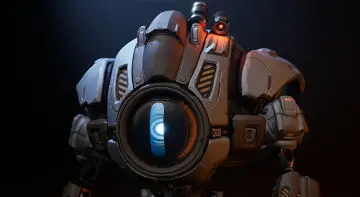
Sci-Fi Character 06 (Necromancer)
Explore the mesh structure, APEX fabric simulation, Blueprint setup, and 56 creature animations included with Sci-Fi Character 06 (Necromancer).
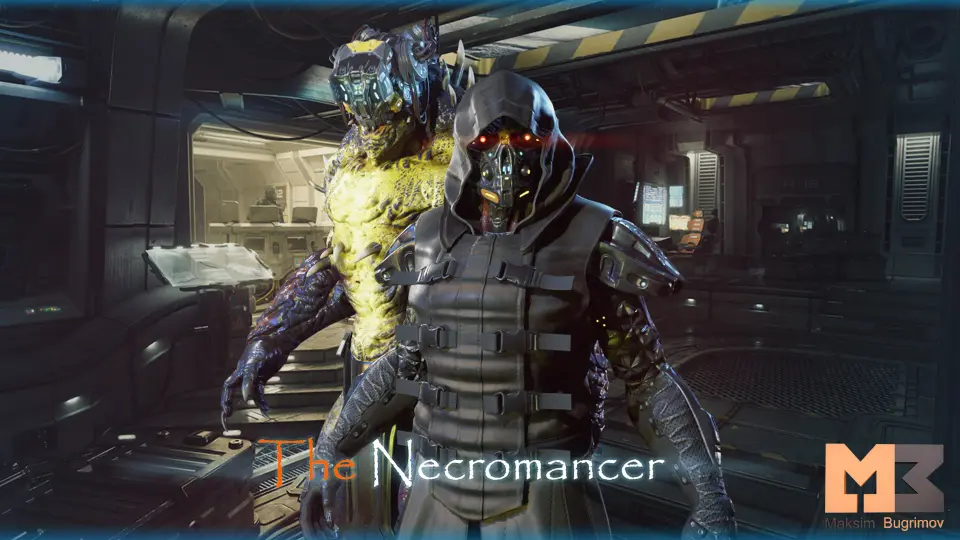
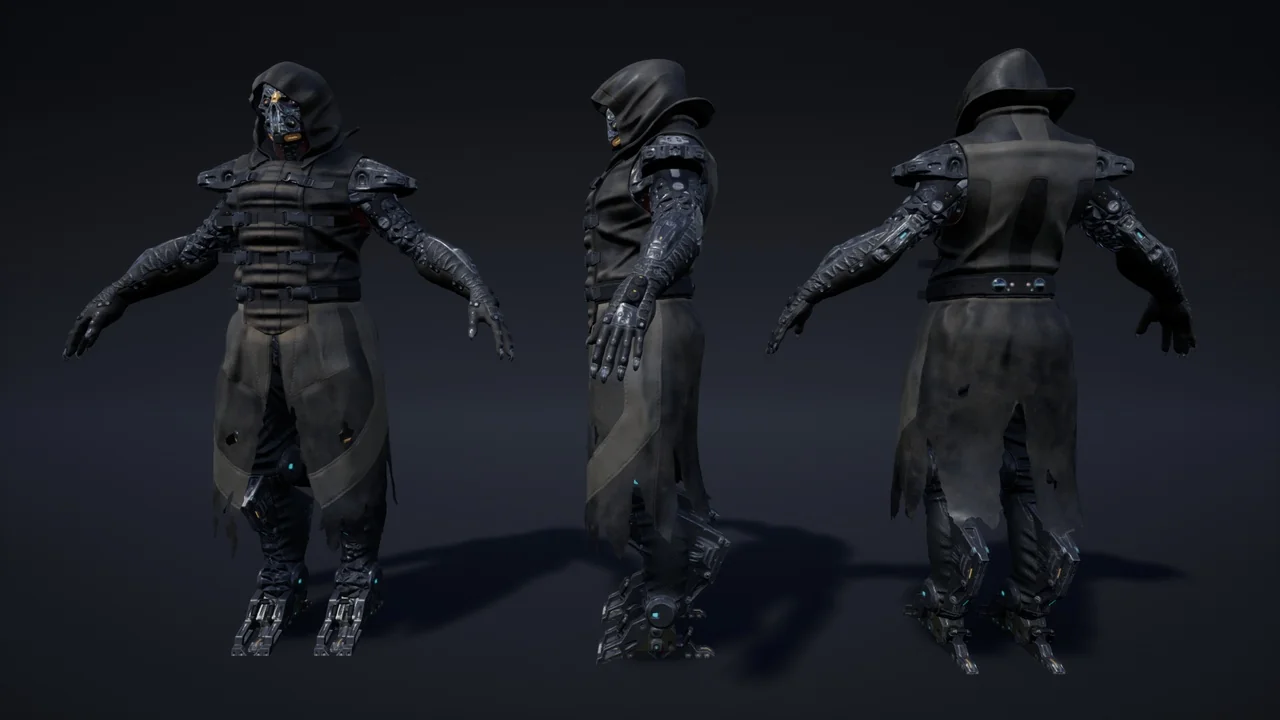
Sci-Fi Character 06 (Necromancer) supplies two distinct geometric workflows inside a real-time production pipeline: a single unified full mesh and an assembly of split body parts. In standard character rendering, a complete single-piece skeletal mesh minimizes draw calls and eliminates seam management issues along internal polygon borders. This full mesh acts as a drop-in asset when the character functions as an uncustomized enemy, an ambient encounter, or an isolated non-player entity.
Offering the model through separated body parts provides immediate utility for modular character systems. Segmented meshes allow developers to swap out limbs, replace specific armor pieces, or isolate components for gore, damage, and dismemberment systems common in horror and action RPG development. Separating the parts also allows dynamic occlusion culling of hidden geometry beneath armor plates or outer garments, reducing unnecessary rasterization overhead on low-poly meshes. Because both continuous and broken-down variants are provided, technical artists can deploy whichever structure suits the memory, customization, or rendering requirements of their scenes.
APEX Fabric Simulation and Dynamic Cloth Behavior
Integrated APEX fabric simulation governs the movement of flexible surfaces on the model. Rather than relying entirely on manual bone skinning or bake-heavy vertex animations for flowing garments, APEX simulation calculates the physics of cloth dynamically at runtime. This mechanic gives robes, cowls, or dangling vestments natural secondary motion that responds directly to environmental collisions, character speed, sudden turns, and external forces.
Cloth simulation within real-time engines often presents challenges if collisions with underlying geometry penetrate the visual surface. The pre-configured APEX dynamic setup ensures that garments interact cleanly with the skeletal components beneath them, preserving visual realism without demanding hand-crafted physics assets from scratch. For a character combining sci-fi armor paneling with necromantic or fantasy drapery, dynamic cloth balances hard metallic surfaces against soft, reactive materials during heavy movement cycles.
Blueprint Logic and Animation Blueprint Structure
Script and Blueprint integrations handle the operational logic required to bring the necromancer into active gameplay. The asset incorporates dedicated Blueprint and Animation Blueprint networks that link player inputs, artificial intelligence states, and visual playback together. An Animation Blueprint standardizes how movement parameters transition from idle stances into active travel, directional turns, and special execution states.
Having functional Blueprint and script connections already wired simplifies game implementation. The Animation Blueprint utilizes state machines and blend spaces to evaluate real-time values—such as character speed, direction, and combat status—and then select the matching animation frames. For technical gameplay designers, this pre-built script infrastructure serves as a functional foundation that connects character logic to health, damage detection, casting states, and mechanical behaviors without needing a rebuilt anim graph.
Motion Delivery via 56 Creature Animations
Compatibility with 56 animations built for creatures gives the necromancer a distinct movement profile. Humanoid animations often fail to convey the unnatural, mechanical, or corrupt demeanor required for horror and fantasy hybrids. By mapping the rig to creature motion sets, the character executes aggressive, stalking, crawling, or animalistic movements that break away from standard bipedal walks.
This pool of 56 animations supports diverse behavioral patterns within RPG and action encounters. Whether an encounter demands distinct attacks, multi-directional locomotion, staggered reactions, recovery frames, or predatory idling, the creature-focused motion set equips the character with complete physical presence. The combination of creature animations with a model tagged across sci-fi, horror, and mech genres opens opportunities to depict possessed exosuits, bio-mechanical monstrosities, or ancient cybernetic horrors whose physiology operates far beyond standard humanoid balance.
Sci-Fi Necromancer Genre Fusion and Low-Poly PBR Architecture
As the sixth entry in the ongoing Sci-Fi series, the character sits directly at the intersection of technology and dark fantasy. The aesthetic bridges hard-edged sci-fi mech plating with ominous necromantic themes. Rendered using physically based rendering (PBR) workflows, the asset ensures that surface properties—such as metalness, roughness, and surface reflection—respond accurately under dynamic lighting engines, soft ambient occlusion, and sudden localized lighting events.
The low-poly construction keeps geometry density within performance limits, allowing instances of the necromancer to run in crowded combat encounters, horde scenarios, or mobile targets without draining polygon budgets. The efficiency of low-poly geometry combined with high-fidelity PBR texturing maintains crisp visual definition across armored chassis sections, biological elements, and simulated fabrics. Sci-Fi Character 06 (Necromancer) arrives equipped to serve as a modular boss, robotic summoner, or dark fantasy antagonist, with functional physics, Blueprint logic, and dynamic motion ready for implementation.
 Characters
 Characters
 Characters
 Characters