"c68a05d5e51405b3"{"id":"1001110","slug":"rome-italian-town","title":"Rome - Italian Town","category":"Cities","engine":"5.2+","assetVersion":"","engineVersion":"Engine Version: 5.2+","tag":"Cities","accent":"blue","visual":"mech","summary":"Over 1,000 modular assets, restaurant interiors, and dynamic day/sunset/overcast lighting make Rome - Italian Town a real-time-ready environment kit for games,","platform":"Unreal Engine","publishedAt":"2026-09-07T11:06:22.302Z","updatedAt":"2026-09-07T11:06:22.302Z","sourceNotes":[],"fileContents":[],"compatibility":["Unreal Engine","Engine Version: 5.2+"],"featuredImage":{"alt":"Rome - Italian Town","src":"/wp-content/uploads/published/2026/09/3e1f1c023570-28e0e765-96f9-483e-82ca-545c71e7561d-b21dc5159d.webp"},"hasDownloadLink":true,"downloads":4,"terms":[{"taxonomy":"category","slug":"cities","name":"Cities"}],"galleryImages":[{"src":"/wp-content/uploads/published/2026/09/bb430e07f985-afd6944a-4351-4d5b-afbf-b53d9327725a-1edfbc22bf.webp","alt":"Rome - Italian Town"},{"src":"/wp-content/uploads/published/2026/09/e23929525ea6-2b9462b7-79c3-43ce-8201-8fbf3bf8f5ce-0c2a154ce5.webp","alt":"Rome - Italian Town"},{"src":"/wp-content/uploads/published/2026/09/0dfe689ea830-40cce758-8869-417b-afe2-b8ee68f988a6-2376f29946.webp","alt":"Rome - Italian Town"},{"src":"/wp-content/uploads/published/2026/09/9e5ed735b4af-a8614ffe-ff55-4bdf-b5e8-1793fb57aa51-8f6d85cc85.webp","alt":"Rome - Italian Town"},{"src":"/wp-content/uploads/published/2026/09/5d97cb570dfa-09482424-b8fb-40ff-a75a-13381506d9cf-63401d24e5.webp","alt":"Rome - Italian Town"},{"src":"/wp-content/uploads/published/2026/09/18708caa8c40-7151cfd4-e877-4112-bd08-d75003cf39c1-8ae62e0a8a.webp","alt":"Rome - Italian Town"},{"src":"/wp-content/uploads/published/2026/09/9289129b9222-7dc36f62-9dba-4ab3-853b-eb05892aecae-e87bd35c56.webp","alt":"Rome - Italian Town"},{"src":"/wp-content/uploads/published/2026/09/c507db5b99c1-bf4556b3-88f3-4589-92dc-f0c79bc0d904-d94bd967d9.webp","alt":"Rome - Italian Town"},{"src":"/wp-content/uploads/published/2026/09/47de09ae54fa-81041272-7957-443a-a7a2-4d109e07d1d3-45de77d7e6.webp","alt":"Rome - Italian Town"},{"src":"/wp-content/uploads/published/2026/09/418e7c2cb8e6-e6049efa-837c-4c9c-9622-7cd4e2d0bfb6-36a097e349.webp","alt":"Rome - Italian Town"}],"accessPanel":{"kind":"resource","title":"Download this resource","eyebrow":"Free Download","message":"Log in or create a free account to start your download.","fileName":"Content.7z","safetyNote":"Resources are manually reviewed before listing to improve quality and reduce obvious risks.","actionLabel":"Download Free","resourceType":"Resource archive"},"contentHtml":"\u003cp\u003eCobblestone streets, restaurant fronts with warm interiors, and classic scooters leaned against old walls. Rome - Italian Town starts with the kind of environment that often demands hours of separate modeling, texturing and dressing work. The difference is that this environment is built for real-time assembly: a modular city kit with more than a thousand assets is the backbone of the release. It does not stop at one beautiful facade or one hero building. Instead, the set is meant to turn a few city blocks into a walkable, shootable Italian setting.\u003c/p\u003e \u003cp\u003eThe package arrives with a production-oriented core already in place. Alongside the structural architecture are indoor restaurant and café spaces that extend the environment into interiors. There are building elevations, cobblestone streets, local urban structures, fountains and other park or street furniture. The asset list pushes past the usual exterior dressing and gives teams a consistent place where characters can dwell as well as pass through.\u003c/p\u003e \u003ch2\u003eMore than a thousand modular pieces for one believable street system\u003c/h2\u003e\n\u003cp\u003eCounting assets tells only part of the working story. City building needs pieces that do not fight each other visually when placed side by side or stacked along a walkable route. The overall content breakdown is structured around Italian architecture and urban texture: classic building fronts, pavement details and the small local details that make a block feel occupied rather than decorative. The inclusion of restaurant and café interiors is what separates this environment from a distant facade kit. A shot can begin on a narrow public street and step into a seating area without bailing out to a separate interior model.\u003c/p\u003e \u003cp\u003eLocal color is not limited to the architectural shell. Classic Italian scooters, charming restaurant entrances and other street-level items give cinemagraphic scenes something to frame. Their presence makes it easier to populate streets without importing mismatched props from other libraries. For modular city building, this shared visual language matters because every extra element—a balcony, a fountain, a signage-adjacent detail—has to coexist with the surrounding geometry.\u003c/p\u003e \u003ch2\u003eReal-time performance with headroom for production cameras\u003c/h2\u003e\n\u003cp\u003eInteractive environments live or die by framerate. The release reports 140 FPS at FULL HD on high scalability settings, measured on a hardware configuration with an RTX 4080, an AMD Ryzen 9, 64 GB RAM and an SSD. That number is not a guarantee for every workstation, but it offers a clear reference point for how far the environment can scale before optimization work becomes the main task. For games, virtual production and VR, that kind of headroom matters because the camera is always moving through dense urban exteriors and lit interiors. Audio, VFX and detailed technical documentation are also included as part of what the developer calls the Pro Workflow.\u003c/p\u003e \u003ch2\u003eThree lighting scenarios, plus night already delivered as an update\u003c/h2\u003e\n\u003cp\u003eLighting is one of the strongest selling points. The town ships with three dynamic scenarios: day, sunset and overcast/rain. Each change in weather or time repaints the same street geometry, giving the environment different production personas without rebuilding assets. The day scenario offers clear visibility and direct sunlight. The sunset scenario pushes the warm lighting that the product advertises, bringing out the texture of stone, wood and plaster. The overcast/rain scenario suits moodier work, where a street can feel quieter and more cinematic.\u003c/p\u003e \u003cp\u003eThe roadmap also shows that the package is not frozen after launch. Version 1.1 already added ten extra level instances, which expands the footage a production can use without rearranging the city from scratch. Version 1.2 followed with a new night lighting scenario, meaning a full night look exists even though the base package originated with three daytime-driven moods. The planned v1.3 update is an indoor gelato setup, the next step toward deepening the interior experience. That forward motion is useful for ongoing projects; the environment becomes a foundation that grows.\u003c/p\u003e \u003ch2\u003eWhere this environment fits inside a production workflow\u003c/h2\u003e\n\u003cp\u003eThe set seems tailored to projects that need an immediate Italian urban backdrop but also require interactive movement. Game teams can drop players into a narrow street and let them discover restaurants from the outside before entering a café. Virtual production needs a real-time backdrop that can react to camera moves and lighting changes; multiple lighting scenarios plus a night setting make it possible to switch scenes within the same set. VR work benefits from an environment where interiors and exteriors are both present, supporting a walkable route rather than a digital facade. For architectural visualization, the presence of indoor restaurant and café spaces means the design can be presented as a lived-in spatial experience, not only an extruded building mass.\u003c/p\u003e \u003cp\u003eThe quality of the models and the warm lighting are not just aesthetic virtues. In all effects, sounds and level instances counted, more than one thousand assets form the basis of a daily production kit. Preview flythrough and walkthrough videos confirm that the town behaves well when the camera is actually moving through it. Teams that need authentic, extended Italian city scenes can treat this environment as a city-starting point, then use its included level instances and lighting flexibility to shape their own sequences.\u003c/p\u003e \u003cp\u003eFor projects that cannot spend months building a full Roman or Italian town from blank geometry, this release offers a denser starting line. It has the repeated architecture and street dressing required to convince viewers, and it can support game logic, virtual cameras and architectural concepts at the same time. The package then offers a package strong enough to be used as a location on its own and flexible enough to become part of a bigger environment pipeline.\u003c/p\u003e\n\n\u003ch2\u003eMore From The Same Workflow\u003c/h2\u003e\n\u003cul\u003e\n\u003cli\u003e\u003ca href=\"https://3dcghub.com/signage-vol-2-town-and-city-nanite-and-low-poly/\" title=\"Signage VOL.2 - Town and City (Nanite and Low Poly)\"\u003eSignage VOL.2 - Town and City (Nanite and Low Poly)\u003c/a\u003e\u003c/li\u003e\n\u003cli\u003e\u003ca href=\"https://3dcghub.com/venice-italian-city/\" title=\"Venice - Italian City\"\u003eVenice - Italian City\u003c/a\u003e\u003c/li\u003e\n\u003cli\u003e\u003ca href=\"https://3dcghub.com/a-futuristic-city-lake-town/\" title=\"A Futuristic City - LAKE TOWN\"\u003eA Futuristic City - LAKE TOWN\u003c/a\u003e\u003c/li\u003e\n\u003cli\u003e\u003ca href=\"https://3dcghub.com/italian-alley-environment-italian-alley-house-building-italian-house-alley/\" title=\"Italian Alley Environment ( Italian Alley House Building Italian House Alley )\"\u003eItalian Alley Environment ( Italian Alley House Building Italian House Alley )\u003c/a\u003e\u003c/li\u003e\n\u003cli\u003e\u003ca href=\"https://3dcghub.com/stylized-italian-town-village-italian-town-stylized-italian-village-stylised/\" title=\"Stylized Italian Town ( Village Italian Town Stylized Italian Village Stylised )\"\u003eStylized Italian Town ( Village Italian Town Stylized Italian Village Stylised )\u003c/a\u003e\u003c/li\u003e\n\u003c/ul\u003e","contentTextLength":6241,"navigation":{"current":865,"total":3860,"previous":{"id":"1001111","slug":"post-apocalypse-city-2","title":"Post Apocalypse City","category":"Cities","platform":"Unreal Engine","updatedAt":"2026-09-07T11:32:13.364Z"},"next":{"id":"1001109","slug":"modular-subway-tunnels","title":"Modular Subway Tunnels","category":"Industrial","platform":"Unreal Engine","updatedAt":"2026-09-07T07:50:51.958Z"}},"relatedResources":[{"id":"27752","slug":"venice-italian-city","title":"Venice - Italian City","category":"Cities","engine":"5.4+","assetVersion":"Engine version: 5.4+","engineVersion":"","tag":"Cities","accent":"blue","visual":"city","summary":"Venice - Italian City focuses on the kinds of scenes that need canals, stone bridges, narrow streets, courtyards, cafés, and historic squares in one cohesive setting. It combines a detailed production-ready core with modular expansion potential, varied ligh...","platform":"Unreal Engine","publishedAt":"2026-04-28T17:14:53.000Z","updatedAt":"2026-04-28T17:14:54.000Z","sourceNotes":[],"fileContents":[],"compatibility":["Unreal Engine","Engine version: 5.4+"],"featuredImage":{"alt":"Venice - Italian City","src":"https://3dcghub.com/wp-content/uploads/2026/04/ba31257f45d5_b73e861b-d58e-453c-9fba-29ea3529e247.webp"},"hasDownloadLink":true,"downloads":3},{"id":"1000024","slug":"signage-vol-2-town-and-city-nanite-and-low-poly","title":"Signage VOL.2 - Town and City (Nanite and Low Poly)","category":"Cities","engine":"5.1+","assetVersion":"","engineVersion":"5.1+","tag":"Cities","accent":"blue","visual":"city","summary":"A city signage collection for Unreal Engine with 230 meshes, Nanite and low poly versions, 4K textures, tint controls, and Lumen support.","platform":"Unreal Engine","publishedAt":"2026-05-20T12:08:20.801Z","updatedAt":"2026-05-20T12:08:20.801Z","sourceNotes":[],"fileContents":[],"compatibility":["Unreal Engine","Engine version: 5.1+"],"featuredImage":{"alt":"Signage VOL.2 - Town and City (Nanite and Low Poly)","src":"/wp-content/uploads/published/2026/05/5dae48205fe5-4cfef502-1be5-4a89-bab8-b50cc0a5fc66-d5fee08561.webp"},"hasDownloadLink":true,"downloads":0},{"id":"7001","slug":"a-futuristic-city-lake-town","title":"A Futuristic City - LAKE TOWN","category":"Cities","engine":"5.3+","assetVersion":"Engine version: 5.3+","engineVersion":"5.1","tag":"Cities","accent":"blue","visual":"city","summary":"Transform your project with A Futuristic City - LAKE TOWN, a comprehensive urban environment featuring realistic PBR textures and animated structures.","platform":"Unreal Engine","publishedAt":"2026-02-20T16:35:07.000Z","updatedAt":"2026-04-19T15:56:04.000Z","sourceNotes":[],"fileContents":[],"compatibility":["Unreal Engine","Engine version: 5.3+"],"featuredImage":{"alt":"A Futuristic City - LAKE TOWN","src":"https://3dcghub.com/wp-content/uploads/2026/02/17422937-7f0e-4494-991b-e97abafc44b2.webp"},"hasDownloadLink":true,"downloads":1}]}
Cities
Rome - Italian Town
Over 1,000 modular assets, restaurant interiors, and dynamic day/sunset/overcast lighting make Rome - Italian Town a real-time-ready environment kit for games,
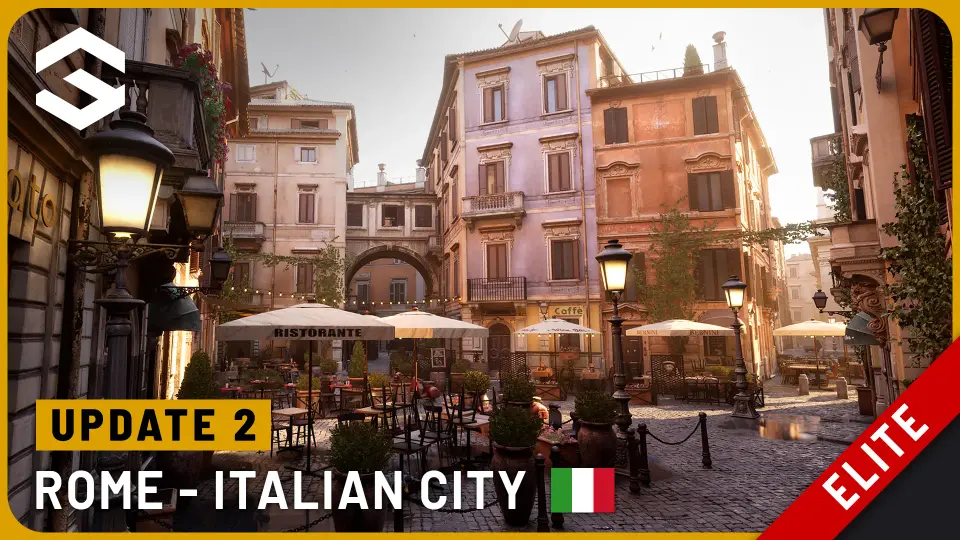
Cobblestone streets, restaurant fronts with warm interiors, and classic scooters leaned against old walls. Rome - Italian Town starts with the kind of environment that often demands hours of separate modeling, texturing and dressing work. The difference is that this environment is built for real-time assembly: a modular city kit with more than a thousand assets is the backbone of the release. It does not stop at one beautiful facade or one hero building. Instead, the set is meant to turn a few city blocks into a walkable, shootable Italian setting.
The package arrives with a production-oriented core already in place. Alongside the structural architecture are indoor restaurant and café spaces that extend the environment into interiors. There are building elevations, cobblestone streets, local urban structures, fountains and other park or street furniture. The asset list pushes past the usual exterior dressing and gives teams a consistent place where characters can dwell as well as pass through.
More than a thousand modular pieces for one believable street system
Counting assets tells only part of the working story. City building needs pieces that do not fight each other visually when placed side by side or stacked along a walkable route. The overall content breakdown is structured around Italian architecture and urban texture: classic building fronts, pavement details and the small local details that make a block feel occupied rather than decorative. The inclusion of restaurant and café interiors is what separates this environment from a distant facade kit. A shot can begin on a narrow public street and step into a seating area without bailing out to a separate interior model.
Local color is not limited to the architectural shell. Classic Italian scooters, charming restaurant entrances and other street-level items give cinemagraphic scenes something to frame. Their presence makes it easier to populate streets without importing mismatched props from other libraries. For modular city building, this shared visual language matters because every extra element—a balcony, a fountain, a signage-adjacent detail—has to coexist with the surrounding geometry.
Real-time performance with headroom for production cameras
Interactive environments live or die by framerate. The release reports 140 FPS at FULL HD on high scalability settings, measured on a hardware configuration with an RTX 4080, an AMD Ryzen 9, 64 GB RAM and an SSD. That number is not a guarantee for every workstation, but it offers a clear reference point for how far the environment can scale before optimization work becomes the main task. For games, virtual production and VR, that kind of headroom matters because the camera is always moving through dense urban exteriors and lit interiors. Audio, VFX and detailed technical documentation are also included as part of what the developer calls the Pro Workflow.
Three lighting scenarios, plus night already delivered as an update
Lighting is one of the strongest selling points. The town ships with three dynamic scenarios: day, sunset and overcast/rain. Each change in weather or time repaints the same street geometry, giving the environment different production personas without rebuilding assets. The day scenario offers clear visibility and direct sunlight. The sunset scenario pushes the warm lighting that the product advertises, bringing out the texture of stone, wood and plaster. The overcast/rain scenario suits moodier work, where a street can feel quieter and more cinematic.
The roadmap also shows that the package is not frozen after launch. Version 1.1 already added ten extra level instances, which expands the footage a production can use without rearranging the city from scratch. Version 1.2 followed with a new night lighting scenario, meaning a full night look exists even though the base package originated with three daytime-driven moods. The planned v1.3 update is an indoor gelato setup, the next step toward deepening the interior experience. That forward motion is useful for ongoing projects; the environment becomes a foundation that grows.
Where this environment fits inside a production workflow
The set seems tailored to projects that need an immediate Italian urban backdrop but also require interactive movement. Game teams can drop players into a narrow street and let them discover restaurants from the outside before entering a café. Virtual production needs a real-time backdrop that can react to camera moves and lighting changes; multiple lighting scenarios plus a night setting make it possible to switch scenes within the same set. VR work benefits from an environment where interiors and exteriors are both present, supporting a walkable route rather than a digital facade. For architectural visualization, the presence of indoor restaurant and café spaces means the design can be presented as a lived-in spatial experience, not only an extruded building mass.
The quality of the models and the warm lighting are not just aesthetic virtues. In all effects, sounds and level instances counted, more than one thousand assets form the basis of a daily production kit. Preview flythrough and walkthrough videos confirm that the town behaves well when the camera is actually moving through it. Teams that need authentic, extended Italian city scenes can treat this environment as a city-starting point, then use its included level instances and lighting flexibility to shape their own sequences.
For projects that cannot spend months building a full Roman or Italian town from blank geometry, this release offers a denser starting line. It has the repeated architecture and street dressing required to convince viewers, and it can support game logic, virtual cameras and architectural concepts at the same time. The package then offers a package strong enough to be used as a location on its own and flexible enough to become part of a bigger environment pipeline.
 Cities
 Cities
 Cities
 Cities