"a5ffaf404b9c2b7e"{"id":"1002639","slug":"rog-modular-medieval-accessories-and-robes","title":"ROG Modular Medieval Accessories and Robes","category":"Clothing","engine":"5.0+","assetVersion":"","engineVersion":"Engine Version: 5.0+","tag":"Clothing","accent":"blue","visual":"mech","summary":"Modular accessories, cloaks, and robes built for realistic medieval dark fantasy, featuring extensive equipment variants, WPO hiding, and multi-rig support.","platform":"Unreal Engine","indexPolicy":"index","publishedAt":"2026-11-15T06:26:45.302Z","updatedAt":"2026-11-15T06:26:45.302Z","sourceNotes":[],"fileContents":[],"compatibility":["Unreal Engine","Engine Version: 5.0+"],"featuredImage":{"alt":"ROG Modular Medieval Accessories and Robes","src":"/wp-content/uploads/published/2026/11/69a96f633207-8c457b95-a3c3-4871-82b8-c2c924a0260b-420c65dbfa.webp"},"hasDownloadLink":true,"downloads":0,"terms":[{"taxonomy":"category","slug":"clothing","name":"Clothing"}],"galleryImages":[{"src":"/wp-content/uploads/published/2026/11/f759de2ac049-522fe5bb-c81d-4442-9881-ed38f2606770-de1886a149.webp","alt":"ROG Modular Medieval Accessories and Robes"},{"src":"/wp-content/uploads/published/2026/11/be2e76ca709c-745d6513-8951-489f-9ea0-b343ada066c3-986ccfa08d.webp","alt":"ROG Modular Medieval Accessories and Robes"},{"src":"/wp-content/uploads/published/2026/11/8cfd6161f720-3a5f3ab5-1b95-4301-82c9-fedfb2517a4c-f144634a7c.webp","alt":"ROG Modular Medieval Accessories and Robes"},{"src":"/wp-content/uploads/published/2026/11/5dfebd5bb6bc-c7f16833-547b-41e9-83b4-a6f27dd258e0-b1d26e4df5.webp","alt":"ROG Modular Medieval Accessories and Robes"},{"src":"/wp-content/uploads/published/2026/11/1a5e4431368e-36a75e37-6d4c-40e2-acae-095109095d05-5dddc46e41.webp","alt":"ROG Modular Medieval Accessories and Robes"},{"src":"/wp-content/uploads/published/2026/11/3be913f13568-155a0fb5-befa-47a0-a65a-f8a5f41d6c21-0bd1ca4681.webp","alt":"ROG Modular Medieval Accessories and Robes"},{"src":"/wp-content/uploads/published/2026/11/de82c39b2e47-aa4ff067-4ba7-4163-b15c-50269e33aa2d-af3a458524.webp","alt":"ROG Modular Medieval Accessories and Robes"},{"src":"/wp-content/uploads/published/2026/11/642e664c122e-b55aa1c3-7abb-4be8-80c9-2379b1f565e3-15dfcbf87d.webp","alt":"ROG Modular Medieval Accessories and Robes"},{"src":"/wp-content/uploads/published/2026/11/80608b3f2a6b-82a3084f-6521-4d0b-a8e7-9264380100f7-2f1f385e1e.webp","alt":"ROG Modular Medieval Accessories and Robes"},{"src":"/wp-content/uploads/published/2026/11/b45e33c30b5e-c6dc212c-60b5-4062-9177-71ca3f01ae2d-d724b43f82.webp","alt":"ROG Modular Medieval Accessories and Robes"}],"accessPanel":{"kind":"resource","title":"Get this resource","eyebrow":"Free resource","message":"Download this resource in your browser.","fileName":"Content.7z","safetyNote":"Resources are manually reviewed before listing to improve quality and reduce obvious risks.","actionLabel":"Get this resource","resourceType":"Resource archive","versions":[]},"contentHtml":"\u003cp\u003eHeavy wool cloaks drape across pauldrons, flowing fabric responds to physical movement, and detailed heraldic emblems mark allegiance across the battlefield. Originally constructed for the dark magical, realistic medieval world of Reign of Guilds, the ROG Modular Medieval Accessories and Robes collection provides a structured visual layer that bridges pure plate armor with flexible clothing. Rather than treating garments as static, full-body replacements, the system focuses on modular items that snap over existing armors or layer neatly beneath outerwear, expanding how individual character silhouettes are constructed across fantasy roleplaying projects.\u003c/p\u003e \u003ch2\u003eModular Layering for Dark Medieval Settings\u003c/h2\u003e \u003cp\u003eCharacters operating in harsh, low-fantasy, or magical combat settings require visual distinction that reflects both functional defense and personal standing. The collection approaches this balance by allowing players or developers to layer a flowing cloak directly over an outfit chosen from a clothing wardrobe, or to supplement base armor sets with designated modular components like matching pauldrons, articulated gloves, and fitted forearm bracers. The aesthetic grounds itself firmly in historical weight while retaining room for ominous, magical stylings, including decorative necromancer pieces adorned with skeletal parts sourced from Necro's Bone Box.\u003c/p\u003e \u003cp\u003eBecause these garments are intended to operate within an active roleplaying framework, they accommodate both high-status regalia and utilitarian field gear. A character can wear bare leather protection or combine extensive plate sets with heraldry-laden cloaks that establish faction loyalty. The visual balance is calibrated for settings where steel meets sorcery, ensuring that heavy fabrics, thick fur trims, and metal fastenings read convincingly side by side in varying lighting conditions.\u003c/p\u003e \u003ch2\u003eRobes, Cloaks, and Equipment Breakdown in v6.1\u003c/h2\u003e \u003cp\u003eThrough iterative updates culminating in version 6.1, the collection has expanded to house 169 equipment items in total, distributed between 164 pieces in the primary catalog and five demo armor pieces intended for immediate scene testing. The modular garment catalog encompasses a broad spectrum of armor weights and fabric cuts:\u003c/p\u003e \u003cul\u003e \u003cli\u003e\u003cstrong\u003eCloaks:\u003c/strong\u003e 36 distinct cloak variants, ranging from standard traveling wraps to a heavy brown mammoth fur cloak that emphasizes cold-weather resilience and commanding status.\u003c/li\u003e \u003cli\u003e\u003cstrong\u003eRobes:\u003c/strong\u003e 32 robe variants tailored to match different caster archetypes, martial monastic orders, and layered traveler looks.\u003c/li\u003e \u003cli\u003e\u003cstrong\u003eShoulders:\u003c/strong\u003e 52 shoulder piece variants designed to mount cleanly over underlying garments or complement exposed mail.\u003c/li\u003e \u003cli\u003e\u003cstrong\u003eGloves:\u003c/strong\u003e 33 glove variants that accommodate distinct material weights, from flexible leather to reinforced protection.\u003c/li\u003e \u003cli\u003e\u003cstrong\u003eBracers:\u003c/strong\u003e 11 bracer pairs exported as separate left and right Skeletal Meshes, granting individual control over asymmetrical arm configurations.\u003c/li\u003e \u003cli\u003e\u003cstrong\u003eHeraldic Designs:\u003c/strong\u003e 26 distinct heraldic patterns supported by a dedicated gallery display asset to showcase emblems directly within engine setups.\u003c/li\u003e\n\u003c/ul\u003e \u003cp\u003eThe addition of 16 robe appearances and 10 cloak cuts in the 6.1 update significantly increases the visual breadth available for spellcaster and rogue archetypes. Each piece adheres to the modular division, allowing developers to keep character art organized across inventory logic and dynamic equipment swaps.\u003c/p\u003e \u003ch2\u003eAccessories Fitting Across Character Rigs\u003c/h2\u003e \u003cp\u003eManaging equipment across disparate character architectures frequently introduces weight-painting discrepancies and skeleton incompatibilities. The ROG system accounts for several widely adopted character rigs directly. Out of the box, compatibility includes the standard Epic Unreal Engine 5 Manny and Quinn skeletons, ensuring immediate drop-in functionality for modern default Unreal pipelines.\u003c/p\u003e \u003cp\u003eSupport extends beyond default engine rigs into specialized character systems. The package supports CodeSpartan Male and Female setups, taking into account both the original and revised female skeleton iterations. Furthermore, the assets include dedicated fittings for the Character Customizer system, providing male and female adjustments for both the original CC skeleton configuration and standard CCMH body meshes. For projects utilizing legacy setups, UE4 Mannequin fits and UCCS fittings are accessible when working in Unreal Engine 5.0. This multi-rig baseline reduces the burden of manual retargeting and refitting when transitioning equipment across diverse NPC populations or customizable player avatars.\u003c/p\u003e \u003ch2\u003eCloth Simulation, Clearance, and Technical Integration\u003c/h2\u003e \u003cp\u003eDraping multiple skeletal meshes over one another creates mechanical challenges, especially when thick textiles interact with rigid armor plates. In this package, selected cloaks and robes come equipped with cloth simulation to produce authentic kinetic draping during sprints, combat swings, and ambient wind exposure. Because physical simulation relies on clear boundary boundaries, integration requires attention to spatial tolerances. Developers must monitor clearance between simulated cloaks and particularly bulky shoulder armor to avoid unwanted intersecting geometry during exaggerated animation states. Similarly, sleeve apertures on robes need deliberate alignment against bulkier gloves and forearm bracers to maintain clean borders at the wrist joints.\u003c/p\u003e \u003cp\u003eTo eliminate interior mesh clipping beneath outer clothing layers without requiring destructive geometry deletes, World Position Offset body hiding is established as the default method in the demo project. Coupled with Render Priority settings, WPO body hiding tucks or suppresses unseen limbs and torso sections under garments while preserving the underlying character mesh intact for subsequent armor un-equipping. While the included demo levels deploy simplified body forms to demonstrate this behavior, production implementations integrating complete third-party character bodies or bespoke custom proportions may require minor refitting adjustments to achieve exact seam alignment.\u003c/p\u003e \u003ch2\u003ePractical Workflows for Equipment Pipelines\u003c/h2\u003e \u003cp\u003eApplying this equipment library within an active game loop centers on standard modular best practices. The separation of left and right forearm meshes into individual skeletal assets facilitates asymmetrical equipment mechanics, such as combining an archer's bracer on one arm with an open sleeve or alternative wrist guard on the other. Character setup workflows tie neatly into inventory integration routines, allowing items to attach programmatically to designated equipment sockets or copy transform logic from parent rigs.\u003c/p\u003e \u003cp\u003eFor teams building complex medieval worlds with dark magical elements, the collection provides a dense, production-ready equipment pool that addresses both common foot-soldier attire and elaborate ceremonial or necromantic dress. The focus on multi-skeleton compatibility, paired with procedural masking techniques like WPO hiding and native cloth simulation, gives technical artists a verified baseline for building diverse, performant character wardrobes.\u003c/p\u003e\n\n\u003ch2\u003eContinue Browsing Similar Packs\u003c/h2\u003e\n\u003cul\u003e\n\u003cli\u003e\u003ca href=\"https://3dcghub.com/glasses/\" rel=\"noopener noreferrer\"\u003eGlasses\u003c/a\u003e\u003c/li\u003e\n\u003cli\u003e\u003ca href=\"https://3dcghub.com/scans-vol-2-clothes-nanite-and-low-poly/\" rel=\"noopener noreferrer\"\u003eScans VOL.2 - Clothes (Nanite \u0026amp; Low Poly)\u003c/a\u003e\u003c/li\u003e\n\u003cli\u003e\u003ca href=\"https://3dcghub.com/astronauts-flight-suits-metahuman-clothing/\" rel=\"noopener noreferrer\"\u003eAstronauts Flight Suits (Metahuman clothing)\u003c/a\u003e\u003c/li\u003e\n\u003cli\u003e\u003ca href=\"https://3dcghub.com/laundry-vol-2-home-laundry-nanite-and-low-poly/\" rel=\"noopener noreferrer\"\u003eLaundry VOL.2 - Home Laundry (Nanite and Low Poly)\u003c/a\u003e\u003c/li\u003e\n\u003cli\u003e\u003ca href=\"https://3dcghub.com/poor-man-outfit/\" rel=\"noopener noreferrer\"\u003ePoor man Outfit\u003c/a\u003e\u003c/li\u003e\n\u003c/ul\u003e","contentTextLength":7265,"navigation":{"current":9,"total":4570,"previous":{"id":"1002640","slug":"scanlabz-interior-volume-1","title":"Scanlabz Interior Volume 1","category":"Buildings \u0026 Architecture","platform":"Unreal Engine","updatedAt":"2026-11-15T06:28:10.818Z"},"next":{"id":"1002638","slug":"restaurant-and-dive-bar-vol-1-games-and-decor","title":"Restaurant and Dive Bar VOL. 1 - Games and Decor","category":"Tools, Objects \u0026 Decor","platform":"Unreal Engine","updatedAt":"2026-11-15T06:25:50.180Z"}},"relatedResources":[{"id":"3906","slug":"glasses","title":"Glasses","category":"Clothing","engine":"4.26+5.0+","assetVersion":"Engine version: 4.26+5.0+","engineVersion":"4.26","tag":"Clothing","accent":"blue","visual":"animation","summary":"Enhance your characters with this realistic 3D glasses pack. Features 24 styles including sunglasses and reading glasses for male and female characters.","platform":"Unreal Engine","indexPolicy":"noindex","publishedAt":"2026-02-09T12:36:13.000Z","updatedAt":"2026-04-19T15:57:32.000Z","sourceNotes":[],"fileContents":[],"compatibility":["Unreal Engine","Engine version: 4.26+5.0+"],"featuredImage":{"alt":"Glasses","src":"https://3dcghub.com/wp-content/uploads/2026/02/1f60d916-fe99-4843-baa2-d71bda0212ea.webp"},"hasDownloadLink":true,"downloads":0},{"id":"1000670","slug":"scans-vol-2-clothes-nanite-and-low-poly","title":"Scans VOL.2 - Clothes (Nanite \u0026 Low Poly)","category":"Clothing","engine":"5.1+","assetVersion":"","engineVersion":"Engine Version: 5.1+","tag":"Clothing","accent":"blue","visual":"mech","summary":"Clothing scan pack for Unreal Engine 5.0+ featuring 68 Nanite and low-poly meshes, 4K textures, shared master material, Lumen support, and custom branding.","platform":"Unreal Engine","indexPolicy":"index","publishedAt":"2026-07-22T10:19:08.974Z","updatedAt":"2026-07-22T10:19:08.974Z","sourceNotes":[],"fileContents":[],"compatibility":["Unreal Engine","Engine Version: 5.1+"],"featuredImage":{"alt":"Scans VOL.2 - Clothes (Nanite \u0026 Low Poly)","src":"/wp-content/uploads/published/2026/07/4fb3b979283b-4df9ac07-3503-4b52-8b78-95ad4659bfce-c36a05da20.webp"},"hasDownloadLink":true,"downloads":2},{"id":"1000763","slug":"astronauts-flight-suits-metahuman-clothing","title":"Astronauts Flight Suits (Metahuman clothing)","category":"Clothing","engine":"5.2+","assetVersion":"","engineVersion":"Engine Version: 5.2+","tag":"Clothing","accent":"blue","visual":"character","summary":"Astronauts Flight Suits for MetaHuman provides male/female jumpsuits, boots, sneakers, caps, and gloves for game and cinematic projects using Unreal Engine.","platform":"Unreal Engine","indexPolicy":"index","publishedAt":"2026-07-28T09:29:36.499Z","updatedAt":"2026-07-28T09:29:36.499Z","sourceNotes":[],"fileContents":[],"compatibility":["Unreal Engine","Engine Version: 5.2+"],"featuredImage":{"alt":"Astronauts Flight Suits (Metahuman clothing)","src":"/wp-content/uploads/published/2026/07/1d7ea697a501-44de9e7d-6e8c-4985-bb9d-ae7a3f166b0c-bab6331135.webp"},"hasDownloadLink":true,"downloads":2}]}
Clothing
ROG Modular Medieval Accessories and Robes
Modular accessories, cloaks, and robes built for realistic medieval dark fantasy, featuring extensive equipment variants, WPO hiding, and multi-rig support.
Category:Unreal Engine,ClothingPlatform: Unreal EngineEngine Version: 5.0+Published: Nov 15, 2026
Clothing
Resource overview
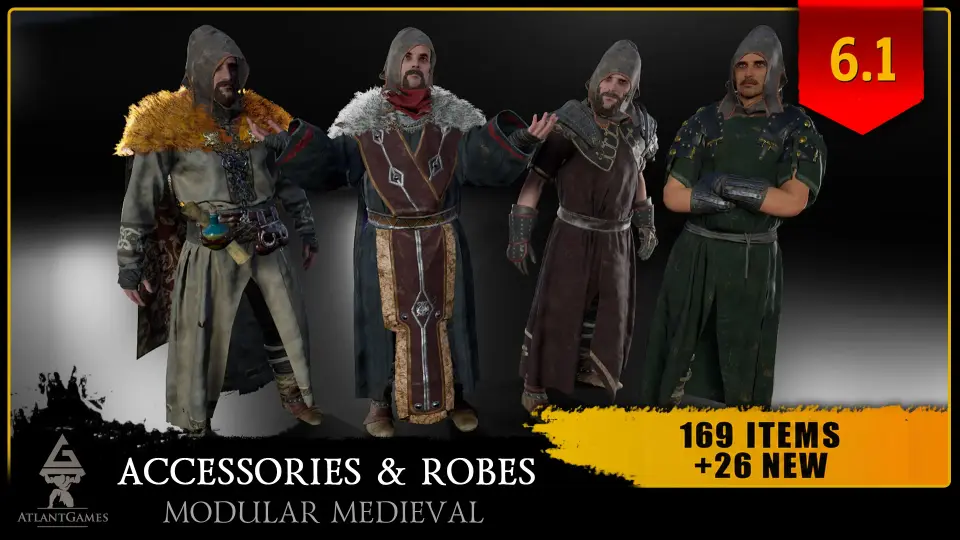
Heavy wool cloaks drape across pauldrons, flowing fabric responds to physical movement, and detailed heraldic emblems mark allegiance across the battlefield. Originally constructed for the dark magical, realistic medieval world of Reign of Guilds, the ROG Modular Medieval Accessories and Robes collection provides a structured visual layer that bridges pure plate armor with flexible clothing. Rather than treating garments as static, full-body replacements, the system focuses on modular items that snap over existing armors or layer neatly beneath outerwear, expanding how individual character silhouettes are constructed across fantasy roleplaying projects.
Modular Layering for Dark Medieval Settings
Characters operating in harsh, low-fantasy, or magical combat settings require visual distinction that reflects both functional defense and personal standing. The collection approaches this balance by allowing players or developers to layer a flowing cloak directly over an outfit chosen from a clothing wardrobe, or to supplement base armor sets with designated modular components like matching pauldrons, articulated gloves, and fitted forearm bracers. The aesthetic grounds itself firmly in historical weight while retaining room for ominous, magical stylings, including decorative necromancer pieces adorned with skeletal parts sourced from Necro's Bone Box.
Because these garments are intended to operate within an active roleplaying framework, they accommodate both high-status regalia and utilitarian field gear. A character can wear bare leather protection or combine extensive plate sets with heraldry-laden cloaks that establish faction loyalty. The visual balance is calibrated for settings where steel meets sorcery, ensuring that heavy fabrics, thick fur trims, and metal fastenings read convincingly side by side in varying lighting conditions.
Robes, Cloaks, and Equipment Breakdown in v6.1
Through iterative updates culminating in version 6.1, the collection has expanded to house 169 equipment items in total, distributed between 164 pieces in the primary catalog and five demo armor pieces intended for immediate scene testing. The modular garment catalog encompasses a broad spectrum of armor weights and fabric cuts:
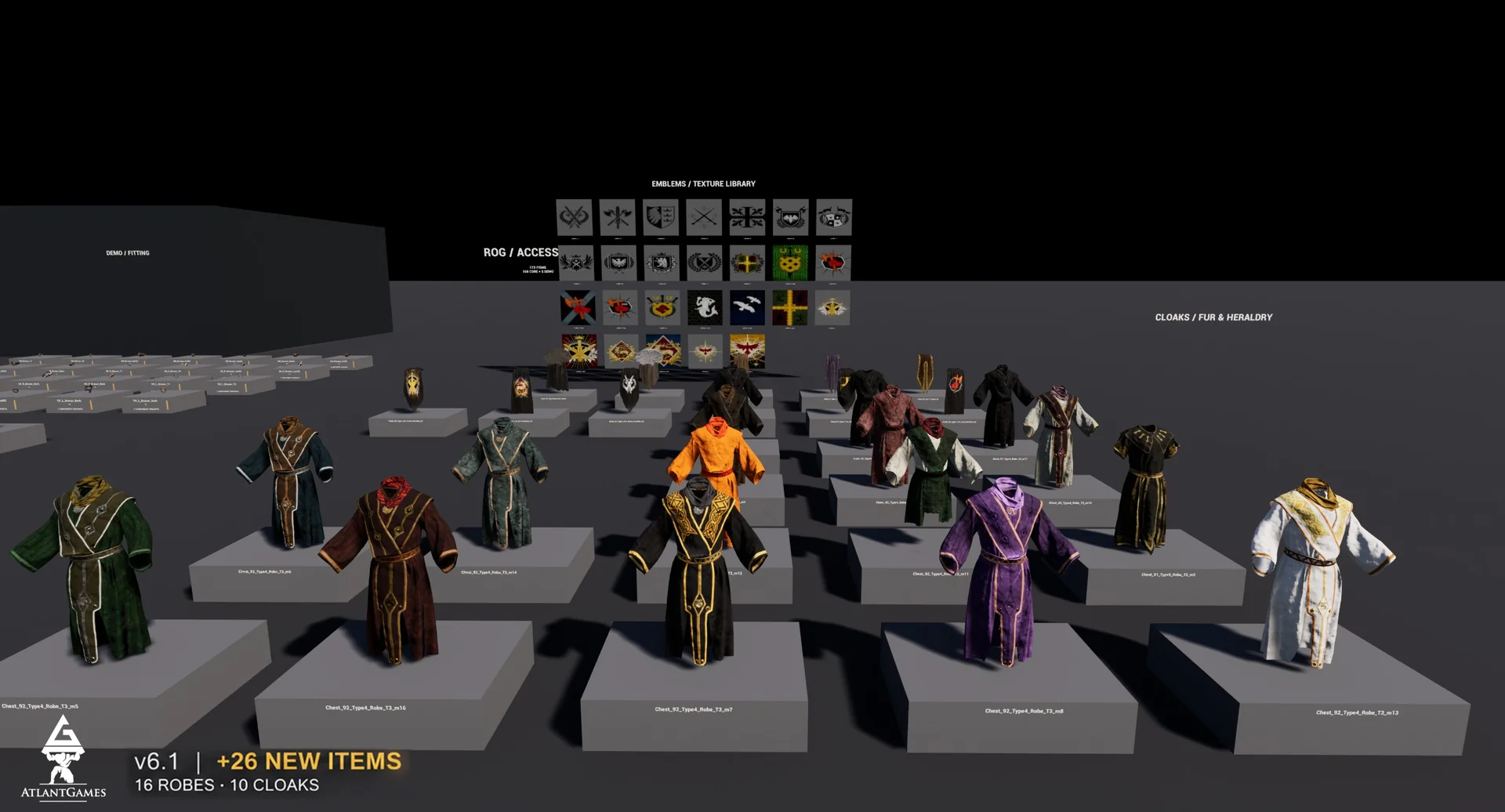
Cloaks: 36 distinct cloak variants, ranging from standard traveling wraps to a heavy brown mammoth fur cloak that emphasizes cold-weather resilience and commanding status.
Robes: 32 robe variants tailored to match different caster archetypes, martial monastic orders, and layered traveler looks.
Shoulders: 52 shoulder piece variants designed to mount cleanly over underlying garments or complement exposed mail.
Gloves: 33 glove variants that accommodate distinct material weights, from flexible leather to reinforced protection.
Bracers: 11 bracer pairs exported as separate left and right Skeletal Meshes, granting individual control over asymmetrical arm configurations.
Heraldic Designs: 26 distinct heraldic patterns supported by a dedicated gallery display asset to showcase emblems directly within engine setups.
The addition of 16 robe appearances and 10 cloak cuts in the 6.1 update significantly increases the visual breadth available for spellcaster and rogue archetypes. Each piece adheres to the modular division, allowing developers to keep character art organized across inventory logic and dynamic equipment swaps.
Accessories Fitting Across Character Rigs
Managing equipment across disparate character architectures frequently introduces weight-painting discrepancies and skeleton incompatibilities. The ROG system accounts for several widely adopted character rigs directly. Out of the box, compatibility includes the standard Epic Unreal Engine 5 Manny and Quinn skeletons, ensuring immediate drop-in functionality for modern default Unreal pipelines.
Support extends beyond default engine rigs into specialized character systems. The package supports CodeSpartan Male and Female setups, taking into account both the original and revised female skeleton iterations. Furthermore, the assets include dedicated fittings for the Character Customizer system, providing male and female adjustments for both the original CC skeleton configuration and standard CCMH body meshes. For projects utilizing legacy setups, UE4 Mannequin fits and UCCS fittings are accessible when working in Unreal Engine 5.0. This multi-rig baseline reduces the burden of manual retargeting and refitting when transitioning equipment across diverse NPC populations or customizable player avatars.
Cloth Simulation, Clearance, and Technical Integration
Draping multiple skeletal meshes over one another creates mechanical challenges, especially when thick textiles interact with rigid armor plates. In this package, selected cloaks and robes come equipped with cloth simulation to produce authentic kinetic draping during sprints, combat swings, and ambient wind exposure. Because physical simulation relies on clear boundary boundaries, integration requires attention to spatial tolerances. Developers must monitor clearance between simulated cloaks and particularly bulky shoulder armor to avoid unwanted intersecting geometry during exaggerated animation states. Similarly, sleeve apertures on robes need deliberate alignment against bulkier gloves and forearm bracers to maintain clean borders at the wrist joints.
To eliminate interior mesh clipping beneath outer clothing layers without requiring destructive geometry deletes, World Position Offset body hiding is established as the default method in the demo project. Coupled with Render Priority settings, WPO body hiding tucks or suppresses unseen limbs and torso sections under garments while preserving the underlying character mesh intact for subsequent armor un-equipping. While the included demo levels deploy simplified body forms to demonstrate this behavior, production implementations integrating complete third-party character bodies or bespoke custom proportions may require minor refitting adjustments to achieve exact seam alignment.
Practical Workflows for Equipment Pipelines
Applying this equipment library within an active game loop centers on standard modular best practices. The separation of left and right forearm meshes into individual skeletal assets facilitates asymmetrical equipment mechanics, such as combining an archer's bracer on one arm with an open sleeve or alternative wrist guard on the other. Character setup workflows tie neatly into inventory integration routines, allowing items to attach programmatically to designated equipment sockets or copy transform logic from parent rigs.
For teams building complex medieval worlds with dark magical elements, the collection provides a dense, production-ready equipment pool that addresses both common foot-soldier attire and elaborate ceremonial or necromantic dress. The focus on multi-skeleton compatibility, paired with procedural masking techniques like WPO hiding and native cloth simulation, gives technical artists a verified baseline for building diverse, performant character wardrobes.
 Clothing
 Clothing
 Clothing
 Clothing