"a5ffaf404b9c2b7e"{"id":"1002638","slug":"restaurant-and-dive-bar-vol-1-games-and-decor","title":"Restaurant and Dive Bar VOL. 1 - Games and Decor","category":"Tools, Objects \u0026 Decor","engine":"5.0+","assetVersion":"","engineVersion":"Engine Version: 5.0+","tag":"Tools","accent":"blue","visual":"mech","summary":"Examine the technical layout, mesh modularity, texture maps, and animation-ready assets in Restaurant and Dive Bar VOL. 1 - Games and Decor for Unreal Engine.","platform":"Unreal Engine","indexPolicy":"index","publishedAt":"2026-11-15T06:25:50.180Z","updatedAt":"2026-11-15T06:25:50.180Z","sourceNotes":[],"fileContents":[],"compatibility":["Unreal Engine","Engine Version: 5.0+"],"featuredImage":{"alt":"Restaurant and Dive Bar VOL. 1 - Games and Decor","src":"/wp-content/uploads/published/2026/11/0f0aec3db7d1-b01fdee2-eeb6-4884-a052-42819b46418e-58be5d082b.webp"},"hasDownloadLink":true,"downloads":0,"terms":[{"taxonomy":"category","slug":"tools-objects-and-decor","name":"Tools, Objects \u0026 Decor"}],"galleryImages":[{"src":"/wp-content/uploads/published/2026/11/d7ee91e43d4f-8677d12d-c7bf-4f5a-8696-4aa3e4a0140b-311cc59038.webp","alt":"Restaurant and Dive Bar VOL. 1 - Games and Decor"},{"src":"/wp-content/uploads/published/2026/11/8e8429bd2c6c-e715efe8-3d11-4692-8335-e5e1ec64ed33-82178c9969.webp","alt":"Restaurant and Dive Bar VOL. 1 - Games and Decor"},{"src":"/wp-content/uploads/published/2026/11/51901881742b-efc21aa4-5379-40b7-a242-45008903c269-618a7bc689.webp","alt":"Restaurant and Dive Bar VOL. 1 - Games and Decor"},{"src":"/wp-content/uploads/published/2026/11/999958d75a6a-4b7eb702-cf9f-4b14-aca1-9e52ab03a441-6e956cd0e6.webp","alt":"Restaurant and Dive Bar VOL. 1 - Games and Decor"},{"src":"/wp-content/uploads/published/2026/11/3e2f3d0c2bea-b9874f50-a071-469e-85d5-961a434dc5b3-809cc65667.webp","alt":"Restaurant and Dive Bar VOL. 1 - Games and Decor"},{"src":"/wp-content/uploads/published/2026/11/832c8da0eef3-91d8b12b-f21c-4647-ba61-459ec10843c9-9c1e6a76b0.webp","alt":"Restaurant and Dive Bar VOL. 1 - Games and Decor"},{"src":"/wp-content/uploads/published/2026/11/cf17130223f4-702a3861-917c-4704-90db-382c730e1a6d-470ea87eee.webp","alt":"Restaurant and Dive Bar VOL. 1 - Games and Decor"},{"src":"/wp-content/uploads/published/2026/11/9c1e220b459d-cc6fe05d-34e6-432c-b1de-5513b6ba1d96-6921a13a2e.webp","alt":"Restaurant and Dive Bar VOL. 1 - Games and Decor"},{"src":"/wp-content/uploads/published/2026/11/4ccaa6caadfb-f9220890-1c3f-4b83-84db-6eabd2b9d425-fc37a9c724.webp","alt":"Restaurant and Dive Bar VOL. 1 - Games and Decor"},{"src":"/wp-content/uploads/published/2026/11/2af287b6bcb6-b2c1143c-3373-4415-9757-d967a4a5f3fc-c3e706f4d1.webp","alt":"Restaurant and Dive Bar VOL. 1 - Games and Decor"}],"accessPanel":{"kind":"resource","title":"Get this resource","eyebrow":"Free resource","message":"Download this resource in your browser.","fileName":"Content.7z","safetyNote":"Resources are manually reviewed before listing to improve quality and reduce obvious risks.","actionLabel":"Get this resource","resourceType":"Resource archive","versions":[]},"contentHtml":"\u003ch2\u003eSetting the Atmosphere Across Restaurant and Dive Bar Environments\u003c/h2\u003e\u003cp\u003eConstructing believable hospitality interiors requires a balance between intentional interior design and lived-in clutter. Restaurant and Dive Bar VOL. 1 - Games and Decor provides an environmental kit built inside Unreal Engine, supplying everything needed to assemble social venues, roadside diners, pool halls, western taverns, and arcade corners. The included maps, materials, Blueprints, and visual effects establish complete scenes that feel grounded, tactile, and visually cohesive.\u003c/p\u003e\u003cp\u003eHospitality environments rely heavily on secondary storytelling. A venue dedicated to nighttime entertainment rarely features pristine surfaces or uniform layouts. Instead, realism stems from worn tabletops, scattered bar accessories, entertainment machines, and specific lighting conditions that evoke smoky, dimly lit hangouts. The package gathers the essential fixtures that turn empty architectural shells into functioning dive bars, casual dining rooms, and recreation halls, providing AAA-standard fidelity tailored to real-time performance parameters.\u003c/p\u003e\u003ch2\u003eMechanical Bull Systems and Interactive Games Props\u003c/h2\u003e\u003cp\u003eCenterpiece attractions define distinct spaces inside recreational venues, and this collection addresses focal entertainment pieces alongside background dressing. Among the primary gameplay-adjacent elements is a ridable mechanical bull setup. Unlike static structural props, the mechanical bull is constructed with separate pieces specifically organized for animation usage. Rigging teams and technical artists can articulate the machine's bucking, spinning, and mounting mechanisms without needing to dissect a single merged mesh.\u003c/p\u003e\u003cp\u003eSurrounding the feature attraction are traditional pub staples including billiards, pool tables, tabletop games, and arcade-style entertainment. These props allow level designers to divide an open interior into purposeful operational zones: an active games area, a relaxed dining floor, and a focal bar counter. Because these entertainment props carry authentic wear patterns and accurate physical scale, they slot naturally into modern, retro, or western-themed hospitality scenarios without breaking visual continuity.\u003c/p\u003e\u003ch2\u003eAsset Assembly and Mesh Architecture Across Decor Pieces\u003c/h2\u003e\u003cp\u003ePopulating large levels prop by prop can quickly balloon layout times. To address world-building efficiency, the library features an inventory of over 85 meshes organized through two distinct distribution formats. Props are supplied both as standalone individual pieces and as pre-assembled clumped assets. The clumped assemblies group naturally related decor items into single cohesive placements, allowing set dressers to rapidly furnish empty corners, fill shelves, and cluster tabletop accessories in a single click.\u003c/p\u003e\u003cp\u003eWhen fine-tuning or custom hero placement is required, the individual meshes provide full granular freedom. Every asset is constructed as a fully enclosed model with detailing carried across all sides. Geometry is not hollowed out or left open at unexposed angles. This complete modeling approach is critical for dynamic scenes where physics, player interaction, or cinematic camera angles might topple a stool, invert a tabletop item, or expose the underside of furniture. Whether viewed from an overhead tactical perspective, an eye-level first-person view, or through low cinematic sweeping shots, the models hold their silhouette and structural integrity from every angle.\u003c/p\u003e\u003ch2\u003eMaster Material Shading and Channel Packing Efficiency\u003c/h2\u003e\u003cp\u003eManaging draw calls and shader complexity across dozens of unique decor items requires a clean shading architecture. The project runs on a centralized master material setup that dictates the rendering behavior for the majority of props and models. By driving surface properties through a unified material graph, global aesthetic adjustments, shader optimizations, and material instances remain clean and maintainable across expansive level builds.\u003c/p\u003e\u003cp\u003eTexture streaming overhead is kept tightly controlled through standardized channel packing. Data for Roughness, Metalness, Ambient Occlusion, and Emissive properties are consolidated into shared texture channels. This eliminates redundant texture lookups and minimizes the memory footprint on the GPU during runtime rendering. The texture allocation reflects careful budget balancing across distinct resolution brackets:\u003c/p\u003e\u003cul\u003e\u003cli\u003e2048 x 2048: 57 texture maps handling primary visual definitions, macro details, and hero surfaces.\u003c/li\u003e\u003cli\u003e1024 x 1024: 1 texture map assigned to mid-sized secondary surface elements.\u003c/li\u003e\u003cli\u003e512 x 512: 1 texture map managing low-priority surface components.\u003c/li\u003e\u003cli\u003e256 x 256: 1 texture map covering minor incidental detail passes.\u003c/li\u003e\u003cli\u003e128 x 128: 3 texture maps handling small-footprint utilities and color swatches.\u003c/li\u003e\u003c/ul\u003e\u003cp\u003eHigh-resolution 2048-pixel maps ensure crisp physical response under dynamic lights, capturing subtle roughness breaks, fingerprints, scuffs, and metallic gleams across surfaces ranging from polished timber to cast iron.\u003c/p\u003e\u003ch2\u003eCinematic Color Grading and Custom Branding\u003c/h2\u003e\u003cp\u003eColor grading plays an equal role alongside mesh detail in defining the tone of a dive bar or restaurant. The collection integrates a dedicated retro cinematic post-process setup complete with a custom Look Up Table (LUT). This color profile shifts lighting values toward vintage, moody tonality, pulling out amber highlights, deep shadows, and softened midtones characteristic of neon-lit nighttime establishments. Developers can adopt this treatment directly or integrate the assets into existing project post-process volumes.\u003c/p\u003e\u003cp\u003eEnvironmental storytelling often encounters legal friction when populating bars and diners with realistic signage, product labels, and advertisements. To eliminate clearance hurdles, every label, brand name, and graphic insignia featured throughout the set was custom-created in-house by the production artists. The graphics mimic authentic commercial branding, brewery typography, and recreation decals without mirroring protected intellectual property, making the entire asset catalog safe for commercial deployment in production environments.\u003c/p\u003e\n\n\u003ch2\u003eMore From The Same Workflow\u003c/h2\u003e\n\u003cul\u003e\n\u003cli\u003e\u003ca href=\"https://3dcghub.com/vintage-scifi-pack-vol-13-collumn/\" rel=\"noopener noreferrer\"\u003eVintage SciFi Pack VOL 13 Collumn\u003c/a\u003e\u003c/li\u003e\n\u003cli\u003e\u003ca href=\"https://3dcghub.com/suburbs-vol-9-kitchen-appliances-nanite-and-low-poly/\" rel=\"noopener noreferrer\"\u003eSuburbs VOL.9 - Kitchen Appliances (Nanite and Low Poly)\u003c/a\u003e\u003c/li\u003e\n\u003cli\u003e\u003ca href=\"https://3dcghub.com/suburbs-vol-1-wall-decor-nanite-and-low-poly/\" rel=\"noopener noreferrer\"\u003eSuburbs VOL.1 - Wall Decor (Nanite and Low Poly)\u003c/a\u003e\u003c/li\u003e\n\u003cli\u003e\u003ca href=\"https://3dcghub.com/holidays-vol-2-halloween-decor-nanite-and-low-poly/\" rel=\"noopener noreferrer\"\u003eHolidays VOL.2 - Halloween Decor (Nanite and Low Poly)\u003c/a\u003e\u003c/li\u003e\n\u003cli\u003e\u003ca href=\"https://3dcghub.com/boatyard-vol-7-fishing-nanite-and-low-poly/\" rel=\"noopener noreferrer\"\u003eBoatyard VOL.7 - Fishing (Nanite and Low Poly)\u003c/a\u003e\u003c/li\u003e\n\u003c/ul\u003e","contentTextLength":6401,"navigation":{"current":10,"total":4570,"previous":{"id":"1002639","slug":"rog-modular-medieval-accessories-and-robes","title":"ROG Modular Medieval Accessories and Robes","category":"Clothing","platform":"Unreal Engine","updatedAt":"2026-11-15T06:26:45.302Z"},"next":{"id":"1002637","slug":"playground-equipment-vol-3-playground-equipment-kid-park-skateboard-3d","title":"Playground Equipment VOL.3 ( Playground Equipment Kid Park Skateboard 3D )","category":"Outdoors","platform":"Unreal Engine","updatedAt":"2026-11-15T06:24:46.828Z"}},"relatedResources":[{"id":"1002259","slug":"vintage-scifi-pack-vol-13-collumn","title":"Vintage SciFi Pack VOL 13 Collumn","category":"Tools, Objects \u0026 Decor","engine":"5.0+","assetVersion":"","engineVersion":"Engine Version: 5.0+","tag":"Tools","accent":"blue","visual":"mech","summary":"Vintage SciFi Pack VOL 13 Collumn features Nanite support for Unreal Engine 5.0+ and Substance Painter PBR textures for alien, space, and horror environments.","platform":"Unreal Engine","indexPolicy":"index","publishedAt":"2026-10-29T16:19:57.954Z","updatedAt":"2026-10-29T16:19:57.954Z","sourceNotes":[],"fileContents":[],"compatibility":["Unreal Engine","Engine Version: 5.0+"],"featuredImage":{"alt":"Vintage SciFi Pack VOL 13 Collumn","src":"/wp-content/uploads/published/2026/10/f6cfce2f6ff6-74c8a433-0b94-42c7-bc7f-99489fe8630b-620dbcc613.webp"},"hasDownloadLink":true,"downloads":0},{"id":"1001494","slug":"suburbs-vol-9-kitchen-appliances-nanite-and-low-poly","title":"Suburbs VOL.9 - Kitchen Appliances (Nanite and Low Poly)","category":"Tools, Objects \u0026 Decor","engine":"5.1+","assetVersion":"","engineVersion":"Engine Version: 5.1+","tag":"Tools","accent":"blue","visual":"mech","summary":"Explore Suburbs VOL.9 - Kitchen Appliances featuring 100 Nanite and low-poly meshes, 4K channel-packed textures, master materials, and Lumen support in UE5.","platform":"Unreal Engine","indexPolicy":"index","publishedAt":"2026-10-08T12:59:10.109Z","updatedAt":"2026-10-08T12:59:10.109Z","sourceNotes":[],"fileContents":[],"compatibility":["Unreal Engine","Engine Version: 5.1+"],"featuredImage":{"alt":"Suburbs VOL.9 - Kitchen Appliances (Nanite and Low Poly)","src":"/wp-content/uploads/published/2026/10/3979285da268-cfab6cc0-906e-4d64-b5c0-261f887167a6-7b5e04d362.webp"},"hasDownloadLink":true,"downloads":1},{"id":"1001457","slug":"suburbs-vol-1-wall-decor-nanite-and-low-poly","title":"Suburbs VOL.1 - Wall Decor (Nanite and Low Poly)","category":"Tools, Objects \u0026 Decor","engine":"5.1+","assetVersion":"","engineVersion":"Engine Version: 5.1+","tag":"Tools","accent":"blue","visual":"mech","summary":"Suburbs VOL.1 - Wall Decor provides 130 Unreal Engine meshes split between Nanite and low-poly versions with 4K textures and full Lumen support.","platform":"Unreal Engine","indexPolicy":"index","publishedAt":"2026-10-08T00:59:33.447Z","updatedAt":"2026-10-08T00:59:33.447Z","sourceNotes":[],"fileContents":[],"compatibility":["Unreal Engine","Engine Version: 5.1+"],"featuredImage":{"alt":"Suburbs VOL.1 - Wall Decor (Nanite and Low Poly)","src":"/wp-content/uploads/published/2026/10/74ebc1534289-9813391a-2ad8-44af-9171-1001780b8321-c5e3107822.webp"},"hasDownloadLink":true,"downloads":1}]}
Tools
Restaurant and Dive Bar VOL. 1 - Games and Decor
Examine the technical layout, mesh modularity, texture maps, and animation-ready assets in Restaurant and Dive Bar VOL. 1 - Games and Decor for Unreal Engine.
Setting the Atmosphere Across Restaurant and Dive Bar Environments
Constructing believable hospitality interiors requires a balance between intentional interior design and lived-in clutter. Restaurant and Dive Bar VOL. 1 - Games and Decor provides an environmental kit built inside Unreal Engine, supplying everything needed to assemble social venues, roadside diners, pool halls, western taverns, and arcade corners. The included maps, materials, Blueprints, and visual effects establish complete scenes that feel grounded, tactile, and visually cohesive.
Hospitality environments rely heavily on secondary storytelling. A venue dedicated to nighttime entertainment rarely features pristine surfaces or uniform layouts. Instead, realism stems from worn tabletops, scattered bar accessories, entertainment machines, and specific lighting conditions that evoke smoky, dimly lit hangouts. The package gathers the essential fixtures that turn empty architectural shells into functioning dive bars, casual dining rooms, and recreation halls, providing AAA-standard fidelity tailored to real-time performance parameters.
Mechanical Bull Systems and Interactive Games Props
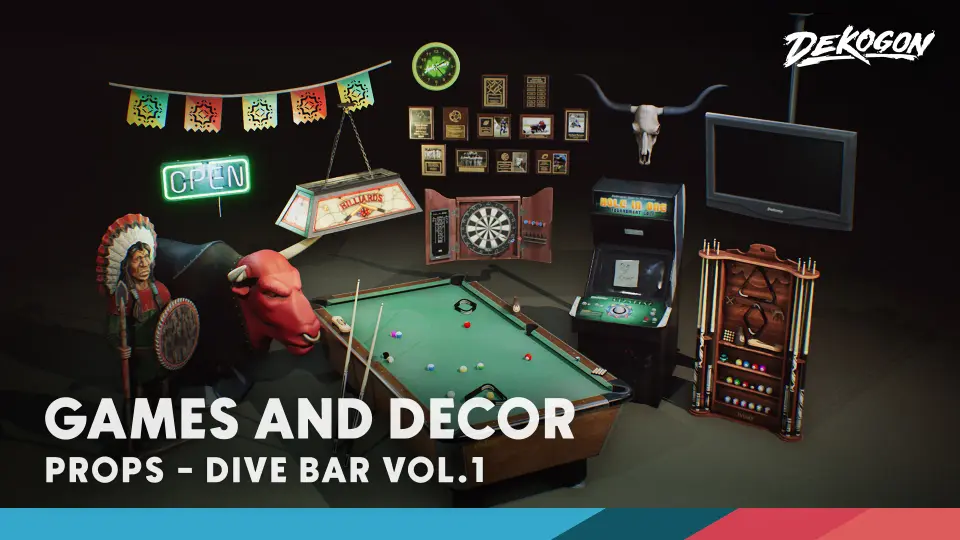
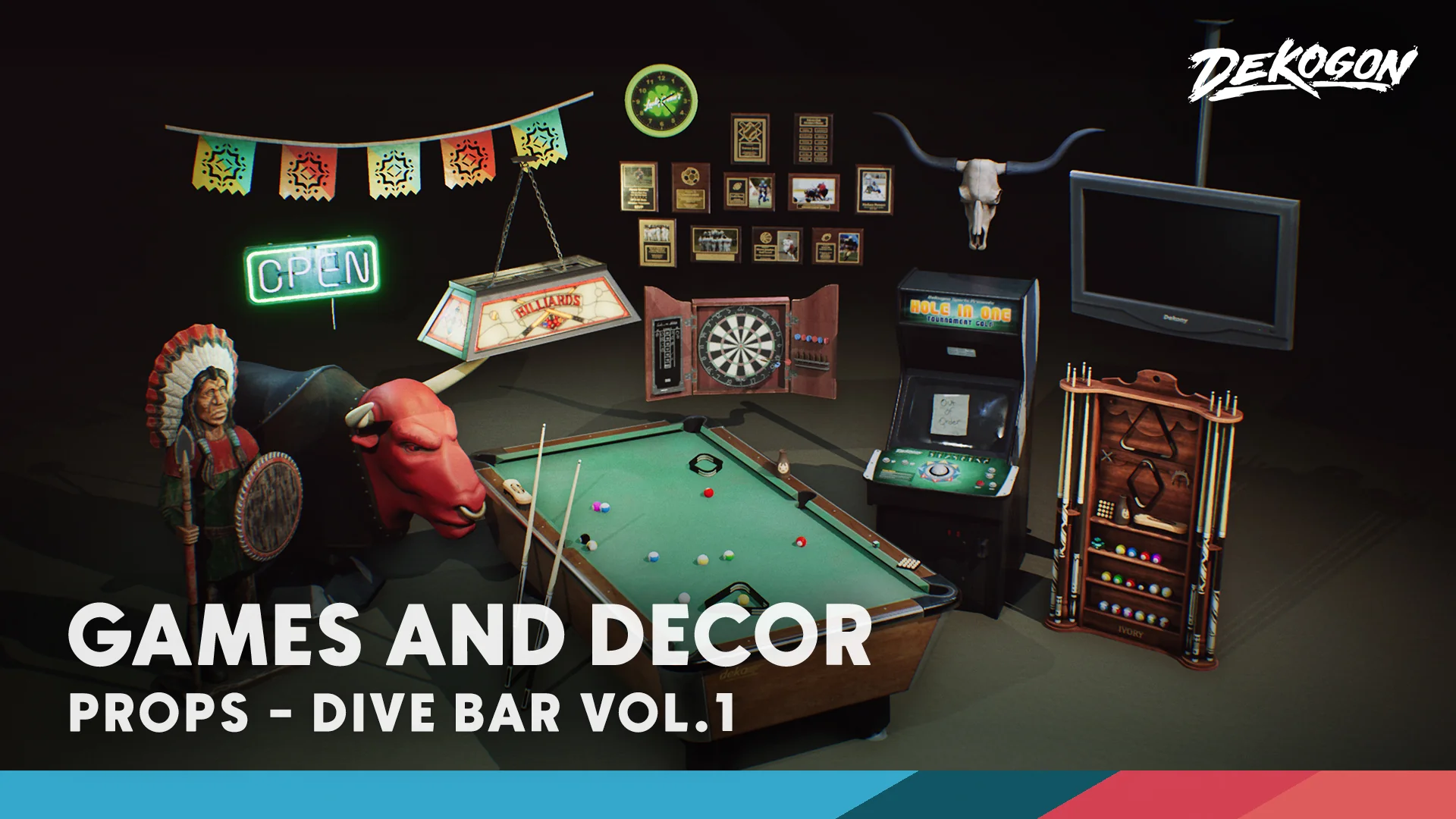
Centerpiece attractions define distinct spaces inside recreational venues, and this collection addresses focal entertainment pieces alongside background dressing. Among the primary gameplay-adjacent elements is a ridable mechanical bull setup. Unlike static structural props, the mechanical bull is constructed with separate pieces specifically organized for animation usage. Rigging teams and technical artists can articulate the machine's bucking, spinning, and mounting mechanisms without needing to dissect a single merged mesh.
Surrounding the feature attraction are traditional pub staples including billiards, pool tables, tabletop games, and arcade-style entertainment. These props allow level designers to divide an open interior into purposeful operational zones: an active games area, a relaxed dining floor, and a focal bar counter. Because these entertainment props carry authentic wear patterns and accurate physical scale, they slot naturally into modern, retro, or western-themed hospitality scenarios without breaking visual continuity.
Asset Assembly and Mesh Architecture Across Decor Pieces
Populating large levels prop by prop can quickly balloon layout times. To address world-building efficiency, the library features an inventory of over 85 meshes organized through two distinct distribution formats. Props are supplied both as standalone individual pieces and as pre-assembled clumped assets. The clumped assemblies group naturally related decor items into single cohesive placements, allowing set dressers to rapidly furnish empty corners, fill shelves, and cluster tabletop accessories in a single click.
When fine-tuning or custom hero placement is required, the individual meshes provide full granular freedom. Every asset is constructed as a fully enclosed model with detailing carried across all sides. Geometry is not hollowed out or left open at unexposed angles. This complete modeling approach is critical for dynamic scenes where physics, player interaction, or cinematic camera angles might topple a stool, invert a tabletop item, or expose the underside of furniture. Whether viewed from an overhead tactical perspective, an eye-level first-person view, or through low cinematic sweeping shots, the models hold their silhouette and structural integrity from every angle.
Master Material Shading and Channel Packing Efficiency
Managing draw calls and shader complexity across dozens of unique decor items requires a clean shading architecture. The project runs on a centralized master material setup that dictates the rendering behavior for the majority of props and models. By driving surface properties through a unified material graph, global aesthetic adjustments, shader optimizations, and material instances remain clean and maintainable across expansive level builds.
Texture streaming overhead is kept tightly controlled through standardized channel packing. Data for Roughness, Metalness, Ambient Occlusion, and Emissive properties are consolidated into shared texture channels. This eliminates redundant texture lookups and minimizes the memory footprint on the GPU during runtime rendering. The texture allocation reflects careful budget balancing across distinct resolution brackets:
2048 x 2048: 57 texture maps handling primary visual definitions, macro details, and hero surfaces.
1024 x 1024: 1 texture map assigned to mid-sized secondary surface elements.
512 x 512: 1 texture map managing low-priority surface components.
256 x 256: 1 texture map covering minor incidental detail passes.
128 x 128: 3 texture maps handling small-footprint utilities and color swatches.
High-resolution 2048-pixel maps ensure crisp physical response under dynamic lights, capturing subtle roughness breaks, fingerprints, scuffs, and metallic gleams across surfaces ranging from polished timber to cast iron.
Cinematic Color Grading and Custom Branding
Color grading plays an equal role alongside mesh detail in defining the tone of a dive bar or restaurant. The collection integrates a dedicated retro cinematic post-process setup complete with a custom Look Up Table (LUT). This color profile shifts lighting values toward vintage, moody tonality, pulling out amber highlights, deep shadows, and softened midtones characteristic of neon-lit nighttime establishments. Developers can adopt this treatment directly or integrate the assets into existing project post-process volumes.
Environmental storytelling often encounters legal friction when populating bars and diners with realistic signage, product labels, and advertisements. To eliminate clearance hurdles, every label, brand name, and graphic insignia featured throughout the set was custom-created in-house by the production artists. The graphics mimic authentic commercial branding, brewery typography, and recreation decals without mirroring protected intellectual property, making the entire asset catalog safe for commercial deployment in production environments.
 Tools
 Tools
 Tools
 Tools