"07a32e720bd988c8"{"id":"1002492","slug":"protective-suit","title":"Protective Suit","category":"Characters \u0026 Creatures","engine":"4.20+,5.0+","assetVersion":"","engineVersion":"Engine Version: 4.20+,5.0+","tag":"Characters","accent":"blue","visual":"character","summary":"Technical overview of the Protective Suit asset, featuring 15,617 triangles, 4K PBR textures, Epic skeleton rigging, and animation blueprint compatibility.","platform":"Unreal Engine","indexPolicy":"index","publishedAt":"2026-11-12T03:57:57.272Z","updatedAt":"2026-11-12T03:57:57.272Z","sourceNotes":[],"fileContents":[],"compatibility":["Unreal Engine","Engine Version: 4.20+,5.0+"],"featuredImage":{"alt":"Protective Suit","src":"/wp-content/uploads/published/2026/11/d763d4b13c4c-f966371f-e244-46ba-9fc2-b1f78d27bc7f-753178560c.webp"},"hasDownloadLink":true,"downloads":0,"terms":[{"taxonomy":"category","slug":"characters-and-creatures","name":"Characters \u0026 Creatures"}],"galleryImages":[{"src":"/wp-content/uploads/published/2026/11/a538f29154f8-2155ec0e-7129-4780-b6ed-1e67e1ddd85b-de9854d638.webp","alt":"Protective Suit"},{"src":"/wp-content/uploads/published/2026/11/b8617c1bfecc-cfee3652-ac35-4de7-a9df-6614a387c2c6-252dd88a97.webp","alt":"Protective Suit"},{"src":"/wp-content/uploads/published/2026/11/9c987155a6c9-d91ba07b-74a8-4f6e-a936-2acb6b7cde7e-c205e0d727.webp","alt":"Protective Suit"},{"src":"/wp-content/uploads/published/2026/11/cedfc5991965-5caffe5b-239d-4dcc-9dc1-f72d9405b670-a6f40cf7a7.webp","alt":"Protective Suit"},{"src":"/wp-content/uploads/published/2026/11/277e44dfc8cc-929837be-f82c-4772-83ce-641e68d445cc-b0b197ce08.webp","alt":"Protective Suit"}],"accessPanel":{"kind":"resource","title":"Get this resource","eyebrow":"Free resource","message":"Download this resource in your browser.","fileName":"Content.7z","safetyNote":"Resources are manually reviewed before listing to improve quality and reduce obvious risks.","actionLabel":"Get this resource","resourceType":"Resource archive","versions":[]},"contentHtml":"\u003cp\u003ePopulating hazardous environments requires character assets that strike an immediate balance between believable surface response and manageable hardware overhead. When staging a laboratory breach, a quarantine perimeter, or an industrial cleanup zone, non-player staff and incidental workers cannot consume the rendering budget reserved for primary gameplay heroes. The Protective Suit is configured precisely to answer that balance, functioning as a lightweight character model tailored for secondary roles, environmental set dressing, and interactive minor characters.\u003c/p\u003e \u003ch2\u003ePolygon Budget and Mesh Density of the Protective Suit\u003c/h2\u003e\n\u003cp\u003eScene performance in complex environments frequently hinges on geometric management. High-density skeletal meshes compound the cost of shadow passes, dynamic lighting, and skinning calculations, particularly when several operatives or researchers appear on screen simultaneously. This asset maintains a clean footprint of 15,617 triangles, classifying it as a dedicated lowpoly mesh built specifically to circumvent bottlenecking in scenes requiring multiple background agents.\u003c/p\u003e\n\u003cp\u003eAt 15,617 triangles, the topology preserves the structural integrity of heavy equipment without wasting geometry on invisible subdivisions. The folds of the protective garment, the volume of the chest and limbs, and the hard-surface forms of the respirator maintain their intended silhouette across mid-range camera distances. Minor characters routinely occupy peripheral sightlines or mid-ground stations where hyper-dense subdivision yields diminishing returns. Restricting the polycount to roughly fifteen thousand triangles allows technical artists to populate facilities with squads of scientists or doctors without incurring heavy draw call and vertex-shading penalties.\u003c/p\u003e \u003ch2\u003eTexture Resolution and PBR Scaling within the Protective Suit\u003c/h2\u003e\n\u003cp\u003eSurface credibility in modern rendering engines relies on physically based rendering (PBR) workflows to accurately emulate materials such as treated fabrics, rubberized seals, coated plastic visors, and metal canister fittings. The character is mapped to a single set of 4K PBR textures, allowing the complete garment and respirator assembly to draw from one consolidated material allocation. This single-set arrangement minimizes texture swaps and material instances per character instance.\u003c/p\u003e\n\u003cp\u003eWhile the full 4K map resolution delivers crisp visual fidelity for close-up inspections or cinematic cutscenes, memory footprints often demand tighter constraints during active gameplay. The master texture set can be downscaled to 2K without a noticeable drop in perceived surface detail. The fabric weave, synthetic wrinkles, and utility seams remain readable at 2048x2048 resolution, giving technical directors immediate control over texture streaming pools. Lowering the texture resolution from 4K to 2K significantly reduces video memory consumption per spawned instance, making the asset practical for hardware targets with stringent memory ceilings or for open-world zones where streaming budgets are fiercely contested.\u003c/p\u003e \u003ch2\u003eEpic Skeleton Rigging and Animationblueprint Integration\u003c/h2\u003e\n\u003cp\u003eDeployment speed depends heavily on how cleanly a character interfaces with established animation pipelines. The asset is built on a rig calibrated directly to the standard Epic skeleton. This skeletal alignment circumvents the complex retargeting procedures, joint realignment, and corrective weight mapping often required when introducing proprietary bone hierarchies into an existing project.\u003c/p\u003e\n\u003cp\u003eBecause the hierarchy matches the Epic skeleton conventions, technical artists can immediately assign free animation packs, standard locomotion systems, and marketplace motion assets directly to the character. Locomotion loops, ambient maintenance gestures, panic reactions, and specialized idle states apply without requiring custom bone translators. The inclusion of script and Animationblueprint compatibility ensures that state machines, blend spaces, and procedural aiming offsets can be set up immediately upon import. Designers can link standard movement logic, patrol routes, or ambient routine scripts to the character mesh without constructing custom animation trees from the ground up.\u003c/p\u003e \u003ch2\u003eChemical, Respirator, and Scientific Roles\u003c/h2\u003e\n\u003cp\u003eThe visual configuration combines the functional elements of chemical isolation equipment, hazardous material defense, and respiratory safety gear. The integrated respirator communicates an operational requirement for sealed airflow, aligning the character with biological containment facilities, deep-underground research labs, post-incident cleanups, or viral outbreak centers. The overall aesthetic maintains a grounded, realistic presentation suited for authentic simulation, speculative scientific facilities, or contemporary procedural dramas.\u003c/p\u003e\n\u003cp\u003eThese specific thematic traits support two primary character archetypes:\u003c/p\u003e\n\u003cul\u003e\n\u003cli\u003e\u003cstrong\u003eThe Field Scientist:\u003c/strong\u003e Analyzing environmental data, cataloging anomalies, inspecting specimen containers, or monitoring control terminals in active containment areas.\u003c/li\u003e\n\u003cli\u003e\u003cstrong\u003eThe Hazardous Response Doctor:\u003c/strong\u003e Tending to quarantine patients, supervising decontamination checkpoints, or moving through contaminated civilian infrastructure during biohazard operations.\u003c/li\u003e\n\u003c/ul\u003e\n\u003cp\u003eBy framing the protective equipment within a clean, realistic visual language, the character functions naturally as an operative who belongs within the Protective Suit Collection ecosystem. It coordinates visually with related equipment sets, allowing developers to maintain thematic continuity across different branches of technical personnel, laboratory assistants, and field workers.\u003c/p\u003e \u003ch2\u003ePractical Implementation for Minor Characters\u003c/h2\u003e\n\u003cp\u003eEvaluating an asset for production deployment requires looking directly at integration cost versus runtime cost. The Protective Suit fulfills the specific role of a secondary character mesh by reducing production friction across multiple technical layers. It provides an optimized 15,617-triangle lowpoly base, single-set 4K PBR textures that safely downscale to 2K, native Epic skeleton compliance, and standard Animationblueprint compatibility. Teams building biohazard levels, clinical laboratories, or hazardous industrial scenes gain a functional, realistic doctor or scientist model that populates the world efficiently without inflating the project's performance budget.\u003c/p\u003e\n\n\u003ch2\u003eContinue Browsing Similar Packs\u003c/h2\u003e\n\u003cul\u003e\n\u003cli\u003e\u003ca href=\"https://3dcghub.com/robot-cyber-suit/\" rel=\"noopener noreferrer\"\u003eRobot Cyber Suit\u003c/a\u003e\u003c/li\u003e\n\u003cli\u003e\u003ca href=\"https://3dcghub.com/cyberpunk-girl/\" rel=\"noopener noreferrer\"\u003eCyberpunk Girl\u003c/a\u003e\u003c/li\u003e\n\u003cli\u003e\u003ca href=\"https://3dcghub.com/ue4-mannequin-dynamic-suit-pack-pbr/\" rel=\"noopener noreferrer\"\u003eUE4 Mannequin Dynamic Suit Pack (PBR)\u003c/a\u003e\u003c/li\u003e\n\u003cli\u003e\u003ca href=\"https://3dcghub.com/l-base-model/\" rel=\"noopener noreferrer\"\u003eL: Base Model\u003c/a\u003e\u003c/li\u003e\n\u003cli\u003e\u003ca href=\"https://3dcghub.com/service-drone/\" rel=\"noopener noreferrer\"\u003eService Drone\u003c/a\u003e\u003c/li\u003e\n\u003c/ul\u003e","contentTextLength":6473,"navigation":{"current":7,"total":4421,"previous":{"id":"1002493","slug":"red-knight","title":"Red Knight","category":"Humans","platform":"Unreal Engine","updatedAt":"2026-11-12T03:58:22.626Z"},"next":{"id":"1002491","slug":"post-apocaliptic-survival-male-character","title":"Post apocaliptic survival male character","category":"Characters \u0026 Creatures","platform":"Unreal Engine","updatedAt":"2026-11-12T03:56:43.462Z"}},"relatedResources":[{"id":"3321","slug":"robot-cyber-suit","title":"Robot Cyber Suit","category":"Characters \u0026 Creatures","engine":"4.26+,5.0+","assetVersion":"Engine version: 4.26+,5.0+","engineVersion":"4.26","tag":"Characters","accent":"blue","visual":"character","summary":"Discover the Robot Cyber Suit for Unreal Engine. Featuring 4K textures, 11 color variations, and full customization for your next sci-fi or cyberpunk game.","platform":"Unreal Engine","indexPolicy":"noindex","publishedAt":"2026-02-09T06:26:31.000Z","updatedAt":"2026-04-19T15:57:39.000Z","sourceNotes":[],"fileContents":[],"compatibility":["Unreal Engine","Engine version: 4.26+,5.0+"],"featuredImage":{"alt":"Robot Cyber Suit","src":"https://3dcghub.com/wp-content/uploads/2026/02/4ec2964e-b01d-48fa-aad6-6c450a71b98d.webp"},"hasDownloadLink":true,"downloads":1},{"id":"2149","slug":"cyberpunk-girl","title":"Cyberpunk Girl","category":"Characters \u0026 Creatures","engine":"5.1+","assetVersion":"","engineVersion":"Engine Version: 5.1+","tag":"Characters","accent":"blue","visual":"character","summary":"Boost your sci-fi project with this realistic Cyberpunk Girl character. Features high-quality battle armor and a professional animation blueprint for games.","platform":"Unreal Engine","indexPolicy":"noindex","publishedAt":"2026-02-07T08:02:10.000Z","updatedAt":"2026-11-10T13:41:41.350Z","sourceNotes":[],"fileContents":[],"compatibility":["Unreal Engine","Engine Version: 5.1+"],"featuredImage":{"alt":"Cyberpunk Girl","src":"https://3dcghub.com/wp-content/uploads/2026/02/5d65630f-717f-480e-9b12-e4804c87c017.webp"},"hasDownloadLink":true,"downloads":0},{"id":"12599","slug":"ue4-mannequin-dynamic-suit-pack-pbr","title":"UE4 Mannequin Dynamic Suit Pack (PBR)","category":"Fabric \u0026 Clothing","engine":"4.26+,5.0+","assetVersion":"Engine version: 4.26+,5.0+","engineVersion":"4.20","tag":"Fabric \u0026 Clothing","accent":"blue","visual":"luts","summary":"Enhance your character visuals with the UE4 Mannequin Dynamic Suit Pack (PBR). This set includes 8 customizable material suits featuring 2K textures and adjustable emissive settings.","platform":"Unreal Engine","indexPolicy":"noindex","publishedAt":"2026-03-07T12:51:51.000Z","updatedAt":"2026-04-19T15:47:50.000Z","sourceNotes":[],"fileContents":[],"compatibility":["Unreal Engine","Engine version: 4.26+,5.0+"],"featuredImage":{"alt":"UE4 Mannequin Dynamic Suit Pack (PBR)","src":"https://3dcghub.com/wp-content/uploads/2026/03/fc543735.webp"},"hasDownloadLink":true,"downloads":0}]}
Characters
Protective Suit
Technical overview of the Protective Suit asset, featuring 15,617 triangles, 4K PBR textures, Epic skeleton rigging, and animation blueprint compatibility.
Populating hazardous environments requires character assets that strike an immediate balance between believable surface response and manageable hardware overhead. When staging a laboratory breach, a quarantine perimeter, or an industrial cleanup zone, non-player staff and incidental workers cannot consume the rendering budget reserved for primary gameplay heroes. The Protective Suit is configured precisely to answer that balance, functioning as a lightweight character model tailored for secondary roles, environmental set dressing, and interactive minor characters.
Polygon Budget and Mesh Density of the Protective Suit
Scene performance in complex environments frequently hinges on geometric management. High-density skeletal meshes compound the cost of shadow passes, dynamic lighting, and skinning calculations, particularly when several operatives or researchers appear on screen simultaneously. This asset maintains a clean footprint of 15,617 triangles, classifying it as a dedicated lowpoly mesh built specifically to circumvent bottlenecking in scenes requiring multiple background agents.
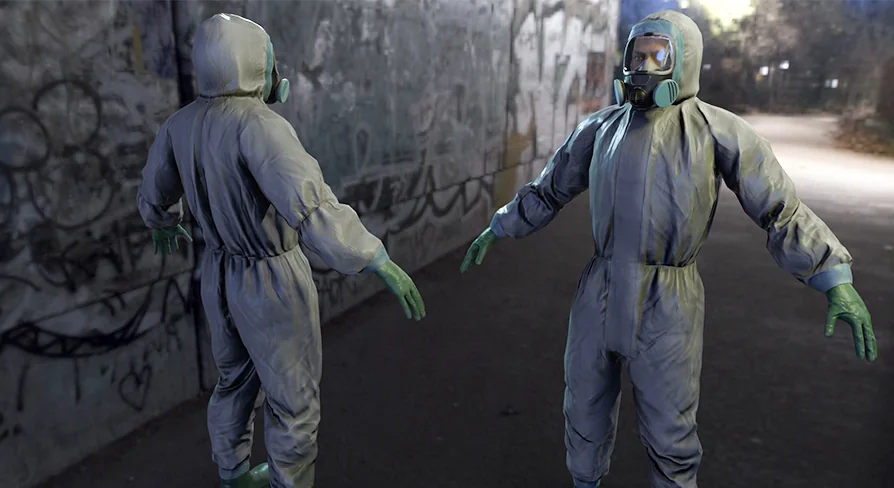
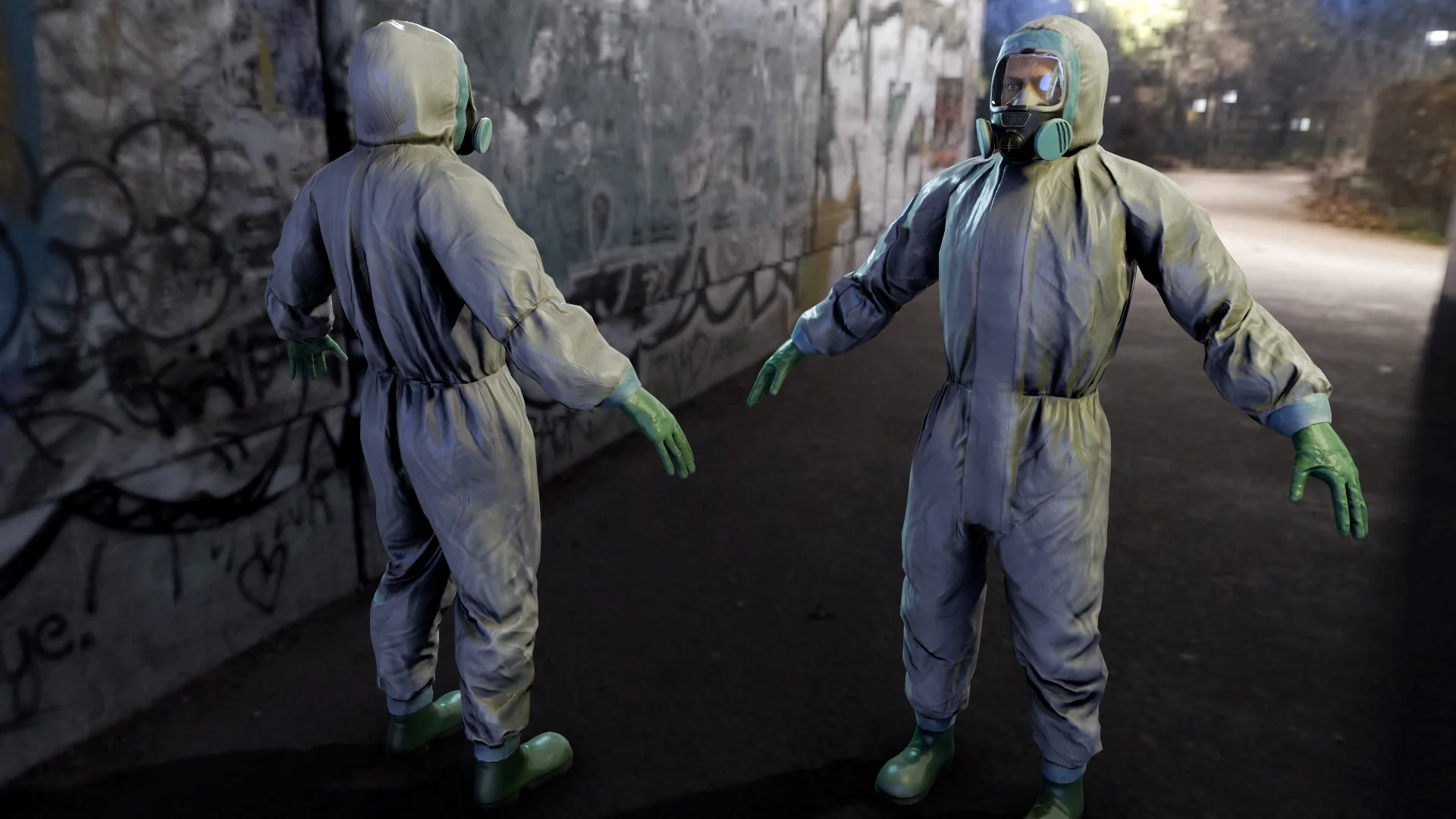
At 15,617 triangles, the topology preserves the structural integrity of heavy equipment without wasting geometry on invisible subdivisions. The folds of the protective garment, the volume of the chest and limbs, and the hard-surface forms of the respirator maintain their intended silhouette across mid-range camera distances. Minor characters routinely occupy peripheral sightlines or mid-ground stations where hyper-dense subdivision yields diminishing returns. Restricting the polycount to roughly fifteen thousand triangles allows technical artists to populate facilities with squads of scientists or doctors without incurring heavy draw call and vertex-shading penalties.
Texture Resolution and PBR Scaling within the Protective Suit
Surface credibility in modern rendering engines relies on physically based rendering (PBR) workflows to accurately emulate materials such as treated fabrics, rubberized seals, coated plastic visors, and metal canister fittings. The character is mapped to a single set of 4K PBR textures, allowing the complete garment and respirator assembly to draw from one consolidated material allocation. This single-set arrangement minimizes texture swaps and material instances per character instance.
While the full 4K map resolution delivers crisp visual fidelity for close-up inspections or cinematic cutscenes, memory footprints often demand tighter constraints during active gameplay. The master texture set can be downscaled to 2K without a noticeable drop in perceived surface detail. The fabric weave, synthetic wrinkles, and utility seams remain readable at 2048x2048 resolution, giving technical directors immediate control over texture streaming pools. Lowering the texture resolution from 4K to 2K significantly reduces video memory consumption per spawned instance, making the asset practical for hardware targets with stringent memory ceilings or for open-world zones where streaming budgets are fiercely contested.
Epic Skeleton Rigging and Animationblueprint Integration
Deployment speed depends heavily on how cleanly a character interfaces with established animation pipelines. The asset is built on a rig calibrated directly to the standard Epic skeleton. This skeletal alignment circumvents the complex retargeting procedures, joint realignment, and corrective weight mapping often required when introducing proprietary bone hierarchies into an existing project.
Because the hierarchy matches the Epic skeleton conventions, technical artists can immediately assign free animation packs, standard locomotion systems, and marketplace motion assets directly to the character. Locomotion loops, ambient maintenance gestures, panic reactions, and specialized idle states apply without requiring custom bone translators. The inclusion of script and Animationblueprint compatibility ensures that state machines, blend spaces, and procedural aiming offsets can be set up immediately upon import. Designers can link standard movement logic, patrol routes, or ambient routine scripts to the character mesh without constructing custom animation trees from the ground up.
Chemical, Respirator, and Scientific Roles
The visual configuration combines the functional elements of chemical isolation equipment, hazardous material defense, and respiratory safety gear. The integrated respirator communicates an operational requirement for sealed airflow, aligning the character with biological containment facilities, deep-underground research labs, post-incident cleanups, or viral outbreak centers. The overall aesthetic maintains a grounded, realistic presentation suited for authentic simulation, speculative scientific facilities, or contemporary procedural dramas.
These specific thematic traits support two primary character archetypes:
The Field Scientist: Analyzing environmental data, cataloging anomalies, inspecting specimen containers, or monitoring control terminals in active containment areas.
The Hazardous Response Doctor: Tending to quarantine patients, supervising decontamination checkpoints, or moving through contaminated civilian infrastructure during biohazard operations.
By framing the protective equipment within a clean, realistic visual language, the character functions naturally as an operative who belongs within the Protective Suit Collection ecosystem. It coordinates visually with related equipment sets, allowing developers to maintain thematic continuity across different branches of technical personnel, laboratory assistants, and field workers.
Practical Implementation for Minor Characters
Evaluating an asset for production deployment requires looking directly at integration cost versus runtime cost. The Protective Suit fulfills the specific role of a secondary character mesh by reducing production friction across multiple technical layers. It provides an optimized 15,617-triangle lowpoly base, single-set 4K PBR textures that safely downscale to 2K, native Epic skeleton compliance, and standard Animationblueprint compatibility. Teams building biohazard levels, clinical laboratories, or hazardous industrial scenes gain a functional, realistic doctor or scientist model that populates the world efficiently without inflating the project's performance budget.
 Characters
 Characters
 Characters
 Fabric & Clothing