"ddd0e3fb95b0aec2"{"id":"1000394","slug":"procedural-forest","title":"Procedural Forest","category":"Forest \u0026 Jungle","engine":"5.0+","assetVersion":"","engineVersion":"Engine Version: 5.0+","tag":"Forest \u0026 Jungle","accent":"blue","visual":"mech","summary":"Explore the Procedural Forest package, featuring AAA-level photogrammetry models, smart water shaders, and optimized procedural rules for Unreal Engine.","platform":"Unreal Engine","publishedAt":"2026-07-07T15:13:16.744Z","updatedAt":"2026-07-07T15:13:16.744Z","sourceNotes":[],"fileContents":[],"compatibility":["Unreal Engine","Engine Version: 5.0+"],"featuredImage":{"alt":"Procedural Forest","src":"/wp-content/uploads/published/2026/07/fc22e8a18881-e320fbd7-97e5-4529-b1d7-a98ccc180720-a5b0bb2a88.webp"},"hasDownloadLink":true,"downloads":0,"terms":[{"taxonomy":"category","slug":"forest-and-jungle","name":"Forest \u0026 Jungle"}],"galleryImages":[{"src":"/wp-content/uploads/published/2026/07/4a7693514c4a-a4fc8757-3242-4ad0-be44-0f5df74f7ad2-50e558ac6f.webp","alt":"Procedural Forest"},{"src":"/wp-content/uploads/published/2026/07/ceef43130e91-7d679101-e1a6-4eac-9a7c-85af71f6028a-1151ac0e04.webp","alt":"Procedural Forest"},{"src":"/wp-content/uploads/published/2026/07/fda0d9f745ca-7b717bd5-141b-481b-9a8e-cd8e5baf9741-47bb882029.webp","alt":"Procedural Forest"},{"src":"/wp-content/uploads/published/2026/07/499187e082c9-409ca170-d820-4406-aa6a-bf9afd9f321a-09bb063970.webp","alt":"Procedural Forest"},{"src":"/wp-content/uploads/published/2026/07/7b22cb60fa03-8b05390c-d9ad-4894-85bc-7a2d4319097d-1dd8862b56.webp","alt":"Procedural Forest"},{"src":"/wp-content/uploads/published/2026/07/a26aa369f3a4-28bf6ea1-9be9-427c-8331-775e68a35ae4-3bc667b8aa.webp","alt":"Procedural Forest"},{"src":"/wp-content/uploads/published/2026/07/ddcffcb909a8-9943d35e-2e82-458f-8d06-d508cea3eb2c-990a9dbc12.webp","alt":"Procedural Forest"},{"src":"/wp-content/uploads/published/2026/07/3714f4801bf2-66b65600-5cd2-487f-82fd-d63db88edc6c-4b8d06ea82.webp","alt":"Procedural Forest"},{"src":"/wp-content/uploads/published/2026/07/82f0d38211a9-650c6ed1-7b51-4d28-bde9-b16ff8b95158-4b30af7ff0.webp","alt":"Procedural Forest"},{"src":"/wp-content/uploads/published/2026/07/1224f05c7ab0-019a4ca5-0e38-4225-8773-47b9c036aba8-6c3100a89a.webp","alt":"Procedural Forest"}],"accessPanel":{"kind":"resource","title":"Download this resource","eyebrow":"Free Download","message":"Log in or create a free account to start your download.","fileName":"ProceduralForest.7z","safetyNote":"Resources are manually reviewed before listing to improve quality and reduce obvious risks.","actionLabel":"Download Free","resourceType":"Resource archive"},"contentHtml":"\u003ch2\u003ePopulating Environments with Procedural Foliage Volumes\u003c/h2\u003e\n\u003cp\u003eBuilding expansive realistic, fantasy, or swamp environments often requires massive amounts of vegetation and environmental dressing. Relying on manual placement for every tree, rock, and fern quickly becomes inefficient, particularly when attempting to achieve the dense visual fidelity expected in modern game development. The Procedural Forest package addresses this bottleneck by providing a fully constructed environment driven entirely by algorithmic rules rather than hand-placed assets.\u003c/p\u003e\n\u003cp\u003eUtilizing Unreal Engine's Procedural Foliage Volumes, the included map demonstrates how to populate a complete woodland scene from the ground up. By examining the accompanying procedural rules within the volumes, developers can understand how to distribute PBR-based photogrammetry assets across large terrain spaces seamlessly. This framework makes it entirely possible to generate complex, overlapping ecosystems without ever needing to drag and drop a single asset manually into the level.\u003c/p\u003e\n\u003ch2\u003eSmart Shader Solutions for Shorelines and Snow Cover\u003c/h2\u003e\n\u003cp\u003eBeyond basic asset scattering, the visual authenticity of a swamp or deep forest relies heavily on how elements interact with water and weather. To support these environmental conditions, the package includes several smart shader solutions designed to be computationally cheap while maintaining high visual quality. One of the primary features is a dynamic water shader engineered to handle the complex intersections between liquid surfaces and solid geometry.\u003c/p\u003e\n\u003cp\u003eWhen meshes intersect with the water, the shader automatically gathers debris along the shorelines and around the bases of objects. This automatic debris gathering grounds the assets naturally into the scene, eliminating the need to manually place floating leaves or scum meshes around every rock or tree trunk. In tandem with the water system, the materials incorporate a smart shoreline wetness effect that dynamically adjusts based on the geometry's proximity to the water surface, ensuring that the transition from dry land to the swampy interior feels cohesive.\u003c/p\u003e\n\u003cp\u003eThe environmental shaders also support a cheap dynamic application of snow cover. Because this effect is calculated dynamically, developers can alter the climate of the forest scene efficiently, shifting from a damp, realistic swamp to a frozen fantasy landscape using the exact same core textures and models.\u003c/p\u003e\n\u003ch2\u003eHeight Map Based Shadows and Octahedral Imposters\u003c/h2\u003e\n\u003cp\u003eRendering dense vegetation with accurate shadows is a notoriously heavy process, especially when targeting console hardware. To maintain performance without sacrificing depth, the Procedural Forest utilizes a highly specific rendering approach for its shadows. The creator engineered a setup built on an unholy alliance between PixelDepthOffset and Contact Shadows. This combination provides a cheap, efficient way to generate pixel-perfect, height-map-based shadows across every single mesh in the scene. Instead of relying solely on expensive traditional shadow maps, this technique ensures that even the smallest details in the photogrammetry textures cast accurate micro-shadows, adding immense depth to the bark, ground cover, and rocky surfaces.\u003c/p\u003e\n\u003cp\u003eTo further optimize the environment for dense usage, the trees are equipped with Octahedral Imposters, serving as advanced billboards that replace complex 3D geometry at a distance. Introduced in the 1.1 content update, these imposters drastically reduce the polygon count in the background while maintaining a convincing silhouette and lighting response. With the release of update 1.2, these imposters have been fully configured to work correctly within Unreal Engine 5.\u003c/p\u003e\n\u003cp\u003ePerformance testing conducted within the provided scene, utilizing the standard Unreal FPS template, demonstrates the effectiveness of these optimizations. The dense forest environment maintains its visual integrity at a 1920x1080 resolution while running smoothly on a standard GeForce 1080 graphics card.\u003c/p\u003e\n\u003ch2\u003eAsset Pack Integration and Unreal Engine Project Settings\u003c/h2\u003e\n\u003cp\u003eIntegrating external environments into existing projects often requires careful attention to engine versions and internal rendering configurations. Originally packaged as a complete Unreal Engine 4.25.4 project, the Procedural Forest shifted its structure in update 1.3 to a standard Asset Pack format. This transition was made specifically to make integration into custom projects easier and less destructive. However, importing this detailed environment requires a few specific adjustments within Unreal Engine's Project Settings to function as intended.\u003c/p\u003e\n\u003cp\u003eWhen bringing the demo level into a new project, developers must uncheck the \"Allow Static Lighting\" option. Because the scene relies heavily on dynamic rendering techniques for its shadows and procedural elements, static lighting will prevent the demo map from displaying correctly. The lighting setup also relies on advanced distance field rendering, requiring developers to ensure that \"Generate Mesh Distance Fields\" is enabled in their settings.\u003c/p\u003e\n\u003cp\u003eThe landscape material has also been streamlined for easier application to custom terrains. By removing Virtual Textures from the landscape setup, the ground materials can now be applied to custom height maps and external landscapes with minimal friction. While the primary engine version has been bumped to Unreal Engine 5.0, legacy users can still access previous versions compatible with UE 4.26, which is required for the Octahedral Imposters, and UE 4.25.\u003c/p\u003e\n\u003ch2\u003eDissecting AAA-Level Models and Shaders\u003c/h2\u003e\n\u003cp\u003eThis package serves a dual purpose for development teams. It provides an immediate library of AAA-level models and photogrammetry textures that are optimized and ready for immediate console usage. At the same time, it acts as a comprehensive technical breakdown for technical artists and level designers.\u003c/p\u003e\n\u003cp\u003eDevelopers looking to dissect professional workflows can explore exactly how the shaders are organized, how lighting is configured for heavy foliage, and how procedural rules are balanced to build convincing, dense worlds efficiently. By tearing apart the project settings and material graphs, creators gain direct insight into structuring content for optimized, large-scale environment generation.\u003c/p\u003e\n\n\u003ch2\u003eContinue Browsing Similar Packs\u003c/h2\u003e\n\u003cul\u003e\n\u003cli\u003e\u003ca href=\"https://3dcghub.com/survival-interactable-procedural-nature-ecosystem/\" title=\"Survival Interactable Procedural Nature Ecosystem\"\u003eSurvival Interactable Procedural Nature Ecosystem\u003c/a\u003e\u003c/li\u003e\n\u003cli\u003e\u003ca href=\"https://3dcghub.com/wildlands-stylized-nature-pine-forest-trees-foliage-nature-forest-biome/\" title=\"Wildlands: Stylized Nature (Pine Forest, Trees, Foliage, Nature, Forest, Biome)\"\u003eWildlands: Stylized Nature (Pine Forest, Trees, Foliage, Nature, Forest, Biome)\u003c/a\u003e\u003c/li\u003e\n\u003cli\u003e\u003ca href=\"https://3dcghub.com/rain-forest-pack/\" title=\"Rain Forest Pack\"\u003eRain Forest Pack\u003c/a\u003e\u003c/li\u003e\n\u003cli\u003e\u003ca href=\"https://3dcghub.com/225-square-km-procedural-forest/\" title=\"225 Square Km Procedural Forest\"\u003e225 Square Km Procedural Forest\u003c/a\u003e\u003c/li\u003e\n\u003cli\u003e\u003ca href=\"https://3dcghub.com/brushify-tropical-pack/\" title=\"Brushify - Tropical Pack\"\u003eBrushify - Tropical Pack\u003c/a\u003e\u003c/li\u003e\n\u003c/ul\u003e","contentTextLength":6523,"navigation":{"current":1256,"total":3511,"previous":{"id":"1000395","slug":"projectile-arcs","title":"Projectile Arcs","category":"Gameplay Features","platform":"Unreal Engine","updatedAt":"2026-07-07T15:19:03.056Z"},"next":{"id":"1000393","slug":"power-plugs-and-sockets-system","title":"Power Plugs And Sockets System","category":"Gameplay Features","platform":"Unreal Engine","updatedAt":"2026-07-07T15:01:55.308Z"}},"relatedResources":[{"id":"1001544","slug":"pine-forest-photogrammetry-based-high-poly-biome","title":"Pine forest - Photogrammetry based High poly Biome","category":"Forest \u0026 Jungle","engine":"5.1+","assetVersion":"","engineVersion":"Engine Version: 5.1+","tag":"Forest \u0026 Jungle","accent":"blue","visual":"mech","summary":"Explore the Pine forest photogrammetry biome, featuring 95 procedural assets, 8K terrain support, RHA texture maps, and high-fidelity wind animation.","platform":"Unreal Engine","publishedAt":"2026-10-10T03:08:19.926Z","updatedAt":"2026-10-10T03:08:19.926Z","sourceNotes":[],"fileContents":[],"compatibility":["Unreal Engine","Engine Version: 5.1+"],"featuredImage":{"alt":"Pine forest - Photogrammetry based High poly Biome","src":"/wp-content/uploads/published/2026/10/82885d3ff947-ab7d61f5-70cf-4902-a8eb-c017c5314e67-95b32130bb.webp"},"hasDownloadLink":true,"downloads":0},{"id":"1000256","slug":"rain-forest-pack","title":"Rain Forest Pack","category":"Forest \u0026 Jungle","engine":"5.0+","assetVersion":"","engineVersion":"Engine Version: 5.0+","tag":"Forest \u0026 Jungle","accent":"blue","visual":"mech","summary":"A fully procedural, photogrammetry-based tropical forest environment for Unreal Engine, featuring shader-based foliage interactivity and 4K textures.","platform":"Unreal Engine","publishedAt":"2026-06-30T22:45:14.446Z","updatedAt":"2026-06-30T22:45:14.446Z","sourceNotes":[],"fileContents":[],"compatibility":["Unreal Engine","Engine Version: 5.0+"],"featuredImage":{"alt":"Rain Forest Pack","src":"/wp-content/uploads/published/2026/06/73c675f710b9-a9b259e6-bdd0-4fa4-b8af-3c472531ddd4-559a55a7d4.webp"},"hasDownloadLink":true,"downloads":4},{"id":"1000663","slug":"red-pine-biome","title":"Red Pine Biome","category":"Forest \u0026 Jungle","engine":"5.4+","assetVersion":"","engineVersion":"Engine Version: 5.4+","tag":"Forest \u0026 Jungle","accent":"blue","visual":"mech","summary":"Red Pine Biome delivers Mediterranean red pine trees, endemic vegetation, cliffs, and scatter with landscape material, procedural foliage, and wind interaction.","platform":"Unreal Engine","publishedAt":"2026-07-22T06:41:11.442Z","updatedAt":"2026-07-22T06:41:11.442Z","sourceNotes":[],"fileContents":[],"compatibility":["Unreal Engine","Engine Version: 5.4+"],"featuredImage":{"alt":"Red Pine Biome","src":"/wp-content/uploads/published/2026/07/b774421f9718-c6d49ccf-c1a0-425a-bc09-3d64bdd79653-d7a4531c7f.webp"},"hasDownloadLink":true,"downloads":1}]}
Forest & Jungle
Procedural Forest
Explore the Procedural Forest package, featuring AAA-level photogrammetry models, smart water shaders, and optimized procedural rules for Unreal Engine.
Populating Environments with Procedural Foliage Volumes
Building expansive realistic, fantasy, or swamp environments often requires massive amounts of vegetation and environmental dressing. Relying on manual placement for every tree, rock, and fern quickly becomes inefficient, particularly when attempting to achieve the dense visual fidelity expected in modern game development. The Procedural Forest package addresses this bottleneck by providing a fully constructed environment driven entirely by algorithmic rules rather than hand-placed assets.
Utilizing Unreal Engine's Procedural Foliage Volumes, the included map demonstrates how to populate a complete woodland scene from the ground up. By examining the accompanying procedural rules within the volumes, developers can understand how to distribute PBR-based photogrammetry assets across large terrain spaces seamlessly. This framework makes it entirely possible to generate complex, overlapping ecosystems without ever needing to drag and drop a single asset manually into the level.
Smart Shader Solutions for Shorelines and Snow Cover
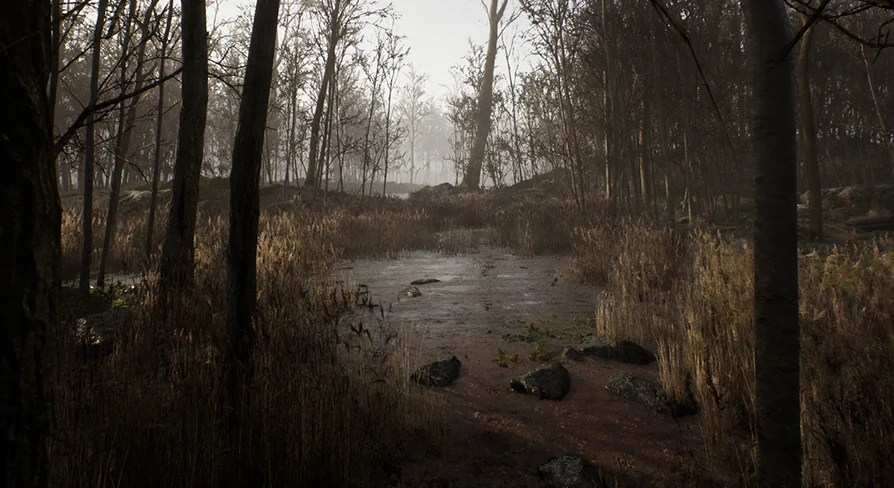
Beyond basic asset scattering, the visual authenticity of a swamp or deep forest relies heavily on how elements interact with water and weather. To support these environmental conditions, the package includes several smart shader solutions designed to be computationally cheap while maintaining high visual quality. One of the primary features is a dynamic water shader engineered to handle the complex intersections between liquid surfaces and solid geometry.
When meshes intersect with the water, the shader automatically gathers debris along the shorelines and around the bases of objects. This automatic debris gathering grounds the assets naturally into the scene, eliminating the need to manually place floating leaves or scum meshes around every rock or tree trunk. In tandem with the water system, the materials incorporate a smart shoreline wetness effect that dynamically adjusts based on the geometry's proximity to the water surface, ensuring that the transition from dry land to the swampy interior feels cohesive.
The environmental shaders also support a cheap dynamic application of snow cover. Because this effect is calculated dynamically, developers can alter the climate of the forest scene efficiently, shifting from a damp, realistic swamp to a frozen fantasy landscape using the exact same core textures and models.
Height Map Based Shadows and Octahedral Imposters
Rendering dense vegetation with accurate shadows is a notoriously heavy process, especially when targeting console hardware. To maintain performance without sacrificing depth, the Procedural Forest utilizes a highly specific rendering approach for its shadows. The creator engineered a setup built on an unholy alliance between PixelDepthOffset and Contact Shadows. This combination provides a cheap, efficient way to generate pixel-perfect, height-map-based shadows across every single mesh in the scene. Instead of relying solely on expensive traditional shadow maps, this technique ensures that even the smallest details in the photogrammetry textures cast accurate micro-shadows, adding immense depth to the bark, ground cover, and rocky surfaces.
To further optimize the environment for dense usage, the trees are equipped with Octahedral Imposters, serving as advanced billboards that replace complex 3D geometry at a distance. Introduced in the 1.1 content update, these imposters drastically reduce the polygon count in the background while maintaining a convincing silhouette and lighting response. With the release of update 1.2, these imposters have been fully configured to work correctly within Unreal Engine 5.
Performance testing conducted within the provided scene, utilizing the standard Unreal FPS template, demonstrates the effectiveness of these optimizations. The dense forest environment maintains its visual integrity at a 1920x1080 resolution while running smoothly on a standard GeForce 1080 graphics card.
Asset Pack Integration and Unreal Engine Project Settings
Integrating external environments into existing projects often requires careful attention to engine versions and internal rendering configurations. Originally packaged as a complete Unreal Engine 4.25.4 project, the Procedural Forest shifted its structure in update 1.3 to a standard Asset Pack format. This transition was made specifically to make integration into custom projects easier and less destructive. However, importing this detailed environment requires a few specific adjustments within Unreal Engine's Project Settings to function as intended.
When bringing the demo level into a new project, developers must uncheck the "Allow Static Lighting" option. Because the scene relies heavily on dynamic rendering techniques for its shadows and procedural elements, static lighting will prevent the demo map from displaying correctly. The lighting setup also relies on advanced distance field rendering, requiring developers to ensure that "Generate Mesh Distance Fields" is enabled in their settings.
The landscape material has also been streamlined for easier application to custom terrains. By removing Virtual Textures from the landscape setup, the ground materials can now be applied to custom height maps and external landscapes with minimal friction. While the primary engine version has been bumped to Unreal Engine 5.0, legacy users can still access previous versions compatible with UE 4.26, which is required for the Octahedral Imposters, and UE 4.25.
Dissecting AAA-Level Models and Shaders
This package serves a dual purpose for development teams. It provides an immediate library of AAA-level models and photogrammetry textures that are optimized and ready for immediate console usage. At the same time, it acts as a comprehensive technical breakdown for technical artists and level designers.
Developers looking to dissect professional workflows can explore exactly how the shaders are organized, how lighting is configured for heavy foliage, and how procedural rules are balanced to build convincing, dense worlds efficiently. By tearing apart the project settings and material graphs, creators gain direct insight into structuring content for optimized, large-scale environment generation.
 Forest & Jungle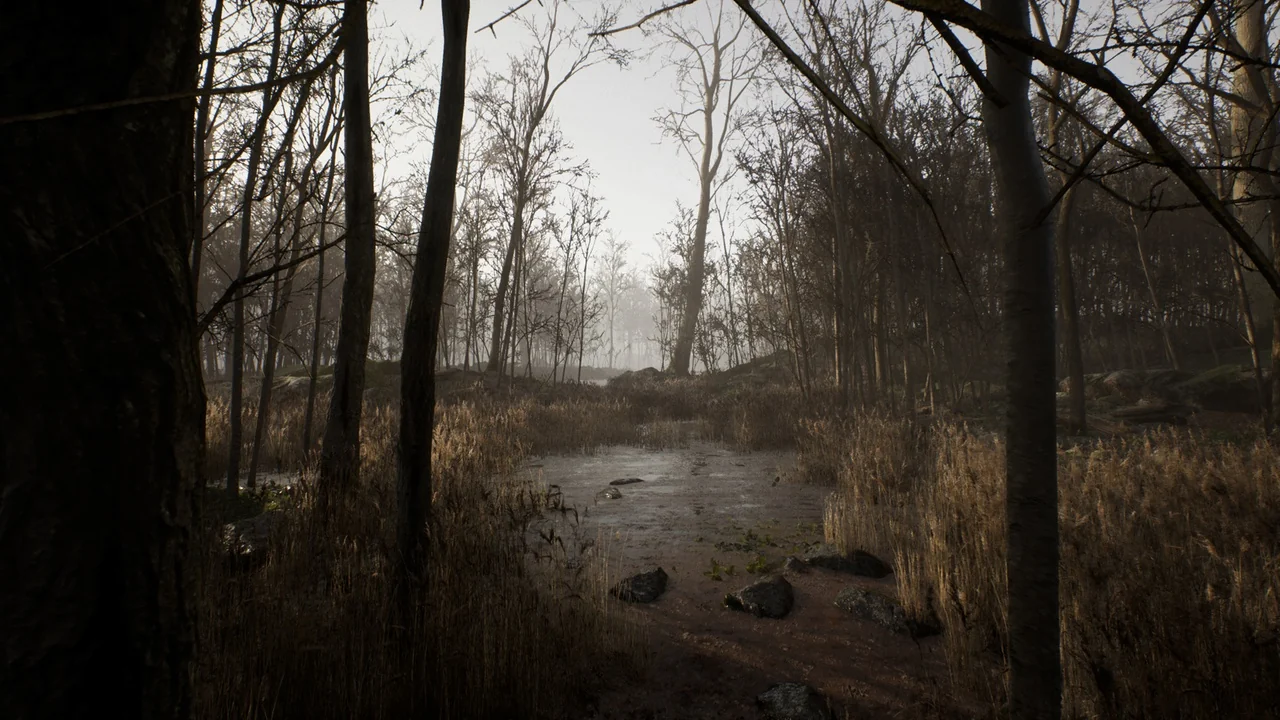
 Forest & Jungle
 Forest & Jungle
 Forest & Jungle