"c83ee50a0da9d10a"{"id":"1000390","slug":"pirate-girl-2","title":"Pirate Girl","category":"Characters \u0026 Creatures","engine":"4.26+,5.0+","assetVersion":"","engineVersion":"Engine Version: 4.26+,5.0+","tag":"Characters","accent":"blue","visual":"character","summary":"A fully rigged, modular female character featuring 4K PBR textures, dynamic hair and cloth physics, and Apple blendshapes for Live Link Face integration.","platform":"Unreal Engine","publishedAt":"2026-07-07T14:41:04.455Z","updatedAt":"2026-07-07T14:41:04.455Z","sourceNotes":[],"fileContents":[],"compatibility":["Unreal Engine","Engine Version: 4.26+,5.0+"],"featuredImage":{"alt":"Pirate Girl","src":"/wp-content/uploads/published/2026/07/d5b9a4f3b1b4-d2969ffe-54f9-4c47-967c-11944d120c4d-e9f1e81ffc.webp"},"hasDownloadLink":true,"downloads":1,"terms":[{"taxonomy":"category","slug":"characters-and-creatures","name":"Characters \u0026 Creatures"}],"galleryImages":[{"src":"/wp-content/uploads/published/2026/07/8627d51d928a-6a1b336b-c763-4750-b5f8-2b9d28ebd856-116b4d8662.webp","alt":"Pirate Girl"},{"src":"/wp-content/uploads/published/2026/07/9443c05a519e-ea9f6bc1-ee61-4c41-ba09-66af58b859c5-019ed7897f.webp","alt":"Pirate Girl"},{"src":"/wp-content/uploads/published/2026/07/1e42fb5ccdec-82835023-770b-43ea-b6ee-9ad68d21a388-34ccd7903e.webp","alt":"Pirate Girl"},{"src":"/wp-content/uploads/published/2026/07/e40125f37658-1aec9f99-615a-4193-8a43-893dd9cf8181-84add4fced.webp","alt":"Pirate Girl"},{"src":"/wp-content/uploads/published/2026/07/814d513b13ab-1ccbccec-38f1-4a02-922f-19b552784938-ae1770e88f.webp","alt":"Pirate Girl"},{"src":"/wp-content/uploads/published/2026/07/0100c72faaa8-cd24276d-25ef-46b0-84b0-b3affbd00239-06f59905cc.webp","alt":"Pirate Girl"},{"src":"/wp-content/uploads/published/2026/07/226128484a87-ed1124ac-3afd-44fa-81ff-8181ad8f08bb-a054e38881.webp","alt":"Pirate Girl"},{"src":"/wp-content/uploads/published/2026/07/7389164fbdcb-36029899-7ae2-42b7-bd8c-5eeb141b9ac1-c47dcf66a3.webp","alt":"Pirate Girl"},{"src":"/wp-content/uploads/published/2026/07/83efc233ec2a-75d3996f-c5f0-4d58-8393-faecebd3835e-d93f839976.webp","alt":"Pirate Girl"},{"src":"/wp-content/uploads/published/2026/07/e59b43fe2c05-34f62b14-eede-48f5-85b0-a4c43eab149f-d76fbbbc31.webp","alt":"Pirate Girl"}],"accessPanel":{"kind":"resource","title":"Download this resource","eyebrow":"Free Download","message":"Log in or create a free account to start your download.","fileName":"Content.7z","safetyNote":"Resources are manually reviewed before listing to improve quality and reduce obvious risks.","actionLabel":"Download Free","resourceType":"Resource archive"},"contentHtml":"\u003ch2\u003eModular Architecture and RPG Implementation\u003c/h2\u003e\n\u003cp\u003eBuilding interactive high-seas environments or fantasy RPGs requires characters that can seamlessly transition from dynamic combat sequences to close-up cinematic dialogues. The Pirate Girl model serves as a comprehensive character solution built specifically for real-time engines. Designed as a female protagonist or detailed NPC, the asset combines a highly modular structural design with high-resolution texturing and an animation-ready skeleton. By providing a complete suite of materials, dynamic physics setups, and facial performance capabilities, developers can integrate this character directly into complex animation blueprints and gameplay scripts.\u003c/p\u003e\n\u003cp\u003eAt the core of the character's implementation is a fully separated modular design that allows developers to adapt her appearance to different scenes. Because the character is built using independent modular parts, clothing, accessories, and headgear can be detached or swapped depending on the specific needs of the project. This separation of parts is particularly beneficial for RPG development, where player characters often equip different gear over the course of a campaign. Developers can write gameplay scripts that target specific skeletal meshes, turning visibility on or off as the in-game inventory changes.\u003c/p\u003e\n\u003cp\u003eA complete nude body is also added to the package, serving as a foundational mesh for those who wish to build custom armor or alternate outfits over the base geometry. Beyond swapping physical parts, the asset includes built-in functionality to recolor various pieces of the character. Utilizing the provided ID maps, artists can easily iterate on the character's color palette, generating multiple distinct looks from a single asset to populate a wider fantasy world with unique crew members.\u003c/p\u003e\n\u003ch2\u003eEpic Skeleton Rigging and Dynamic Cloth Physics\u003c/h2\u003e\n\u003cp\u003eTo support gameplay movement and action sequences, the character is rigged to the Epic skeleton, ensuring that existing animations retarget natively within Unreal Engine. This compatibility allows developers to plug the model directly into established animation blueprints without requiring complex rig adjustments. However, the skeletal hierarchy extends beyond the standard bipedal setup by incorporating extra bones specifically designed to drive secondary animation.\u003c/p\u003e\n\u003cp\u003eThe character's hair is supported by a dedicated chain of joints—specifically \u003ccode\u003eHair_r1\u003c/code\u003e, \u003ccode\u003eHair_r2\u003c/code\u003e, \u003ccode\u003eHair_r3\u003c/code\u003e, and \u003ccode\u003eHair_r4\u003c/code\u003e—ensuring that long strands follow the character's momentum. Similarly, the pirate-themed attire is rigged for overlapping movement. Extra bones are included for the cloth elements, specifically targeting the hat and belt. The hat's loose bandages are controlled by \u003ccode\u003eHat_bandage_l1\u003c/code\u003e, \u003ccode\u003eHat_bandage_l2\u003c/code\u003e, and \u003ccode\u003eHat_bandage_l3\u003c/code\u003e, while the belt features its own dedicated articulation through \u003ccode\u003eBelt_bandage\u003c/code\u003e, \u003ccode\u003eBelt_bandage1\u003c/code\u003e, and \u003ccode\u003eBelt_bandage2\u003c/code\u003e.\u003c/p\u003e\n\u003cp\u003eTo maximize the realism of these elements in motion, physics is enabled for both the hair and the cloth. This allows the engine's physics solver to calculate the overlapping action of the bandages, belt, and hair during rapid sword swings or running animations, adding substantial weight and fluidity to the character's presence in a scene.\u003c/p\u003e\n\u003ch2\u003eFacial Expressions and Live Link Compatibility\u003c/h2\u003e\n\u003cp\u003eFor projects that require deep narrative engagement or high-fidelity cutscenes, the character is fully equipped for detailed facial animation. The mesh includes comprehensive facial expressions driven by built-in morph targets. Because these morphs are formatted as Apple blendshapes, the character is entirely compatible with Live Link Face.\u003c/p\u003e\n\u003cp\u003eThe presence of these specific morph targets ensures that every major facial muscle movement—from blinking and squinting to complex phonetic mouth shapes—is accounted for natively within the geometry. By integrating seamlessly with Live Link Face, developers can capture nuanced performances using a smartphone camera and stream the facial data directly onto the character in real-time. This setup allows teams to bypass traditional manual keyframing for facial expressions, significantly accelerating the animation pipeline for dialogue-heavy RPGs or virtual production environments.\u003c/p\u003e\n\u003ch2\u003e4K Material Setup and Customization\u003c/h2\u003e\n\u003cp\u003eThe visual fidelity of the character is maintained through an extensive array of 4K textures, structured for modern physically based rendering pipelines. The modular clothing, accessories, and hat each utilize dedicated 4K texture sets that include Albedo and Normal maps, alongside a packed Occlusion, Metallic, and Roughness map to optimize memory usage. These specific sets also include ID maps to support the character's recoloring features.\u003c/p\u003e\n\u003cp\u003eThe organic elements of the model receive the same high-resolution treatment. The head, body, eyes, and mouth are all backed by their own 4K Albedo, Normal, and packed Occlusion+Metallic+Roughness maps. The character's hair utilizes a specialized rendering approach, relying on a unique 4K texture suite that includes Albedo, Alpha, Root, Depth, and ID maps to accurately simulate the complex light scattering and transparency of individual hair strands. The eyelashes are kept slightly more optimized, using 1K Albedo and Alpha maps to maintain crisp detail around the eyes without consuming unnecessary texture memory.\u003c/p\u003e\n\u003cp\u003eTo ensure these textures perform correctly out of the box, the package includes a complete architecture of materials, material functions, and material instances. The inclusion of material instances is a critical workflow advantage. By utilizing instances derived from the core material functions, developers can adjust the recolor settings via the ID masks in real-time without needing to recompile the master shaders.\u003c/p\u003e\n\u003ch2\u003eGeometry Breakdown and the Sword Prop\u003c/h2\u003e\n\u003cp\u003eAs a combat-ready fantasy character, she is equipped with a distinct sword prop. The sword is an independent asset with its own 4K texture set consisting of Albedo, Normal, and Occlusion+Metallic+Roughness maps. In terms of geometry, the sword itself consists of 2,326 vertices, 4,770 edges, 2,461 faces, and 4,607 triangles.\u003c/p\u003e\n\u003cp\u003eThe character's underlying nude body consists of 26,398 vertices, 77,243 edges, 50,884 faces, and 50,884 triangles. When fully assembled with all modular clothing, hair, weapons, and accessories, the complete character model represents a dense, high-quality technical footprint. The full asset comprises 81,309 vertices, 165,459 edges, 84,489 faces, and 141,656 triangles, providing a highly detailed silhouette suitable for modern platforms.\u003c/p\u003e\n\n\u003ch2\u003eExplore Similar Assets\u003c/h2\u003e\n\u003cul\u003e\n\u003cli\u003e\u003ca href=\"https://3dcghub.com/pirate-girl/\" title=\"Pirate Girl\"\u003ePirate Girl\u003c/a\u003e\u003c/li\u003e\n\u003cli\u003e\u003ca href=\"https://3dcghub.com/daemon-girl-deluxe-version-game-ready/\" title=\"Daemon Girl Deluxe Version - Game Ready\"\u003eDaemon Girl Deluxe Version - Game Ready\u003c/a\u003e\u003c/li\u003e\n\u003cli\u003e\u003ca href=\"https://3dcghub.com/cosmo-fox-girl-sci-fi-kitsune/\" title=\"Cosmo Fox Girl / Sci-fi Kitsune\"\u003eCosmo Fox Girl / Sci-fi Kitsune\u003c/a\u003e\u003c/li\u003e\n\u003cli\u003e\u003ca href=\"https://3dcghub.com/pink-cyber-girl/\" title=\"PINK CYBER GIRL\"\u003ePINK CYBER GIRL\u003c/a\u003e\u003c/li\u003e\n\u003cli\u003e\u003ca href=\"https://3dcghub.com/beach-girls/\" title=\"Beach Girls\"\u003eBeach Girls\u003c/a\u003e\u003c/li\u003e\n\u003c/ul\u003e","contentTextLength":6671,"navigation":{"current":1247,"total":3498,"previous":{"id":"1000391","slug":"planes-in-the-sky","title":"Planes in the Sky","category":"Procedural Systems","platform":"Unreal Engine","updatedAt":"2026-07-07T14:47:18.340Z"},"next":{"id":"1000389","slug":"pedestrians","title":"Pedestrians","category":"Gestures","platform":"Unreal Engine","updatedAt":"2026-07-07T14:36:23.705Z"}},"relatedResources":[{"id":"3233","slug":"pirate-girl","title":"Pirate Girl","category":"Characters \u0026 Creatures","engine":"4.26+,5.0+","assetVersion":"Engine version: 4.26+,5.0+","engineVersion":"4.27","tag":"Characters","accent":"blue","visual":"character","summary":"Discover a high-quality Pirate Girl 3D character featuring advanced physics, facial blendshapes, and realistic hair movement for your next game project.","platform":"Unreal Engine","publishedAt":"2026-02-08T16:54:05.000Z","updatedAt":"2026-04-19T15:57:40.000Z","sourceNotes":[],"fileContents":[],"compatibility":["Unreal Engine","Engine version: 4.26+,5.0+"],"featuredImage":{"alt":"Pirate Girl","src":"https://3dcghub.com/wp-content/uploads/2026/02/2a7cb292-f001-459c-815d-a72ab279c05e.webp"},"hasDownloadLink":true,"downloads":0},{"id":"1000982","slug":"ciber-girl","title":"Ciber Girl","category":"Characters \u0026 Creatures","engine":"4.26+,5.0+","assetVersion":"","engineVersion":"Engine Version: 4.26+,5.0+","tag":"Characters","accent":"blue","visual":"character","summary":"Ciber Girl is a UE4-ready spacesuit character for cyberpunk and space-themed games, with high-res textures for close-ups and two mesh variants.","platform":"Unreal Engine","publishedAt":"2026-08-18T06:05:02.961Z","updatedAt":"2026-08-18T06:05:02.961Z","sourceNotes":[],"fileContents":[],"compatibility":["Unreal Engine","Engine Version: 4.26+,5.0+"],"featuredImage":{"alt":"Ciber Girl","src":"/wp-content/uploads/published/2026/08/7e37c25eccec-8383d00e-a861-4b5e-af13-1f40cdd07fa5-661965bd05.webp"},"hasDownloadLink":true,"downloads":1},{"id":"1000497","slug":"amazonian-warrior-girl","title":"Amazonian warrior girl","category":"Characters \u0026 Creatures","engine":"4.26+,5.0+","assetVersion":"","engineVersion":"Engine Version: 4.26+,5.0+","tag":"Characters","accent":"blue","visual":"character","summary":"A rigged, low-poly Amazonian warrior girl character model with 4K PBR textures, two interchangeable skin materials, and default skeleton compatibility for Unrea","platform":"Unreal Engine","publishedAt":"2026-07-13T04:00:54.006Z","updatedAt":"2026-07-13T04:00:54.006Z","sourceNotes":[],"fileContents":[],"compatibility":["Unreal Engine","Engine Version: 4.26+,5.0+"],"featuredImage":{"alt":"Amazonian warrior girl","src":"/wp-content/uploads/published/2026/07/6dff3d76561b-2ab1fcb9-dce7-4128-a8dc-9f79d681a72a-92625e72af.webp"},"hasDownloadLink":true,"downloads":1}]}
Characters
Pirate Girl
A fully rigged, modular female character featuring 4K PBR textures, dynamic hair and cloth physics, and Apple blendshapes for Live Link Face integration.
Building interactive high-seas environments or fantasy RPGs requires characters that can seamlessly transition from dynamic combat sequences to close-up cinematic dialogues. The Pirate Girl model serves as a comprehensive character solution built specifically for real-time engines. Designed as a female protagonist or detailed NPC, the asset combines a highly modular structural design with high-resolution texturing and an animation-ready skeleton. By providing a complete suite of materials, dynamic physics setups, and facial performance capabilities, developers can integrate this character directly into complex animation blueprints and gameplay scripts.
At the core of the character's implementation is a fully separated modular design that allows developers to adapt her appearance to different scenes. Because the character is built using independent modular parts, clothing, accessories, and headgear can be detached or swapped depending on the specific needs of the project. This separation of parts is particularly beneficial for RPG development, where player characters often equip different gear over the course of a campaign. Developers can write gameplay scripts that target specific skeletal meshes, turning visibility on or off as the in-game inventory changes.
A complete nude body is also added to the package, serving as a foundational mesh for those who wish to build custom armor or alternate outfits over the base geometry. Beyond swapping physical parts, the asset includes built-in functionality to recolor various pieces of the character. Utilizing the provided ID maps, artists can easily iterate on the character's color palette, generating multiple distinct looks from a single asset to populate a wider fantasy world with unique crew members.
Epic Skeleton Rigging and Dynamic Cloth Physics
To support gameplay movement and action sequences, the character is rigged to the Epic skeleton, ensuring that existing animations retarget natively within Unreal Engine. This compatibility allows developers to plug the model directly into established animation blueprints without requiring complex rig adjustments. However, the skeletal hierarchy extends beyond the standard bipedal setup by incorporating extra bones specifically designed to drive secondary animation.
The character's hair is supported by a dedicated chain of joints—specifically Hair_r1, Hair_r2, Hair_r3, and Hair_r4—ensuring that long strands follow the character's momentum. Similarly, the pirate-themed attire is rigged for overlapping movement. Extra bones are included for the cloth elements, specifically targeting the hat and belt. The hat's loose bandages are controlled by Hat_bandage_l1, Hat_bandage_l2, and Hat_bandage_l3, while the belt features its own dedicated articulation through Belt_bandage, Belt_bandage1, and Belt_bandage2.
To maximize the realism of these elements in motion, physics is enabled for both the hair and the cloth. This allows the engine's physics solver to calculate the overlapping action of the bandages, belt, and hair during rapid sword swings or running animations, adding substantial weight and fluidity to the character's presence in a scene.
Facial Expressions and Live Link Compatibility
For projects that require deep narrative engagement or high-fidelity cutscenes, the character is fully equipped for detailed facial animation. The mesh includes comprehensive facial expressions driven by built-in morph targets. Because these morphs are formatted as Apple blendshapes, the character is entirely compatible with Live Link Face.
The presence of these specific morph targets ensures that every major facial muscle movement—from blinking and squinting to complex phonetic mouth shapes—is accounted for natively within the geometry. By integrating seamlessly with Live Link Face, developers can capture nuanced performances using a smartphone camera and stream the facial data directly onto the character in real-time. This setup allows teams to bypass traditional manual keyframing for facial expressions, significantly accelerating the animation pipeline for dialogue-heavy RPGs or virtual production environments.
4K Material Setup and Customization
The visual fidelity of the character is maintained through an extensive array of 4K textures, structured for modern physically based rendering pipelines. The modular clothing, accessories, and hat each utilize dedicated 4K texture sets that include Albedo and Normal maps, alongside a packed Occlusion, Metallic, and Roughness map to optimize memory usage. These specific sets also include ID maps to support the character's recoloring features.
The organic elements of the model receive the same high-resolution treatment. The head, body, eyes, and mouth are all backed by their own 4K Albedo, Normal, and packed Occlusion+Metallic+Roughness maps. The character's hair utilizes a specialized rendering approach, relying on a unique 4K texture suite that includes Albedo, Alpha, Root, Depth, and ID maps to accurately simulate the complex light scattering and transparency of individual hair strands. The eyelashes are kept slightly more optimized, using 1K Albedo and Alpha maps to maintain crisp detail around the eyes without consuming unnecessary texture memory.
To ensure these textures perform correctly out of the box, the package includes a complete architecture of materials, material functions, and material instances. The inclusion of material instances is a critical workflow advantage. By utilizing instances derived from the core material functions, developers can adjust the recolor settings via the ID masks in real-time without needing to recompile the master shaders.
Geometry Breakdown and the Sword Prop
As a combat-ready fantasy character, she is equipped with a distinct sword prop. The sword is an independent asset with its own 4K texture set consisting of Albedo, Normal, and Occlusion+Metallic+Roughness maps. In terms of geometry, the sword itself consists of 2,326 vertices, 4,770 edges, 2,461 faces, and 4,607 triangles.
The character's underlying nude body consists of 26,398 vertices, 77,243 edges, 50,884 faces, and 50,884 triangles. When fully assembled with all modular clothing, hair, weapons, and accessories, the complete character model represents a dense, high-quality technical footprint. The full asset comprises 81,309 vertices, 165,459 edges, 84,489 faces, and 141,656 triangles, providing a highly detailed silhouette suitable for modern platforms.
 Characters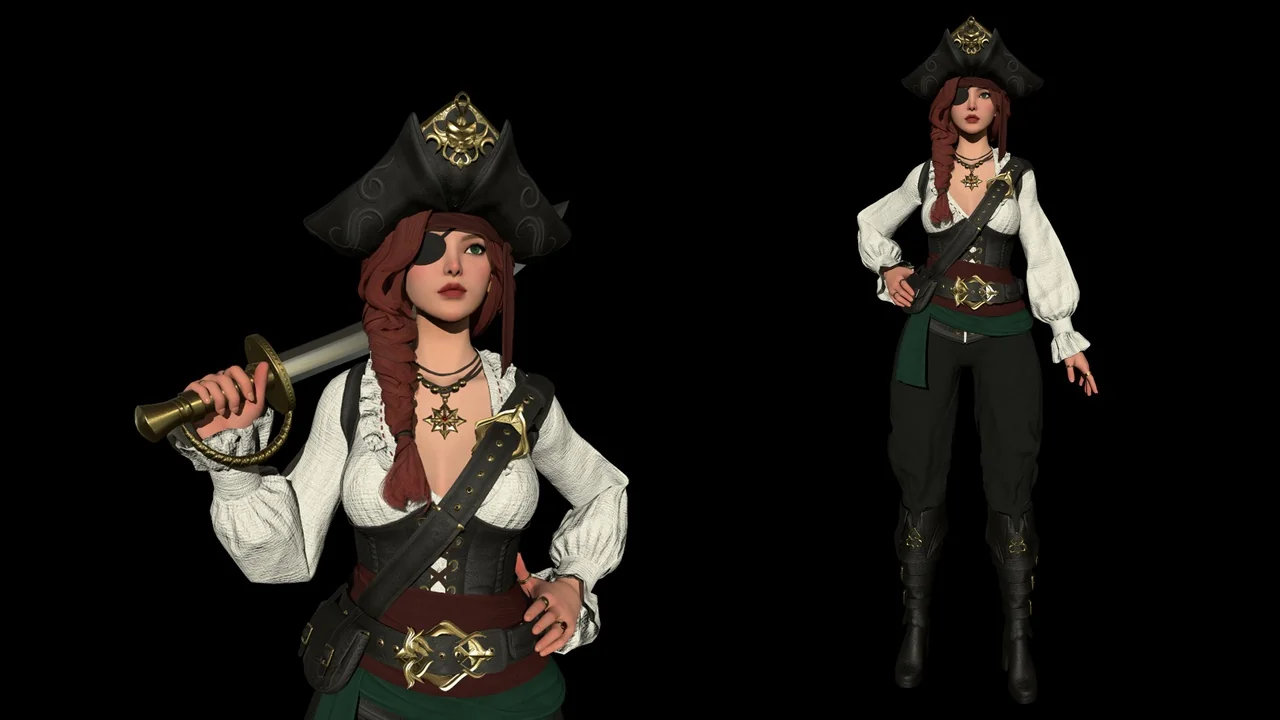
 Characters
 Characters
 Characters