"c14ff6bd758dadb1"{"id":"1000085","slug":"old-shipyard","title":"Old Shipyard","category":"Industrial","engine":"Engine Version: 5.0+","assetVersion":"Engine Version: 5.0+","engineVersion":"","tag":"Industrial","accent":"blue","visual":"mech","summary":"A UE5 old shipyard scene with modular buildings, reusable textures, procedural wetness, Lumen support, and Nanite compatibility.","platform":"Unreal Engine","publishedAt":"2026-06-05T16:15:41.441Z","updatedAt":"2026-06-05T16:15:41.441Z","sourceNotes":[],"fileContents":[],"compatibility":["Unreal Engine","Engine Version: 5.0+"],"featuredImage":{"alt":"Old Shipyard","src":"/wp-content/uploads/published/2026/06/86494c21506e-e5f1f09d-1985-4c33-baa4-40507a416dd0-38e4fa3b33.webp"},"hasDownloadLink":true,"downloads":1,"terms":[{"taxonomy":"category","slug":"industrial-environments","name":"Industrial"}],"galleryImages":[{"src":"/wp-content/uploads/published/2026/06/7d0c3387d6e8-d7f6e5e3-a6d6-4727-9209-78bb2a103e4c-868473ccb5.webp","alt":"Old Shipyard"},{"src":"/wp-content/uploads/published/2026/06/9be2729f9673-b5f904b9-6236-4e30-920e-388fd728530d-7ab3524317.webp","alt":"Old Shipyard"},{"src":"/wp-content/uploads/published/2026/06/39eac5801762-a6801133-2a40-4d88-b107-1aa3552a5922-82331c99d9.webp","alt":"Old Shipyard"},{"src":"/wp-content/uploads/published/2026/06/2105dadf718d-4aeb785f-64e6-473b-b75e-bb367eff5c61-56d858f5de.webp","alt":"Old Shipyard"},{"src":"/wp-content/uploads/published/2026/06/da86bf3eeba0-bd20ea9f-cba6-4c51-a309-aa1dcd3f3e40-55f74dcc75.webp","alt":"Old Shipyard"},{"src":"/wp-content/uploads/published/2026/06/3d0a8aea4692-d286fdfb-320b-4548-aabd-3da5b39d1b4a-70b8280626.webp","alt":"Old Shipyard"},{"src":"/wp-content/uploads/published/2026/06/5c57ca5c345c-c785445f-1b27-4046-aeac-49c71c675d64-8095637b64.webp","alt":"Old Shipyard"},{"src":"/wp-content/uploads/published/2026/06/fcbe35513a37-4602ca83-5390-407f-a11d-cee311de07b9-7c079e139f.webp","alt":"Old Shipyard"},{"src":"/wp-content/uploads/published/2026/06/c9b813dbc88b-f9eeac33-e855-4a06-9ef8-fce8c071546a-f4fa5d496b.webp","alt":"Old Shipyard"},{"src":"/wp-content/uploads/published/2026/06/94b716440af3-d4e8e060-7f87-4933-a987-51df2aecfce2-dfd8ce8ad0.webp","alt":"Old Shipyard"}],"accessPanel":{"kind":"resource","title":"Access this resource","eyebrow":"Free Download","message":"Log in or create a free account to start your download.","fileName":"Content.7z","safetyNote":"Resources are manually reviewed before listing to improve quality and reduce obvious risks.","actionLabel":"Download Free","resourceType":"Resource archive"},"contentHtml":"\u003cp\u003eMove a building piece in this shipyard and the surface damage changes with it. Brick wear and dirt are driven by randomized texture behavior based on mesh position in the world, so the modular parts do not stay visually frozen when they are rearranged. That single detail says a lot about how Old Shipyard fits into production: it is not just a static showcase scene, but an environment package meant to be assembled, adjusted, and reused inside Unreal Engine 5.\u003c/p\u003e \u003cp\u003eOld Shipyard includes the full scene as well as the assets visible in the presented renders. It comes with both an assembled scene and separate asset levels, which makes it practical for teams that want either the ready-made environment or the individual pieces for their own layout work. The visual target is realistic, and the set leans into an industrial coastal mood shaped by metal, concrete, brick, sea-facing structures, machinery, and an apocalyptic edge.\u003c/p\u003e \u003ch2\u003eOld Shipyard as a modular Unreal Engine 5 environment\u003c/h2\u003e\n\u003cp\u003eThe core of the package is its modular building workflow. The buildings were made as modular pieces, and those pieces use tileable textures with correct normals. Instead of relying on vertex paint or decals, the scene handles surface breakup through its material setup. That matters in a production context because the environment is structured around repeatable parts and reusable materials rather than one-off detailing methods tied to a single composition.\u003c/p\u003e \u003cp\u003eNo vertex paint and no decals gives the scene a very specific technical character. The material solution carries a larger share of the visual work, while the building parts remain flexible. Dirt and brick damage are generated through randomized textures linked to each mesh position in the world. As a result, moving pieces creates different damage variation automatically. For environment assembly, that helps modular repetition feel less obvious without requiring artists to manually rework every section.\u003c/p\u003e \u003cp\u003eThe package also emphasizes minimum unique textures, along with texture and instance reusability. In a real workflow, that points toward a scene built to stretch materials across multiple elements rather than depending on a large library of bespoke maps. Old Shipyard is therefore well suited to projects where broad environmental coverage and consistent surface language matter as much as isolated hero assets.\u003c/p\u003e \u003ch2\u003eTileable textures, UV usage, and background assets\u003c/h2\u003e\n\u003cp\u003eTexture use in Old Shipyard follows a clear hierarchy. The buildings use tileable textures with correct normals, while some background elements are kept even simpler. Port cranes and the tree use fairly basic tileable textures intended for background use. That separation makes sense in a scene of this scale: visual effort is concentrated where players or cameras are more likely to read structural detail, while distant forms stay efficient.\u003c/p\u003e \u003cp\u003eThe dressing assets also reveal how the package is prepared for environment work. Concrete pieces, roof elements, port containers, and similar props use the first UV channel to keep texel density, while the second UV channel is used for masks. This is a practical layout for a set that expects repeated placement and material variation across many parts. It supports consistency across modular dressing while still allowing masked control where needed.\u003c/p\u003e \u003cp\u003eBecause the project relies on reusable textures and instances, the environment reads as a system rather than a collection of disconnected props. That makes Old Shipyard especially relevant for artists building industrial waterfront scenes, post-apocalyptic spaces, or large realistic levels where visual cohesion needs to survive repeated use of the same parts.\u003c/p\u003e \u003ch2\u003eProcedural wetness and cheap material shaders in scene work\u003c/h2\u003e\n\u003cp\u003eOld Shipyard includes adjustable procedural wetness, which gives the environment a direct way to shift surface mood without replacing the entire material approach. In a dockside or sea-adjacent setting, wetness can strongly affect how concrete, brick, and metal read under lighting. Having that adjustment available at the material level is useful when a team needs to push the scene toward a freshly rained-on look or a damp harbor atmosphere.\u003c/p\u003e \u003cp\u003eThe shaders are described as cheap material shaders, which places this scene in an interesting spot. The visual target is AAA quality, but the material strategy is still conscious of efficiency. That combination is important in production use. It suggests an attempt to balance realism and scalability, especially in an environment that includes assembled scene content, modular structures, background machinery, and a broad set of dressing assets.\u003c/p\u003e \u003cp\u003eSince the package avoids decals and vertex paint, the procedural and shader-based side of the setup becomes even more central. This gives a shipyard scene where look development is not locked to hand-placed overlay detail. Teams evaluating environment packs for iteration-heavy work will likely notice that this structure favors rearrangement and repeated use.\u003c/p\u003e \u003ch2\u003eRobot textures and baked cloth animation\u003c/h2\u003e\n\u003cp\u003eAmong the scene elements, the robot stands out as a more specifically detailed asset. It uses two unique 4K texture sets: one 4K set for the body and one 4K set for a leg. The other leg is a symmetrical model. This gives the robot a different texture treatment from the broader environment pieces, which mostly lean on shared and tileable material strategies.\u003c/p\u003e \u003cp\u003eThat contrast tells you where Old Shipyard places its detail budget. Large structural and background elements favor reuse, while the robot receives unique texture attention. Inside a project, that makes the robot feel closer to a focal asset inside the wider scene, even as the overall environment remains grounded in modular construction.\u003c/p\u003e \u003cp\u003eThe cloth animation in the project was baked in Marvelous Designer. It has no rigging and no bones. That is a very specific implementation detail, and it matters for anyone assessing how the animated cloth behaves in the scene. Rather than being set up as a rigged cloth component, it exists as baked motion. For scene presentation and fixed environmental motion, that can be exactly the intended use.\u003c/p\u003e \u003ch2\u003eLumen, Nanite, HDRI Backdrop, and default ray tracing\u003c/h2\u003e\n\u003cp\u003eOld Shipyard is made for Unreal Engine 5.0 and higher, with support for Lumen. It also works with Nanite, though Nanite is disabled by default. Those details place it firmly in a modern UE5 rendering workflow, especially for users who want to take advantage of current lighting and geometry handling features in realistic environment scenes.\u003c/p\u003e \u003cp\u003eThe project uses the HDRI Backdrop plugin, and that plugin needs to be enabled. Ray tracing is enabled by default as well. Together, those points shape how the scene is expected to be opened and evaluated. Old Shipyard is not simply a folder of meshes and materials; it is a scene package with rendering expectations already in place, including a lighting workflow tied to Lumen and an environment setup that depends on HDRI Backdrop.\u003c/p\u003e \u003cp\u003eFor teams testing scenes inside UE5, these details help define where the package fits. It is appropriate for artists who want a realistic shipyard environment already aligned with Lumen-era rendering, while still leaving room to toggle or manage features such as Nanite depending on project needs. Since the package includes both the assembled scene and asset levels, it can serve either as a ready environment reference or as a modular source for constructing a different industrial coastal layout.\u003c/p\u003e \u003ch2\u003eWhere Old Shipyard fits best\u003c/h2\u003e\n\u003cp\u003eOld Shipyard works best when the goal is to place a realistic industrial waterfront scene into a UE5 pipeline without building every surface language from scratch. Its strongest production traits are not just the finished look, but the way that look is maintained through modular buildings, tileable textures, reusable instances, randomized damage variation, and adjustable wetness. The environment supports Lumen, works with Nanite, expects HDRI Backdrop, and arrives with ray tracing enabled by default.\u003c/p\u003e \u003cp\u003eThe clearest takeaway is simple: this is a UE5 shipyard scene that favors modular assembly and material-driven variation over decals, vertex painting, or heavily bespoke texturing across the whole set.\u003c/p\u003e\n\n\u003ch2\u003eMore From The Same Workflow\u003c/h2\u003e\n\u003cul\u003e\n\u003cli\u003e\u003ca href=\"https://3dcghub.com/old-industrial-city-and-shipyard-industrial-interiors-industrial-town/\" title=\"Old Industrial City and Shipyard \u0026amp; Industrial Interiors (Industrial Town)\"\u003eOld Industrial City and Shipyard \u0026amp; Industrial Interiors (Industrial Town)\u003c/a\u003e\u003c/li\u003e\n\u003cli\u003e\u003ca href=\"https://3dcghub.com/old-factory/\" title=\"Old Factory\"\u003eOld Factory\u003c/a\u003e\u003c/li\u003e\n\u003cli\u003e\u003ca href=\"https://3dcghub.com/modular-sewers-tunnels-modular-sewers-modular-tunnels-modular-corridor/\" title=\"Modular Sewers \u0026amp; Tunnels (Modular Sewers, Modular Tunnels, Modular Corridor)\"\u003eModular Sewers \u0026amp; Tunnels (Modular Sewers, Modular Tunnels, Modular Corridor)\u003c/a\u003e\u003c/li\u003e\n\u003cli\u003e\u003ca href=\"https://3dcghub.com/post-apocalyptic-melee-weapons-vol-2-post-apocalyptic-melee-weapons-weapon-old/\" title=\"Post Apocalyptic Melee Weapons VOL.2 (Post Apocalyptic Melee Weapons Weapon Old)\"\u003ePost Apocalyptic Melee Weapons VOL.2 (Post Apocalyptic Melee Weapons Weapon Old)\u003c/a\u003e\u003c/li\u003e\n\u003cli\u003e\u003ca href=\"https://3dcghub.com/medieval-viking-weapons-and-shields-set-medieval-viking-weapons-shield-old/\" title=\"Medieval / Viking Weapons and Shields Set ( Medieval Viking Weapons Shield Old )\"\u003eMedieval / Viking Weapons and Shields Set ( Medieval Viking Weapons Shield Old )\u003c/a\u003e\u003c/li\u003e\n\u003c/ul\u003e","contentTextLength":8557,"navigation":{"current":1777,"total":3719,"previous":{"id":"1000086","slug":"ork-rogue","title":"Ork Rogue","category":"Creatures \u0026 Monsters","platform":"Unreal Engine","updatedAt":"2026-06-05T16:40:06.485Z"},"next":{"id":"1000084","slug":"ocean-monster-fish-pack-part-2-underwater-creatures-fish-low-poly-11","title":"Ocean Monster Fish Pack - Part 2 - Underwater Creatures - Fish low poly - #11","category":"Creatures \u0026 Monsters","platform":"Unreal Engine","updatedAt":"2026-06-05T16:10:19.047Z"}},"relatedResources":[{"id":"8677","slug":"old-industrial-city-and-shipyard-industrial-interiors-industrial-town","title":"Old Industrial City and Shipyard \u0026 Industrial Interiors (Industrial Town)","category":"Industrial","engine":"4.26+,5.0+","assetVersion":"Engine version: 4.26+,5.0+","engineVersion":"4.20","tag":"Industrial","accent":"blue","visual":"city","summary":"Build detailed industrial landscapes with this comprehensive asset pack. It features modular factories, shipyard components, and realistic interiors for game developers.","platform":"Unreal Engine","publishedAt":"2026-02-23T18:29:31.000Z","updatedAt":"2026-04-19T15:55:22.000Z","sourceNotes":[],"fileContents":[],"compatibility":["Unreal Engine"],"featuredImage":{"alt":"Old Industrial City and Shipyard \u0026 Industrial Interiors (Industrial Town)","src":"https://3dcghub.com/wp-content/uploads/2026/02/7b7298b4-8bd7-4c75-bd5c-4617d0d9495c.webp"},"hasDownloadLink":true,"downloads":1},{"id":"8668","slug":"old-factory","title":"Old Factory","category":"Industrial","engine":"4.26+,5.0+","assetVersion":"Engine version: 4.26+,5.0+","engineVersion":"4.25","tag":"Industrial","accent":"blue","visual":"city","summary":"Enhance your game design with a comprehensive industrial asset pack. It includes modular buildings with interiors, realistic vehicles, and high-quality props for any project.","platform":"Unreal Engine","publishedAt":"2026-02-23T18:26:50.000Z","updatedAt":"2026-04-19T15:55:22.000Z","sourceNotes":[],"fileContents":[],"compatibility":["Unreal Engine","Engine version: 4.26+,5.0+"],"featuredImage":{"alt":"Old Factory","src":"https://3dcghub.com/wp-content/uploads/2026/02/7b931562-39a9-4b2e-b018-8589d854fb44.webp"},"hasDownloadLink":true,"downloads":0},{"id":"1000825","slug":"fences-vol-4-old-fences-modular-nanite-and-low-poly","title":"Fences VOL.4 - Old Fences Modular (Nanite and Low Poly)","category":"Railings \u0026 Fences","engine":"5.1+","assetVersion":"","engineVersion":"Engine Version: 5.1+","tag":"Railings \u0026 Fences","accent":"blue","visual":"mech","summary":"Modular old fence pack for Unreal Engine 5.0+ with 114 Nanite and low poly meshes, 4k textures, tintable materials, and Lumen support for AAA scenes.","platform":"Unreal Engine","publishedAt":"2026-08-01T13:32:42.101Z","updatedAt":"2026-08-01T13:32:42.101Z","sourceNotes":[],"fileContents":[],"compatibility":["Unreal Engine","Engine Version: 5.1+"],"featuredImage":{"alt":"Fences VOL.4 - Old Fences Modular (Nanite and Low Poly)","src":"/wp-content/uploads/published/2026/08/75b50f7705c0-f4b7406f-4829-4ec1-af8b-e83a8ca55bcb-c48e128b97.webp"},"hasDownloadLink":true,"downloads":1}]}
Industrial
Old Shipyard
A UE5 old shipyard scene with modular buildings, reusable textures, procedural wetness, Lumen support, and Nanite compatibility.
Category:Unreal Engine,IndustrialPlatform: Unreal EngineEngine Version: 5.0+Published: Jun 5, 2026
Industrial
Resource overview
Move a building piece in this shipyard and the surface damage changes with it. Brick wear and dirt are driven by randomized texture behavior based on mesh position in the world, so the modular parts do not stay visually frozen when they are rearranged. That single detail says a lot about how Old Shipyard fits into production: it is not just a static showcase scene, but an environment package meant to be assembled, adjusted, and reused inside Unreal Engine 5.
Old Shipyard includes the full scene as well as the assets visible in the presented renders. It comes with both an assembled scene and separate asset levels, which makes it practical for teams that want either the ready-made environment or the individual pieces for their own layout work. The visual target is realistic, and the set leans into an industrial coastal mood shaped by metal, concrete, brick, sea-facing structures, machinery, and an apocalyptic edge.
Old Shipyard as a modular Unreal Engine 5 environment
The core of the package is its modular building workflow. The buildings were made as modular pieces, and those pieces use tileable textures with correct normals. Instead of relying on vertex paint or decals, the scene handles surface breakup through its material setup. That matters in a production context because the environment is structured around repeatable parts and reusable materials rather than one-off detailing methods tied to a single composition.
No vertex paint and no decals gives the scene a very specific technical character. The material solution carries a larger share of the visual work, while the building parts remain flexible. Dirt and brick damage are generated through randomized textures linked to each mesh position in the world. As a result, moving pieces creates different damage variation automatically. For environment assembly, that helps modular repetition feel less obvious without requiring artists to manually rework every section.
The package also emphasizes minimum unique textures, along with texture and instance reusability. In a real workflow, that points toward a scene built to stretch materials across multiple elements rather than depending on a large library of bespoke maps. Old Shipyard is therefore well suited to projects where broad environmental coverage and consistent surface language matter as much as isolated hero assets.
Tileable textures, UV usage, and background assets
Texture use in Old Shipyard follows a clear hierarchy. The buildings use tileable textures with correct normals, while some background elements are kept even simpler. Port cranes and the tree use fairly basic tileable textures intended for background use. That separation makes sense in a scene of this scale: visual effort is concentrated where players or cameras are more likely to read structural detail, while distant forms stay efficient.
The dressing assets also reveal how the package is prepared for environment work. Concrete pieces, roof elements, port containers, and similar props use the first UV channel to keep texel density, while the second UV channel is used for masks. This is a practical layout for a set that expects repeated placement and material variation across many parts. It supports consistency across modular dressing while still allowing masked control where needed.
Because the project relies on reusable textures and instances, the environment reads as a system rather than a collection of disconnected props. That makes Old Shipyard especially relevant for artists building industrial waterfront scenes, post-apocalyptic spaces, or large realistic levels where visual cohesion needs to survive repeated use of the same parts.
Procedural wetness and cheap material shaders in scene work
Old Shipyard includes adjustable procedural wetness, which gives the environment a direct way to shift surface mood without replacing the entire material approach. In a dockside or sea-adjacent setting, wetness can strongly affect how concrete, brick, and metal read under lighting. Having that adjustment available at the material level is useful when a team needs to push the scene toward a freshly rained-on look or a damp harbor atmosphere.
The shaders are described as cheap material shaders, which places this scene in an interesting spot. The visual target is AAA quality, but the material strategy is still conscious of efficiency. That combination is important in production use. It suggests an attempt to balance realism and scalability, especially in an environment that includes assembled scene content, modular structures, background machinery, and a broad set of dressing assets.
Since the package avoids decals and vertex paint, the procedural and shader-based side of the setup becomes even more central. This gives a shipyard scene where look development is not locked to hand-placed overlay detail. Teams evaluating environment packs for iteration-heavy work will likely notice that this structure favors rearrangement and repeated use.
Robot textures and baked cloth animation
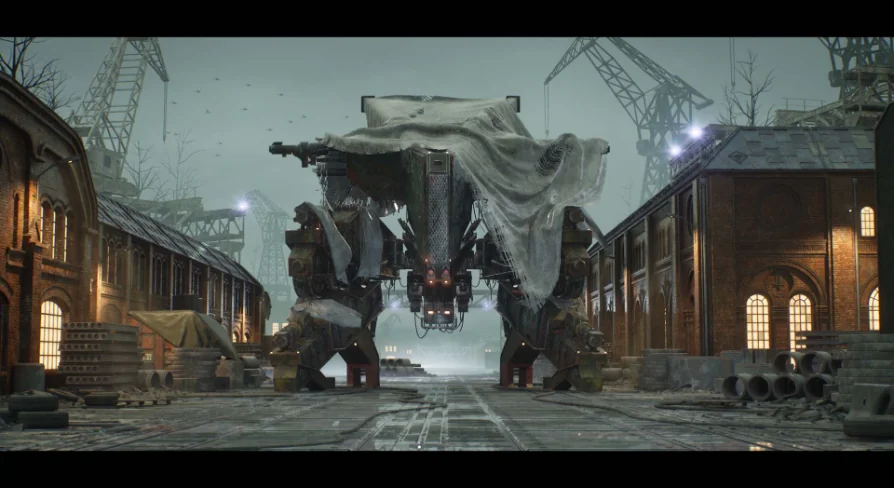
Among the scene elements, the robot stands out as a more specifically detailed asset. It uses two unique 4K texture sets: one 4K set for the body and one 4K set for a leg. The other leg is a symmetrical model. This gives the robot a different texture treatment from the broader environment pieces, which mostly lean on shared and tileable material strategies.
That contrast tells you where Old Shipyard places its detail budget. Large structural and background elements favor reuse, while the robot receives unique texture attention. Inside a project, that makes the robot feel closer to a focal asset inside the wider scene, even as the overall environment remains grounded in modular construction.
The cloth animation in the project was baked in Marvelous Designer. It has no rigging and no bones. That is a very specific implementation detail, and it matters for anyone assessing how the animated cloth behaves in the scene. Rather than being set up as a rigged cloth component, it exists as baked motion. For scene presentation and fixed environmental motion, that can be exactly the intended use.
Lumen, Nanite, HDRI Backdrop, and default ray tracing
Old Shipyard is made for Unreal Engine 5.0 and higher, with support for Lumen. It also works with Nanite, though Nanite is disabled by default. Those details place it firmly in a modern UE5 rendering workflow, especially for users who want to take advantage of current lighting and geometry handling features in realistic environment scenes.
The project uses the HDRI Backdrop plugin, and that plugin needs to be enabled. Ray tracing is enabled by default as well. Together, those points shape how the scene is expected to be opened and evaluated. Old Shipyard is not simply a folder of meshes and materials; it is a scene package with rendering expectations already in place, including a lighting workflow tied to Lumen and an environment setup that depends on HDRI Backdrop.
For teams testing scenes inside UE5, these details help define where the package fits. It is appropriate for artists who want a realistic shipyard environment already aligned with Lumen-era rendering, while still leaving room to toggle or manage features such as Nanite depending on project needs. Since the package includes both the assembled scene and asset levels, it can serve either as a ready environment reference or as a modular source for constructing a different industrial coastal layout.
Where Old Shipyard fits best
Old Shipyard works best when the goal is to place a realistic industrial waterfront scene into a UE5 pipeline without building every surface language from scratch. Its strongest production traits are not just the finished look, but the way that look is maintained through modular buildings, tileable textures, reusable instances, randomized damage variation, and adjustable wetness. The environment supports Lumen, works with Nanite, expects HDRI Backdrop, and arrives with ray tracing enabled by default.
The clearest takeaway is simple: this is a UE5 shipyard scene that favors modular assembly and material-driven variation over decals, vertex painting, or heavily bespoke texturing across the whole set.
 Industrial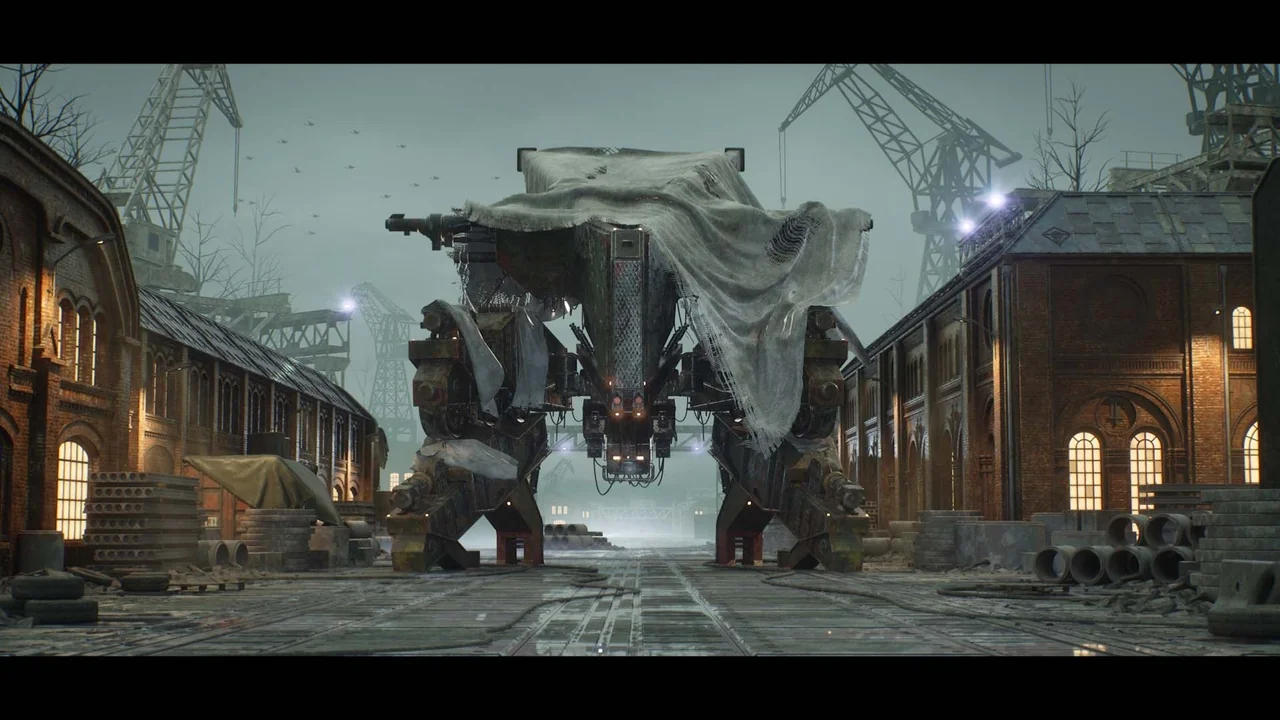
 Industrial
 Industrial
 Railings & Fences