"6ac84fdb0bd06614"{"id":"28222","slug":"musical-instruments-vol-1-nanite-and-low-poly","title":"Musical Instruments VOL.1 (Nanite and Low Poly)","category":"Musical","engine":"5.1+","assetVersion":"Engine version: 5.1+","engineVersion":"","tag":"Musical","accent":"blue","visual":"audio","summary":"Musical Instruments VOL.1 focuses on a common production need: populating scenes with detailed instruments without being locked into a single geometry workflow. The pack combines Nanite and low poly versions of each mesh, alongside 4K textures, master mater...","platform":"Unreal Engine","publishedAt":"2026-05-06T15:31:53.000Z","updatedAt":"2026-05-06T15:31:54.000Z","sourceNotes":[],"fileContents":[],"compatibility":["Audio","Engine version: 5.1+"],"featuredImage":{"alt":"Musical Instruments VOL.1 (Nanite and Low Poly)","src":"https://3dcghub.com/wp-content/uploads/2026/05/d655fc2d4c69_00ad2886-c47d-41c1-9c09-ae5f5219c404.webp"},"hasDownloadLink":true,"downloads":0,"terms":[{"taxonomy":"category","slug":"musical","name":"Musical"},{"taxonomy":"post_tag","slug":"environment","name":"Environment"},{"taxonomy":"post_tag","slug":"prop","name":"Prop"},{"taxonomy":"post_tag","slug":"unreal-engine-5","name":"Unreal Engine 5"}],"galleryImages":[{"src":"https://3dcghub.com/wp-content/uploads/2026/05/4941204e9197_73d0cd1c-863a-4c35-bf15-0a802c4f51eb.webp","alt":"Musical Instruments VOL.1 (Nanite and Low Poly)"},{"src":"https://3dcghub.com/wp-content/uploads/2026/05/34a3d4e45fbe_5b28c44a-0f9c-4b97-b379-7dd4ea5cee03.webp","alt":"Musical Instruments VOL.1 (Nanite and Low Poly)"},{"src":"https://3dcghub.com/wp-content/uploads/2026/05/f17e09059f5f_2a3913c9-9c4f-4128-9d6b-d79e20a22a8d.webp","alt":"Musical Instruments VOL.1 (Nanite and Low Poly)"},{"src":"https://3dcghub.com/wp-content/uploads/2026/05/abbc721e04b0_13182c9c-0adf-4830-8422-bddfa3d06d38.webp","alt":"Musical Instruments VOL.1 (Nanite and Low Poly)"},{"src":"https://3dcghub.com/wp-content/uploads/2026/05/c101c7c986c3_7dc585d3-f3ba-4afc-a2fd-50adf326fab2.webp","alt":"Musical Instruments VOL.1 (Nanite and Low Poly)"},{"src":"https://3dcghub.com/wp-content/uploads/2026/05/24973e3fa3a8_1f1f4ef7-f6bb-4ecb-813a-713c61182015.webp","alt":"Musical Instruments VOL.1 (Nanite and Low Poly)"},{"src":"https://3dcghub.com/wp-content/uploads/2026/05/25f088cb0f12_073c349c-6550-411c-81e4-06dcc3b81f51.webp","alt":"Musical Instruments VOL.1 (Nanite and Low Poly)"},{"src":"https://3dcghub.com/wp-content/uploads/2026/05/749efbabcd74_18362994-f7e9-4d52-bae9-f61baf4c7e57.webp","alt":"Musical Instruments VOL.1 (Nanite and Low Poly)"},{"src":"https://3dcghub.com/wp-content/uploads/2026/05/123c9afc2ad7_cfa6742e-0ccf-4c81-84ed-1932c526689a.webp","alt":"Musical Instruments VOL.1 (Nanite and Low Poly)"},{"src":"https://3dcghub.com/wp-content/uploads/2026/05/b6ea5f6f5e6d_d272e941-7d74-47cd-ad8a-090add4a764c.webp","alt":"Musical Instruments VOL.1 (Nanite and Low Poly)"}],"accessPanel":{"kind":"resource","title":"Access this resource","eyebrow":"Free Download","message":"Log in or create a free account to start your download.","fileName":"Content.7z","safetyNote":"All resources are 100% manually reviewed to eliminate all risks.","actionLabel":"Download Free","resourceType":"Resource archive"},"contentHtml":"\u003cp\u003eFilling a scene with believable instruments can quickly turn into a slow asset pass, especially when a project needs both close-up fidelity and lighter geometry options for broader gameplay use. Musical Instruments VOL.1 addresses that by pairing high-detail Nanite meshes with low poly counterparts for the same set of props, keeping visual consistency while giving teams two practical ways to place the same objects in production.\u003c/p\u003e\u003cp\u003eThe collection includes 96 meshes in total, split as 48 instruments and prop variants with both Nanite and low poly versions of each mesh. Everything pictured is included with assets, maps, and materials created in Unreal Engine. The stated target is realistic AAA-quality visuals, style, and budget, which frames the pack as a scene-building set for projects that need convincing instrument models rather than stylized placeholders.\u003c/p\u003e\u003ch2\u003eUsing Musical Instruments VOL.1 in real-time scenes\u003c/h2\u003e\u003cp\u003eThe most immediate strength here is flexibility at setup level. Each asset exists in a Nanite version for high-fidelity polycounts and in a low poly version as well, so teams are not locked into one rendering approach.\u003c/p\u003e\u003cp\u003eThat split makes the pack usable across different scene priorities inside the same project. A hero shot, cinematic corner, or closer environmental detail can lean on the Nanite meshes, while wider playable spaces or areas that need lighter geometry can draw from the low poly set without changing the visual theme of the scene. Because the package covers both versions of each mesh rather than mixing unrelated objects, it supports a cleaner handoff between art direction and implementation. The focus stays on placing instruments where they fit the scene instead of rebuilding the same prop library twice.\u003c/p\u003e\u003ch2\u003eNanite and low poly versions of each mesh\u003c/h2\u003e\u003cp\u003eThe pack states clearly that the assets are constructed using Nanite for high-quality fidelity polycounts, while also including low poly versions. That dual-setup is one of the most concrete production details in the package.\u003c/p\u003e\u003cp\u003eIn practical terms, that gives Unreal Engine users options for how they stage a music venue, rehearsal room, studio corner, lounge interior, or any other instrument-focused environment. Tags associated with the pack point toward a broad spread of instrument types and music themes, including piano, guitar, drum, brass, string, wind, jazz, sound, and music. What matters most is not an exhaustive item-by-item inventory, but the fact that the collection is aimed at building scenes around musical equipment and related props with realism in mind. Fully detailed models from all sides also support placement from different camera angles, which is useful when instruments are not just background dressing but part of the room composition.\u003c/p\u003e\u003ch2\u003e4K textures, channel packing, and master material control\u003c/h2\u003e\u003cp\u003eMaterial workflow is another area where the pack stays concrete. It includes high-quality, high-fidelity texture sets at 4K resolution and a master material setup that controls the majority of props and models.\u003c/p\u003e\u003cp\u003eThat matters during scene assembly because it suggests a more unified material pass across the collection instead of isolated one-off shaders for every object. The material setup also includes added controls for roughness, albedo, normals, and more, giving room for adjustment without stepping outside the established material framework. Channel-packed roughness, metalness, and ambient occlusion are included as part of the texture workflow. For environment artists and prop artists working inside Unreal Engine, that combination points to a pack that is not only about mesh count, but also about reducing repetitive setup when tuning surfaces across multiple instruments. The assets are presented as optimized for games, so the visual detail is paired with an implementation path meant for real-time use rather than static-only presentation.\u003c/p\u003e\u003ch2\u003eLumen support and the included post process look\u003c/h2\u003e\u003cp\u003eLighting and presentation are not treated as an afterthought. The product supports Lumen for Unreal Engine 5.0 and above, and it also includes a realistic post process and Look Up Table.\u003c/p\u003e\u003cp\u003eThose two details shape how quickly the pack can settle into a polished Unreal scene. Lumen support matters for projects already working within Unreal Engine 5 lighting workflows, while the included post process and LUT help establish a finished presentation style around the props. For instrument-heavy scenes, surface response is a big part of believability, especially when metal, wood, paint, lacquer, and fabric elements sit close together in frame. The supplied controls for roughness and normals work in tandem with that broader lighting and post-process setup, letting the visual character of the assets read more clearly under real-time lighting conditions.\u003c/p\u003e\u003ch2\u003eWhere Musical Instruments VOL.1 fits best\u003c/h2\u003e\u003cp\u003eThis pack is most useful when a project needs a ready-made library of realistic musical instruments with enough detail for close inspection and enough flexibility for game scene deployment. It is also notable that all branding and labels are custom made by the studio, with the assets described as free of legal issues on that front.\u003c/p\u003e\u003cp\u003eThat makes the collection a strong fit for Unreal Engine productions that need instrument props without spending extra time replacing visible branded elements. Teams building interior sets, music-themed environments, staged performance spaces, or atmospheric rooms that rely on instrument silhouettes and material detail will get the clearest benefit. The combination of 96 meshes, dual Nanite and low poly coverage, 4K texture sets, centralized material controls, channel-packed maps, game optimization, and Lumen support places it squarely in the production phase where artists need to move from empty space to finished scene dressing with as little reinvention as possible.\u003c/p\u003e\n\n\u003ch2\u003eContinue Browsing Similar Packs\u003c/h2\u003e\n\u003cul\u003e\n\u003cli\u003e\u003ca href=\"https://3dcghub.com/mountain-village-environment-village-modular-village-houses-village-props/\" title=\"Mountain Village Environment (Village, Modular Village Houses, Village Props)\"\u003eMountain Village Environment (Village, Modular Village Houses, Village Props)\u003c/a\u003e\u003c/li\u003e\n\u003cli\u003e\u003ca href=\"https://3dcghub.com/medieval-props-kit/\" title=\"Medieval Props Kit\"\u003eMedieval Props Kit\u003c/a\u003e\u003c/li\u003e\n\u003cli\u003e\u003ca href=\"https://3dcghub.com/medieval-props-pack/\" title=\"Medieval Props Pack\"\u003eMedieval Props Pack\u003c/a\u003e\u003c/li\u003e\n\u003cli\u003e\u003ca href=\"https://3dcghub.com/military-props-pack-high-quality-3d-assets-for-game-dev/\" title=\"Military Props Pack\"\u003eMilitary Props Pack\u003c/a\u003e\u003c/li\u003e\n\u003c/ul\u003e\n\n\u003ch2\u003eAsset Gallery\u003c/h2\u003e","contentTextLength":6020,"navigation":{"current":1321,"total":3181,"previous":{"id":"28235","slug":"grid-material","title":"Grid material","category":"Variety","platform":"Unreal Engine","updatedAt":"2026-05-06T15:32:02.000Z"},"next":{"id":"28206","slug":"military-ninja-shadows-series","title":"Military Ninja - Shadows Series","category":"Combat","platform":"Unreal Engine","updatedAt":"2026-05-06T14:04:03.000Z"}},"relatedResources":[{"id":"28590","slug":"buildings-vol-3-attachments-nanite-and-low-poly","title":"Buildings VOL.3 - Attachments (Nanite and Low Poly)","category":"Packs","engine":"5.1+","assetVersion":"Engine version: 5.1+","engineVersion":"","tag":"Packs","accent":"blue","visual":"audio","summary":"Buildings VOL.3 - Attachments (Nanite and Low Poly) focuses on the smaller structural and utility pieces that give interiors and exteriors believable function. With matching Nanite and low poly versions, 4K textures, and a shared material setup, it fits pro...","platform":"Unreal Engine","publishedAt":"2026-05-17T13:14:04.000Z","updatedAt":"2026-05-17T13:14:05.000Z","sourceNotes":[],"fileContents":[],"compatibility":["Unreal Engine","Engine version: 5.1+"],"featuredImage":{"alt":"Buildings VOL.3 - Attachments (Nanite and Low Poly)","src":"https://3dcghub.com/wp-content/uploads/2026/05/8a5e8006583e_2f3d4470-56b3-4748-9407-11317273be5e.webp"},"hasDownloadLink":true,"downloads":0},{"id":"28248","slug":"holidays-vol-1-halloween-decor-nanite-and-low-poly","title":"Holidays VOL.1 - Halloween Decor (Nanite and Low Poly)","category":"Holiday","engine":"5.2+","assetVersion":"Engine version: 5.2+","engineVersion":"","tag":"Holiday","accent":"blue","visual":"city","summary":"This Halloween decor collection is aimed at scenes that need a strong spooky read without sacrificing material control or game-focused optimization. It includes 76 meshes with both Nanite and low poly versions, plus shared texture sheets, 4K texture sets, a...","platform":"Unreal Engine","publishedAt":"2026-05-06T15:39:46.000Z","updatedAt":"2026-05-06T15:39:52.000Z","sourceNotes":[],"fileContents":[],"compatibility":["Unreal Engine","Engine version: 5.2+"],"featuredImage":{"alt":"Holidays VOL.1 - Halloween Decor (Nanite and Low Poly)","src":"https://3dcghub.com/wp-content/uploads/2026/05/02367722e94b_bcc0b98c-b4e7-4e54-a933-28c2a4250747.webp"},"hasDownloadLink":true,"downloads":0},{"id":"27674","slug":"foliage-vol-6-broom-bushes-nanite-and-low-poly","title":"Foliage VOL.6 - Broom Bushes (Nanite and Low Poly)","category":"Trees","engine":"5.1+","assetVersion":"Engine version: 5.1+","engineVersion":"","tag":"Trees","accent":"blue","visual":"luts","summary":"Foliage VOL.6 – Broom Bushes focuses on outdoor plant coverage for fields, landscapes, and natural exterior scenes. The pack combines Nanite and low poly versions of the same vegetation set, backed by 4K textures, master materials, and Lumen support.","platform":"Unreal Engine","publishedAt":"2026-04-28T08:13:57.000Z","updatedAt":"2026-04-28T08:13:58.000Z","sourceNotes":[],"fileContents":[],"compatibility":["Unreal Engine","Engine version: 5.1+"],"featuredImage":{"alt":"Foliage VOL.6 - Broom Bushes (Nanite and Low Poly)","src":"https://3dcghub.com/wp-content/uploads/2026/04/e662cdc0cb88_d9e62228-571b-4121-b9aa-b4f305510fa7.webp"},"hasDownloadLink":true,"downloads":0}]}
Musical
Musical Instruments VOL.1 (Nanite and Low Poly)
Musical Instruments VOL.1 focuses on a common production need: populating scenes with detailed instruments without being locked into a single geometry workflow. The pack combines Nanite and low poly versions of each mesh, alongside 4K textures, master mater...
Category:Unreal Engine, MusicalPlatform: Unreal EngineEngine version: 5.1+Published: May 6, 2026
Musical
Resource overview
Filling a scene with believable instruments can quickly turn into a slow asset pass, especially when a project needs both close-up fidelity and lighter geometry options for broader gameplay use. Musical Instruments VOL.1 addresses that by pairing high-detail Nanite meshes with low poly counterparts for the same set of props, keeping visual consistency while giving teams two practical ways to place the same objects in production.
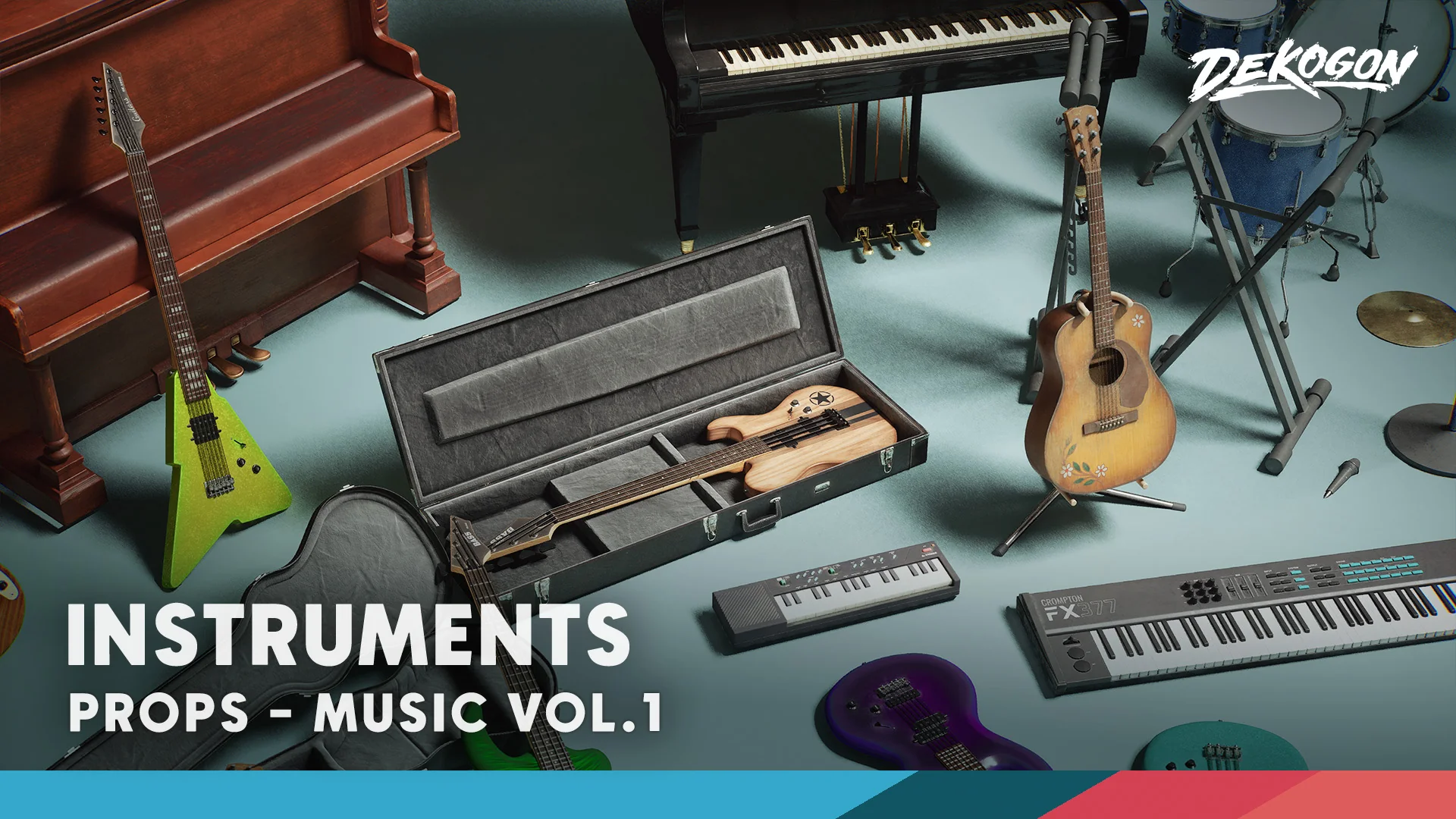
The collection includes 96 meshes in total, split as 48 instruments and prop variants with both Nanite and low poly versions of each mesh. Everything pictured is included with assets, maps, and materials created in Unreal Engine. The stated target is realistic AAA-quality visuals, style, and budget, which frames the pack as a scene-building set for projects that need convincing instrument models rather than stylized placeholders.
Using Musical Instruments VOL.1 in real-time scenes
The most immediate strength here is flexibility at setup level. Each asset exists in a Nanite version for high-fidelity polycounts and in a low poly version as well, so teams are not locked into one rendering approach.
That split makes the pack usable across different scene priorities inside the same project. A hero shot, cinematic corner, or closer environmental detail can lean on the Nanite meshes, while wider playable spaces or areas that need lighter geometry can draw from the low poly set without changing the visual theme of the scene. Because the package covers both versions of each mesh rather than mixing unrelated objects, it supports a cleaner handoff between art direction and implementation. The focus stays on placing instruments where they fit the scene instead of rebuilding the same prop library twice.
Nanite and low poly versions of each mesh
The pack states clearly that the assets are constructed using Nanite for high-quality fidelity polycounts, while also including low poly versions. That dual-setup is one of the most concrete production details in the package.
In practical terms, that gives Unreal Engine users options for how they stage a music venue, rehearsal room, studio corner, lounge interior, or any other instrument-focused environment. Tags associated with the pack point toward a broad spread of instrument types and music themes, including piano, guitar, drum, brass, string, wind, jazz, sound, and music. What matters most is not an exhaustive item-by-item inventory, but the fact that the collection is aimed at building scenes around musical equipment and related props with realism in mind. Fully detailed models from all sides also support placement from different camera angles, which is useful when instruments are not just background dressing but part of the room composition.
4K textures, channel packing, and master material control
Material workflow is another area where the pack stays concrete. It includes high-quality, high-fidelity texture sets at 4K resolution and a master material setup that controls the majority of props and models.
That matters during scene assembly because it suggests a more unified material pass across the collection instead of isolated one-off shaders for every object. The material setup also includes added controls for roughness, albedo, normals, and more, giving room for adjustment without stepping outside the established material framework. Channel-packed roughness, metalness, and ambient occlusion are included as part of the texture workflow. For environment artists and prop artists working inside Unreal Engine, that combination points to a pack that is not only about mesh count, but also about reducing repetitive setup when tuning surfaces across multiple instruments. The assets are presented as optimized for games, so the visual detail is paired with an implementation path meant for real-time use rather than static-only presentation.
Lumen support and the included post process look
Lighting and presentation are not treated as an afterthought. The product supports Lumen for Unreal Engine 5.0 and above, and it also includes a realistic post process and Look Up Table.
Those two details shape how quickly the pack can settle into a polished Unreal scene. Lumen support matters for projects already working within Unreal Engine 5 lighting workflows, while the included post process and LUT help establish a finished presentation style around the props. For instrument-heavy scenes, surface response is a big part of believability, especially when metal, wood, paint, lacquer, and fabric elements sit close together in frame. The supplied controls for roughness and normals work in tandem with that broader lighting and post-process setup, letting the visual character of the assets read more clearly under real-time lighting conditions.
Where Musical Instruments VOL.1 fits best
This pack is most useful when a project needs a ready-made library of realistic musical instruments with enough detail for close inspection and enough flexibility for game scene deployment. It is also notable that all branding and labels are custom made by the studio, with the assets described as free of legal issues on that front.
That makes the collection a strong fit for Unreal Engine productions that need instrument props without spending extra time replacing visible branded elements. Teams building interior sets, music-themed environments, staged performance spaces, or atmospheric rooms that rely on instrument silhouettes and material detail will get the clearest benefit. The combination of 96 meshes, dual Nanite and low poly coverage, 4K texture sets, centralized material controls, channel-packed maps, game optimization, and Lumen support places it squarely in the production phase where artists need to move from empty space to finished scene dressing with as little reinvention as possible.
 Musical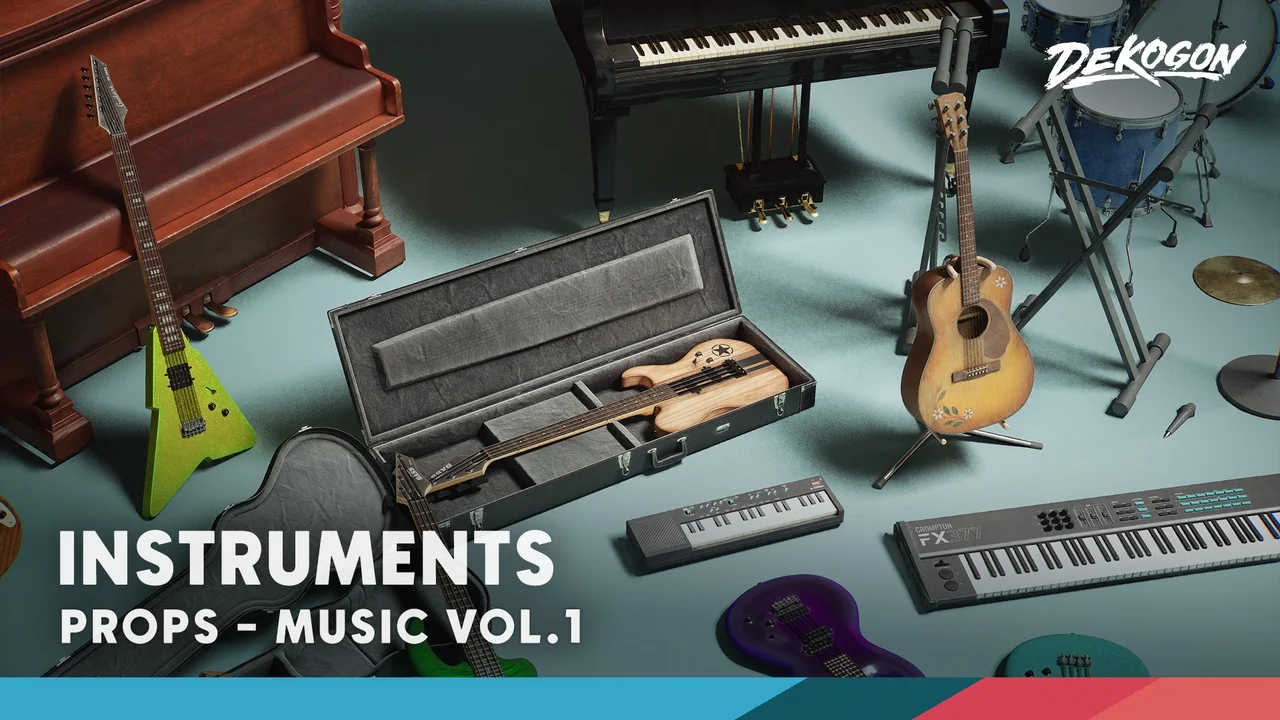
 Packs
Packs Holiday
 Trees
Trees