"a338a1d501976271"{"id":"1000315","slug":"monowheel-bike","title":"MonoWheel Bike","category":"Characters \u0026 Creatures","engine":"5.0+","assetVersion":"","engineVersion":"Engine Version: 5.0+","tag":"Characters","accent":"blue","visual":"character","summary":"An in-depth look at the MonoWheel Bike, a drivable asset featuring ground-to-air traversal, multiple visual styles, and Character class-based stability.","platform":"Unreal Engine","publishedAt":"2026-07-04T16:19:12.627Z","updatedAt":"2026-07-04T16:19:12.627Z","sourceNotes":[],"fileContents":[],"compatibility":["Unreal Engine","Engine Version: 5.0+"],"featuredImage":{"alt":"MonoWheel Bike","src":"/wp-content/uploads/published/2026/07/e79827a7201b-dd64ffee-442a-4397-87fa-73a2eddd811f-37da3dcbad.webp"},"hasDownloadLink":true,"downloads":0,"terms":[{"taxonomy":"category","slug":"characters-and-creatures","name":"Characters \u0026 Creatures"}],"galleryImages":[{"src":"/wp-content/uploads/published/2026/07/c9724a59a269-73bf6b8c-f68d-4175-8338-64f72330e660-6707055c42.webp","alt":"MonoWheel Bike"},{"src":"/wp-content/uploads/published/2026/07/ce89320f4073-bacc42b3-be2c-4a4b-bd21-854f8e8bdc94-67580ef384.webp","alt":"MonoWheel Bike"},{"src":"/wp-content/uploads/published/2026/07/6e527c97724f-5d702616-7a70-4585-ab75-44184e35f47d-6a57d4d4db.webp","alt":"MonoWheel Bike"},{"src":"/wp-content/uploads/published/2026/07/035e86cd9147-677ca4bc-1b45-4c12-b624-aff55dfd8ff1-3251616159.webp","alt":"MonoWheel Bike"},{"src":"/wp-content/uploads/published/2026/07/8dd1ef3d9076-5b24d09e-4d40-4bc1-9197-d99d00c21d47-cc8118fa94.webp","alt":"MonoWheel Bike"},{"src":"/wp-content/uploads/published/2026/07/1b66bc215096-476f087c-b739-4671-92a9-99b24110d577-1ab357dfd9.webp","alt":"MonoWheel Bike"},{"src":"/wp-content/uploads/published/2026/07/d25b866df868-206c2118-fb08-434e-9905-db89c8d3c02e-fcb39c04ea.webp","alt":"MonoWheel Bike"},{"src":"/wp-content/uploads/published/2026/07/77c8615d32d6-ec21dffe-99d2-41eb-9018-994d50cb1c88-dd3d652d29.webp","alt":"MonoWheel Bike"},{"src":"/wp-content/uploads/published/2026/07/18e50d15c45d-3d61609b-8ce1-438c-a8df-7a5fd22b9a9a-bc59b186a4.webp","alt":"MonoWheel Bike"},{"src":"/wp-content/uploads/published/2026/07/210da304d4bc-d3d06ea2-36ab-424a-ab93-266aa58bfc85-6f6fbb5597.webp","alt":"MonoWheel Bike"}],"accessPanel":{"kind":"resource","title":"Download this resource","eyebrow":"Free Download","message":"Log in or create a free account to start your download.","fileName":"Content.7z","safetyNote":"Resources are manually reviewed before listing to improve quality and reduce obvious risks.","actionLabel":"Download Free","resourceType":"Resource archive"},"contentHtml":"\u003ch2\u003eIntegrating Ground and Aerial Traversal\u003c/h2\u003e\n\u003cp\u003eDevelopers building expansive environments or science fiction settings often need traversal systems that handle diverse terrain and vertical challenges. The MonoWheel Bike provides a drivable machine designed specifically for these scenarios. Rather than locking players into a single mode of transport, this vehicle operates on the ground like a standard motorcycle but retains the built-in ability to transform into a flying vehicle. This dual functionality allows a player to navigate rough ground terrain and then seamlessly take to the air when environmental obstacles dictate a sudden change in elevation.\u003c/p\u003e\n\u003cp\u003eFor level designers, having a single actor capable of both ground driving and flight opens up new possibilities for map verticality and pacing. Players do not need to locate a landing pad to swap out their ground transport for a separate aerial machine. The transition happens within the single core actor, ensuring that momentum and exploration remain uninterrupted regardless of the landscape ahead.\u003c/p\u003e\n\u003ch2\u003eVisual Customization and Anime-Style Outlines\u003c/h2\u003e\n\u003cp\u003eThe visual identity of the MonoWheel Bike is highly adaptable, catering to different performance targets and artistic directions. The package includes four distinct bike meshes to fit specific project requirements. The primary flight version handles the complex dual-mode traversal, while a dedicated non-flight version is provided specifically to maintain a lower performance cost. This non-flight mesh offers a practical optimization path for game types that strictly require ground-based movement. If a project features a racing mode, a closed-circuit track, or an indoor environment where vertical flight is impossible by design, developers can deploy the non-flight mesh to save on processing overhead.\u003c/p\u003e\n\u003cp\u003eIn addition to these standard realistic meshes, the package offers outlined variants for both the flight and non-flight models. These outlined versions apply a distinct black outline to the geometry, making the vehicle an immediate fit for anime-style games, cel-shaded environments, or stylized comic-book aesthetics.\u003c/p\u003e\n\u003cp\u003eBeyond the meshes themselves, developers have granular control over the vehicle's surface properties. The MonoWheel Bike includes four complete sets of materials. Each material set is engineered to support color masking, giving artists the ability to modify and adjust the vehicle's appearance dynamically. This masking capability ensures the bike can be recolored to match specific in-game factions, player customization choices, or overall project palettes without needing to author entirely new texture maps outside the engine.\u003c/p\u003e\n\u003ch2\u003eEngineering the MonoWheel Using the Character Class\u003c/h2\u003e\n\u003cp\u003eUnder the hood, the MonoWheel Bike employs a specific structural approach to ensure gameplay stability. Instead of relying on the engine’s standard wheeled vehicle blueprint classes, the core actor is built upon the default engine “Character” class. This technical route was chosen to combat the inherent instability of a monowheel design within traditional vehicle physics simulations. When applied to standard wheeled vehicle physics, a single-wheel design often struggles with balance, resulting in the actor flipping out, falling over, or exhibiting unpredictable, wacky behaviors during active gameplay.\u003c/p\u003e\n\u003cp\u003eBy utilizing the Character class, the MonoWheel Bike trades some of the complex, granular physics interactions expected from a multi-wheeled vehicle for a highly stable and predictable movement model. While this means the bike might lack certain nuanced suspension mechanics or tire-friction physics, it actively solves the critical issue of tipping and erratic collision responses. An added benefit of this structural choice is its high compatibility with artificial intelligence. Because the bike is fundamentally recognized by the engine as a Character, it integrates much more easily with most general AI systems available on the marketplace. Developers can assign standard navigation and pathfinding logic to the MonoWheel Bike, allowing non-player characters to pilot the machine effectively without requiring custom vehicle-handling scripts.\u003c/p\u003e\n\u003ch2\u003eRider Animations, Effects, and Audio Integration\u003c/h2\u003e\n\u003cp\u003eTo create a complete traversal experience, the MonoWheel Bike is packaged with all the necessary supplementary effects and animations. It includes dedicated particle effects that generate dust trails as the machine moves, physically grounding the vehicle within its environment during ground traversal. Movement audio is also integrated directly into the core actor, providing the necessary auditory feedback for acceleration and travel.\u003c/p\u003e\n\u003cp\u003eFor character integration, the package supplies specific animations tailored to a rider operating the single-wheel control scheme. A basic trace and message node setup is built into the logic, allowing characters to easily interact with and enter the vehicle upon request. The inclusion of this basic trace and message node provides a clean foundational template for developers. Instead of forcing a complex mounting system, the trace logic simply detects the player's proximity and request, seamlessly triggering the entry sequence.\u003c/p\u003e\n\u003ch2\u003eNetwork Replication and Engine Compatibility\u003c/h2\u003e\n\u003cp\u003eTo ensure developers can test and implement the system immediately, the package comes with assets and example characters rigged to both the UE4 and UE5 mannequins and skeletons. For those working in Unreal Engine 5, the package specifically includes two demo third-person characters pre-configured with the rider animations, making integration as quick and easy as possible.\u003c/p\u003e\n\u003cp\u003eThe MonoWheel Bike is fully built to support multiplayer project requirements out of the box. The product is replicated to work in networked environments, saving developers the headache of manually networking the vehicle's movement and transformation states. Because the MonoWheel Bike is already replicated, the server authoritatively handles the state changes between driving and flying. This ensures that all connected clients see the same transformations, dust particle trails, and rider animations simultaneously, maintaining synchronization during high-speed gameplay.\u003c/p\u003e\n\n\u003ch2\u003eMore From The Same Workflow\u003c/h2\u003e\n\u003cul\u003e\n\u003cli\u003e\u003ca href=\"https://3dcghub.com/superzombie8/\" title=\"SuperZombie8\"\u003eSuperZombie8\u003c/a\u003e\u003c/li\u003e\n\u003cli\u003e\u003ca href=\"https://3dcghub.com/stylized-female-character-janedoe/\" title=\"Stylized Female Character - JaneDoe\"\u003eStylized Female Character - JaneDoe\u003c/a\u003e\u003c/li\u003e\n\u003cli\u003e\u003ca href=\"https://3dcghub.com/asian-armour-metahuman/\" title=\"Asian Armour - Metahuman\"\u003eAsian Armour - Metahuman\u003c/a\u003e\u003c/li\u003e\n\u003cli\u003e\u003ca href=\"https://3dcghub.com/evil-forest-creature/\" title=\"Evil Forest Creature\"\u003eEvil Forest Creature\u003c/a\u003e\u003c/li\u003e\n\u003cli\u003e\u003ca href=\"https://3dcghub.com/medieval-armour-metahuman-male-female/\" title=\"Medieval Armour - Metahuman - Male/Female\"\u003eMedieval Armour - Metahuman - Male/Female\u003c/a\u003e\u003c/li\u003e\n\u003c/ul\u003e","contentTextLength":6348,"navigation":{"current":1161,"total":3338,"previous":{"id":"1000316","slug":"multiplayer-object-throwing-system","title":"Multiplayer Object Throwing System","category":"Gameplay Features","platform":"Unreal Engine","updatedAt":"2026-07-04T16:23:14.143Z"},"next":{"id":"1000314","slug":"modular-synth-presets-1-edm-pop-drums","title":"Modular Synth Presets 1 EDM POP Drums","category":"Procedural Systems","platform":"Unreal Engine","updatedAt":"2026-07-04T16:14:58.414Z"}},"relatedResources":[{"id":"1000814","slug":"downhill-bike-mtb","title":"Downhill BIke (MTB)","category":"Characters \u0026 Creatures","engine":"5.0+","assetVersion":"","engineVersion":"Engine Version: 5.0+","tag":"Characters","accent":"blue","visual":"character","summary":"Unreal Engine downhill mountain bike with dynamic suspension, modular parts, 4K textures, trick animations, crash mechanics, and Enhanced Input support for PC.","platform":"Unreal Engine","publishedAt":"2026-07-31T11:12:37.598Z","updatedAt":"2026-07-31T11:12:37.598Z","sourceNotes":[],"fileContents":[],"compatibility":["Unreal Engine","Engine Version: 5.0+"],"featuredImage":{"alt":"Downhill BIke (MTB)","src":"/wp-content/uploads/published/2026/07/5f77665f1262-596349ea-bc7e-4387-8522-4ff8fe8d89f2-ef4012faf6.webp"},"hasDownloadLink":true,"downloads":1},{"id":"1000070","slug":"infected-rage-unleashed","title":"INFECTED Rage Unleashed","category":"Characters \u0026 Creatures","engine":"Engine Version: 5.5+","assetVersion":"Engine Version: 5.5+","engineVersion":"","tag":"Characters","accent":"blue","visual":"character","summary":"A post-apocalyptic crowd bundle with 300+ infected assets, 200 characters, modular parts, 9 groups, rigs, and Blender and UE5 workflow support.","platform":"Unreal Engine","publishedAt":"2026-06-01T15:15:17.561Z","updatedAt":"2026-10-03T14:08:27.227Z","sourceNotes":[],"fileContents":[],"compatibility":["Unreal Engine","Engine Version: 5.5+"],"featuredImage":{"alt":"INFECTED Rage Unleashed","src":"/wp-content/uploads/published/2026/06/3c8a2b26a8b1-infected-box3-57234c04b4.webp"},"hasDownloadLink":true,"downloads":2},{"id":"1001368","slug":"streamer-girl-sci-fi-stylized-toon-webcam-performer","title":"Streamer girl. Sci-fi stylized toon webcam performer","category":"Characters \u0026 Creatures","engine":"5.0+","assetVersion":"","engineVersion":"Engine Version: 5.0+","tag":"Characters","accent":"blue","visual":"character","summary":"Explore the stylized Streamer Girl character for Unreal Engine, featuring 52 Apple ARKit blendshapes, modular clothing, UDIM texturing, and custom shaders.","platform":"Unreal Engine","publishedAt":"2026-10-04T10:36:06.426Z","updatedAt":"2026-10-04T10:36:06.426Z","sourceNotes":[],"fileContents":[],"compatibility":["Unreal Engine","Engine Version: 5.0+"],"featuredImage":{"alt":"Streamer girl. Sci-fi stylized toon webcam performer","src":"/wp-content/uploads/published/2026/10/909150773bfa-d823be5a-de7d-4656-8817-00e85f717de4-1bd2465383.webp"},"hasDownloadLink":true,"downloads":0}]}
Characters
MonoWheel Bike
An in-depth look at the MonoWheel Bike, a drivable asset featuring ground-to-air traversal, multiple visual styles, and Character class-based stability.
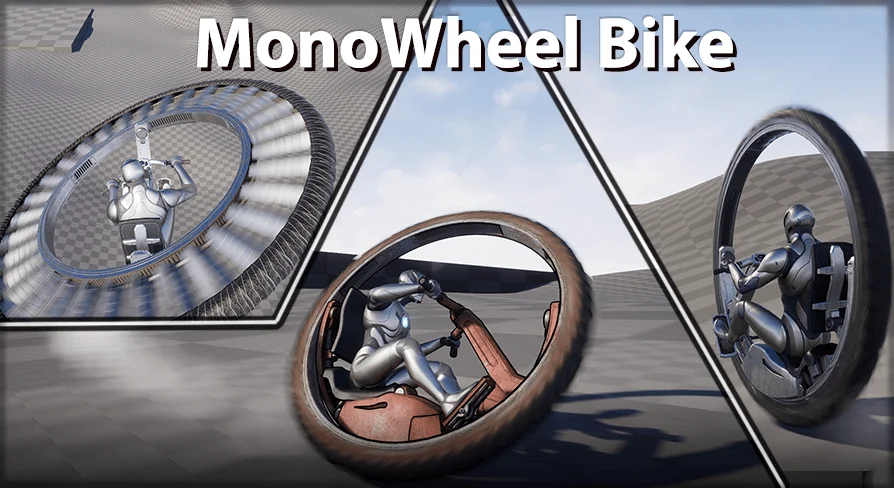
Developers building expansive environments or science fiction settings often need traversal systems that handle diverse terrain and vertical challenges. The MonoWheel Bike provides a drivable machine designed specifically for these scenarios. Rather than locking players into a single mode of transport, this vehicle operates on the ground like a standard motorcycle but retains the built-in ability to transform into a flying vehicle. This dual functionality allows a player to navigate rough ground terrain and then seamlessly take to the air when environmental obstacles dictate a sudden change in elevation.
For level designers, having a single actor capable of both ground driving and flight opens up new possibilities for map verticality and pacing. Players do not need to locate a landing pad to swap out their ground transport for a separate aerial machine. The transition happens within the single core actor, ensuring that momentum and exploration remain uninterrupted regardless of the landscape ahead.
Visual Customization and Anime-Style Outlines
The visual identity of the MonoWheel Bike is highly adaptable, catering to different performance targets and artistic directions. The package includes four distinct bike meshes to fit specific project requirements. The primary flight version handles the complex dual-mode traversal, while a dedicated non-flight version is provided specifically to maintain a lower performance cost. This non-flight mesh offers a practical optimization path for game types that strictly require ground-based movement. If a project features a racing mode, a closed-circuit track, or an indoor environment where vertical flight is impossible by design, developers can deploy the non-flight mesh to save on processing overhead.
In addition to these standard realistic meshes, the package offers outlined variants for both the flight and non-flight models. These outlined versions apply a distinct black outline to the geometry, making the vehicle an immediate fit for anime-style games, cel-shaded environments, or stylized comic-book aesthetics.
Beyond the meshes themselves, developers have granular control over the vehicle's surface properties. The MonoWheel Bike includes four complete sets of materials. Each material set is engineered to support color masking, giving artists the ability to modify and adjust the vehicle's appearance dynamically. This masking capability ensures the bike can be recolored to match specific in-game factions, player customization choices, or overall project palettes without needing to author entirely new texture maps outside the engine.
Engineering the MonoWheel Using the Character Class
Under the hood, the MonoWheel Bike employs a specific structural approach to ensure gameplay stability. Instead of relying on the engine’s standard wheeled vehicle blueprint classes, the core actor is built upon the default engine “Character” class. This technical route was chosen to combat the inherent instability of a monowheel design within traditional vehicle physics simulations. When applied to standard wheeled vehicle physics, a single-wheel design often struggles with balance, resulting in the actor flipping out, falling over, or exhibiting unpredictable, wacky behaviors during active gameplay.
By utilizing the Character class, the MonoWheel Bike trades some of the complex, granular physics interactions expected from a multi-wheeled vehicle for a highly stable and predictable movement model. While this means the bike might lack certain nuanced suspension mechanics or tire-friction physics, it actively solves the critical issue of tipping and erratic collision responses. An added benefit of this structural choice is its high compatibility with artificial intelligence. Because the bike is fundamentally recognized by the engine as a Character, it integrates much more easily with most general AI systems available on the marketplace. Developers can assign standard navigation and pathfinding logic to the MonoWheel Bike, allowing non-player characters to pilot the machine effectively without requiring custom vehicle-handling scripts.
Rider Animations, Effects, and Audio Integration
To create a complete traversal experience, the MonoWheel Bike is packaged with all the necessary supplementary effects and animations. It includes dedicated particle effects that generate dust trails as the machine moves, physically grounding the vehicle within its environment during ground traversal. Movement audio is also integrated directly into the core actor, providing the necessary auditory feedback for acceleration and travel.
For character integration, the package supplies specific animations tailored to a rider operating the single-wheel control scheme. A basic trace and message node setup is built into the logic, allowing characters to easily interact with and enter the vehicle upon request. The inclusion of this basic trace and message node provides a clean foundational template for developers. Instead of forcing a complex mounting system, the trace logic simply detects the player's proximity and request, seamlessly triggering the entry sequence.
Network Replication and Engine Compatibility
To ensure developers can test and implement the system immediately, the package comes with assets and example characters rigged to both the UE4 and UE5 mannequins and skeletons. For those working in Unreal Engine 5, the package specifically includes two demo third-person characters pre-configured with the rider animations, making integration as quick and easy as possible.
The MonoWheel Bike is fully built to support multiplayer project requirements out of the box. The product is replicated to work in networked environments, saving developers the headache of manually networking the vehicle's movement and transformation states. Because the MonoWheel Bike is already replicated, the server authoritatively handles the state changes between driving and flying. This ensures that all connected clients see the same transformations, dust particle trails, and rider animations simultaneously, maintaining synchronization during high-speed gameplay.
 Characters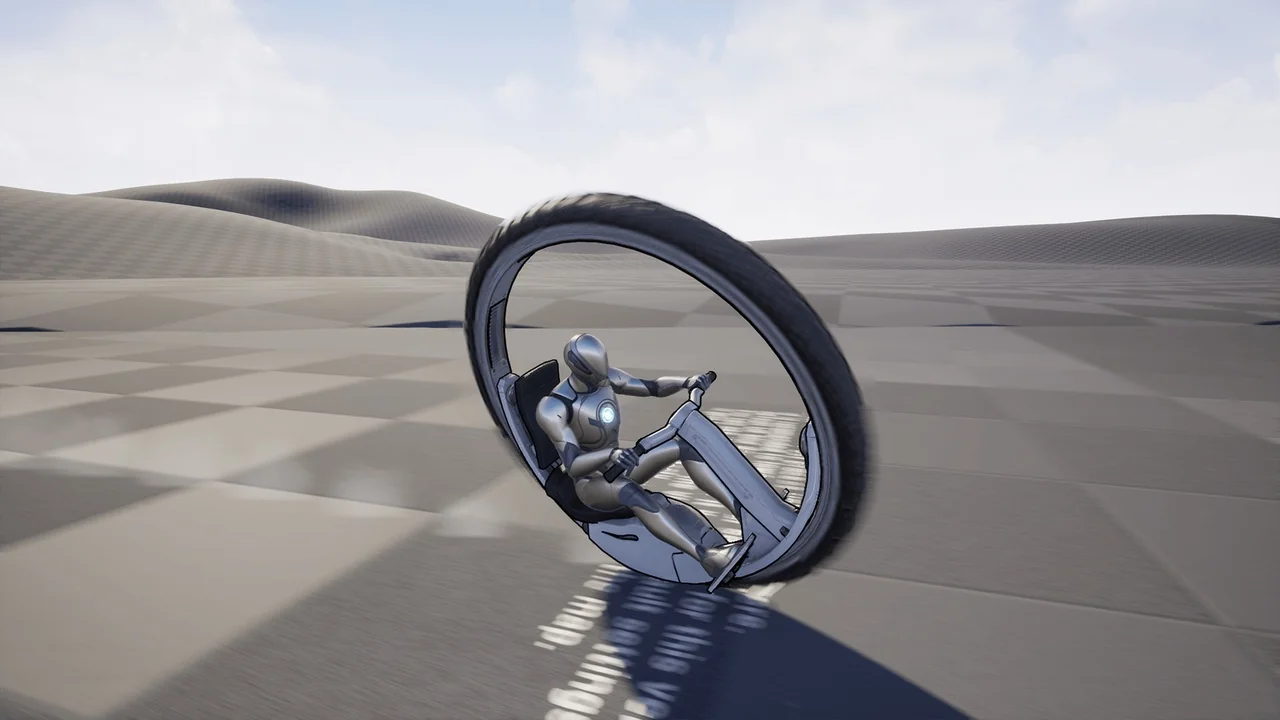
 Characters
 Characters
 Characters