"4a94497540a6fc24"{"id":"1002714","slug":"modular-sci-fi-treatment-station-environment","title":"Modular Sci-Fi Treatment Station Environment","category":"Industrial","engine":"5.0+","assetVersion":"","engineVersion":"Engine Version: 5.0+","tag":"Industrial","accent":"blue","visual":"city","summary":"Build industrial sci-fi dam and water treatment facilities in Unreal Engine 4 and 5 with the Modular Sci-Fi Treatment Station Environment.","platform":"Unreal Engine","indexPolicy":"index","publishedAt":"2026-11-17T18:45:56.057Z","updatedAt":"2026-11-17T18:45:56.057Z","sourceNotes":[],"fileContents":[],"compatibility":["Unreal Engine","Engine Version: 5.0+"],"featuredImage":{"alt":"Modular Sci-Fi Treatment Station Environment","src":"/wp-content/uploads/published/2026/11/381a719825ec-389c9008-dd75-4cc8-898e-4939a1c48522-a283a92537.webp"},"hasDownloadLink":true,"downloads":0,"terms":[{"taxonomy":"category","slug":"industrial","name":"Industrial"}],"galleryImages":[{"src":"/wp-content/uploads/published/2026/11/e4959c1265ac-1ea3331a-e060-43ad-916c-8e5fc09ad0ea-5d74356e06.webp","alt":"Modular Sci-Fi Treatment Station Environment"},{"src":"/wp-content/uploads/published/2026/11/3022b085e1cd-d64d4ea7-dfa1-4ff5-a8d3-0b2b9351cf7f-d1f0babaaf.webp","alt":"Modular Sci-Fi Treatment Station Environment"},{"src":"/wp-content/uploads/published/2026/11/a9eab35a5950-ea80594d-5f38-451d-b9a7-6b7f0dc7b411-16b8052dbc.webp","alt":"Modular Sci-Fi Treatment Station Environment"},{"src":"/wp-content/uploads/published/2026/11/6b78b6cdecfc-5a75802c-6e52-48e0-83f4-9c39ef923c70-a6017ed423.webp","alt":"Modular Sci-Fi Treatment Station Environment"},{"src":"/wp-content/uploads/published/2026/11/093ae7c9a0a0-3c2b721f-2a97-43ce-9d50-2803540524b6-7cf7e6809a.webp","alt":"Modular Sci-Fi Treatment Station Environment"},{"src":"/wp-content/uploads/published/2026/11/78f50ff11c3c-ec034415-ffa2-4c17-b473-936ec5b0e8a1-00a8acaa8e.webp","alt":"Modular Sci-Fi Treatment Station Environment"},{"src":"/wp-content/uploads/published/2026/11/9cfa103219ce-c36dae56-3a5e-49a4-a593-aabdccb42e9d-407cc57639.webp","alt":"Modular Sci-Fi Treatment Station Environment"},{"src":"/wp-content/uploads/published/2026/11/6aa24bd5c5b9-1aa58847-1cbe-40a0-a0b6-5fd51c75abc0-bc3300ef22.webp","alt":"Modular Sci-Fi Treatment Station Environment"},{"src":"/wp-content/uploads/published/2026/11/0f7d3f81cf6c-6c0bfabe-052b-47a2-ac76-b87408db3bd8-dd0b83258c.webp","alt":"Modular Sci-Fi Treatment Station Environment"}],"accessPanel":{"kind":"resource","title":"Get this resource","safetyNote":"Resources are manually reviewed before listing to improve quality and reduce obvious risks.","fileName":"Content.7z","resourceType":"Resource archive","versions":[]},"contentHtml":"\u003cp\u003eIndustrial sci-fi settings rely heavily on utilitarian architecture—facilities engineered to process fluids, regulate energy, and manage planetary or municipal resources while maintaining convincing structural coherence. The Modular Sci-Fi Treatment Station Environment addresses this exact production need, functioning as a complete kit for establishing industrial treatment stations, dam operations, and water-processing sectors inside modern real-time pipelines.\u003c/p\u003e \u003cp\u003eBy framing environmental design around utility systems rather than generic corridors, the asset collection invites level creators to assemble functional facilities. The included pieces are tuned to connect cleanly, giving developers the structural freedom to sketch sprawling dam walls, submerged intake halls, filtration conduits, or tight maintenance shafts without running into awkward seam lines or conflicting geometry.\u003c/p\u003e \u003ch2\u003eAssembling Water Infrastructure with Sci-Fi Treatment Modules\u003c/h2\u003e \u003cp\u003eWater management and processing facilities present specific spatial requirements in level construction. Vast elevation changes, heavy containment barriers, massive piping conduits, and perimeter platforms dominate these environments. Because this package carries tags explicitly oriented around dams, water systems, treatment stations, and environmental level layout, its component set directly targets those infrastructural needs.\u003c/p\u003e \u003cp\u003ePlacing structural elements within a level begins with the larger spatial framework. When drafting a dam or fluid handling station, vertical scale plays a dominant role. Broad retaining walls and industrial substructures must anchor the scene, establishing the sense of heavy mechanical weight typical of civil-scale sci-fi installations. From there, secondary walkways, structural dividers, and fluid processing equipment can be organized along logical service paths.\u003c/p\u003e \u003cp\u003eBecause the environment targets treatment stations, organizing the layout around a tangible operational pipeline enhances the worldbuilding. Water intake points, purification or chemical filtration nodes, and primary drainage shafts can serve as intuitive navigational landmarks. Players naturally read the purpose of a space when functional machinery dictates the geometry, moving from massive containment basins down into detailed monitoring bays or access corridors.\u003c/p\u003e \u003ch2\u003eModular Assembly and User Modification in Practice\u003c/h2\u003e \u003cp\u003eThe core philosophy of the kit revolves around modularity and user adaptability. Every piece was built to fit together neatly, ensuring that grid-aligned level blocks join smoothly without visible misalignment. This consistent alignment allows technical artists and level designers to prototype expansive station wings rapidly, testing scale and spatial transitions before committing to detailed set dressing.\u003c/p\u003e \u003cp\u003eBeyond standard modular grid snapping, the pieces are built so that users can modify them easily. Projects rarely demand an entirely rigid, off-the-shelf structural layout; art directors frequently need to adjust proportions, alter sub-elements, or repurpose foundational pieces to match specific scene directions. The built-in modifiability makes it possible to introduce a custom personal touch, turning uniform facility sections into unique, mission-specific backdrops.\u003c/p\u003e \u003cp\u003eModifying components to suit individual production needs might involve altering surface hierarchies, combining distinct architectural elements to build unique machinery housings, or breaking repetitive corridor lengths with customized access points. Because the basic modular logic remains uniform across the collection, adjustments can be carried out without breaking the underlying snapping points that keep the treatment station components aligned.\u003c/p\u003e \u003ch2\u003eEvaluating Station Architecture in the Playable Demonstration\u003c/h2\u003e \u003cp\u003eGauging whether an environment kit suits a project requires more than inspecting static images. The Modular Sci-Fi Treatment Station Environment includes both a dedicated video showcase and a standalone playable build demo, giving development teams two distinct ways to evaluate asset performance and physical proportions before deploying them into active development.\u003c/p\u003e \u003cp\u003eReviewing the video showcase provides a quick overview of intended lighting moods, surface reflections on industrial paneling, and the intended visual balance between structural framework and open water or dam elements. It illustrates how the individual modules unite to form a complete, cohesive environmental sequence under motion.\u003c/p\u003e \u003cp\u003eThe playable build demo offers a far more technical assessment. Navigating an active runtime environment lets designers inspect collision volumes, test player camera clearance across tight stairwells and catwalks, and judge real-world scale directly against an active character controller. This hands-on testing clarifies sightlines, scale ratios, and movement dynamics, confirming how the station modules behave during real gameplay scenarios rather than simply admiring still renders.\u003c/p\u003e \u003ch2\u003eEngine Integration and Documentation for UE4 and UE5\u003c/h2\u003e \u003cp\u003eDeploying environmental packages into active project branches requires solid engine stability. This treatment station environment was authored specifically for getting started on projects in Unreal Engine 4 and later iterations, ensuring that modern Unreal systems can ingest and display the assets cleanly. Whether operating within traditional UE4 rendering pipelines or bringing the collection into newer Unreal Engine 5 projects, the geometry and material structure integrate naturally into the engine's level composition tools.\u003c/p\u003e \u003cp\u003eOngoing maintenance is supported by a generic live document shared across the creator's suite of Unreal Engine 4 and 5 products. Centralized documentation provides a consistent technical reference point, detailing best practices for scene setup, material handling, and asset management across engine generations. Instead of navigating static or outdated notes, developers can consult current guidelines aligned with standard engine workflows.\u003c/p\u003e \u003cp\u003eWhen unexpected technical snags, engine anomalies, or specific implementation questions arise, support channels exist through direct messaging and dedicated community servers. Direct communication avenues allow creators to flag bugs, seek workflow advice, or clarify asset behavior directly with the developer, smoothing out implementation hurdles during production sprints.\u003c/p\u003e \u003ch2\u003ePractical Value for Industrial Sci-Fi Projects\u003c/h2\u003e \u003cp\u003eThe Modular Sci-Fi Treatment Station Environment addresses a clear niche: industrial, fluid-centric sci-fi level design based on functional infrastructure. Rather than supplying a static, unchangeable diorama, the kit delivers an adaptable framework that teams can assemble, modify, and extend. With confirmed support bridging Unreal Engine 4 and Unreal Engine 5, verified live documentation, and interactive playable demos ready for immediate review, the package provides a solid, dependable launching point for any production requiring believable aquatic and environmental industrial facilities.\u003c/p\u003e\n\n\u003ch2\u003eRelated Resources Worth Checking\u003c/h2\u003e\n\u003cul\u003e\n\u003cli\u003e\u003ca href=\"https://3dcghub.com/spaceport-and-space-center-environment-kit/\" rel=\"noopener noreferrer\"\u003eSpaceport and Space Center Environment Kit\u003c/a\u003e\u003c/li\u003e\n\u003cli\u003e\u003ca href=\"https://3dcghub.com/matte-painting-skybox-pack-sci-fi-skies/\" rel=\"noopener noreferrer\"\u003eMatte Painting Skybox Pack: Sci Fi Skies\u003c/a\u003e\u003c/li\u003e\n\u003cli\u003e\u003ca href=\"https://3dcghub.com/space-frontier-stations-and-ships/\" rel=\"noopener noreferrer\"\u003eSpace Frontier Stations \u0026amp; Ships\u003c/a\u003e\u003c/li\u003e\n\u003cli\u003e\u003ca href=\"https://3dcghub.com/scifi-environment-offworld/\" rel=\"noopener noreferrer\"\u003eSciFi Environment — \u0026#039;Offworld\u0026#039;\u003c/a\u003e\u003c/li\u003e\n\u003cli\u003e\u003ca href=\"https://3dcghub.com/scifi-kitbash-level-builder-vol-2/\" rel=\"noopener noreferrer\"\u003eSciFi Kitbash Level Builder Vol.2\u003c/a\u003e\u003c/li\u003e\n\u003c/ul\u003e","contentTextLength":7237,"navigation":{"current":6,"total":4642,"previous":{"id":"1002715","slug":"modular-sci-fi-village","title":"Modular Sci-Fi village","category":"Sci-Fi","platform":"Unreal Engine","updatedAt":"2026-11-17T18:47:47.599Z"},"next":{"id":"1002713","slug":"modular-medieval-town-with-interior","title":"Modular Medieval Town with Interior","category":"Medieval","platform":"Unreal Engine","updatedAt":"2026-11-17T18:44:35.652Z"}},"relatedResources":[{"id":"1001703","slug":"spaceport-and-space-center-environment-kit","title":"Spaceport and Space Center Environment Kit","category":"Industrial","engine":"5.1+","assetVersion":"","engineVersion":"Engine Version: 5.1+","tag":"Industrial","accent":"blue","visual":"city","summary":"Build modern and sci-fi cosmodrome levels for AAA game and VR production with the modular Spaceport and Space Center Environment Kit.","platform":"Unreal Engine","indexPolicy":"index","publishedAt":"2026-10-14T17:04:35.251Z","updatedAt":"2026-10-14T17:04:35.251Z","sourceNotes":[],"fileContents":[],"compatibility":["Unreal Engine","Engine Version: 5.1+"],"featuredImage":{"alt":"Spaceport and Space Center Environment Kit","src":"/wp-content/uploads/published/2026/10/f080b2ba56c6-037828f6-1226-4ccb-ae28-27cca473c9bc-237cc88641.webp"},"fileSizeBytes":2889345818,"hasDownloadLink":true,"downloads":0},{"id":"1001738","slug":"matte-painting-skybox-pack-sci-fi-skies","title":"Matte Painting Skybox Pack: Sci Fi Skies","category":"Sky \u0026 Space","engine":"5.4+","assetVersion":"","engineVersion":"Engine Version: 5.4+","tag":"Sky \u0026 Space","accent":"blue","visual":"mech","summary":"Explore the Matte Painting Skybox Pack: Sci Fi Skies, featuring 4K flowmap-animated planetary sky domes, custom material instances, and an 8K landscape asset.","platform":"Unreal Engine","indexPolicy":"index","publishedAt":"2026-10-20T02:44:03.470Z","updatedAt":"2026-10-20T02:44:03.470Z","sourceNotes":[],"fileContents":[],"compatibility":["Unreal Engine","Engine Version: 5.4+"],"featuredImage":{"alt":"Matte Painting Skybox Pack: Sci Fi Skies","src":"/wp-content/uploads/published/2026/10/6e354c99b4bb-3c780b28-0873-4b45-8f2d-2dc105f13c80-99f104e800.webp"},"fileSizeBytes":2371271719,"hasDownloadLink":true,"downloads":2},{"id":"1001667","slug":"space-frontier-stations-and-ships","title":"Space Frontier Stations \u0026 Ships","category":"Sky \u0026 Space","engine":"5.0+","assetVersion":"","engineVersion":"Engine Version: 5.0+","tag":"Sky \u0026 Space","accent":"blue","visual":"mech","summary":"Build vast sci-fi environments with Space Frontier Stations \u0026 Ships, featuring 60+ blueprints, procedural scattering, flyable ships, and Nanite/Lumen support.","platform":"Unreal Engine","indexPolicy":"index","publishedAt":"2026-10-13T15:09:29.578Z","updatedAt":"2026-10-13T15:09:29.578Z","sourceNotes":[],"fileContents":[],"compatibility":["Unreal Engine","Engine Version: 5.0+"],"featuredImage":{"alt":"Space Frontier Stations \u0026 Ships","src":"/wp-content/uploads/published/2026/10/bc4215e944b8-2c47d31a-f13b-40d5-a5c8-3a6f3f1b6ef5-5a5ee01424.webp"},"fileSizeBytes":1194943953,"hasDownloadLink":true,"downloads":1}]}
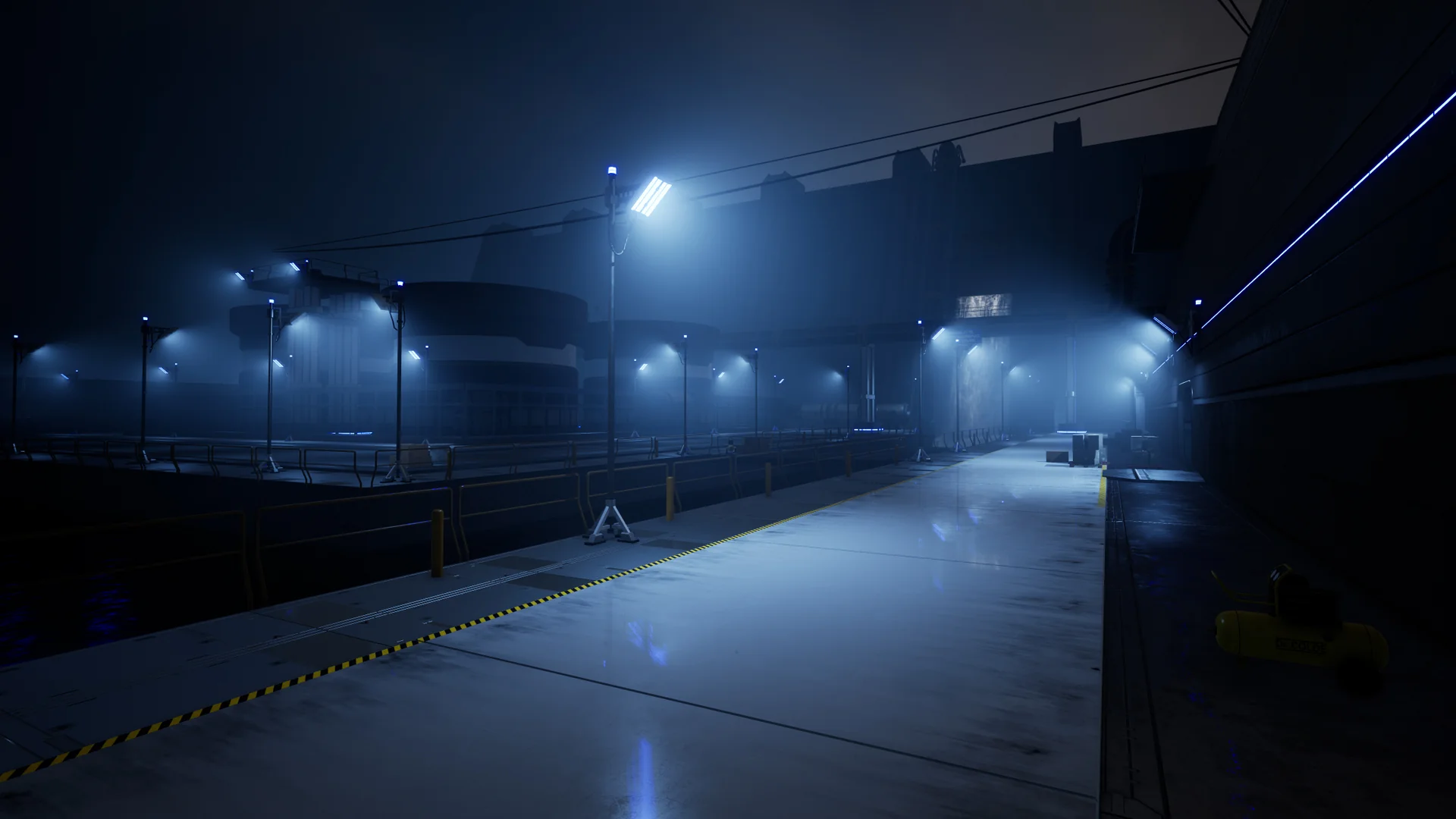
Resource screenshots
1 / 9
Join our channel
Follow 3DCGHUB on Telegram for new resource drops, migration updates, and community notices.
Industrial sci-fi settings rely heavily on utilitarian architecture—facilities engineered to process fluids, regulate energy, and manage planetary or municipal resources while maintaining convincing structural coherence. The Modular Sci-Fi Treatment Station Environment addresses this exact production need, functioning as a complete kit for establishing industrial treatment stations, dam operations, and water-processing sectors inside modern real-time pipelines.
By framing environmental design around utility systems rather than generic corridors, the asset collection invites level creators to assemble functional facilities. The included pieces are tuned to connect cleanly, giving developers the structural freedom to sketch sprawling dam walls, submerged intake halls, filtration conduits, or tight maintenance shafts without running into awkward seam lines or conflicting geometry.
Assembling Water Infrastructure with Sci-Fi Treatment Modules
Water management and processing facilities present specific spatial requirements in level construction. Vast elevation changes, heavy containment barriers, massive piping conduits, and perimeter platforms dominate these environments. Because this package carries tags explicitly oriented around dams, water systems, treatment stations, and environmental level layout, its component set directly targets those infrastructural needs.
Placing structural elements within a level begins with the larger spatial framework. When drafting a dam or fluid handling station, vertical scale plays a dominant role. Broad retaining walls and industrial substructures must anchor the scene, establishing the sense of heavy mechanical weight typical of civil-scale sci-fi installations. From there, secondary walkways, structural dividers, and fluid processing equipment can be organized along logical service paths.
Because the environment targets treatment stations, organizing the layout around a tangible operational pipeline enhances the worldbuilding. Water intake points, purification or chemical filtration nodes, and primary drainage shafts can serve as intuitive navigational landmarks. Players naturally read the purpose of a space when functional machinery dictates the geometry, moving from massive containment basins down into detailed monitoring bays or access corridors.
Modular Assembly and User Modification in Practice
The core philosophy of the kit revolves around modularity and user adaptability. Every piece was built to fit together neatly, ensuring that grid-aligned level blocks join smoothly without visible misalignment. This consistent alignment allows technical artists and level designers to prototype expansive station wings rapidly, testing scale and spatial transitions before committing to detailed set dressing.
Beyond standard modular grid snapping, the pieces are built so that users can modify them easily. Projects rarely demand an entirely rigid, off-the-shelf structural layout; art directors frequently need to adjust proportions, alter sub-elements, or repurpose foundational pieces to match specific scene directions. The built-in modifiability makes it possible to introduce a custom personal touch, turning uniform facility sections into unique, mission-specific backdrops.
Modifying components to suit individual production needs might involve altering surface hierarchies, combining distinct architectural elements to build unique machinery housings, or breaking repetitive corridor lengths with customized access points. Because the basic modular logic remains uniform across the collection, adjustments can be carried out without breaking the underlying snapping points that keep the treatment station components aligned.
Evaluating Station Architecture in the Playable Demonstration
Gauging whether an environment kit suits a project requires more than inspecting static images. The Modular Sci-Fi Treatment Station Environment includes both a dedicated video showcase and a standalone playable build demo, giving development teams two distinct ways to evaluate asset performance and physical proportions before deploying them into active development.
Reviewing the video showcase provides a quick overview of intended lighting moods, surface reflections on industrial paneling, and the intended visual balance between structural framework and open water or dam elements. It illustrates how the individual modules unite to form a complete, cohesive environmental sequence under motion.
The playable build demo offers a far more technical assessment. Navigating an active runtime environment lets designers inspect collision volumes, test player camera clearance across tight stairwells and catwalks, and judge real-world scale directly against an active character controller. This hands-on testing clarifies sightlines, scale ratios, and movement dynamics, confirming how the station modules behave during real gameplay scenarios rather than simply admiring still renders.
Engine Integration and Documentation for UE4 and UE5
Deploying environmental packages into active project branches requires solid engine stability. This treatment station environment was authored specifically for getting started on projects in Unreal Engine 4 and later iterations, ensuring that modern Unreal systems can ingest and display the assets cleanly. Whether operating within traditional UE4 rendering pipelines or bringing the collection into newer Unreal Engine 5 projects, the geometry and material structure integrate naturally into the engine's level composition tools.
Ongoing maintenance is supported by a generic live document shared across the creator's suite of Unreal Engine 4 and 5 products. Centralized documentation provides a consistent technical reference point, detailing best practices for scene setup, material handling, and asset management across engine generations. Instead of navigating static or outdated notes, developers can consult current guidelines aligned with standard engine workflows.
When unexpected technical snags, engine anomalies, or specific implementation questions arise, support channels exist through direct messaging and dedicated community servers. Direct communication avenues allow creators to flag bugs, seek workflow advice, or clarify asset behavior directly with the developer, smoothing out implementation hurdles during production sprints.
Practical Value for Industrial Sci-Fi Projects
The Modular Sci-Fi Treatment Station Environment addresses a clear niche: industrial, fluid-centric sci-fi level design based on functional infrastructure. Rather than supplying a static, unchangeable diorama, the kit delivers an adaptable framework that teams can assemble, modify, and extend. With confirmed support bridging Unreal Engine 4 and Unreal Engine 5, verified live documentation, and interactive playable demos ready for immediate review, the package provides a solid, dependable launching point for any production requiring believable aquatic and environmental industrial facilities.
 Industrial
 Sky & Space
 Sky & Space