"4a94497540a6fc24"{"id":"1002711","slug":"modular-gothic-fantasy-environment","title":"Modular Gothic/Fantasy Environment","category":"Medieval","engine":"5.0+","assetVersion":"","engineVersion":"Engine Version: 5.0+","tag":"Medieval","accent":"blue","visual":"city","summary":"Examine the Modular Gothic/Fantasy Environment, featuring optimized architecture, soaring spires, and versatile pieces for RPG and fantasy level design.","platform":"Unreal Engine","indexPolicy":"index","publishedAt":"2026-11-17T18:42:13.429Z","updatedAt":"2026-11-17T18:42:13.429Z","sourceNotes":[],"fileContents":[],"compatibility":["Unreal Engine","Engine Version: 5.0+"],"featuredImage":{"alt":"Modular Gothic/Fantasy Environment","src":"/wp-content/uploads/published/2026/11/3ea4f74fdc30-86a38695-c918-45f4-baa2-228d1aaf2e71-5d514399c3.webp"},"hasDownloadLink":true,"downloads":0,"terms":[{"taxonomy":"category","slug":"medieval","name":"Medieval"}],"galleryImages":[{"src":"/wp-content/uploads/published/2026/11/dda8d9f9a20e-5d5d6411-67e5-445a-92d3-736c46d75382-9ed30b6571.webp","alt":"Modular Gothic/Fantasy Environment"},{"src":"/wp-content/uploads/published/2026/11/426fac50e8ac-c6956e46-17cc-40e6-88b9-2ad07e7cb9f2-0eb9c6c78b.webp","alt":"Modular Gothic/Fantasy Environment"},{"src":"/wp-content/uploads/published/2026/11/f49ae31774e4-d369709c-46eb-42e8-ac0d-c48532ef69dd-da5c67d6f5.webp","alt":"Modular Gothic/Fantasy Environment"},{"src":"/wp-content/uploads/published/2026/11/833176143bce-eccc4123-c5a7-4f82-a75f-be7863da27ce-00d12216c7.webp","alt":"Modular Gothic/Fantasy Environment"},{"src":"/wp-content/uploads/published/2026/11/94d0e638a5b2-89e68b2f-0309-4a2d-9c4d-e60e2f49082c-c1e2392b3a.webp","alt":"Modular Gothic/Fantasy Environment"},{"src":"/wp-content/uploads/published/2026/11/bb1961e37c24-5a38c5e1-6e09-4df4-88ba-b1679d7a526c-b8c04a3ecf.webp","alt":"Modular Gothic/Fantasy Environment"},{"src":"/wp-content/uploads/published/2026/11/2c21141ce8a8-5ad4f85c-b84a-4f2a-b75c-2d72952c8452-35ce0b9830.webp","alt":"Modular Gothic/Fantasy Environment"},{"src":"/wp-content/uploads/published/2026/11/b80dc208cf73-f89f0fdb-1f02-4d9e-a74d-0659c4b8e533-2ddbd31695.webp","alt":"Modular Gothic/Fantasy Environment"}],"accessPanel":{"kind":"resource","title":"Get this resource","safetyNote":"Resources are manually reviewed before listing to improve quality and reduce obvious risks.","fileName":"Content.7z","resourceType":"Resource archive","versions":[]},"contentHtml":"\u003ch2\u003eReviewing Real-Time Scale with the Playable Demo\u003c/h2\u003e\n\u003cp\u003eStarting the assembly of a monumental game space requires an early understanding of scale, movement clearance, and environmental framing. The workflow for this package opens with real-time verification tools, notably a playable demo alongside a comprehensive demo video. Testing an environment inside an interactive build clarifies how dynamic character movement feels against the structural geometry before scene dressing begins. Walking a player avatar across stone surfaces, through arched passages, and beneath high vaulted ceilings immediately reveals how camera collisions and sightlines function at ground level.\u003c/p\u003e\n\u003cp\u003eThe companion demo video acts as an instant visual reference for staging, pacing, and layout balance. Observing pre-built showcase arrangements demonstrates how the individual architectural components fit together to construct sprawling compositions without visual clutter. Reviewing video footage provides clear insight into how shadow depth, vertical elevations, and open plazas can be juxtaposed to generate visual drama. For level designers, these assets eliminate initial guesswork, establishing verified benchmarks for distance, eye-level composition, and general player navigation.\u003c/p\u003e \u003ch2\u003eAssembling Modular Fantasy Architecture from Base Elements\u003c/h2\u003e\n\u003cp\u003eModular construction is the foundation of versatile worldbuilding, allowing developers to create expansive locations without relying on repetitive prefabricated compounds. The modular pieces included in this set are engineered to unlock huge architectural variety, giving creators the freedom to design custom layouts tailored specifically to their game mechanics. Instead of being locked into a singular castle layout or a rigid church floor plan, designers can arrange walls, pillars, buttresses, and archways into completely distinct footprints.\u003c/p\u003e\n\u003cp\u003eThe versatility of the modular assets supports both interior sanctums and massive exterior fortifications. Narrow, claustrophobic stone corridors can transition seamlessly into expansive multi-tiered throne rooms, deep subterranean halls, or wide outdoor courtyards. Because the pieces conform to a cohesive modular logic, components line up cleanly along standard grid increments, speeding up the grayboxing-to-final-art pipeline. This system makes it straightforward to iterate rapidly on level geometry, testing different combat encounter arenas, branching exploration paths, and vertical platforming routes directly within the scene hierarchy.\u003c/p\u003e \u003ch2\u003eStructural Scale with Gothic Spires and Castle Outlines\u003c/h2\u003e\n\u003cp\u003eGothic design relies on striking verticality, structural grandeur, and ornate silhouettes, all of which are reflected in the package through soaring spires and large structures. Spires reach upward to puncture skyboxes, serving as natural landmark indicators that orient players across vast game maps. When placed across distance, these high-reaching points create memorable horizon lines that draw the eye toward critical objectives, citadel gates, or looming dungeons.\u003c/p\u003e\n\u003cp\u003eBeyond the vertical spires, the large structures supply the mass needed to anchor massive castle designs, cathedral compounds, and fortified citadels. The verified thematic tags highlight an intersection of gothic, medieval, and industrial architecture. This unique cross-section allows designers to move away from purely fairy-tale castles toward heavier, stone-hewn fortifications with imposing structural weight. Massive outer bastions can be erected to flank gatehouses, while deep foundation blocks allow fortress complexes to emerge naturally out of rugged terrain, cliffsides, or rocky valleys.\u003c/p\u003e \u003ch2\u003ePerformance Management in an Optimized Environment\u003c/h2\u003e\n\u003cp\u003eLarge-scale architectural scenes can quickly become a performance liability if geometry and spatial layouts are not treated with technical discipline. This asset collection is developed specifically as an optimized environment, recognizing that fantasy games and RPGs demand stable frame pacing during heavy exploration and combat sequences. Even when stacking modules into towering structures or building multi-layered fortresses, the underlying optimization keeps scenes running cleanly.\u003c/p\u003e\n\u003cp\u003eMaintaining high rendering performance is crucial when constructing vast open-world levels or densely packed castle courtyards. Because the environment pieces are optimized for production use, developers can duplicate modular structures across broad vistas without running into severe rendering bottlenecks. This allows for rich scene complexity, deep draw distances, and expansive spatial depth while preserving the hardware headroom necessary for character rendering, enemy artificial intelligence, visual effects, and physics calculations.\u003c/p\u003e \u003ch2\u003eLevel Design Applications across RPG and Medieval Worlds\u003c/h2\u003e\n\u003cp\u003eThe core focus of this toolkit centers on RPG and fantasy game development, where world spaces must communicate history, scale, and atmosphere purely through stone and mortar. Architectural design in role-playing games functions as non-verbal storytelling; massive, imposing gothic walls convey ancient authority, desolation, or entrenched power before an NPC speaks a word. Designers crafting medieval quests, dark fantasy campaigns, or fortress-siege scenarios can adapt the modular kit to reflect these distinct narrative tones.\u003c/p\u003e\n\u003cp\u003eFor level designers, the modular variety facilitates purposeful pacing. You can construct vast open castle yards intended for large-scale battles, segmented by defensive chokepoints and stepped ramparts that give ranged combatants high-ground advantage. In contrast, subterranean passages and winding tower stairwells can be assembled to enforce methodical, close-quarters encounters. The broad architectural variety ensures that separate wings of a single fortress—such as living quarters, defensive battlements, great halls, and ceremonial sanctuaries—feel visually distinct while remaining unified within the same gothic fantasy universe.\u003c/p\u003e \u003ch2\u003eImplementation Workflow and Discord Support Channels\u003c/h2\u003e\n\u003cp\u003eIntegrating third-party modular kits into an active game pipeline often surfaces technical questions regarding assembly practices, snapping workflows, or layout optimization. Direct communication and troubleshooting for this environment package are handled through an official Discord community. Joining the dedicated Discord channel connects developers directly with support, offering an accessible avenue for practical assistance, technical questions, and continuous implementation advice during production.\u003c/p\u003e\n\n\u003ch2\u003eRelated Resources Worth Checking\u003c/h2\u003e\n\u003cul\u003e\n\u003cli\u003e\u003ca href=\"https://3dcghub.com/medieval-fantasy-ruins-dark-forest-environment/\" rel=\"noopener noreferrer\"\u003eMedieval Fantasy Ruins - Dark Forest Environment\u003c/a\u003e\u003c/li\u003e\n\u003cli\u003e\u003ca href=\"https://3dcghub.com/medieval-village-rustic-fantasy-settlement-environment/\" rel=\"noopener noreferrer\"\u003eMedieval Village – Rustic Fantasy Settlement Environment\u003c/a\u003e\u003c/li\u003e\n\u003cli\u003e\u003ca href=\"https://3dcghub.com/modular-gothic-temple-medieval-winter-snow/\" rel=\"noopener noreferrer\"\u003eModular Gothic Temple (medieval/winter/snow)\u003c/a\u003e\u003c/li\u003e\n\u003cli\u003e\u003ca href=\"https://3dcghub.com/gothic-street-environment-gothic-street-environment-fantasy-building-house/\" rel=\"noopener noreferrer\"\u003eGothic Street Environment ( Gothic Street Environment Fantasy Building House )\u003c/a\u003e\u003c/li\u003e\n\u003cli\u003e\u003ca href=\"https://3dcghub.com/school-of-magic-gothic-modular-environment/\" rel=\"noopener noreferrer\"\u003eSchool of Magic - Gothic Modular Environment\u003c/a\u003e\u003c/li\u003e\n\u003c/ul\u003e","contentTextLength":6828,"navigation":{"current":9,"total":4642,"previous":{"id":"1002712","slug":"modular-industrial-area","title":"Modular Industrial Area","category":"Industrial","platform":"Unreal Engine","updatedAt":"2026-11-17T18:43:18.423Z"},"next":{"id":"1002710","slug":"modular-bakery-shop","title":"Modular Bakery Shop","category":"Interior","platform":"Unreal Engine","updatedAt":"2026-11-17T18:41:12.083Z"}},"relatedResources":[{"id":"27172","slug":"medieval-fantasy-ruins-dark-forest-environment","title":"Medieval Fantasy Ruins - Dark Forest Environment","category":"Medieval","engine":"5.4+","assetVersion":"Engine version: 5.4+","engineVersion":"","tag":"Medieval","accent":"blue","visual":"city","summary":"This environment package gives dark fantasy projects a ready-made foundation of ruins, forest atmosphere, and dungeon spaces. Its two lighting scenarios and UE5-focused rebuilds make it useful for scenes that need a moody, believable backdrop.","platform":"Unreal Engine","indexPolicy":"index","publishedAt":"2026-04-21T15:06:52.000Z","updatedAt":"2026-11-14T10:16:15.890Z","sourceNotes":[],"fileContents":[],"compatibility":["Unreal Engine","Engine version: 5.4+"],"featuredImage":{"alt":"Medieval Fantasy Ruins - Dark Forest Environment","src":"https://3dcghub.com/wp-content/uploads/2026/04/7c6c817f53df_64665e7e-05cd-4ee7-9b62-b484ab0e85fb.webp"},"fileSizeBytes":10266003559,"hasDownloadLink":true,"downloads":3},{"id":"1001923","slug":"medieval-village-rustic-fantasy-settlement-environment","title":"Medieval Village – Rustic Fantasy Settlement Environment","category":"Medieval","engine":"5.0+","assetVersion":"","engineVersion":"Engine Version: 5.0+","tag":"Medieval","accent":"blue","visual":"city","summary":"Construct realistic fantasy settlements with Medieval Village, featuring 226 unique meshes, a preassembled scene, and Lumen support for Unreal Engine 5.0.3.","platform":"Unreal Engine","indexPolicy":"index","publishedAt":"2026-10-22T11:59:25.455Z","updatedAt":"2026-10-22T11:59:25.455Z","sourceNotes":[],"fileContents":[],"compatibility":["Unreal Engine","Engine Version: 5.0+"],"featuredImage":{"alt":"Medieval Village – Rustic Fantasy Settlement Environment","src":"/wp-content/uploads/published/2026/10/40c75c7b54de-a05504b5-5f8b-4bda-9ada-1e5d0b70034d-5b77b6b1bd.webp"},"fileSizeBytes":1839066305,"hasDownloadLink":true,"downloads":1},{"id":"1002682","slug":"modular-gothic-temple-medieval-winter-snow","title":"Modular Gothic Temple (medieval/winter/snow)","category":"Fantasy","engine":"5.0+","assetVersion":"","engineVersion":"Engine Version: 5.0+","tag":"Fantasy","accent":"blue","visual":"mech","summary":"Explore the Modular Gothic Temple environment kit, featuring dedicated shaders for brick walls, columns, and trees in a realistic medieval winter setting.","platform":"Unreal Engine","indexPolicy":"index","publishedAt":"2026-11-16T22:33:11.443Z","updatedAt":"2026-11-16T22:33:11.443Z","sourceNotes":[],"fileContents":[],"compatibility":["Unreal Engine","Engine Version: 5.0+"],"featuredImage":{"alt":"Modular Gothic Temple (medieval/winter/snow)","src":"/wp-content/uploads/published/2026/11/2a5f400bf753-913b21ae-da2d-4fd6-ba6b-2813ac54e941-8be955e6cd.webp"},"fileSizeBytes":1487471966,"hasDownloadLink":true,"downloads":0}]}
Resource screenshots
1 / 8
Join our channel
Follow 3DCGHUB on Telegram for new resource drops, migration updates, and community notices.
Resources are manually reviewed before listing to improve quality and reduce obvious risks.
No account required
Medieval
Modular Gothic/Fantasy Environment
Examine the Modular Gothic/Fantasy Environment, featuring optimized architecture, soaring spires, and versatile pieces for RPG and fantasy level design.
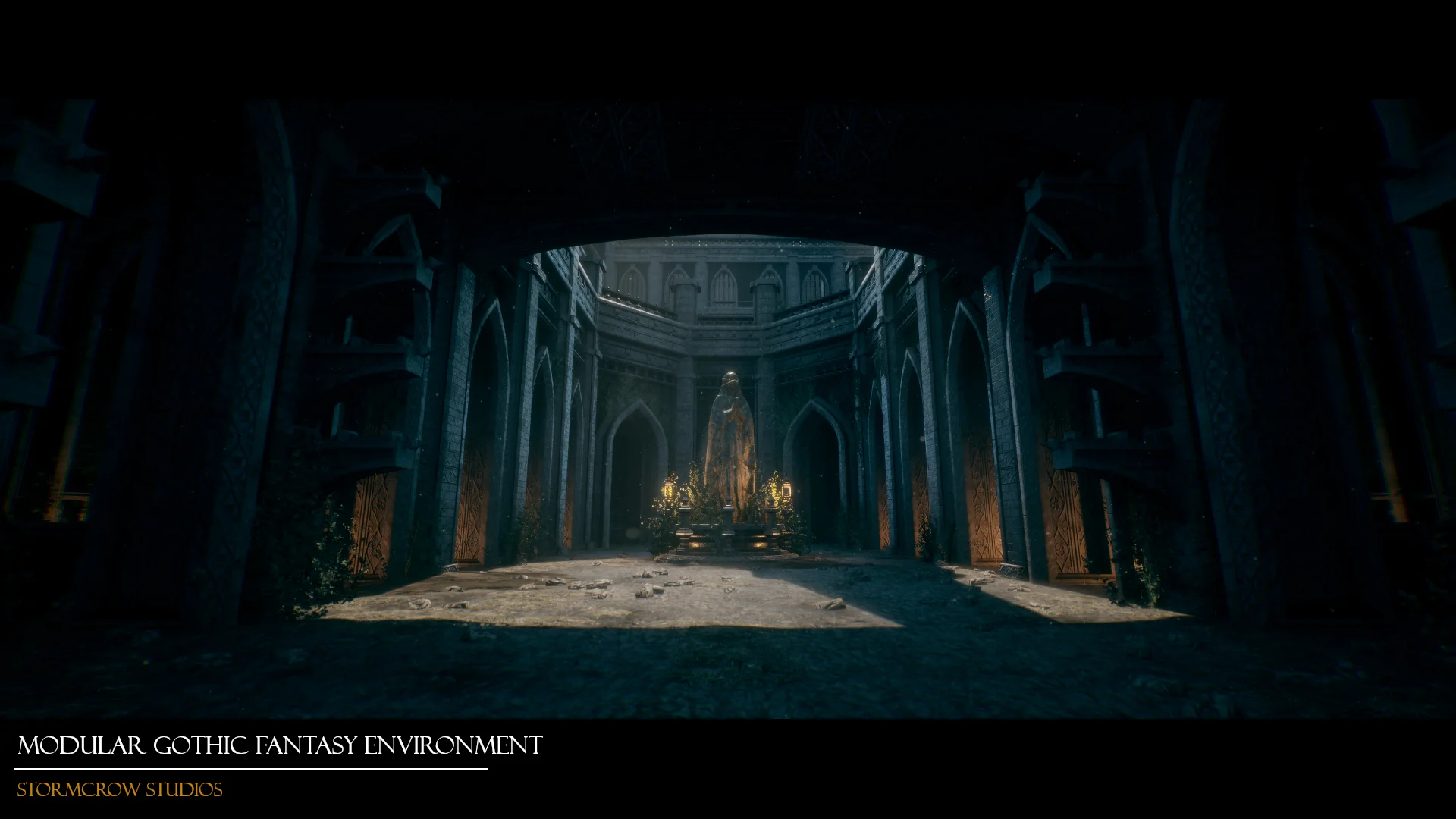
Starting the assembly of a monumental game space requires an early understanding of scale, movement clearance, and environmental framing. The workflow for this package opens with real-time verification tools, notably a playable demo alongside a comprehensive demo video. Testing an environment inside an interactive build clarifies how dynamic character movement feels against the structural geometry before scene dressing begins. Walking a player avatar across stone surfaces, through arched passages, and beneath high vaulted ceilings immediately reveals how camera collisions and sightlines function at ground level.
The companion demo video acts as an instant visual reference for staging, pacing, and layout balance. Observing pre-built showcase arrangements demonstrates how the individual architectural components fit together to construct sprawling compositions without visual clutter. Reviewing video footage provides clear insight into how shadow depth, vertical elevations, and open plazas can be juxtaposed to generate visual drama. For level designers, these assets eliminate initial guesswork, establishing verified benchmarks for distance, eye-level composition, and general player navigation.
Assembling Modular Fantasy Architecture from Base Elements
Modular construction is the foundation of versatile worldbuilding, allowing developers to create expansive locations without relying on repetitive prefabricated compounds. The modular pieces included in this set are engineered to unlock huge architectural variety, giving creators the freedom to design custom layouts tailored specifically to their game mechanics. Instead of being locked into a singular castle layout or a rigid church floor plan, designers can arrange walls, pillars, buttresses, and archways into completely distinct footprints.
The versatility of the modular assets supports both interior sanctums and massive exterior fortifications. Narrow, claustrophobic stone corridors can transition seamlessly into expansive multi-tiered throne rooms, deep subterranean halls, or wide outdoor courtyards. Because the pieces conform to a cohesive modular logic, components line up cleanly along standard grid increments, speeding up the grayboxing-to-final-art pipeline. This system makes it straightforward to iterate rapidly on level geometry, testing different combat encounter arenas, branching exploration paths, and vertical platforming routes directly within the scene hierarchy.
Structural Scale with Gothic Spires and Castle Outlines
Gothic design relies on striking verticality, structural grandeur, and ornate silhouettes, all of which are reflected in the package through soaring spires and large structures. Spires reach upward to puncture skyboxes, serving as natural landmark indicators that orient players across vast game maps. When placed across distance, these high-reaching points create memorable horizon lines that draw the eye toward critical objectives, citadel gates, or looming dungeons.
Beyond the vertical spires, the large structures supply the mass needed to anchor massive castle designs, cathedral compounds, and fortified citadels. The verified thematic tags highlight an intersection of gothic, medieval, and industrial architecture. This unique cross-section allows designers to move away from purely fairy-tale castles toward heavier, stone-hewn fortifications with imposing structural weight. Massive outer bastions can be erected to flank gatehouses, while deep foundation blocks allow fortress complexes to emerge naturally out of rugged terrain, cliffsides, or rocky valleys.
Performance Management in an Optimized Environment
Large-scale architectural scenes can quickly become a performance liability if geometry and spatial layouts are not treated with technical discipline. This asset collection is developed specifically as an optimized environment, recognizing that fantasy games and RPGs demand stable frame pacing during heavy exploration and combat sequences. Even when stacking modules into towering structures or building multi-layered fortresses, the underlying optimization keeps scenes running cleanly.
Maintaining high rendering performance is crucial when constructing vast open-world levels or densely packed castle courtyards. Because the environment pieces are optimized for production use, developers can duplicate modular structures across broad vistas without running into severe rendering bottlenecks. This allows for rich scene complexity, deep draw distances, and expansive spatial depth while preserving the hardware headroom necessary for character rendering, enemy artificial intelligence, visual effects, and physics calculations.
Level Design Applications across RPG and Medieval Worlds
The core focus of this toolkit centers on RPG and fantasy game development, where world spaces must communicate history, scale, and atmosphere purely through stone and mortar. Architectural design in role-playing games functions as non-verbal storytelling; massive, imposing gothic walls convey ancient authority, desolation, or entrenched power before an NPC speaks a word. Designers crafting medieval quests, dark fantasy campaigns, or fortress-siege scenarios can adapt the modular kit to reflect these distinct narrative tones.
For level designers, the modular variety facilitates purposeful pacing. You can construct vast open castle yards intended for large-scale battles, segmented by defensive chokepoints and stepped ramparts that give ranged combatants high-ground advantage. In contrast, subterranean passages and winding tower stairwells can be assembled to enforce methodical, close-quarters encounters. The broad architectural variety ensures that separate wings of a single fortress—such as living quarters, defensive battlements, great halls, and ceremonial sanctuaries—feel visually distinct while remaining unified within the same gothic fantasy universe.
Implementation Workflow and Discord Support Channels
Integrating third-party modular kits into an active game pipeline often surfaces technical questions regarding assembly practices, snapping workflows, or layout optimization. Direct communication and troubleshooting for this environment package are handled through an official Discord community. Joining the dedicated Discord channel connects developers directly with support, offering an accessible avenue for practical assistance, technical questions, and continuous implementation advice during production.
 Medieval
 Medieval
 Fantasy