"95fdaf16012263fa"{"id":"1002323","slug":"maz537-battle-truck-6-versions","title":"MAZ537 / Battle Truck / 6 Versions","category":"Vehicles \u0026 Transportation","engine":"4.24+,5.0+","assetVersion":"","engineVersion":"Engine Version: 4.24+,5.0+","tag":"Vehicles","accent":"blue","visual":"mech","summary":"A Russian MAZ537 combat truck package with six blueprint variations, twelve textures, and five camo and paint schemes spanning green forest, beige urban, white,","platform":"Unreal Engine","indexPolicy":"index","publishedAt":"2026-11-06T06:24:58.002Z","updatedAt":"2026-11-06T06:24:58.002Z","sourceNotes":[],"fileContents":[],"compatibility":["Unreal Engine","Engine Version: 4.24+,5.0+"],"featuredImage":{"alt":"MAZ537 / Battle Truck / 6 Versions","src":"/wp-content/uploads/published/2026/11/e43f77c846bf-f97ea65b-02f4-4ad8-a428-0e55a116e75f-3fe3271b04.webp"},"hasDownloadLink":true,"downloads":0,"terms":[{"taxonomy":"category","slug":"vehicles-and-transportation","name":"Vehicles \u0026 Transportation"}],"galleryImages":[{"src":"/wp-content/uploads/published/2026/11/2af83977a206-b581fccc-c1a1-4932-9eee-be8e61e2d221-c0727a3097.webp","alt":"MAZ537 / Battle Truck / 6 Versions"},{"src":"/wp-content/uploads/published/2026/11/faa5d493b08e-f4e451ab-297f-4693-9a6e-c7d1bbb6d198-0cbae63ad8.webp","alt":"MAZ537 / Battle Truck / 6 Versions"},{"src":"/wp-content/uploads/published/2026/11/8fe323edf329-d40aafe3-725a-4f7d-9568-29eba5a66a0d-e883571db6.webp","alt":"MAZ537 / Battle Truck / 6 Versions"},{"src":"/wp-content/uploads/published/2026/11/7312740de370-0ac635ca-c887-4c8e-92ff-ff73e11d5d7d-e80a000e3e.webp","alt":"MAZ537 / Battle Truck / 6 Versions"},{"src":"/wp-content/uploads/published/2026/11/c4d023f3c0b0-ea0f5cd4-31f0-45f8-a173-d8184cb00c91-238c74fbfc.webp","alt":"MAZ537 / Battle Truck / 6 Versions"},{"src":"/wp-content/uploads/published/2026/11/4e782f1f1df2-5da15db1-55f4-4a65-aa99-74c5b7fa6bda-f8ca14c495.webp","alt":"MAZ537 / Battle Truck / 6 Versions"},{"src":"/wp-content/uploads/published/2026/11/1f242028c03f-16dc74da-92da-4cb1-81b9-93090bfa09bc-bbd539347e.webp","alt":"MAZ537 / Battle Truck / 6 Versions"},{"src":"/wp-content/uploads/published/2026/11/06ae54a55aa6-3dc97eb6-37b7-44ed-8b76-77337f467196-c16919f930.webp","alt":"MAZ537 / Battle Truck / 6 Versions"},{"src":"/wp-content/uploads/published/2026/11/eff364045018-4f602896-3f67-4cd9-8949-d1d0fa022e58-342f1f4614.webp","alt":"MAZ537 / Battle Truck / 6 Versions"},{"src":"/wp-content/uploads/published/2026/11/cdceea69528c-ee37f698-cb17-4346-a9bc-a13195c58fd2-5c6e6ff6f0.webp","alt":"MAZ537 / Battle Truck / 6 Versions"}],"accessPanel":{"kind":"resource","title":"Get this resource","eyebrow":"Free resource","message":"3DCGHUB is the service provider for this listing. Access is fulfilled through the official publisher channel.","fileName":"Content.7z","safetyNote":"Resources are manually reviewed before listing to improve quality and reduce obvious risks.","actionLabel":"Get this resource","resourceType":"Resource archive","versions":[]},"contentHtml":"\u003ch2\u003eA single truck mesh, six ways to drive it\u003c/h2\u003e\n\u003cp\u003eMost vehicle packs make you choose between one hero model and a pile of near-duplicates. This MAZ537 package takes a narrower route: one mesh, six blueprints, and a set of paint and camo material swaps. This gives a Russian combat truck you can field as a drivable object in several configurations without hunting through a folder of meshes that all need separate rigging attention.\u003c/p\u003e\n\u003cp\u003eThe number worth paying attention to is the blueprint count. Six blueprints sitting on top of a single mesh means the variation lives in logic and materials rather than in geometry, which keeps the asset light and predictable when you drop it into a scene. Tags like Drivable and Lowpoly point at where it fits: a truck you can actually move through a level, built with a lean enough geometry budget to survive being spawned more than once.\u003c/p\u003e \u003ch2\u003eGreen forest, beige urban, and everything in between\u003c/h2\u003e\n\u003cp\u003ePaint schemes are where the package does its heaviest lifting. Green forest camo and beige urban camo cover the two most common battlefield settings. Plain green and plain beige give you the same palettes without the pattern, which is useful when a camo print would read as too busy at distance or under heavy lighting.\u003c/p\u003e\n\u003cp\u003eWhite and black round out the set. White earns its place in snow and winter terrain, where a forest camo truck would break the read of the environment. Black suits night operations, industrial yards, or any scene where you want the truck to sit as a silhouette rather than a focal point. Ten material or texture sets in all, drawn from twelve textures total, with eight materials and material instances holding them together.\u003c/p\u003e\n\u003ch3\u003eWhat the material count means for swaps\u003c/h3\u003e\n\u003cp\u003eEight materials and instances against twelve textures is a tidy ratio. You are not rebuilding shaders to change the truck's appearance; you are pointing the existing set at a different scheme. For a scene that needs a convoy of mixed vehicles, that gives you visual variety from one model without multiplying your draw-call footprint by the number of trucks on screen.\u003c/p\u003e \u003ch2\u003ePlacing a MAZ537 in a scene that already has a mood\u003c/h2\u003e\n\u003cp\u003eThe truck carries the Pbr and Realistic tags alongside Lowpoly, which is a pairing that shapes how it should be lit. Physically based materials with Lumen in the mix means the paint reacts to whatever lighting you have built — a warm dusk bounce, a cold overcast fill, the harsh key of a midday exterior. The camo patterns will read differently under each, so it is worth testing the green forest scheme and the beige urban scheme under the same sky before committing to one.\u003c/p\u003e\n\u003cp\u003eA single-mesh truck is also easy to dress a set around. Park it as a static prop and it becomes a scale reference for the rest of the environment. Drop it beside Weaponry and Armory assets and it reads as part of a supply line or a staging area rather than an isolated showcase piece. The Army, War, and Military tags describe the company it keeps.\u003c/p\u003e \u003ch2\u003eDrivable logic as the starting point, not the finish line\u003c/h2\u003e\n\u003cp\u003eBecause the six variations are blueprints rather than separate models, the package gives you a drivable base to build on. Transport and Transportation tags suggest the obvious role: moving something or someone across a level. Battle and Combat tags open the other direction, where the truck becomes a mobile platform in a firefight.\u003c/p\u003e\n\u003cp\u003eSix blueprints on one mesh keeps that decision cheap. You can audition several behaviours side by side in the same scene, see which reads best under Lumen lighting and the camo you have chosen, and then keep the one that works. The blueprint spread is the flexibility; the single mesh is the consistency.\u003c/p\u003e \u003ch2\u003eMatching the asset to the production it lands in\u003c/h2\u003e\n\u003cp\u003eScene, Person, and Vehicle tags together hint at the intended company: this is a truck meant to share frame space with characters and environment work, not to stand alone in a turntable. That makes the plain green and plain beige schemes the quiet workhorses of the set — easy to blend into a busy scene without pulling the eye. Save the forest and urban camo for the shots where the truck is the subject.\u003c/p\u003e\n\u003cp\u003eFor a project that needs one credible Russian military truck across several environments, the package covers the ground with a modest footprint: one mesh, twelve textures, eight materials, six blueprints, and five camouflage or colour schemes to move between. Where it fits in production is straightforward — a drivable, PBR-lit truck that can be repainted per scene rather than rebuilt per scene.\u003c/p\u003e\n\n\u003ch2\u003eRelated Resources Worth Checking\u003c/h2\u003e\n\u003cul\u003e\n\u003cli\u003e\u003ca href=\"https://3dcghub.com/vehicles-vol-5-trucks-tractors-buses-low-poly/\" rel=\"noopener noreferrer\"\u003eVehicles VOL.5 - Trucks, Tractors, Buses (Low Poly)\u003c/a\u003e\u003c/li\u003e\n\u003cli\u003e\u003ca href=\"https://3dcghub.com/military-truck-rigged-bp-controllable-military-truck-army-drivable-car-3d/\" rel=\"noopener noreferrer\"\u003eMilitary Truck - Rigged/BP Controllable ( Military Truck Army Drivable Car 3D )\u003c/a\u003e\u003c/li\u003e\n\u003cli\u003e\u003ca href=\"https://3dcghub.com/truck-and-trailers/\" rel=\"noopener noreferrer\"\u003eTruck and Trailers\u003c/a\u003e\u003c/li\u003e\n\u003cli\u003e\u003ca href=\"https://3dcghub.com/buggy-vehicles-pack/\" rel=\"noopener noreferrer\"\u003eBuggy Vehicles Pack\u003c/a\u003e\u003c/li\u003e\n\u003cli\u003e\u003ca href=\"https://3dcghub.com/airliner/\" rel=\"noopener noreferrer\"\u003eAirliner\u003c/a\u003e\u003c/li\u003e\n\u003c/ul\u003e","contentTextLength":4712,"navigation":{"current":45,"total":4291,"previous":{"id":"1002324","slug":"measurement-spline","title":"Measurement Spline","category":"Vehicles \u0026 Transportation","platform":"Unreal Engine","updatedAt":"2026-11-06T06:29:03.999Z"},"next":{"id":"1002322","slug":"layer-based-neural-network","title":"Layer-Based Neural Network","category":"Procedural Systems","platform":"Unreal Engine","updatedAt":"2026-11-06T06:23:23.848Z"}},"relatedResources":[{"id":"1000495","slug":"vehicles-vol-5-trucks-tractors-buses-low-poly","title":"Vehicles VOL.5 - Trucks, Tractors, Buses (Low Poly)","category":"Vehicles \u0026 Transportation","engine":"5.1+","assetVersion":"","engineVersion":"Engine Version: 5.1+","tag":"Vehicles","accent":"blue","visual":"mech","summary":"A prop-only vehicle pack of trucks, tractors, and buses with 4k textures, master material controls, and Lumen support for Unreal Engine 5.1+.","platform":"Unreal Engine","indexPolicy":"index","publishedAt":"2026-07-13T03:43:56.572Z","updatedAt":"2026-07-13T03:43:56.572Z","sourceNotes":[],"fileContents":[],"compatibility":["Unreal Engine","Engine Version: 5.1+"],"featuredImage":{"alt":"Vehicles VOL.5 - Trucks, Tractors, Buses (Low Poly)","src":"/wp-content/uploads/published/2026/07/58cb2f5ebbef-d7b63d3f-8209-40ea-8f7f-03c754bd1f60-b0de32e215.webp"},"hasDownloadLink":true,"downloads":1},{"id":"5159","slug":"military-truck-rigged-bp-controllable-military-truck-army-drivable-car-3d","title":"Military Truck - Rigged/BP Controllable ( Military Truck Army Drivable Car 3D )","category":"Vehicles \u0026 Transportation","engine":"4.26+,5.0+","assetVersion":"Engine version: 4.26+,5.0+","engineVersion":"4.18","tag":"Vehicles","accent":"blue","visual":"mech","summary":"Enhance your project with a high-quality, drivable military truck for Unreal Engine. Featuring AAA visuals and a full Blueprint setup for easy integration.","platform":"Unreal Engine","indexPolicy":"noindex","publishedAt":"2026-02-14T17:58:00.000Z","updatedAt":"2026-04-19T15:57:00.000Z","sourceNotes":[],"fileContents":[],"compatibility":["Unreal Engine","Engine version: 4.26+,5.0+"],"featuredImage":{"alt":"Military Truck - Rigged/BP Controllable ( Military Truck Army Drivable Car 3D )","src":"https://3dcghub.com/wp-content/uploads/2026/02/2a08f5a0-548d-4b3c-80b8-341938a33ab3.webp"},"hasDownloadLink":true,"downloads":0},{"id":"5316","slug":"truck-and-trailers","title":"Truck and Trailers","category":"Vehicles \u0026 Transportation","engine":"4.27,5.0+","assetVersion":"Engine version: 4.27,5.0+","engineVersion":"4.22","tag":"Vehicles","accent":"blue","visual":"mech","summary":"Enhance your simulation games with high-quality drivable trucks and customizable trailers. This asset package features realistic interiors and advanced blueprin","platform":"Unreal Engine","indexPolicy":"noindex","publishedAt":"2026-02-15T14:11:01.000Z","updatedAt":"2026-04-19T15:56:58.000Z","sourceNotes":[],"fileContents":[],"compatibility":["Unreal Engine","Engine version: 4.27,5.0+"],"featuredImage":{"alt":"Truck and Trailers","src":"https://3dcghub.com/wp-content/uploads/2026/02/edd96ff4-0cc0-4db6-bfa2-bdef6f72b463.webp"},"hasDownloadLink":true,"downloads":0}]}
Vehicles
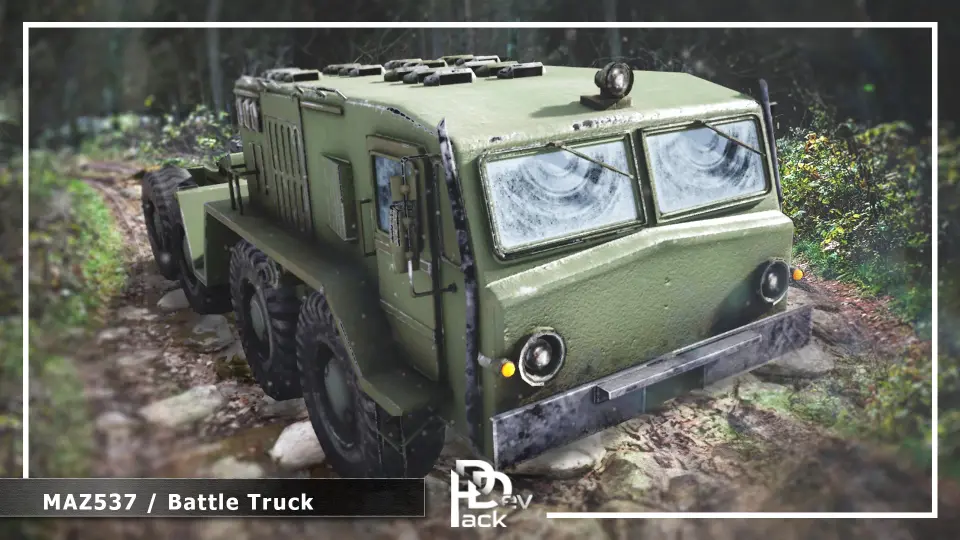
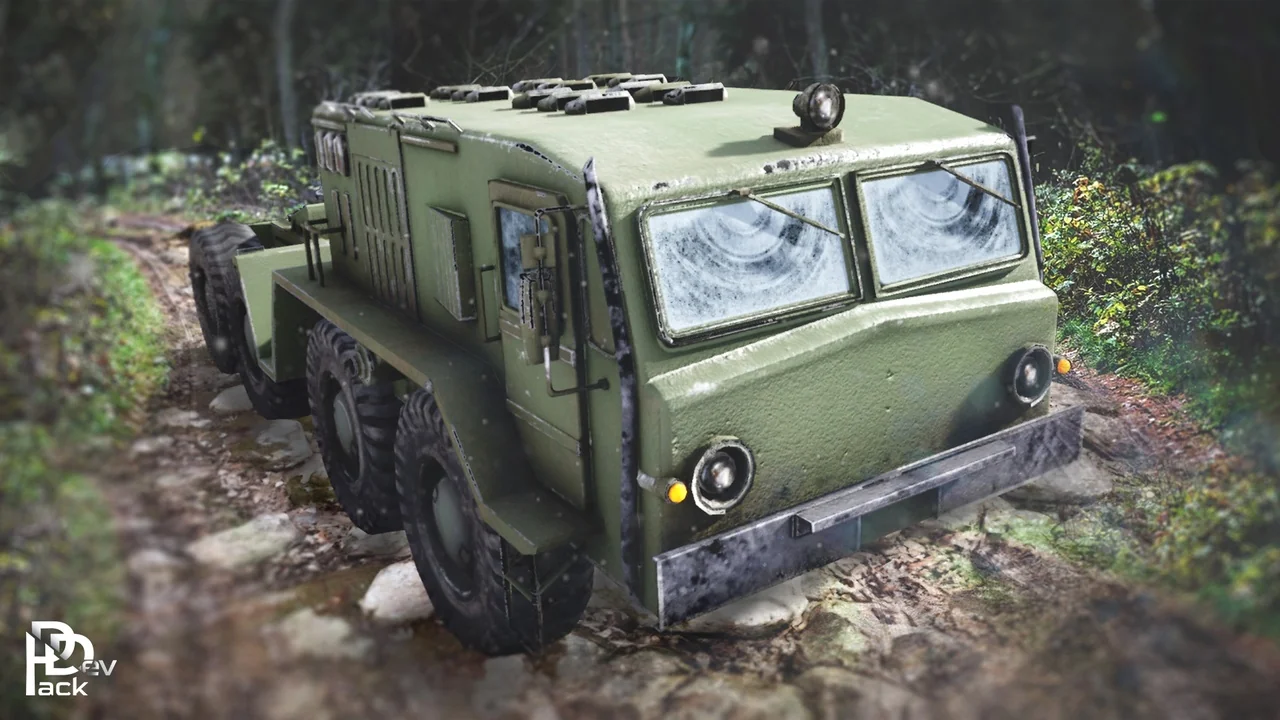
MAZ537 / Battle Truck / 6 Versions
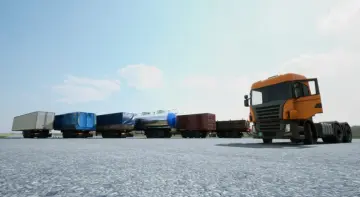
A Russian MAZ537 combat truck package with six blueprint variations, twelve textures, and five camo and paint schemes spanning green forest, beige urban, white,
Most vehicle packs make you choose between one hero model and a pile of near-duplicates. This MAZ537 package takes a narrower route: one mesh, six blueprints, and a set of paint and camo material swaps. This gives a Russian combat truck you can field as a drivable object in several configurations without hunting through a folder of meshes that all need separate rigging attention.
The number worth paying attention to is the blueprint count. Six blueprints sitting on top of a single mesh means the variation lives in logic and materials rather than in geometry, which keeps the asset light and predictable when you drop it into a scene. Tags like Drivable and Lowpoly point at where it fits: a truck you can actually move through a level, built with a lean enough geometry budget to survive being spawned more than once.
Green forest, beige urban, and everything in between
Paint schemes are where the package does its heaviest lifting. Green forest camo and beige urban camo cover the two most common battlefield settings. Plain green and plain beige give you the same palettes without the pattern, which is useful when a camo print would read as too busy at distance or under heavy lighting.
White and black round out the set. White earns its place in snow and winter terrain, where a forest camo truck would break the read of the environment. Black suits night operations, industrial yards, or any scene where you want the truck to sit as a silhouette rather than a focal point. Ten material or texture sets in all, drawn from twelve textures total, with eight materials and material instances holding them together.
What the material count means for swaps
Eight materials and instances against twelve textures is a tidy ratio. You are not rebuilding shaders to change the truck's appearance; you are pointing the existing set at a different scheme. For a scene that needs a convoy of mixed vehicles, that gives you visual variety from one model without multiplying your draw-call footprint by the number of trucks on screen.
Placing a MAZ537 in a scene that already has a mood
The truck carries the Pbr and Realistic tags alongside Lowpoly, which is a pairing that shapes how it should be lit. Physically based materials with Lumen in the mix means the paint reacts to whatever lighting you have built — a warm dusk bounce, a cold overcast fill, the harsh key of a midday exterior. The camo patterns will read differently under each, so it is worth testing the green forest scheme and the beige urban scheme under the same sky before committing to one.
A single-mesh truck is also easy to dress a set around. Park it as a static prop and it becomes a scale reference for the rest of the environment. Drop it beside Weaponry and Armory assets and it reads as part of a supply line or a staging area rather than an isolated showcase piece. The Army, War, and Military tags describe the company it keeps.
Drivable logic as the starting point, not the finish line
Because the six variations are blueprints rather than separate models, the package gives you a drivable base to build on. Transport and Transportation tags suggest the obvious role: moving something or someone across a level. Battle and Combat tags open the other direction, where the truck becomes a mobile platform in a firefight.
Six blueprints on one mesh keeps that decision cheap. You can audition several behaviours side by side in the same scene, see which reads best under Lumen lighting and the camo you have chosen, and then keep the one that works. The blueprint spread is the flexibility; the single mesh is the consistency.
Matching the asset to the production it lands in
Scene, Person, and Vehicle tags together hint at the intended company: this is a truck meant to share frame space with characters and environment work, not to stand alone in a turntable. That makes the plain green and plain beige schemes the quiet workhorses of the set — easy to blend into a busy scene without pulling the eye. Save the forest and urban camo for the shots where the truck is the subject.
For a project that needs one credible Russian military truck across several environments, the package covers the ground with a modest footprint: one mesh, twelve textures, eight materials, six blueprints, and five camouflage or colour schemes to move between. Where it fits in production is straightforward — a drivable, PBR-lit truck that can be repainted per scene rather than rebuilt per scene.
 Vehicles
 Vehicles
 Vehicles
 Vehicles