"c14ff6bd758dadb1"{"id":"1000641","slug":"magic-kit-02","title":"Magic Kit 02","category":"Spells \u0026 Combat","engine":"5.6+","assetVersion":"","engineVersion":"Engine Version: 5.6+","tag":"Spells \u0026 Combat","accent":"blue","visual":"mech","summary":"A Niagara-based Unreal Engine VFX pack with wind, dark matter, shadow, and spiritual energy spells, including basic attacks, defensive effects, and special abil","platform":"Unreal Engine","publishedAt":"2026-07-21T17:22:03.882Z","updatedAt":"2026-07-21T17:22:03.882Z","sourceNotes":[],"fileContents":[],"compatibility":["Unreal Engine","Engine Version: 5.6+"],"featuredImage":{"alt":"Magic Kit 02","src":"/wp-content/uploads/published/2026/07/93a41e195ab2-f1f69b0a-6f09-4260-83bb-cff53276c122-60478e8700.webp"},"hasDownloadLink":true,"downloads":2,"terms":[{"taxonomy":"category","slug":"spells-and-combat","name":"Spells \u0026 Combat"}],"galleryImages":[{"src":"/wp-content/uploads/published/2026/07/a78f3daf454b-6f7894da-4083-4b70-a195-a763dbfe948e-fc749feb08.webp","alt":"Magic Kit 02"},{"src":"/wp-content/uploads/published/2026/07/142641152489-a48e5784-1aa1-4785-b1ac-6c4bcaad4210-a5741599df.webp","alt":"Magic Kit 02"},{"src":"/wp-content/uploads/published/2026/07/147f3459f49a-cfb3eefd-a01f-4015-b91f-e1b2241a0aac-11a6a7479f.webp","alt":"Magic Kit 02"},{"src":"/wp-content/uploads/published/2026/07/c8c26b21f2de-f17ee44a-6d2f-4975-9d73-713d1fa57423-d00650a3b1.webp","alt":"Magic Kit 02"},{"src":"/wp-content/uploads/published/2026/07/d53226452321-a31bf201-fb1c-4f57-95fc-d8beb8fcf254-67668058cb.webp","alt":"Magic Kit 02"},{"src":"/wp-content/uploads/published/2026/07/4d022b9badc3-cf3c9c0c-f54a-4bd6-ae7c-65da68feb868-d50f20824a.webp","alt":"Magic Kit 02"},{"src":"/wp-content/uploads/published/2026/07/a461e6bdaf3a-34c7f05c-6c88-4e44-ad84-3d72817cdb5e-d4340d9644.webp","alt":"Magic Kit 02"},{"src":"/wp-content/uploads/published/2026/07/1935cc112a9f-9ee3153f-67be-4ee8-bb20-4000652830f0-2302f22977.webp","alt":"Magic Kit 02"},{"src":"/wp-content/uploads/published/2026/07/45f359a49e3d-12a42ca2-9551-4931-a9e1-652543dff119-f8cfaff767.webp","alt":"Magic Kit 02"},{"src":"/wp-content/uploads/published/2026/07/d3478632852e-a870a173-6a1c-42bf-b123-cbd1b318692c-8a792452d3.webp","alt":"Magic Kit 02"}],"accessPanel":{"kind":"resource","title":"Download this resource","eyebrow":"Free Download","message":"Log in or create a free account to start your download.","fileName":"MagicKit02.7z","safetyNote":"Resources are manually reviewed before listing to improve quality and reduce obvious risks.","actionLabel":"Download Free","resourceType":"Resource archive"},"contentHtml":"\u003cp\u003eWhen a combat encounter needs eruptive wind gusts, swirling dark matter, shifting shadow forms, or spiritual energy bursts, the visual layer has to read instantly and feel distinct per element. Magic Kit 02 approaches that need by compartmentalizing fantasy spell work into four elemental families, each structured around the same gameplay-oriented pattern: three basic attacks, one defensive effect, and one special ability. Every particle effect in the package is built as a Niagara System, keeping the toolchain consistent across the board.\u003c/p\u003e \u003ch2\u003eThe Four Elements: Wind, Dark Matter, Shadow, and Spiritual Energy\u003c/h2\u003e \u003cp\u003eThe pack's identity rests on four clearly separated elemental themes. Wind suggests movement-driven visuals—gusts, cutting air, or pressure waves. Dark Matter shifts into cosmic or gravitational territory, fitting effects that feel heavy, distorted, or physically wrong. Shadow leans into concealment and silhouette work, useful for stealth-adjacent abilities or corrupted magic. Spiritual Energy rounds the set out with ethereal, soul-adjacent aesthetics that suit healing, projection, or ascendant attacks.\u003c/p\u003e \u003cp\u003eEach element follows the same internal structure. Three basic attacks give developers room to scale damage tiers or combo progression without reaching outside the element's visual language. A single defensive effect per element handles shielding, parry moments, or damage mitigation visuals. One special ability per element serves as the high-impact, likely cooldown-gated ability that players recognize as a heavy moment in combat.\u003c/p\u003e \u003ch2\u003eNiagara Systems Across the Board\u003c/h2\u003e \u003cp\u003eUnreal Engine's Niagara is the sole particle framework here. That uniformity matters for projects already committed to Niagara, since every effect in the kit lives in the same system structure. Teams do not need to bridge Cascade-based legacy particles into a Niagara-focused pipeline. The four elemental families—wind, dark matter, shadow, and spiritual energy—share one authoring approach, which simplifies maintenance and iteration if art directors decide to push one element's intensity higher or pull another back.\u003c/p\u003e \u003cp\u003eBecause every particle setup is a Niagara System, the effects integrate into existing Unreal projects without requiring a second VFX tool to interpret or adapt them. The consistency also means that scaling intensity, adjusting emitter counts, or retiming bursts happens through a familiar interface rather than across mixed particle tools.\u003c/p\u003e \u003ch2\u003eWind, Dark Matter, Shadow, and Spiritual Energy Blueprint Examples\u003c/h2\u003e \u003cp\u003eBeyond raw particle systems, the kit includes some Blueprints with examples of use. This is a meaningful inclusion for developers who want to see how effects might trigger in a scene, hook into gameplay logic, or layer together during ability sequences. The Blueprints serve as functional references rather than standalone mechanics—they demonstrate particle placement in practical contexts, giving developers a structural starting point.\u003c/p\u003e \u003cp\u003eFor teams prototyping an RPG or action-oriented build, having Blueprint examples alongside the Niagara VFX cuts down the guesswork involved in wiring visuals to events. A special ability, for instance, can be previewed in context rather than dropped into a blank scene with no behavior attached. The defensive effects benefit similarly, since shield or barrier visuals often need to synchronize with incoming damage timing.\u003c/p\u003e \u003ch2\u003eWhere the Kit Fits in a Broader VFX Collection\u003c/h2\u003e \u003cp\u003eMagic Kit 02 is part of a lineup that includes Magic Kit 01, Magic Kit 03, Magic Kit 04, and Magic Kit 05. Together they belong to a collection containing more than 150 unique VFX. That broader context matters when planning a project's full visual effects scope. A team could treat this specific kit as the second block of elemental coverage, filling out wind, dark matter, shadow, and spiritual energy while leaning on the other kits for additional elemental variety or complementary effect types.\u003c/p\u003e \u003cp\u003eFor projects that need a sustained pipeline of magic visuals across multiple updates, expansions, or character classes, situating this pack within the larger five-kit set is a practical consideration. The collection's scale—over 150 unique effects—suggests that these kits are structured to accumulate rather than overlap heavily, each covering its own thematic ground.\u003c/p\u003e \u003ch2\u003eProject Scenes Best Suited for These Effects\u003c/h2\u003e \u003cp\u003eFantasy combat is the clearest fit. The tag set attached to the pack—Visual, Effect, Defense, Fantasy, Spell, Wind, Attack, Shadow, Magic, Spirit, Galaxy—maps directly onto genres where elemental abilities, spell combos, and ability-driven encounters are central to the experience. Action RPGs, spellcasting-focused combat games, and boss encounters where each phase shifts elemental tone would all benefit from the four-element structure.\u003c/p\u003e \u003cp\u003eThe defensive effects open up specific scene types beyond pure offense. A parry-heavy combat system could use the shield visuals as reactive feedback. A phase-based boss could trigger a defensive effect before switching attack patterns. The special abilities, being singular per element, naturally suit ultimate-style moves where the visual needs to communicate a decisive, high-stakes moment.\u003c/p\u003e \u003cp\u003eGameplay systems shaped by elemental interactions—wind countered by shadow, spiritual energy clashing with dark matter—gain a cohesive visual baseline from having all four elements in a single kit. Rather than pulling effects from disparate sources and matching intensity after the fact, developers start with a set authored under shared constraints.\u003c/p\u003e \u003ch2\u003eWho Benefits Most from Magic Kit 02\u003c/h2\u003e \u003cp\u003eDevelopers working in Unreal Engine with an existing Niagara-based workflow are the primary audience. The Blueprint examples make the kit approachable for smaller teams or solo developers who want functional context alongside raw particle assets, rather than importing systems and wiring them up from absolute zero. Teams already using other installments in the series—and looking to expand into a second set of elemental themes—will find the structural consistency useful for maintaining visual coherence across a broader magic system.\u003c/p\u003e \u003cp\u003eNarrative-driven RPGs that rely on elemental contrast between characters or factions can use the four-element split as direct visual shorthand. Wind reads as speed and pressure, shadow as deception and threat, spiritual energy as purity or mysticism, and dark matter as instability or cosmic force. That range gives combat designers a palette where each element carries clear meaning without requiring custom-built effects for every ability tier.\u003c/p\u003e \u003cp\u003eThe strongest takeaway for teams evaluating this package: Magic Kit 02 delivers four structurally parallel elemental sets in Niagara, each with the same attack-defense-special breakdown, plus Blueprint examples showing how to put those effects into context. For projects that need cohesive elemental spell coverage in Unreal Engine, that structural consistency is what separates this pack from loose collections of unrelated particle effects.\u003c/p\u003e\n\n\u003ch2\u003eRelated Resources Worth Checking\u003c/h2\u003e\n\u003cul\u003e\n\u003cli\u003e\u003ca href=\"https://3dcghub.com/magic-kit-01/\" title=\"Magic Kit 01\"\u003eMagic Kit 01\u003c/a\u003e\u003c/li\u003e\n\u003cli\u003e\u003ca href=\"https://3dcghub.com/poison-magic-niagara/\" title=\"Poison Magic Niagara\"\u003ePoison Magic Niagara\u003c/a\u003e\u003c/li\u003e\n\u003cli\u003e\u003ca href=\"https://3dcghub.com/nature-vfx-with-vine-growth/\" title=\"Nature VFX with Vine Growth\"\u003eNature VFX with Vine Growth\u003c/a\u003e\u003c/li\u003e\n\u003cli\u003e\u003ca href=\"https://3dcghub.com/cosmic-vfx/\" title=\"Cosmic VFX\"\u003eCosmic VFX\u003c/a\u003e\u003c/li\u003e\n\u003cli\u003e\u003ca href=\"https://3dcghub.com/magic-projectiles-vol-2-niagara/\" title=\"Magic Projectiles Vol. 2 - Niagara\"\u003eMagic Projectiles Vol. 2 - Niagara\u003c/a\u003e\u003c/li\u003e\n\u003c/ul\u003e","contentTextLength":7125,"navigation":{"current":1220,"total":3719,"previous":{"id":"1000642","slug":"mc-dungeon-life-animation-pack","title":"MC Dungeon Life Animation Pack","category":"Combat","platform":"Unreal Engine","updatedAt":"2026-07-21T17:26:19.432Z"},"next":{"id":"1000640","slug":"magic-cast-vfx","title":"Magic Cast VFX","category":"Spells \u0026 Combat","platform":"Unreal Engine","updatedAt":"2026-07-21T17:18:10.029Z"}},"relatedResources":[{"id":"16432","slug":"magic-kit-01","title":"Magic Kit 01","category":"Spells \u0026 Combat","engine":"4.26+,5.0+","assetVersion":"Engine version: 4.26+,5.0+","engineVersion":"4.26","tag":"Spells \u0026 Combat","accent":"blue","visual":"character","summary":"Magic Kit 01 is a specialized VFX pack featuring four elements with unique attack and defense abilities. Built with the Niagara System, it includes example Blueprints for easy integration.","platform":"Unreal Engine","publishedAt":"2026-03-12T17:08:09.000Z","updatedAt":"2026-04-19T15:44:33.000Z","sourceNotes":[],"fileContents":[],"compatibility":["Unreal Engine","Engine version: 4.26+,5.0+"],"featuredImage":{"alt":"Magic Kit 01","src":"https://3dcghub.com/wp-content/uploads/2026/03/c38d577f-f411-4f15-a921-9ddd9f27c2a1.webp"},"hasDownloadLink":true,"downloads":1},{"id":"1001294","slug":"mixed-magic-spell-vfx-pack","title":"Mixed Magic - Spell VFX Pack","category":"Spells \u0026 Combat","engine":"5.0+","assetVersion":"","engineVersion":"Engine Version: 5.0+","tag":"Spells \u0026 Combat","accent":"blue","visual":"mech","summary":"Mixed Magic - Spell VFX Pack supplies 26 elemental spells across fire, dark, water, lightning, and ice, featuring optimized Niagara effects and modular setups.","platform":"Unreal Engine","publishedAt":"2026-10-01T16:45:14.765Z","updatedAt":"2026-10-01T16:45:14.765Z","sourceNotes":[],"fileContents":[],"compatibility":["Unreal Engine","Engine Version: 5.0+"],"featuredImage":{"alt":"Mixed Magic - Spell VFX Pack","src":"/wp-content/uploads/published/2026/10/ef0800e3666d-b2bcf8aa-d8f2-463e-ac03-e36462e93277-64b5a9843e.webp"},"hasDownloadLink":true,"downloads":4},{"id":"1001189","slug":"mega-magic-vfx-bundle","title":"Mega Magic VFX Bundle","category":"Spells \u0026 Combat","engine":"5.0+","assetVersion":"","engineVersion":"Engine Version: 5.0+","tag":"Spells \u0026 Combat","accent":"blue","visual":"mech","summary":"Explore the Mega Magic VFX Bundle featuring 61 unique stylized visual effects, covering magic auras, defensive shields, and explosive attack spells.","platform":"Unreal Engine","publishedAt":"2026-09-17T06:44:28.385Z","updatedAt":"2026-09-17T06:44:28.385Z","sourceNotes":[],"fileContents":[],"compatibility":["Unreal Engine","Engine Version: 5.0+"],"featuredImage":{"alt":"Mega Magic VFX Bundle","src":"/wp-content/uploads/published/2026/09/01c1ab5194a0-31a84eec-fb18-455f-9cf4-27bc9436ceee-e5479c5fe0.webp"},"hasDownloadLink":true,"downloads":6}]}
Spells & Combat
Magic Kit 02
A Niagara-based Unreal Engine VFX pack with wind, dark matter, shadow, and spiritual energy spells, including basic attacks, defensive effects, and special abil
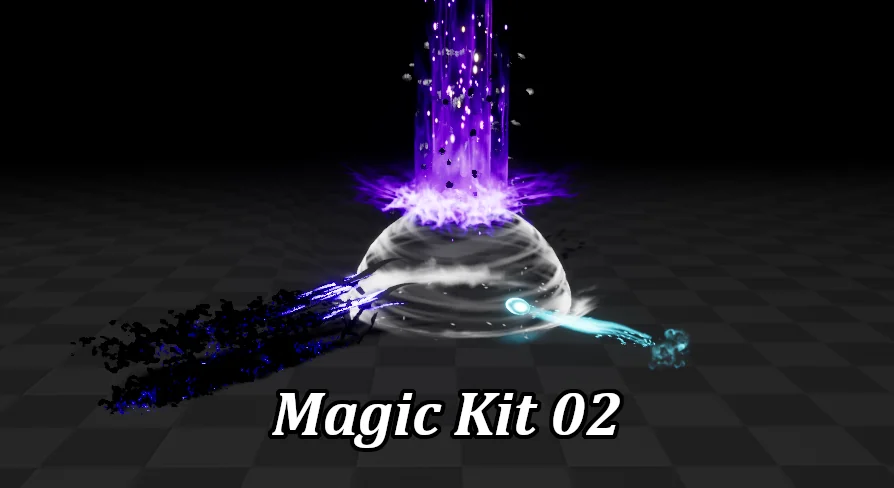
When a combat encounter needs eruptive wind gusts, swirling dark matter, shifting shadow forms, or spiritual energy bursts, the visual layer has to read instantly and feel distinct per element. Magic Kit 02 approaches that need by compartmentalizing fantasy spell work into four elemental families, each structured around the same gameplay-oriented pattern: three basic attacks, one defensive effect, and one special ability. Every particle effect in the package is built as a Niagara System, keeping the toolchain consistent across the board.
The Four Elements: Wind, Dark Matter, Shadow, and Spiritual Energy
The pack's identity rests on four clearly separated elemental themes. Wind suggests movement-driven visuals—gusts, cutting air, or pressure waves. Dark Matter shifts into cosmic or gravitational territory, fitting effects that feel heavy, distorted, or physically wrong. Shadow leans into concealment and silhouette work, useful for stealth-adjacent abilities or corrupted magic. Spiritual Energy rounds the set out with ethereal, soul-adjacent aesthetics that suit healing, projection, or ascendant attacks.
Each element follows the same internal structure. Three basic attacks give developers room to scale damage tiers or combo progression without reaching outside the element's visual language. A single defensive effect per element handles shielding, parry moments, or damage mitigation visuals. One special ability per element serves as the high-impact, likely cooldown-gated ability that players recognize as a heavy moment in combat.
Niagara Systems Across the Board
Unreal Engine's Niagara is the sole particle framework here. That uniformity matters for projects already committed to Niagara, since every effect in the kit lives in the same system structure. Teams do not need to bridge Cascade-based legacy particles into a Niagara-focused pipeline. The four elemental families—wind, dark matter, shadow, and spiritual energy—share one authoring approach, which simplifies maintenance and iteration if art directors decide to push one element's intensity higher or pull another back.
Because every particle setup is a Niagara System, the effects integrate into existing Unreal projects without requiring a second VFX tool to interpret or adapt them. The consistency also means that scaling intensity, adjusting emitter counts, or retiming bursts happens through a familiar interface rather than across mixed particle tools.
Wind, Dark Matter, Shadow, and Spiritual Energy Blueprint Examples
Beyond raw particle systems, the kit includes some Blueprints with examples of use. This is a meaningful inclusion for developers who want to see how effects might trigger in a scene, hook into gameplay logic, or layer together during ability sequences. The Blueprints serve as functional references rather than standalone mechanics—they demonstrate particle placement in practical contexts, giving developers a structural starting point.
For teams prototyping an RPG or action-oriented build, having Blueprint examples alongside the Niagara VFX cuts down the guesswork involved in wiring visuals to events. A special ability, for instance, can be previewed in context rather than dropped into a blank scene with no behavior attached. The defensive effects benefit similarly, since shield or barrier visuals often need to synchronize with incoming damage timing.
Where the Kit Fits in a Broader VFX Collection
Magic Kit 02 is part of a lineup that includes Magic Kit 01, Magic Kit 03, Magic Kit 04, and Magic Kit 05. Together they belong to a collection containing more than 150 unique VFX. That broader context matters when planning a project's full visual effects scope. A team could treat this specific kit as the second block of elemental coverage, filling out wind, dark matter, shadow, and spiritual energy while leaning on the other kits for additional elemental variety or complementary effect types.
For projects that need a sustained pipeline of magic visuals across multiple updates, expansions, or character classes, situating this pack within the larger five-kit set is a practical consideration. The collection's scale—over 150 unique effects—suggests that these kits are structured to accumulate rather than overlap heavily, each covering its own thematic ground.
Project Scenes Best Suited for These Effects
Fantasy combat is the clearest fit. The tag set attached to the pack—Visual, Effect, Defense, Fantasy, Spell, Wind, Attack, Shadow, Magic, Spirit, Galaxy—maps directly onto genres where elemental abilities, spell combos, and ability-driven encounters are central to the experience. Action RPGs, spellcasting-focused combat games, and boss encounters where each phase shifts elemental tone would all benefit from the four-element structure.
The defensive effects open up specific scene types beyond pure offense. A parry-heavy combat system could use the shield visuals as reactive feedback. A phase-based boss could trigger a defensive effect before switching attack patterns. The special abilities, being singular per element, naturally suit ultimate-style moves where the visual needs to communicate a decisive, high-stakes moment.
Gameplay systems shaped by elemental interactions—wind countered by shadow, spiritual energy clashing with dark matter—gain a cohesive visual baseline from having all four elements in a single kit. Rather than pulling effects from disparate sources and matching intensity after the fact, developers start with a set authored under shared constraints.
Who Benefits Most from Magic Kit 02
Developers working in Unreal Engine with an existing Niagara-based workflow are the primary audience. The Blueprint examples make the kit approachable for smaller teams or solo developers who want functional context alongside raw particle assets, rather than importing systems and wiring them up from absolute zero. Teams already using other installments in the series—and looking to expand into a second set of elemental themes—will find the structural consistency useful for maintaining visual coherence across a broader magic system.
Narrative-driven RPGs that rely on elemental contrast between characters or factions can use the four-element split as direct visual shorthand. Wind reads as speed and pressure, shadow as deception and threat, spiritual energy as purity or mysticism, and dark matter as instability or cosmic force. That range gives combat designers a palette where each element carries clear meaning without requiring custom-built effects for every ability tier.
The strongest takeaway for teams evaluating this package: Magic Kit 02 delivers four structurally parallel elemental sets in Niagara, each with the same attack-defense-special breakdown, plus Blueprint examples showing how to put those effects into context. For projects that need cohesive elemental spell coverage in Unreal Engine, that structural consistency is what separates this pack from loose collections of unrelated particle effects.
 Spells & Combat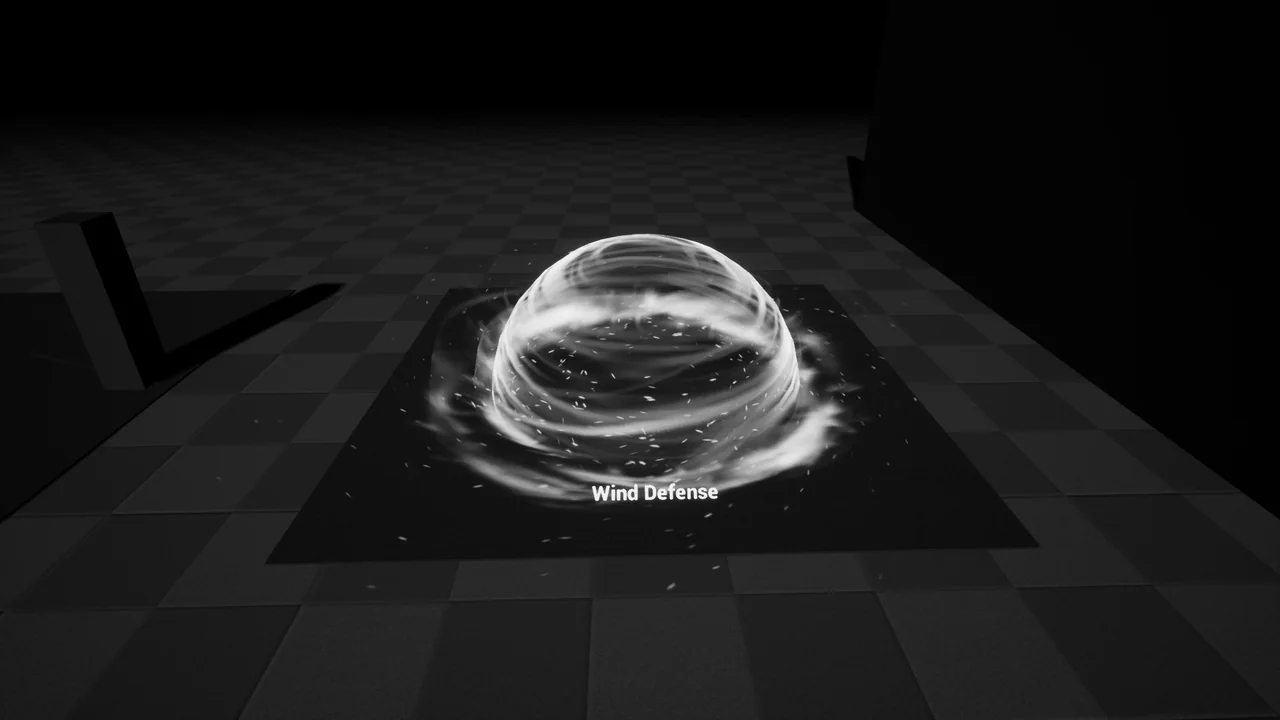
 Spells & Combat
 Spells & Combat
 Spells & Combat