"c14ff6bd758dadb1"{"id":"1000323","slug":"poison-magic-niagara","title":"Poison Magic Niagara","category":"Spells \u0026 Combat","engine":"5.0+","assetVersion":"","engineVersion":"Engine Version: 5.0+","tag":"Spells \u0026 Combat","accent":"blue","visual":"mech","summary":"Enhance your project with Poison Magic Niagara, featuring customizable visual effects for spells, shields, slashes, and toxic splashes in real-time environments","platform":"Unreal Engine","publishedAt":"2026-07-05T06:06:50.287Z","updatedAt":"2026-07-05T06:06:50.287Z","sourceNotes":[],"fileContents":[],"compatibility":["Unreal Engine","Engine Version: 5.0+"],"featuredImage":{"alt":"Poison Magic Niagara","src":"/wp-content/uploads/published/2026/07/e08c4226a189-311bc2cf-7f07-4bf2-b917-9a009c7e42d0-4bde2cc9b0.webp"},"hasDownloadLink":true,"downloads":2,"terms":[{"taxonomy":"category","slug":"spells-and-combat","name":"Spells \u0026 Combat"}],"galleryImages":[{"src":"/wp-content/uploads/published/2026/07/3daa2a477d85-40b8e605-48b2-4584-988a-9788726d868c-8b9328ae91.webp","alt":"Poison Magic Niagara"},{"src":"/wp-content/uploads/published/2026/07/8ccc745e0913-29692803-9324-4d5c-857f-f0d96e7fa703-b3726adf09.webp","alt":"Poison Magic Niagara"},{"src":"/wp-content/uploads/published/2026/07/a5ae0c59f1ae-e46cb4fc-9a14-447f-b393-464ae5735c0d-b07fcb601a.webp","alt":"Poison Magic Niagara"},{"src":"/wp-content/uploads/published/2026/07/6e6fc6309e6b-ae5dd68e-a956-43eb-96bc-9ae0dab48144-0c8bb1c1af.webp","alt":"Poison Magic Niagara"},{"src":"/wp-content/uploads/published/2026/07/09a482b06cea-65226e91-adf9-4e9a-82ae-ffb4dc59db92-2882198d4f.webp","alt":"Poison Magic Niagara"},{"src":"/wp-content/uploads/published/2026/07/d40b236426a0-ce3af62e-6aa2-46d2-9bc8-0bac6c79cc35-8e1520d354.webp","alt":"Poison Magic Niagara"},{"src":"/wp-content/uploads/published/2026/07/09bf1cf6a273-62b0e9e5-1b5a-4c9b-9b48-5194c8f6560b-de135fda67.webp","alt":"Poison Magic Niagara"},{"src":"/wp-content/uploads/published/2026/07/c9e95a196a39-d203c2b1-d48a-4c40-a7d1-d3eab944baac-87a7025757.webp","alt":"Poison Magic Niagara"},{"src":"/wp-content/uploads/published/2026/07/a3bc20c1f245-ba4bf893-b9db-409e-91ba-d35114236ae2-d5a0993234.webp","alt":"Poison Magic Niagara"},{"src":"/wp-content/uploads/published/2026/07/96c9261bd17c-317fd785-32df-45b3-ae09-6a819d769345-267aaef897.webp","alt":"Poison Magic Niagara"}],"accessPanel":{"kind":"resource","title":"Download this resource","eyebrow":"Free Download","message":"Log in or create a free account to start your download.","fileName":"Content.7z","safetyNote":"Resources are manually reviewed before listing to improve quality and reduce obvious risks.","actionLabel":"Download Free","resourceType":"Resource archive"},"contentHtml":"\u003cp\u003eWhen implementing toxic abilities, venomous creature attacks, or environmental hazards, the visual feedback needs to clearly communicate danger and status effects to the player. Poison Magic Niagara provides a specialized suite of visual effects built directly within the Niagara framework. Rather than relying on static meshes or generic particle bursts, this collection focuses specifically on the thematic elements of poison and magic. By utilizing the Niagara system, the effects are optimized for real-time rendering, ensuring that complex spellcasting, lingering toxic clouds, and sudden environmental hazards integrate smoothly into the broader project environment without disrupting the visual flow.\u003c/p\u003e \u003ch2\u003eScaling and Color Adjustment Workflows\u003c/h2\u003e\n\u003cp\u003eA critical aspect of implementing visual effects across a varied game world is flexibility within the editor environment. The system allows developers to change both the size and color of the included effects, a feature demonstrated directly in the project trailer. This parameter control is central to modern VFX workflows, as it allows a single base system to be heavily repurposed across multiple scenarios.\u003c/p\u003e\n\u003cp\u003eAdjusting the size means a specific poison effect can be scaled down to fit the precise attack animation of a small venomous insect, or scaled up massively to serve as an area-of-effect spell cast by a raid boss. Similarly, color customization breaks the rigid reliance on the traditional neon green typically associated with poison in video games. Developers can shift the hues to create deep purple toxic swamps, sickly yellow acid splashes, or dark, corrupted magical barriers. This inherent adaptability ensures the visual effects can match the specific art direction, lighting conditions, and color palettes of different levels without requiring technical artists to build entirely new particle systems from the ground up for every variation.\u003c/p\u003e \u003ch2\u003eStructuring Offensive Interactions: Slashes and Splashes\u003c/h2\u003e\n\u003cp\u003eThe asset pack is categorized around several specific types of combat interactions, prominently featuring Slash and Splash effects. Each of these represents a different physical method of delivering poison damage within a game's spatial mechanics.\u003c/p\u003e\n\u003cp\u003eSlash effects are typically tied closely to melee combat animations. They provide a sweeping toxic trail or a distinct impact visual when a weapon coated in poison strikes a target. This gives immediate, satisfying feedback for close-quarters engagements, telegraphing the exact arc and reach of the weapon. Splash effects cater to projectiles, exploding vials, or traps. These effects are intended for moments where the poison needs to visually disperse over a surface or area upon impact, indicating a localized zone of danger. By covering these distinct physical delivery methods, the pack supports a diverse range of character classes—from rogues using poisoned daggers to alchemists throwing toxic flasks.\u003c/p\u003e \u003ch2\u003eDefining Magical Systems and Spells\u003c/h2\u003e\n\u003cp\u003eBeyond physical weapon strikes, the package heavily emphasizes the Spell and Magic categories. The spell-based visual effects cover the casting animations, channeling phases, and magical projectiles associated with ranged magic combat. This allows mages, necromancers, or highly magical creatures to hurl concentrated toxic energy at their opponents. The distinction between a physical splash and a magical spell is crucial in fantasy game development, as spells often require distinct buildup visuals, traveling particle trails, and complex impact bursts that differentiate them from standard physical attacks.\u003c/p\u003e \u003ch2\u003eDefensive Maneuvers and Status Buffs\u003c/h2\u003e\n\u003cp\u003eIn complex combat systems, poison is not always a simple projectile; it frequently acts as a persistent state or a defensive mechanism. Poison Magic Niagara includes effects specifically intended for these non-offensive maneuvers, highlighting Shield and Buff visuals.\u003c/p\u003e\n\u003cp\u003eThe inclusion of shield effects allows developers to wrap characters, NPCs, or interactive objects in a protective, toxic barrier. This visually warns attackers of reciprocal damage or status ailments if they attempt to breach the shield. Buff effects are essential for communicating temporary state changes directly on the character model. Whether a character has actively imbued their own weapons with venom, gained a temporary resistance to toxic environments, or is suffering from a lingering damage-over-time affliction, these visual indicators provide necessary diegetic context. This allows players to read the flow of combat naturally without having to constantly monitor user interface icons.\u003c/p\u003e \u003ch2\u003eIntegration with Elemental and Creature Systems\u003c/h2\u003e\n\u003cp\u003ePoison Magic Niagara is designed to sit alongside a much larger ecosystem of elemental and creature-focused assets. This pack complements a wide array of other Niagara-based magic systems, including Water, Earth, Air, Ice, and Fire Magic, as well as an overarching Pack Magic Effects Niagara 1 and Ultra Pack Textures. For studios building comprehensive RPGs or fantasy games with complex elemental interaction matrices, having a unified visual style across all magic types ensures aesthetic consistency throughout the project.\u003c/p\u003e\n\u003cp\u003eThe poison effects tie naturally into creature assets, specifically the Monster Pack: Creatures and Monster Pack: Insects. Venomous insects and toxic monsters require highly specific visual effects to properly telegraph their unique attacks and abilities to the player. Integrating these customizable poison spells, splashes, and buffs directly with those specific enemy types provides a cohesive combat experience, ensuring that the visual language of the monstrous enemies perfectly matches the established magical systems of the surrounding game world.\u003c/p\u003e\n\n\u003ch2\u003eRelated Resources Worth Checking\u003c/h2\u003e\n\u003cul\u003e\n\u003cli\u003e\u003ca href=\"https://3dcghub.com/magic-projectiles-vol-2-niagara/\" title=\"Magic Projectiles Vol. 2 - Niagara\"\u003eMagic Projectiles Vol. 2 - Niagara\u003c/a\u003e\u003c/li\u003e\n\u003cli\u003e\u003ca href=\"https://3dcghub.com/sky-open-vfx/\" title=\"Sky Open VFX\"\u003eSky Open VFX\u003c/a\u003e\u003c/li\u003e\n\u003cli\u003e\u003ca href=\"https://3dcghub.com/cosmic-vfx/\" title=\"Cosmic VFX\"\u003eCosmic VFX\u003c/a\u003e\u003c/li\u003e\n\u003cli\u003e\u003ca href=\"https://3dcghub.com/ice-magic-spells-niagara-fx/\" title=\"Ice Magic Spells Niagara FX\"\u003eIce Magic Spells Niagara FX\u003c/a\u003e\u003c/li\u003e\n\u003cli\u003e\u003ca href=\"https://3dcghub.com/water-magic-niagara/\" title=\"Water Magic Niagara\"\u003eWater Magic Niagara\u003c/a\u003e\u003c/li\u003e\n\u003c/ul\u003e","contentTextLength":5849,"navigation":{"current":1543,"total":3719,"previous":{"id":"1000324","slug":"polyzones-plugin","title":"PolyZones Plugin","category":"Engine Tools","platform":"Unreal Engine","updatedAt":"2026-07-05T06:11:42.782Z"},"next":{"id":"1000322","slug":"pn-gaiden-animations","title":"PN Gaiden Animations","category":"Variety","platform":"Unreal Engine","updatedAt":"2026-07-05T05:48:59.840Z"}},"relatedResources":[{"id":"1001294","slug":"mixed-magic-spell-vfx-pack","title":"Mixed Magic - Spell VFX Pack","category":"Spells \u0026 Combat","engine":"5.0+","assetVersion":"","engineVersion":"Engine Version: 5.0+","tag":"Spells \u0026 Combat","accent":"blue","visual":"mech","summary":"Mixed Magic - Spell VFX Pack supplies 26 elemental spells across fire, dark, water, lightning, and ice, featuring optimized Niagara effects and modular setups.","platform":"Unreal Engine","publishedAt":"2026-10-01T16:45:14.765Z","updatedAt":"2026-10-01T16:45:14.765Z","sourceNotes":[],"fileContents":[],"compatibility":["Unreal Engine","Engine Version: 5.0+"],"featuredImage":{"alt":"Mixed Magic - Spell VFX Pack","src":"/wp-content/uploads/published/2026/10/ef0800e3666d-b2bcf8aa-d8f2-463e-ac03-e36462e93277-64b5a9843e.webp"},"hasDownloadLink":true,"downloads":4},{"id":"1000641","slug":"magic-kit-02","title":"Magic Kit 02","category":"Spells \u0026 Combat","engine":"5.6+","assetVersion":"","engineVersion":"Engine Version: 5.6+","tag":"Spells \u0026 Combat","accent":"blue","visual":"mech","summary":"A Niagara-based Unreal Engine VFX pack with wind, dark matter, shadow, and spiritual energy spells, including basic attacks, defensive effects, and special abil","platform":"Unreal Engine","publishedAt":"2026-07-21T17:22:03.882Z","updatedAt":"2026-07-21T17:22:03.882Z","sourceNotes":[],"fileContents":[],"compatibility":["Unreal Engine","Engine Version: 5.6+"],"featuredImage":{"alt":"Magic Kit 02","src":"/wp-content/uploads/published/2026/07/93a41e195ab2-f1f69b0a-6f09-4260-83bb-cff53276c122-60478e8700.webp"},"hasDownloadLink":true,"downloads":2},{"id":"16838","slug":"water-magic-niagara","title":"Water Magic Niagara","category":"Spells \u0026 Combat","engine":"5.0+","assetVersion":"Engine version: 5.0+","engineVersion":"5.0","tag":"Spells \u0026 Combat","accent":"blue","visual":"animation","summary":"Enhance your project with Water Magic Niagara, a specialized collection of aquatic visual effects. This pack allows for easy customization of size and color to fit any magical gameplay scenario.","platform":"Unreal Engine","publishedAt":"2026-03-12T18:03:54.000Z","updatedAt":"2026-04-19T15:43:41.000Z","sourceNotes":[],"fileContents":[],"compatibility":["Unreal Engine","Engine version: 5.0+"],"featuredImage":{"alt":"Water Magic Niagara","src":"https://3dcghub.com/wp-content/uploads/2026/03/cb921e64-127c-40c5-869f-c9c1dbc93b27.webp"},"hasDownloadLink":true,"downloads":7}]}
Spells & Combat
Poison Magic Niagara
Enhance your project with Poison Magic Niagara, featuring customizable visual effects for spells, shields, slashes, and toxic splashes in real-time environments
When implementing toxic abilities, venomous creature attacks, or environmental hazards, the visual feedback needs to clearly communicate danger and status effects to the player. Poison Magic Niagara provides a specialized suite of visual effects built directly within the Niagara framework. Rather than relying on static meshes or generic particle bursts, this collection focuses specifically on the thematic elements of poison and magic. By utilizing the Niagara system, the effects are optimized for real-time rendering, ensuring that complex spellcasting, lingering toxic clouds, and sudden environmental hazards integrate smoothly into the broader project environment without disrupting the visual flow.
Scaling and Color Adjustment Workflows
A critical aspect of implementing visual effects across a varied game world is flexibility within the editor environment. The system allows developers to change both the size and color of the included effects, a feature demonstrated directly in the project trailer. This parameter control is central to modern VFX workflows, as it allows a single base system to be heavily repurposed across multiple scenarios.
Adjusting the size means a specific poison effect can be scaled down to fit the precise attack animation of a small venomous insect, or scaled up massively to serve as an area-of-effect spell cast by a raid boss. Similarly, color customization breaks the rigid reliance on the traditional neon green typically associated with poison in video games. Developers can shift the hues to create deep purple toxic swamps, sickly yellow acid splashes, or dark, corrupted magical barriers. This inherent adaptability ensures the visual effects can match the specific art direction, lighting conditions, and color palettes of different levels without requiring technical artists to build entirely new particle systems from the ground up for every variation.
Structuring Offensive Interactions: Slashes and Splashes
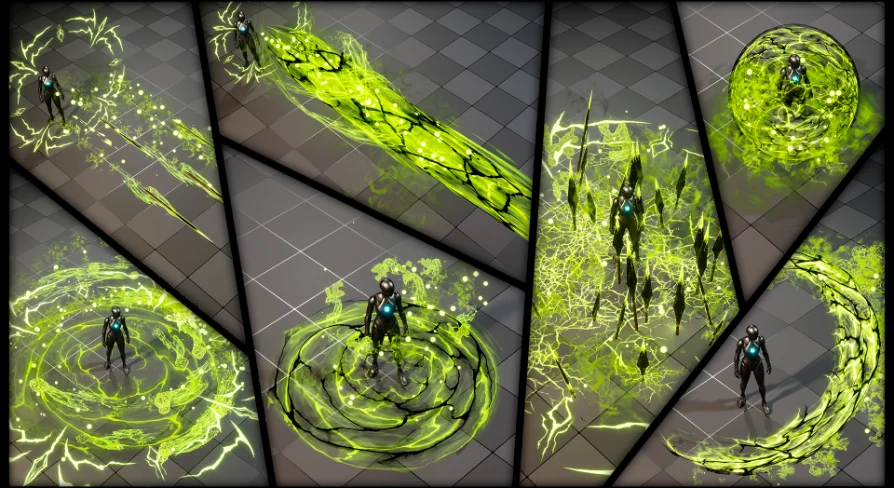
The asset pack is categorized around several specific types of combat interactions, prominently featuring Slash and Splash effects. Each of these represents a different physical method of delivering poison damage within a game's spatial mechanics.
Slash effects are typically tied closely to melee combat animations. They provide a sweeping toxic trail or a distinct impact visual when a weapon coated in poison strikes a target. This gives immediate, satisfying feedback for close-quarters engagements, telegraphing the exact arc and reach of the weapon. Splash effects cater to projectiles, exploding vials, or traps. These effects are intended for moments where the poison needs to visually disperse over a surface or area upon impact, indicating a localized zone of danger. By covering these distinct physical delivery methods, the pack supports a diverse range of character classes—from rogues using poisoned daggers to alchemists throwing toxic flasks.
Defining Magical Systems and Spells
Beyond physical weapon strikes, the package heavily emphasizes the Spell and Magic categories. The spell-based visual effects cover the casting animations, channeling phases, and magical projectiles associated with ranged magic combat. This allows mages, necromancers, or highly magical creatures to hurl concentrated toxic energy at their opponents. The distinction between a physical splash and a magical spell is crucial in fantasy game development, as spells often require distinct buildup visuals, traveling particle trails, and complex impact bursts that differentiate them from standard physical attacks.
Defensive Maneuvers and Status Buffs
In complex combat systems, poison is not always a simple projectile; it frequently acts as a persistent state or a defensive mechanism. Poison Magic Niagara includes effects specifically intended for these non-offensive maneuvers, highlighting Shield and Buff visuals.
The inclusion of shield effects allows developers to wrap characters, NPCs, or interactive objects in a protective, toxic barrier. This visually warns attackers of reciprocal damage or status ailments if they attempt to breach the shield. Buff effects are essential for communicating temporary state changes directly on the character model. Whether a character has actively imbued their own weapons with venom, gained a temporary resistance to toxic environments, or is suffering from a lingering damage-over-time affliction, these visual indicators provide necessary diegetic context. This allows players to read the flow of combat naturally without having to constantly monitor user interface icons.
Integration with Elemental and Creature Systems
Poison Magic Niagara is designed to sit alongside a much larger ecosystem of elemental and creature-focused assets. This pack complements a wide array of other Niagara-based magic systems, including Water, Earth, Air, Ice, and Fire Magic, as well as an overarching Pack Magic Effects Niagara 1 and Ultra Pack Textures. For studios building comprehensive RPGs or fantasy games with complex elemental interaction matrices, having a unified visual style across all magic types ensures aesthetic consistency throughout the project.
The poison effects tie naturally into creature assets, specifically the Monster Pack: Creatures and Monster Pack: Insects. Venomous insects and toxic monsters require highly specific visual effects to properly telegraph their unique attacks and abilities to the player. Integrating these customizable poison spells, splashes, and buffs directly with those specific enemy types provides a cohesive combat experience, ensuring that the visual language of the monstrous enemies perfectly matches the established magical systems of the surrounding game world.
 Spells & Combat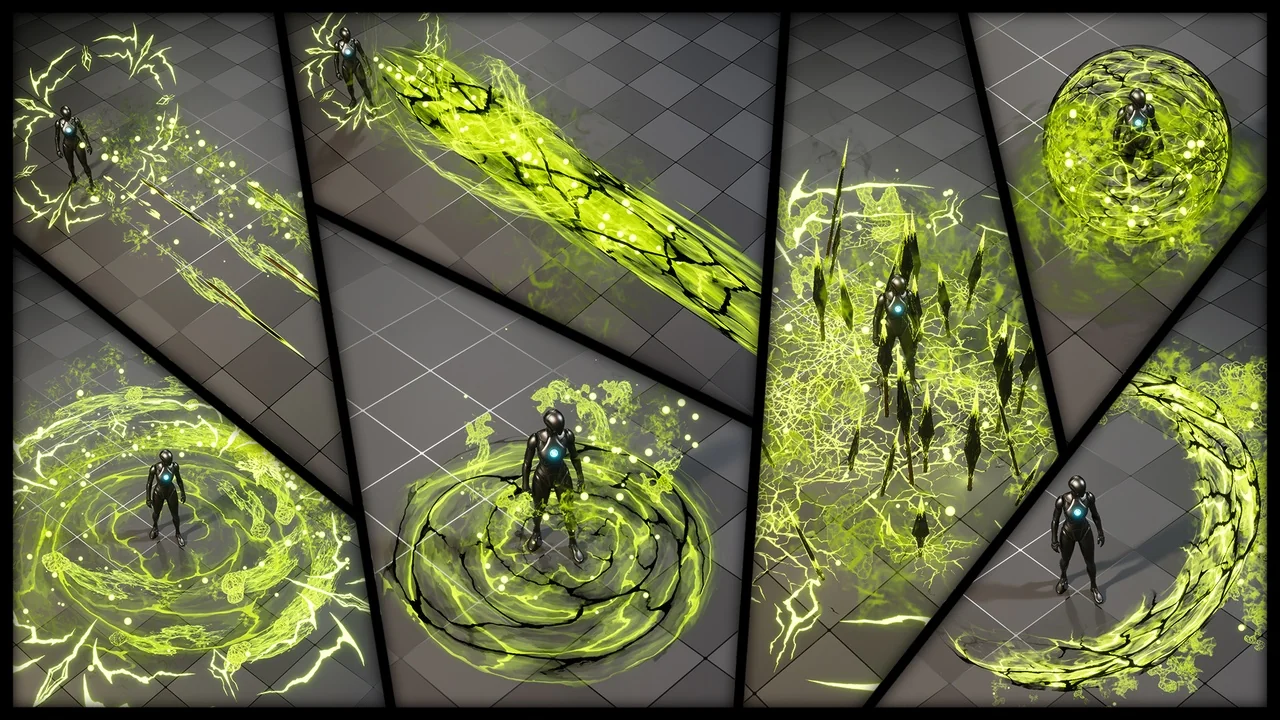
 Spells & Combat
 Spells & Combat
 Spells & Combat