"059e11fbf316ed56"{"id":"1001294","slug":"mixed-magic-spell-vfx-pack","title":"Mixed Magic - Spell VFX Pack","category":"Spells \u0026 Combat","engine":"5.0+","assetVersion":"","engineVersion":"Engine Version: 5.0+","tag":"Spells \u0026 Combat","accent":"blue","visual":"mech","summary":"Mixed Magic - Spell VFX Pack supplies 26 elemental spells across fire, dark, water, lightning, and ice, featuring optimized Niagara effects and modular setups.","platform":"Unreal Engine","publishedAt":"2026-10-01T16:45:14.765Z","updatedAt":"2026-10-01T16:45:14.765Z","sourceNotes":[],"fileContents":[],"compatibility":["Unreal Engine","Engine Version: 5.0+"],"featuredImage":{"alt":"Mixed Magic - Spell VFX Pack","src":"/wp-content/uploads/published/2026/10/ef0800e3666d-b2bcf8aa-d8f2-463e-ac03-e36462e93277-64b5a9843e.webp"},"hasDownloadLink":true,"downloads":0,"terms":[{"taxonomy":"category","slug":"spells-and-combat","name":"Spells \u0026 Combat"}],"galleryImages":[{"src":"/wp-content/uploads/published/2026/10/9ea74055fe25-dd0a62c0-007b-40d0-9780-a310607ed418-bfd74102f4.webp","alt":"Mixed Magic - Spell VFX Pack"},{"src":"/wp-content/uploads/published/2026/10/18e78753d250-8d410ae8-c539-4e4b-a5c3-704976b54496-5f4099deb6.webp","alt":"Mixed Magic - Spell VFX Pack"},{"src":"/wp-content/uploads/published/2026/10/82c34fccea11-1080a8e3-056e-4112-9c76-08524322e097-7874f9b6e7.webp","alt":"Mixed Magic - Spell VFX Pack"},{"src":"/wp-content/uploads/published/2026/10/b9069a3e7028-ecfb50f6-df03-476a-986c-bd04f9a030c5-4e4673ab71.webp","alt":"Mixed Magic - Spell VFX Pack"},{"src":"/wp-content/uploads/published/2026/10/b17b55a250b1-bd193587-f957-4938-8bec-bdf6cb4535b5-d3545c75d3.webp","alt":"Mixed Magic - Spell VFX Pack"},{"src":"/wp-content/uploads/published/2026/10/895a177deff9-75e2fefb-33b1-4113-a8b2-7824958a670b-e554d558bd.webp","alt":"Mixed Magic - Spell VFX Pack"},{"src":"/wp-content/uploads/published/2026/10/dd3f0ad17d13-240b3897-424e-4319-9d66-bb5724492ce2-a7c22f2dec.webp","alt":"Mixed Magic - Spell VFX Pack"},{"src":"/wp-content/uploads/published/2026/10/8dcd1a52e2dc-2b0823ec-d6c3-4185-8013-96a711e920c0-e71545ec78.webp","alt":"Mixed Magic - Spell VFX Pack"},{"src":"/wp-content/uploads/published/2026/10/451161bd4780-1926af69-b180-4541-a9c9-bfa4aa9f224c-86bdd6edeb.webp","alt":"Mixed Magic - Spell VFX Pack"},{"src":"/wp-content/uploads/published/2026/10/50da0e0f3d2d-38aa0f91-4a03-479c-9561-a2886de62332-b447dee5c5.webp","alt":"Mixed Magic - Spell VFX Pack"}],"accessPanel":{"kind":"resource","title":"Download this resource","eyebrow":"Free Download","message":"Log in or create a free account to start your download.","fileName":"Content.7z","safetyNote":"Resources are manually reviewed before listing to improve quality and reduce obvious risks.","actionLabel":"Download Free","resourceType":"Resource archive"},"contentHtml":"\u003ch2\u003eElemental Disciplines Across the 26 Mixed Magic Visual Effects\u003c/h2\u003e\n\u003cp\u003eSpellcasting mechanics in action games require visual clarity, distinct elemental silhouettes, and modular responsiveness. Mixed Magic - Spell VFX Pack addresses these core requirements by assembling 26 distinct visual effects organized into five functional elemental disciplines: fire, dark, water, lightning, and ice. This distribution gives character ability kits a clear visual taxonomy, allowing designers to assign specific damage archetypes and combat behaviors to clearly differentiated energy signatures.\u003c/p\u003e\n\u003cp\u003eRather than confining spells to uniform shapes, the asset collection covers multiple mechanical phases of combat interaction. Ranged combat relies heavily on clean trajectories, and the pack accounts for this by providing projectile paths, sudden area-of-effect bursts, realistic explosions, and sharp point-of-impact detonations. Magicians, wizards, and spellcasters constructed within this framework can shift fluidly between dense kinetic bursts—such as crushing water blasts or cracking lightning surges—and lingering elemental hazards rendered through dark void energies or incandescent flame.\u003c/p\u003e \u003ch2\u003eDecoupling Projectiles: Magma Shot and Gelmir Fury Revisions\u003c/h2\u003e\n\u003cp\u003eIntegrating projectile-based spell systems into dynamic gameplay can be complicated when projectile paths, muzzle flashes, and terminal impacts are bundled into a single rigid particle system. The asset handles this challenge through targeted component decoupling. Key combat spells, specifically Magma Shot and Gelmir Fury, feature separated visual elements to accommodate granular game logic.\u003c/p\u003e\n\u003cp\u003eBy separating the travelling projectile VFX from the subsequent impact and explosion events, the system allows programmers to bind effects directly to collision traces, projectile movement components, or character sockets without visual hitching. Magma Shot benefits from dedicated buffs to its projectile presence, giving the traveling mass of molten rock and fire sufficient volumetric weight and readable light emission during high-speed transit. Gelmir Fury follows a similar treatment, enabling projectile streams and localized impact detonations to fire independently during complex attack sequences.\u003c/p\u003e \u003ch2\u003eNiagara User Parameters and Spell Control\u003c/h2\u003e\n\u003cp\u003eSystem configuration inside real-time engines often requires adjusting visual behavior without modifying underlying emitter graphs. Mixed Magic - Spell VFX Pack incorporates exposed user parameters across several visual effects within the Niagara framework. Exposing these controls streamlines setup, allowing developers to adapt spell properties directly from the particle system component or through gameplay blueprints.\u003c/p\u003e\n\u003cp\u003eUser parameters make it straightforward to modify scale, emission frequency, color intensity, and lifetime metrics across varied actor classes. A fire blast intended for a minor minion can share the core Niagara logic of a boss-tier explosion while scaling particle density, light radius, and velocity via external parameters. This level of exposure prevents duplicate asset proliferation in the content browser and keeps project architecture structured around reusable Niagara emitters.\u003c/p\u003e \u003ch2\u003eOptimization Details for Shattering Crystal\u003c/h2\u003e\n\u003cp\u003eComplex spell effects that simulate shattering surfaces, crystalline shards, and dynamic particulate volume can place substantial demands on GPU fill rate and particle counts. Within the ice spell roster, the Shattering Crystal visual effect underwent specific optimization passes to address potential performance bottlenecks.\u003c/p\u003e\n\u003cp\u003eBalancing visual realism against frame stability requires careful management of emitter particle lifetimes, mesh debris counts, and material draw overhead. The optimization performed on Shattering Crystal refines these properties so that crystalline fragmentations, high-velocity ice shards, and light-catching dust burst outward cleanly upon impact without causing frame drops during chaotic combat encounters. This focused performance tuning ensures the asset holds up well in dense battlefields where multiple spellcasters trigger simultaneous overlapping spell events.\u003c/p\u003e \u003ch2\u003eMaterial Architecture and Elemental FX Integration\u003c/h2\u003e\n\u003cp\u003eTying fire, dark, water, lightning, and ice assets together within a single unified project requires a coherent shading framework. The pack relies on a high-quality material system configured to handle varying optical requirements, from the opaque, incandescent crust of magma to the translucent, light-refracting surfaces of pressurized water and crystalline ice.\u003c/p\u003e\n\u003cp\u003eBecause the material hierarchy is built to interface cleanly with Niagara particle systems, parameters governing emissivity, fresnel intensity, and dissolve states remain consistent across the elemental spectrum. This shared architecture also facilitates visual compatibility alongside dedicated single-element libraries, such as the Ice Element - Spell VFX Pack, ensuring that character kits combining ice shards with dark magic, electrical bursts, or burning magma maintain uniform material fidelity and rendering behavior across all encounter types.\u003c/p\u003e\n\n\u003ch2\u003eMore From The Same Workflow\u003c/h2\u003e\n\u003cul\u003e\n\u003cli\u003e\u003ca href=\"https://3dcghub.com/water-magic-niagara/\" title=\"Water Magic Niagara\"\u003eWater Magic Niagara\u003c/a\u003e\u003c/li\u003e\n\u003cli\u003e\u003ca href=\"https://3dcghub.com/sky-open-vfx/\" title=\"Sky Open VFX\"\u003eSky Open VFX\u003c/a\u003e\u003c/li\u003e\n\u003cli\u003e\u003ca href=\"https://3dcghub.com/environment-vfx-pack-high-quality/\" title=\"Environment VFX Pack - High Quality\"\u003eEnvironment VFX Pack - High Quality\u003c/a\u003e\u003c/li\u003e\n\u003cli\u003e\u003ca href=\"https://3dcghub.com/mega-magic-vfx-bundle/\" title=\"Mega Magic VFX Bundle\"\u003eMega Magic VFX Bundle\u003c/a\u003e\u003c/li\u003e\n\u003cli\u003e\u003ca href=\"https://3dcghub.com/melee-weapon-aura-vfx-energy-auras-and-glowing-effects-for-melee-weapons/\" title=\"Melee Weapon Aura VFX – Energy Auras \u0026amp; Glowing Effects for Melee Weapons\"\u003eMelee Weapon Aura VFX – Energy Auras \u0026amp; Glowing Effects for Melee Weapons\u003c/a\u003e\u003c/li\u003e\n\u003c/ul\u003e","contentTextLength":5300,"navigation":{"current":3,"total":3238,"previous":{"id":"1001295","slug":"rpg-crafting-and-environment-vfx","title":"RPG - Crafting \u0026 Environment VFX","category":"Variety","platform":"Unreal Engine","updatedAt":"2026-10-01T16:45:54.300Z"},"next":{"id":"1001293","slug":"melee-weapon-aura-vfx-energy-auras-and-glowing-effects-for-melee-weapons","title":"Melee Weapon Aura VFX – Energy Auras \u0026 Glowing Effects for Melee Weapons","category":"Spells \u0026 Combat","platform":"Unreal Engine","updatedAt":"2026-10-01T16:43:48.677Z"}},"relatedResources":[{"id":"16838","slug":"water-magic-niagara","title":"Water Magic Niagara","category":"Spells \u0026 Combat","engine":"5.0+","assetVersion":"Engine version: 5.0+","engineVersion":"5.0","tag":"Spells \u0026 Combat","accent":"blue","visual":"animation","summary":"Enhance your project with Water Magic Niagara, a specialized collection of aquatic visual effects. This pack allows for easy customization of size and color to fit any magical gameplay scenario.","platform":"Unreal Engine","publishedAt":"2026-03-12T18:03:54.000Z","updatedAt":"2026-04-19T15:43:41.000Z","sourceNotes":[],"fileContents":[],"compatibility":["Unreal Engine","Engine version: 5.0+"],"featuredImage":{"alt":"Water Magic Niagara","src":"https://3dcghub.com/wp-content/uploads/2026/03/cb921e64-127c-40c5-869f-c9c1dbc93b27.webp"},"hasDownloadLink":true,"downloads":6},{"id":"16710","slug":"sky-open-vfx","title":"Sky Open VFX","category":"Spells \u0026 Combat","engine":"5.2+","assetVersion":"Engine version: 5.2+","engineVersion":"5.2","tag":"Spells \u0026 Combat","accent":"blue","visual":"mech","summary":"Enhance your digital environments with Sky Open VFX, a highly customizable set of visual effects ranging from dark magic portals to holy light circles.","platform":"Unreal Engine","publishedAt":"2026-03-12T17:49:42.000Z","updatedAt":"2026-04-19T15:43:43.000Z","sourceNotes":[],"fileContents":[],"compatibility":["Unreal Engine","Engine version: 5.2+"],"featuredImage":{"alt":"Sky Open VFX","src":"https://3dcghub.com/wp-content/uploads/2026/03/7084dc7a-75c8-427e-942b-79ba34243928.webp"},"hasDownloadLink":true,"downloads":1},{"id":"16322","slug":"environment-vfx-pack-high-quality","title":"Environment VFX Pack - High Quality","category":"Spells \u0026 Combat","engine":"5.3+","assetVersion":"Engine version: 5.3+","engineVersion":"4.26","tag":"Spells \u0026 Combat","accent":"blue","visual":"city","summary":"The Environment VFX Pack - High Quality provides a comprehensive set of 34 Niagara-based visual effects for game environments. This collection includes essential elements like lightning, rain, and magic particles designed for easy customization.","platform":"Unreal Engine","publishedAt":"2026-03-12T16:49:25.000Z","updatedAt":"2026-04-19T15:44:34.000Z","sourceNotes":[],"fileContents":[],"compatibility":["Unreal Engine","Engine version: 5.3+"],"featuredImage":{"alt":"Environment VFX Pack - High Quality","src":"https://3dcghub.com/wp-content/uploads/2026/03/9531c963-1f2d-4c94-8205-a6fe30ba8ff2.webp"},"hasDownloadLink":true,"downloads":0}]}
Spells & Combat
Mixed Magic - Spell VFX Pack
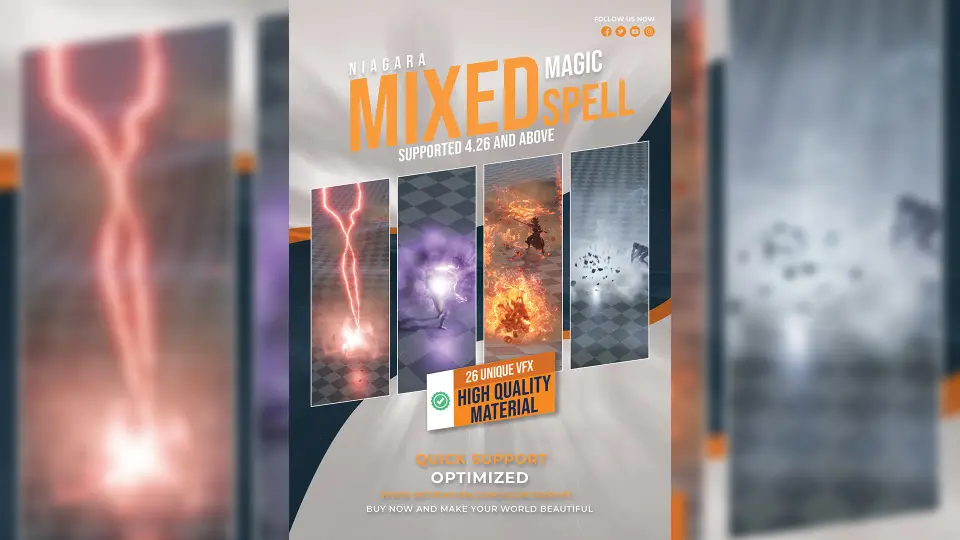
Mixed Magic - Spell VFX Pack supplies 26 elemental spells across fire, dark, water, lightning, and ice, featuring optimized Niagara effects and modular setups.
Elemental Disciplines Across the 26 Mixed Magic Visual Effects
Spellcasting mechanics in action games require visual clarity, distinct elemental silhouettes, and modular responsiveness. Mixed Magic - Spell VFX Pack addresses these core requirements by assembling 26 distinct visual effects organized into five functional elemental disciplines: fire, dark, water, lightning, and ice. This distribution gives character ability kits a clear visual taxonomy, allowing designers to assign specific damage archetypes and combat behaviors to clearly differentiated energy signatures.
Rather than confining spells to uniform shapes, the asset collection covers multiple mechanical phases of combat interaction. Ranged combat relies heavily on clean trajectories, and the pack accounts for this by providing projectile paths, sudden area-of-effect bursts, realistic explosions, and sharp point-of-impact detonations. Magicians, wizards, and spellcasters constructed within this framework can shift fluidly between dense kinetic bursts—such as crushing water blasts or cracking lightning surges—and lingering elemental hazards rendered through dark void energies or incandescent flame.
Decoupling Projectiles: Magma Shot and Gelmir Fury Revisions
Integrating projectile-based spell systems into dynamic gameplay can be complicated when projectile paths, muzzle flashes, and terminal impacts are bundled into a single rigid particle system. The asset handles this challenge through targeted component decoupling. Key combat spells, specifically Magma Shot and Gelmir Fury, feature separated visual elements to accommodate granular game logic.
By separating the travelling projectile VFX from the subsequent impact and explosion events, the system allows programmers to bind effects directly to collision traces, projectile movement components, or character sockets without visual hitching. Magma Shot benefits from dedicated buffs to its projectile presence, giving the traveling mass of molten rock and fire sufficient volumetric weight and readable light emission during high-speed transit. Gelmir Fury follows a similar treatment, enabling projectile streams and localized impact detonations to fire independently during complex attack sequences.
Niagara User Parameters and Spell Control
System configuration inside real-time engines often requires adjusting visual behavior without modifying underlying emitter graphs. Mixed Magic - Spell VFX Pack incorporates exposed user parameters across several visual effects within the Niagara framework. Exposing these controls streamlines setup, allowing developers to adapt spell properties directly from the particle system component or through gameplay blueprints.
User parameters make it straightforward to modify scale, emission frequency, color intensity, and lifetime metrics across varied actor classes. A fire blast intended for a minor minion can share the core Niagara logic of a boss-tier explosion while scaling particle density, light radius, and velocity via external parameters. This level of exposure prevents duplicate asset proliferation in the content browser and keeps project architecture structured around reusable Niagara emitters.
Optimization Details for Shattering Crystal
Complex spell effects that simulate shattering surfaces, crystalline shards, and dynamic particulate volume can place substantial demands on GPU fill rate and particle counts. Within the ice spell roster, the Shattering Crystal visual effect underwent specific optimization passes to address potential performance bottlenecks.
Balancing visual realism against frame stability requires careful management of emitter particle lifetimes, mesh debris counts, and material draw overhead. The optimization performed on Shattering Crystal refines these properties so that crystalline fragmentations, high-velocity ice shards, and light-catching dust burst outward cleanly upon impact without causing frame drops during chaotic combat encounters. This focused performance tuning ensures the asset holds up well in dense battlefields where multiple spellcasters trigger simultaneous overlapping spell events.
Material Architecture and Elemental FX Integration
Tying fire, dark, water, lightning, and ice assets together within a single unified project requires a coherent shading framework. The pack relies on a high-quality material system configured to handle varying optical requirements, from the opaque, incandescent crust of magma to the translucent, light-refracting surfaces of pressurized water and crystalline ice.
Because the material hierarchy is built to interface cleanly with Niagara particle systems, parameters governing emissivity, fresnel intensity, and dissolve states remain consistent across the elemental spectrum. This shared architecture also facilitates visual compatibility alongside dedicated single-element libraries, such as the Ice Element - Spell VFX Pack, ensuring that character kits combining ice shards with dark magic, electrical bursts, or burning magma maintain uniform material fidelity and rendering behavior across all encounter types.
 Spells & Combat
 Spells & Combat
 Spells & Combat
 Spells & Combat