"b00678cacce53329"{"id":"1002801","slug":"looping-fire-fx","title":"Looping Fire FX","category":"Fire \u0026 Explosions","engine":"4.20+,5.0+","assetVersion":"","engineVersion":"Engine Version: 4.20+,5.0+","tag":"Fire \u0026 Explosions","accent":"blue","visual":"mech","summary":"Explore Looping Fire FX, featuring 10 flame systems, 7 smoke variations, 3 ember emitters, and 29 high-resolution 4096x4096 flipbook textures for environments.","platform":"Unreal Engine","indexPolicy":"index","publishedAt":"2026-11-20T07:26:12.081Z","updatedAt":"2026-11-20T07:26:12.081Z","sourceNotes":[],"fileContents":[],"compatibility":["Unreal Engine","Engine Version: 4.20+,5.0+"],"featuredImage":{"alt":"Looping Fire FX","src":"/wp-content/uploads/published/2026/11/148af81c7a63-5f18a808-46a5-45ea-8114-8297ed5f01f3-3a2f806afe.webp"},"fileSizeBytes":134796799,"hasDownloadLink":true,"downloads":0,"terms":[{"taxonomy":"category","slug":"fire-and-explosions","name":"Fire \u0026 Explosions"}],"galleryImages":[{"src":"/wp-content/uploads/published/2026/11/49763cef28a1-6041b9b2-22f3-43f6-8bcb-acafa5ae0085-108ec8315c.webp","alt":"Looping Fire FX"},{"src":"/wp-content/uploads/published/2026/11/6187c6b982f5-3589ebc6-d45d-43a4-b9bc-4479bd509dc6-65ed66a1f0.webp","alt":"Looping Fire FX"},{"src":"/wp-content/uploads/published/2026/11/2c6252975cac-4b250a95-2a9b-4418-ac93-88deb22a9052-db6ff3a13e.webp","alt":"Looping Fire FX"},{"src":"/wp-content/uploads/published/2026/11/74a7a62e44d0-4c42438e-4f25-4a54-9911-d859de9140ba-0ac884412a.webp","alt":"Looping Fire FX"},{"src":"/wp-content/uploads/published/2026/11/979f6ccafc3a-252b429e-8b33-4091-8c16-44c403fb5695-cd4f57fe13.webp","alt":"Looping Fire FX"}],"accessPanel":{"kind":"resource","title":"Get this resource","safetyNote":"Resources are manually reviewed before listing to improve quality and reduce obvious risks.","fileName":"Looping Fire FX.7z","resourceType":"Resource archive","versions":[]},"contentHtml":"\u003ch2\u003eContinuous Ambience and Motion in Looping Fire FX\u003c/h2\u003e\n\u003cp\u003eAmbient fire in digital environments presents a distinct technical demand: it must loop continuously without visible seam jumps, resets, or awkward cycling. In dynamic levels and cinematic stages, background elements remain visible across indefinite spans of time. A fire effect that pops or hitches draws the eye away from focal points, breaking the illusion of a living space. Looping Fire FX addresses this specific environmental requirement by delivering particle setups engineered to cycle seamlessly while maintaining realistic motion.\u003c/p\u003e\n\u003cp\u003eThe package emphasizes continuous playback across all its core emitters. Rather than handling short, one-shot explosive combustion, these particle systems sustain persistent combustion. Flame tongues curl, expand, and dissipate along controlled trajectories, allowing scenes to maintain believable thermal energy throughout long gameplay sessions or static camera holds. Because the collection focuses on background and ambient implementation, each component is calibrated to sit naturally within world geometry, prop sets, and broad architectural vistas without demanding manual timing adjustments.\u003c/p\u003e \u003ch2\u003eDistinct Particle Behaviors Across the Looping Fire Systems\u003c/h2\u003e\n\u003cp\u003eCombustion takes varied shapes depending on fuel sources, air currents, and surface confines. Within this collection, variety is established through 10 unique looping flame particle systems. Each system presents an individual silhouette, velocity pattern, and turbulence profile, preventing environmental set dressing from feeling cloned across a single location.\u003c/p\u003e\n\u003cp\u003eHaving 10 dedicated flame systems allows a scene to feature multiple fires while retaining visual diversity. An open pit fire displays wider flame tongues and outward expansion, whereas a narrow brazier, wall torch, or localized structural burn demands tighter vertical draft and specific dispersal speeds. By distributing different particle configurations across an environment, creators can build multi-point burn sequences where no two nearby flame sources share identical rhythmic cycles or flame structures. Each system maintains realistic combustion velocity, reflecting the physical behavior of burning air and natural updrafts.\u003c/p\u003e \u003ch2\u003eSmoke Variations and Plume Dynamics\u003c/h2\u003e\n\u003cp\u003eFire rarely exists in physical reality without an accompanying byproduct of incomplete combustion. Looping Fire FX provides 7 separate smoke particle systems to accompany the flame emitters or function independently across a scene. Smoke plumes operate under different aerodynamic forces than active flame bodies, requiring distinct rise rates, diffusion speeds, and volumetric densities.\u003c/p\u003e\n\u003cp\u003eThe 7 smoke systems allow for distinct environmental treatments:\u003c/p\u003e\n\u003cul\u003e\n\u003cli\u003eHeavy, dense plumes suitable for intense combustion zones where thick soot gathers directly above fuel sources.\u003c/li\u003e\n\u003cli\u003eLighter, wispy smoke columns that drift slowly through cooler surrounding air, simulating steady embers or expiring flame sites.\u003c/li\u003e\n\u003cli\u003eDispersed haze emitters that blend the immediate fire perimeter into the broader ambient lighting of the set.\u003c/li\u003e\n\u003cli\u003eLayered vertical updrafts designed to align directly above high-intensity flame systems.\u003c/li\u003e\n\u003c/ul\u003e\n\u003cp\u003eBecause these smoke systems loop continuously alongside the flames, they avoid the hard cutoffs that often plague looping alpha cards. The particle layers maintain consistent density shifts, simulating the gradual cooling and dispersion of particulates into the surrounding air.\u003c/p\u003e \u003ch2\u003eEmber Dynamics and Ambient Spark Generation\u003c/h2\u003e\n\u003cp\u003eTo complete the combustion hierarchy, the package incorporates 3 basic ember systems featuring both looping and bursting behaviors. Embers add high-frequency, small-scale motion that accentuates the slower, broader movement of flame tongues and rising smoke.\u003c/p\u003e\n\u003cp\u003eThe distinction between looping and bursting embers serves different environmental needs. The continuous looping ember systems generate a persistent stream of small glowing specks that lift off the heat source and ride the vertical air currents created by the flames. This ongoing upward drift provides scale, depth, and micro-movement, reinforcing the upward draft of the thermal zone. The bursting ember setups introduce intermittent flares of spark dispersal, mimicking the sudden crackle of popping fuel or sudden air disturbances. Combining steady looping embers with occasional bursting sparks yields a dynamic heat zone that captures both consistent heat and unpredictable physical reactions.\u003c/p\u003e \u003ch2\u003eFlipbook Resolutions and Texture Architecture\u003c/h2\u003e\n\u003cp\u003eUnderlying the particle emitters is a robust visual foundation consisting of 29 high-resolution 4096x4096 textures. High-resolution texture maps are essential for realistic fire representation, ensuring that delicate flame edges, turbulent wisps, and semi-transparent smoke fringes retain crisp definition even when viewed at close distances or across large display resolutions.\u003c/p\u003e\n\u003cp\u003eWithin this texture asset pool are 22 fire and smoke flipbook animations. Flipbooks encode dynamic fluid-simulation data directly onto texture sheets, capturing complex fluid dynamics, rolling vortices, and natural dissipation frame by frame. Running fluid dynamics through 4096x4096 flipbooks grants the particles realistic fluid motion without requiring real-time volumetric fluid simulation. The frame-by-frame progression delivers organic turbulence, internal brightness variations, and realistic density falloff. Because the 22 flipbooks are split across distinct fire and smoke types, creators can mix and match texture sheets across the 10 flame and 7 smoke systems, creating nuanced hybrid materials and tailored particle responses.\u003c/p\u003e \u003ch2\u003eEnvironmental Implementation for Realistic Background Scenes\u003c/h2\u003e\n\u003cp\u003eThe primary utility of Looping Fire FX lies in its ready-to-place architecture for realistic environments. Constructing realistic combustion from scratch typically demands extensive time simulating smoke volumes, rendering multi-frame flipbook sheets, tuning loop crossover points, and balancing emitter lifetimes. By supplying pre-built systems that loop infinitely, the collection removes the technical overhead associated with loop creation.\u003c/p\u003e\n\u003cp\u003eThe balance of 10 flame variations, 7 smoke types, 3 ember emitters, and 29 hi-res 4096x4096 textures equips technical artists and level designers to populate burned-out ruins, military conflict zones, historic interiors, camp setups, and industrial complexes. The elements function cooperatively: a base flame system handles the radiant core, a complementary smoke system supplies the rising column, and the ember systems provide airborne particulate interest. With endless loops already resolved, scenes remain visually stable over extended render passes or open-ended gameplay runs, ensuring consistent ambient realism throughout the production.\u003c/p\u003e\n\n\u003ch2\u003eExplore Similar Assets\u003c/h2\u003e\n\u003cul\u003e\n\u003cli\u003e\u003ca href=\"https://3dcghub.com/fire-and-explosion-fx-pack/\" rel=\"noopener noreferrer\"\u003eFire and Explosion FX Pack\u003c/a\u003e\u003c/li\u003e\n\u003cli\u003e\u003ca href=\"https://3dcghub.com/atmospheric-entry-fx/\" rel=\"noopener noreferrer\"\u003eAtmospheric Entry FX\u003c/a\u003e\u003c/li\u003e\n\u003cli\u003e\u003ca href=\"https://3dcghub.com/rocket-thruster-exhaust-fx/\" rel=\"noopener noreferrer\"\u003eRocket Thruster Exhaust FX\u003c/a\u003e\u003c/li\u003e\n\u003cli\u003e\u003ca href=\"https://3dcghub.com/real-fire-pack-2d-effect-pack/\" rel=\"noopener noreferrer\"\u003eReal Fire Pack 2d Effect Pack\u003c/a\u003e\u003c/li\u003e\n\u003cli\u003e\u003ca href=\"https://3dcghub.com/impact-explosion-fx-vdb/\" rel=\"noopener noreferrer\"\u003eImpact Explosion FX VDB\u003c/a\u003e\u003c/li\u003e\n\u003c/ul\u003e","contentTextLength":6936,"navigation":{"current":79,"total":4797,"previous":{"id":"1002802","slug":"luos-s-lowpoly-particle-pack","title":"Luos's LowPoly Particle Pack","category":"Spells \u0026 Combat","platform":"Unreal Engine","updatedAt":"2026-11-20T07:27:05.323Z"},"next":{"id":"1002800","slug":"liquid-explosionvfx","title":"Liquid_ExplosionVFX","category":"Variety","platform":"Unreal Engine","updatedAt":"2026-11-20T07:25:30.337Z"}},"relatedResources":[{"id":"1002842","slug":"stylized-shooting-vfx-niagara-muzzle-bullet-trail-impact","title":"Stylized Shooting VFX Niagara (Muzzle - Bullet Trail - Impact)","category":"Fire \u0026 Explosions","engine":"4.26+,5.0+","assetVersion":"","engineVersion":"Engine Version: 4.26+,5.0+","tag":"Fire \u0026 Explosions","accent":"blue","visual":"mech","summary":"A technical breakdown of the 17 Niagara FX included in Stylized Shooting VFX Niagara, spanning muzzle flashes, bullet trails, ribbons, and impacts.","platform":"Unreal Engine","indexPolicy":"index","publishedAt":"2026-11-20T12:23:46.116Z","updatedAt":"2026-11-20T12:23:46.116Z","sourceNotes":[],"fileContents":[],"compatibility":["Unreal Engine","Engine Version: 4.26+,5.0+"],"featuredImage":{"alt":"Stylized Shooting VFX Niagara (Muzzle - Bullet Trail - Impact)","src":"/wp-content/uploads/published/2026/11/2982b94a8a48-32843b42-3712-436e-9699-f1872f57f17e-55d053e3b3.webp"},"fileSizeBytes":21027598,"hasDownloadLink":true,"downloads":0},{"id":"1001729","slug":"fire-and-explosion-fx-pack","title":"Fire and Explosion FX Pack","category":"Fire \u0026 Explosions","engine":"4.26+,5.0+","assetVersion":"","engineVersion":"Engine Version: 4.26+,5.0+","tag":"Fire \u0026 Explosions","accent":"blue","visual":"mech","summary":"A realistic Fire and Explosion FX Pack featuring Cascade particle systems, integrated smoke and flame elements, and texture-reduced LODs for performance.","platform":"Unreal Engine","indexPolicy":"index","publishedAt":"2026-10-20T02:35:47.507Z","updatedAt":"2026-10-20T02:35:47.507Z","sourceNotes":[],"fileContents":[],"compatibility":["Unreal Engine","Engine Version: 4.26+,5.0+"],"featuredImage":{"alt":"Fire and Explosion FX Pack","src":"/wp-content/uploads/published/2026/10/29ffccd00068-29108bee-a10a-4930-aee5-fe5b89f5c353-cd254a582f.webp"},"fileSizeBytes":354268741,"hasDownloadLink":true,"downloads":0},{"id":"15535","slug":"atmospheric-entry-fx","title":"Atmospheric Entry FX","category":"Fire \u0026 Explosions","engine":"4.27,5.0+","assetVersion":"Engine version: 4.27,5.0+","engineVersion":"4.27","tag":"Fire \u0026 Explosions","accent":"blue","visual":"luts","summary":"Enhance your space-themed projects with Atmospheric Entry FX, a collection of 10 Niagara particle systems. These customizable effects are perfect for simulating spacecraft reentry and meteor impacts.","platform":"Unreal Engine","indexPolicy":"noindex","publishedAt":"2026-03-12T12:05:17.000Z","updatedAt":"2026-04-19T15:44:45.000Z","sourceNotes":[],"fileContents":[],"compatibility":["Unreal Engine","Engine version: 4.27,5.0+"],"featuredImage":{"alt":"Atmospheric Entry FX","src":"https://3dcghub.com/wp-content/uploads/2026/03/8b28ab8c-fcb0-48b8-8bc3-0fd66214d582.webp"},"fileSizeBytes":140133701,"hasDownloadLink":true,"downloads":2}]}
Resource screenshots
1 / 5
Join our channel
Follow 3DCGHUB on Telegram for new resource drops, migration updates, and community notices.
Ambient fire in digital environments presents a distinct technical demand: it must loop continuously without visible seam jumps, resets, or awkward cycling. In dynamic levels and cinematic stages, background elements remain visible across indefinite spans of time. A fire effect that pops or hitches draws the eye away from focal points, breaking the illusion of a living space. Looping Fire FX addresses this specific environmental requirement by delivering particle setups engineered to cycle seamlessly while maintaining realistic motion.
The package emphasizes continuous playback across all its core emitters. Rather than handling short, one-shot explosive combustion, these particle systems sustain persistent combustion. Flame tongues curl, expand, and dissipate along controlled trajectories, allowing scenes to maintain believable thermal energy throughout long gameplay sessions or static camera holds. Because the collection focuses on background and ambient implementation, each component is calibrated to sit naturally within world geometry, prop sets, and broad architectural vistas without demanding manual timing adjustments.
Distinct Particle Behaviors Across the Looping Fire Systems
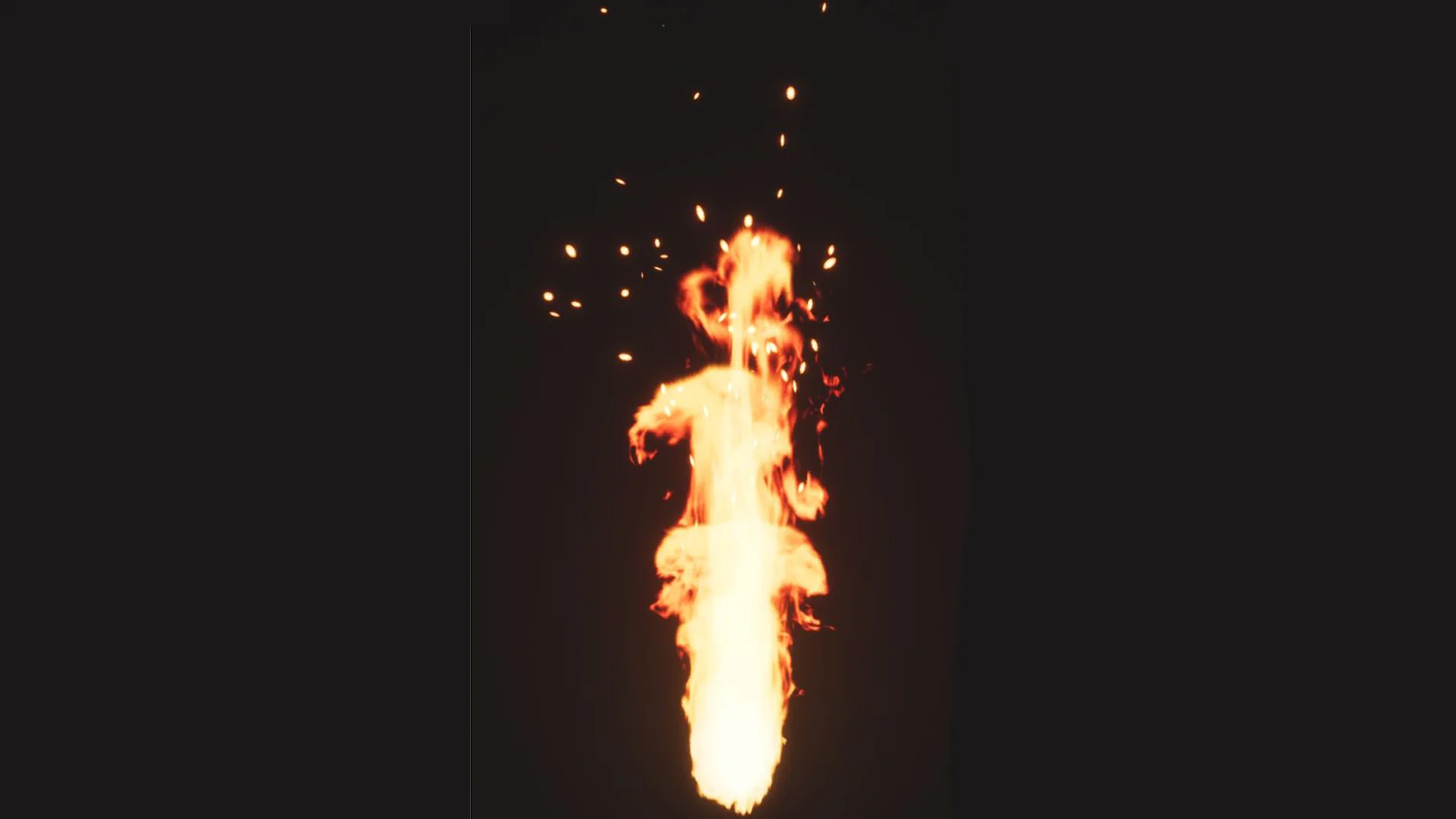
Combustion takes varied shapes depending on fuel sources, air currents, and surface confines. Within this collection, variety is established through 10 unique looping flame particle systems. Each system presents an individual silhouette, velocity pattern, and turbulence profile, preventing environmental set dressing from feeling cloned across a single location.
Having 10 dedicated flame systems allows a scene to feature multiple fires while retaining visual diversity. An open pit fire displays wider flame tongues and outward expansion, whereas a narrow brazier, wall torch, or localized structural burn demands tighter vertical draft and specific dispersal speeds. By distributing different particle configurations across an environment, creators can build multi-point burn sequences where no two nearby flame sources share identical rhythmic cycles or flame structures. Each system maintains realistic combustion velocity, reflecting the physical behavior of burning air and natural updrafts.
Smoke Variations and Plume Dynamics
Fire rarely exists in physical reality without an accompanying byproduct of incomplete combustion. Looping Fire FX provides 7 separate smoke particle systems to accompany the flame emitters or function independently across a scene. Smoke plumes operate under different aerodynamic forces than active flame bodies, requiring distinct rise rates, diffusion speeds, and volumetric densities.
The 7 smoke systems allow for distinct environmental treatments:
Heavy, dense plumes suitable for intense combustion zones where thick soot gathers directly above fuel sources.
Lighter, wispy smoke columns that drift slowly through cooler surrounding air, simulating steady embers or expiring flame sites.
Dispersed haze emitters that blend the immediate fire perimeter into the broader ambient lighting of the set.
Layered vertical updrafts designed to align directly above high-intensity flame systems.
Because these smoke systems loop continuously alongside the flames, they avoid the hard cutoffs that often plague looping alpha cards. The particle layers maintain consistent density shifts, simulating the gradual cooling and dispersion of particulates into the surrounding air.
Ember Dynamics and Ambient Spark Generation
To complete the combustion hierarchy, the package incorporates 3 basic ember systems featuring both looping and bursting behaviors. Embers add high-frequency, small-scale motion that accentuates the slower, broader movement of flame tongues and rising smoke.
The distinction between looping and bursting embers serves different environmental needs. The continuous looping ember systems generate a persistent stream of small glowing specks that lift off the heat source and ride the vertical air currents created by the flames. This ongoing upward drift provides scale, depth, and micro-movement, reinforcing the upward draft of the thermal zone. The bursting ember setups introduce intermittent flares of spark dispersal, mimicking the sudden crackle of popping fuel or sudden air disturbances. Combining steady looping embers with occasional bursting sparks yields a dynamic heat zone that captures both consistent heat and unpredictable physical reactions.
Flipbook Resolutions and Texture Architecture
Underlying the particle emitters is a robust visual foundation consisting of 29 high-resolution 4096x4096 textures. High-resolution texture maps are essential for realistic fire representation, ensuring that delicate flame edges, turbulent wisps, and semi-transparent smoke fringes retain crisp definition even when viewed at close distances or across large display resolutions.
Within this texture asset pool are 22 fire and smoke flipbook animations. Flipbooks encode dynamic fluid-simulation data directly onto texture sheets, capturing complex fluid dynamics, rolling vortices, and natural dissipation frame by frame. Running fluid dynamics through 4096x4096 flipbooks grants the particles realistic fluid motion without requiring real-time volumetric fluid simulation. The frame-by-frame progression delivers organic turbulence, internal brightness variations, and realistic density falloff. Because the 22 flipbooks are split across distinct fire and smoke types, creators can mix and match texture sheets across the 10 flame and 7 smoke systems, creating nuanced hybrid materials and tailored particle responses.
Environmental Implementation for Realistic Background Scenes
The primary utility of Looping Fire FX lies in its ready-to-place architecture for realistic environments. Constructing realistic combustion from scratch typically demands extensive time simulating smoke volumes, rendering multi-frame flipbook sheets, tuning loop crossover points, and balancing emitter lifetimes. By supplying pre-built systems that loop infinitely, the collection removes the technical overhead associated with loop creation.
The balance of 10 flame variations, 7 smoke types, 3 ember emitters, and 29 hi-res 4096x4096 textures equips technical artists and level designers to populate burned-out ruins, military conflict zones, historic interiors, camp setups, and industrial complexes. The elements function cooperatively: a base flame system handles the radiant core, a complementary smoke system supplies the rising column, and the ember systems provide airborne particulate interest. With endless loops already resolved, scenes remain visually stable over extended render passes or open-ended gameplay runs, ensuring consistent ambient realism throughout the production.
 Fire & Explosions
 Fire & Explosions
 Fire & Explosions