"a338a1d501976271"{"id":"1000307","slug":"knights-pack","title":"Knights (Pack)","category":"Characters \u0026 Creatures","engine":"4.26+,5.0+","assetVersion":"","engineVersion":"Engine Version: 4.26+,5.0+","tag":"Characters","accent":"blue","visual":"character","summary":"A low-poly, PBR-textured modular character pack featuring five rigged knights, complete with weapons, shields, cloth physics, and UE4/UE5 skeleton compatibility","platform":"Unreal Engine","publishedAt":"2026-07-04T09:34:36.390Z","updatedAt":"2026-07-04T09:34:36.390Z","sourceNotes":[],"fileContents":[],"compatibility":["Unreal Engine","Engine Version: 4.26+,5.0+"],"featuredImage":{"alt":"Knights (Pack)","src":"/wp-content/uploads/published/2026/07/f5d481484e2e-39f58c2e-1e1d-40f4-b413-8833fc4de822-cfe441e5c2.webp"},"hasDownloadLink":true,"downloads":1,"terms":[{"taxonomy":"category","slug":"characters-and-creatures","name":"Characters \u0026 Creatures"}],"galleryImages":[{"src":"/wp-content/uploads/published/2026/07/53dfc34afd6d-c47335d5-b47d-425e-b0f9-b0db07a55781-608bc58bee.webp","alt":"Knights (Pack)"},{"src":"/wp-content/uploads/published/2026/07/17cf05e8fac0-5a6ff3f6-03dc-434d-a4e2-a2efb571e812-2f866b6515.webp","alt":"Knights (Pack)"},{"src":"/wp-content/uploads/published/2026/07/80acdbb1de6b-4dc25837-ce49-4e6c-8e2b-1fdcb657ffc1-6381f7484f.webp","alt":"Knights (Pack)"},{"src":"/wp-content/uploads/published/2026/07/377cd947dd77-200b747d-2210-42ce-94f3-f48e372973f6-553c15a479.webp","alt":"Knights (Pack)"},{"src":"/wp-content/uploads/published/2026/07/9203d16b4a99-233b1f3b-647f-4dda-82c1-afbbb03b2244-4c16fee294.webp","alt":"Knights (Pack)"},{"src":"/wp-content/uploads/published/2026/07/dca439ef180c-14c53a88-461c-46b4-abe3-6cd0098cbbcd-59250b05ba.webp","alt":"Knights (Pack)"},{"src":"/wp-content/uploads/published/2026/07/1885d340e4a7-8932e018-a75c-45d9-a5dd-38bbdf8091b2-511637e92f.webp","alt":"Knights (Pack)"},{"src":"/wp-content/uploads/published/2026/07/2b0627a71641-9e914ffb-79ae-4390-b266-7544b43c59e5-19c27ab854.webp","alt":"Knights (Pack)"},{"src":"/wp-content/uploads/published/2026/07/d3791cc793e0-aacadb6f-e7f8-4b57-896f-5e2c49f42dea-f26aff6a4b.webp","alt":"Knights (Pack)"},{"src":"/wp-content/uploads/published/2026/07/0534f84bb6eb-b56da42b-722c-48c2-9d51-fe61e880bbba-cf52996b12.webp","alt":"Knights (Pack)"}],"accessPanel":{"kind":"resource","title":"Download this resource","eyebrow":"Free Download","message":"Log in or create a free account to start your download.","fileName":"Content.7z","safetyNote":"Resources are manually reviewed before listing to improve quality and reduce obvious risks.","actionLabel":"Download Free","resourceType":"Resource archive"},"contentHtml":"\u003ch2\u003ePopulating a Low-Poly Fantasy Roster\u003c/h2\u003e\n\u003cp\u003eBuilding a believable medieval or fantasy faction requires a diverse cast of heavily armored units that share a cohesive visual identity. The Knights (Pack) provides a foundational roster designed specifically for populating these types of game worlds. Featuring a total of five distinct character models, the collection is split between four male knights and one female knight. This distribution allows developers to build out a varied faction hierarchy, whether they are setting up a player-controlled party in a role-playing game, creating distinct enemy types for a hack-and-slash action title, or populating a medieval castle environment with diverse guards and commanders.\u003c/p\u003e\n\u003cp\u003eShaped by a low-poly aesthetic, these characters maintain an optimized geometry count that is highly suitable for performance-heavy projects, mobile games, or titles featuring large crowds of AI. Despite the stylized, lower-polygon geometry, the characters utilize PBR (Physically Based Rendering) materials. This combination of low-poly modeling and PBR texturing is a powerful workflow. It ensures that while the polygon count remains efficient for rendering, the surfaces of the armor, cloth, and leather react accurately to complex environmental lighting. Metallic plates will catch the glare of a torch or the sun, while matte fabrics will absorb the light, giving the assets a modern, polished look that elevates the underlying geometry.\u003c/p\u003e\n\u003ch2\u003eModular Armor Systems and Pre-Assembled Meshes\u003c/h2\u003e\n\u003cp\u003eA critical component of character integration in modern game development is how the meshes are structured to allow for flexibility in the pipeline. This package offers a dual approach to character assembly. The knights are initially built with separate, modular parts. For developers looking to implement character customization systems, this modularity allows different armor pieces, helmets, and accessories to be swapped or hidden entirely through blueprint logic. It opens up the possibility for visual progression systems where players equip different gear as they level up, or for generating numerous variations of NPC guards by mixing and matching the available components across the roster.\u003c/p\u003e\n\u003cp\u003eRecognizing that assembling modular parts can be time-consuming during the early stages of level design or quick prototyping, the creator has also included all models collected into full meshes. This convenience means that a developer or level designer can immediately drag and drop a fully intact knight directly into a scene without having to piece together the individual components first. Having both the separated pieces for deep mechanical integration and the full meshes for rapid visual deployment provides significant flexibility depending on the current phase of production.\u003c/p\u003e\n\u003ch2\u003eEquipping Weapons, Shields, and Cloth Physics\u003c/h2\u003e\n\u003cp\u003eBeyond the core character meshes, the assets come equipped with the necessary tools for medieval combat scenarios. The collection includes a variety of different weapons and shields, allowing each of the five knights to be outfitted with distinct combat loadouts right out of the box. This is particularly useful for differentiating character classes within a game. Developers can easily assign a heavy shield to a defensive tank character or specific melee weapons to aggressive, front-line combatants, ensuring that the visual silhouette of the character matches their intended gameplay function.\u003c/p\u003e\n\u003cp\u003eTo enhance the visual fidelity of these characters in motion, some of the models are configured with active cloth physics. In a fantasy setting, knights often wear tabards, capes, or loose fabric draped over their heavy armor. By incorporating cloth physics into the models, these specific fabric elements simulate dynamic secondary movement. The cloth reacts naturally to the character’s walk cycle, rapid combat animations, and environmental wind effects. This dynamic motion breaks up the visual rigidity typically associated with heavily armored, low-poly characters, making them feel much more grounded and alive during gameplay.\u003c/p\u003e\n\u003ch2\u003eStreamlined Unreal Engine 4 and 5 Rigging\u003c/h2\u003e\n\u003cp\u003eThe animation pipeline is frequently one of the most complex and time-consuming hurdles in game development, particularly when dealing with imported skeletal meshes from external sources. To address this friction directly, all characters in the pack are equipped with two separate rigs: one tailored specifically for Unreal Engine 4 and another updated for Unreal Engine 5. By providing both skeletal structures natively, the assets bridge the gap between projects maintained on the older engine architecture and those actively transitioning to the latest technology.\u003c/p\u003e\n\u003cp\u003eThe standout technical feature of this rigging setup is the workflow it enables for animators and developers. Users do not need to go through the often tedious and error-prone process of retargeting animations from one skeleton to another. Instead, the characters are designed so that developers can simply reassign them to the existing Epic Skeleton within their current project. This direct plug-and-play approach drastically reduces setup time. It allows developers to immediately apply their existing, expansive libraries of marketplace movement, idle, and combat animations directly to the new knight meshes without worrying about bone misalignment or distorted limbs.\u003c/p\u003e\n\u003ch2\u003eAnimation Blueprints and Foundational Logic\u003c/h2\u003e\n\u003cp\u003eSupporting the character meshes and streamlined rigging, the package also includes essential logic elements like Animation Blueprints and foundational scripts. An Animation Blueprint provides the necessary framework for blending different animation states together—such as transitioning smoothly from a patrol walk to a full sprint, or triggering a precise block animation when the character raises their included shield. Having these scripts and blueprints included means the foundational technical setup is already established upon importing the asset. Developers can focus on tweaking the behavior, speeds, and state transitions to fit their specific combat design needs rather than building the complex animation blending logic entirely from scratch. The combination of easy skeleton reassignment and pre-built animation blueprints ensures these knights can be quickly transitioned from static models into fully interactive game elements.\u003c/p\u003e\n\n\u003ch2\u003eRelated Resources Worth Checking\u003c/h2\u003e\n\u003cul\u003e\n\u003cli\u003e\u003ca href=\"https://3dcghub.com/gothic-knight/\" title=\"Gothic Knight\"\u003eGothic Knight\u003c/a\u003e\u003c/li\u003e\n\u003cli\u003e\u003ca href=\"https://3dcghub.com/skeleton-pack/\" title=\"Skeleton pack\"\u003eSkeleton pack\u003c/a\u003e\u003c/li\u003e\n\u003cli\u003e\u003ca href=\"https://3dcghub.com/medieval-armour-metahuman-male-female/\" title=\"Medieval Armour - Metahuman - Male/Female\"\u003eMedieval Armour - Metahuman - Male/Female\u003c/a\u003e\u003c/li\u003e\n\u003cli\u003e\u003ca href=\"https://3dcghub.com/undead-horse-and-unholy-knight/\" title=\"Undead Horse and Unholy Knight\"\u003eUndead Horse and Unholy Knight\u003c/a\u003e\u003c/li\u003e\n\u003cli\u003e\u003ca href=\"https://3dcghub.com/amazon-female-warrior-native-knight-realistic-girl-mmorpg-stylized-character/\" title=\"Amazon Female Warrior, Native Knight Realistic Girl MMORPG Stylized Character\"\u003eAmazon Female Warrior, Native Knight Realistic Girl MMORPG Stylized Character\u003c/a\u003e\u003c/li\u003e\n\u003c/ul\u003e","contentTextLength":6553,"navigation":{"current":1169,"total":3338,"previous":{"id":"1000308","slug":"landscape-combinator","title":"Landscape Combinator","category":"Procedural Systems","platform":"Unreal Engine","updatedAt":"2026-07-04T09:38:35.413Z"},"next":{"id":"1000306","slug":"knight-vesuvius","title":"Knight Vesuvius","category":"Humans","platform":"Unreal Engine","updatedAt":"2026-07-04T09:23:21.715Z"}},"relatedResources":[{"id":"2509","slug":"gothic-knight","title":"Gothic Knight","category":"Characters \u0026 Creatures","engine":"4.26+5.0+","assetVersion":"Engine version: 4.26+5.0+","engineVersion":"4.19","tag":"Characters","accent":"blue","visual":"character","summary":"Enhance your fantasy game with this photorealistic Gothic Knight for Unreal Engine. Features advanced customization, APEX cloth physics, and full rigging.","platform":"Unreal Engine","publishedAt":"2026-02-07T10:13:14.000Z","updatedAt":"2026-04-19T15:58:01.000Z","sourceNotes":[],"fileContents":[],"compatibility":["Unreal Engine","Engine version: 4.26+5.0+"],"featuredImage":{"alt":"Gothic Knight","src":"https://3dcghub.com/wp-content/uploads/2026/02/fb088327-75e5-4d4b-9bb7-1eba4df22b52.webp"},"hasDownloadLink":true,"downloads":0},{"id":"3501","slug":"skeleton-pack","title":"Skeleton pack","category":"Characters \u0026 Creatures","engine":"4.26+,5.0+","assetVersion":"Engine version: 4.26+,5.0+","engineVersion":"4.19","tag":"Characters","accent":"blue","visual":"character","summary":"Enhance your horror or RPG project with this high-quality skeleton character pack. Featuring 5 unique undead models rigged to the UE4 skeleton for Unreal Engine","platform":"Unreal Engine","publishedAt":"2026-02-09T08:14:53.000Z","updatedAt":"2026-04-19T15:57:37.000Z","sourceNotes":[],"fileContents":[],"compatibility":["Unreal Engine","Engine version: 4.26+,5.0+"],"featuredImage":{"alt":"Skeleton pack","src":"https://3dcghub.com/wp-content/uploads/2026/02/d1938d65-ccf0-463e-a904-48a83ad16555.webp"},"hasDownloadLink":true,"downloads":0},{"id":"3013","slug":"medieval-armour-metahuman-male-female","title":"Medieval Armour - Metahuman - Male/Female","category":"Characters \u0026 Creatures","engine":"5.0+","assetVersion":"Engine version: 5.0+","engineVersion":"5.0","tag":"Characters","accent":"blue","visual":"character","summary":"Enhance your game with this modular Medieval Armour pack. Fully compatible with MetaHuman and Unreal Engine 5, featuring customizable knight and soldier sets.","platform":"Unreal Engine","publishedAt":"2026-02-07T16:24:55.000Z","updatedAt":"2026-04-19T15:57:43.000Z","sourceNotes":[],"fileContents":[],"compatibility":["Unreal Engine","Engine version: 5.0+"],"featuredImage":{"alt":"Medieval Armour - Metahuman - Male/Female","src":"https://3dcghub.com/wp-content/uploads/2026/02/a9674880-5e39-4e2c-8bce-51cab7294e45.webp"},"hasDownloadLink":true,"downloads":9}]}
Characters
Knights (Pack)
A low-poly, PBR-textured modular character pack featuring five rigged knights, complete with weapons, shields, cloth physics, and UE4/UE5 skeleton compatibility
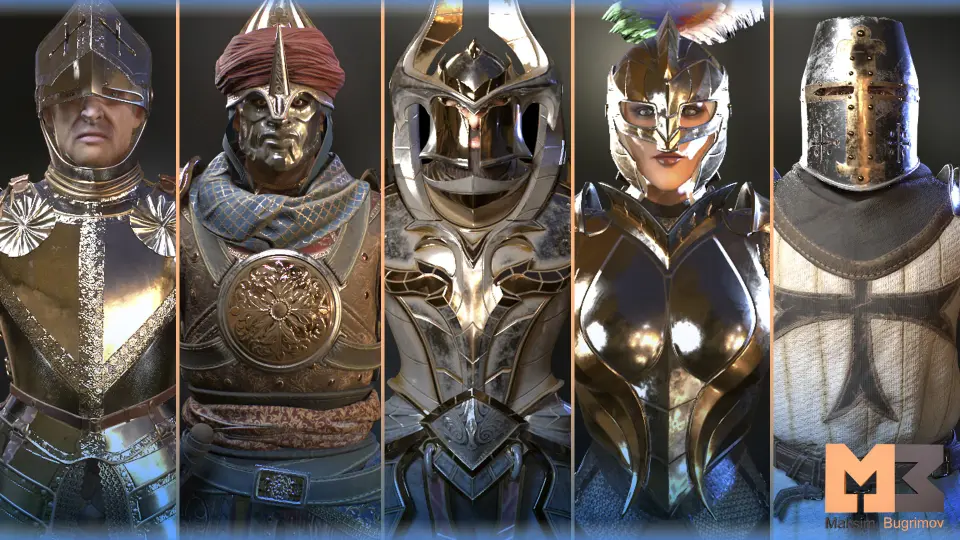
Building a believable medieval or fantasy faction requires a diverse cast of heavily armored units that share a cohesive visual identity. The Knights (Pack) provides a foundational roster designed specifically for populating these types of game worlds. Featuring a total of five distinct character models, the collection is split between four male knights and one female knight. This distribution allows developers to build out a varied faction hierarchy, whether they are setting up a player-controlled party in a role-playing game, creating distinct enemy types for a hack-and-slash action title, or populating a medieval castle environment with diverse guards and commanders.
Shaped by a low-poly aesthetic, these characters maintain an optimized geometry count that is highly suitable for performance-heavy projects, mobile games, or titles featuring large crowds of AI. Despite the stylized, lower-polygon geometry, the characters utilize PBR (Physically Based Rendering) materials. This combination of low-poly modeling and PBR texturing is a powerful workflow. It ensures that while the polygon count remains efficient for rendering, the surfaces of the armor, cloth, and leather react accurately to complex environmental lighting. Metallic plates will catch the glare of a torch or the sun, while matte fabrics will absorb the light, giving the assets a modern, polished look that elevates the underlying geometry.
Modular Armor Systems and Pre-Assembled Meshes
A critical component of character integration in modern game development is how the meshes are structured to allow for flexibility in the pipeline. This package offers a dual approach to character assembly. The knights are initially built with separate, modular parts. For developers looking to implement character customization systems, this modularity allows different armor pieces, helmets, and accessories to be swapped or hidden entirely through blueprint logic. It opens up the possibility for visual progression systems where players equip different gear as they level up, or for generating numerous variations of NPC guards by mixing and matching the available components across the roster.
Recognizing that assembling modular parts can be time-consuming during the early stages of level design or quick prototyping, the creator has also included all models collected into full meshes. This convenience means that a developer or level designer can immediately drag and drop a fully intact knight directly into a scene without having to piece together the individual components first. Having both the separated pieces for deep mechanical integration and the full meshes for rapid visual deployment provides significant flexibility depending on the current phase of production.
Equipping Weapons, Shields, and Cloth Physics
Beyond the core character meshes, the assets come equipped with the necessary tools for medieval combat scenarios. The collection includes a variety of different weapons and shields, allowing each of the five knights to be outfitted with distinct combat loadouts right out of the box. This is particularly useful for differentiating character classes within a game. Developers can easily assign a heavy shield to a defensive tank character or specific melee weapons to aggressive, front-line combatants, ensuring that the visual silhouette of the character matches their intended gameplay function.
To enhance the visual fidelity of these characters in motion, some of the models are configured with active cloth physics. In a fantasy setting, knights often wear tabards, capes, or loose fabric draped over their heavy armor. By incorporating cloth physics into the models, these specific fabric elements simulate dynamic secondary movement. The cloth reacts naturally to the character’s walk cycle, rapid combat animations, and environmental wind effects. This dynamic motion breaks up the visual rigidity typically associated with heavily armored, low-poly characters, making them feel much more grounded and alive during gameplay.
Streamlined Unreal Engine 4 and 5 Rigging
The animation pipeline is frequently one of the most complex and time-consuming hurdles in game development, particularly when dealing with imported skeletal meshes from external sources. To address this friction directly, all characters in the pack are equipped with two separate rigs: one tailored specifically for Unreal Engine 4 and another updated for Unreal Engine 5. By providing both skeletal structures natively, the assets bridge the gap between projects maintained on the older engine architecture and those actively transitioning to the latest technology.
The standout technical feature of this rigging setup is the workflow it enables for animators and developers. Users do not need to go through the often tedious and error-prone process of retargeting animations from one skeleton to another. Instead, the characters are designed so that developers can simply reassign them to the existing Epic Skeleton within their current project. This direct plug-and-play approach drastically reduces setup time. It allows developers to immediately apply their existing, expansive libraries of marketplace movement, idle, and combat animations directly to the new knight meshes without worrying about bone misalignment or distorted limbs.
Animation Blueprints and Foundational Logic
Supporting the character meshes and streamlined rigging, the package also includes essential logic elements like Animation Blueprints and foundational scripts. An Animation Blueprint provides the necessary framework for blending different animation states together—such as transitioning smoothly from a patrol walk to a full sprint, or triggering a precise block animation when the character raises their included shield. Having these scripts and blueprints included means the foundational technical setup is already established upon importing the asset. Developers can focus on tweaking the behavior, speeds, and state transitions to fit their specific combat design needs rather than building the complex animation blending logic entirely from scratch. The combination of easy skeleton reassignment and pre-built animation blueprints ensures these knights can be quickly transitioned from static models into fully interactive game elements.
 Characters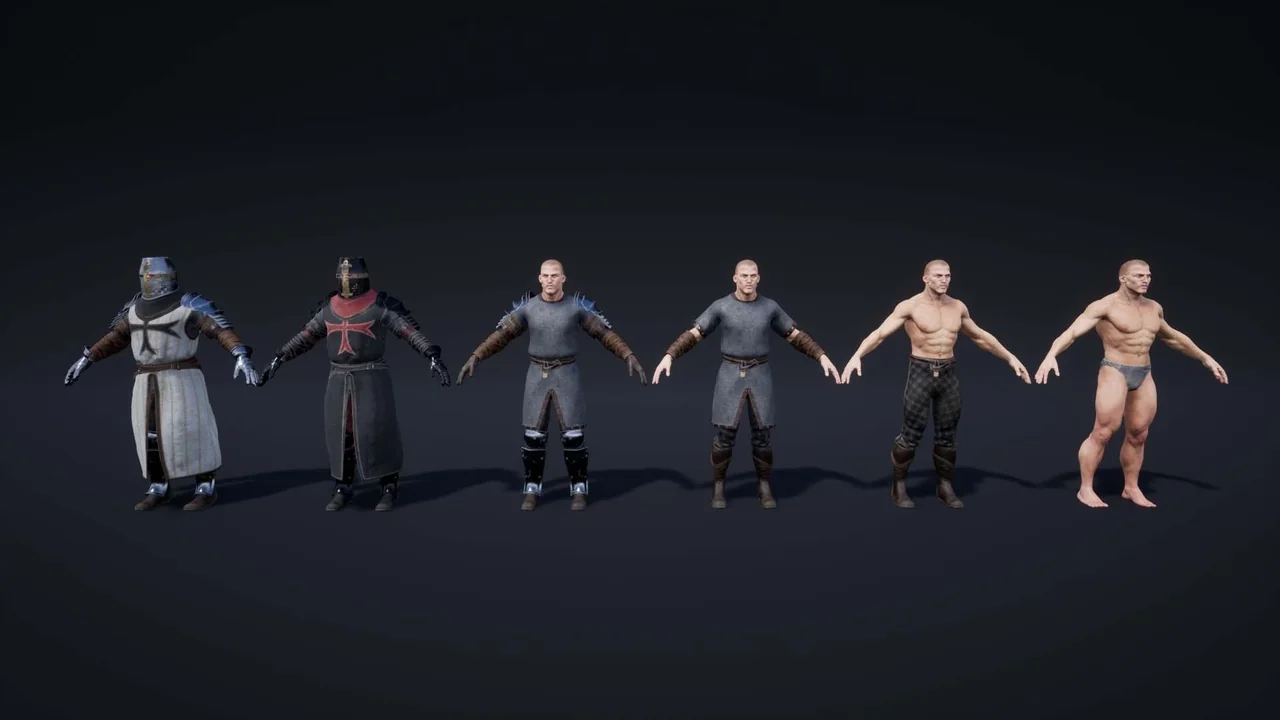
 Characters
 Characters
 Characters