"fa182e0cd0a6ea73"{"id":"1001815","slug":"kitchen-restaurant-props-vol-2-food-shipment-boxes","title":"Kitchen/Restaurant Props VOL.2 - Food Shipment Boxes","category":"Hardware","engine":"4.17+,5.0+","assetVersion":"","engineVersion":"Engine Version: 4.17+,5.0+","tag":"Hardware","accent":"blue","visual":"mech","summary":"Explore Kitchen/Restaurant Props VOL.2 - Food Shipment Boxes: 51 Unreal Engine meshes, master material controls, channel packing, and custom branding.","platform":"Unreal Engine","publishedAt":"2026-10-21T08:08:39.546Z","updatedAt":"2026-10-21T08:08:39.546Z","sourceNotes":[],"fileContents":[],"compatibility":["Unreal Engine","Engine Version: 4.17+,5.0+"],"featuredImage":{"alt":"Kitchen/Restaurant Props VOL.2 - Food Shipment Boxes","src":"/wp-content/uploads/published/2026/10/916c8024fa3c-41b8de00-6661-468d-bbce-90f386155b81-3ad3140c32.webp"},"hasDownloadLink":true,"downloads":0,"terms":[{"taxonomy":"category","slug":"hardware","name":"Hardware"}],"galleryImages":[{"src":"/wp-content/uploads/published/2026/10/75ceb49a2770-038fe938-adf2-4360-994b-698c3082d659-e18bf993f4.webp","alt":"Kitchen/Restaurant Props VOL.2 - Food Shipment Boxes"},{"src":"/wp-content/uploads/published/2026/10/ca88446437d3-40afa9f7-db3d-42dc-977b-3eaa076d7635-40164f5a24.webp","alt":"Kitchen/Restaurant Props VOL.2 - Food Shipment Boxes"},{"src":"/wp-content/uploads/published/2026/10/79b591fc370b-1ef42e31-1868-4f3d-89f1-4712c4ce762e-f33d30e486.webp","alt":"Kitchen/Restaurant Props VOL.2 - Food Shipment Boxes"},{"src":"/wp-content/uploads/published/2026/10/010adbc063c9-dc5ac30a-7dd3-4366-aae0-3fc68937a974-fac8a93ec4.webp","alt":"Kitchen/Restaurant Props VOL.2 - Food Shipment Boxes"},{"src":"/wp-content/uploads/published/2026/10/d97bcc93742b-bd5a6900-55ca-4c20-b3ac-77d1675f8eec-60a1bc9f42.webp","alt":"Kitchen/Restaurant Props VOL.2 - Food Shipment Boxes"},{"src":"/wp-content/uploads/published/2026/10/a25baab11857-5dde2580-bcf3-4a44-a3e1-c7edd3086942-5344bd208a.webp","alt":"Kitchen/Restaurant Props VOL.2 - Food Shipment Boxes"},{"src":"/wp-content/uploads/published/2026/10/7c69c28cf5bb-b0c1a4f2-1f0f-4e13-9db3-f4b4adaae70b-e37ba8f260.webp","alt":"Kitchen/Restaurant Props VOL.2 - Food Shipment Boxes"},{"src":"/wp-content/uploads/published/2026/10/dd1d13343445-55062831-b74a-4f82-8ad8-310aaef47f5e-b92bb62031.webp","alt":"Kitchen/Restaurant Props VOL.2 - Food Shipment Boxes"},{"src":"/wp-content/uploads/published/2026/10/00dc9893a2f8-fd1c995b-6db1-4246-80a8-d96cbe44842e-2d541dcac0.webp","alt":"Kitchen/Restaurant Props VOL.2 - Food Shipment Boxes"}],"accessPanel":{"kind":"resource","title":"Download this resource","eyebrow":"Free Download","message":"Log in or create a free account to start your download.","fileName":"Content.7z","safetyNote":"Resources are manually reviewed before listing to improve quality and reduce obvious risks.","actionLabel":"Download Free","resourceType":"Resource archive"},"contentHtml":"\u003cp\u003eCommercial kitchens and delivery bays depend on high-volume background dressing to look operational. Stacking corrugated boxes against cold storage doors or loading wooden skids near an alleyway exit immediately signals the rhythm of daily replenishment. Kitchen/Restaurant Props VOL.2 - Food Shipment Boxes gathers 51 specialized meshes designed to populate these back-of-house culinary and transit spaces in Unreal Engine, targeting AAA visual standards while staying mindful of real-time performance constraints.\u003c/p\u003e \u003ch2\u003eStaging Service Spaces with Food Shipment Boxes and Packaging Meshes\u003c/h2\u003e\n\u003cp\u003eThe collection supplies 51 distinct static meshes representing cardboard boxes, crates, packages, and shipping containers tailored to restaurant supply chains. Rather than functioning as flat, single-angle set dressing, every model features geometry and texture work built to be viewed from all sides. Level designers can tumble boxes onto their corners, stack packages irregularly on industrial wire shelving, or leave half-unpacked containers tilted on prep tables without exposing hollow backsides or missing faces.\u003c/p\u003e \u003cp\u003eBecause these objects serve as repeatable world clutter, the models rely on low-poly foundations that fit dense scene layouts. Placing multiple variations across pantry shelves, storerooms, and delivery docks allows creators to build believable bulk food deliveries. The modularity of the shipping containers lets level artists combine various box dimensions to break up repetitive corridors and reinforce the utilitarian aesthetic of commercial food preparation areas.\u003c/p\u003e \u003ch2\u003eMaster Material Configuration and Texture Channel Packing\u003c/h2\u003e\n\u003cp\u003eManaging draw calls and shader complexity across dozens of small props requires a disciplined shading setup. The package handles surface properties through a centralized master material that governs the majority of the props and models in the project. Rather than assigning disjointed, single-use shaders to every container, instances of this master material drive surface alterations uniformly across the prop collection.\u003c/p\u003e \u003cp\u003eArtists can adjust parameters directly in the material instances, fine-tuning albedo color, roughness response, and normal map intensity to match surrounding scene lighting. The underlying texture mapping uses channel packing, storing Roughness, Metalness, Ambient Occlusion, and Emissive data within single image files. Consolidating four independent mask channels into one texture map reduces texture memory overhead and streamlines sampler calls inside the Unreal Engine graphics pipeline.\u003c/p\u003e \u003cp\u003eThe texture suite prioritizes resolution where surface detail is most visible while conserving memory on smaller components:\u003c/p\u003e\n\u003cul\u003e \u003cli\u003e2048 \u0026times; 2048: 11 texture maps for core container surfaces, large cardboard flats, and primary materials\u003c/li\u003e \u003cli\u003e512 \u0026times; 512: 1 texture map for mid-frequency asset elements\u003c/li\u003e \u003cli\u003e256 \u0026times; 256: 1 texture map for compact surface components\u003c/li\u003e \u003cli\u003e128 \u0026times; 128: 3 texture maps dedicated to low-surface-area utility masks\u003c/li\u003e\n\u003c/ul\u003e \u003ch2\u003eCustom Branding, Label Art, and Asset Safety\u003c/h2\u003e\n\u003cp\u003eRealistic package clutter often presents legal hazards when real-world corporate logos, shipping barcodes, or food brand emblems appear in interactive projects. Real commercial packaging usually displays regulatory markings, distributor names, and product indicators that cannot be duplicated directly in commercial games or broadcasts without licensing exposure.\u003c/p\u003e \u003cp\u003eAll graphics, typography, tape, stamps, and product labeling across these 51 meshes were custom-authored by Dekogon Kollab artists. The fictitious graphics mirror the visual cadence of real restaurant food distributors—complete with batch stamps, shipping details, and commodity classifications—while remaining completely free of intellectual property conflicts. This makes the collection viable for commercial games, broadcast cinematics, and architectural visualization without requiring label clearance or texture scrub passes.\u003c/p\u003e \u003ch2\u003eTesting Assets in the Dynamic Lighting Scene\u003c/h2\u003e\n\u003cp\u003eEvaluating prop response under moving light sources is essential before placing assets into active levels. The pack includes an integrated dynamic lighting test scene specifically configured to show surface behavior under live shadow casting and varying incident light. Within this environment, the included post-process volume and calibrated Look Up Table (LUT) illustrate the visual tone, contrast, and specular falloff intended by the artists.\u003c/p\u003e \u003cp\u003eBecause cardboard, untreated paper labels, and tape reflect light with subtle specular rolls and rough micro-surfaces, inspecting them under dynamic conditions ensures that the material instances do not blow out under harsh interior spotlights or disappear in shadowed walk-in freezers. Teams can inspect how the channel-packed ambient occlusion anchors box contact points and how normal map bevels catch glancing light along creased cardboard folds.\u003c/p\u003e \u003ch2\u003eDeployment Across Game Environments and Meridian 1988 Staging\u003c/h2\u003e\n\u003cp\u003eWhile targeted directly at real-time game production, the detailed texturing and all-side modeling allow these shipment boxes to integrate cleanly into high-resolution architectural visualizations of commercial kitchens, grocery hubs, and distribution warehouses. The clean topology prevents silhouette breakdown during tight cinematic shots, such as cutscenes set around prep counters or loading bays.\u003c/p\u003e \u003cp\u003eThe assets are also compatible with Meridian 1988: Cedar Point School - Modular Environment (VOL 57). Integrating these restaurant food shipment boxes into that modular institutional environment provides period-appropriate kitchen clutter, dry storage supplies, and cafeteria inventory, expanding the visual storytelling of institutional utility rooms without style discrepancies.\u003c/p\u003e\n\n\u003ch2\u003eContinue Browsing Similar Packs\u003c/h2\u003e\n\u003cul\u003e\n\u003cli\u003e\u003ca href=\"https://3dcghub.com/bank-heist-vol-2/\" title=\"Bank Heist - VOL.2\"\u003eBank Heist - VOL.2\u003c/a\u003e\u003c/li\u003e\n\u003cli\u003e\u003ca href=\"https://3dcghub.com/vending-machine-food-and-drink-prop-pack/\" title=\"Vending Machine + Food \u0026amp; Drink - Prop Pack\"\u003eVending Machine + Food \u0026amp; Drink - Prop Pack\u003c/a\u003e\u003c/li\u003e\n\u003cli\u003e\u003ca href=\"https://3dcghub.com/electrocomponents-kitbash/\" title=\"Electrocomponents kitbash\"\u003eElectrocomponents kitbash\u003c/a\u003e\u003c/li\u003e\n\u003cli\u003e\u003ca href=\"https://3dcghub.com/power-tools-pack/\" title=\"Power Tools Pack\"\u003ePower Tools Pack\u003c/a\u003e\u003c/li\u003e\n\u003cli\u003e\u003ca href=\"https://3dcghub.com/fast-food-restaurant/\" title=\"Fast Food Restaurant\"\u003eFast Food Restaurant\u003c/a\u003e\u003c/li\u003e\n\u003c/ul\u003e","contentTextLength":5874,"navigation":{"current":41,"total":3789,"previous":{"id":"1001816","slug":"lost-shrine","title":"Lost Shrine","category":"Temple","platform":"Unreal Engine","updatedAt":"2026-10-21T08:10:07.530Z"},"next":{"id":"1001814","slug":"kaboom-sounds-sound-effects","title":"KABOOM Sounds - Sound Effects","category":"Sound Effects","platform":"Unreal Engine","updatedAt":"2026-10-21T08:07:51.103Z"}},"relatedResources":[{"id":"1001426","slug":"bank-heist-vol-2","title":"Bank Heist - VOL.2","category":"Guns","engine":"4.17+,5.0+","assetVersion":"","engineVersion":"Engine Version: 4.17+,5.0+","tag":"Guns","accent":"blue","visual":"mech","summary":"Explore Bank Heist - VOL.2 for Unreal Engine, featuring AAA props, custom branding, packed master materials, and a test dynamic lighting scene.","platform":"Unreal Engine","publishedAt":"2026-10-07T06:03:40.391Z","updatedAt":"2026-10-07T06:03:40.391Z","sourceNotes":[],"fileContents":[],"compatibility":["Unreal Engine","Engine Version: 4.17+,5.0+"],"featuredImage":{"alt":"Bank Heist - VOL.2","src":"/wp-content/uploads/published/2026/10/348c1f77e730-ae193926-299b-4ab6-994e-2b4c2482d3fe-2dd82fe0ff.webp"},"hasDownloadLink":true,"downloads":0},{"id":"1001371","slug":"vending-machine-food-and-drink-prop-pack","title":"Vending Machine + Food \u0026 Drink - Prop Pack","category":"Food \u0026 Drink","engine":"4.23+,5.0+","assetVersion":"","engineVersion":"Engine Version: 4.23+,5.0+","tag":"Food \u0026 Drink","accent":"blue","visual":"mech","summary":"Explore the game-ready Vending Machine + Food \u0026 Drink Prop Pack for Unreal Engine, featuring 8 distinct vending machines, 14 food and drink items, and textures.","platform":"Unreal Engine","publishedAt":"2026-10-04T10:38:58.451Z","updatedAt":"2026-10-04T10:38:58.451Z","sourceNotes":[],"fileContents":[],"compatibility":["Unreal Engine","Engine Version: 4.23+,5.0+"],"featuredImage":{"alt":"Vending Machine + Food \u0026 Drink - Prop Pack","src":"/wp-content/uploads/published/2026/10/eded0ab9cddd-c197f6d3-69d9-4c0b-9f58-050617b09ed5-f8ee6ddbfa.webp"},"hasDownloadLink":true,"downloads":0},{"id":"27605","slug":"electrocomponents-kitbash","title":"Electrocomponents kitbash","category":"Hardware","engine":"4.27,5.0+","assetVersion":"Engine version: 4.27,5.0+","engineVersion":"","tag":"Hardware","accent":"blue","visual":"city","summary":"Electrocomponents kitbash gathers electrical parts, bench tools, and breadboard wiring into one set for electronics-focused scenes. It also includes PBR materials, standard material texturing, and blueprints for LED animation on the boards.","platform":"Unreal Engine","publishedAt":"2026-04-26T13:25:01.000Z","updatedAt":"2026-04-26T13:25:03.000Z","sourceNotes":[],"fileContents":[],"compatibility":["Unreal Engine","Engine version: 4.27,5.0+"],"featuredImage":{"alt":"Electrocomponents kitbash","src":"https://3dcghub.com/wp-content/uploads/2026/04/5679ccb7dd4a_8515c65d-a0b6-4772-ab07-228c4e6b25df.webp"},"hasDownloadLink":true,"downloads":1}]}
Explore Kitchen/Restaurant Props VOL.2 - Food Shipment Boxes: 51 Unreal Engine meshes, master material controls, channel packing, and custom branding.
Category:Unreal Engine,HardwarePlatform: Unreal EngineEngine Version: 4.17+,5.0+Published: Oct 21, 2026
Hardware
Resource overview
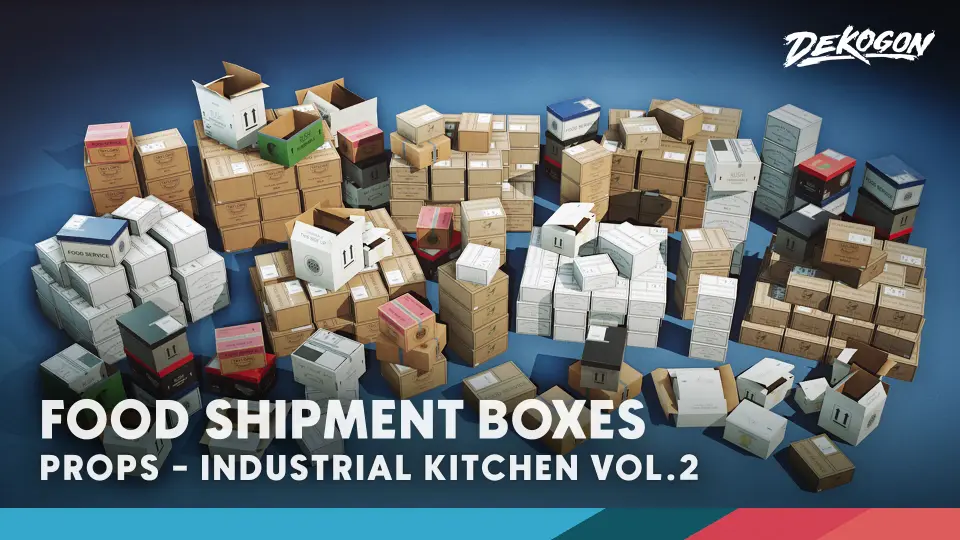
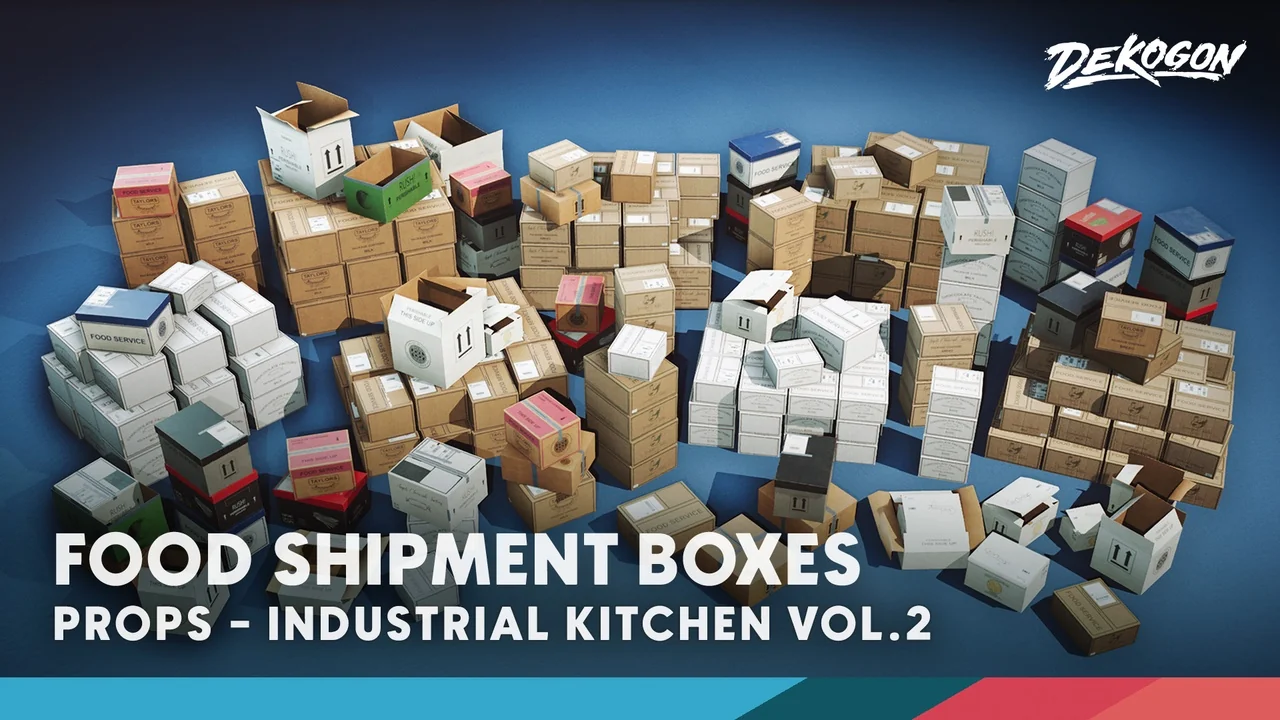
Commercial kitchens and delivery bays depend on high-volume background dressing to look operational. Stacking corrugated boxes against cold storage doors or loading wooden skids near an alleyway exit immediately signals the rhythm of daily replenishment. Kitchen/Restaurant Props VOL.2 - Food Shipment Boxes gathers 51 specialized meshes designed to populate these back-of-house culinary and transit spaces in Unreal Engine, targeting AAA visual standards while staying mindful of real-time performance constraints.
Staging Service Spaces with Food Shipment Boxes and Packaging Meshes
The collection supplies 51 distinct static meshes representing cardboard boxes, crates, packages, and shipping containers tailored to restaurant supply chains. Rather than functioning as flat, single-angle set dressing, every model features geometry and texture work built to be viewed from all sides. Level designers can tumble boxes onto their corners, stack packages irregularly on industrial wire shelving, or leave half-unpacked containers tilted on prep tables without exposing hollow backsides or missing faces.
Because these objects serve as repeatable world clutter, the models rely on low-poly foundations that fit dense scene layouts. Placing multiple variations across pantry shelves, storerooms, and delivery docks allows creators to build believable bulk food deliveries. The modularity of the shipping containers lets level artists combine various box dimensions to break up repetitive corridors and reinforce the utilitarian aesthetic of commercial food preparation areas.
Master Material Configuration and Texture Channel Packing
Managing draw calls and shader complexity across dozens of small props requires a disciplined shading setup. The package handles surface properties through a centralized master material that governs the majority of the props and models in the project. Rather than assigning disjointed, single-use shaders to every container, instances of this master material drive surface alterations uniformly across the prop collection.
Artists can adjust parameters directly in the material instances, fine-tuning albedo color, roughness response, and normal map intensity to match surrounding scene lighting. The underlying texture mapping uses channel packing, storing Roughness, Metalness, Ambient Occlusion, and Emissive data within single image files. Consolidating four independent mask channels into one texture map reduces texture memory overhead and streamlines sampler calls inside the Unreal Engine graphics pipeline.
The texture suite prioritizes resolution where surface detail is most visible while conserving memory on smaller components:
2048 × 2048: 11 texture maps for core container surfaces, large cardboard flats, and primary materials
512 × 512: 1 texture map for mid-frequency asset elements
256 × 256: 1 texture map for compact surface components
Realistic package clutter often presents legal hazards when real-world corporate logos, shipping barcodes, or food brand emblems appear in interactive projects. Real commercial packaging usually displays regulatory markings, distributor names, and product indicators that cannot be duplicated directly in commercial games or broadcasts without licensing exposure.
All graphics, typography, tape, stamps, and product labeling across these 51 meshes were custom-authored by Dekogon Kollab artists. The fictitious graphics mirror the visual cadence of real restaurant food distributors—complete with batch stamps, shipping details, and commodity classifications—while remaining completely free of intellectual property conflicts. This makes the collection viable for commercial games, broadcast cinematics, and architectural visualization without requiring label clearance or texture scrub passes.
Testing Assets in the Dynamic Lighting Scene
Evaluating prop response under moving light sources is essential before placing assets into active levels. The pack includes an integrated dynamic lighting test scene specifically configured to show surface behavior under live shadow casting and varying incident light. Within this environment, the included post-process volume and calibrated Look Up Table (LUT) illustrate the visual tone, contrast, and specular falloff intended by the artists.
Because cardboard, untreated paper labels, and tape reflect light with subtle specular rolls and rough micro-surfaces, inspecting them under dynamic conditions ensures that the material instances do not blow out under harsh interior spotlights or disappear in shadowed walk-in freezers. Teams can inspect how the channel-packed ambient occlusion anchors box contact points and how normal map bevels catch glancing light along creased cardboard folds.
Deployment Across Game Environments and Meridian 1988 Staging
While targeted directly at real-time game production, the detailed texturing and all-side modeling allow these shipment boxes to integrate cleanly into high-resolution architectural visualizations of commercial kitchens, grocery hubs, and distribution warehouses. The clean topology prevents silhouette breakdown during tight cinematic shots, such as cutscenes set around prep counters or loading bays.
The assets are also compatible with Meridian 1988: Cedar Point School - Modular Environment (VOL 57). Integrating these restaurant food shipment boxes into that modular institutional environment provides period-appropriate kitchen clutter, dry storage supplies, and cafeteria inventory, expanding the visual storytelling of institutional utility rooms without style discrepancies.
 Hardware
 Guns
 Food & Drink
 Hardware