"7066dd76da796369"{"id":"1000733","slug":"gothic-exterior-megapack","title":"Gothic Exterior Megapack","category":"Procedural Systems","engine":"5.4","assetVersion":"Asset Version: 1.03","engineVersion":"Engine Version: 5.4","tag":"Procedural Systems","accent":"blue","visual":"mech","summary":"Modular gothic exterior environment for Unreal Engine 5 with Lumen lighting, Nanite-enabled meshes, spline tools, grid-snapping assets, and a playable demo.","platform":"Unreal Engine","publishedAt":"2026-07-26T16:23:14.210Z","updatedAt":"2026-07-26T16:23:14.210Z","sourceNotes":[],"fileContents":[],"compatibility":["Unreal Engine","Asset Version: 1.03","Engine Version: 5.4"],"featuredImage":{"alt":"Gothic Exterior Megapack","src":"/wp-content/uploads/published/2026/07/266bf57aeaec-206bfcf7-facb-4e2f-b5d3-f17a1b04a41b-548edf8ed6.webp"},"hasDownloadLink":true,"downloads":0,"terms":[{"taxonomy":"category","slug":"procedural-systems-tools-and-plugins","name":"Procedural Systems"}],"galleryImages":[{"src":"/wp-content/uploads/published/2026/07/704855089232-df4eb2b4-4904-444d-8e39-4bd9c5e4d03b-12b2a2e26f.webp","alt":"Gothic Exterior Megapack"},{"src":"/wp-content/uploads/published/2026/07/3b19f0c453ba-46cd24da-c077-408f-8c51-ebcca482312f-af28b18e45.webp","alt":"Gothic Exterior Megapack"},{"src":"/wp-content/uploads/published/2026/07/c4c739e6bfb6-952711ed-33fe-404d-9732-14caef5cdbf1-1db6733786.webp","alt":"Gothic Exterior Megapack"},{"src":"/wp-content/uploads/published/2026/07/cb689330cc55-29a23789-bcba-495d-8944-432e7e18fe38-a8ac50cefe.webp","alt":"Gothic Exterior Megapack"},{"src":"/wp-content/uploads/published/2026/07/b76cfd017e7f-53a15db1-76db-48ea-b35a-602391535b93-0af9c7b3e8.webp","alt":"Gothic Exterior Megapack"},{"src":"/wp-content/uploads/published/2026/07/74b682704b49-bf1e68db-73d4-4c4e-9736-a3468d9cfa78-d6ba8b88c6.webp","alt":"Gothic Exterior Megapack"},{"src":"/wp-content/uploads/published/2026/07/f443f894b996-f778794d-9d65-4e21-bc9b-05bcd48067b9-2bdb4bbbc4.webp","alt":"Gothic Exterior Megapack"},{"src":"/wp-content/uploads/published/2026/07/e01bf3cfd18a-1177e55f-6465-4c66-8569-929eb6ecf2c6-96cd21db43.webp","alt":"Gothic Exterior Megapack"},{"src":"/wp-content/uploads/published/2026/07/2dd230eb91be-9a1c686c-f015-4226-ac67-5e7b0be697f9-c48af0bc01.webp","alt":"Gothic Exterior Megapack"}],"accessPanel":{"kind":"resource","title":"Download this resource","eyebrow":"Free Download","message":"Log in or create a free account to start your download.","fileName":"1.03.7z","safetyNote":"Resources are manually reviewed before listing to improve quality and reduce obvious risks.","actionLabel":"Download Free","resourceType":"Resource archive"},"contentHtml":"\u003cp\u003eA cold gothic environment lives or dies by how its pieces fit together. The Gothic Exterior Megapack is based on modular construction, with every piece snapping to the grid for straightforward assembly of graveyards, ruins, and palatial exteriors. Master Materials govern the look of those pieces, exposing global parameters so changes ripple across the scene rather than requiring per-instance edits. A snowy, winter mood is central to the visual identity the pack casts, and the included tags point toward a specific set of scene types: \u003cem\u003egraveyard\u003c/em\u003e, \u003cem\u003eruin\u003c/em\u003e, \u003cem\u003epalace\u003c/em\u003e, \u003cem\u003estatue\u003c/em\u003e, and \u003cem\u003efoliage\u003c/em\u003e.\u003c/p\u003e\n\n\u003ch2\u003eLumen, Nanite, and the Unreal Engine 5 Update\u003c/h2\u003e\n\u003cp\u003eThe pack has been updated for compatibility with Unreal Engine 5. That update introduced Lumen lighting to the scene, which is reflected in refreshed images accompanying the release. The transition also brought Nanite-enabled meshes into the fold, meaning the modular pieces can draw on virtualized geometry to handle high detail counts without the traditional LOD management overhead.\u003c/p\u003e\n\n\u003cp\u003eThose two technologies change the picture for how the assets render and what they demand of the hardware running them. Lumen provides real-time global illumination, so the cold gothic mood adapts dynamically to light sources placed in the scene. Nanite handles the geometry side, allowing dense architectural detail and statue meshes to render efficiently even when repeated across a large graveyard layout.\u003c/p\u003e\n\n\u003ch2\u003eSpline Tools and the Plugin Versus Non-Plugin Versions\u003c/h2\u003e\n\u003cp\u003eOne of the distinguishing structural details is that the Gothic Exterior Megapack is distributed as a plugin. Project-based installation requires following the included documentation rather than a simple asset drop-in. The plugin contains C++ tools and spline-based utilities that form part of the workflow.\u003c/p\u003e\n\n\u003cp\u003eA non-plugin version has been made available as an additional file. That version strips out the C++ tools, so teams working in environments where plugin installation is not possible still get access to the modular assets themselves, but they lose the spline-driven toolset.\u003c/p\u003e\n\n\u003ch3\u003eFixes Across Versions\u003c/h3\u003e\n\u003cp\u003eThe update history covers three patches that touch on spline visibility, C++ construction, and spline functionality:\u003c/p\u003e\n\u003cul\u003e\n \u003cli\u003e\u003cstrong\u003ev1.01\u003c/strong\u003e — Fixed an issue where spline tools were invisible in packaged game builds.\u003c/li\u003e\n \u003cli\u003e\u003cstrong\u003ev1.02\u003c/strong\u003e — Fixed C++ issues related to a construction bug, introduced Lumen lighting, and enabled Nanite on the meshes.\u003c/li\u003e\n \u003cli\u003e\u003cstrong\u003ev1.03\u003c/strong\u003e — Fixed an issue with splines.\u003c/li\u003e\n\u003c/ul\u003e\n\n\u003cp\u003eThese fixes matter specifically because spline tools are central to the customizability the pack offers. A spline system invisible in a packaged build or prone to construction errors would undercut the promise of flexible, paint-and-place workflows. That the pack also includes vertex painting, foliage tools, and a Master Material system with global parameter control tells us that the tools serve a hands-on approach to scene dressing.\u003c/p\u003e\n\n\u003ch2\u003eModularity, Master Materials, and Performance Optimization\u003c/h2\u003e\n\u003cp\u003eModularity and customizability rank among the main focuses of the Gothic Exterior Megapack. All modular assets snap to the grid. That grid-snapping behavior governs how walls, ruined sections, palace elements, and statues align, which in turn governs how quickly a usable scene can be assembled.\u003c/p\u003e\n\n\u003cp\u003eMaster Materials play a complementary role. Rather than baking every visual variant into a separate texture set, the Master Materials expose parameters that can be modified globally. That means a single change can propagate across multiple instances, which is time-saving when establishing a consistent winter or ruin aesthetic across a large graveyard.\u003c/p\u003e\n\n\u003cp\u003eOptimization was a stated goal throughout development. Textures, models, shaders, and tools were all optimized and tested in real-time build conditions. Making sure the assets look like part of a coherent, cold gothic environment is part of the process; making sure they do so while maintaining solid performance is the other part. The materials and tools provide switches and options that allow performance tuning to match different target hardware or project needs.\u003c/p\u003e\n\n\u003ch2\u003eThe Playable Demo and Performance Testing\u003c/h2\u003e\n\u003cp\u003eA playable demo has been provided in a pre-assembled environment. The demo serves two purposes. First, it lets users experience the cold gothic mood the pack is designed to evoke, seeing how the snow, graveyard, statue, and ruin elements compose into a coherent scene. Second, it functions as a real-world benchmark. Running the demo lets a team measure how the pack performs on their specific PC configuration before committing to a full integration.\u003c/p\u003e\n\n\u003cp\u003eThe showcase demo was assembled targeting the highest visual quality possible. That high target is a deliberate choice; it pushes the render settings to show what the assets are capable of. The performance profile of the pack itself remains flexible. Within the tools and materials, switches and options allow users to tune render cost and increase performance as their project scope demands.\u003c/p\u003e\n\n\u003ch2\u003eCompanion Resources and Cross-Platform Availability\u003c/h2\u003e\n\u003cp\u003eThe Gothic Exterior Megapack forms one half of a larger gothic vision. A companion release, \u003cem\u003eGothic Interior Megapack\u003c/em\u003e, handles the interior spaces. Together, the two packs cover both the outside and inside of a gothic structure, from graveyard exteriors to palace interiors.\u003c/p\u003e\n\n\u003cp\u003eThe pack also extends beyond Unreal Engine. It is available on the Unity Store, making the modular gothic assets accessible to teams working outside the Unreal Engine ecosystem. PDF documentation accompanies the pack, providing the installation and usage guidance necessary for the plugin-based workflow.\u003c/p\u003e\n\n\u003ch2\u003eWho Benefits Most from This Gothic Exterior Kit\u003c/h2\u003e\n\u003cp\u003eTeams building dark fantasy, dungeon, or gothic underworld projects stand to gain the most from this pack. The modular, grid-snapping assets, combined with the spline tools and global Master Materials, create a workflow suited for assembling large exterior environments like graveyards and ruined palaces quickly. For projects that leverage Unreal Engine 5 features like Lumen and Nanite, the update to support those technologies means the assets integrate into modern rendering pipelines natively. Teams needing to prototype or benchmark gothic scenes can use the playable demo to test the visual and performance fit before full-scale production begins.\u003c/p\u003e\n\n\u003ch2\u003eExplore Similar Assets\u003c/h2\u003e\n\u003cul\u003e\n\u003cli\u003e\u003ca href=\"https://3dcghub.com/gothic-interior-megapack/\" title=\"Gothic Interior Megapack\"\u003eGothic Interior Megapack\u003c/a\u003e\u003c/li\u003e\n\u003cli\u003e\u003ca href=\"https://3dcghub.com/cyberpunk-environment-megapack-cyberpunk-exterior-scifi-cyberpunk-cyberpunk/\" title=\"Cyberpunk Environment Megapack ( Cyberpunk Exterior Scifi Cyberpunk Cyberpunk )\"\u003eCyberpunk Environment Megapack ( Cyberpunk Exterior Scifi Cyberpunk Cyberpunk )\u003c/a\u003e\u003c/li\u003e\n\u003cli\u003e\u003ca href=\"https://3dcghub.com/soviet-apartment-megapack-modular-interior-exterior/\" title=\"Soviet Apartment Megapack - Modular Interior Exterior\"\u003eSoviet Apartment Megapack - Modular Interior Exterior\u003c/a\u003e\u003c/li\u003e\n\u003cli\u003e\u003ca href=\"https://3dcghub.com/feudal-japan-exterior-props-vol1/\" title=\"Feudal Japan Exterior Props Vol1\"\u003eFeudal Japan Exterior Props Vol1\u003c/a\u003e\u003c/li\u003e\n\u003cli\u003e\u003ca href=\"https://3dcghub.com/procedural-fps-recoil-system/\" title=\"Procedural FPS Recoil System\"\u003eProcedural FPS Recoil System\u003c/a\u003e\u003c/li\u003e\n\u003c/ul\u003e","contentTextLength":6522,"navigation":{"current":1432,"total":4016,"previous":{"id":"1000734","slug":"unreal-mcp-server-370-ai-tools-for-ue5-editor-automation-via-mcp","title":"Unreal MCP Server — 370+ AI Tools for UE5 Editor Automation via MCP","category":"Engine Tools","platform":"Unreal Engine","updatedAt":"2026-07-26T16:27:55.382Z"},"next":{"id":"1000732","slug":"enhanced-movement-system","title":"Enhanced Movement System","category":"Action-Adventure","platform":"Unreal Engine","updatedAt":"2026-07-26T16:09:42.506Z"}},"relatedResources":[{"id":"1000513","slug":"gothic-interior-megapack","title":"Gothic Interior Megapack","category":"Dungeon","engine":"5.0+","assetVersion":"","engineVersion":"Engine Version: 5.0+","tag":"Dungeon","accent":"blue","visual":"mech","summary":"Gothic Interior Megapack delivers 400 modular cathedral and dungeon assets for Unreal Engine, featuring Nanite and Lumen support, grid-snapping assembly, and a","platform":"Unreal Engine","publishedAt":"2026-07-13T13:56:55.513Z","updatedAt":"2026-07-13T13:56:55.513Z","sourceNotes":[],"fileContents":[],"compatibility":["Unreal Engine","Engine Version: 5.0+"],"featuredImage":{"alt":"Gothic Interior Megapack","src":"/wp-content/uploads/published/2026/07/4a31589e4770-0de1999b-ffab-492e-a278-d7a63dded49b-9cafae1bf2.webp"},"hasDownloadLink":true,"downloads":1},{"id":"1000426","slug":"feudal-japan-exterior-props-vol1","title":"Feudal Japan Exterior Props Vol1","category":"Art \u0026 Statues","engine":"5.1+","assetVersion":"","engineVersion":"Engine Version: 5.1+","tag":"Art \u0026 Statues","accent":"blue","visual":"mech","summary":"Feudal Japan Exterior Props Vol1 supplies Unreal Engine 5-compatible 3D props, pulled from the Feudal Japan Megapack, to populate period environments with statu","platform":"Unreal Engine","publishedAt":"2026-07-09T20:48:07.858Z","updatedAt":"2026-07-09T20:48:07.858Z","sourceNotes":[],"fileContents":[],"compatibility":["Unreal Engine","Engine Version: 5.1+"],"featuredImage":{"alt":"Feudal Japan Exterior Props Vol1","src":"/wp-content/uploads/published/2026/07/fa26362621a4-c08faca2-788a-474e-8500-c237c90667c8-3cb6fe529d.webp"},"hasDownloadLink":true,"downloads":0},{"id":"9019","slug":"soviet-apartment-megapack-modular-interior-exterior","title":"Soviet Apartment Megapack - Modular Interior Exterior","category":"Interior","engine":"4.26+,5.0+","assetVersion":"Engine version: 4.26+,5.0+","engineVersion":"4.24","tag":"Interior","accent":"blue","visual":"city","summary":"Transform your game environments with the Soviet Apartment Megapack - Modular Interior Exterior. This comprehensive kit features hundreds of assets, from modular elevators to detailed furniture, perfect for realistic urban settings.","platform":"Unreal Engine","publishedAt":"2026-02-25T17:45:40.000Z","updatedAt":"2026-04-19T15:55:19.000Z","sourceNotes":[],"fileContents":[],"compatibility":["Unreal Engine","Engine version: 4.26+,5.0+"],"featuredImage":{"alt":"Soviet Apartment Megapack - Modular Interior Exterior","src":"https://3dcghub.com/wp-content/uploads/2026/02/2084d866-2385-4ce7-822d-bc15f9879365.webp"},"hasDownloadLink":true,"downloads":3}]}
Procedural Systems
Gothic Exterior Megapack
Modular gothic exterior environment for Unreal Engine 5 with Lumen lighting, Nanite-enabled meshes, spline tools, grid-snapping assets, and a playable demo.
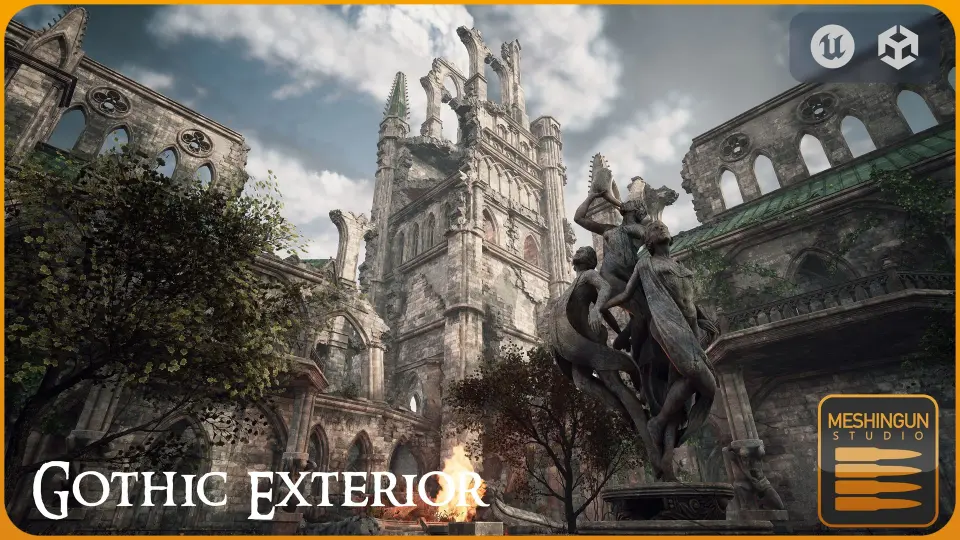
A cold gothic environment lives or dies by how its pieces fit together. The Gothic Exterior Megapack is based on modular construction, with every piece snapping to the grid for straightforward assembly of graveyards, ruins, and palatial exteriors. Master Materials govern the look of those pieces, exposing global parameters so changes ripple across the scene rather than requiring per-instance edits. A snowy, winter mood is central to the visual identity the pack casts, and the included tags point toward a specific set of scene types: graveyard, ruin, palace, statue, and foliage.
Lumen, Nanite, and the Unreal Engine 5 Update
The pack has been updated for compatibility with Unreal Engine 5. That update introduced Lumen lighting to the scene, which is reflected in refreshed images accompanying the release. The transition also brought Nanite-enabled meshes into the fold, meaning the modular pieces can draw on virtualized geometry to handle high detail counts without the traditional LOD management overhead.
Those two technologies change the picture for how the assets render and what they demand of the hardware running them. Lumen provides real-time global illumination, so the cold gothic mood adapts dynamically to light sources placed in the scene. Nanite handles the geometry side, allowing dense architectural detail and statue meshes to render efficiently even when repeated across a large graveyard layout.
Spline Tools and the Plugin Versus Non-Plugin Versions
One of the distinguishing structural details is that the Gothic Exterior Megapack is distributed as a plugin. Project-based installation requires following the included documentation rather than a simple asset drop-in. The plugin contains C++ tools and spline-based utilities that form part of the workflow.
A non-plugin version has been made available as an additional file. That version strips out the C++ tools, so teams working in environments where plugin installation is not possible still get access to the modular assets themselves, but they lose the spline-driven toolset.
Fixes Across Versions
The update history covers three patches that touch on spline visibility, C++ construction, and spline functionality:
v1.01 — Fixed an issue where spline tools were invisible in packaged game builds.
v1.02 — Fixed C++ issues related to a construction bug, introduced Lumen lighting, and enabled Nanite on the meshes.
v1.03 — Fixed an issue with splines.
These fixes matter specifically because spline tools are central to the customizability the pack offers. A spline system invisible in a packaged build or prone to construction errors would undercut the promise of flexible, paint-and-place workflows. That the pack also includes vertex painting, foliage tools, and a Master Material system with global parameter control tells us that the tools serve a hands-on approach to scene dressing.
Modularity, Master Materials, and Performance Optimization
Modularity and customizability rank among the main focuses of the Gothic Exterior Megapack. All modular assets snap to the grid. That grid-snapping behavior governs how walls, ruined sections, palace elements, and statues align, which in turn governs how quickly a usable scene can be assembled.
Master Materials play a complementary role. Rather than baking every visual variant into a separate texture set, the Master Materials expose parameters that can be modified globally. That means a single change can propagate across multiple instances, which is time-saving when establishing a consistent winter or ruin aesthetic across a large graveyard.
Optimization was a stated goal throughout development. Textures, models, shaders, and tools were all optimized and tested in real-time build conditions. Making sure the assets look like part of a coherent, cold gothic environment is part of the process; making sure they do so while maintaining solid performance is the other part. The materials and tools provide switches and options that allow performance tuning to match different target hardware or project needs.
The Playable Demo and Performance Testing
A playable demo has been provided in a pre-assembled environment. The demo serves two purposes. First, it lets users experience the cold gothic mood the pack is designed to evoke, seeing how the snow, graveyard, statue, and ruin elements compose into a coherent scene. Second, it functions as a real-world benchmark. Running the demo lets a team measure how the pack performs on their specific PC configuration before committing to a full integration.
The showcase demo was assembled targeting the highest visual quality possible. That high target is a deliberate choice; it pushes the render settings to show what the assets are capable of. The performance profile of the pack itself remains flexible. Within the tools and materials, switches and options allow users to tune render cost and increase performance as their project scope demands.
Companion Resources and Cross-Platform Availability
The Gothic Exterior Megapack forms one half of a larger gothic vision. A companion release, Gothic Interior Megapack, handles the interior spaces. Together, the two packs cover both the outside and inside of a gothic structure, from graveyard exteriors to palace interiors.
The pack also extends beyond Unreal Engine. It is available on the Unity Store, making the modular gothic assets accessible to teams working outside the Unreal Engine ecosystem. PDF documentation accompanies the pack, providing the installation and usage guidance necessary for the plugin-based workflow.
Who Benefits Most from This Gothic Exterior Kit
Teams building dark fantasy, dungeon, or gothic underworld projects stand to gain the most from this pack. The modular, grid-snapping assets, combined with the spline tools and global Master Materials, create a workflow suited for assembling large exterior environments like graveyards and ruined palaces quickly. For projects that leverage Unreal Engine 5 features like Lumen and Nanite, the update to support those technologies means the assets integrate into modern rendering pipelines natively. Teams needing to prototype or benchmark gothic scenes can use the playable demo to test the visual and performance fit before full-scale production begins.
 Procedural Systems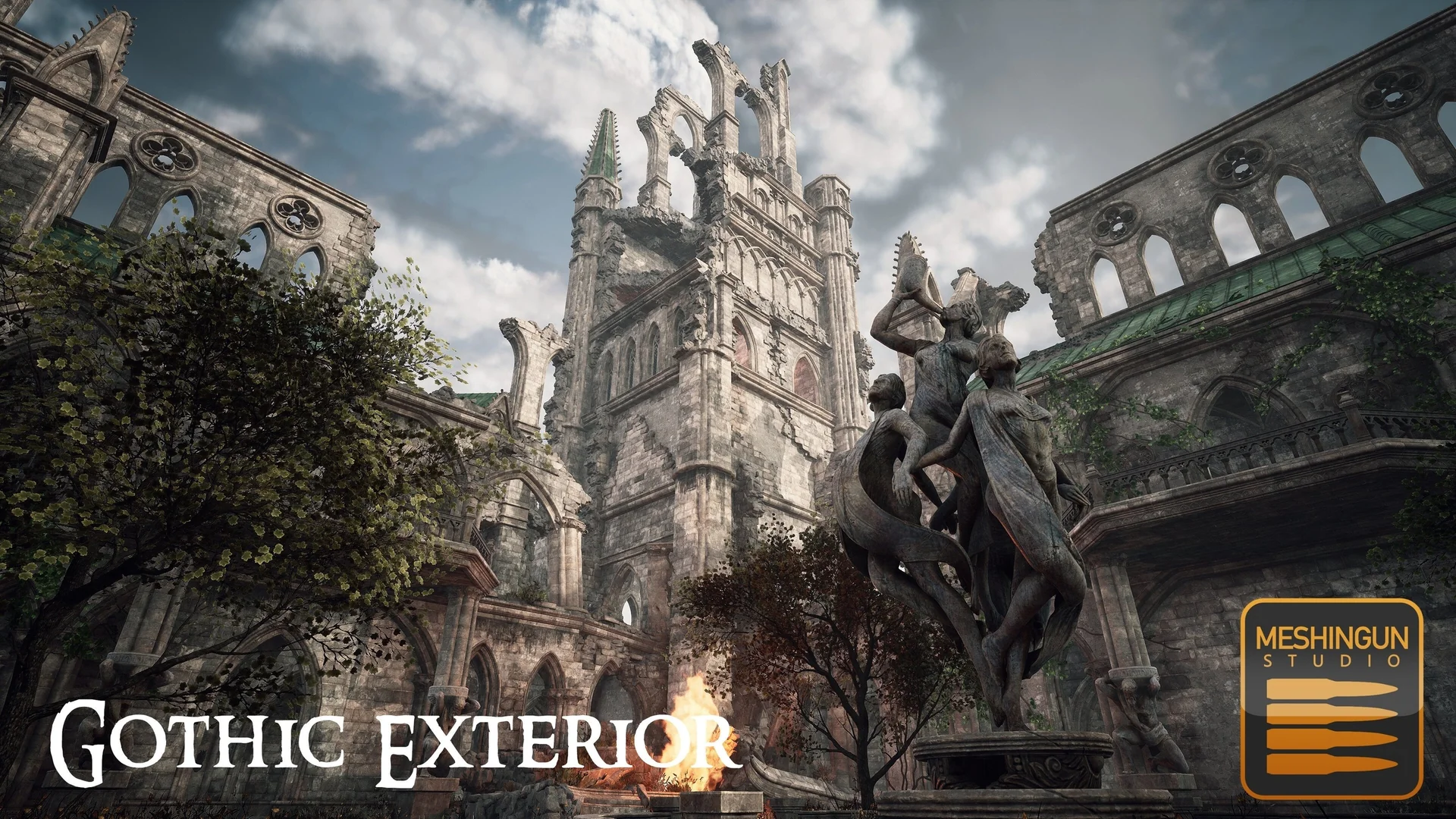
 Dungeon
 Art & Statues
 Interior