"a19e0535960bd083"{"id":"1002031","slug":"forest-huntress","title":"Forest Huntress","category":"Characters \u0026 Creatures","engine":"4.26+,5.0+","assetVersion":"","engineVersion":"Engine Version: 4.26+,5.0+","tag":"Characters","accent":"blue","visual":"character","summary":"Explore the Forest Huntress character mesh, featuring a UE4 skeleton, 33 animations, separate mesh parts, and cloth and hair physics simulation.","platform":"Unreal Engine","publishedAt":"2026-10-26T13:33:57.375Z","updatedAt":"2026-10-26T13:33:57.375Z","sourceNotes":[],"fileContents":[],"compatibility":["Unreal Engine","Engine Version: 4.26+,5.0+"],"featuredImage":{"alt":"Forest Huntress","src":"/wp-content/uploads/published/2026/10/103c56ba9e61-bd41b8f8-2e59-4a34-aec0-e89215bd74d3-c808921e65.webp"},"hasDownloadLink":true,"downloads":0,"terms":[{"taxonomy":"category","slug":"characters-and-creatures","name":"Characters \u0026 Creatures"}],"galleryImages":[{"src":"/wp-content/uploads/published/2026/10/87d9e0e2a643-67e839d8-0ac2-4181-ad0e-5dc2ec9beded-a918f70306.webp","alt":"Forest Huntress"},{"src":"/wp-content/uploads/published/2026/10/1effaa597989-95bba813-2542-4c4d-bc3b-6cf403d61b61-044fc6a852.webp","alt":"Forest Huntress"},{"src":"/wp-content/uploads/published/2026/10/21c40071d5cf-3dc1179b-995b-4936-9166-0afab257ea0d-60bcfa439e.webp","alt":"Forest Huntress"},{"src":"/wp-content/uploads/published/2026/10/094116b7ff86-32bebd77-ee18-4491-8447-5e1a6cd412a6-03971a4873.webp","alt":"Forest Huntress"},{"src":"/wp-content/uploads/published/2026/10/b69ef5cd0764-b4765bef-3bc8-4629-a45a-29fbda37c4d5-95bce3f290.webp","alt":"Forest Huntress"},{"src":"/wp-content/uploads/published/2026/10/9dc52caf659a-2ee02a22-1dc9-4ba4-a90e-bcfc299f00dc-5fb0e6f96c.webp","alt":"Forest Huntress"},{"src":"/wp-content/uploads/published/2026/10/17ad9a5495d3-0dff0ee5-5732-4039-8fe7-18a9dc2027ef-76ab289339.webp","alt":"Forest Huntress"},{"src":"/wp-content/uploads/published/2026/10/7e3fb18df4a6-037fe216-c6a5-4553-bc03-ac6aac204a7d-142ab2878b.webp","alt":"Forest Huntress"},{"src":"/wp-content/uploads/published/2026/10/93a3bfb1fb7d-86965ea0-f309-485c-8e62-650caca04787-2ec5240f93.webp","alt":"Forest Huntress"}],"accessPanel":{"kind":"resource","title":"Download this resource","eyebrow":"Free Download","message":"Log in or create a free account to start your download.","fileName":"Content.7z","safetyNote":"Resources are manually reviewed before listing to improve quality and reduce obvious risks.","actionLabel":"Download Free","resourceType":"Resource archive"},"contentHtml":"\u003cp\u003eThird-person action titles, wilderness survival prototypes, and fantasy exploration games routinely rely on agile humanoid characters capable of traversing uneven terrain while engaging in direct combat. Forest Huntress supplies a dedicated female hunter character archetype rigged to the UE4 skeleton. The asset combines an optimized geometry budget with dedicated cloth and hair physics simulation, multiple visual variations, and an extensive locomotion and combat animation library configured for real-time project environments.\u003c/p\u003e \u003ch2\u003eRigging Architecture and the UE4 Skeleton Framework\u003c/h2\u003e\n\u003cp\u003eThe foundation of Forest Huntress relies on the standard Epic skeleton hierarchy, ensuring direct compatibility across projects utilizing Unreal Engine 4 and Unreal Engine 5 pipelines. Because the character maps directly to this standard bone setup, developers can integrate the asset straight into existing third-person character blueprints, animation blueprints, and state machines without requiring extensive custom bone retargeting steps.\u003c/p\u003e\n\u003cp\u003eUsing the native Epic skeleton structure also preserves alignment with standard IK chains, aim offsets, and socket systems. Developers adding gear, quivers, or equipment to the hands or spine can attach items to established bone sockets reliably. The rigging accommodates fluid motion across both fast locomotion sequences and subtle physical secondary motions, maintaining correct deformation through the limbs and torso during complex movements.\u003c/p\u003e \u003ch2\u003eGeometry Budget, Vertices, and Separate Mesh Parts\u003c/h2\u003e\n\u003cp\u003eForest Huntress keeps real-time rendering demands in check by adhering to a lowpoly character footprint. The technical specifications reflect a disciplined geometry distribution across the entire model:\u003c/p\u003e\n\u003cul\u003e \u003cli\u003ePolygons: 19,743\u003c/li\u003e \u003cli\u003eVertices: 22,438\u003c/li\u003e \u003cli\u003eTriangles: 29,707\u003c/li\u003e\n\u003c/ul\u003e\n\u003cp\u003eSitting comfortably under 30,000 triangles, the mesh is light enough for dense outdoor scenes, crowd encounters, or performance-sensitive gameplay modes without sacrificing silhouette clarity. Edge flow is focused around primary deforming joints such as shoulders, elbows, hips, and knees, keeping visual pinching to a minimum throughout extreme poses.\u003c/p\u003e\n\u003cp\u003eThe model is constructed with separate mesh parts beyond one collapsed surface. Dividing the character into discrete sections gives technical artists and gameplay programmers the ability to isolate specific pieces of the mesh during gameplay. Individual sections can be toggled, swapped, or hidden to accommodate armor swaps, damage states, visual customization systems, or optimization routines such as disabling non-visible internal surfaces.\u003c/p\u003e \u003ch2\u003eCloth and Hair Physics Simulation Across Three Character Skins\u003c/h2\u003e\n\u003cp\u003eVisual fidelity in third-person perspectives depends heavily on secondary motion, especially when a character sprints, leaps, or pivots rapidly. Forest Huntress features integrated cloth and hair physics simulation configured directly for the mesh over the Epic skeleton. Hair strands and fabric elements react dynamically to player movement vectors, environmental forces, and skeletal velocity, preventing rigid clipping and grounding the character within the scene.\u003c/p\u003e\n\u003cp\u003eTo support visual variety across different game environments or team alignments, the model comes with three distinct skins. These material variations allow the hunter to blend into varying biomes or represent distinct character tiers without altering underlying bone weights or mesh parameters. Because the three skins share identical skeletal structures and collision hulls, swapping between them requires no adjustments to gameplay logic or physics properties.\u003c/p\u003e \u003ch2\u003eDirectional Locomotion and Combat Breakdown Across 33 Animations\u003c/h2\u003e\n\u003cp\u003eForest Huntress includes a comprehensive set of 33 in-place animations that cover basic navigation, weapon handling, hit reactions, and combat states. The collection provides the baseline states necessary to build a responsive character controller out of the box.\u003c/p\u003e\n\u003cp\u003eLocomotion covers full directional traversal, featuring three variations each for standard movement vectors:\u003c/p\u003e\n\u003cul\u003e \u003cli\u003eWalk (3 variations)\u003c/li\u003e \u003cli\u003eWalk back (3 variations)\u003c/li\u003e \u003cli\u003eWalk left (3 variations)\u003c/li\u003e \u003cli\u003eWalk right (3 variations)\u003c/li\u003e \u003cli\u003eRun (3 variations)\u003c/li\u003e \u003cli\u003eIdle (3 variations)\u003c/li\u003e\n\u003c/ul\u003e\n\u003cp\u003eProviding three distinct variations per direction allows developers to construct nuanced blend spaces. Instead of relying on a single looping cycle, animation state machines can blend between slight posture changes or step cadences, breaking up visual repetition during long exploration sequences. Directional walk cycles (forward, backward, left, right) simplify the setup of strafing mechanics, combat target-locking, and free-camera navigation.\u003c/p\u003e\n\u003cp\u003eVerticality and recovery are supported by three jump animations, enabling transition setups for takeoff, apex suspension, and landing. When engaging opponents, the animation roster supplies three attack variations suitable for multi-hit combo chains, along with two distinct get-hit reaction clips to register enemy impacts without disrupting combat pacing. Fatal encounters are handled by three separate death animations to prevent identical defeat poses in repeated encounters.\u003c/p\u003e\n\u003cp\u003eState transitions between exploration and active engagement are handled through dedicated weapon-handling clips:\u003c/p\u003e\n\u003cul\u003e \u003cli\u003eDraw weapon (2 variations)\u003c/li\u003e \u003cli\u003eHide weapon (2 variations)\u003c/li\u003e\n\u003c/ul\u003e\n\u003cp\u003eThese equip and unequip clips make it possible to implement clear armed and unarmed stances, dynamically driving weapon attachment sockets between hand locations and holster or back positions.\u003c/p\u003e \u003ch2\u003eProject Suitability and Technical Scope\u003c/h2\u003e\n\u003cp\u003eTeams building third-person survival titles, action RPGs, or arena combat games driven by bow and arrow hunting mechanics will find Forest Huntress directly applicable to their prototyping and production needs. The presence of discrete mesh components benefits developers implementing modular equipment systems, while the under-30k triangle count preserves GPU headroom for foliage, dynamic lighting, and particle effects in complex forest environments. Combined with the 33-animation locomotion library and built-in physics setup on the standard UE4 skeleton, the package provides a self-contained character base ready for instant blueprint integration.\u003c/p\u003e\n\n\u003ch2\u003eMore From The Same Workflow\u003c/h2\u003e\n\u003cul\u003e\n\u003cli\u003e\u003ca href=\"https://3dcghub.com/forest-druid-girl/\" title=\"Forest Druid Girl\"\u003eForest Druid Girl\u003c/a\u003e\u003c/li\u003e\n\u003cli\u003e\u003ca href=\"https://3dcghub.com/stylized-forest-animals-rpg-bundle/\" title=\"Stylized Forest Animals - RPG Bundle\"\u003eStylized Forest Animals - RPG Bundle\u003c/a\u003e\u003c/li\u003e\n\u003cli\u003e\u003ca href=\"https://3dcghub.com/forest-golems/\" title=\"Forest Golems\"\u003eForest Golems\u003c/a\u003e\u003c/li\u003e\n\u003cli\u003e\u003ca href=\"https://3dcghub.com/evil-forest-creature/\" title=\"Evil Forest Creature\"\u003eEvil Forest Creature\u003c/a\u003e\u003c/li\u003e\n\u003cli\u003e\u003ca href=\"https://3dcghub.com/forest-guardian/\" title=\"Forest Guardian\"\u003eForest Guardian\u003c/a\u003e\u003c/li\u003e\n\u003c/ul\u003e","contentTextLength":6263,"navigation":{"current":60,"total":4026,"previous":{"id":"1002032","slug":"forest-pack-easy-landscape-with-plants-and-flowers","title":"Forest pack. Easy landscape with plants and flowers","category":"Fantasy","platform":"Unreal Engine","updatedAt":"2026-10-26T13:36:51.883Z"},"next":{"id":"1002030","slug":"forest-druid-girl","title":"Forest Druid Girl","category":"Characters \u0026 Creatures","platform":"Unreal Engine","updatedAt":"2026-10-26T13:33:04.443Z"}},"relatedResources":[{"id":"1002030","slug":"forest-druid-girl","title":"Forest Druid Girl","category":"Characters \u0026 Creatures","engine":"4.25+,5.0+","assetVersion":"","engineVersion":"Engine Version: 4.25+,5.0+","tag":"Characters","accent":"blue","visual":"character","summary":"Technical overview of Forest Druid Girl, featuring dual rigged body shapes, Epic Skeleton support, 9 PBR 4K texture sets, and material customization.","platform":"Unreal Engine","publishedAt":"2026-10-26T13:33:04.443Z","updatedAt":"2026-10-26T13:33:04.443Z","sourceNotes":[],"fileContents":[],"compatibility":["Unreal Engine","Engine Version: 4.25+,5.0+"],"featuredImage":{"alt":"Forest Druid Girl","src":"/wp-content/uploads/published/2026/10/0956b92a091d-c4130ad6-e1ad-496e-824a-f12d432c94df-bc0f375af0.webp"},"hasDownloadLink":true,"downloads":0},{"id":"1000890","slug":"stylized-forest-animals-rpg-bundle","title":"Stylized Forest Animals - RPG Bundle","category":"Characters \u0026 Creatures","engine":"4.27,5.0+","assetVersion":"","engineVersion":"Engine Version: 4.27,5.0+","tag":"Characters","accent":"blue","visual":"character","summary":"A stylized forest animal bundle for RPGs with 12 creatures, boss variants, 500+ animations, 100+ custom icons, and 7-11 color variations per animal.","platform":"Unreal Engine","publishedAt":"2026-08-06T04:29:55.435Z","updatedAt":"2026-08-06T04:29:55.435Z","sourceNotes":[],"fileContents":[],"compatibility":["Unreal Engine","Engine Version: 4.27,5.0+"],"featuredImage":{"alt":"Stylized Forest Animals - RPG Bundle","src":"/wp-content/uploads/published/2026/08/1488a5a702dc-cfea2ec0-1a50-4f8b-9e18-c5933c6b53e8-5cfe2cdd18.webp"},"hasDownloadLink":true,"downloads":0},{"id":"2436","slug":"forest-golems","title":"Forest Golems","category":"Characters \u0026 Creatures","engine":"4.27,5.0+","assetVersion":"Engine version: 4.27,5.0+","engineVersion":"5.2","tag":"Characters","accent":"blue","visual":"character","summary":"Bring your game worlds to life with the Forest Golem asset pack. Featuring realistic, toon, and poly art styles with high-quality animations and textures.","platform":"Unreal Engine","publishedAt":"2026-02-07T09:50:16.000Z","updatedAt":"2026-04-19T15:58:02.000Z","sourceNotes":[],"fileContents":[],"compatibility":["Unreal Engine","Engine version: 4.27,5.0+"],"featuredImage":{"alt":"Forest Golems","src":"https://3dcghub.com/wp-content/uploads/2026/02/c6849508-6bf7-485f-9aed-03c0ed80775b.webp"},"hasDownloadLink":true,"downloads":1}]}
Characters
Forest Huntress
Explore the Forest Huntress character mesh, featuring a UE4 skeleton, 33 animations, separate mesh parts, and cloth and hair physics simulation.
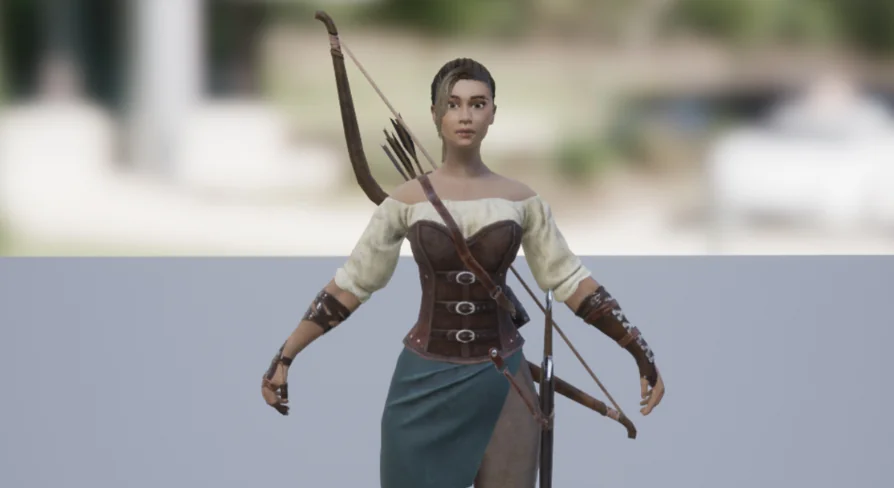
Third-person action titles, wilderness survival prototypes, and fantasy exploration games routinely rely on agile humanoid characters capable of traversing uneven terrain while engaging in direct combat. Forest Huntress supplies a dedicated female hunter character archetype rigged to the UE4 skeleton. The asset combines an optimized geometry budget with dedicated cloth and hair physics simulation, multiple visual variations, and an extensive locomotion and combat animation library configured for real-time project environments.
Rigging Architecture and the UE4 Skeleton Framework
The foundation of Forest Huntress relies on the standard Epic skeleton hierarchy, ensuring direct compatibility across projects utilizing Unreal Engine 4 and Unreal Engine 5 pipelines. Because the character maps directly to this standard bone setup, developers can integrate the asset straight into existing third-person character blueprints, animation blueprints, and state machines without requiring extensive custom bone retargeting steps.
Using the native Epic skeleton structure also preserves alignment with standard IK chains, aim offsets, and socket systems. Developers adding gear, quivers, or equipment to the hands or spine can attach items to established bone sockets reliably. The rigging accommodates fluid motion across both fast locomotion sequences and subtle physical secondary motions, maintaining correct deformation through the limbs and torso during complex movements.
Geometry Budget, Vertices, and Separate Mesh Parts
Forest Huntress keeps real-time rendering demands in check by adhering to a lowpoly character footprint. The technical specifications reflect a disciplined geometry distribution across the entire model:
Polygons: 19,743
Vertices: 22,438
Triangles: 29,707
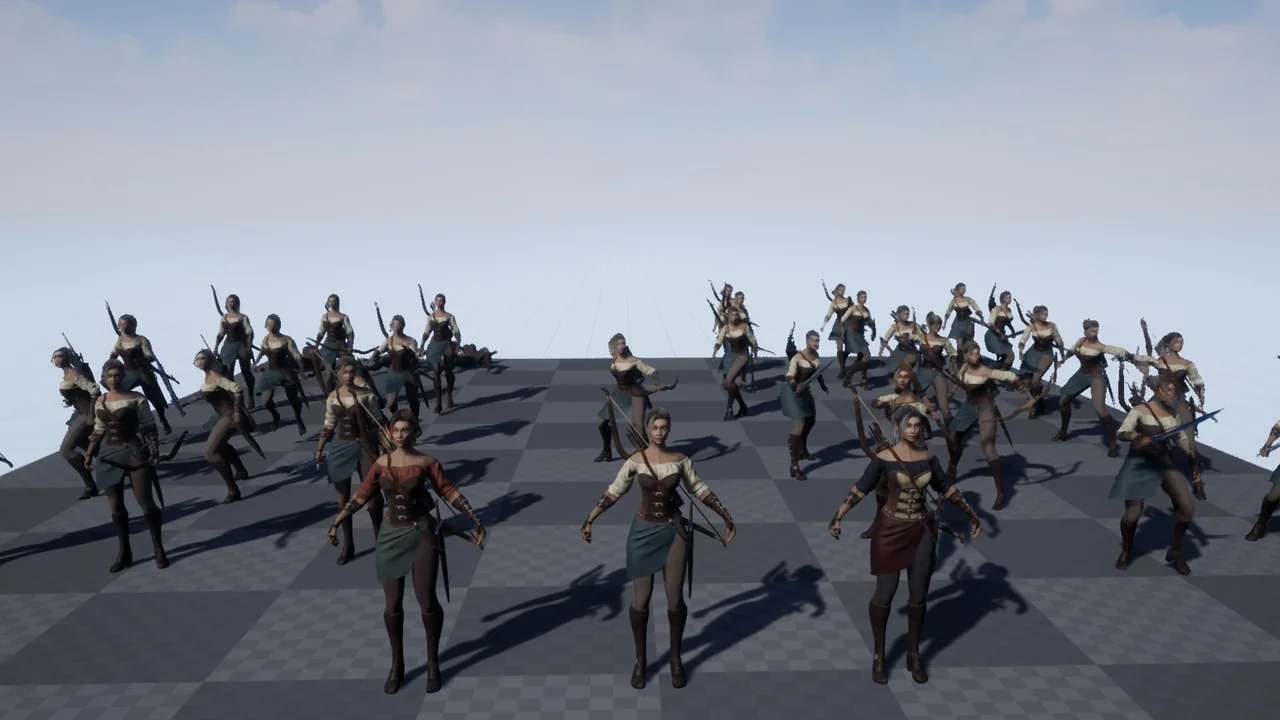
Sitting comfortably under 30,000 triangles, the mesh is light enough for dense outdoor scenes, crowd encounters, or performance-sensitive gameplay modes without sacrificing silhouette clarity. Edge flow is focused around primary deforming joints such as shoulders, elbows, hips, and knees, keeping visual pinching to a minimum throughout extreme poses.
The model is constructed with separate mesh parts beyond one collapsed surface. Dividing the character into discrete sections gives technical artists and gameplay programmers the ability to isolate specific pieces of the mesh during gameplay. Individual sections can be toggled, swapped, or hidden to accommodate armor swaps, damage states, visual customization systems, or optimization routines such as disabling non-visible internal surfaces.
Cloth and Hair Physics Simulation Across Three Character Skins
Visual fidelity in third-person perspectives depends heavily on secondary motion, especially when a character sprints, leaps, or pivots rapidly. Forest Huntress features integrated cloth and hair physics simulation configured directly for the mesh over the Epic skeleton. Hair strands and fabric elements react dynamically to player movement vectors, environmental forces, and skeletal velocity, preventing rigid clipping and grounding the character within the scene.
To support visual variety across different game environments or team alignments, the model comes with three distinct skins. These material variations allow the hunter to blend into varying biomes or represent distinct character tiers without altering underlying bone weights or mesh parameters. Because the three skins share identical skeletal structures and collision hulls, swapping between them requires no adjustments to gameplay logic or physics properties.
Directional Locomotion and Combat Breakdown Across 33 Animations
Forest Huntress includes a comprehensive set of 33 in-place animations that cover basic navigation, weapon handling, hit reactions, and combat states. The collection provides the baseline states necessary to build a responsive character controller out of the box.
Locomotion covers full directional traversal, featuring three variations each for standard movement vectors:
Walk (3 variations)
Walk back (3 variations)
Walk left (3 variations)
Walk right (3 variations)
Run (3 variations)
Idle (3 variations)
Providing three distinct variations per direction allows developers to construct nuanced blend spaces. Instead of relying on a single looping cycle, animation state machines can blend between slight posture changes or step cadences, breaking up visual repetition during long exploration sequences. Directional walk cycles (forward, backward, left, right) simplify the setup of strafing mechanics, combat target-locking, and free-camera navigation.
Verticality and recovery are supported by three jump animations, enabling transition setups for takeoff, apex suspension, and landing. When engaging opponents, the animation roster supplies three attack variations suitable for multi-hit combo chains, along with two distinct get-hit reaction clips to register enemy impacts without disrupting combat pacing. Fatal encounters are handled by three separate death animations to prevent identical defeat poses in repeated encounters.
State transitions between exploration and active engagement are handled through dedicated weapon-handling clips:
Draw weapon (2 variations)
Hide weapon (2 variations)
These equip and unequip clips make it possible to implement clear armed and unarmed stances, dynamically driving weapon attachment sockets between hand locations and holster or back positions.
Project Suitability and Technical Scope
Teams building third-person survival titles, action RPGs, or arena combat games driven by bow and arrow hunting mechanics will find Forest Huntress directly applicable to their prototyping and production needs. The presence of discrete mesh components benefits developers implementing modular equipment systems, while the under-30k triangle count preserves GPU headroom for foliage, dynamic lighting, and particle effects in complex forest environments. Combined with the 33-animation locomotion library and built-in physics setup on the standard UE4 skeleton, the package provides a self-contained character base ready for instant blueprint integration.
 Characters
 Characters
 Characters
 Characters