"0148f1904a9b0d16"{"id":"1002583","slug":"forest-animals-pack","title":"FOREST ANIMALS PACK","category":"Characters \u0026 Creatures","engine":"5.0+","assetVersion":"","engineVersion":"Engine Version: 5.0+","tag":"Characters","accent":"blue","visual":"character","summary":"Detailed breakdown of the Forest Animals Pack, featuring seven realistic wildlife species, multi-stage LODs, skeletal rigs, and animation blueprints.","platform":"Unreal Engine","indexPolicy":"index","publishedAt":"2026-11-14T05:24:35.063Z","updatedAt":"2026-11-14T05:24:35.063Z","sourceNotes":[],"fileContents":[],"compatibility":["Unreal Engine","Engine Version: 5.0+"],"featuredImage":{"alt":"FOREST ANIMALS PACK","src":"/wp-content/uploads/published/2026/11/47f1fc69b1b7-27b11c6a-f64f-45e1-a656-77c559a0a1d9-6cd3ba68de.webp"},"hasDownloadLink":true,"downloads":0,"terms":[{"taxonomy":"category","slug":"characters-and-creatures","name":"Characters \u0026 Creatures"}],"galleryImages":[{"src":"/wp-content/uploads/published/2026/11/257d6a2d7179-39fce653-b6cb-43ca-a3cc-81292d25bf0b-eab3793377.webp","alt":"FOREST ANIMALS PACK"},{"src":"/wp-content/uploads/published/2026/11/3f24c444550d-b680c84e-4a5e-4eb5-b0cd-6df9bbd3ddd9-b7351eb3ce.webp","alt":"FOREST ANIMALS PACK"},{"src":"/wp-content/uploads/published/2026/11/2dbfc8f8942d-5b2b1330-6162-4c8d-8cfb-637bcd570dde-dee381655c.webp","alt":"FOREST ANIMALS PACK"},{"src":"/wp-content/uploads/published/2026/11/155ba8a978b2-db27cb85-9803-4dbc-b2fd-2f3a9c77ec7d-4db4f06f9b.webp","alt":"FOREST ANIMALS PACK"},{"src":"/wp-content/uploads/published/2026/11/0ad61b041377-a1b7437b-af1d-4822-b0a2-fa71aa66ec5a-9722710d62.webp","alt":"FOREST ANIMALS PACK"},{"src":"/wp-content/uploads/published/2026/11/bfd0ef0ca3c1-4ed3a8a1-ca12-4f94-b752-01966c2346d3-3ef09ec07e.webp","alt":"FOREST ANIMALS PACK"},{"src":"/wp-content/uploads/published/2026/11/16562d1f02a8-732fd1bf-a730-4fd7-8ff0-6a8dda74c37b-9f7f4d00c1.webp","alt":"FOREST ANIMALS PACK"}],"accessPanel":{"kind":"resource","title":"Get this resource","eyebrow":"Free resource","message":"Download this resource in your browser.","fileName":"Content.7z","safetyNote":"Resources are manually reviewed before listing to improve quality and reduce obvious risks.","actionLabel":"Get this resource","resourceType":"Resource archive","versions":[]},"contentHtml":"\u003cp\u003ePopulating outdoor environments requires a balanced roster of realistic fauna capable of filling predator, prey, and scavenger niches without placing unmanageable strain on rendering pipelines. FOREST ANIMALS PACK brings together seven foundational woodland creatures: Bear, Boar, Deer Doe, Deer Stag, Fox, Rabbit, and Wolf. Each creature represents a distinct physiological profile, complete with specialized geometric scaling across levels of detail, customized skeletal rigs, dedicated dual-material setups, high-resolution texture maps, and standalone motion libraries tied directly into scripting and animation blueprints.\u003c/p\u003e \u003ch2\u003eSeven Distinct Wildlife Species in the Forest Animals Pack\u003c/h2\u003e\n\u003cp\u003eThe collection organizes its creature roster to cover the primary ecological layers of temperate and northern woodlands. At the apex sits the Bear, built with the heavy mass and broad silhouette expected of a dominant woodland omnivore. Running alongside the Bear are the pack hunters and solitary opportunists: the Wolf, shaped for lean predatory movement, and the Fox, which occupies an agile intermediate scale suitable for brushland and undergrowth.\u003c/p\u003e\n\u003cp\u003eUngulates are split into distinct sexual dimorphic models instead of one shared mesh. The Deer Stag features full antler geometry and broad shoulder proportions, while the Deer Doe offers a streamlined cervid structure with its own dedicated movement assets. Grounding the lower canopy and understory are the Boar, possessing a dense, low-slung anatomical frame, and the Rabbit, which provides an essential small-prey presence to give brush and meadow spaces natural visual activity.\u003c/p\u003e \u003ch2\u003ePolygon Budgets and LOD Scaling Across the Forest Species\u003c/h2\u003e\n\u003cp\u003eReal-time scene density hinges on aggressive, predictable polygon scaling. Each animal in the collection ships with three explicit level-of-detail steps, letting runtime renderers cull triangle density smoothly as camera distances increase.\u003c/p\u003e\n\u003cp\u003eThe Deer Stag carries the highest peak complexity in the collection due to its antler architecture and muscular stature. It begins at 11.18 thousand triangles at base LOD, steps down to 8.83 thousand triangles at intermediate distance, and settles at 6.48 thousand triangles for long-range passes. The companion Deer Doe starts close behind at 10.54 thousand triangles, transitioning through 7.98 thousand triangles down to 5.41 thousand triangles at its outermost threshold. This dual structure gives herds uniform visual fidelity while shedding roughly half their geometric weight at distance.\u003c/p\u003e\n\u003cp\u003eThe heavier predators and omnivores follow a similar stepped degradation curve. The Bear leads with 10.5 thousand triangles at maximum fidelity, decreasing to 8.9 thousand triangles, and reaching 7.3 thousand triangles at LOD2. The Wolf opens at 10 thousand triangles flat, tapering to 7.82 thousand triangles, and completing its long-range LOD at 5.68 thousand triangles. For the Boar, the initial mesh weighs in at 9.55 thousand triangles, dropping to 7.64 thousand triangles before reaching a lean 5.72 thousand triangles at the furthest distance.\u003c/p\u003e\n\u003cp\u003eSmaller fauna utilize scaled-down base budgets that keep distant draw overhead minimal. The Fox starts at 9.27 thousand triangles, stepping to 7.44 thousand triangles and 5.61 thousand triangles. The Rabbit represents the most lightweight asset in the entire group: opening at 5.65 thousand triangles, stepping down to 3.89 thousand triangles, and terminating at just 2.11 thousand triangles at LOD2. This lightweight footprint makes scattering multiple instances across open clearings practical without overwhelming the draw-call and vertex-processing budget.\u003c/p\u003e \u003ch2\u003eSkeletal Rigging and Bone Architecture of the Animals\u003c/h2\u003e\n\u003cp\u003eDeformation quality across quadrupeds depends heavily on maintaining clean bone hierarchies without inflating the computational cost of vertex skinning. The animals maintain tight, disciplined bone counts ranging between 31 and 35 bones, striking a pragmatic balance between fluid articulation and low runtime overhead.\u003c/p\u003e\n\u003cp\u003eBoth the Deer Doe and Deer Stag share an identical skeleton configuration based on 31 bones. Keeping the bone count uniform between the male and female variants simplifies systemic animation retargeting and shared environmental interaction mechanics. The Boar uses the most complex skeletal hierarchy in the pack at 35 bones, accommodating its pronounced snout, thick neck mass, and short hindquarters.\u003c/p\u003e\n\u003cp\u003eThe Bear, Wolf, Fox, and Rabbit converge on an identical skeletal count of 33 bones each. This shared 33-bone baseline across vastly different anatomical archetypes—from the compact skeletal proportions of the rabbit to the elongated canine structure of the wolf and fox, through to the heavy shoulder mechanics of the bear—establishes a dependable baseline for rigging pipelines. The lean bone count ensures that CPU skinning calculations and GPU matrix uploads remain lightweight, even when dozens of individual quadrupeds occupy the same active scene quadrant.\u003c/p\u003e \u003ch2\u003eSurfacing, 4K and 2K Texturing, and Dual Material Setups\u003c/h2\u003e\n\u003cp\u003eSurface definition across all seven species adheres to a uniform structure: each creature utilizes exactly two material slots. Segmenting the animal into two materials allows separate control over distinct anatomical zones—such as isolating eyes, claws, inner mouth cavities, or horn surfaces from primary pelt and skin shaders—without fragmenting the mesh into excessive draw calls.\u003c/p\u003e\n\u003cp\u003eTexture resolution is allocated strategically according to physical screen real estate. Larger and medium-sized species receive 4K texture sets to preserve hair definition, muscle creases, and skin details during close-up camera encounters:\u003c/p\u003e\n\u003cul\u003e\n\u003cli\u003eBear: 4K textures mapped across 2 materials\u003c/li\u003e\n\u003cli\u003eBoar: 4K textures mapped across 2 materials\u003c/li\u003e\n\u003cli\u003eDeer Doe: 4K textures mapped across 2 materials\u003c/li\u003e\n\u003cli\u003eDeer Stag: 4K textures mapped across 2 materials\u003c/li\u003e\n\u003cli\u003eWolf: 4K textures mapped across 2 materials\u003c/li\u003e\n\u003c/ul\u003e\n\u003cp\u003eFor smaller woodland wildlife, texture resolution drops to 2K. Both the Fox and the Rabbit utilize 2K texture maps paired with their two-material setups. This resolution tiering reflects real-world visibility: smaller creatures rarely command the screen space of a bear or stag, making 2K texture maps optimal for preserving memory bandwidth while keeping fur texturing sharp from standard gameplay viewpoints.\u003c/p\u003e \u003ch2\u003eMotion Control Through Animation Blueprints and Scripted Behavior\u003c/h2\u003e\n\u003cp\u003eVisual fidelity requires believable locomotion to function convincingly. FOREST ANIMALS PACK provides dedicated animation clips tailored to each animal's behavioral role, backed by an Animation Blueprint and script support for immediate runtime deployment. Across the seven animals, the pack includes 97 individual animation clips.\u003c/p\u003e\n\u003cp\u003ePredatory and alert behaviors demand the widest kinetic diversity. The Wolf features the largest motion set in the pack with 17 animations, supporting varied gaits, stalking actions, and reactive posturing. The Bear, Fox, and Rabbit each feature 16 animations, giving them the expressive latitude needed for foraging, sniffing, sprinting, idle standing, and fleeing.\u003c/p\u003e\n\u003cp\u003eThe Boar includes 13 animations, providing adequate coverage for aggressive charges, rooting, and transitional locomotion. The Deer Stag features 11 animations, accommodating antler posturing, alertness checks, and bounding strides. The Deer Doe utilizes 8 animations, concentrating strictly on essential herd mechanics including walking, running, idle browsing, and flight responses.\u003c/p\u003e\n\u003cp\u003eThe inclusion of scripted logic and Animation Blueprints connects these animation pools directly to character controllers. Instead of assembling state machines, blend spaces, and transitions from scratch, projects can plug the included blueprints directly into patrol, flee, and agro logic. The realistic art style works hand-in-hand with these animation sets to create convincing environmental wildlife behaviors right out of the box.\u003c/p\u003e \u003ch2\u003eEcosystem Integration Alongside Farm Animals Pack\u003c/h2\u003e\n\u003cp\u003eProjects rarely isolate forest wilderness completely from settled pastoral zones. FOREST ANIMALS PACK features direct compatibility with FARM ANIMALS PACK, enabling shared development frameworks across domestic and wild creatures. Because both asset sets are based on complementary low-poly optimization standards, modular material counts, and standardized animation blueprints, developers can mix wildlife and domestic livestock within the same world borders without stylistic or technical friction.\u003c/p\u003e\n\u003cp\u003eWhether staging a wolf stalking a rural pasture perimeter, boars encroaching on crop fields, or foxes raiding barns, the shared structural DNA between both packs ensures consistent rendering overhead, predictable skeletal performance, and a unified aesthetic across the entire environmental ecosystem.\u003c/p\u003e\n\n\u003ch2\u003eExplore Similar Assets\u003c/h2\u003e\n\u003cul\u003e\n\u003cli\u003e\u003ca href=\"https://3dcghub.com/bear-female/\" rel=\"noopener noreferrer\"\u003eBear - Female\u003c/a\u003e\u003c/li\u003e\n\u003cli\u003e\u003ca href=\"https://3dcghub.com/deer-family/\" rel=\"noopener noreferrer\"\u003eDeer Family\u003c/a\u003e\u003c/li\u003e\n\u003cli\u003e\u003ca href=\"https://3dcghub.com/stylized-forest-animals-rpg-bundle/\" rel=\"noopener noreferrer\"\u003eStylized Forest Animals - RPG Bundle\u003c/a\u003e\u003c/li\u003e\n\u003cli\u003e\u003ca href=\"https://3dcghub.com/evil-forest-creature/\" rel=\"noopener noreferrer\"\u003eEvil Forest Creature\u003c/a\u003e\u003c/li\u003e\n\u003cli\u003e\u003ca href=\"https://3dcghub.com/forest-guardian/\" rel=\"noopener noreferrer\"\u003eForest Guardian\u003c/a\u003e\u003c/li\u003e\n\u003c/ul\u003e","contentTextLength":8856,"navigation":{"current":66,"total":4543,"previous":{"id":"1002584","slug":"industrial-infrastructure","title":"Industrial Infrastructure","category":"Industrial Buildings","platform":"Unreal Engine","updatedAt":"2026-11-14T05:25:42.660Z"},"next":{"id":"1002582","slug":"dodge-it-component","title":"Dodge It Component","category":"Weapons \u0026 Combat","platform":"Unreal Engine","updatedAt":"2026-11-14T05:22:36.409Z"}},"relatedResources":[{"id":"1753","slug":"bear-female","title":"Bear - Female","category":"Characters \u0026 Creatures","engine":"5.1+","assetVersion":"Engine version: 5.1+","engineVersion":"5.1","tag":"Characters","accent":"blue","visual":"character","summary":"Enhance your game with this realistic female bear 3D model. Features 80+ animations, 4K textures, and mobile-ready optimization for professional projects.","platform":"Unreal Engine","indexPolicy":"noindex","publishedAt":"2026-02-06T20:52:02.000Z","updatedAt":"2026-04-19T15:58:29.000Z","sourceNotes":[],"fileContents":[],"compatibility":["Unreal Engine","Engine version: 5.1+"],"featuredImage":{"alt":"Bear - Female","src":"https://3dcghub.com/wp-content/uploads/2026/02/294b6e6b-6e4d-4b7b-bea8-2c587af8c5f4.webp"},"hasDownloadLink":true,"downloads":1},{"id":"2201","slug":"deer-family","title":"Deer Family","category":"Characters \u0026 Creatures","engine":"5.1+","assetVersion":"Engine version: 5.1+","engineVersion":"5.1","tag":"Characters","accent":"blue","visual":"character","summary":"Enhance your digital environments with this professional Deer Family asset pack. Includes realistic Stag, Doe, and Calf models with over 65 animations.","platform":"Unreal Engine","indexPolicy":"noindex","publishedAt":"2026-02-07T08:23:05.000Z","updatedAt":"2026-04-19T15:58:05.000Z","sourceNotes":[],"fileContents":[],"compatibility":["Unreal Engine","Engine version: 5.1+"],"featuredImage":{"alt":"Deer Family","src":"https://3dcghub.com/wp-content/uploads/2026/02/05745e04-e7a8-4ad7-b7b8-3b75b91c5d48.webp"},"hasDownloadLink":true,"downloads":0},{"id":"1000890","slug":"stylized-forest-animals-rpg-bundle","title":"Stylized Forest Animals - RPG Bundle","category":"Characters \u0026 Creatures","engine":"4.27,5.0+","assetVersion":"","engineVersion":"Engine Version: 4.27,5.0+","tag":"Characters","accent":"blue","visual":"character","summary":"A stylized forest animal bundle for RPGs with 12 creatures, boss variants, 500+ animations, 100+ custom icons, and 7-11 color variations per animal.","platform":"Unreal Engine","indexPolicy":"index","publishedAt":"2026-08-06T04:29:55.435Z","updatedAt":"2026-08-06T04:29:55.435Z","sourceNotes":[],"fileContents":[],"compatibility":["Unreal Engine","Engine Version: 4.27,5.0+"],"featuredImage":{"alt":"Stylized Forest Animals - RPG Bundle","src":"/wp-content/uploads/published/2026/08/1488a5a702dc-cfea2ec0-1a50-4f8b-9e18-c5933c6b53e8-5cfe2cdd18.webp"},"hasDownloadLink":true,"downloads":1}]}
Characters
FOREST ANIMALS PACK
Detailed breakdown of the Forest Animals Pack, featuring seven realistic wildlife species, multi-stage LODs, skeletal rigs, and animation blueprints.
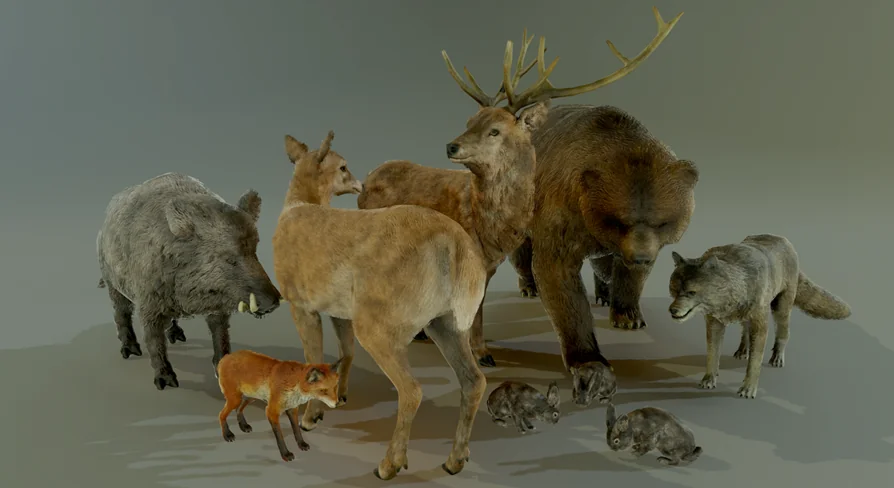
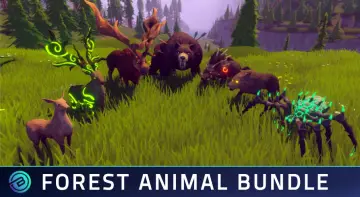
Populating outdoor environments requires a balanced roster of realistic fauna capable of filling predator, prey, and scavenger niches without placing unmanageable strain on rendering pipelines. FOREST ANIMALS PACK brings together seven foundational woodland creatures: Bear, Boar, Deer Doe, Deer Stag, Fox, Rabbit, and Wolf. Each creature represents a distinct physiological profile, complete with specialized geometric scaling across levels of detail, customized skeletal rigs, dedicated dual-material setups, high-resolution texture maps, and standalone motion libraries tied directly into scripting and animation blueprints.
Seven Distinct Wildlife Species in the Forest Animals Pack
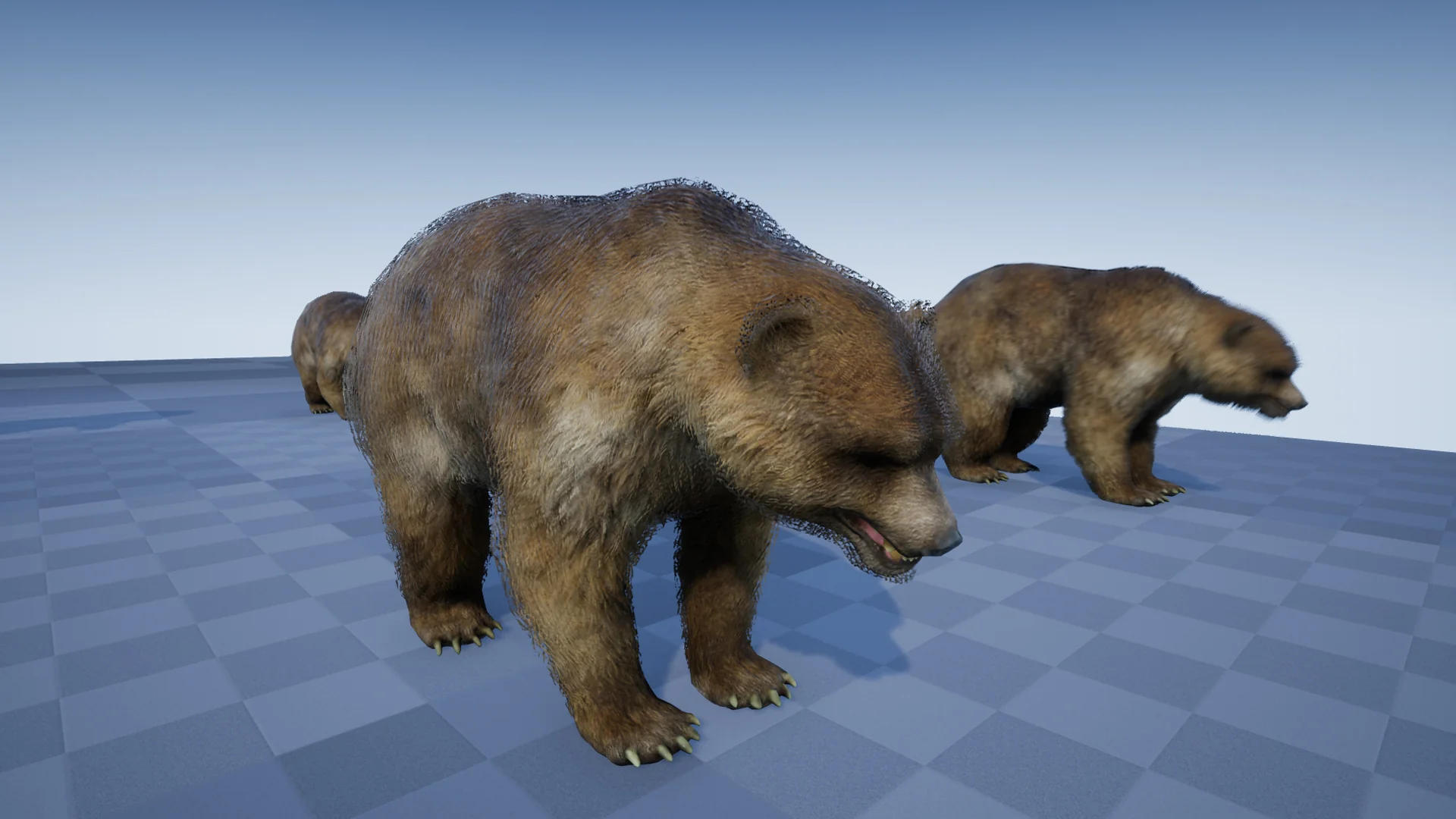
The collection organizes its creature roster to cover the primary ecological layers of temperate and northern woodlands. At the apex sits the Bear, built with the heavy mass and broad silhouette expected of a dominant woodland omnivore. Running alongside the Bear are the pack hunters and solitary opportunists: the Wolf, shaped for lean predatory movement, and the Fox, which occupies an agile intermediate scale suitable for brushland and undergrowth.
Ungulates are split into distinct sexual dimorphic models instead of one shared mesh. The Deer Stag features full antler geometry and broad shoulder proportions, while the Deer Doe offers a streamlined cervid structure with its own dedicated movement assets. Grounding the lower canopy and understory are the Boar, possessing a dense, low-slung anatomical frame, and the Rabbit, which provides an essential small-prey presence to give brush and meadow spaces natural visual activity.
Polygon Budgets and LOD Scaling Across the Forest Species
Real-time scene density hinges on aggressive, predictable polygon scaling. Each animal in the collection ships with three explicit level-of-detail steps, letting runtime renderers cull triangle density smoothly as camera distances increase.
The Deer Stag carries the highest peak complexity in the collection due to its antler architecture and muscular stature. It begins at 11.18 thousand triangles at base LOD, steps down to 8.83 thousand triangles at intermediate distance, and settles at 6.48 thousand triangles for long-range passes. The companion Deer Doe starts close behind at 10.54 thousand triangles, transitioning through 7.98 thousand triangles down to 5.41 thousand triangles at its outermost threshold. This dual structure gives herds uniform visual fidelity while shedding roughly half their geometric weight at distance.
The heavier predators and omnivores follow a similar stepped degradation curve. The Bear leads with 10.5 thousand triangles at maximum fidelity, decreasing to 8.9 thousand triangles, and reaching 7.3 thousand triangles at LOD2. The Wolf opens at 10 thousand triangles flat, tapering to 7.82 thousand triangles, and completing its long-range LOD at 5.68 thousand triangles. For the Boar, the initial mesh weighs in at 9.55 thousand triangles, dropping to 7.64 thousand triangles before reaching a lean 5.72 thousand triangles at the furthest distance.
Smaller fauna utilize scaled-down base budgets that keep distant draw overhead minimal. The Fox starts at 9.27 thousand triangles, stepping to 7.44 thousand triangles and 5.61 thousand triangles. The Rabbit represents the most lightweight asset in the entire group: opening at 5.65 thousand triangles, stepping down to 3.89 thousand triangles, and terminating at just 2.11 thousand triangles at LOD2. This lightweight footprint makes scattering multiple instances across open clearings practical without overwhelming the draw-call and vertex-processing budget.
Skeletal Rigging and Bone Architecture of the Animals
Deformation quality across quadrupeds depends heavily on maintaining clean bone hierarchies without inflating the computational cost of vertex skinning. The animals maintain tight, disciplined bone counts ranging between 31 and 35 bones, striking a pragmatic balance between fluid articulation and low runtime overhead.
Both the Deer Doe and Deer Stag share an identical skeleton configuration based on 31 bones. Keeping the bone count uniform between the male and female variants simplifies systemic animation retargeting and shared environmental interaction mechanics. The Boar uses the most complex skeletal hierarchy in the pack at 35 bones, accommodating its pronounced snout, thick neck mass, and short hindquarters.
The Bear, Wolf, Fox, and Rabbit converge on an identical skeletal count of 33 bones each. This shared 33-bone baseline across vastly different anatomical archetypes—from the compact skeletal proportions of the rabbit to the elongated canine structure of the wolf and fox, through to the heavy shoulder mechanics of the bear—establishes a dependable baseline for rigging pipelines. The lean bone count ensures that CPU skinning calculations and GPU matrix uploads remain lightweight, even when dozens of individual quadrupeds occupy the same active scene quadrant.
Surfacing, 4K and 2K Texturing, and Dual Material Setups
Surface definition across all seven species adheres to a uniform structure: each creature utilizes exactly two material slots. Segmenting the animal into two materials allows separate control over distinct anatomical zones—such as isolating eyes, claws, inner mouth cavities, or horn surfaces from primary pelt and skin shaders—without fragmenting the mesh into excessive draw calls.
Texture resolution is allocated strategically according to physical screen real estate. Larger and medium-sized species receive 4K texture sets to preserve hair definition, muscle creases, and skin details during close-up camera encounters:
Bear: 4K textures mapped across 2 materials
Boar: 4K textures mapped across 2 materials
Deer Doe: 4K textures mapped across 2 materials
Deer Stag: 4K textures mapped across 2 materials
Wolf: 4K textures mapped across 2 materials
For smaller woodland wildlife, texture resolution drops to 2K. Both the Fox and the Rabbit utilize 2K texture maps paired with their two-material setups. This resolution tiering reflects real-world visibility: smaller creatures rarely command the screen space of a bear or stag, making 2K texture maps optimal for preserving memory bandwidth while keeping fur texturing sharp from standard gameplay viewpoints.
Motion Control Through Animation Blueprints and Scripted Behavior
Visual fidelity requires believable locomotion to function convincingly. FOREST ANIMALS PACK provides dedicated animation clips tailored to each animal's behavioral role, backed by an Animation Blueprint and script support for immediate runtime deployment. Across the seven animals, the pack includes 97 individual animation clips.
Predatory and alert behaviors demand the widest kinetic diversity. The Wolf features the largest motion set in the pack with 17 animations, supporting varied gaits, stalking actions, and reactive posturing. The Bear, Fox, and Rabbit each feature 16 animations, giving them the expressive latitude needed for foraging, sniffing, sprinting, idle standing, and fleeing.
The Boar includes 13 animations, providing adequate coverage for aggressive charges, rooting, and transitional locomotion. The Deer Stag features 11 animations, accommodating antler posturing, alertness checks, and bounding strides. The Deer Doe utilizes 8 animations, concentrating strictly on essential herd mechanics including walking, running, idle browsing, and flight responses.
The inclusion of scripted logic and Animation Blueprints connects these animation pools directly to character controllers. Instead of assembling state machines, blend spaces, and transitions from scratch, projects can plug the included blueprints directly into patrol, flee, and agro logic. The realistic art style works hand-in-hand with these animation sets to create convincing environmental wildlife behaviors right out of the box.
Ecosystem Integration Alongside Farm Animals Pack
Projects rarely isolate forest wilderness completely from settled pastoral zones. FOREST ANIMALS PACK features direct compatibility with FARM ANIMALS PACK, enabling shared development frameworks across domestic and wild creatures. Because both asset sets are based on complementary low-poly optimization standards, modular material counts, and standardized animation blueprints, developers can mix wildlife and domestic livestock within the same world borders without stylistic or technical friction.
Whether staging a wolf stalking a rural pasture perimeter, boars encroaching on crop fields, or foxes raiding barns, the shared structural DNA between both packs ensures consistent rendering overhead, predictable skeletal performance, and a unified aesthetic across the entire environmental ecosystem.
 Characters
 Characters
 Characters
 Characters