"b00678cacce53329"{"id":"1002779","slug":"cyberpunk-megapack-environment-bundle","title":"Cyberpunk MEGApack Environment Bundle","category":"Cities","engine":"4.21+,5.0+","assetVersion":"","engineVersion":"Engine Version: 4.21+,5.0+","tag":"Cities","accent":"blue","visual":"city","summary":"Build cohesive sci-fi levels with the Cyberpunk MEGApack Environment Bundle, combining exterior cityscapes, interior rooms, and detailed facility sets.","platform":"Unreal Engine","indexPolicy":"index","publishedAt":"2026-11-20T06:58:12.620Z","updatedAt":"2026-11-20T06:58:12.620Z","sourceNotes":[],"fileContents":[],"compatibility":["Unreal Engine","Engine Version: 4.21+,5.0+"],"featuredImage":{"alt":"Cyberpunk MEGApack Environment Bundle","src":"/wp-content/uploads/published/2026/11/e92d79a11a0a-a88b14f5-af5c-49b5-9439-bcbe692d7a4d-8e85690bfe.webp"},"fileSizeBytes":3096169040,"hasDownloadLink":true,"downloads":0,"terms":[{"taxonomy":"category","slug":"cities","name":"Cities"}],"galleryImages":[{"src":"/wp-content/uploads/published/2026/11/6ff483632a40-015eca88-1c8b-4c3a-a984-5086158c411e-15319e6fc8.webp","alt":"Cyberpunk MEGApack Environment Bundle"},{"src":"/wp-content/uploads/published/2026/11/7c87f442666b-a37bf0a1-a1f9-4498-9ffe-7ccdb0805647-1e3325ee76.webp","alt":"Cyberpunk MEGApack Environment Bundle"},{"src":"/wp-content/uploads/published/2026/11/25f965da2d6e-d2981356-80d6-4626-a223-684eedd17213-bde01bcce4.webp","alt":"Cyberpunk MEGApack Environment Bundle"},{"src":"/wp-content/uploads/published/2026/11/034a9ea9212b-a9db1df4-3528-4833-8989-40cf0b44da77-89c9af86bb.webp","alt":"Cyberpunk MEGApack Environment Bundle"},{"src":"/wp-content/uploads/published/2026/11/cbee62bc3a66-5bba0a0a-08c1-4e3a-a103-aad0b49a9ddd-73d0f187b0.webp","alt":"Cyberpunk MEGApack Environment Bundle"},{"src":"/wp-content/uploads/published/2026/11/3711e049e15c-9a975caf-af5f-4447-afbc-6daf34ec07e8-bfa3868f69.webp","alt":"Cyberpunk MEGApack Environment Bundle"},{"src":"/wp-content/uploads/published/2026/11/64912ee4f435-8fbdc812-036f-4f3b-86ed-87faa84bc471-238e47887d.webp","alt":"Cyberpunk MEGApack Environment Bundle"},{"src":"/wp-content/uploads/published/2026/11/186e87a25e29-4ee3bb64-12a3-47b6-bfbb-d2efb4b5230a-90d9e0d789.webp","alt":"Cyberpunk MEGApack Environment Bundle"},{"src":"/wp-content/uploads/published/2026/11/2ad0895f3ee9-2ccee208-93e9-4b30-b4f2-2ee099a45009-bcfceb8183.webp","alt":"Cyberpunk MEGApack Environment Bundle"},{"src":"/wp-content/uploads/published/2026/11/6c92cb1e23f0-f181137e-560c-4313-aff2-0cebd9d491e1-1c23fe491c.webp","alt":"Cyberpunk MEGApack Environment Bundle"}],"accessPanel":{"kind":"resource","title":"Get this resource","safetyNote":"Resources are manually reviewed before listing to improve quality and reduce obvious risks.","fileName":"Content.7z","resourceType":"Resource archive","versions":[]},"contentHtml":"\u003cp\u003eDense city blocks, layered neon aesthetics, and industrial utility define the visual language of futuristic urban spaces. Constructing such worlds demands assets that match across scale, texture density, and architectural logic. The Cyberpunk MEGApack Environment Bundle approaches this challenge by collecting three distinct scene packs into a single framework: an exterior environment kitbash collection, an interior environment kitbash collection, and a dedicated public facility set. Together, they allow level designers and 3D artists to map out continuous, photorealistic levels that transition naturally from broad outdoor corridors into cramped indoor zones.\u003c/p\u003e \u003ch2\u003eAssembling Exterior Cityscapes with the Cyberpunk Environment Kitbash Elements\u003c/h2\u003e\n\u003cp\u003eOutdoor sci-fi environments depend heavily on scale, modularity, and strong architectural silhouettes. The exterior portion of the collection centers on modular architectural forms that reflect a mixture of high-tech cybernetic infrastructure, classic Japanese metropolitan influence, and weathered vintage styling. These exterior elements let builders assemble multi-tiered street layouts, public thoroughfares, and overhead infrastructure that define a functioning cityscape.\u003c/p\u003e \u003cp\u003eBecause the pieces are built as a kitbash collection, designers can arrange structural facades, access points, and walkways without locking themselves into fixed, pre-computed layouts. The collection provides the baseline geometry needed to delineate pedestrian street levels from towering upper structures. Handcrafted details throughout the architecture supply the characteristic density associated with speculative urban centers, balancing pristine technical panels against aging, worn structural supports.\u003c/p\u003e \u003cp\u003eBeyond massive walls and structural columns, the exterior environment relies on a wide array of props to ground each scene. Street-level dressing, transit points, and utility hardware break up repetitive wall panels and turn raw geometric blocks into lived-in public sectors. Designers can establish busy city hubs or quiet back-alley transitions, mixing clean lines with utilitarian clutter to reflect different districts within the same world.\u003c/p\u003e \u003ch2\u003eConstructing Layered Spaces with the Cyberpunk Interior Set\u003c/h2\u003e\n\u003cp\u003eMoving a player or camera off the street requires a seamless shift in visual treatment. The Cyberpunk Interior Environment Kitbash Set directly complements outdoor architecture by providing the hardware, structural dividers, and fixtures needed to build indoor scenes. These components handle the transition from open street views into residential spaces, commercial shops, security checkpoints, and hidden underground corridors.\u003c/p\u003e \u003cp\u003eInterior scenes demand a tighter focus on surface fidelity and prop distribution. The kitbash elements include specialized wall sections, ceiling grids, doorways, and structural frames that can be snapped together to form intricate floor plans. Designers can craft compact industrial rooms or sprawling corporate lobbies, adapting the modular panels to match the narrative tone of the scene. The inclusion of vintage and fantasy touches alongside traditional sci-fi shapes adds character, preventing spaces from feeling like sterile corridors.\u003c/p\u003e \u003cp\u003eHandcrafted indoor props populate these rooms, giving artists the materials needed to tell stories purely through environmental dressing. Workstations, control fixtures, seating, and decorative accents help establish who occupies a room and what takes place there. By using the bundled modular architecture alongside specific surface dressings, spaces can be tailored to look abandoned, heavily trafficked, or repurposed by city inhabitants.\u003c/p\u003e \u003ch2\u003eGranular Realism in the Cyberpunk Toilet Set\u003c/h2\u003e\n\u003cp\u003eSpecialized utility areas often present a distinct challenge in game production because standard architectural kits rarely include the specific hardware required for believable sanitation facilities. The Cyberpunk Toilet Set resolves this by zeroing in on public restroom infrastructure, providing focused assets that fit seamlessly into the broader aesthetic framework.\u003c/p\u003e \u003cp\u003eThis collection balances utilitarian sanitation equipment with the distinct, grungy cybernetic edge found throughout the rest of the package. It contains modular stalls, plumbing runs, sinks, waste receptacles, and related fixtures tailored for high-traffic public installations. Rather than relying on generic modern furnishings, the pieces showcase worn surfaces, heavy-duty industrial fixings, and stylized fixtures that mesh with both Japanese-inspired metropolitan architecture and grounded, photorealistic environments.\u003c/p\u003e \u003cp\u003eIntegrating a dedicated facility set into larger interior plans lets developers construct fully explorable structures without sudden drops in prop detail. A player moving from an exterior alleyway through a dimly lit back entrance into a public washroom experiences unbroken visual consistency. The surfaces convey age, heavy public usage, and moisture, reinforcing the tactile, gritty side of future urban living.\u003c/p\u003e \u003ch2\u003ePBR Surfaces and Customization Across the MEGApack Bundle\u003c/h2\u003e\n\u003cp\u003eVisual consistency across separate exterior and interior environments relies entirely on how materials respond to illumination. Every asset across all three included environments utilizes physically based rendering (PBR) materials, ensuring that metal, plastic, concrete, glass, and tile react predictably under diverse lighting setups. Whether catching harsh artificial neon, diffuse indoor panels, or dim emergency illumination, the surfaces retain their physical accuracy.\u003c/p\u003e \u003cp\u003eThe collection supplies a large number of individual textures, materials, and props that facilitate extensive visual customization. Rather than confining artists to a single color palette or wear level, these resources make it possible to tune surfaces for clean, high-end commercial districts or distressed, rain-soaked alleyways. Roughness maps, normal details, and metallic values are calibrated to meet AAA game quality standards, preserving surface nuance even under close inspection by a first-person camera.\u003c/p\u003e \u003cp\u003eThis deep library of textures and material definitions also helps prevent visual repetition across sprawling levels. By swapping material assignments or altering prop arrangements, teams can reuse core architectural shapes across multiple blocks without scenes looking identical. The high-resolution material setups ensure that fine bevels, seams, and weathering appear sharp and physically grounded from any viewing distance.\u003c/p\u003e \u003ch2\u003eBlueprint Logic, Audio, and Modular Level Design Workflows\u003c/h2\u003e\n\u003cp\u003eBuilding cohesive levels requires more than static meshes; it involves interactive structure and spatial context. The bundle incorporates blueprints to streamline how modular components are placed and organized within game levels. Using blueprint-assisted assembly cuts down on repetitive scene-building tasks, allowing rapid prototyping of street grids, complex wall runs, and populated room layouts.\u003c/p\u003e \u003cp\u003eComplementing the visual assets, audio components are integrated directly into the collection. Environmental sound is essential for selling the atmosphere of futuristic infrastructure, from the low electrical hum of heavy indoor panels to the resonant reverberation of secluded public spaces. Having sound elements ready alongside the modular geometry and interactive blueprints accelerates scene assembly, letting artists evaluate atmosphere and acoustics simultaneously.\u003c/p\u003e \u003cp\u003eThe synergy between exterior architecture, modular interiors, utility facilities, PBR materials, audio, and blueprints makes the package a comprehensive kitbash resource. Teams can move from rough level blocking to polished, detailed environments while keeping artistic direction unified across every corner of the game world.\u003c/p\u003e\n\n\u003ch2\u003eMore From The Same Workflow\u003c/h2\u003e\n\u003cul\u003e\n\u003cli\u003e\u003ca href=\"https://3dcghub.com/modern-city-downtown-megapack-modern-city-downtown-building-usa-town-street/\" rel=\"noopener noreferrer\"\u003eModern City Downtown Megapack ( Modern City Downtown Building USA Town Street )\u003c/a\u003e\u003c/li\u003e\n\u003cli\u003e\u003ca href=\"https://3dcghub.com/stylized-lowpoly-cyberpunk-city-stylized-stylised-cyber-cyberpunk-scifi-3d/\" rel=\"noopener noreferrer\"\u003eStylized Lowpoly Cyberpunk City ( Stylized Stylised Cyber Cyberpunk Scifi 3D )\u003c/a\u003e\u003c/li\u003e\n\u003cli\u003e\u003ca href=\"https://3dcghub.com/future-slums-2/\" rel=\"noopener noreferrer\"\u003eFuture Slums 2\u003c/a\u003e\u003c/li\u003e\n\u003cli\u003e\u003ca href=\"https://3dcghub.com/modular-urban-city-asset-megapack/\" rel=\"noopener noreferrer\"\u003eModular Urban City Asset Megapack\u003c/a\u003e\u003c/li\u003e\n\u003cli\u003e\u003ca href=\"https://3dcghub.com/city-environment-megapack-vol-02/\" rel=\"noopener noreferrer\"\u003eCity Environment Megapack vol 02\u003c/a\u003e\u003c/li\u003e\n\u003c/ul\u003e","contentTextLength":8018,"navigation":{"current":101,"total":4797,"previous":{"id":"1002780","slug":"dash-vfx","title":"Dash VFX","category":"Spells \u0026 Combat","platform":"Unreal Engine","updatedAt":"2026-11-20T07:02:17.168Z"},"next":{"id":"1002778","slug":"cartoony-impact-stylized-particle-simulation-1","title":"Cartoony Impact - Stylized Particle Simulation #1","category":"Variety","platform":"Unreal Engine","updatedAt":"2026-11-20T06:57:02.071Z"}},"relatedResources":[{"id":"7224","slug":"modern-city-downtown-megapack-modern-city-downtown-building-usa-town-street","title":"Modern City Downtown Megapack ( Modern City Downtown Building USA Town Street )","category":"Cities","engine":"4.26+,5.0+","assetVersion":"Engine version: 4.26+,5.0+","engineVersion":"4.19","tag":"Cities","accent":"blue","visual":"city","summary":"Create stunning, high-fidelity urban environments with this comprehensive modular megacollection. It features over 350 unique models, detailed interiors, and advanced level design tools for professional creators.","platform":"Unreal Engine","indexPolicy":"noindex","publishedAt":"2026-02-20T18:17:02.000Z","updatedAt":"2026-04-19T15:56:02.000Z","sourceNotes":[],"fileContents":[],"compatibility":["Unreal Engine","Engine version: 4.26+,5.0+"],"featuredImage":{"alt":"Modern City Downtown Megapack ( Modern City Downtown Building USA Town Street )","src":"https://3dcghub.com/wp-content/uploads/2026/02/ed834a7f-d138-4d89-837b-61a72700df67.webp"},"fileSizeBytes":2458510823,"hasDownloadLink":true,"downloads":1},{"id":"1000103","slug":"stylized-lowpoly-cyberpunk-city-stylized-stylised-cyber-cyberpunk-scifi-3d","title":"Stylized Lowpoly Cyberpunk City ( Stylized Stylised Cyber Cyberpunk Scifi 3D )","category":"Cities","engine":"Engine Version: 4.27,5.0+","assetVersion":"Engine Version: 4.27,5.0+","engineVersion":"","tag":"Cities","accent":"blue","visual":"city","summary":"A low poly cyberpunk city environment with props, vehicles, characters, and buildings, optimized for game-ready projects and compatible with ULAT.","platform":"Unreal Engine","indexPolicy":"index","publishedAt":"2026-06-07T15:58:50.126Z","updatedAt":"2026-06-07T15:58:50.126Z","sourceNotes":[],"fileContents":[],"compatibility":["Unreal Engine","Engine Version: 4.27,5.0+"],"featuredImage":{"alt":"Stylized Lowpoly Cyberpunk City ( Stylized Stylised Cyber Cyberpunk Scifi 3D )","src":"/wp-content/uploads/published/2026/06/2332b6a7469b-3ed0854a-db36-4a8a-b80c-b053ee8e1197-67c66d6338.webp"},"fileSizeBytes":67746334,"hasDownloadLink":true,"downloads":0},{"id":"7157","slug":"future-slums-2","title":"Future Slums 2","category":"Cities","engine":"4.26+,5.0+","assetVersion":"Engine version: 4.26+,5.0+","engineVersion":"4.26","tag":"Cities","accent":"blue","visual":"city","summary":"Transform your digital worlds with Future Slums 2, a collection of high-poly assets designed for cinematic excellence. Create dense, urban decay with neon-lit alleys and towering shantytowns.","platform":"Unreal Engine","indexPolicy":"noindex","publishedAt":"2026-02-20T17:54:25.000Z","updatedAt":"2026-04-19T15:56:03.000Z","sourceNotes":[],"fileContents":[],"compatibility":["Unreal Engine","Engine version: 4.26+,5.0+"],"featuredImage":{"alt":"Future Slums 2","src":"https://3dcghub.com/wp-content/uploads/2026/02/7adfe70b-a5c6-479e-b8a2-c7341570086b.webp"},"fileSizeBytes":9932248589,"hasDownloadLink":true,"downloads":0}]}
Resource screenshots
1 / 10
Join our channel
Follow 3DCGHUB on Telegram for new resource drops, migration updates, and community notices.
Dense city blocks, layered neon aesthetics, and industrial utility define the visual language of futuristic urban spaces. Constructing such worlds demands assets that match across scale, texture density, and architectural logic. The Cyberpunk MEGApack Environment Bundle approaches this challenge by collecting three distinct scene packs into a single framework: an exterior environment kitbash collection, an interior environment kitbash collection, and a dedicated public facility set. Together, they allow level designers and 3D artists to map out continuous, photorealistic levels that transition naturally from broad outdoor corridors into cramped indoor zones.
Assembling Exterior Cityscapes with the Cyberpunk Environment Kitbash Elements
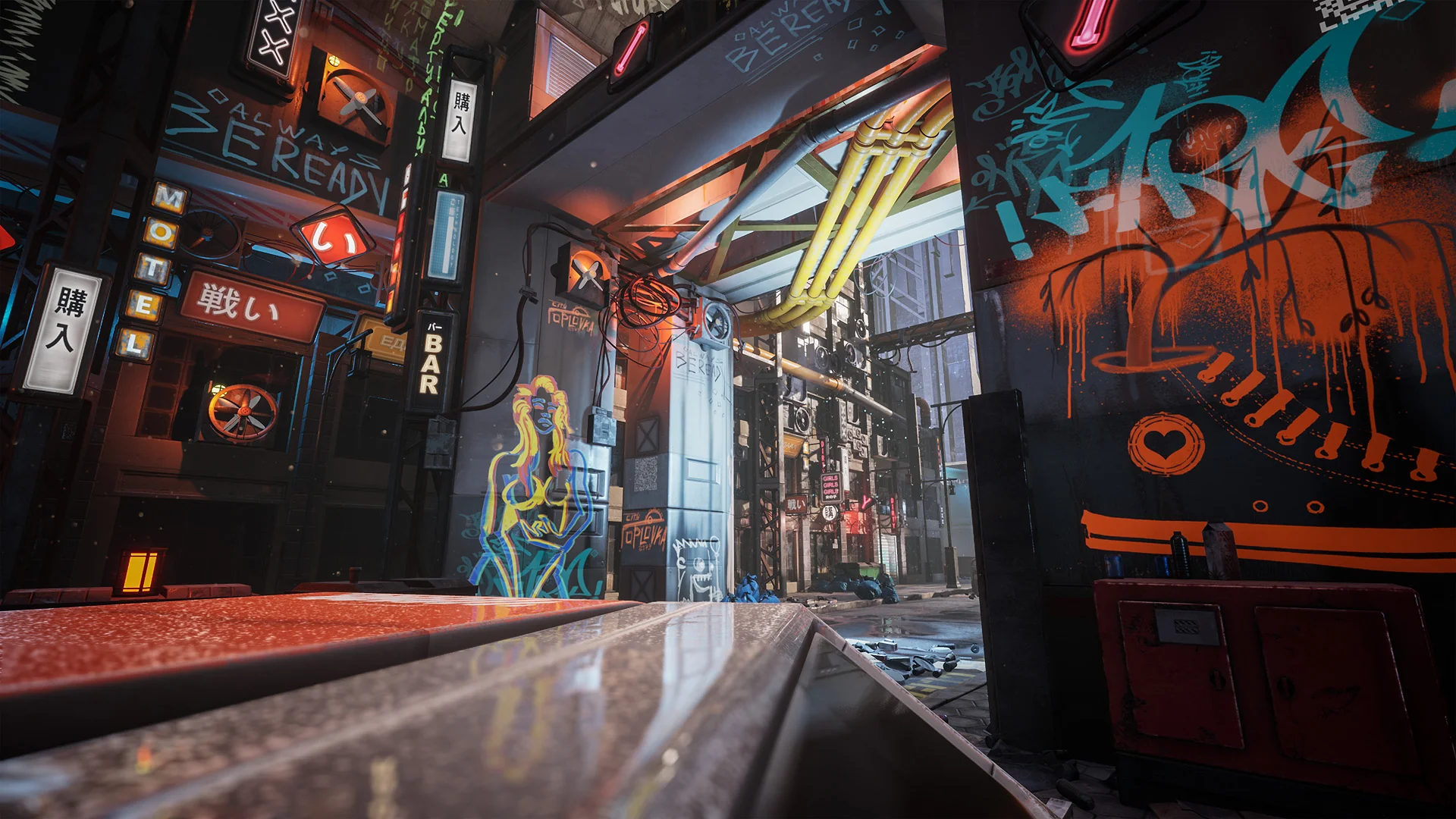
Outdoor sci-fi environments depend heavily on scale, modularity, and strong architectural silhouettes. The exterior portion of the collection centers on modular architectural forms that reflect a mixture of high-tech cybernetic infrastructure, classic Japanese metropolitan influence, and weathered vintage styling. These exterior elements let builders assemble multi-tiered street layouts, public thoroughfares, and overhead infrastructure that define a functioning cityscape.
Because the pieces are built as a kitbash collection, designers can arrange structural facades, access points, and walkways without locking themselves into fixed, pre-computed layouts. The collection provides the baseline geometry needed to delineate pedestrian street levels from towering upper structures. Handcrafted details throughout the architecture supply the characteristic density associated with speculative urban centers, balancing pristine technical panels against aging, worn structural supports.
Beyond massive walls and structural columns, the exterior environment relies on a wide array of props to ground each scene. Street-level dressing, transit points, and utility hardware break up repetitive wall panels and turn raw geometric blocks into lived-in public sectors. Designers can establish busy city hubs or quiet back-alley transitions, mixing clean lines with utilitarian clutter to reflect different districts within the same world.
Constructing Layered Spaces with the Cyberpunk Interior Set
Moving a player or camera off the street requires a seamless shift in visual treatment. The Cyberpunk Interior Environment Kitbash Set directly complements outdoor architecture by providing the hardware, structural dividers, and fixtures needed to build indoor scenes. These components handle the transition from open street views into residential spaces, commercial shops, security checkpoints, and hidden underground corridors.
Interior scenes demand a tighter focus on surface fidelity and prop distribution. The kitbash elements include specialized wall sections, ceiling grids, doorways, and structural frames that can be snapped together to form intricate floor plans. Designers can craft compact industrial rooms or sprawling corporate lobbies, adapting the modular panels to match the narrative tone of the scene. The inclusion of vintage and fantasy touches alongside traditional sci-fi shapes adds character, preventing spaces from feeling like sterile corridors.
Handcrafted indoor props populate these rooms, giving artists the materials needed to tell stories purely through environmental dressing. Workstations, control fixtures, seating, and decorative accents help establish who occupies a room and what takes place there. By using the bundled modular architecture alongside specific surface dressings, spaces can be tailored to look abandoned, heavily trafficked, or repurposed by city inhabitants.
Granular Realism in the Cyberpunk Toilet Set
Specialized utility areas often present a distinct challenge in game production because standard architectural kits rarely include the specific hardware required for believable sanitation facilities. The Cyberpunk Toilet Set resolves this by zeroing in on public restroom infrastructure, providing focused assets that fit seamlessly into the broader aesthetic framework.
This collection balances utilitarian sanitation equipment with the distinct, grungy cybernetic edge found throughout the rest of the package. It contains modular stalls, plumbing runs, sinks, waste receptacles, and related fixtures tailored for high-traffic public installations. Rather than relying on generic modern furnishings, the pieces showcase worn surfaces, heavy-duty industrial fixings, and stylized fixtures that mesh with both Japanese-inspired metropolitan architecture and grounded, photorealistic environments.
Integrating a dedicated facility set into larger interior plans lets developers construct fully explorable structures without sudden drops in prop detail. A player moving from an exterior alleyway through a dimly lit back entrance into a public washroom experiences unbroken visual consistency. The surfaces convey age, heavy public usage, and moisture, reinforcing the tactile, gritty side of future urban living.
PBR Surfaces and Customization Across the MEGApack Bundle
Visual consistency across separate exterior and interior environments relies entirely on how materials respond to illumination. Every asset across all three included environments utilizes physically based rendering (PBR) materials, ensuring that metal, plastic, concrete, glass, and tile react predictably under diverse lighting setups. Whether catching harsh artificial neon, diffuse indoor panels, or dim emergency illumination, the surfaces retain their physical accuracy.
The collection supplies a large number of individual textures, materials, and props that facilitate extensive visual customization. Rather than confining artists to a single color palette or wear level, these resources make it possible to tune surfaces for clean, high-end commercial districts or distressed, rain-soaked alleyways. Roughness maps, normal details, and metallic values are calibrated to meet AAA game quality standards, preserving surface nuance even under close inspection by a first-person camera.
This deep library of textures and material definitions also helps prevent visual repetition across sprawling levels. By swapping material assignments or altering prop arrangements, teams can reuse core architectural shapes across multiple blocks without scenes looking identical. The high-resolution material setups ensure that fine bevels, seams, and weathering appear sharp and physically grounded from any viewing distance.
Blueprint Logic, Audio, and Modular Level Design Workflows
Building cohesive levels requires more than static meshes; it involves interactive structure and spatial context. The bundle incorporates blueprints to streamline how modular components are placed and organized within game levels. Using blueprint-assisted assembly cuts down on repetitive scene-building tasks, allowing rapid prototyping of street grids, complex wall runs, and populated room layouts.
Complementing the visual assets, audio components are integrated directly into the collection. Environmental sound is essential for selling the atmosphere of futuristic infrastructure, from the low electrical hum of heavy indoor panels to the resonant reverberation of secluded public spaces. Having sound elements ready alongside the modular geometry and interactive blueprints accelerates scene assembly, letting artists evaluate atmosphere and acoustics simultaneously.
The synergy between exterior architecture, modular interiors, utility facilities, PBR materials, audio, and blueprints makes the package a comprehensive kitbash resource. Teams can move from rough level blocking to polished, detailed environments while keeping artistic direction unified across every corner of the game world.
 Cities
 Cities
 Cities