"4a94497540a6fc24"{"id":"1002698","slug":"countryside-windmills-and-barns","title":"Countryside: Windmills \u0026 Barns","category":"Rural","engine":"5.0+","assetVersion":"","engineVersion":"Engine Version: 5.0+","tag":"Rural","accent":"blue","visual":"mech","summary":"Explore Countryside: Windmills \u0026 Barns, featuring modular rural architecture, interchangeable materials, prefabs, and day-night demo levels.","platform":"Unreal Engine","indexPolicy":"index","publishedAt":"2026-11-17T18:25:44.046Z","updatedAt":"2026-11-17T18:25:44.046Z","sourceNotes":[],"fileContents":[],"compatibility":["Unreal Engine","Engine Version: 5.0+"],"featuredImage":{"alt":"Countryside: Windmills \u0026 Barns","src":"/wp-content/uploads/published/2026/11/d9d6c0847466-92c0ada3-84ed-4bea-a4cb-5f094c4c5fb0-68344b2cb8.webp"},"hasDownloadLink":true,"downloads":0,"terms":[{"taxonomy":"category","slug":"rural","name":"Rural"}],"galleryImages":[{"src":"/wp-content/uploads/published/2026/11/585b5d67d99b-f02c1d91-bb06-408d-861c-cfe925ca6b0a-ca89307031.webp","alt":"Countryside: Windmills \u0026 Barns"},{"src":"/wp-content/uploads/published/2026/11/3c73f5ecc353-1b52c663-2771-4895-9e04-0f9dddc0b6a1-323f25816a.webp","alt":"Countryside: Windmills \u0026 Barns"},{"src":"/wp-content/uploads/published/2026/11/fb690e4d0e1b-179f4f9f-09bc-452c-a986-896a12d9b11d-f284442c53.webp","alt":"Countryside: Windmills \u0026 Barns"},{"src":"/wp-content/uploads/published/2026/11/f084866d81a4-b130064d-6581-47b8-9292-41f9166b672d-9f0427ca7f.webp","alt":"Countryside: Windmills \u0026 Barns"},{"src":"/wp-content/uploads/published/2026/11/4cdb95e1cd42-07c9951a-3e62-4279-a7fb-48f67dbe1b57-a3d25a790d.webp","alt":"Countryside: Windmills \u0026 Barns"},{"src":"/wp-content/uploads/published/2026/11/d1d9f137b8bd-94e9924d-ca15-4954-869b-95621c9c9d4c-cd2a5bc601.webp","alt":"Countryside: Windmills \u0026 Barns"},{"src":"/wp-content/uploads/published/2026/11/1338c74e0008-b705dac1-3428-4ffa-973d-02ac206befde-1e156f06ad.webp","alt":"Countryside: Windmills \u0026 Barns"},{"src":"/wp-content/uploads/published/2026/11/ad98011d1c45-ce993fa9-bf96-4fa8-87dd-f973aa5bfd7f-539ef59a84.webp","alt":"Countryside: Windmills \u0026 Barns"},{"src":"/wp-content/uploads/published/2026/11/9ca744e9789d-a930542b-9d5c-4059-b1bd-07bac16301f5-cc3cf35e25.webp","alt":"Countryside: Windmills \u0026 Barns"},{"src":"/wp-content/uploads/published/2026/11/135d545dbf74-dcf1eb44-0ede-4468-86cb-b780dc2259bc-10c4f4f275.webp","alt":"Countryside: Windmills \u0026 Barns"}],"accessPanel":{"kind":"resource","title":"Get this resource","safetyNote":"Resources are manually reviewed before listing to improve quality and reduce obvious risks.","fileName":"Content.7z","resourceType":"Resource archive","versions":[]},"contentHtml":"\u003ch2\u003eStructural Freedom with Modular Barns and Prefabs\u003c/h2\u003e\n\u003cp\u003eRural architecture in digital scenes demands both structural variety and rapid placement. The primary structure in this package is an extremely modular barn built to accommodate multiple stages of scene construction. Instead of locking level designers into a single static silhouette, the environment provides both ready-to-use prefabs and loose, individual structural parts. Creators can immediately drop fully configured prefabs into an open meadow to establish a working farmyard quickly, or construct unique outbuildings from scratch using the constituent elements.\u003c/p\u003e\n\u003cp\u003eThe library of discrete elements includes boards, pillars, doorframes, and related framing pieces. Having access to raw boards allows for natural irregularity along walls, gables, and floorings. An artist constructing an aged medieval storehouse can tilt, offset, or space individual boards to reflect weathered timber. Pillars establish the core framing and load-bearing logic of interior and exterior agricultural layouts, defining open-air shelters, stalls, or multi-tier haylofts. Because doorframes are separated from the main wall geometry, designers can dictate entry points freely, building pass-through barns, side stables, or sealed granaries without modifying base meshes in external DCC software.\u003c/p\u003e\n\u003cp\u003eThis division between atomic assets and assembled prefabs solves a frequent production bottleneck. When dressing a sprawling village or extensive countryside, placing unique buildings manually from individual planks would consume excessive time. Placing identical prefabricated buildings across multiple acres, conversely, leads to noticeable repetition. By mixing pre-assembled prefabs for distant background farms and custom board-and-pillar configurations for hero gameplay spaces, scene creators maintain visual diversity while keeping layout workflows efficient.\u003c/p\u003e \u003ch2\u003eWindmills and Rural Focal Points Across the Level\u003c/h2\u003e\n\u003cp\u003eStanding alongside the farming outbuildings is a dedicated windmill structure, built for direct reuse across varied landscapes. In open-world countryside, village greens, and pastoral farm environments, vertical landmarks prevent terrain from feeling flat and guide player navigation across wide natural clearings. The windmill serves as an architectural anchor that balances the low, elongated footprint of the modular barns.\u003c/p\u003e\n\u003cp\u003eBecause the package supports realistic, medieval, and fantasy aesthetics, the windmill functions in multiple thematic contexts. Positioned on a grassy hillside, it suggests an active agricultural settlement relying on wind power for daily grain milling. When paired with weathered board configurations and placed on the outskirts of a dense forest or quiet valley, it integrates naturally into fantasy hamlets or rustic historical villages. The reusable nature of the asset ensures it can appear as a solitary hilltop outpost, a central communal facility inside a farming village, or one of several functional stations scattered across a wider farming district.\u003c/p\u003e\n\u003cp\u003eThe asset structure incorporates Blueprint functionality to aid integration and scene arrangement. Managing complex composite assemblies—such as rotating sails, central drive mechanisms, or modular annexes attached to the tower base—benefits directly from Blueprint packaging. Level designers can drop the structure into uneven natural terrain, align its structural supports to the ground mesh, and keep the building logic intact without handling disconnected components manually during landscape sculpting.\u003c/p\u003e \u003ch2\u003eMaterial Swaps and Surface Variation Across Countryside Assets\u003c/h2\u003e\n\u003cp\u003eOne of the primary challenges in building believable wooden settlements is surface repetition. When multiple farm buildings, fences, or towers sit within the same camera frame, sharing a single texture treatment makes the environment appear artificial. To counter this, most of the models across the collection include a couple of interchangeable materials.\u003c/p\u003e\n\u003cp\u003eThese interchangeable materials allow developers to alter the visual age, wear, and tone of wooden structures across a single scene. A newly erected barn can display clean, preserved timber, while a neighboring tool shed or animal stall uses a darkened, weathered, or moisture-stained material variant. Swapping materials across boards, pillars, and doorframes introduces localized contrast within a single structure, ensuring that large exterior facades avoid uniform patterning.\u003c/p\u003e\n\u003cp\u003eInterchangeable materials also expand the aesthetic range across different game genres. A realistic modern rural setting might prioritize standard weathered wood and tidy agricultural surfaces. A fantasy or medieval project, on the other hand, can deploy alternate material assignments to ground the architecture in damp, untamed wilderness or ancient rural settlements. Because the material variations are already configured for the models, adjusting the mood of a farmstead requires no custom shader authoring or texture remaking.\u003c/p\u003e \u003ch2\u003eLighting Profiles Across Daytime and Nighttime Environments\u003c/h2\u003e\n\u003cp\u003eTo demonstrate the spatial and artistic qualities of the assets, the package includes complete demo levels configured for both daytime and nighttime conditions. These ready-built levels show how the modular elements, blueprints, and materials assemble into a coherent, peaceful rural environment surrounded by nature.\u003c/p\u003e\n\u003cp\u003eIn the daytime demo level, sunlight emphasizes the physical depth created by individual boards, exposed pillars, and overhanging barn roofs. Hard directional shadows cast across structural frames expose gaps between wood slats, highlighting the dimensional quality of the individual pieces. The daylight presentation validates how the modular prefabs integrate with open grassy terrain, paths, and farm surroundings under clean illumination.\u003c/p\u003e\n\u003cp\u003eThe nighttime demo level reveals a contrasting atmospheric profile. Under low-light conditions, the silhouettes of the windmill and barn rooflines dominate the scene against the sky. The peaceful mood central to the environment's design shifts toward quiet, secluded countryside realism. Interior framing elements, doorframes, and wooden pillars react to localized, artificial light sources or moonlight, showing how the interchangeable materials maintain their tactile surface properties without washing out or losing definition in dark environments. Having both configurations pre-built gives artists a clear technical reference for balancing light bounce, shadow depth, and surface readability throughout complete day-night cycles.\u003c/p\u003e\n\n\u003ch2\u003eRelated Resources Worth Checking\u003c/h2\u003e\n\u003cul\u003e\n\u003cli\u003e\u003ca href=\"https://3dcghub.com/american-drive-modular-winter-house-with-interior/\" rel=\"noopener noreferrer\"\u003eAmerican Drive | Modular Winter House with Interior\u003c/a\u003e\u003c/li\u003e\n\u003cli\u003e\u003ca href=\"https://3dcghub.com/barn-swallow/\" rel=\"noopener noreferrer\"\u003eBarn Swallow\u003c/a\u003e\u003c/li\u003e\n\u003cli\u003e\u003ca href=\"https://3dcghub.com/medieval-windmill-with-interiors-medieval-rural-windmill-medieval-landscape/\" rel=\"noopener noreferrer\"\u003eMedieval Windmill with interiors ( Medieval Rural Windmill, Medieval Landscape )\u003c/a\u003e\u003c/li\u003e\n\u003cli\u003e\u003ca href=\"https://3dcghub.com/barnyard-megapack-barn-barn-props-farm-environment/\" rel=\"noopener noreferrer\"\u003eBarnyard Megapack (Barn, Barn Props, Farm Environment)\u003c/a\u003e\u003c/li\u003e\n\u003cli\u003e\u003ca href=\"https://3dcghub.com/pure-nature-meadows/\" rel=\"noopener noreferrer\"\u003ePure Nature : Meadows\u003c/a\u003e\u003c/li\u003e\n\u003c/ul\u003e","contentTextLength":6789,"navigation":{"current":22,"total":4642,"previous":{"id":"1002699","slug":"day-by-the-beach","title":"Day by the Beach","category":"Island","platform":"Unreal Engine","updatedAt":"2026-11-17T18:26:39.493Z"},"next":{"id":"1002697","slug":"clouds-and-skies","title":"Clouds \u0026 Skies","category":"Sky \u0026 Space","platform":"Unreal Engine","updatedAt":"2026-11-17T18:23:39.346Z"}},"relatedResources":[{"id":"1002718","slug":"nordic-fishing-hut-coastal-lakeside-cabin-interior-exterior","title":"Nordic Fishing Hut - Coastal Lakeside Cabin [Interior + Exterior]","category":"Rural","engine":"5.2+","assetVersion":"","engineVersion":"Engine Version: 5.2+","tag":"Rural","accent":"blue","visual":"mech","summary":"Explore the technical setup, Nanite integration, blueprints, and material workflows of the Nordic Fishing Hut coastal lakeside environment for Unreal Engine.","platform":"Unreal Engine","indexPolicy":"index","publishedAt":"2026-11-17T18:51:34.222Z","updatedAt":"2026-11-17T18:51:34.222Z","sourceNotes":[],"fileContents":[],"compatibility":["Unreal Engine","Engine Version: 5.2+"],"featuredImage":{"alt":"Nordic Fishing Hut - Coastal Lakeside Cabin [Interior + Exterior]","src":"/wp-content/uploads/published/2026/11/a16e5dcc0fed-80d23879-53dd-468b-b86f-a77ad5b8a276-abe74ae9ee.webp"},"hasDownloadLink":true,"downloads":0},{"id":"1000420","slug":"american-drive-modular-winter-house-with-interior","title":"American Drive | Modular Winter House with Interior","category":"Rural","engine":"5.5+","assetVersion":"","engineVersion":"Engine Version: 5.5+","tag":"Rural","accent":"blue","visual":"mech","summary":"Discover the American Drive modular kit, featuring seamless snapping architecture, fully furnished interiors, and snowy winter PBR materials.","platform":"Unreal Engine","indexPolicy":"index","publishedAt":"2026-07-09T17:46:14.043Z","updatedAt":"2026-07-09T17:46:14.043Z","sourceNotes":[],"fileContents":[],"compatibility":["Unreal Engine","Engine Version: 5.5+"],"featuredImage":{"alt":"American Drive | Modular Winter House with Interior","src":"/wp-content/uploads/published/2026/07/e75566b06008-b2f29b5c-7eab-444a-adee-42b3355479b9-e55459e3f5.webp"},"fileSizeBytes":8814421359,"hasDownloadLink":true,"downloads":1},{"id":"1002422","slug":"barn-swallow","title":"Barn Swallow","category":"Birds","engine":"5.1+","assetVersion":"","engineVersion":"Engine Version: 5.1+","tag":"Birds","accent":"blue","visual":"mech","summary":"Explore the Barn Swallow low poly animated 3D model for Unreal Engine, featuring 17 animations, 4K textures, quad geometry, and sample level assets.","platform":"Unreal Engine","indexPolicy":"index","publishedAt":"2026-11-10T18:15:16.962Z","updatedAt":"2026-11-10T18:15:16.962Z","sourceNotes":[],"fileContents":[],"compatibility":["Unreal Engine","Engine Version: 5.1+"],"featuredImage":{"alt":"Barn Swallow","src":"/wp-content/uploads/published/2026/11/1c57b560516c-225a469c-c35d-4407-88a0-e1bd3360b5d1-1d9bf79f8e.webp"},"fileSizeBytes":64894348,"hasDownloadLink":true,"downloads":0}]}
Resource screenshots
1 / 10
Join our channel
Follow 3DCGHUB on Telegram for new resource drops, migration updates, and community notices.
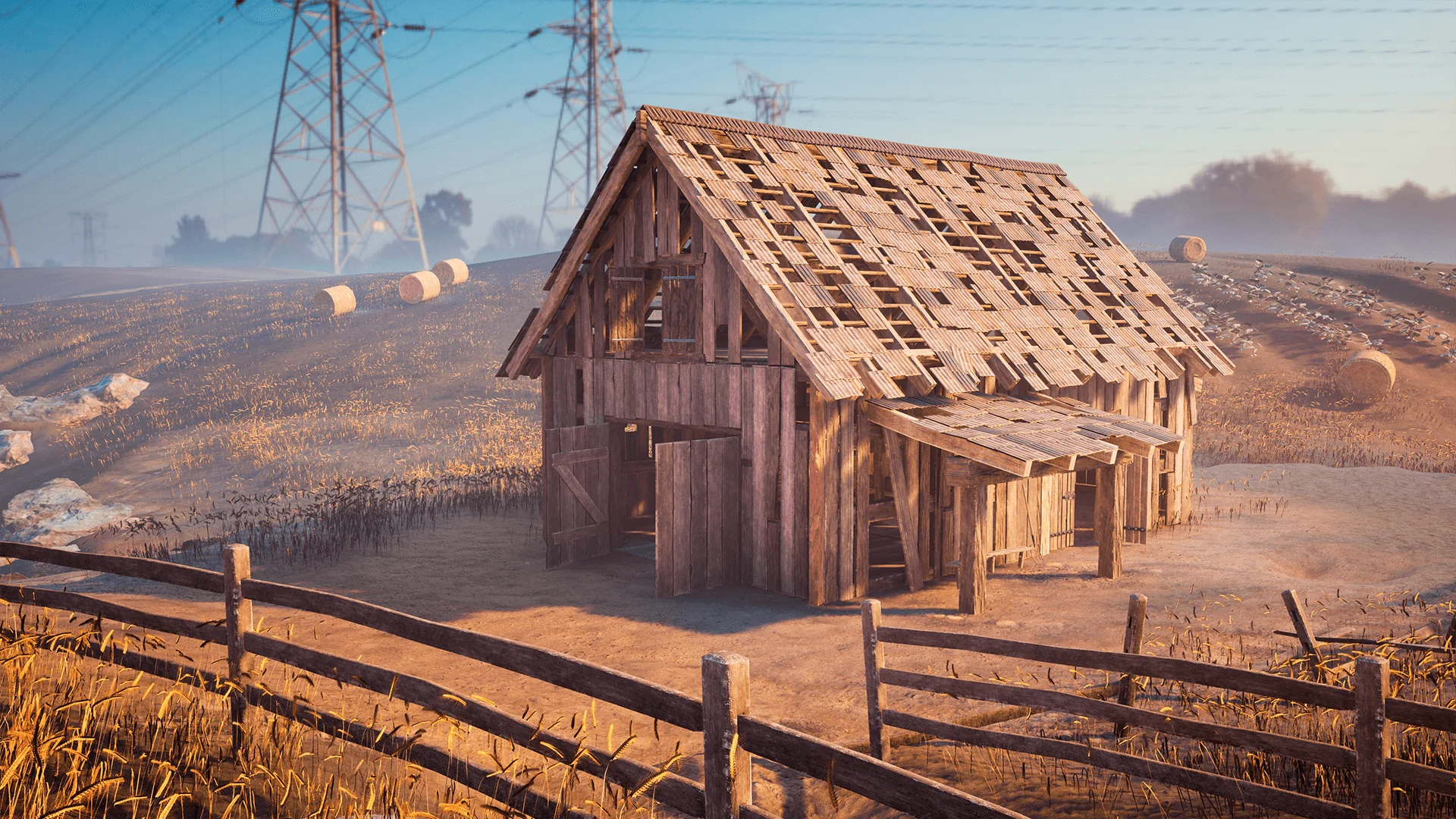
Rural architecture in digital scenes demands both structural variety and rapid placement. The primary structure in this package is an extremely modular barn built to accommodate multiple stages of scene construction. Instead of locking level designers into a single static silhouette, the environment provides both ready-to-use prefabs and loose, individual structural parts. Creators can immediately drop fully configured prefabs into an open meadow to establish a working farmyard quickly, or construct unique outbuildings from scratch using the constituent elements.
The library of discrete elements includes boards, pillars, doorframes, and related framing pieces. Having access to raw boards allows for natural irregularity along walls, gables, and floorings. An artist constructing an aged medieval storehouse can tilt, offset, or space individual boards to reflect weathered timber. Pillars establish the core framing and load-bearing logic of interior and exterior agricultural layouts, defining open-air shelters, stalls, or multi-tier haylofts. Because doorframes are separated from the main wall geometry, designers can dictate entry points freely, building pass-through barns, side stables, or sealed granaries without modifying base meshes in external DCC software.
This division between atomic assets and assembled prefabs solves a frequent production bottleneck. When dressing a sprawling village or extensive countryside, placing unique buildings manually from individual planks would consume excessive time. Placing identical prefabricated buildings across multiple acres, conversely, leads to noticeable repetition. By mixing pre-assembled prefabs for distant background farms and custom board-and-pillar configurations for hero gameplay spaces, scene creators maintain visual diversity while keeping layout workflows efficient.
Windmills and Rural Focal Points Across the Level
Standing alongside the farming outbuildings is a dedicated windmill structure, built for direct reuse across varied landscapes. In open-world countryside, village greens, and pastoral farm environments, vertical landmarks prevent terrain from feeling flat and guide player navigation across wide natural clearings. The windmill serves as an architectural anchor that balances the low, elongated footprint of the modular barns.
Because the package supports realistic, medieval, and fantasy aesthetics, the windmill functions in multiple thematic contexts. Positioned on a grassy hillside, it suggests an active agricultural settlement relying on wind power for daily grain milling. When paired with weathered board configurations and placed on the outskirts of a dense forest or quiet valley, it integrates naturally into fantasy hamlets or rustic historical villages. The reusable nature of the asset ensures it can appear as a solitary hilltop outpost, a central communal facility inside a farming village, or one of several functional stations scattered across a wider farming district.
The asset structure incorporates Blueprint functionality to aid integration and scene arrangement. Managing complex composite assemblies—such as rotating sails, central drive mechanisms, or modular annexes attached to the tower base—benefits directly from Blueprint packaging. Level designers can drop the structure into uneven natural terrain, align its structural supports to the ground mesh, and keep the building logic intact without handling disconnected components manually during landscape sculpting.
Material Swaps and Surface Variation Across Countryside Assets
One of the primary challenges in building believable wooden settlements is surface repetition. When multiple farm buildings, fences, or towers sit within the same camera frame, sharing a single texture treatment makes the environment appear artificial. To counter this, most of the models across the collection include a couple of interchangeable materials.
These interchangeable materials allow developers to alter the visual age, wear, and tone of wooden structures across a single scene. A newly erected barn can display clean, preserved timber, while a neighboring tool shed or animal stall uses a darkened, weathered, or moisture-stained material variant. Swapping materials across boards, pillars, and doorframes introduces localized contrast within a single structure, ensuring that large exterior facades avoid uniform patterning.
Interchangeable materials also expand the aesthetic range across different game genres. A realistic modern rural setting might prioritize standard weathered wood and tidy agricultural surfaces. A fantasy or medieval project, on the other hand, can deploy alternate material assignments to ground the architecture in damp, untamed wilderness or ancient rural settlements. Because the material variations are already configured for the models, adjusting the mood of a farmstead requires no custom shader authoring or texture remaking.
Lighting Profiles Across Daytime and Nighttime Environments
To demonstrate the spatial and artistic qualities of the assets, the package includes complete demo levels configured for both daytime and nighttime conditions. These ready-built levels show how the modular elements, blueprints, and materials assemble into a coherent, peaceful rural environment surrounded by nature.
In the daytime demo level, sunlight emphasizes the physical depth created by individual boards, exposed pillars, and overhanging barn roofs. Hard directional shadows cast across structural frames expose gaps between wood slats, highlighting the dimensional quality of the individual pieces. The daylight presentation validates how the modular prefabs integrate with open grassy terrain, paths, and farm surroundings under clean illumination.
The nighttime demo level reveals a contrasting atmospheric profile. Under low-light conditions, the silhouettes of the windmill and barn rooflines dominate the scene against the sky. The peaceful mood central to the environment's design shifts toward quiet, secluded countryside realism. Interior framing elements, doorframes, and wooden pillars react to localized, artificial light sources or moonlight, showing how the interchangeable materials maintain their tactile surface properties without washing out or losing definition in dark environments. Having both configurations pre-built gives artists a clear technical reference for balancing light bounce, shadow depth, and surface readability throughout complete day-night cycles.
 Rural
 Rural
 Birds