"95ccd6d7c96110f6"{"id":"1002450","slug":"complete-animals-pack","title":"Complete Animals Pack","category":"Animals","engine":"4.18+,5.0+","assetVersion":"","engineVersion":"Engine Version: 4.18+,5.0+","tag":"Animals","accent":"blue","visual":"mech","summary":"Explore the Complete Animals Pack featuring 103 animated creatures, Groom hair assets, morph targets, root-motion locomotion, and IK-equipped Blueprints.","platform":"Unreal Engine","indexPolicy":"index","publishedAt":"2026-11-11T02:21:00.355Z","updatedAt":"2026-11-11T02:21:00.355Z","sourceNotes":[],"fileContents":[],"compatibility":["Unreal Engine","Engine Version: 4.18+,5.0+"],"featuredImage":{"alt":"Complete Animals Pack","src":"/wp-content/uploads/published/2026/11/4252a72c6ee5-23368acf-b26c-4523-b939-0e40d6a3cc49-21636f2e35.webp"},"hasDownloadLink":true,"downloads":0,"terms":[{"taxonomy":"category","slug":"animals","name":"Animals"}],"galleryImages":[{"src":"/wp-content/uploads/published/2026/11/f1c17399c4b0-92b47ba5-0d9c-4ae3-9dd6-2e1b41bfe046-781c25cba1.webp","alt":"Complete Animals Pack"},{"src":"/wp-content/uploads/published/2026/11/f0d45644da03-0ddcdca5-78f7-4a7a-ae9f-0351ed69b492-3c7b19a7a0.webp","alt":"Complete Animals Pack"},{"src":"/wp-content/uploads/published/2026/11/fede7cd1ea06-80559a7c-54a6-45c2-ad42-425c6b1f66aa-9ce3d9a9f0.webp","alt":"Complete Animals Pack"},{"src":"/wp-content/uploads/published/2026/11/400f9e0a52d8-6ad33924-230c-4521-94cf-cd17d86bf398-3ff00414ac.webp","alt":"Complete Animals Pack"},{"src":"/wp-content/uploads/published/2026/11/5f3a42230783-b292716b-0597-48fc-a478-880c048c96e0-ea52ece40d.webp","alt":"Complete Animals Pack"},{"src":"/wp-content/uploads/published/2026/11/fb4d7089c4ff-883bc5c4-747a-40fd-8d1a-bf1cdaf49c77-f71b8c152d.webp","alt":"Complete Animals Pack"},{"src":"/wp-content/uploads/published/2026/11/07c981aef33e-0df16d89-b314-46fe-b14b-988ab3d97510-0c5633224c.webp","alt":"Complete Animals Pack"},{"src":"/wp-content/uploads/published/2026/11/d5f3f78b2526-465ca7d2-8bc6-4f28-8aa1-b266f6604e2e-00cf82ebc2.webp","alt":"Complete Animals Pack"},{"src":"/wp-content/uploads/published/2026/11/6cfc80404bc9-86db9f4a-c2bf-4f3a-9ce6-882a63a2aa07-98e0bdc55d.webp","alt":"Complete Animals Pack"}],"accessPanel":{"kind":"resource","title":"Get this resource","eyebrow":"Free resource","message":"Download this resource in your browser.","fileName":"Content.7z","safetyNote":"Resources are manually reviewed before listing to improve quality and reduce obvious risks.","actionLabel":"Get this resource","resourceType":"Resource archive","versions":[]},"contentHtml":"\u003ch2\u003eSpecies Roster and Faunal Scope in the Complete Animals Collection\u003c/h2\u003e\u003cp\u003ePopulating digital ecosystems demands a broad and diverse cast of fauna, spanning land, sky, and water. This library brings together 103 distinct animals across five biological classifications, uniting contemporary wildlife with prehistoric creatures. The collection encompasses 32 mammals, 28 reptiles and amphibians, 21 birds, 14 fish, and 8 invertebrates, offering a self-contained biological ecosystem ready for integration into interactive scenes.\u003c/p\u003e\u003cp\u003eThe mammalian selection includes an expansive variety of quadrupeds and marine species. Terrestrial mammals range from household and farm animals such as the dog, cat, cattle, horse, pig, goat, and rabbit, to wild savannah and forest creatures like the lion, elephant, giraffe, zebra, impala, wildebeest, black rhinoceros, and hippopotamus. Specialized creatures such as the anteater, armadillo, beaver, capybara, deer, fruit bat, jerboa, squirrel, tapir, wolf, and bear fill out woodland and arid biomes. Marine mammals like the dolphin, orca, and earless seal provide options for aquatic environments, alongside rodents like the mouse.\u003c/p\u003e\u003cp\u003eAvian species cover flight dynamics and ground-dwelling behavior across 21 entries. Birds of prey like the bald eagle, harpy eagle, and vulture appear alongside common avians such as the robin, raven, seagull, canary, cardinal, budgerigar, and white-eye. Ground and wading species include the ostrich, cassowary, red-crowned crane, shoebill, swan, and secretarybird, joined by flightless cold-climate penguins and domestic chickens. Specialized species like the toucan and the prehistoric archaeopteryx expand avian projects into exotic or ancient contexts.\u003c/p\u003e\u003cp\u003eCold-blooded creatures make up a substantial share of the roster. Amphibians and modern reptiles encompass the poison dart frog, crocodile, gecko, leaf-tailed gecko, iguana, Komodo dragon, snake, and five distinct turtles and tortoises. Alongside living reptiles, the library includes prehistoric dinosaurs and marine reptiles such as Tyrannosaurus, Velociraptor, Allosaurus, Spinosaurus, Brachiosaurus, Diplodocus, Stegosaurus, Triceratops, Ankylosaurus, Gallimimus, Pachycephalosaurus, Parasaurolophus, Mosasaurus, Elasmosaurus, Pteranodon, and Rhamphorhynchus.\u003c/p\u003e\u003cp\u003eAquatic environments gain life through 14 varieties of fish, featuring ocean predators such as the great white shark, game fish like salmon, black rockfish, horse mackerel, mahi-mahi, and tuna, alongside freshwater and ornamental varieties including goldfish, koi, angelfish, arowana, ayu, betta, and pirarucu, as well as the prehistoric placoderm Dunkleosteus. The eight invertebrate specimens—snow crab, tarantula, ant, bee, gold beetle, scorpion, ammonite, and Anomalocaris—provide micro-fauna and ancient sea creatures for detailed macro shots or paleozoic settings.\u003c/p\u003e\u003ch2\u003eSkeletal Mesh Setup, Vertex Densities, and Texture Configurations\u003c/h2\u003e\u003cp\u003eEvery specimen inside the library is supplied as a rigged skeletal mesh. Vertex densities vary based on anatomical complexity, ranging from 1,000 vertices for simpler specimens up to 30,000 vertices for large, anatomically intricate quadrupeds and dinosaurs. This performance tiering allows the assets to run within dense group scenes or stand on their own as hero characters. Texture resolutions scale proportionally from 512x512 up to 4096x4096 maps, matching the visual requirements of small invertebrates up to massive prehistoric reptiles.\u003c/p\u003e\u003cp\u003eProportions across the collection are scaled to match the standard Epic skeleton for human-scale reference, ensuring realistic spatial volume across mammalian and reptilian species. Exceptions to this standard scale are reserved for insects and the poison dart frog, which maintain dimensions suited to micro-fauna setups. While scaled relative to standard proportions, the skeletons do not share the human Epic bone hierarchy, utilizing custom anatomical bone chains mapped directly to quadrupedal, avian, serpentine, and aquatic mechanics.\u003c/p\u003e\u003ch2\u003eRoot Motion Locomotion, In-Place Sets, and Animation Blueprints\u003c/h2\u003e\u003cp\u003eLocomotion forms a core component of animal behavior, requiring specific transitions and directional handling. Across the asset library, 4,592 total animations are available when counting in-place variations separately from their root-motion counterparts. Terrestrial and non-aquatic animals come supplied with the fundamental directional movement sets required for navigation: WalkForward, TurnRight, TurnLeft, and WalkBack. Both root-motion and in-place versions are supplied for ground-based locomotion, giving creators the choice between precise kinematic coordinate-driven motion and capsule-driven character controller handling.\u003c/p\u003e\u003cp\u003eSwimming and flying creatures depart from standard ground root-motion patterns, operating via custom rotational and forward movement profiles tailored to aerial and underwater spaces. For complex skeletal setups such as birds, dedicated Blueprints come equipped with inverse kinematics (IK) systems, allowing feet and wings to adjust naturally across uneven surfaces and contact points. A playable third-person character Blueprint is also bundled with the package, facilitating rapid in-engine testing of movement banks, directional turns, and state switches without requiring custom controller programming from scratch.\u003c/p\u003e\u003ch2\u003eMorphed Mesh Assets and Character Testing Workflows in the Complete Animals Library\u003c/h2\u003e\u003cp\u003eGeometric flexibility has been expanded across the character directories through specialized morph data systems. For the vast majority of characters—excluding the toucan and triceratops—morphed skeletal meshes are placed directly within each creature's character folder, such as \u003ccode\u003e/Cattle/Characters/SK_CattleMiddlePolyMorph\u003c/code\u003e. These morph-ready geometries allow runtime alterations to body volume and structure.\u003c/p\u003e\u003cp\u003eIntegration of these morphed meshes can be evaluated directly inside the included demo environments. Creators can inspect and drive the morphed configurations on third-person test characters by swapping the primary morph data asset, designated under the naming pattern \u003ccode\u003eDA_MeshName_MorphData\u003c/code\u003e (for example, \u003ccode\u003eCattle/Blueprints/DA_CattleMiddlePolyMorph_MorphData\u003c/code\u003e). This architecture decouples base mesh definitions from profile variants, offering a direct pathway to test mesh deformation and shape variations without altering the underlying master rigs.\u003c/p\u003e\u003ch2\u003eGroom Hair Requirements and Rendering Configuration\u003c/h2\u003e\u003cp\u003eHigh-fidelity fur and feather rendering is handled through Groom assets built directly for mammalian and avian models, including dedicated UV support across 13 selected animals. Working with these strand-based features requires specific engine-level toggles to function correctly. The Groom plugin must be activated within project settings, alongside the explicit activation of the Compute Skin Cache under the project rendering optimization tab.\u003c/p\u003e\u003cp\u003eExecution and stability for the Groom strand assets are validated exclusively under Windows operating systems. While the general skeletal meshes, textures, animations, and Blueprint logic run across both Windows and macOS build and development targets, the Groom strand assets remain excluded from macOS workflows. Deploying these assets within modern urban scenes or open biomes—such as city sample demos alongside avian, African, or prehistoric packs—ensures strand-level detail remains fully anchored to animated skeletal meshes under supported render passes.\u003c/p\u003e\n\n\u003ch2\u003eExplore Similar Assets\u003c/h2\u003e\n\u003cul\u003e\n\u003cli\u003e\u003ca href=\"https://3dcghub.com/stylized-fantasy-creatures-bundle/\" rel=\"noopener noreferrer\"\u003eStylized Fantasy Creatures Bundle\u003c/a\u003e\u003c/li\u003e\n\u003cli\u003e\u003ca href=\"https://3dcghub.com/panthers-pack/\" rel=\"noopener noreferrer\"\u003ePanthers pack\u003c/a\u003e\u003c/li\u003e\n\u003cli\u003e\u003ca href=\"https://3dcghub.com/spiders-pack/\" rel=\"noopener noreferrer\"\u003eSpiders pack\u003c/a\u003e\u003c/li\u003e\n\u003cli\u003e\u003ca href=\"https://3dcghub.com/rog-creatures-wolf/\" rel=\"noopener noreferrer\"\u003eROG Creatures: Wolf\u003c/a\u003e\u003c/li\u003e\n\u003cli\u003e\u003ca href=\"https://3dcghub.com/royal-crab-king-sebastian-rock-land-creature-red-crustacean-monster-18/\" rel=\"noopener noreferrer\"\u003eRoyal Crab - King Sebastian - Rock Land Creature - Red Crustacean Monster- #18\u003c/a\u003e\u003c/li\u003e\n\u003c/ul\u003e","contentTextLength":7613,"navigation":{"current":15,"total":4387,"previous":{"id":"1002451","slug":"dragon-2","title":"Dragon","category":"Creatures \u0026 Monsters","platform":"Unreal Engine","updatedAt":"2026-11-11T06:44:24.088Z"},"next":{"id":"1002449","slug":"dragon-knight","title":"Dragon Knight","category":"Humans","platform":"Unreal Engine","updatedAt":"2026-11-10T18:54:05.186Z"}},"relatedResources":[{"id":"1001604","slug":"stylized-fantasy-creatures-bundle","title":"Stylized Fantasy Creatures Bundle","category":"Animals","engine":"4.18+,5.0+","assetVersion":"","engineVersion":"Engine Version: 4.18+,5.0+","tag":"Animals","accent":"blue","visual":"character","summary":"A deep look at the Stylized Fantasy Creatures Bundle, detailing its 21 beasts, modular mechanics, blend shapes, and dedicated engine texture maps.","platform":"Unreal Engine","indexPolicy":"index","publishedAt":"2026-10-10T16:29:20.837Z","updatedAt":"2026-10-10T16:29:20.837Z","sourceNotes":[],"fileContents":[],"compatibility":["Unreal Engine","Engine Version: 4.18+,5.0+"],"featuredImage":{"alt":"Stylized Fantasy Creatures Bundle","src":"/wp-content/uploads/published/2026/10/4ce43d63aca8-255d8d16-4dae-48a6-9430-e767fabb165a-17b0baf57f.webp"},"hasDownloadLink":true,"downloads":2},{"id":"1616","slug":"panthers-pack","title":"Panthers pack","category":"Animals","engine":"4.26+,5.0+","assetVersion":"Engine version: 4.26+,5.0+","engineVersion":"4.25","tag":"Animals","accent":"blue","visual":"character","summary":"Enhance your game with this professional panther asset pack. Includes realistic and fantasy skins, 4K PBR textures, and 16 animations for game developers.","platform":"Unreal Engine","indexPolicy":"index","publishedAt":"2026-02-06T20:08:21.000Z","updatedAt":"2026-04-19T15:58:07.000Z","sourceNotes":[],"fileContents":[],"compatibility":["Unreal Engine","Engine version: 4.26+,5.0+"],"featuredImage":{"alt":"Panthers pack","src":"https://3dcghub.com/wp-content/uploads/2026/02/5ade6ad0-a129-49ee-b9b2-cee2c6aedff0.webp"},"hasDownloadLink":true,"downloads":1},{"id":"1001364","slug":"spiders-pack","title":"Spiders pack","category":"Animals","engine":"4.23+,5.0+","assetVersion":"","engineVersion":"Engine Version: 4.23+,5.0+","tag":"Animals","accent":"blue","visual":"mech","summary":"Explore Spiders pack, featuring three unique meshes, six materials, and thirteen animations for cave, forest, and swamp fantasy creature encounters.","platform":"Unreal Engine","indexPolicy":"index","publishedAt":"2026-10-04T10:33:17.972Z","updatedAt":"2026-10-04T10:33:17.972Z","sourceNotes":[],"fileContents":[],"compatibility":["Unreal Engine","Engine Version: 4.23+,5.0+"],"featuredImage":{"alt":"Spiders pack","src":"/wp-content/uploads/published/2026/10/7fa8ce563f7a-bbb98fb7-f42c-41e4-b9bd-2282c79826c7-486fdee7a2.webp"},"hasDownloadLink":true,"downloads":3}]}
Animals
Complete Animals Pack
Explore the Complete Animals Pack featuring 103 animated creatures, Groom hair assets, morph targets, root-motion locomotion, and IK-equipped Blueprints.
Category:Unreal Engine,AnimalsPlatform: Unreal EngineEngine Version: 4.18+,5.0+Published: Nov 11, 2026
Animals
Resource overview
Species Roster and Faunal Scope in the Complete Animals Collection
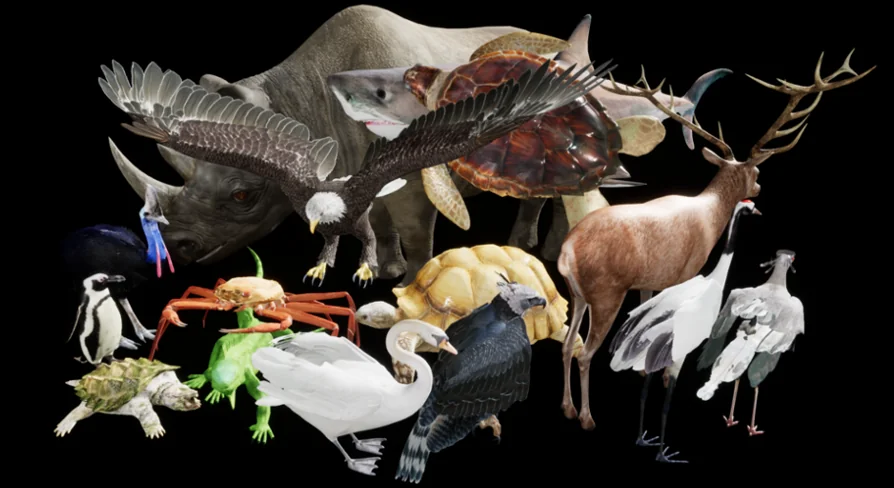
Populating digital ecosystems demands a broad and diverse cast of fauna, spanning land, sky, and water. This library brings together 103 distinct animals across five biological classifications, uniting contemporary wildlife with prehistoric creatures. The collection encompasses 32 mammals, 28 reptiles and amphibians, 21 birds, 14 fish, and 8 invertebrates, offering a self-contained biological ecosystem ready for integration into interactive scenes.
The mammalian selection includes an expansive variety of quadrupeds and marine species. Terrestrial mammals range from household and farm animals such as the dog, cat, cattle, horse, pig, goat, and rabbit, to wild savannah and forest creatures like the lion, elephant, giraffe, zebra, impala, wildebeest, black rhinoceros, and hippopotamus. Specialized creatures such as the anteater, armadillo, beaver, capybara, deer, fruit bat, jerboa, squirrel, tapir, wolf, and bear fill out woodland and arid biomes. Marine mammals like the dolphin, orca, and earless seal provide options for aquatic environments, alongside rodents like the mouse.
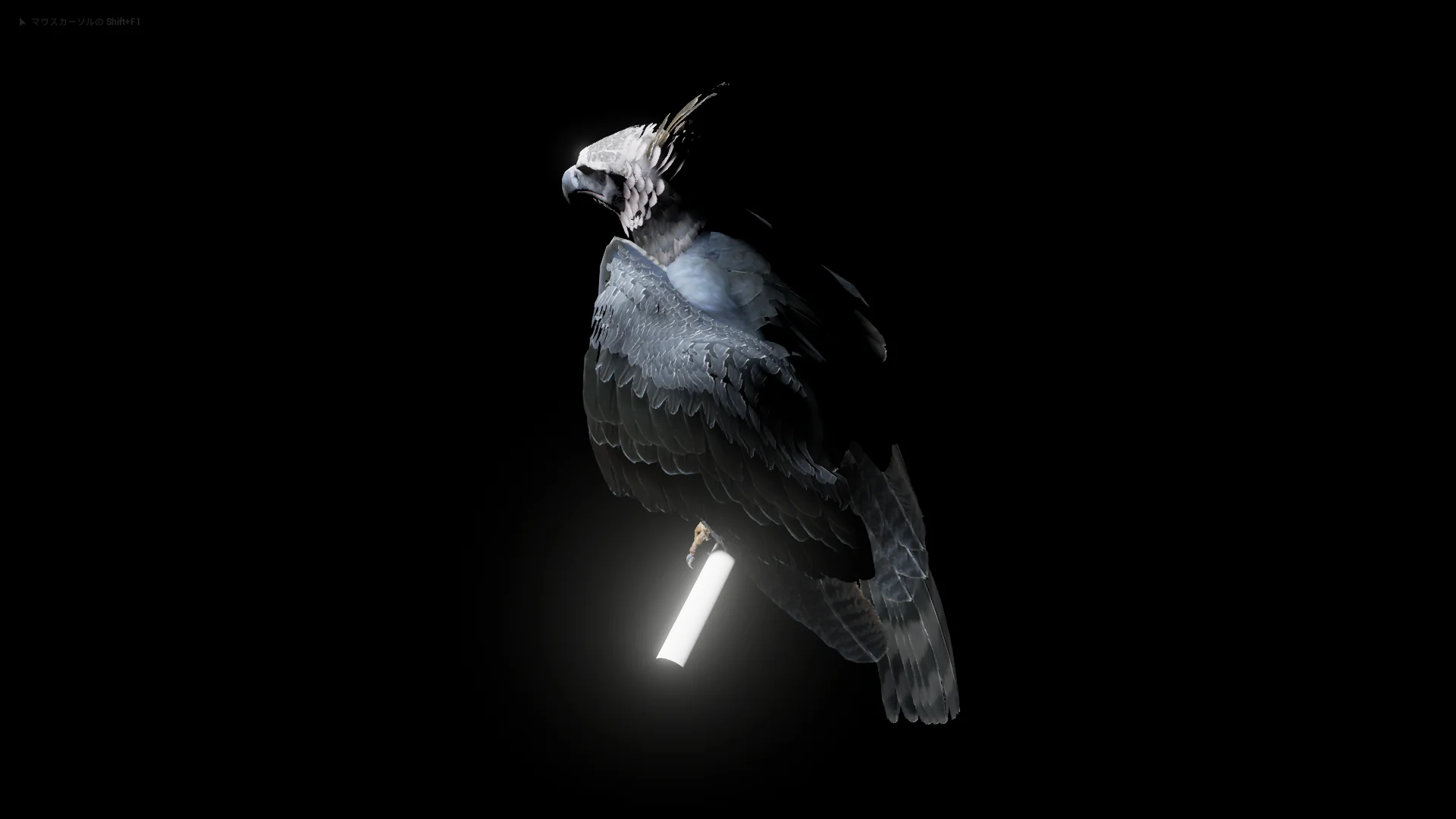
Avian species cover flight dynamics and ground-dwelling behavior across 21 entries. Birds of prey like the bald eagle, harpy eagle, and vulture appear alongside common avians such as the robin, raven, seagull, canary, cardinal, budgerigar, and white-eye. Ground and wading species include the ostrich, cassowary, red-crowned crane, shoebill, swan, and secretarybird, joined by flightless cold-climate penguins and domestic chickens. Specialized species like the toucan and the prehistoric archaeopteryx expand avian projects into exotic or ancient contexts.
Cold-blooded creatures make up a substantial share of the roster. Amphibians and modern reptiles encompass the poison dart frog, crocodile, gecko, leaf-tailed gecko, iguana, Komodo dragon, snake, and five distinct turtles and tortoises. Alongside living reptiles, the library includes prehistoric dinosaurs and marine reptiles such as Tyrannosaurus, Velociraptor, Allosaurus, Spinosaurus, Brachiosaurus, Diplodocus, Stegosaurus, Triceratops, Ankylosaurus, Gallimimus, Pachycephalosaurus, Parasaurolophus, Mosasaurus, Elasmosaurus, Pteranodon, and Rhamphorhynchus.
Aquatic environments gain life through 14 varieties of fish, featuring ocean predators such as the great white shark, game fish like salmon, black rockfish, horse mackerel, mahi-mahi, and tuna, alongside freshwater and ornamental varieties including goldfish, koi, angelfish, arowana, ayu, betta, and pirarucu, as well as the prehistoric placoderm Dunkleosteus. The eight invertebrate specimens—snow crab, tarantula, ant, bee, gold beetle, scorpion, ammonite, and Anomalocaris—provide micro-fauna and ancient sea creatures for detailed macro shots or paleozoic settings.
Skeletal Mesh Setup, Vertex Densities, and Texture Configurations
Every specimen inside the library is supplied as a rigged skeletal mesh. Vertex densities vary based on anatomical complexity, ranging from 1,000 vertices for simpler specimens up to 30,000 vertices for large, anatomically intricate quadrupeds and dinosaurs. This performance tiering allows the assets to run within dense group scenes or stand on their own as hero characters. Texture resolutions scale proportionally from 512x512 up to 4096x4096 maps, matching the visual requirements of small invertebrates up to massive prehistoric reptiles.
Proportions across the collection are scaled to match the standard Epic skeleton for human-scale reference, ensuring realistic spatial volume across mammalian and reptilian species. Exceptions to this standard scale are reserved for insects and the poison dart frog, which maintain dimensions suited to micro-fauna setups. While scaled relative to standard proportions, the skeletons do not share the human Epic bone hierarchy, utilizing custom anatomical bone chains mapped directly to quadrupedal, avian, serpentine, and aquatic mechanics.
Root Motion Locomotion, In-Place Sets, and Animation Blueprints
Locomotion forms a core component of animal behavior, requiring specific transitions and directional handling. Across the asset library, 4,592 total animations are available when counting in-place variations separately from their root-motion counterparts. Terrestrial and non-aquatic animals come supplied with the fundamental directional movement sets required for navigation: WalkForward, TurnRight, TurnLeft, and WalkBack. Both root-motion and in-place versions are supplied for ground-based locomotion, giving creators the choice between precise kinematic coordinate-driven motion and capsule-driven character controller handling.
Swimming and flying creatures depart from standard ground root-motion patterns, operating via custom rotational and forward movement profiles tailored to aerial and underwater spaces. For complex skeletal setups such as birds, dedicated Blueprints come equipped with inverse kinematics (IK) systems, allowing feet and wings to adjust naturally across uneven surfaces and contact points. A playable third-person character Blueprint is also bundled with the package, facilitating rapid in-engine testing of movement banks, directional turns, and state switches without requiring custom controller programming from scratch.
Morphed Mesh Assets and Character Testing Workflows in the Complete Animals Library
Geometric flexibility has been expanded across the character directories through specialized morph data systems. For the vast majority of characters—excluding the toucan and triceratops—morphed skeletal meshes are placed directly within each creature's character folder, such as /Cattle/Characters/SK_CattleMiddlePolyMorph. These morph-ready geometries allow runtime alterations to body volume and structure.
Integration of these morphed meshes can be evaluated directly inside the included demo environments. Creators can inspect and drive the morphed configurations on third-person test characters by swapping the primary morph data asset, designated under the naming pattern DA_MeshName_MorphData (for example, Cattle/Blueprints/DA_CattleMiddlePolyMorph_MorphData). This architecture decouples base mesh definitions from profile variants, offering a direct pathway to test mesh deformation and shape variations without altering the underlying master rigs.
Groom Hair Requirements and Rendering Configuration
High-fidelity fur and feather rendering is handled through Groom assets built directly for mammalian and avian models, including dedicated UV support across 13 selected animals. Working with these strand-based features requires specific engine-level toggles to function correctly. The Groom plugin must be activated within project settings, alongside the explicit activation of the Compute Skin Cache under the project rendering optimization tab.
Execution and stability for the Groom strand assets are validated exclusively under Windows operating systems. While the general skeletal meshes, textures, animations, and Blueprint logic run across both Windows and macOS build and development targets, the Groom strand assets remain excluded from macOS workflows. Deploying these assets within modern urban scenes or open biomes—such as city sample demos alongside avian, African, or prehistoric packs—ensures strand-level detail remains fully anchored to animated skeletal meshes under supported render passes.
 Animals
 Animals
 Animals
 Animals