"177e4e4394b9ce1f"{"id":"1001604","slug":"stylized-fantasy-creatures-bundle","title":"Stylized Fantasy Creatures Bundle","category":"Animals","engine":"4.18+,5.0+","assetVersion":"","engineVersion":"Engine Version: 4.18+,5.0+","tag":"Animals","accent":"blue","visual":"character","summary":"A deep look at the Stylized Fantasy Creatures Bundle, detailing its 21 beasts, modular mechanics, blend shapes, and dedicated engine texture maps.","platform":"Unreal Engine","publishedAt":"2026-10-10T16:29:20.837Z","updatedAt":"2026-10-10T16:29:20.837Z","sourceNotes":[],"fileContents":[],"compatibility":["Unreal Engine","Engine Version: 4.18+,5.0+"],"featuredImage":{"alt":"Stylized Fantasy Creatures Bundle","src":"/wp-content/uploads/published/2026/10/4ce43d63aca8-255d8d16-4dae-48a6-9430-e767fabb165a-17b0baf57f.webp"},"hasDownloadLink":true,"downloads":0,"terms":[{"taxonomy":"category","slug":"animals","name":"Animals"}],"galleryImages":[{"src":"/wp-content/uploads/published/2026/10/3dfcff413a3f-89fa223b-14f0-4289-a5c3-99f4bee758e5-deb907fc89.webp","alt":"Stylized Fantasy Creatures Bundle"},{"src":"/wp-content/uploads/published/2026/10/b7c3d62a144c-0bd6d77b-a83f-4dc6-8f5a-a0749b0f289f-83266d1b85.webp","alt":"Stylized Fantasy Creatures Bundle"},{"src":"/wp-content/uploads/published/2026/10/aef1c7b9eb97-71554187-f002-4959-8c82-1ffca58910d5-3eed20da40.webp","alt":"Stylized Fantasy Creatures Bundle"},{"src":"/wp-content/uploads/published/2026/10/26dc7b76348a-337f992a-4189-408d-91a7-795309d7a6c2-ca4d6c5bd7.webp","alt":"Stylized Fantasy Creatures Bundle"},{"src":"/wp-content/uploads/published/2026/10/f29bbf6dd9cd-46f8125e-bf24-491e-a5b5-752584924d4a-2b1a9b1f59.webp","alt":"Stylized Fantasy Creatures Bundle"},{"src":"/wp-content/uploads/published/2026/10/c13cc0a0b0c1-c8d6c93f-55b6-4e8d-8d4a-7ca38bd13701-df86ea8a33.webp","alt":"Stylized Fantasy Creatures Bundle"},{"src":"/wp-content/uploads/published/2026/10/62a9c889e0b8-7db6624e-d12d-467a-81d3-a1011b24cc40-a9b9572c74.webp","alt":"Stylized Fantasy Creatures Bundle"},{"src":"/wp-content/uploads/published/2026/10/7a58bd970420-79e20c94-bf39-42f9-b522-ffa42157c8e6-45c8a52ca8.webp","alt":"Stylized Fantasy Creatures Bundle"},{"src":"/wp-content/uploads/published/2026/10/34ca2bde47b9-c47257a6-a2cd-457f-9047-701b91bb5d44-190befeed8.webp","alt":"Stylized Fantasy Creatures Bundle"},{"src":"/wp-content/uploads/published/2026/10/b93bebe63fdb-89c8bec6-cff3-4707-8f0f-1f2a914bae6d-b72dca1ba5.webp","alt":"Stylized Fantasy Creatures Bundle"}],"accessPanel":{"kind":"resource","title":"Download this resource","eyebrow":"Free Download","message":"Log in or create a free account to start your download.","fileName":"Content.7z","safetyNote":"Resources are manually reviewed before listing to improve quality and reduce obvious risks.","actionLabel":"Download Free","resourceType":"Resource archive"},"contentHtml":"\u003cp\u003ePopulating a stylized world often demands a balanced mix of docile wildlife, farmstead livestock, and hostile wilderness predators. The Stylized Fantasy Creatures Bundle addresses this ecological spectrum by assembling twenty-one distinct animals and monsters suited for fantasy role-playing games, top-down strategy titles, multiplayer battle arenas, and massive online games. Because every asset is tailored for both first-person and third-person perspectives, the models retain clean readabilities whether viewed from an overhead isometric camera or framed up close during direct combat encounters.\u003c/p\u003e \u003ch2\u003eThe Twenty-One Creature Roster Across Stylized Biomes\u003c/h2\u003e\n\u003cp\u003eThe collection spans a broad set of creature archetypes that fit naturally into distinct zones of a fantasy game map. Domestic and village environments make use of familiar pastoral species, including the Chicken, Cow, Pig, Sheep, Cat, and Goat. These assets provide immediate environmental dressing for agricultural settlements, rural outposts, and bustling town hubs without requiring separate asset collections for baseline farm life.\u003c/p\u003e \u003cp\u003eBeyond peaceful livestock, the package transitions into woodland, swamp, and predatory fauna. Forest clearings and mountain passes can be populated with the Bear, Wolf, Boar, and Tiger, giving designers foundational apex predators and mid-tier wandering threats. Airborne encounters utilize the Eagle and Bat, opening up vertical combat opportunities and cavern exploration hazards. Subterranean or damp biomes receive insectoid and reptilian threats, including the Spider, Wasp, Snake, Crocodile, Toad, and a Small Dinosaur. Rounding out coastal, riverbank, and forest floor zones are the Snail, Turtle, and Hermit Crab, providing non-traditional critters that fulfill niche wildlife and scavenger roles.\u003c/p\u003e \u003ch2\u003eModular Setup for Shelled Creatures\u003c/h2\u003e\n\u003cp\u003eTo avoid repetitive visuals across multiple encounters, three of the twenty-one creatures feature modular architecture. The Hermit Crab, Turtle, and Snail are configured to support interchangeable outfits and exterior elements, enabling developers to customize their shells and accessories directly. By decoupling these structural shell elements, a scene can feature several individuals of the same core species side by side without producing an identical visual silhouette.\u003c/p\u003e \u003cp\u003eThis modular separation allows designers to designate visual hierarchies within a single creature type. A baseline Snail or Turtle might carry a simple natural shell in an early gameplay area, while an armored or adorned variant can serve as an elite mob, a vendor companion, or an objective-bearing creature deeper into a campaign. Swapping these modular parts offers practical variety without inflating draw calls or requiring entirely distinct character meshes for every minor variation in enemy rank.\u003c/p\u003e \u003ch2\u003eBlend Shapes for Mammals and Wildlife Variance\u003c/h2\u003e\n\u003cp\u003eMesh customization extends beyond modular attachments through integrated blend shapes, which are included on five specific mammals: the Wolf, Bear, Boar, Goat, and Pig. Blend shape deformation targets allow teams to modify the physical proportions, bulk, and features of these models dynamically or across prefab variants.\u003c/p\u003e \u003cp\u003eIn practice, these morph targets enable continuous visual differentiation across encounter designs:\u003c/p\u003e\n\u003cul\u003e \u003cli\u003e\u003cstrong\u003eAdolescent to Alpha Scaling:\u003c/strong\u003e A standard Boar or Wolf can shift from a leaner, younger profile to a bulky, muscular alpha beast through shape deformation rather than pure uniform scale transforms.\u003c/li\u003e \u003cli\u003e\u003cstrong\u003eTusk and Horn Accents:\u003c/strong\u003e Morphs applied to Goats and Boars modify their defensive protrusions, signifying higher difficulty ratings or distinct subspecies.\u003c/li\u003e \u003cli\u003e\u003cstrong\u003eLivestock Diversity:\u003c/strong\u003e Pigs and Goats can exhibit varying weights and physical traits across pastures, preventing farms and settlements from looking like identical clones.\u003c/li\u003e \u003cli\u003e\u003cstrong\u003ePhysical Impact and Reaction:\u003c/strong\u003e Morph sliders can be tied into gameplay scripts or animation blueprints to adjust creature expressions or physical posture during aggressive states.\u003c/li\u003e\n\u003c/ul\u003e \u003ch2\u003eHand-Painted Materials and Dedicated Unreal Engine and Unity Maps\u003c/h2\u003e\n\u003cp\u003eTexture work across the package combines stylized hand-painted diffuse work with physically based rendering utility maps. Each of the twenty-one creatures features three to five hand-painted skin color variations, supported by an aggregate library of 96 diffuse maps. These alternative colorways allow biomes to express distinct color narratives, such as swamp-adapted green predators, corrupted dark variants, or snow-dusted tundra forms.\u003c/p\u003e \u003cp\u003eLighting and surface definition are handled through 23 normal maps and 19 emissive maps, providing localized glow effects for venomous stingers, magical eyes, or bioluminescent markings. Surface response is optimized across modern pipelines by offering distinct texture packs for Unreal Engine and Unity:\u003c/p\u003e\n\u003cul\u003e \u003cli\u003e\u003cstrong\u003eUnreal Engine Workflow:\u003c/strong\u003e Utilizes 23 channel-packed ORM maps, bundling Ambient Occlusion, Roughness, and Metallic data into unified RGB channels to minimize memory overhead and sample instructions within material graphs.\u003c/li\u003e \u003cli\u003e\u003cstrong\u003eUnity Workflow:\u003c/strong\u003e Employs 23 dedicated Metallic and Smoothness maps alongside 23 standalone Ambient Occlusion maps, matching the default channel requirements of Unity Standard and modern Universal Render Pipeline surface shaders.\u003c/li\u003e\n\u003c/ul\u003e \u003ch2\u003eProduction Pipeline Considerations and Project Suitability\u003c/h2\u003e\n\u003cp\u003eDesigned around low-poly structures with animation blueprints and script readiness in mind, the bundle fits cleanly into resource-conscious production pipelines like MMOs, MOBAs, and real-time strategy games where high on-screen actor counts are mandatory. The inclusion of engine-specific textures means teams do not need to spend technical artist hours repacking texture channels or remapping roughness inversions manually.\u003c/p\u003e \u003cp\u003eFor studios operating within specialized distribution frameworks, the developer notes that any project planning to implement these assets within NFT or blockchain-related architectures must make contact via email for clearance prior to deployment. For traditional PC, console, and mobile game development, the asset provides a cohesive stylized bestiary ready for immediate stage placement, enemy spawners, and interactive ambient life.\u003c/p\u003e\n\n\u003ch2\u003eMore From The Same Workflow\u003c/h2\u003e\n\u003cul\u003e\n\u003cli\u003e\u003ca href=\"https://3dcghub.com/panthers-pack/\" title=\"Panthers pack\"\u003ePanthers pack\u003c/a\u003e\u003c/li\u003e\n\u003cli\u003e\u003ca href=\"https://3dcghub.com/spiders-pack/\" title=\"Spiders pack\"\u003eSpiders pack\u003c/a\u003e\u003c/li\u003e\n\u003cli\u003e\u003ca href=\"https://3dcghub.com/animated-stylized-wizard/\" title=\"Animated Stylized Wizard\"\u003eAnimated Stylized Wizard\u003c/a\u003e\u003c/li\u003e\n\u003cli\u003e\u003ca href=\"https://3dcghub.com/unlit-stylized-military-characters/\" title=\"Unlit Stylized Military Characters\"\u003eUnlit Stylized Military Characters\u003c/a\u003e\u003c/li\u003e\n\u003cli\u003e\u003ca href=\"https://3dcghub.com/shaman-girl-modular/\" title=\"Shaman Girl Modular\"\u003eShaman Girl Modular\u003c/a\u003e\u003c/li\u003e\n\u003c/ul\u003e","contentTextLength":6300,"navigation":{"current":10,"total":3551,"previous":{"id":"1001605","slug":"cyberpunk-sniper-girl","title":"Cyberpunk Sniper Girl","category":"Characters \u0026 Creatures","platform":"Unreal Engine","updatedAt":"2026-10-10T16:29:58.108Z"},"next":{"id":"1001603","slug":"stones-vol-1-scanned-materials","title":"Stones Vol. 1 - Scanned Materials","category":"Stone","platform":"Unreal Engine","updatedAt":"2026-10-10T16:27:55.183Z"}},"relatedResources":[{"id":"1616","slug":"panthers-pack","title":"Panthers pack","category":"Animals","engine":"4.26+,5.0+","assetVersion":"Engine version: 4.26+,5.0+","engineVersion":"4.25","tag":"Animals","accent":"blue","visual":"character","summary":"Enhance your game with this professional panther asset pack. Includes realistic and fantasy skins, 4K PBR textures, and 16 animations for game developers.","platform":"Unreal Engine","publishedAt":"2026-02-06T20:08:21.000Z","updatedAt":"2026-04-19T15:58:07.000Z","sourceNotes":[],"fileContents":[],"compatibility":["Unreal Engine","Engine version: 4.26+,5.0+"],"featuredImage":{"alt":"Panthers pack","src":"https://3dcghub.com/wp-content/uploads/2026/02/5ade6ad0-a129-49ee-b9b2-cee2c6aedff0.webp"},"hasDownloadLink":true,"downloads":1},{"id":"1001364","slug":"spiders-pack","title":"Spiders pack","category":"Animals","engine":"4.23+,5.0+","assetVersion":"","engineVersion":"Engine Version: 4.23+,5.0+","tag":"Animals","accent":"blue","visual":"mech","summary":"Explore Spiders pack, featuring three unique meshes, six materials, and thirteen animations for cave, forest, and swamp fantasy creature encounters.","platform":"Unreal Engine","publishedAt":"2026-10-04T10:33:17.972Z","updatedAt":"2026-10-04T10:33:17.972Z","sourceNotes":[],"fileContents":[],"compatibility":["Unreal Engine","Engine Version: 4.23+,5.0+"],"featuredImage":{"alt":"Spiders pack","src":"/wp-content/uploads/published/2026/10/7fa8ce563f7a-bbb98fb7-f42c-41e4-b9bd-2282c79826c7-486fdee7a2.webp"},"hasDownloadLink":true,"downloads":1},{"id":"1001425","slug":"animated-stylized-wizard","title":"Animated Stylized Wizard","category":"Characters \u0026 Creatures","engine":"4.18+,5.0+","assetVersion":"","engineVersion":"Engine Version: 4.18+,5.0+","tag":"Characters","accent":"blue","visual":"character","summary":"Explore the Animated Stylized Wizard featuring a handpainted game-ready model, 70 animations, 14 character texture variations, and matched staff weapons.","platform":"Unreal Engine","publishedAt":"2026-10-07T06:00:07.988Z","updatedAt":"2026-10-07T06:00:07.988Z","sourceNotes":[],"fileContents":[],"compatibility":["Unreal Engine","Engine Version: 4.18+,5.0+"],"featuredImage":{"alt":"Animated Stylized Wizard","src":"/wp-content/uploads/published/2026/10/3509b7d14a4a-ca8d0d8e-9c9c-48f2-b020-6f6572cff412-d78d80b38a.webp"},"hasDownloadLink":true,"downloads":0}]}
Animals
Stylized Fantasy Creatures Bundle
A deep look at the Stylized Fantasy Creatures Bundle, detailing its 21 beasts, modular mechanics, blend shapes, and dedicated engine texture maps.
Category:Unreal Engine,AnimalsPlatform: Unreal EngineEngine Version: 4.18+,5.0+Published: Oct 10, 2026
Animals
Resource overview
Populating a stylized world often demands a balanced mix of docile wildlife, farmstead livestock, and hostile wilderness predators. The Stylized Fantasy Creatures Bundle addresses this ecological spectrum by assembling twenty-one distinct animals and monsters suited for fantasy role-playing games, top-down strategy titles, multiplayer battle arenas, and massive online games. Because every asset is tailored for both first-person and third-person perspectives, the models retain clean readabilities whether viewed from an overhead isometric camera or framed up close during direct combat encounters.
The Twenty-One Creature Roster Across Stylized Biomes
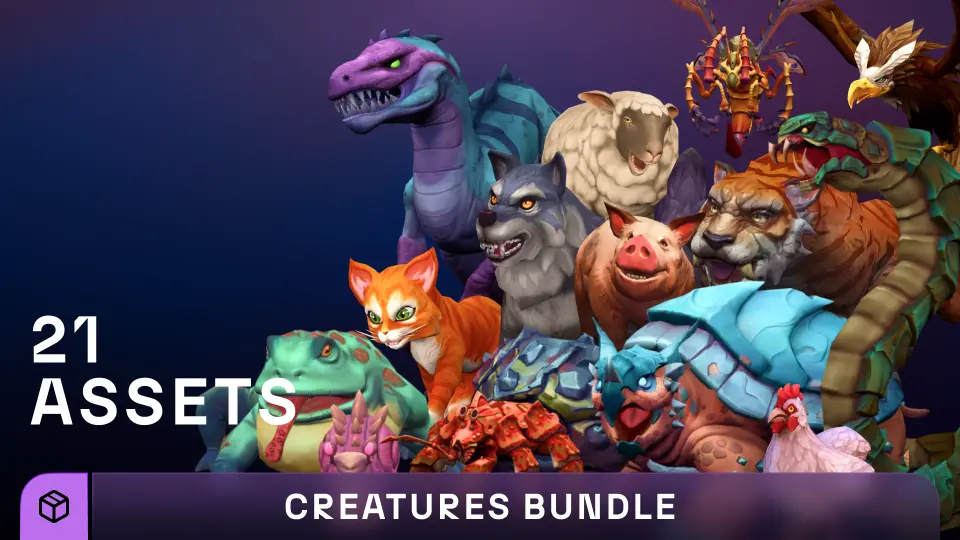
The collection spans a broad set of creature archetypes that fit naturally into distinct zones of a fantasy game map. Domestic and village environments make use of familiar pastoral species, including the Chicken, Cow, Pig, Sheep, Cat, and Goat. These assets provide immediate environmental dressing for agricultural settlements, rural outposts, and bustling town hubs without requiring separate asset collections for baseline farm life.
Beyond peaceful livestock, the package transitions into woodland, swamp, and predatory fauna. Forest clearings and mountain passes can be populated with the Bear, Wolf, Boar, and Tiger, giving designers foundational apex predators and mid-tier wandering threats. Airborne encounters utilize the Eagle and Bat, opening up vertical combat opportunities and cavern exploration hazards. Subterranean or damp biomes receive insectoid and reptilian threats, including the Spider, Wasp, Snake, Crocodile, Toad, and a Small Dinosaur. Rounding out coastal, riverbank, and forest floor zones are the Snail, Turtle, and Hermit Crab, providing non-traditional critters that fulfill niche wildlife and scavenger roles.
Modular Setup for Shelled Creatures
To avoid repetitive visuals across multiple encounters, three of the twenty-one creatures feature modular architecture. The Hermit Crab, Turtle, and Snail are configured to support interchangeable outfits and exterior elements, enabling developers to customize their shells and accessories directly. By decoupling these structural shell elements, a scene can feature several individuals of the same core species side by side without producing an identical visual silhouette.
This modular separation allows designers to designate visual hierarchies within a single creature type. A baseline Snail or Turtle might carry a simple natural shell in an early gameplay area, while an armored or adorned variant can serve as an elite mob, a vendor companion, or an objective-bearing creature deeper into a campaign. Swapping these modular parts offers practical variety without inflating draw calls or requiring entirely distinct character meshes for every minor variation in enemy rank.
Blend Shapes for Mammals and Wildlife Variance
Mesh customization extends beyond modular attachments through integrated blend shapes, which are included on five specific mammals: the Wolf, Bear, Boar, Goat, and Pig. Blend shape deformation targets allow teams to modify the physical proportions, bulk, and features of these models dynamically or across prefab variants.
In practice, these morph targets enable continuous visual differentiation across encounter designs:
Adolescent to Alpha Scaling: A standard Boar or Wolf can shift from a leaner, younger profile to a bulky, muscular alpha beast through shape deformation rather than pure uniform scale transforms.
Tusk and Horn Accents: Morphs applied to Goats and Boars modify their defensive protrusions, signifying higher difficulty ratings or distinct subspecies.
Livestock Diversity: Pigs and Goats can exhibit varying weights and physical traits across pastures, preventing farms and settlements from looking like identical clones.
Physical Impact and Reaction: Morph sliders can be tied into gameplay scripts or animation blueprints to adjust creature expressions or physical posture during aggressive states.
Hand-Painted Materials and Dedicated Unreal Engine and Unity Maps
Texture work across the package combines stylized hand-painted diffuse work with physically based rendering utility maps. Each of the twenty-one creatures features three to five hand-painted skin color variations, supported by an aggregate library of 96 diffuse maps. These alternative colorways allow biomes to express distinct color narratives, such as swamp-adapted green predators, corrupted dark variants, or snow-dusted tundra forms.
Lighting and surface definition are handled through 23 normal maps and 19 emissive maps, providing localized glow effects for venomous stingers, magical eyes, or bioluminescent markings. Surface response is optimized across modern pipelines by offering distinct texture packs for Unreal Engine and Unity:
Unreal Engine Workflow: Utilizes 23 channel-packed ORM maps, bundling Ambient Occlusion, Roughness, and Metallic data into unified RGB channels to minimize memory overhead and sample instructions within material graphs.
Unity Workflow: Employs 23 dedicated Metallic and Smoothness maps alongside 23 standalone Ambient Occlusion maps, matching the default channel requirements of Unity Standard and modern Universal Render Pipeline surface shaders.
Production Pipeline Considerations and Project Suitability
Designed around low-poly structures with animation blueprints and script readiness in mind, the bundle fits cleanly into resource-conscious production pipelines like MMOs, MOBAs, and real-time strategy games where high on-screen actor counts are mandatory. The inclusion of engine-specific textures means teams do not need to spend technical artist hours repacking texture channels or remapping roughness inversions manually.
For studios operating within specialized distribution frameworks, the developer notes that any project planning to implement these assets within NFT or blockchain-related architectures must make contact via email for clearance prior to deployment. For traditional PC, console, and mobile game development, the asset provides a cohesive stylized bestiary ready for immediate stage placement, enemy spawners, and interactive ambient life.
 Animals
 Animals
 Animals
 Characters