"7aa4acc705f0d80b"{"id":"1001980","slug":"city-props","title":"City props","category":"Street / Road","engine":"4.27+,5.0+","assetVersion":"","engineVersion":"Engine Version: 4.27+,5.0+","tag":"Street / Road","accent":"blue","visual":"city","summary":"Examine the City props collection featuring NYC street environment assets, traffic cones, road blockers, streetlights, and sidewalk clutter for AAA levels.","platform":"Unreal Engine","publishedAt":"2026-10-24T14:26:23.412Z","updatedAt":"2026-10-24T14:26:23.412Z","sourceNotes":[],"fileContents":[],"compatibility":["Unreal Engine","Engine Version: 4.27+,5.0+"],"featuredImage":{"alt":"City props","src":"/wp-content/uploads/published/2026/10/cd2686124802-95efbad4-95c0-4ef5-9e96-5eebea595eba-189dd637ad.webp"},"hasDownloadLink":true,"downloads":0,"terms":[{"taxonomy":"category","slug":"street-road","name":"Street / Road"}],"galleryImages":[{"src":"/wp-content/uploads/published/2026/10/9737c7d5ceaf-49c02ba1-480a-4a48-b463-84ba30d06b84-1ad7b246d7.webp","alt":"City props"},{"src":"/wp-content/uploads/published/2026/10/0895ce0847c7-b610b34c-12cf-4d26-82b6-ffb9a3f884ed-39921ad032.webp","alt":"City props"},{"src":"/wp-content/uploads/published/2026/10/d0ded1990533-e991102b-cfea-4840-a8c3-c200faab7df0-891aba0114.webp","alt":"City props"},{"src":"/wp-content/uploads/published/2026/10/9c133fca9079-80372362-c2ee-408a-a43f-65e6459ccd60-0dad05d8d8.webp","alt":"City props"},{"src":"/wp-content/uploads/published/2026/10/0d484c85e579-e818ce9f-891e-4165-af1e-49d2ae2dbb14-647159fa00.webp","alt":"City props"},{"src":"/wp-content/uploads/published/2026/10/353a6b2327c1-a8146882-e4df-4696-832a-1cec5e1669a6-e4a397a2ff.webp","alt":"City props"},{"src":"/wp-content/uploads/published/2026/10/315aaa97b691-92d3f807-0bd1-46c6-a21f-49cea7fe05b5-51685fa305.webp","alt":"City props"},{"src":"/wp-content/uploads/published/2026/10/82659bfd781f-8b3225e6-4a47-4a6c-8901-2275978eb774-833a9141e5.webp","alt":"City props"}],"accessPanel":{"kind":"resource","title":"Download this resource","eyebrow":"Free Download","message":"Log in or create a free account to start your download.","fileName":"Content.7z","safetyNote":"Resources are manually reviewed before listing to improve quality and reduce obvious risks.","actionLabel":"Download Free","resourceType":"Resource archive"},"contentHtml":"\u003cp\u003eEmpty roadways and unpopulated sidewalks quickly break spatial immersion in interactive environments. A city scene requires dense, recognizable street dressing before an urban corridor registers as a believable location. The City props set targets this baseline requirement, providing core NYC street environment pieces built to dress layouts across AAA game productions, virtual reality environments, and cinematic sequences. By supplying standard roadside fixtures alongside casual street litter, the collection equips level designers with the components needed to transition an environment from an empty greybox blockout into a working urban space.\u003c/p\u003e \u003ch2\u003eAssembling Base Props for NYC Street Environment Layouts\u003c/h2\u003e\n\u003cp\u003eUrban blockouts rely on recurring architectural and utility elements to ground player perspective. Without infrastructure elements such as lighting poles and traffic boundary markers, streets lack both functional scale and visual boundaries. The set supplies primary fixtures that establish vertical and horizontal dimensions across roads, curbs, and shopfronts.\u003c/p\u003e \u003cp\u003ePlacing street light assets along curb lines establishes rhythm across long exterior views. These fixtures outline the perimeter of pedestrian spaces while offering anchor points for localized night illumination. In scenes configured for VR, tall vertical fixtures give the player direct visual cues regarding real-world proportions, making the surrounding buildings appear properly scaled. When paired with horizontal road fixtures, these upright elements create an alternating cadence that prevents city blocks from appearing flat or repetitive.\u003c/p\u003e \u003cp\u003eBecause the collection concentrates on base props required to fill layouts, these components serve as structural set dressing rather than one-off hero set pieces. Level designers can duplicate them along sidewalks, distribute them outside commercial frontages, or cluster them around intersections to create dense town streets without having to model individual utility elements from scratch.\u003c/p\u003e \u003ch2\u003eSidewalk Clutter from Carton Boxes to Rubbish and Advertising\u003c/h2\u003e\n\u003cp\u003eTrue city streets rarely present clean, pristine surfaces. Natural foot traffic and commercial deliveries generate visible layers of incidental trash and paper clutter. The inclusion of carton_boxes, rubbish elements, advertising boards, and signs allows environment artists to break up uniform ground textures and disrupt straight geometric lines.\u003c/p\u003e \u003cp\u003eFlattened or stacked carton_boxes placed along alley corners and storefront entryways immediately alter the personality of a street. A neat stack against a roll-up door implies an active retail business receiving shipments, while rumpled or discarded boxes combined with loose rubbish indicate neglected back alleys or industrial service lanes. These low-lying elements interrupt flat pavement materials, catching light at ground level and breaking up continuous normal maps.\u003c/p\u003e \u003cp\u003eAdvertising signs add distinct commercial identity to sidewalk stretches. Pushed against building facades or set perpendicular to pedestrian pathways, advertising elements introduce secondary visual interest without demanding custom environmental architecture. In urban settings, signs direct foot traffic, establish the character of commercial districts, and supply localized narrative context, shifting an environment from a generic town space into an identifiable New York style district.\u003c/p\u003e \u003ch2\u003eVerticality and Pedestrian Scale with Street Lights, Tables, and Drink Fridges\u003c/h2\u003e\n\u003cp\u003eSidewalk spaces function as intermediary zones between roadways and storefronts. Populating this threshold demands items that suggest daily commercial activity and pedestrian pauses. The collection features tables, drink_fridge units, and streetlights to establish functional street-side pockets.\u003c/p\u003e \u003cp\u003eA drink_fridge positioned adjacent to a storefront exterior gives corner bodegas and convenience stores their signature street presence. Such refrigeration units introduce distinct boxy silhouettes, complete with commercial glass door frames and interior shelving volume. In high-density street arrangements, placing a drink fridge outdoors instantly conveys close-quarters urban life where commercial operations routinely spill onto the pavement.\u003c/p\u003e \u003cp\u003eTables placed curbside or tucked beneath awnings introduce small functional staging areas. These surfaces allow scene builders to establish outdoor dining areas, flea market stalls, or casual sidewalk seating. In cinematic shots, having mid-height assets like tables and refrigeration units situated between the camera and background structures generates critical depth layers. The camera can rack focus past a tabletop or drink fridge edge toward characters or vehicles on the street, yielding a composition that feels physically situated inside an occupied city block.\u003c/p\u003e \u003ch2\u003eControlling Traversal with Road Blokers and Road Cones\u003c/h2\u003e\n\u003cp\u003eNavigation design in street environments demands clear, physically plausible boundaries. Players need visual markers that explain why a lane is closed, where detours exist, or why an intersection is impassable. The road blokers and road cone assets within the pack address these functional layout needs directly.\u003c/p\u003e \u003cp\u003eRoad cones deliver high-visibility boundary cues. Scattering road cones around utility holes, along freshly painted road markings, or flanking maintenance vehicles informs players of restricted zones using recognizable municipal language. Because cones are portable and standard, artists can place them in tight groupings or loose single-file lines to subtly nudge players away from dead ends or level boundaries without relying on invisible walls.\u003c/p\u003e \u003cp\u003eHeavier road blokers provide rigid, unmistakable barriers. Positioned across multi-lane avenues, road blockers close off unfinished portions of a map or create fortified checkpoints suitable for high-tension scenes, municipal blockades, or cyberpunk-themed quarantine sectors. Stacking road blockers in staggered arrangements allows level artists to filter foot traffic while completely denying vehicle traversal, directly serving pacing and gameplay gating requirements.\u003c/p\u003e \u003ch2\u003eCinematic Staging, VR Fidelity, and Project Compatibility\u003c/h2\u003e\n\u003cp\u003eHigh-end game engines require props that maintain surface definition and accurate profile silhouettes under close inspection. Because the assets are built to satisfy AAA game, VR, and cinematic quality thresholds, the geometry and material definition hold up when viewed at head-height in virtual reality or framed directly in front of a cinematic camera lens.\u003c/p\u003e \u003cp\u003eIn virtual reality environments, low-resolution geometry and flat textures are immediately noticeable. The prop set accounts for close-range player inspection around roadside objects, ensuring that surfaces such as the rims of road cones, the corners of carton boxes, and the edges of street tables do not collapse into low-poly artifacts when inspected up close. For cinematic projects, the realistic proportions of the street lights and commercial clutter make lens matching straightforward, allowing focal lengths to behave as expected against authentic NYC scale standards.\u003c/p\u003e \u003cp\u003eBeyond traditional modern urban street scenes, the versatility of baseline props extends across multiple thematic combinations. While tailored to contemporary NYC, town, and cyberpunk layouts, the asset set also functions in mixed asset pipelines, carrying compatibility with Medieval Watermill Town projects where basic environmental dressing, structural blocking, and functional boundary markers can be adapted for hybrid layout needs. For developers assembling street corridors, the City props collection delivers the functional building blocks necessary to turn blank pavements into lived-in, fully realized urban settings.\u003c/p\u003e\n\n\u003ch2\u003eContinue Browsing Similar Packs\u003c/h2\u003e\n\u003cul\u003e\n\u003cli\u003e\u003ca href=\"https://3dcghub.com/modular-amsterdam-city-street-with-canal/\" title=\"Modular Amsterdam City Street with Canal\"\u003eModular Amsterdam City Street with Canal\u003c/a\u003e\u003c/li\u003e\n\u003cli\u003e\u003ca href=\"https://3dcghub.com/cyberpunk-night-street-cyberpunk-town-cyberpunk-props-night-city/\" title=\"Cyberpunk Night Street ( Cyberpunk Town, Cyberpunk Props , Night City )\"\u003eCyberpunk Night Street ( Cyberpunk Town, Cyberpunk Props , Night City )\u003c/a\u003e\u003c/li\u003e\n\u003cli\u003e\u003ca href=\"https://3dcghub.com/dystopian-city-environment-cyberpunk-cyberpunk-city-cyberpunk-buildings/\" title=\"Dystopian City Environment (Cyberpunk, Cyberpunk City, Cyberpunk Buildings)\"\u003eDystopian City Environment (Cyberpunk, Cyberpunk City, Cyberpunk Buildings)\u003c/a\u003e\u003c/li\u003e\n\u003cli\u003e\u003ca href=\"https://3dcghub.com/stylized-lowpoly-cyberpunk-city-stylized-stylised-cyber-cyberpunk-scifi-3d/\" title=\"Stylized Lowpoly Cyberpunk City ( Stylized Stylised Cyber Cyberpunk Scifi 3D )\"\u003eStylized Lowpoly Cyberpunk City ( Stylized Stylised Cyber Cyberpunk Scifi 3D )\u003c/a\u003e\u003c/li\u003e\n\u003cli\u003e\u003ca href=\"https://3dcghub.com/fire-hydrant-package/\" title=\"Fire Hydrant Package\"\u003eFire Hydrant Package\u003c/a\u003e\u003c/li\u003e\n\u003c/ul\u003e","contentTextLength":8021,"navigation":{"current":10,"total":3925,"previous":{"id":"1001981","slug":"cling-component-system","title":"Cling Component System","category":"Artificial Intelligence","platform":"Unreal Engine","updatedAt":"2026-10-24T14:27:09.481Z"},"next":{"id":"1001979","slug":"circus-adventure-pack","title":"Circus Adventure Pack","category":"Cities","platform":"Unreal Engine","updatedAt":"2026-10-24T14:25:44.603Z"}},"relatedResources":[{"id":"1001701","slug":"modular-amsterdam-city-street-with-canal","title":"Modular Amsterdam City Street with Canal","category":"Cities","engine":"5.4+","assetVersion":"","engineVersion":"Engine Version: 5.4+","tag":"Cities","accent":"blue","visual":"city","summary":"Build authentic Dutch urban scenes with modular canal-side architecture, street props, Nanite-ready meshes, and 4K PBR textures in Unreal Engine.","platform":"Unreal Engine","publishedAt":"2026-10-14T13:30:10.202Z","updatedAt":"2026-10-14T13:30:10.202Z","sourceNotes":[],"fileContents":[],"compatibility":["Unreal Engine","Engine Version: 5.4+"],"featuredImage":{"alt":"Modular Amsterdam City Street with Canal","src":"/wp-content/uploads/published/2026/10/23e966ee0759-1a53411b-9b5a-4e48-86dc-fc10e925d417-6eb4ff8a13.webp"},"hasDownloadLink":true,"downloads":2},{"id":"7617","slug":"cyberpunk-night-street-cyberpunk-town-cyberpunk-props-night-city","title":"Cyberpunk Night Street ( Cyberpunk Town, Cyberpunk Props , Night City )","category":"Cyberpunk","engine":"5.1+","assetVersion":"Engine version: 5.1+","engineVersion":"5.1","tag":"Cyberpunk","accent":"blue","visual":"city","summary":"Transform your digital environments with a comprehensive collection of modular buildings, neon props, and gritty street assets designed for futuristic cityscapes.","platform":"Unreal Engine","publishedAt":"2026-02-21T17:05:44.000Z","updatedAt":"2026-07-13T11:55:33.583Z","sourceNotes":[],"fileContents":[],"compatibility":["Unreal Engine","Engine version: 5.1+"],"featuredImage":{"alt":"Cyberpunk Night Street ( Cyberpunk Town, Cyberpunk Props , Night City )","src":"https://3dcghub.com/wp-content/uploads/2026/02/98b1667a-a348-4361-aee6-0a3281b3f848.webp"},"hasDownloadLink":true,"downloads":1},{"id":"1001384","slug":"dystopian-city-environment-cyberpunk-cyberpunk-city-cyberpunk-buildings","title":"Dystopian City Environment (Cyberpunk, Cyberpunk City, Cyberpunk Buildings)","category":"Cyberpunk","engine":"4.22+,5.0+","assetVersion":"","engineVersion":"Engine Version: 4.22+,5.0+","tag":"Cyberpunk","accent":"blue","visual":"city","summary":"Explore the Dystopian City Environment, featuring cyberpunk building blueprints, highway spline tools, street props, and an island map with static lighting.","platform":"Unreal Engine","publishedAt":"2026-10-04T15:02:41.998Z","updatedAt":"2026-10-04T15:02:41.998Z","sourceNotes":[],"fileContents":[],"compatibility":["Unreal Engine","Engine Version: 4.22+,5.0+"],"featuredImage":{"alt":"Dystopian City Environment (Cyberpunk, Cyberpunk City, Cyberpunk Buildings)","src":"/wp-content/uploads/published/2026/10/a9881c905287-f3d9ccf9-65cf-4a6b-abcd-771735b75281-e567afcd10.webp"},"hasDownloadLink":true,"downloads":1}]}
Street / Road
City props
Examine the City props collection featuring NYC street environment assets, traffic cones, road blockers, streetlights, and sidewalk clutter for AAA levels.
Empty roadways and unpopulated sidewalks quickly break spatial immersion in interactive environments. A city scene requires dense, recognizable street dressing before an urban corridor registers as a believable location. The City props set targets this baseline requirement, providing core NYC street environment pieces built to dress layouts across AAA game productions, virtual reality environments, and cinematic sequences. By supplying standard roadside fixtures alongside casual street litter, the collection equips level designers with the components needed to transition an environment from an empty greybox blockout into a working urban space.
Assembling Base Props for NYC Street Environment Layouts
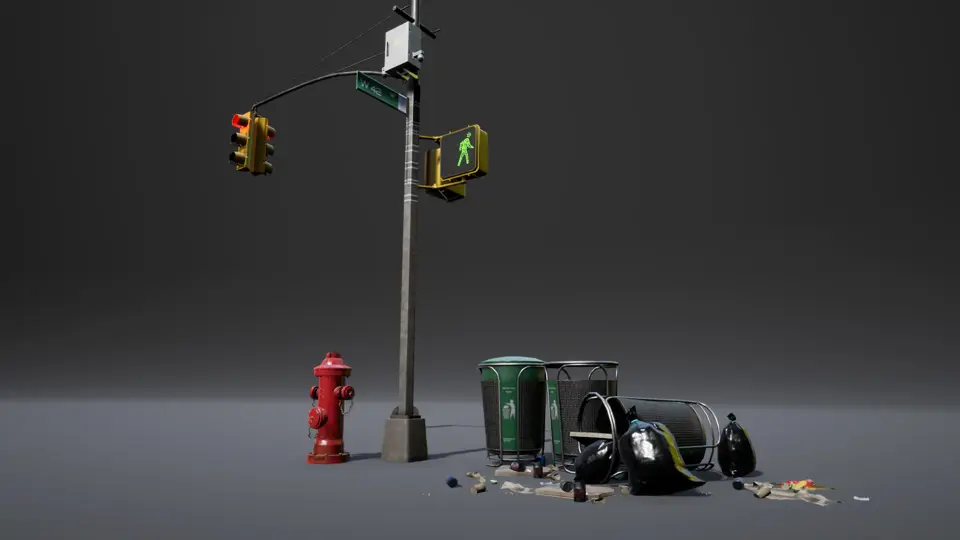
Urban blockouts rely on recurring architectural and utility elements to ground player perspective. Without infrastructure elements such as lighting poles and traffic boundary markers, streets lack both functional scale and visual boundaries. The set supplies primary fixtures that establish vertical and horizontal dimensions across roads, curbs, and shopfronts.
Placing street light assets along curb lines establishes rhythm across long exterior views. These fixtures outline the perimeter of pedestrian spaces while offering anchor points for localized night illumination. In scenes configured for VR, tall vertical fixtures give the player direct visual cues regarding real-world proportions, making the surrounding buildings appear properly scaled. When paired with horizontal road fixtures, these upright elements create an alternating cadence that prevents city blocks from appearing flat or repetitive.
Because the collection concentrates on base props required to fill layouts, these components serve as structural set dressing rather than one-off hero set pieces. Level designers can duplicate them along sidewalks, distribute them outside commercial frontages, or cluster them around intersections to create dense town streets without having to model individual utility elements from scratch.
Sidewalk Clutter from Carton Boxes to Rubbish and Advertising
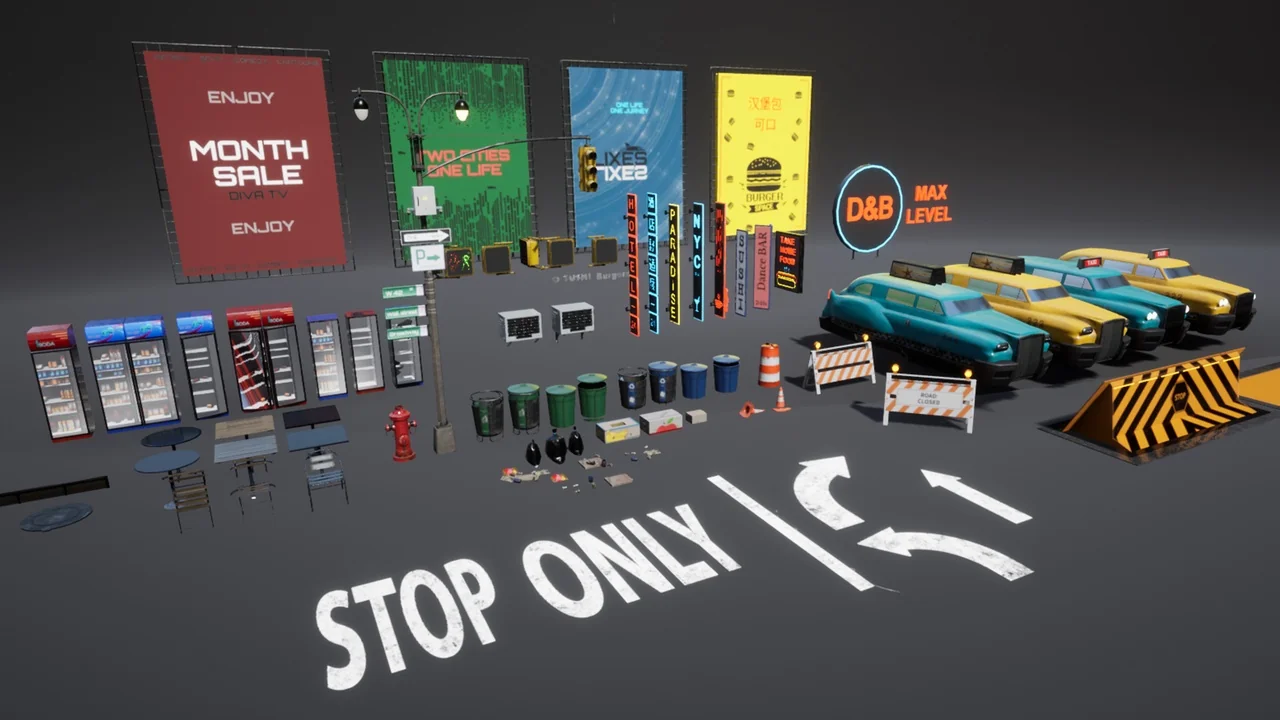
True city streets rarely present clean, pristine surfaces. Natural foot traffic and commercial deliveries generate visible layers of incidental trash and paper clutter. The inclusion of carton_boxes, rubbish elements, advertising boards, and signs allows environment artists to break up uniform ground textures and disrupt straight geometric lines.
Flattened or stacked carton_boxes placed along alley corners and storefront entryways immediately alter the personality of a street. A neat stack against a roll-up door implies an active retail business receiving shipments, while rumpled or discarded boxes combined with loose rubbish indicate neglected back alleys or industrial service lanes. These low-lying elements interrupt flat pavement materials, catching light at ground level and breaking up continuous normal maps.
Advertising signs add distinct commercial identity to sidewalk stretches. Pushed against building facades or set perpendicular to pedestrian pathways, advertising elements introduce secondary visual interest without demanding custom environmental architecture. In urban settings, signs direct foot traffic, establish the character of commercial districts, and supply localized narrative context, shifting an environment from a generic town space into an identifiable New York style district.
Verticality and Pedestrian Scale with Street Lights, Tables, and Drink Fridges
Sidewalk spaces function as intermediary zones between roadways and storefronts. Populating this threshold demands items that suggest daily commercial activity and pedestrian pauses. The collection features tables, drink_fridge units, and streetlights to establish functional street-side pockets.
A drink_fridge positioned adjacent to a storefront exterior gives corner bodegas and convenience stores their signature street presence. Such refrigeration units introduce distinct boxy silhouettes, complete with commercial glass door frames and interior shelving volume. In high-density street arrangements, placing a drink fridge outdoors instantly conveys close-quarters urban life where commercial operations routinely spill onto the pavement.
Tables placed curbside or tucked beneath awnings introduce small functional staging areas. These surfaces allow scene builders to establish outdoor dining areas, flea market stalls, or casual sidewalk seating. In cinematic shots, having mid-height assets like tables and refrigeration units situated between the camera and background structures generates critical depth layers. The camera can rack focus past a tabletop or drink fridge edge toward characters or vehicles on the street, yielding a composition that feels physically situated inside an occupied city block.
Controlling Traversal with Road Blokers and Road Cones
Navigation design in street environments demands clear, physically plausible boundaries. Players need visual markers that explain why a lane is closed, where detours exist, or why an intersection is impassable. The road blokers and road cone assets within the pack address these functional layout needs directly.
Road cones deliver high-visibility boundary cues. Scattering road cones around utility holes, along freshly painted road markings, or flanking maintenance vehicles informs players of restricted zones using recognizable municipal language. Because cones are portable and standard, artists can place them in tight groupings or loose single-file lines to subtly nudge players away from dead ends or level boundaries without relying on invisible walls.
Heavier road blokers provide rigid, unmistakable barriers. Positioned across multi-lane avenues, road blockers close off unfinished portions of a map or create fortified checkpoints suitable for high-tension scenes, municipal blockades, or cyberpunk-themed quarantine sectors. Stacking road blockers in staggered arrangements allows level artists to filter foot traffic while completely denying vehicle traversal, directly serving pacing and gameplay gating requirements.
Cinematic Staging, VR Fidelity, and Project Compatibility
High-end game engines require props that maintain surface definition and accurate profile silhouettes under close inspection. Because the assets are built to satisfy AAA game, VR, and cinematic quality thresholds, the geometry and material definition hold up when viewed at head-height in virtual reality or framed directly in front of a cinematic camera lens.
In virtual reality environments, low-resolution geometry and flat textures are immediately noticeable. The prop set accounts for close-range player inspection around roadside objects, ensuring that surfaces such as the rims of road cones, the corners of carton boxes, and the edges of street tables do not collapse into low-poly artifacts when inspected up close. For cinematic projects, the realistic proportions of the street lights and commercial clutter make lens matching straightforward, allowing focal lengths to behave as expected against authentic NYC scale standards.
Beyond traditional modern urban street scenes, the versatility of baseline props extends across multiple thematic combinations. While tailored to contemporary NYC, town, and cyberpunk layouts, the asset set also functions in mixed asset pipelines, carrying compatibility with Medieval Watermill Town projects where basic environmental dressing, structural blocking, and functional boundary markers can be adapted for hybrid layout needs. For developers assembling street corridors, the City props collection delivers the functional building blocks necessary to turn blank pavements into lived-in, fully realized urban settings.
 Street / Road
 Cities
 Cyberpunk
 Cyberpunk